
| REPORT ATTRIBUTE | DETAILS |
|---|---|
| Historical Period | 2019-2022 |
| Base Year | 2023 |
| Forecast Period | 2024-2032 |
| Baby Personal Care Market Size 2023 | USD 88915.2 Million |
| Baby Personal Care Market, CAGR | 6.80% |
| Baby Personal Care Market Size 2032 | USD 160737.5 Million |
Market Insights
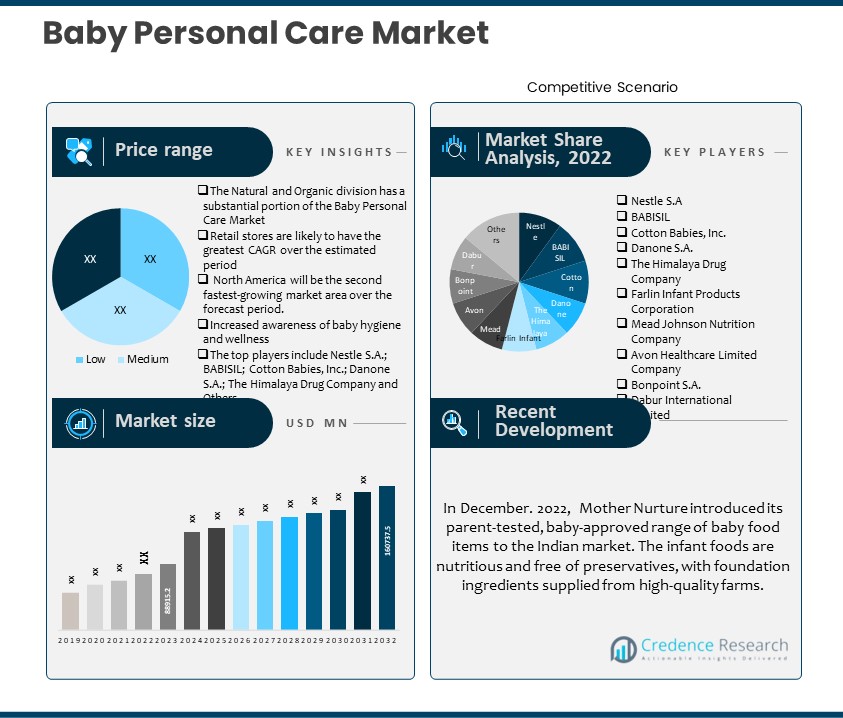
- The global demand for Baby Personal Care was valued at USD 88915.2 Million in 2023 and is expected to reach USD 160737.5 Million in 2032, growing at a CAGR of 6.80% between 2024 and 2032.
- The Baby Hair Care Products department had the highest revenue share, accounting for roughly 67%, while the Baby Skincare Products section is expected to have the highest compound annual growth rate.
- The Natural and Organic division has a substantial share of the Baby Personal Care market, and the Hypoallergenic and Fragrance-Free sector is a popular segment.
- Retail stores are likely to have the highest CAGR over the estimated period, while the Online Retail channel is expected to develop the fastest during the projection period.
- Asia Pacific is expected to account for 42% of total sales, while North America is the second fastest-growing market sector over the forecast period.
- Growing innovation in baby care products is fueling market growth.
- Using chemicals in baby products to reduce sales
Executive Summary
Market Definition
Baby Personal Care items are items designed for newborns and children under the age of three. Baby Care Products are generally designed to be mild and non-irritating, and the components used are chosen specifically for these features. Baby Care Products include Baby Skin Care, Baby Hair Care, Bathing Products, Baby Toiletries, and Baby Food and Beverages. The market is divided into five distribution channels: convenience stores, hypermarkets, online markets, specialty stores, and supermarkets.
Market Overview
The global Baby Personal Care Market has witnessed steady growth in recent years and is expected to grow at a CAGR of 6.80% between 2024 and 2032. The market was valued at USD 88915.2 million in 2023 and is expected to reach USD 160737.5 million in 2032.
Baby personal care includes baby oil, baby shampoo, baby powder, diapers, baby wipes, baby seats, and safety products, baby food, baby clothing, and baby toys, which are essential for babies. The increasing number of newborn babies each year is a key element driving market expansion. Rising demand for infant care kits in developed and developing countries worldwide to ensure healthy babies fueled market growth in 2021.
The growing need for high-quality diapers, baby meals, and cosmetics that do not hurt the baby's skin is propelling the market forward. Rising demand for organic and gluten-free newborn feeding products is opening up new market growth opportunities worldwide. Parents must choose organic and eco-friendly infant skin care products to avoid chemical discomfort, which is driving market expansion.
An rising proportion of working women influenced baby care kit sales in 2021. According to figures given by the International Labour Organization, a United Nations agency, the total female workforce grew in 2021 when compared to previous years. The present global work force participation rate for women is 53% and for men is 47%, increasing mothers' reliance on instant infant supplies and hence driving sales of baby care kits/items.
Segmentation By Product Type
- The Baby Hair Care Products section had the highest revenue share, accounting for around 67%. This trend will continue in the next years. The need for baby wipes, baby washes, and baby shampoos and conditioners are examples of products that are widely utilized around the world.
- The Baby Skincare Products section is predicted to have the largest compound annual growth rate in the following years, at approximately 5.4%. This section inclu*des powders, massage oils, face creams, and moisturizers, and the need for these goods has expanded in recent years to preserve the scale's health.
Segmentation by Ingredient Focus
- The Natural and Organic section has a sizable share of the Baby Personal Care Market. This is due to the growing demand for non-toxic and environmentally friendly products among parents who value natural components for their children.
- On the other hand, the Hypoallergenic and Fragrance-Free sector is popular because it caters to babies with sensitive skin or allergies, offering gentle treatment without harsh chemicals or strong fragrances that may irritate delicate skin.
Segmentation by Distribution Channel
- Retail Stores are expected to have the highest CAGR during the estimated period due to lower prices compared to other retail stores and the availability of a wider range of personal care items for babies compared to other distribution channels/platforms.
- The Online Retail channel is predicted to grow the quickest during the projection period. The increasing number of working women and e-commerce companies' doorstep delivery are the primary drivers of this segment's growth.
Segmentation by Region
- Asia Pacific is projected to account for 42% of total sales.
- North America is the second fastest-growing market area throughout the forecast period.
- The rest of the world, including Latin America, the Middle East, and Africa, supplies the remaining demand for Baby Personal Care.
Asia Pacific has emerged as the largest market for baby care products. The Asia Pacific market is rising because the population of Asian countries is quickly increasing at a significant rate. The most populous countries, China and India, are likely to grow the industry. According to UNICEF, the top two nations with the highest birth rates in 2921 were India and China, which greatly influenced the expansion of the baby care goods market. Increasing urbanization and growing consumer expenditure have contributed to this exceptional market growth in 2021.
Moreover, North America is the second fastest-growing market region, mainly due to the increased adoption of baby care packages, such as strollers, car seats, baby monitors, and safety gates. Most parents in the U.S. focus on items that cater to the nutritional needs of their newborns. Products with better newborn formulas and easy-to-digest baby foods that are safe to consume and FDA-approved are in higher demand in the U.S. 5.
Key Highlights of the Report
Product Type, Ingredient Focus, Distribution Channel, and Region segment the global Baby Personal Care Market. In terms of revenue share, the Baby Skincare Products category was the greatest, and its compound annual growth rate is expected to be the highest as well. Additionally, the Online Retail channel is anticipated to increase at the fastest rate during the projection period. The Hypoallergenic and Fragrance-Free sector is a popular one and Asia Pacific, leading the market growth.
The market is driven by rising demand for natural and organic infant care products and technological improvements that result in safer and more effective formulations. The baby care sector faces challenges such as strict laws and compliance requirements, high competition from established companies and new entrants, and maintaining affordability while fulfilling quality standards.
Asia Pacific is expected to hold the largest market share over the projection period. The region's growth is driven by the rising food, beverage, personal care, and cosmetics industries, particularly in India and China. Also, North America is expected to grow rapidly during the projection period. Furthermore, Europe is expected to expand fast throughout the projected period as the food and beverage industry's need for Baby Personal Care solutions rises.
What Are The Main Drivers Of The Global Baby Personal Care Market?
The Baby Personal Care Market is being driven by increased parental knowledge of baby health and cleanliness, resulting in a greater need for safe and effective solutions. Furthermore, the market is seeing an increase in the demand of natural and organic infant care products as parents emphasize non-toxic and environmentally friendly solutions for their children. In addition, technical improvements are critical in the development of novel formulations that ensure the safety and well-being of infants.
What Are The Major Challenges Faced By The Global Baby Personal Care Market?
The market has constraints such as tight laws and compliance requirements particular to the baby care business, which can be difficult for enterprises operating in this area. Also, the fierce competition between established brands and new entrants puts pressure on manufacturers to differentiate their products while maintaining high quality standards. Moreover, companies must strike a balance between preserving product affordability and meeting quality and safety concerns.
What Are The Growth Opportunities In The Global Baby Personal Care Market?
There are numerous prospects for expansion in the Baby Personal Care Market. Companies can consider expanding into emerging markets with a growing middle-class population, thereby tapping into new consumer bases and revenue streams. Creating creative and original product offers that respond to parents' changing demands and preferences can help businesses stand out in a competitive market setting.
Market Drivers
Several factors drive the global Baby Personal Care Market. The following are the key drivers of the global Baby Personal Care Market:
Growing Innovation in Baby Care Products Is Driving Market Growth
Growing innovation in various infant foods that contain specific fat and protein blends is intended to boost babies' brain development, hence driving market growth. Increased customer demand for high-quality infant food products that provide adequate nourishment for babies is critical to boosting market growth. For instance, in March 2021, Danone, a French business, debuted formula milk in the United Kingdom in the form of pre-measured tabs. The new formula milk tabs dissolve quickly, making it easy and comfortable for moms to feed their newborns.
Market Restraints
The global Baby Personal Care Market faces some challenges that may hinder its growth. These include the following:
Use of Chemicals in Baby Products to Reduce Product Sales
Product recalls are used to retrieve a defective or potentially hazardous product from consumers. Following the discovery of safety risks with the product, the producer or the government may request recalls. Product recalls in the baby care industry can harm firms' brand reputations, reducing consumer base and sales. For instance 2022, Mother Nurture introduced its parent-tested, baby-approved baby food range, in August 2022, Johnson & Johnson, a US-based firm, stated that it would stop distributing tal-based baby powder worldwide. The company was facing many lawsuits for utilizing a dangerous substance known as "Asbestos" in their talc-based baby powder, which caused a number of health issues, including ovarian cancer, and harmed the brand's reputation.
Opportunities
The global Baby Personal Care Market offers significant growth opportunities. These include the following:
Surging Infant Population Drives Growth In The Baby Personal Care Market
The increasing infant population is likely to drive future growth in the baby care products industry. The infant population is the number of infants or newborns within a certain demographic group or geographic area, from birth to one year of age. Baby care goods are designed to meet the special needs and sensitivities of infants, including anything from cosmetics, diapers, and feeding supplies to safety equipment and nursery accessories.
For instance, in September 2023, the Centers for Disease Control and Prevention, a US-based health institution, reported 3,664,292 child births in 2021, with a birth rate of 11.0 per 1,000 inhabitants. As a result, the growing infant population is driving the expansion of the baby care product market.
Competitive Landscape
Key Players
The global Baby Personal Care Market is highly competitive, with several key players. Some of the major players in the market and their market share are as follows:
- Nestle S.A
- BABISIL
- Cotton Babies, Inc.
- Danone S.A.
- The Himalaya Drug Company
- Farlin Infant Products Corporation
- Mead Johnson Nutrition Company
- Avon Healthcare Limited Company
- Bonpoint S.A.
- Dabur International Limited
- Wipro Consumer Care & Lighting (Wipro Group); Abbott Nutrition
- Burt’s Bees Inc.
- L’Oreal S.A.
- Marks & Spencer PLC
- Nivea
- Unilever PLC.
These organizations prioritize product innovation, Ingredient Focus expansion, and mergers and acquisitions to stay competitive.
The global Baby Personal Care Market's key players continually seek to stay ahead by offering new products and developments.
In August 2023, Mamaearth opened its Exclusive Brand Outlet (EBO) in Bengaluru. This opening, which is strategically located at the famed Mantri Square Mall in Malleshwaram, is a huge step forward for Mamaearth. The Bengaluru EBO plans to offer a broad range of toxin-free personal care products, including baby care, beauty, and personal care solutions.
In July 2022, Hindustan Unilever (HUL) launched a line of baby care products under the Dove brand to boost Johnson & Johnson's global presence.
In July 2022, Johnson & Johnson, a US-based company, introduced a new skin and hair care line for babies called "Vivvi & Bloom." The company is introducing shampoo, body lotion, and body massage oil for infants and toddlers. The brand introduced the products to fulfill the growing need of millennial parents for their children. The products will also be available through e-commerce platforms like Amazon and Flipkart.
Summary of Key Findings
- The expanding infant population drives growth in the baby Personal care market
- Market segmented By Product Type, Ingredient Focus, Distribution Channel, and region.
- Baby Skincare Products section is anticipated to have the highest compound annual growth rate.
- The Boxes & Cartons section is also predicted to rise the fastest.
- Asia Pacific is leading in market growth; the market is highly competitive with key players, including Nestle S.A.; BABISIL; Cotton Babies, Inc.; Danone S.A.; The Himalaya Drug Company and Others.
Future Outlook
- Increasing demand for natural and organic baby care products.
- Technological breakthroughs result in unique product formulations.
- Growing emphasis on the safety and efficacy of newborn personal care products.
- Expanding online retail channels for more convenient shopping
- Increased awareness of baby hygiene and wellness
How CXOs Can Benefit from the Credence Research Baby Personal Care Market Report
The Credence Research Baby Personal Care Market Report provides CXOs with a comprehensive overview of the market, including:
- Market size and growth forecast: The report provides detailed estimates of the global Baby Personal Care Market size, segmented By Product Type, Ingredient Focus, Distribution Channel, and region. It also includes forecasts for the market through 2032 based on key trends and drivers.
- Market segmentation: The report segments the Baby Personal Care Market By Type, Ingredient Focus, Distribution Channel, and region. This segmentation provides CXOs with a granular understanding of the market and the opportunities in each segment.
- Competitive Landscape: The report profiles the key players in the Baby Personal Care Market and provides insights into their strategies, product offerings, and financial performance. This information can help CXOs to identify and assess their competition.
- Key trends and drivers: The report identifies and analyzes the key trends and drivers that are shaping the Baby Personal Care Market. This information can help CXOs to make informed decisions about their investments and strategies.
CXOs can use the insights from the Credence Research Baby Personal Care Market Report to:
- Identify growth opportunities: The report can help CXOs to identify new growth opportunities in the Baby Personal Care Market. For example, it can pinpoint emerging trends in industries like aerospace and automotive, helping executives make informed decisions on expanding their product lines or entering new market segments where Baby Personal Care's properties can be leveraged for success.
- Make informed investment decisions: The report can help CXOs make informed investment decisions about Baby Personal Care. For example, it can provide crucial insights into market trends, competitive landscape, and potential growth areas, empowering executives to allocate resources strategically and seize opportunities for maximizing returns on investments in the Baby Personal Care sector.
- Develop competitive strategies: The report can help CXOs develop competitive strategies for their Baby Personal Care businesses. For example, it can offer valuable insights into market trends, competitor analysis, and innovative End-user industries of Baby Personal Care, enabling executives to stay ahead of the competition and drive business growth in this dynamic industry.
- Track market developments: The report can help CXOs monitor market developments and stay ahead of the curve. For example, it provides insights into the latest trends and innovations in the Baby Personal Care Market.
Overall, the Credence Research Baby Personal Care Market Report is a valuable resource for CXOs who are looking to gain a deeper understanding of the market and identify opportunities for growth.
Segmentation
- By Product Type:
- Baby Skincare Products
- Baby Bath Products
- Diapers and Wipes
- Baby Hair Care Products
- Baby Oral Care Products
- Baby Sun Care Products
- Baby Fragrances
- Other Baby Care Products
- By Ingredient Focus:
- Natural and Organic
- Hypoallergenic and Fragrance-Free
- Dermatologist-Tested and Pediatrician-Recommended
- By Distribution Channel:
- Retail Stores
- Online Retail
- Direct Sales
- By Region
- North America
- The U.S.
- Canada
- Mexico
- Europe
- Germany
- France
- The U.K.
- Italy
- Spain
- Rest of Europe
- Asia Pacific
- China
- Japan
- India
- South Korea
- South-east Asia
- Rest of Asia Pacific
- Latin America
- Brazil
- Argentina
- Rest of Latin America
- Middle East & Africa
- GCC Countries
- South Africa
- Rest of the Middle East and Africa
- North America

Request a Free Sample
Fill in your details and we'll send you a free sample report.
- Sample data tables & charts
- Research methodology
Market Dynamics
Rising Preference for Natural and Organic Products
Parents are increasingly seeking baby personal care products made with natural and organic ingredients to avoid exposure to harsh chemicals, driving demand for safer, eco-friendly alternatives.
Expanding Infant Population in Emerging Markets
Rapid population growth and high birth rates in countries like India and China are fueling demand for baby personal care products, especially in the Asia Pacific region.
Innovation in Product Formulations and Packaging
Manufacturers are introducing novel product formats, such as pre-measured formula tabs and hypoallergenic wipes, which enhance convenience and safety, attracting more consumers.
Growth of Online Retail Channels
The proliferation of e-commerce platforms and the convenience of doorstep delivery are making it easier for parents to access a wide range of baby personal care products, accelerating market growth.
Increasing Female Workforce Participation
As more women join the workforce, there is a greater reliance on ready-to-use baby care kits and products, boosting sales of convenient and time-saving personal care solutions.
Need a Custom Version of This Report?
Tailor the scope, geography, or segments to your exact requirements.
- Custom geography or segment scope
- Direct access to our analyst team
Frequently Asked Questions
What is the current size of the global Baby Personal Care Market?
What is the expected growth rate of the Baby Personal Care Market between 2024 and 2032?
Which segment is leading the market share in terms of Product Type?
Which Ingredient Focus segment governs the demand for Baby Personal Care in the world?
Who are the major players in the global Baby Personal Care Market?
Table of Content
Chapter 1 Market Segmentation
- 1.1 Segmentation Framework
- 1.1.1 Product and Service Classification
- 1.1.2 Application and End-Use Classification
- 1.1.3 Technology and Solution Classification
- 1.1.4 Customer and Distribution Channel Classification
- 1.1.5 Geographic Segmentation
- 1.1.6 Market Segment Definitions and Boundaries
- 1.2 By Product Type
- 1.2.1 Baby Skincare Products
- 1.2.2 Baby Bath Products
- 1.2.3 Diapers and Wipes
- 1.2.4 Baby Hair Care Products
- 1.2.5 Baby Oral Care Products
- 1.2.6 Baby Sun Care Products
- 1.2.7 Baby Fragrances
- 1.2.8 Other Baby Care Products
- 1.3 By Ingredient Focus
- 1.3.1 Natural and Organic
- 1.3.2 Hypoallergenic and Fragrance-Free
- 1.3.3 Dermatologist-Tested and Pediatrician-Recommended
Chapter 2 Introduction
- 2.1 Report Objectives and Scope
- 2.2 Product Definition and Industry Terminology
- 2.3 Market Inclusions and Exclusions
- 2.4 Research Process
- 2.4.1 Primary Research and Expert Interviews
- 2.4.2 Secondary Research and Source Review
- 2.4.3 Top-Down and Bottom-Up Estimation
- 2.4.4 Data Triangulation and Verification
- 2.5 Market Size Measurement Basis
- 2.5.1 2023: USD 88915.2 Million → 2032: USD 160,737.5 Million
- 2.6 Historical and Forecast Reference Periods
- 2.6.1 Base Year: 2023
- 2.6.2 Forecast Period: 2023-2032
- 2.7 Research Assumptions and Limitations
Chapter 3 Executive Summary
- 3.1 Market Snapshot and Key Findings
- 3.2 Base-Year Market Size, 2023
- 3.3 Forecast Market Size, 2032
- 3.4 Revenue and Volume Growth Outlook
- 3.5 Key Demand and Supply Indicators
- 3.6 Leading Market Segments
- 3.7 Fastest-Growing Market Opportunities
- 3.8 Regional Performance Highlights
- 3.9 Technology and Industry Transformation
- 3.10 Competitive Landscape Summary
- 3.11 Analyst View and Strategic Implications
Chapter 4 Global Baby Personal Care Market Trends and Developments
- 4.1 Historical Industry Development
- 4.2 Recent Market Trends and Developments
- 4.3 Demand and Customer Behavior Trends
- 4.4 Technology and Product Innovation
- 4.5 Artificial Intelligence, Automation and Digitalization
- 4.6 Local Manufacturing and Supply Chain Realignment
- 4.7 Industry Partnerships, Mergers and Acquisitions
- 4.8 Sustainability and Circular Economy Developments
- 4.9 Government and Private Sector Investment Trends
- 4.10 Emerging Business Models and Commercialization
- 4.11 Industry Developments and Announcements
Chapter 5 Global Baby Personal Care Market Production, Supply and Demand Analysis
- 5.1 Demand Trend and Consumption Analysis
- 5.2 Demand Forecast, 2023-2032
- 5.3 Production and Output Trend
- 5.4 Production and Output Forecast, 2023-2032
- 5.5 Installed Capacity and Capacity Utilization
- 5.6 Company-Wise Production Plants and Statistics
- 5.6.1 Installed Production Capacity
- 5.6.2 Actual Production
- 5.6.3 Planned Capacity and Expansion Targets
- 5.7 Supply Chain Structure and Procurement Trends
- 5.8 Supply-Demand Gap and Bottlenecks
- 5.9 Import Dependence and Sourcing Structure
- 5.10 Contract Manufacturing and Outsourcing
- 5.11 Regional Supply and Demand Concentration
Chapter 6 Global Baby Personal Care Market Pricing Analysis
- 6.1 Pricing Structure and Measurement
- 6.2 Historical Pricing Trends
- 6.3 Pricing Outlook, 2023-2032
- 6.4 Average Selling Price and Unit Economics
- 6.5 Pricing by Product and Market Segment
- 6.6 Geographic Pricing Differences
- 6.7 Key Input, Energy, Labor and Logistics Costs
- 6.8 Contract Pricing and Purchasing Models
- 6.9 Pricing Sensitivity and Competitive Positioning
- 6.10 Price, Margin and Profitability Implications
Chapter 7 Global Baby Personal Care Market Dynamics
- 7.1 Market Growth Drivers
- 7.1.1 Demand-Side Drivers
- 7.1.2 Technology and Innovation Drivers
- 7.1.3 Infrastructure and Investment Drivers
- 7.1.4 Regulatory and Policy Drivers
- 7.2 Market Restraints
- 7.2.1 Cost and Affordability Constraints
- 7.2.2 Technology and Adoption Barriers
- 7.2.3 Supply Chain and Operational Constraints
- 7.3 Market Challenges
- 7.3.1 Competitive Pressure and Margin Erosion
- 7.3.2 Skills, Infrastructure and Implementation Gaps
- 7.4 Emerging Market Opportunities
- 7.5 Market Dynamics Impact and Time-Horizon Assessment
Chapter 8 Global Baby Personal Care Value Chain Analysis
- 8.1 Industry Value Chain Overview
- 8.2 Upstream Suppliers and Critical Inputs
- 8.3 Technology and Component Providers
- 8.4 Manufacturing or Service Delivery
- 8.5 Distribution, Channel Partners and Integrators
- 8.6 Downstream Applications and End Users
- 8.7 Value Addition and Profit Pools
- 8.8 Vertical Integration and Outsourcing
- 8.9 Supplier Concentration and Risk
- 8.10 Supply Chain Localization and Resilience
Chapter 9 Global Baby Personal Care Market Regulations and Policies
- 9.1 Relevant Laws, Standards and Compliance Frameworks
- 9.2 Product, Service, Safety and Quality Requirements
- 9.3 Government Policies, Incentives and Subsidies
- 9.4 Imports, Exports and Trade Barriers
- 9.5 Public Procurement and Local Content Requirements
- 9.6 Environmental and Sustainability Compliance
- 9.7 Upcoming Policy Changes and Market Implications
Chapter 10 Global Baby Personal Care Market Hotspots and Opportunities
- 10.1 Market Opportunity Mapping and Growth Hotspots
- 10.2 High-Growth Applications and Customer Groups
- 10.3 Underserved Markets and White-Space Opportunities
- 10.4 Emerging Technology and Product Opportunities
- 10.5 New Capacity and Investment Hotspots
- 10.6 Market Entry and Expansion Opportunities
- 10.7 Distribution and Partnership Opportunities
- 10.8 Near-Term and Long-Term Commercial Potential
- 10.9 Opportunity Attractiveness and Execution Risks
Chapter 11 Global Baby Personal Care Market Outlook, 2023-2032
- 11.1 Market Size and Analysis
- 11.1.1 Revenue (Market Measurement: 2023: USD 88915.2 Million → 2032: USD 160,737.5 Million)
- 11.1.2 Market Volume and Quantity Sold
- 11.1.3 Historical Market Size
- 11.1.4 Base-Year Market Size, 2023
- 11.2 Market Forecast, 2023-2032
- 11.2.1 Revenue Forecast to 2032
- 11.2.2 Volume Forecast to 2032
- 11.2.3 CAGR and Year-on-Year Growth
- 11.2.4 Incremental Revenue Opportunity
- 11.3 Forecast Assumptions and Scenario Analysis
- 11.3.1 Base-Case Forecast
- 11.3.2 Optimistic and Conservative Scenarios
- 11.3.3 Technology, Pricing and Policy Sensitivities
- 11.4 Market Attractiveness and Growth Outlook
Chapter 12 Global Baby Personal Care Market Segmentation and Outlook
- 12.1 Segmentation Summary and Market Shares, 2023
- 12.2 Largest and Fastest-Growing Segments
- 12.3 By Product Type - Market Size and Forecast, 2023-2032
- 12.3.1 Segment Definition and Scope
- 12.3.2 Historical Market Size
- 12.3.3 Revenue Forecast, 2023-2032
- 12.3.4 Volume Forecast, 2023-2032
- 12.3.5 Base-Year Market Share, 2023
- 12.3.6 Segment CAGR and Growth Drivers
- 12.3.7 Subsegment Market Size and Forecast
- 12.3.7.1 Baby Skincare Products
- 12.3.7.2 Baby Bath Products
- 12.3.7.3 Diapers and Wipes
- 12.3.7.4 Baby Hair Care Products
- 12.3.7.5 Baby Oral Care Products
- 12.3.7.6 Baby Sun Care Products
- 12.3.7.7 Baby Fragrances
- 12.3.7.8 Other Baby Care Products
- 12.3.8 Subsegment Pricing and Adoption Trends
- 12.3.9 Leading Suppliers and Competition
- 12.3.10 Regional Demand and Opportunities
- 12.4 By Ingredient Focus - Market Size and Forecast, 2023-2032
- 12.4.1 Segment Definition and Scope
- 12.4.2 Historical Market Size
- 12.4.3 Revenue Forecast, 2023-2032
- 12.4.4 Volume Forecast, 2023-2032
- 12.4.5 Base-Year Market Share, 2023
- 12.4.6 Segment CAGR and Growth Drivers
- 12.4.7 Subsegment Market Size and Forecast
- 12.4.7.1 Natural and Organic
- 12.4.7.2 Hypoallergenic and Fragrance-Free
- 12.4.7.3 Dermatologist-Tested and Pediatrician-Recommended
- 12.4.8 Subsegment Pricing and Adoption Trends
- 12.4.9 Leading Suppliers and Competition
- 12.4.10 Regional Demand and Opportunities
- 12.5 Segment Growth Comparison
- 12.6 Segment Attractiveness and Priority Matrix
Chapter 13 Global Baby Personal Care Geographic Market Outlook, 2023-2032
- 13.1 Regional Market Size and Share, 2023
- 13.2 Regional Market Forecast, 2023-2032
- 13.3 Regional Pricing, Production and Demand Differences
- 13.4 North America
- 13.4.1 United States
- 13.4.2 Canada
- 13.4.3 Mexico
- 13.5 Europe
- 13.5.1 Germany
- 13.5.2 France
- 13.5.3 Italy
- 13.5.4 United Kingdom
- 13.5.5 Spain
- 13.5.6 Poland
- 13.5.7 Russia
- 13.5.8 Netherlands
- 13.5.9 Belgium
- 13.5.10 Sweden
- 13.5.11 Denmark
- 13.5.12 Norway
- 13.5.13 Rest of Europe
- 13.6 Asia Pacific
- 13.6.1 China
- 13.6.2 India
- 13.6.3 Japan
- 13.6.4 South Korea
- 13.6.5 Thailand
- 13.6.6 Indonesia
- 13.6.7 Vietnam
- 13.6.8 Malaysia
- 13.6.9 Australia
- 13.6.10 Rest of Asia Pacific
- 13.7 Latin America
- 13.7.1 Brazil
- 13.7.2 Argentina
- 13.7.3 Colombia
- 13.7.4 Chile
- 13.7.5 Rest of Latin America
- 13.8 Middle East
- 13.8.1 Saudi Arabia
- 13.8.2 United Arab Emirates
- 13.8.3 Turkey
- 13.8.4 Israel
- 13.8.5 Iran
- 13.8.6 Rest of the Middle East
- 13.9 Africa
- 13.9.1 South Africa
- 13.9.2 Egypt
- 13.9.3 Nigeria
- 13.9.4 Morocco
- 13.9.5 Rest of Africa
- 13.10 Regional Investment, Policy and Supply Chain Differences
- 13.11 Regional Competitive Landscape
- 13.12 Geographic Growth Hotspots
Chapter 14 Global Baby Personal Care Technology, Innovation and Sustainability Outlook
- 14.1 Technology Landscape and Maturity
- 14.2 Product, Process and Service Innovation
- 14.3 AI, Automation and Digital Tools in the Industry
- 14.4 Technology Adoption and Performance Benchmarking
- 14.5 Innovation Pipeline and R&D Investment
- 14.6 Patent and Intellectual Property Trends
- 14.7 Energy Efficiency and Resource Management
- 14.8 Sustainability, Recycling and Circularity
- 14.9 Technology Roadmap, 2023-2032
- 14.10 Risks of Obsolescence and Technology Substitution
Chapter 15 Global Baby Personal Care Market Key Strategic Imperatives
- 15.1 Growth and Market Entry Priorities
- 15.2 High-Return Products and Segments
- 15.3 Pricing, Profitability and Cost Optimization
- 15.4 Technology Investment and Product Differentiation
- 15.5 Supply Chain Localization and Resilience
- 15.6 Distribution and Customer Acquisition
- 15.7 Partnership, Acquisition and Capacity Strategy
- 15.8 Regional Expansion Priorities
- 15.9 Short-, Medium- and Long-Term Actions
Chapter 16 Competition Outlook
- 16.1 Industry Competition Characteristics
- 16.2 Market Structure and Concentration
- 16.3 Market Share and Competitive Positioning, 2023
- 16.4 Company-Wise Revenue and Product Benchmarking
- 16.5 Production and Service Capacity Benchmarking
- 16.6 Technology, Pricing and Differentiation
- 16.7 Regional Footprint and Distribution Strength
- 16.8 Mergers, Acquisitions and Strategic Alliances
- 16.9 New Entrants and Competitive Threats
- 16.10 Porter's Five Forces and Industry Attractiveness
- 16.11 Competitive Outlook, 2023-2032
Chapter 17 Company Profiles
- 17.1 Company Coverage and Selection Criteria
- 17.2 Nestle S.A.
- 17.2.1 Business Description
- 17.2.2 Company Ownership and Geographic Presence
- 17.2.3 Product and Service Portfolio
- 17.2.4 Manufacturing and Operating Footprint
- 17.2.5 Production Capacity and Expansion Plans
- 17.2.6 Financial Performance and Investment
- 17.2.7 Market Share and Competitive Position
- 17.2.8 Technology and Innovation Capabilities
- 17.2.9 Strategic Alliances or Partnerships
- 17.2.10 Recent Developments
- 17.2.11 Growth Strategy and Outlook
- 17.3 Danone S.A.
- 17.4 Johnson & Johnson
- 17.5 Unilever PLC
- 17.6 The Himalaya Drug Company
- 17.7 Burt’s Bees Inc.
- 17.8 Wipro Consumer Care & Lighting
- 17.9 Dabur International Limited
- 17.10 Cotton Babies, Inc.
- 17.11 L’Oreal S.A.
- 17.12 Other Relevant Market Participants
Note: Every listed company is profiled on the structure shown under the first company. The company list is preliminary and may change based on research findings, market developments, data availability and client requirements.
Chapter 18 Disclaimer
- 18.1 Research and Forecast Disclaimer
- 18.2 Data Source and Estimation Limitations
Note: The depth of individual sections depends on data availability for this market. Volume, capacity, trade and other unit-based metrics are included where applicable.

