
| REPORT ATTRIBUTE | DETAILS |
|---|---|
| Historical Period | 2019-2022 |
| Base Year | 2023 |
| Forecast Period | 2024-2032 |
| Botanical Supplements Market Size 2023 | USD 69514.2 Million |
| Botanical Supplements Market, CAGR | 3.40% |
| Botanical Supplements Market Size 2032 | USD 93920.06 Million |
Market Insights
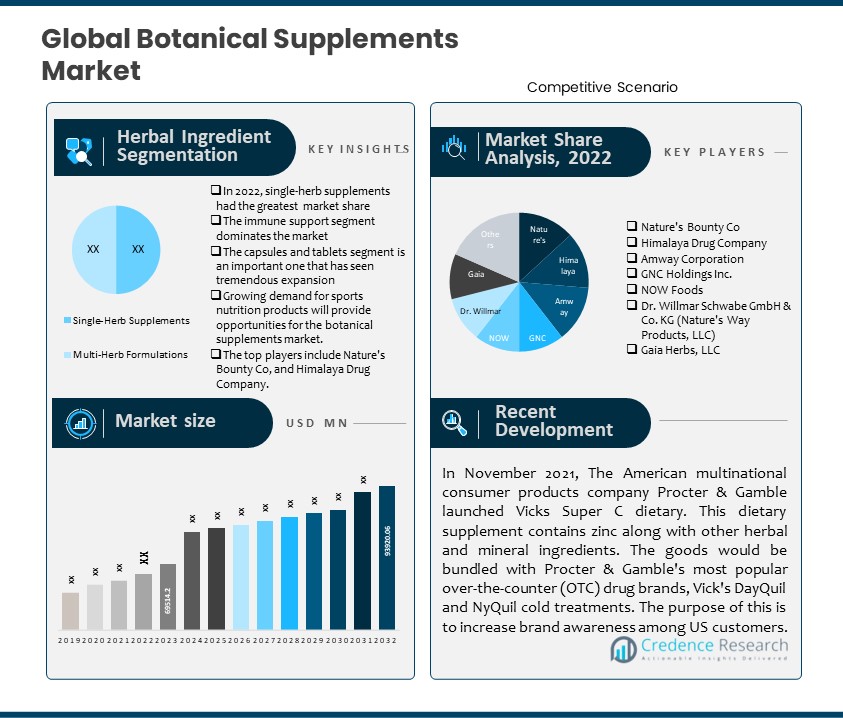
- The global market for botanical supplements is expected to grow from its estimated USD 69514.2 million in 2023 to USD 93920.06 million in 2032 at a compound annual growth rate (CAGR) of 3.40% between 2024 and 2032.
- The significant category is single-herb supplements. On the other hand, multi-herb formulations are expected to grow at a strong CAGR.
- The leading targeted health benefits segment is immune support.
- The CAGR for capsules and tablets is expected to be the highest during the projection period.
- The organic supplements segment will have the highest CAGR throughout the prediction period.
- Adults are estimated to have the greatest CAGR during the forecast period.
- Retail stores are predicted to grow faster over the projection period.
- North America dominated the botanical supplements market.
- Regarding the botanical supplements market share, Europe is expected to come second.
- Asia Pacific is anticipated to grow fastest in the botanical supplements market.
- The primary drivers of the market are rising disposable income in developing nations, growing interest in preventive healthcare, growing demand for sports nutrition products, and growing preferences for natural and organic products.
- The e-commerce industry's growth, partnerships with conventional medical professionals, and the utilization of digital health platforms and apps to provide tailored recommendations are some of the factors propelling the botanical supplement market.
Executive Summary
Market Definition
The global industry that produces, distributes, and sells dietary supplements made from plants or plant extracts with the goal of supplying extra nutrients or health benefits above and beyond those found in a typical diet is known as the "botanical supplements market." Usually derived from botanical sources like herbs, roots, leaves, fruits, or flowers, these supplements include concentrated forms of vitamins, minerals, antioxidants, enzymes, amino acids, and other bioactive substances. Products that are marketed for different health benefits, such as immune support, digestion, weight management, cardiovascular health, cognitive health, and general wellness, are widely available in the market. These products include capsules, tablets, powders, extracts, tinctures, and teas.
Market Overview
The botanical supplements sector is estimated to develop at a 3.40% compound annual growth rate (CAGR) between 2024 and 2032, maintaining its current upward trend. The market will keep developing, rising from its estimated value of USD 69514.2 million in 2023 to USD 93920.06 million in 2032.
The market for botanical supplements is being driven by consumers' growing awareness of health and wellness. This pattern is indicative of a larger cultural movement in favor of proactive health management as well as an increasing inclination toward natural and holistic methods of well-being. Instead of only treating health problems after they occur, consumers are more and more looking for ways to prevent them. In line with this trend of preventive healthcare, botanical supplements are seen as a proactive way to preserve general health and fend off illness. Consumers are beginning to distrust pharmaceuticals and synthetic ingredients more and more because they believe they have more potential side effects. Botanical supplements are safer options with fewer side effects because they are derived from natural sources like plants and herbs.
Customers are now better equipped to educate themselves about health-related issues due to the widespread availability of information on the internet and social media. Individuals are inclined to integrate botanical supplements into their daily regimens as their awareness of these supplements' possible advantages grows. Scientific research is supporting the effectiveness of botanical ingredients in treating and promoting health in an increasing number of ways. Consumer trust in the efficacy of botanical supplements rises in tandem with the amount of evidence supporting them. Many people are seeking additional support for their health as a result of modern lifestyles marked by stress, poor dietary habits, and environmental pollutants. Supplements containing botanical extracts provide a practical and easily obtainable way to enhance lifestyle modifications intended to enhance general health.
Segmentation by Herbal Ingredient
- Single-herb supplements dominated the market. Supplements made with just one herb are designed to maximize the health advantages that come with using that specific herb. Every supplement highlights the special qualities and ingredients present in that particular plant.
- The multi-herb formulations category will exhibit a sizable CAGR during the projected period. In the botanical supplement industry, products that blend powders or extracts from several different herbs into one supplement are known as multi-herb formulations. In contrast to taking individual herbs alone, these formulations are frequently made to have a synergistic effect, where the combination of herbs is thought to increase the supplement's overall efficacy.
Segmentation by Targeted Health Benefits
- The main targeted health benefit is immune support. The immune system is the body's defense system against pathogens, including bacteria, viruses, and other dangerous substances. It is made up of an intricate web of tissues, organs, and cells that cooperate to recognize and eliminate external invaders while preserving tolerance to the body's own cells.
- The digestive health category will likely register a significant CAGR during forecasting. Botanical supplements intended for digestive health commonly contain natural ingredients derived from plants and herbs. These ingredients could include herbs like peppermint, ginger, turmeric, licorice root, aloe vera, and different kinds of probiotics.
- Other targeted health benefits, such as cognitive health, joint and bone health, and heart health, also contribute to the demand for botanical supplements.
Segmentation by Formulation Type
- The capsules and tablets category is projected to grow at the fastest rate over the projection period. Usually composed of gelatin or vegetarian substitutes, capsules contain liquid or powdered botanical extracts or supplements. Powdered botanical extracts or supplements are compressed into solid, frequently flat shapes to create tablets.
- Other formulation types, including liquid extracts and tinctures, powders and granules, softgels, and teas and infusions, also influence the need for botanical supplements.
Segmentation by Certification and Quality
- The organic supplements segment will likely have the highest CAGR during the projection period. The plants used to produce organic supplements are not treated with synthetic pesticides, herbicides, or genetically modified organisms (GMOs). The emphasis on biodiversity and soil health in organic farming methods can result in plants with higher nutrient contents.
- Other certifications and qualities, such as non-GMO supplements, third-party tested, and standardized extracts, also contribute to the demand for botanical supplements.
Segmentation by Target Demographic
- The adults category will be expected to have the foremost CAGR during the prediction period. Adults are increasingly favoring preventive healthcare and proactive health management. A growing number of adults are using botanical supplements to augment their diet and address particular health issues.
- Other target demographics, such as seniors, children and adolescents, and athletes and fitness enthusiasts, also contribute to the demand for botanical supplements.
Segmentation by Distribution Channel
- Retail stores are expected to have the foremost CAGR during the prediction period. These are niche retailers that specialize in offering natural and organic goods, such as plant-based dietary supplements. In addition to various health foods, vitamins, and natural remedies, they frequently provide an extensive assortment of plant-based and herbal supplements.
- Other distribution channels, such as online retail, direct sales, and multi-level marketing (MLM), also contribute to the demand for botanical supplements.
Segmentation by Region
- North America leads the botanical supplements market. This is due to the rising use of dietary supplements and the growing awareness of supplements containing botanical ingredients in North America.
- Europe is estimated to rank second in market size for botanical supplements.
- Asia Pacific will witness the most rapid growth in the botanical supplements market.
- Regions such as Africa, the Middle East, and Latin America cover the remaining requirement for botanical supplements.
Rising demand for supplements that boost immunity, the global expansion of the health and wellness sector, and the growing demand for sports nutrition products that contain botanical extracts are all expected to contribute to the market's faster growth.
The North American region holds a dominant position in the botanical supplements market. In North American countries such as the United States, the use of dietary supplements has increased dramatically over the last ten or so years. Notably, dietary supplements were taken by 75% of American adults in 2018, a 10% increase over the previous ten years. The main factor driving the market in the region is the rising consumption of dietary supplements, along with the growing awareness of supplements infused with botanical extracts. With consumers' perspectives predicted to shift and a greater reliance on private label brands in addition to national brands, the "alt-medicine" trend is predicted to generate substantial revenue growth for producers of herbal supplements. Supermarkets such as Walmart and Costco are contributing to the trend by improving their private-label products with new packaging, in-store consumer education, and new branding and formulations.
Throughout the forecast, the Asia Pacific botanical supplements market is anticipated to expand fastest. The Asia Pacific region is seeing a growing trend toward wellness and health. The advantages of using botanical supplements to prevent and maintain general health are becoming more widely known to consumers. Disposable income has increased as a result of economic growth in nations like China, India, and Southeast Asia. Customers can now afford to spend more money on health products, such as botanical supplements, because of this. Certain governments in the Asia-Pacific region are encouraging the use of botanical supplements and traditional medicines by enacting laws and policies that support them. This promotes market expansion by guaranteeing product safety and quality standards.
Key Highlights of the Report
The global botanical supplements market is segmented by herbal ingredient, targeted health benefits, formulation type, certification and quality, target demographic, distribution channel, and region. Single-herb supplements are the market spearhead. Immune support is the top category. The capsules and tablets category is anticipated to increase at the highest CAGR throughout the projection period. The organic supplements segment will experience the highest CAGR during the forecast period. The botanical supplements market is expanding mostly in North America.
One of the main factors influencing botanical supplements is the wide variation in the potency and composition of botanical extracts. Botanical extracts are made from plants, and their contents can differ greatly based on the type of plant, growing environment, region, and harvesting techniques, among other things. Due to this inherent variability, different concentrations of active ingredients may be present in each batch of botanical extract, which could have a range of physiological effects. Because of their adaptability, botanical supplements can be tailored to each person's requirements and preferences. Manufacturers can combine different botanical extracts to create custom formulations aimed at addressing particular health issues or achieving desired results. Customers looking for natural alternatives and individualized approaches to wellness and health will find this customization appealing.
North America is expected to account for the largest portion of the global botanical supplements market. The North American market for botanical supplements is expanding as a result of ongoing studies into the efficacy and safety of botanical ingredients, as well as novel formulation and delivery techniques. In order to appeal to a wider range of consumers, manufacturers are investing in the development of new products with enhanced bioavailability and targeted health benefits. Botanical supplements are becoming more widely available in the Asia Pacific area through a variety of distribution channels, such as health food stores, internet merchants, and pharmacies. Customers will find these products easier to obtain as a result, which will spur market expansion.
Which Key Factors Are Driving The Global Botanical Supplements Market?
The growing inclination towards plant-based products, technological progress in extraction techniques, and the expansion of online retail outlets that enhance accessibility are the main drivers of the botanical supplement market.
What Are The Main Challenges Confronting The Botanical Supplements Market Globally?
A number of problems are impeding the expansion of the botanical supplement industry. These include the absence of established dosage guidelines for botanical supplements and the wide variations in the makeup and strength of botanical extracts.
What Market Opportunities Exist For Botanical supplements Globally?
Several reasons, including the development of innovative delivery systems, the use of e-commerce to sell directly to consumers, and the formation of partnerships with gyms and fitness centers, are propelling the market for botanical supplements.
Market Drivers
Multiple factors propel the botanical supplements industry across the globe. The primary factors propelling the global botanical supplements market are as follows:
An Upsurge in Lifestyle-Related Diseases
The global market for botanical supplements is expanding at a substantial rate due to the increase in lifestyle-related diseases. Lifestyle diseases, commonly referred to as non-communicable diseases (NCDs), are medical conditions linked to unhealthy habits and behaviors like overindulgence in alcohol, smoking, poor diet, and inactivity. Conditions like diabetes, obesity, heart disease, and some forms of cancer are among these illnesses. Diets heavy in processed foods, sugar, and unhealthy fats and low in fruits, vegetables, and fiber have become more popular as a result of the globalization of food systems. Numerous diseases related to lifestyle are linked to this dietary pattern. A more sedentary lifestyle has resulted from technological advancements, as people spend more time sitting for work, play, and amusement. One major risk factor for lifestyle diseases is a lack of physical activity. Because of things like social expectations, financial worries, and work pressure, modern lifestyles are frequently linked to high levels of stress. Diseases associated with a lifestyle can arise as a result of prolonged stress. These factors support the growth of the global market.
Market Restraints
There are several obstacles that the global botanical supplements market must overcome to continue growing. Among them are the following:
Insufficient Scientific Proof Of Effectiveness
Evidence-based products are in greater demand, particularly from consumers who are concerned about their health. There is insufficient scientific data to support the claims made by consumers about the efficacy of botanical supplements. Customers might be reluctant to buy these products in the absence of convincing evidence of their efficacy, which would affect market demand. Before allowing a product to be sold, regulatory bodies frequently need strong scientific proof of its efficacy and safety. Insufficient evidence could lead to regulatory obstacles, which would make it challenging for botanical supplements to be approved or to satisfy requirements. This may restrict access to markets and impede industry expansion. The limited evidence of efficacy also raises concerns concerning possible side effects or drug interactions. In the need for compelling scientific proof of their efficacy and safety, botanical supplements may pose health concerns to users, which could lead to regulatory scrutiny and unfavorable market reactions.
Opportunities
There are plenty of potential prospects in the global botanical supplements industry. Among these are the following:
Growing Pattern of Strategic Alliances in the Botanical Supplement Sector
A major trend that is becoming more and more common in the market for botanical supplements is strategic partnerships between businesses. Businesses that produce botanical supplements are collaborating and forming alliances in order to create new goods and technology. For example, the partnership that offers access to materials on botanical ingredients was formed in July 2021 by the American Herbal Pharmacopoeia (AHP), the American Botanical Council (ABC), and the ABC-AHP-NCNPR Botanical Adulterants Prevention Program (BAPP). The alliance aims to give information and control capabilities to the dietary supplement industry so it can combat adulteration.
Competitive Landscape
Key Players
There are several major competitors in the fiercely competitive global botanical supplements market. The following are a few of the leading market participants and their market shares:
- Nature's Bounty Co
- Himalaya Drug Company
- Amway Corporation
- GNC Holdings Inc.
- NOW Foods
- Dr. Willmar Schwabe GmbH & Co. KG (Nature's Way Products, LLC)
- Gaia Herbs, LLC
- Others
These companies prioritize product innovation, distribution channel expansion, mergers, and acquisitions to remain competitive.
The largest suppliers in the global botanical supplements market continuously work to keep one step ahead of the competition by developing innovative concepts and products.
In March 2022, The cutting-edge, science-led manufacturer of dairy and non-dairy solutions, Glanbia Nutritionals, introduced Bar Pro 100/120 MPCs and Bar Flex 100 WPC protein solutions, which provide an extrusion process that is less glassy, chalky, and powdery. In order to overcome production and sensory problems associated with protein extrusion in the cereal and snack market, new components were created for the protein solutions.
In November 2021, Ixoreal Biomed, a Supplier of ingredients, and Glanbia Nutritionals partnered. By combining an excellent ashwagandha extract like KSM-66, customers can obtain a potent ingredient for their ready-to-mix powders, ready-to-drink beverages, gummies, effervescent and chewable products.
Summary of Key Findings
- Emerging trends in the botanical supplement industry, such as partnership agreements, are anticipated to support market expansion throughout the anticipated period.
- The market is segmented by herbal ingredients, targeted health benefits, formulation type, certification and quality, target demographic, distribution channel, and region.
- The most popular herbal ingredient in the market is single-herb supplements.
- Immune support is the foremost category.
- Regarding CAGR, capsules, and tablets are expected to grow fastest during the forecast period.
- The category for adults will likely see the highest CAGR during the anticipated time frame.
- North America is leading market development; the market is highly competitive with key players including Nature's Bounty Co, Himalaya Drug Company, Amway Corporation, GNC Holdings Inc., NOW Foods, Dr. Willmar Schwabe GmbH & Co. KG (Nature's Way Products, LLC), Gaia Herbs, LLC, and Others.
Future Outlook
- The botanical supplements industry is expected to increase significantly in North America and has a positive outlook worldwide.
- The market for botanical supplements is expected to grow more quickly due to the growing demand for botanicals in personal care products.
- One of the main challenges expected to impede the growth of the botanical supplements market during the forecast duration is possible conflicts with prescription drugs.
- To stay ahead of the competition, key enterprises must develop new products, expand their market reach, and keep their prices competitive.
How CXOs Can Benefit from the Credence Research Botanical Supplements Market Report
CXOs may get a detailed picture of the market in the Credence Research Botanical Supplements Market Report, which includes:
- Market size and growth forecast: The report provides detailed estimates of the global botanical supplements market size, segmented by herbal ingredient, targeted health benefits, formulation type, certification and quality, target demographic, distribution channel, and region. It also includes forecasts for the market through 2032 based on key trends and drivers.
- Market segmentation: The research report breaks down the market for botanical supplements into segments based on the herbal ingredient, targeted health benefits, formulation type, certification and quality, target demographic, distribution channel, and region. This segmentation provides CXOs with a granular understanding of the market and the opportunities in each segment.
- Competitive landscape: The research report offers a detailed analysis of the major companies in the botanical supplements industry, including information on their business plans, product lines, and earnings. CXOs can use this information to evaluate and identify their competitors.
- Key trends and drivers: The research report identifies and evaluates the main trends and factors influencing the market for botanical supplements. CXOs can use this information to make well-informed choices regarding their plans and investments.
CXOs can use the insights from the Credence Research Botanical Supplements Market Report to:
- Identify growth opportunities: This analysis may help CXOs identify new growth opportunities in the botanical supplements sector. For example, the report identifies the growing demand for botanical supplements from the personal care sector as a key opportunity.
- Make informed investment decisions: The report helps CXOs choose botanical supplements wisely. For example, the research study provides information on the critical factors to consider when selecting botanical supplement solutions and evaluating botanical supplement suppliers.
- Develop competitive strategies: CXOs can use the research report to develop competitive strategies for their botanical supplement businesses. For example, the research paper outlines the main strategies suppliers utilize to differentiate themselves from competitors.
- Track market developments: This research report may help CXOs stay ahead of the curve by tracking market developments. For instance, it offers insights into the most recent developments and trends in the market for botanical supplements.
In general, CXOs seeking to expand their industry knowledge and spot growth prospects will find the Credence Research Botanical Supplements Market Report useful.
Segmentation
- By Herbal Ingredient Segmentation
- Single-Herb Supplements
- Multi-Herb Formulations
- By Targeted Health Benefits Segmentation
- Immune Support
- Digestive Health
- Cognitive Health
- Joint and Bone Health
- Heart Health
- By Formulation Type Segmentation
- Capsules and Tablets
- Liquid Extracts and Tinctures
- Powders and Granules
- Softgels
- Teas and Infusions
- By Certification and Quality Segmentation
- Organic Supplements
- Non-GMO Supplements
- Third-Party Tested
- Standardized Extracts
- By Target Demographic Segmentation
- Adults
- Seniors
- Children and Adolescents
- Athletes and Fitness Enthusiasts
- By Distribution Channel Segmentation
- Retail Stores
- Online Retail
- Direct Sales and Multi-Level Marketing (MLM)
- By Region
- North America
- The U.S.
- Canada
- Mexico
- Europe
- Germany
- France
- The U.K.
- Italy
- Spain
- Rest of Europe
- Asia Pacific
- China
- Japan
- India
- South Korea
- South-east Asia
- Rest of Asia Pacific
- Latin America
- Brazil
- Argentina
- Rest of Latin America
- Middle East & Africa
- GCC Countries
- South Africa
- Rest of Middle East and Africa
- North America

Request a Free Sample
Fill in your details and we'll send you a free sample report.
- Sample data tables & charts
- Research methodology
Market Dynamics
Shift Toward Preventive Healthcare
Consumers are increasingly seeking proactive approaches to health management, favoring botanical supplements as a natural means to prevent illness and maintain wellness, which is fueling market growth.
Rising Disposable Income in Developing Regions
Economic growth in countries across Asia Pacific and Latin America is enabling more consumers to afford premium health products, including botanical supplements, expanding the market's customer base.
Preference for Natural and Organic Products
Growing skepticism toward synthetic ingredients and pharmaceuticals is driving consumers to choose botanical supplements, especially those certified as organic or non-GMO, boosting demand for plant-based alternatives.
Expansion of Retail and E-Commerce Channels
The proliferation of health-focused retail stores and online platforms has made botanical supplements more accessible, allowing consumers to easily research, compare, and purchase products, thus accelerating market penetration.
Scientific Validation and Product Innovation
Increasing scientific research supporting the efficacy of botanical ingredients and ongoing innovation in supplement formulations (such as enhanced bioavailability and targeted blends) are building consumer trust and expanding product offerings.
Need a Custom Version of This Report?
Tailor the scope, geography, or segments to your exact requirements.
- Custom geography or segment scope
- Direct access to our analyst team
Frequently Asked Questions
How much does the global market currently hold for botanical supplements?
What is the projected growth rate of the botanical supplements market between 2024 and 2032?
In terms of the herbal ingredient, which market category is leading?
Regarding targeted health benefits, which market category is in the lead?
Which certification and quality segment is estimated to have the highest CAGR throughout the forecast period?
Who are the main players in the global botanical supplements industry?
Table of Content
Chapter 1 Market Segmentation
- 1.1 Segmentation Framework
- 1.1.1 Product and Service Classification
- 1.1.2 Application and End-Use Classification
- 1.1.3 Technology and Solution Classification
- 1.1.4 Customer and Distribution Channel Classification
- 1.1.5 Geographic Segmentation
- 1.1.6 Market Segment Definitions and Boundaries
- 1.2 By Formulation Type
- 1.2.1 Capsules and Tablets
- 1.2.2 Liquid Extracts and Tinctures
- 1.2.3 Powders and Granules
- 1.2.4 Softgels
- 1.2.5 Teas and Infusions
- 1.3 By Herbal Ingredient
- 1.3.1 Single-Herb Supplements
- 1.3.2 Multi-Herb Formulations
- 1.4 By Targeted Health Benefits
- 1.4.1 Immune Support
- 1.4.2 Digestive Health
- 1.4.3 Cognitive Health
- 1.4.4 Joint and Bone Health
- 1.4.5 Heart Health
Chapter 2 Introduction
- 2.1 Report Objectives and Scope
- 2.2 Product Definition and Industry Terminology
- 2.3 Market Inclusions and Exclusions
- 2.4 Research Process
- 2.4.1 Primary Research and Expert Interviews
- 2.4.2 Secondary Research and Source Review
- 2.4.3 Top-Down and Bottom-Up Estimation
- 2.4.4 Data Triangulation and Verification
- 2.5 Market Size Measurement Basis
- 2.5.1 2023: USD 69,514.2 million → 2032: USD 93,920.06 million
- 2.6 Historical and Forecast Reference Periods
- 2.6.1 Base Year: 2023
- 2.6.2 Forecast Period: 2023-2032
- 2.7 Research Assumptions and Limitations
Chapter 3 Executive Summary
- 3.1 Market Snapshot and Key Findings
- 3.2 Base-Year Market Size, 2023
- 3.3 Forecast Market Size, 2032
- 3.4 Revenue and Volume Growth Outlook
- 3.5 Key Demand and Supply Indicators
- 3.6 Leading Market Segments
- 3.7 Fastest-Growing Market Opportunities
- 3.8 Regional Performance Highlights
- 3.9 Technology and Industry Transformation
- 3.10 Competitive Landscape Summary
- 3.11 Analyst View and Strategic Implications
Chapter 4 Global Botanical Supplements Market Trends and Developments
- 4.1 Historical Industry Development
- 4.2 Recent Market Trends and Developments
- 4.3 Demand and Customer Behavior Trends
- 4.4 Technology and Product Innovation
- 4.5 Artificial Intelligence, Automation and Digitalization
- 4.6 Local Manufacturing and Supply Chain Realignment
- 4.7 Industry Partnerships, Mergers and Acquisitions
- 4.8 Sustainability and Circular Economy Developments
- 4.9 Government and Private Sector Investment Trends
- 4.10 Emerging Business Models and Commercialization
- 4.11 Industry Developments and Announcements
Chapter 5 Global Botanical Supplements Market Production, Supply and Demand Analysis
- 5.1 Demand Trend and Consumption Analysis
- 5.2 Demand Forecast, 2023-2032
- 5.3 Production and Output Trend
- 5.4 Production and Output Forecast, 2023-2032
- 5.5 Installed Capacity and Capacity Utilization
- 5.6 Company-Wise Production Plants and Statistics
- 5.6.1 Installed Production Capacity
- 5.6.2 Actual Production
- 5.6.3 Planned Capacity and Expansion Targets
- 5.7 Supply Chain Structure and Procurement Trends
- 5.8 Supply-Demand Gap and Bottlenecks
- 5.9 Import Dependence and Sourcing Structure
- 5.10 Contract Manufacturing and Outsourcing
- 5.11 Regional Supply and Demand Concentration
Chapter 6 Global Botanical Supplements Market Pricing Analysis
- 6.1 Pricing Structure and Measurement
- 6.2 Historical Pricing Trends
- 6.3 Pricing Outlook, 2023-2032
- 6.4 Average Selling Price and Unit Economics
- 6.5 Pricing by Product and Market Segment
- 6.6 Geographic Pricing Differences
- 6.7 Key Input, Energy, Labor and Logistics Costs
- 6.8 Contract Pricing and Purchasing Models
- 6.9 Pricing Sensitivity and Competitive Positioning
- 6.10 Price, Margin and Profitability Implications
Chapter 7 Global Botanical Supplements Market Dynamics
- 7.1 Market Growth Drivers
- 7.1.1 Demand-Side Drivers
- 7.1.2 Technology and Innovation Drivers
- 7.1.3 Infrastructure and Investment Drivers
- 7.1.4 Regulatory and Policy Drivers
- 7.2 Market Restraints
- 7.2.1 Cost and Affordability Constraints
- 7.2.2 Technology and Adoption Barriers
- 7.2.3 Supply Chain and Operational Constraints
- 7.3 Market Challenges
- 7.3.1 Competitive Pressure and Margin Erosion
- 7.3.2 Skills, Infrastructure and Implementation Gaps
- 7.4 Emerging Market Opportunities
- 7.5 Market Dynamics Impact and Time-Horizon Assessment
Chapter 8 Global Botanical Supplements Value Chain Analysis
- 8.1 Industry Value Chain Overview
- 8.2 Upstream Suppliers and Critical Inputs
- 8.3 Technology and Component Providers
- 8.4 Manufacturing or Service Delivery
- 8.5 Distribution, Channel Partners and Integrators
- 8.6 Downstream Applications and End Users
- 8.7 Value Addition and Profit Pools
- 8.8 Vertical Integration and Outsourcing
- 8.9 Supplier Concentration and Risk
- 8.10 Supply Chain Localization and Resilience
Chapter 9 Global Botanical Supplements Market Regulations and Policies
- 9.1 Relevant Laws, Standards and Compliance Frameworks
- 9.2 Product, Service, Safety and Quality Requirements
- 9.3 Government Policies, Incentives and Subsidies
- 9.4 Imports, Exports and Trade Barriers
- 9.5 Public Procurement and Local Content Requirements
- 9.6 Environmental and Sustainability Compliance
- 9.7 Upcoming Policy Changes and Market Implications
Chapter 10 Global Botanical Supplements Market Hotspots and Opportunities
- 10.1 Market Opportunity Mapping and Growth Hotspots
- 10.2 High-Growth Applications and Customer Groups
- 10.3 Underserved Markets and White-Space Opportunities
- 10.4 Emerging Technology and Product Opportunities
- 10.5 New Capacity and Investment Hotspots
- 10.6 Market Entry and Expansion Opportunities
- 10.7 Distribution and Partnership Opportunities
- 10.8 Near-Term and Long-Term Commercial Potential
- 10.9 Opportunity Attractiveness and Execution Risks
Chapter 11 Global Botanical Supplements Market Outlook, 2023-2032
- 11.1 Market Size and Analysis
- 11.1.1 Revenue (Market Measurement: 2023: USD 69,514.2 million → 2032: USD 93,920.06 million)
- 11.1.2 Market Volume and Quantity Sold
- 11.1.3 Historical Market Size
- 11.1.4 Base-Year Market Size, 2023
- 11.2 Market Forecast, 2023-2032
- 11.2.1 Revenue Forecast to 2032
- 11.2.2 Volume Forecast to 2032
- 11.2.3 CAGR and Year-on-Year Growth
- 11.2.4 Incremental Revenue Opportunity
- 11.3 Forecast Assumptions and Scenario Analysis
- 11.3.1 Base-Case Forecast
- 11.3.2 Optimistic and Conservative Scenarios
- 11.3.3 Technology, Pricing and Policy Sensitivities
- 11.4 Market Attractiveness and Growth Outlook
Chapter 12 Global Botanical Supplements Market Segmentation and Outlook
- 12.1 Segmentation Summary and Market Shares, 2023
- 12.2 Largest and Fastest-Growing Segments
- 12.3 By Formulation Type - Market Size and Forecast, 2023-2032
- 12.3.1 Segment Definition and Scope
- 12.3.2 Historical Market Size
- 12.3.3 Revenue Forecast, 2023-2032
- 12.3.4 Volume Forecast, 2023-2032
- 12.3.5 Base-Year Market Share, 2023
- 12.3.6 Segment CAGR and Growth Drivers
- 12.3.7 Subsegment Market Size and Forecast
- 12.3.7.1 Capsules and Tablets
- 12.3.7.2 Liquid Extracts and Tinctures
- 12.3.7.3 Powders and Granules
- 12.3.7.4 Softgels
- 12.3.7.5 Teas and Infusions
- 12.3.8 Subsegment Pricing and Adoption Trends
- 12.3.9 Leading Suppliers and Competition
- 12.3.10 Regional Demand and Opportunities
- 12.4 By Herbal Ingredient - Market Size and Forecast, 2023-2032
- 12.4.1 Segment Definition and Scope
- 12.4.2 Historical Market Size
- 12.4.3 Revenue Forecast, 2023-2032
- 12.4.4 Volume Forecast, 2023-2032
- 12.4.5 Base-Year Market Share, 2023
- 12.4.6 Segment CAGR and Growth Drivers
- 12.4.7 Subsegment Market Size and Forecast
- 12.4.7.1 Single-Herb Supplements
- 12.4.7.2 Multi-Herb Formulations
- 12.4.8 Subsegment Pricing and Adoption Trends
- 12.4.9 Leading Suppliers and Competition
- 12.4.10 Regional Demand and Opportunities
- 12.5 By Targeted Health Benefits - Market Size and Forecast, 2023-2032
- 12.5.1 Segment Definition and Scope
- 12.5.2 Historical Market Size
- 12.5.3 Revenue Forecast, 2023-2032
- 12.5.4 Volume Forecast, 2023-2032
- 12.5.5 Base-Year Market Share, 2023
- 12.5.6 Segment CAGR and Growth Drivers
- 12.5.7 Subsegment Market Size and Forecast
- 12.5.7.1 Immune Support
- 12.5.7.2 Digestive Health
- 12.5.7.3 Cognitive Health
- 12.5.7.4 Joint and Bone Health
- 12.5.7.5 Heart Health
- 12.5.8 Subsegment Pricing and Adoption Trends
- 12.5.9 Leading Suppliers and Competition
- 12.5.10 Regional Demand and Opportunities
- 12.6 Segment Growth Comparison
- 12.7 Segment Attractiveness and Priority Matrix
Chapter 13 Global Botanical Supplements Geographic Market Outlook, 2023-2032
- 13.1 Regional Market Size and Share, 2023
- 13.2 Regional Market Forecast, 2023-2032
- 13.3 Regional Pricing, Production and Demand Differences
- 13.4 North America
- 13.4.1 United States
- 13.4.2 Canada
- 13.4.3 Mexico
- 13.5 Europe
- 13.5.1 Germany
- 13.5.2 France
- 13.5.3 Italy
- 13.5.4 United Kingdom
- 13.5.5 Spain
- 13.5.6 Poland
- 13.5.7 Russia
- 13.5.8 Netherlands
- 13.5.9 Belgium
- 13.5.10 Sweden
- 13.5.11 Denmark
- 13.5.12 Norway
- 13.5.13 Rest of Europe
- 13.6 Asia Pacific
- 13.6.1 China
- 13.6.2 India
- 13.6.3 Japan
- 13.6.4 South Korea
- 13.6.5 Thailand
- 13.6.6 Indonesia
- 13.6.7 Vietnam
- 13.6.8 Malaysia
- 13.6.9 Australia
- 13.6.10 Rest of Asia Pacific
- 13.7 Latin America
- 13.7.1 Brazil
- 13.7.2 Argentina
- 13.7.3 Colombia
- 13.7.4 Chile
- 13.7.5 Rest of Latin America
- 13.8 Middle East
- 13.8.1 Saudi Arabia
- 13.8.2 United Arab Emirates
- 13.8.3 Turkey
- 13.8.4 Israel
- 13.8.5 Iran
- 13.8.6 Rest of the Middle East
- 13.9 Africa
- 13.9.1 South Africa
- 13.9.2 Egypt
- 13.9.3 Nigeria
- 13.9.4 Morocco
- 13.9.5 Rest of Africa
- 13.10 Regional Investment, Policy and Supply Chain Differences
- 13.11 Regional Competitive Landscape
- 13.12 Geographic Growth Hotspots
Chapter 14 Global Botanical Supplements Technology, Innovation and Sustainability Outlook
- 14.1 Technology Landscape and Maturity
- 14.2 Product, Process and Service Innovation
- 14.3 AI, Automation and Digital Tools in the Industry
- 14.4 Technology Adoption and Performance Benchmarking
- 14.5 Innovation Pipeline and R&D Investment
- 14.6 Patent and Intellectual Property Trends
- 14.7 Energy Efficiency and Resource Management
- 14.8 Sustainability, Recycling and Circularity
- 14.9 Technology Roadmap, 2023-2032
- 14.10 Risks of Obsolescence and Technology Substitution
Chapter 15 Global Botanical Supplements Market Key Strategic Imperatives
- 15.1 Growth and Market Entry Priorities
- 15.2 High-Return Products and Segments
- 15.3 Pricing, Profitability and Cost Optimization
- 15.4 Technology Investment and Product Differentiation
- 15.5 Supply Chain Localization and Resilience
- 15.6 Distribution and Customer Acquisition
- 15.7 Partnership, Acquisition and Capacity Strategy
- 15.8 Regional Expansion Priorities
- 15.9 Short-, Medium- and Long-Term Actions
Chapter 16 Competition Outlook
- 16.1 Industry Competition Characteristics
- 16.2 Market Structure and Concentration
- 16.3 Market Share and Competitive Positioning, 2023
- 16.4 Company-Wise Revenue and Product Benchmarking
- 16.5 Production and Service Capacity Benchmarking
- 16.6 Technology, Pricing and Differentiation
- 16.7 Regional Footprint and Distribution Strength
- 16.8 Mergers, Acquisitions and Strategic Alliances
- 16.9 New Entrants and Competitive Threats
- 16.10 Porter's Five Forces and Industry Attractiveness
- 16.11 Competitive Outlook, 2023-2032
Chapter 17 Company Profiles
- 17.1 Company Coverage and Selection Criteria
- 17.2 Nature's Bounty Co
- 17.2.1 Business Description
- 17.2.2 Company Ownership and Geographic Presence
- 17.2.3 Product and Service Portfolio
- 17.2.4 Manufacturing and Operating Footprint
- 17.2.5 Production Capacity and Expansion Plans
- 17.2.6 Financial Performance and Investment
- 17.2.7 Market Share and Competitive Position
- 17.2.8 Technology and Innovation Capabilities
- 17.2.9 Strategic Alliances or Partnerships
- 17.2.10 Recent Developments
- 17.2.11 Growth Strategy and Outlook
- 17.3 Himalaya Drug Company
- 17.4 Amway Corporation
- 17.5 GNC Holdings Inc.
- 17.6 NOW Foods
- 17.7 Dr. Willmar Schwabe GmbH & Co. KG (Nature's Way Products, LLC)
- 17.8 Gaia Herbs, LLC
- 17.9 Herbalife Nutrition
- 17.10 Solgar Inc.
- 17.11 Jamieson Wellness Inc.
- 17.12 Other Relevant Market Participants
Note: Every listed company is profiled on the structure shown under the first company. The company list is preliminary and may change based on research findings, market developments, data availability and client requirements.
Chapter 18 Disclaimer
- 18.1 Research and Forecast Disclaimer
- 18.2 Data Source and Estimation Limitations
Note: The depth of individual sections depends on data availability for this market. Volume, capacity, trade and other unit-based metrics are included where applicable.

