
Market Overview
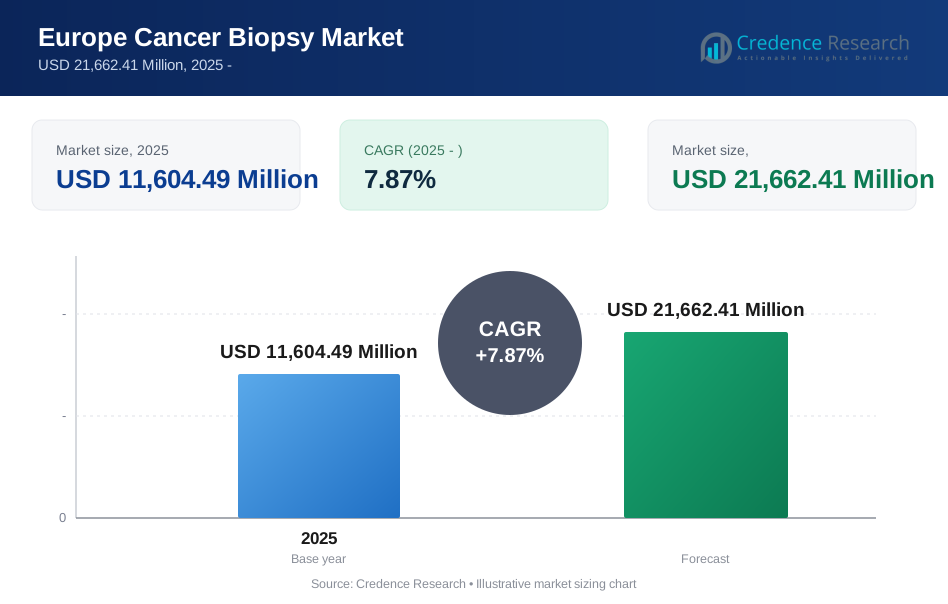
The Europe Cancer Biopsy Market is projected to grow from USD 11,604.49 Million in 2025 to an estimated USD 21,662.41 Million by 2032, with a CAGR of 7.87% from 2025 to 2032.
Market expansion is driven by rising cancer incidence, wider use of precision oncology and growing adoption of minimally invasive liquid biopsy workflows across clinical settings.
Within Europe, Germany leads regional demand because of its strong oncology care infrastructure, advanced molecular diagnostics capacity and high spending on cancer screening and treatment.
| REPORT ATTRIBUTE | DETAILS |
|---|---|
| Historical Period: | 2020-2023 |
| Base Year | 2025 |
| Forecast Period | 2025-2032 |
| Europe Cancer Biopsy Market Market Size 2025 | USD 11,604.49 Million |
| Europe Cancer Biopsy Market CAGR | 7.87% |
| Europe Cancer Biopsy Market Market Size 2032 | USD 21,662.41 Million |
Market Insights
- Western Europe accounted for 34.2% of Europe Cancer Biopsy Market revenue in 2025, supported by its strong concentration of oncology centers, advanced pathology networks, high healthcare spending, and broad use of image-guided and minimally invasive biopsy procedures.
- Consumables led product demand in 2025 with an estimated 38.6% share because recurring biopsy procedures require steady use of reagents, slides, needles and collection components.
- Tissue biopsies remained dominant by type with an estimated 71.4% share in 2025 because they remain standard for histopathology confirmation and biomarker testing.
- Leading companies shaping market competition include QIAGEN, Illumina, Inc., BD, F. Hoffmann-La Roche Ltd. and Guardant Health Inc.
- Key market trend centers on integrating next-generation sequencing, circulating tumor DNA analysis and automated sample preparation into routine cancer diagnosis pathways.

Market Segmentation Analysis
By product - Consumables anchor repeat demand across biopsy workflows
On the basis of product, the market is classified into Instrument, Kits, Consumables and Services. Consumables held the largest share, accounting for 38.6% in 2025. Growth reflects repeated use of needles, reagents, collection tubes, slides and pathology inputs across tissue and liquid biopsy procedures.
Demand remains strong because cancer testing volumes continue to rise in hospitals and diagnostic laboratories. Laboratories also prefer validated consumable platforms that improve sample integrity and workflow consistency. Key companies operating in this segment include QIAGEN, BD and Hologic, Inc.
By type - Tissue biopsies preserve frontline clinical relevance
On the basis of type, the market is classified into Tissue Biopsies and Liquid Biopsies. Tissue Biopsies dominated the market with 71.4% share in 2025. This leadership reflects their essential role in confirming malignancy, grading tumors and enabling immunohistochemistry and genomic profiling.
Clinicians continue to rely on tissue samples for definitive diagnosis in solid tumors, especially before therapy selection. Adoption remains high across tertiary hospitals and cancer centers with established pathology departments. Key companies operating in this segment include F. Hoffmann-La Roche Ltd., Illumina, Inc. and QIAGEN.
By application - Lung cancer leads biopsy demand across oncology use cases
On the basis of application, the market is classified into Lung Cancer, Stomach Cancer, Colorectal Cancer, Breast Cancer, Prostate Cancer, Liver Cancer, Esophagus Cancer, Cervical Cancer, Kidney Cancer, Bladder Cancer and Other Cancers. Lung Cancer held the leading share at 19.8% in 2025.
Its dominance is linked to high disease burden, frequent need for molecular testing and growing use of repeat biopsies to monitor targeted therapy resistance. Both tissue and liquid biopsy demand are elevated in this application. Key companies operating in this segment include Guardant Health Inc., Biodesix and Illumina, Inc.
By end user - Hospitals remain primary purchasing and procedure centers
On the basis of end user, the market is classified into Hospitals, Diagnostic Centres and Research Institutes. Hospitals held the largest share, representing 56.3% in 2025. Their dominance stems from integrated oncology care, access to imaging-guided interventions and in-house pathology and surgical capabilities.
Hospitals also manage large patient volumes and complex cancer cases that require multidisciplinary diagnostics. Procurement favors broad biopsy portfolios with service support and assay reliability. Key companies operating in this segment include BD, F. Hoffmann-La Roche Ltd. and Hologic, Inc.
Key Growth Drivers
Rising cancer burden increases diagnostic testing volumes
Europe continues to face a heavy and rising cancer burden, which is increasing demand for tissue sampling, pathology review, and molecular biopsy testing as hospitals and specialized diagnostic centres handle more lung, breast, colorectal, and prostate cancer cases within formal diagnostic pathways.
Screening expansion is adding to this flow, with the European Commission aiming to offer breast, cervical, and colorectal screening to 90 percent of eligible EU citizens and also extending policy attention to lung and prostate cancers, which supports earlier referral and more biopsy procedures across the region.
The scale is evident in the numbers: IARC estimated 4,471,422 new cancer cases in Europe in 2022, including 557,532 breast, 538,262 colorectal, 484,306 lung, and 473,011 prostate cases, while Roche reported CHF 13.8 billion in Diagnostics sales in 2025 and said its diagnostics solutions touched 258 million lives, underlining how laboratories increasingly need dependable instruments, kits, and consumables to manage higher sample volumes without compromising turnaround time or analytical accuracy.
Precision oncology expands need for biomarker-led biopsy workflows
Precision oncology is reshaping cancer management across Europe. Oncologists increasingly depend on biopsy-derived molecular information to identify actionable mutations, select targeted therapies and monitor treatment resistance. This trend is increasing use of advanced assays in both tissue biopsies and liquid biopsies.
Next-generation sequencing, companion diagnostics and multi-marker panels now play a larger role in routine oncology practice. As therapeutic decisions become more genotype-specific, demand rises for sample quality, standardized pre-analytical handling and platforms that can support complex molecular testing at scale.
Pharmaceutical expansion in targeted therapies reinforces this shift. Large oncology developers now commercialize broad portfolios linked to biomarker testing, which encourages providers to strengthen biopsy infrastructure and integrate pathology with genomic analysis. This alignment between diagnostics and therapy selection remains a durable market growth engine.
Less invasive liquid biopsy adoption improves access and repeat testing
Liquid biopsy is gaining ground in Europe because it offers faster, less invasive sampling and is especially useful when repeat tissue collection is difficult in metastatic disease, frail patients, and cancers that need ongoing tracking of mutation evolution.
Clinical adoption is moving forward as assay sensitivity improves and expert guidance from ESMO states that validated, adequately sensitive plasma ctDNA assays have utility for identifying actionable mutations in advanced cancer and may be used in routine clinical practice with appropriate awareness of assay limits. This momentum is also visible in commercial-scale implementation, as Roche France, Foundation Medicine, and Gustave Roussy built an in-house liquid biopsy partnership around FoundationOne Liquid CDx, which analyzes more than 300 cancer-related genes, and Gustave Roussy noted that genomic profiling is indicated for up to 200,000 patients every year in France, showing why laboratories and cancer centres are investing in workflows that shorten reporting time and make repeatable monitoring more practical for therapy selection, minimal residual disease surveillance, and relapse detection.
Key Trends & Opportunities
Trend-
Molecular profiling moves deeper into routine oncology care
Europe Cancer Biopsy Market is seeing stronger alignment between biopsy procedures and comprehensive molecular profiling. Tissue samples are increasingly processed not only for histology but also for genomic and proteomic analysis. This shift raises demand for high-quality collection systems, extraction kits and sequencing-compatible workflows.
Laboratory modernization is supporting this trend. More cancer centres are adopting automated sample preparation and digital pathology tools to improve throughput and reduce pre-analytical variability. One important supporting signal is the continued rise in installed next-generation sequencing capacity across major European reference laboratories and oncology networks.
Liquid biopsy expands from advanced disease into monitoring pathways
Liquid biopsy adoption is moving beyond late-stage mutation detection into longitudinal monitoring, recurrence assessment and therapy response tracking. Clinicians value its lower procedural burden and ability to capture dynamic tumor changes over time. This makes the technology especially relevant in lung, colorectal and breast cancer management.
Commercial developers are refining assay sensitivity, panel breadth and turnaround time to meet routine clinical needs. As evidence grows, healthcare providers are evaluating how liquid biopsy can complement tissue biopsies rather than replace them. This hybrid diagnostic model is becoming a defining direction for the market.
Opportunity -
Expand access through decentralized testing networks
A major opportunity lies in extending advanced cancer biopsy services beyond large academic hospitals into regional hospital systems and community diagnostic networks. Europe has meaningful variation in oncology testing access, which creates room for providers offering standardized instruments, easy-to-use kits and central-lab service support.
Companies that simplify logistics, stabilize samples during transport and integrate software for results interpretation can improve adoption in less concentrated healthcare settings. This opportunity is particularly strong where referral patterns support hub-and-spoke diagnostics and where health systems aim to reduce time to treatment initiation.
Build value through companion diagnostics and service models
Another strong opportunity comes from linking biopsy platforms with companion diagnostics, laboratory services and oncology partnerships. As targeted therapies expand, providers that pair assays with clinically actionable insights can strengthen their position with hospitals, pharmaceutical companies and specialized cancer centres.
Service-led models also create recurring revenue through testing support, assay validation and workflow optimization. In Europe, purchasers increasingly evaluate not only device performance but also quality systems, training and reimbursement readiness. Vendors that address these factors can capture share in both tissue and liquid biopsy segments.
Key Challenges
Challenge -
Reimbursement and evidence requirements vary across markets
Europe remains a fragmented market with significant variation in reimbursement rules, health technology assessment standards and clinical pathway adoption. This creates uneven uptake for advanced biopsy platforms, especially liquid biopsy tests that require strong clinical utility evidence before broader payer acceptance.
Manufacturers must often navigate country-specific approval expectations, coding structures and procurement processes. These differences can slow commercialization, delay routine use and increase market entry costs even when technologies show clear technical value in oncology diagnostics.
Sample quality and workflow standardization remain critical barriers
Biopsy performance depends heavily on collection quality, storage conditions and laboratory processing consistency. Tissue samples may be limited or degraded, while liquid biopsy assays can be affected by low tumor DNA abundance and pre-analytical variability. These factors can influence sensitivity and reporting confidence.
Healthcare providers therefore demand rigorous validation, operator training and integrated quality control. Vendors that fail to deliver reproducible workflows may face slower adoption, particularly in decentralized settings where technical expertise and infrastructure vary across institutions.
Regional Analysis
Western Europe - 34.2%
Western Europe holds the largest share of the Europe Cancer Biopsy Market due to its strong concentration of oncology centers, advanced pathology networks, high healthcare spending, and broad use of image-guided and minimally invasive biopsy procedures. Germany, France, the Netherlands, Belgium, Austria, Switzerland, and Luxembourg are the main contributors. Germany and France, in particular, anchor demand because of their large patient pools and strong hospital-based cancer diagnostics ecosystems. Higher per-capita health expenditure in countries such as Germany and Switzerland also supports faster adoption of advanced biopsy needles, vacuum-assisted systems, liquid biopsy workflows, and molecular pathology-linked biopsy testing.
Southern Europe - 23.1%
Southern Europe represents the second-largest share, supported by sizable populations and steady cancer diagnosis volumes across Italy, Spain, Portugal, and Greece. Italy and Spain account for most of the regional demand, driven by large public hospital systems, increasing oncology case detection, and expanding use of breast, gastrointestinal, prostate, and lung cancer biopsy procedures. However, the market remains somewhat constrained versus Western Europe because screening participation and diagnostic throughput are less uniform across countries, which creates variation in biopsy volumes and access to premium devices.
Northern Europe - 17.4%
Northern Europe commands a strong share despite its smaller population base because countries such as the UK, Ireland, Denmark, Sweden, Norway, and Finland have highly organized cancer pathways, good screening participation, and well-developed diagnostic services. OECD data show that countries such as Denmark, Sweden, Finland, and the Netherlands achieve some of the strongest screening participation levels in Europe, which supports early lesion detection and steady biopsy demand. The UK is the largest single contributor in this subregion, while the Nordics contribute disproportionately through high-value adoption of precision diagnostics and structured referral systems.
Central Europe - 14.6%
Central Europe accounts for a meaningful share, led by Poland, Czechia, Hungary, Slovakia, and Slovenia. The region benefits from improving cancer care investment, growing modernization of diagnostic labs, and gradual convergence in cancer spending with Western Europe. Poland is the largest market in this cluster because of its population scale and expanding oncology care capacity. Still, market share remains below Western and Southern Europe because screening coverage, hospital funding depth, and access to premium biopsy technologies are still less consistent across the region.
Eastern Europe - 10.7%
Eastern Europe holds the smallest share, though it remains an important growth zone for the Europe Cancer Biopsy Market. Countries including Romania, Bulgaria, Croatia, and the Baltic states are seeing rising cancer care needs, but market development is moderated by lower per-capita health expenditure, lower screening participation in several markets, and uneven pathology and oncology infrastructure. OECD evidence shows that some Eastern European countries continue to trail broader European averages in screening uptake and spending, which limits present market size even as long-term demand strengthens.
Market Segmentations
- Product
- Instrument
- Kits
- Consumables
- Services
- Type
- Tissue Biopsies
- Liquid Biopsies
- Application
- Lung Cancer
- Stomach Cancer
- Colorectal Cancer
- Breast Cancer
- Prostate Cancer
- Liver Cancer
- Esophagus Cancer
- Cervical Cancer
- Kidney Cancer
- Bladder Cancer
- Other Cancers
- End User
- Hospitals
- Diagnostic Centres
- Research Institutes
- By Geography
Competitive Landscape
Competition in the Europe Cancer Biopsy Market is marked by strong innovation in molecular assays, liquid biopsy platforms and integrated pathology workflows. Leading companies focus on expanding assay sensitivity, sample preparation efficiency and biomarker coverage to support precision oncology use cases across solid tumors.
Product strategy increasingly centers on pairing instruments, kits and consumables with software, laboratory services and companion diagnostic capabilities. Companies also pursue distribution partnerships with hospital networks, diagnostic laboratories and regional channel partners to widen market access and improve service responsiveness.
Competitive intensity remains high as established diagnostics firms compete with specialized oncology testing companies. Differentiation depends on analytical performance, regulatory readiness, clinical evidence, reimbursement positioning and the ability to support both centralized and decentralized testing environments.
Key Player Analysis
- QIAGEN
- Illumina, Inc.
- ANGLE plc
- BD
- Biodesix
- Lucence Health Inc.
- Myriad Genetics, Inc.
- Hologic, Inc.
- Oncimmune Holdings PLC
- F. Hoffmann-La Roche Ltd.
- Guardant Health Inc.
- Epigenomics AG
Recent Developments
- In May 2025, NHS England began rolling out a liquid biopsy blood test for lung cancer patients, calling it the first national health system deployment of the approach at that scale. The announcement said the test can help some patients receive targeted treatment up to two weeks earlier and may reduce the need for additional invasive tissue biopsies, making it a significant clinical innovation in Europe’s cancer biopsy pathway.
- In July 2025, Barcelona-based Flomics Biotech joined the Eurostars-funded LUMINA project to develop a platform for detecting lung cancer recurrence through liquid biopsy and artificial intelligence. The consortium includes Uppsala University in Sweden and Oncodia AB, and the project is designed to combine circulating RNA and DNA biomarkers with predictive algorithms to identify minimal residual disease before relapse becomes clinically visible, which gives the collaboration strong translational relevance for European oncology diagnostics.
- In December 2025, Guardant Health and Rome’s Policlinico Gemelli launched FPG 360, an in-house liquid biopsy testing service in Italy based on Guardant360 CDx technology. The reports said the service is one of the first dedicated liquid-biopsy facilities housed within an Italian hospital system and is intended to let cancer patients access comprehensive genomic profiling locally instead of sending samples abroad, strengthening both routine care and clinical research.
- In March 2026, France-based Koelis announced new products at EAU 2026 in London to improve MRI-ultrasound fusion biopsy workflows in prostate cancer. The company said its updates include AI-assisted 3D image processing and workflow improvements intended to make transperineal targeted biopsy more efficient while linking biopsy more seamlessly to focal therapy, making this a notable product-led advance in Europe’s prostate cancer intervention market.
Request a Free Sample
Fill in your details and we'll send you a free sample report.
- Sample data tables & charts
- Research methodology
Need a Custom Version of This Report?
Tailor the scope, geography, or segments to your exact requirements.
- Custom geography or segment scope
- Direct access to our analyst team
Frequently Asked Questions
What is the size of the Europe Cancer Biopsy Market in 2024?
What is driving growth in the Europe Cancer Biopsy Market?
What are key trends in the Europe Cancer Biopsy Market?
Who are the top players in the Europe Cancer Biopsy Market?
Table of Content
Chapter 1. Report Introduction
- 1.1 Report Description & Purpose
- 1.1.1 Report Title & Market Definition
- 1.1.2 Unique Selling Propositions (USP) & Key Differentiators
- 1.1.3 Value Proposition for Stakeholders
- 1.2 Research Objectives
- 1.2.1 Market Sizing Objectives (Volume & Revenue)
- 1.2.2 Segmentation Objectives
- 1.2.3 Competitive Intelligence Objectives
- 1.2.4 Forecast & Scenario Objectives
- 1.3 Report Scope
- 1.3.1 Europe Cancer Biopsy Scope – Types & Subtypes Covered
- 1.3.2 Geographic Scope – Regions & Countries Covered
- 1.3.3 Historical Period, Base Year & Forecast Period (2025; forecast to the forecast period)
- 1.3.4 Inclusions & Exclusions
- 1.4 HS Code & Classification Framework
- 1.5 Currency, Units & Pricing Basis
- 1.6 Target Stakeholders
- 1.7 Limitations & Assumptions
Chapter 2. Executive Summary
- 2.1 Global Europe Cancer Biopsy Market Snapshot
- 2.1.1 Market Size – Historical (2025) & Forecast (the forecast period) (2025: USD 11,604.49 Million → forecast year: USD 21,662.41 Million)
- 2.1.2 Volume & Revenue – Global Totals
- 2.1.3 Key Market Highlights – Top Five Facts
- 2.2 Europe Cancer Biopsy Market Segmentation Snapshot
- 2.2.1 Market Split by Region – 2025 vs.
- 2.3 Competitive Snapshot
- 2.3.1 Top 10 Players by Revenue Share – 2025
- 2.3.2 Top 10 Players by Volume Share – 2025
- 2.3.3 Recent Strategic Developments (18-Month Summary)
- 2.4 Key Investment Highlights & Strategic Conclusions
Chapter 3. Europe Cancer Biopsy Market Dynamics & Industry Analysis
- 3.1 Market Overview & Context
- 3.1.1 Europe Cancer Biopsy Market Position in the Broader Automotive Value Chain
- 3.1.2 OEM vs. Replacement Market Dynamics
- 3.1.3 Market Maturity & Development Stage by Region
- 3.2 Europe Cancer Biopsy Market Drivers
- 3.3 Europe Cancer Biopsy Market Restraints & Challenges
- 3.4 Europe Cancer Biopsy Market Opportunities
- 3.5 Porter's Five Forces Analysis
- 3.5.1 Threat of New Entrants
- 3.5.2 Bargaining Power of Suppliers
- 3.5.3 Bargaining Power of Buyers
- 3.5.4 Threat of Substitutes
- 3.5.5 Competitive Rivalry – Intensity Assessment
- 3.6 Europe Cancer Biopsy Value Chain Analysis
- 3.6.1 Upstream – Raw Material/Input Suppliers
- 3.6.1.1 Raw Material/Input 1
- 3.6.1.2 Raw Material/Input 2
- 3.6.1.3 Raw Material/Input 3
- 3.6.2 Midstream – Production/Manufacturing/Service Delivery
- 3.6.2.1 Production/Process Overview
- 3.6.2.2 Key Facility Locations & Capacity by Manufacturer
- 3.6.3 Downstream – Distribution & End Consumer
- 3.6.3.1 Primary Channel – B2B/OEM
- 3.6.3.2 Secondary Channels – Dealer, Retail, Online, Direct
- 3.6.4 Value Chain Profitability Analysis
- 3.6.1 Upstream – Raw Material/Input Suppliers
- 3.7 PESTEL Analysis
- 3.7.1 Political Factors
- 3.7.2 Economic Factors
- 3.7.3 Social Factors
- 3.7.4 Technological Factors
- 3.7.5 Environmental Factors
- 3.7.6 Legal Factors
- 3.8 Europe Cancer Biopsy Supply Chain Analysis
- 3.8.1 Raw Material/Input Supply Risk Assessment
- 3.8.2 Manufacturing Concentration Risk (Geographic Exposure)
- 3.8.3 Trade Disruption Impact Analysis
- 3.9 Regulatory & Policy Landscape
Note: The regulatory and policy landscape section covers regulations based on their applicability to the market, Europe Cancer Biopsy category, geography, and scope of the study. Only regulatory frameworks with a material impact on operations, compliance, trade, sustainability, or market access are analyzed in detail.
Chapter 4. Key Investment Pockets & Opportunity Analysis
- 4.1 Europe Cancer Biopsy Market Attractiveness Analysis
- 4.1.1 By Region – Investment Attractiveness Matrix (Volume × CAGR)
- 4.2 Absolute Revenue Growth Opportunity
- 4.2.1 By Region – Absolute USD Growth Through the forecast period
- 4.3 Incremental Volume Opportunity
- 4.3.1 By Region – Incremental Volume Through the forecast period
- 4.3.2 Segment – Incremental Volume
- 4.4 Emerging Submarket Opportunity Deep Dive (Subject to Applicability)
- 4.5 Emerging Market Opportunity Scorecards
- 4.5.1 United States
- 4.5.2 Europe
- 4.5.3 Asia
- 4.5.4 Middle East & Africa
Note: Emerging Market Opportunity Scorecards will be included based on relevance and strategic importance. Regions listed are indicative and may vary depending on data availability and market dynamics.
Chapter 5. Europe Cancer Biopsy Import-Export Analysis & Trade Flows
- 5.1 Global Trade Overview
- 5.1.1 Global Export Value by Country (2025)
- 5.1.2 Global Export Volume by Country (2025)
- 5.1.3 Global Import Value by Country (2025)
- 5.1.4 Global Import Volume by Country (2025)
- 5.1.5 Net Trade Balance by Country (2025)
- 5.2 Export Analysis – Segment
- 5.2.1 Type 1 (HS Code)
- 5.2.2 Type 2 (HS Code)
- 5.2.3 Type 3 (HS Code)
- 5.2.4 Type 4 (HS Code)
- 5.2.5 Type 5 (HS Code)
- 5.3 Import Analysis – Segment
- 5.3.1 Type 1 (HS Code)
- 5.3.2 Type 2 (HS Code)
- 5.3.3 Type 3 (HS Code)
- 5.3.4 Type 4 (HS Code)
- 5.3.5 Type 5 (HS Code)
- 5.4 Average Unit Trade Prices
- 5.4.1 Average Export Price – Segment & Country
- 5.4.2 Average Import Price – Segment & Source Country
- 5.4.3 Price Trends (2025)
- 5.5 Key Trade Route Analysis
- 5.5.1 Trade Route 1
- 5.5.2 Trade Route 2
- 5.5.3 Trade Route 3
- 5.5.4 Trade Route 4
- 5.5.5 Trade Route 5
- 5.6 Trade Policy Impact Assessment
- 5.6.1 US Anti-Dumping & Section 301 Tariffs
- 5.6.2 EU Customs Union Impact
- 5.6.3 Major Free Trade Agreements
- 5.6.4 USMCA Rules of Origin
Note: Trade policy analysis will be included only where relevant to the Europe Cancer Biopsy market.
Chapter 6. Competitive Landscape & Company Benchmarking
- 6.1 Europe Cancer Biopsy Market Concentration & Structure
- 6.1.1 Herfindahl-Hirschman Index (HHI) – vs. 2025
- 6.1.2 Tier 1, Tier 2 & Tier 3 Market Structure
- 6.1.3 Global, Regional & Local Player Dynamics
- 6.2 Europe Cancer Biopsy Market Share Analysis – 2025
- 6.2.1 Global Revenue Share by Company
- 6.2.2 Global Volume Share by Company
- 6.2.3 Regional Revenue Share
- 6.2.4 Market Share Evolution ( vs. 2025)
- 6.2.5 OEM Segment Share by Company
- 6.2.6 Replacement Segment Share by Company
- 6.3 Production/Delivery Capacity & Facility Analysis
- 6.3.1 Global Installed Capacity
- 6.3.2 Capacity Utilization Rates
- 6.3.3 Production/Output Volume
- 6.3.4 Facility Locations & Capacity Map
- 6.3.5 Planned Capacity Additions
- 6.4 Europe Cancer Biopsy Competitive Benchmarking Matrix
- 6.4.1 Revenue, Volume, CAGR & Profitability Comparison
- 6.4.2 Channel Revenue Mix
- 6.4.3 Geographic Revenue Exposure
- 6.4.4 R&D Intensity
- 6.4.5 Sustainability Maturity
- 6.5 Strategic Developments in Europe Cancer Biopsy (Last 24 Months)
- 6.5.1 Mergers, Acquisitions & Divestments
- 6.5.2 New Europe Cancer Biopsy Launches
- 6.5.3 Facility Expansions
- 6.5.4 Strategic Alliances, Joint Ventures & Partnerships
- 6.5.5 Distribution Expansion & Market Entry
- 6.5.6 Sustainability & ESG Initiatives
- 6.6 Competitive Strategy Mapping
- 6.6.1 Leader, Challenger, Follower & Niche Classification
- 6.6.2 Pricing Strategy Comparison
- 6.6.3 Channel Strategy Matrix
Note: Strategic developments are included based on their materiality and the availability of reliable information.
Chapter 7. Global Europe Cancer Biopsy Market – By Distribution Channel
- 7.1 Segment Overview
- 7.1.1 Volume & Revenue Split by Channel (2025 & )
- 7.1.2 Channel Mix Evolution (the forecast period)
Chapter 8. Regional Market Analysis – Global Overview
- 8.1 Global Regional Overview
- 8.1.1 Regional Volume Share
- 8.1.2 Regional Revenue Share
- 8.1.3 Regional Volume by Region
- 8.1.4 Regional Revenue by Region
- 8.1.5 Regional Forecast Through the forecast period
- 8.2 Cross-Regional Segment Analysis
- 8.2.1 By Distribution Channel
- 8.2.2 By Brand/Price Tier
Chapter 9. North America Europe Cancer Biopsy Market
- 9.1 United States
- 9.2 Canada
- 9.3 Mexico
Chapter 10. Europe Europe Cancer Biopsy Market
- 10.1 Germany
- 10.2 France
- 10.3 Italy
- 10.4 United Kingdom
- 10.5 Spain
- 10.6 Poland
- 10.7 Russia
- 10.8 Netherlands
- 10.9 Belgium
- 10.10 Sweden
- 10.11 Denmark
- 10.12 Norway
- 10.13 Rest of Europe
Chapter 11. Asia Pacific Europe Cancer Biopsy Market
- 11.1 China
- 11.2 India
- 11.3 Japan
- 11.4 South Korea
- 11.5 Thailand
- 11.6 Indonesia
- 11.7 Vietnam
- 11.8 Malaysia
- 11.9 Australia
- 11.10 Rest of Asia Pacific
Chapter 12. Latin America Europe Cancer Biopsy Market
- 12.1 Brazil
- 12.2 Argentina
- 12.3 Colombia
- 12.4 Chile
- 12.5 Rest of Latin America
Chapter 13. Middle East Europe Cancer Biopsy Market
- 13.1 Saudi Arabia
- 13.2 United Arab Emirates
- 13.3 Turkey
- 13.4 Israel
- 13.5 Iran
- 13.6 Rest of the Middle East
Chapter 14. Africa Europe Cancer Biopsy Market
- 14.1 South Africa
- 14.2 Egypt
- 14.3 Nigeria
- 14.4 Morocco
- 14.5 Rest of Africa
Chapter 15. Europe Cancer Biopsy Company Profiles
- 15.1 [Company 01]
- 15.1.1 Company Overview
- 15.1.2 Key Management Personnel
- 15.1.3 Products & Services Portfolio
- 15.1.4 Financial Performance
- 15.1.5 Key Market Focus & Geographic Presence
- 15.1.6 Recent Developments & Strategic Initiatives
Note: The company profile list is preliminary and may change based on research findings, market developments, data availability, and client requirements.
Chapter 16. Appendices
- Appendix A – List of Abbreviations & Acronyms
- Appendix B – Industry Classification Code Reference – Full Series
- Appendix C – Production & Capacity Data Tables
- Appendix D – End-Use & Demand Base Tables
- Appendix E – Consumption & Replacement Rate Assumptions
- Appendix F – ASP Reference Tables
- Appendix G – Manufacturing & Facility Database
- Appendix H – Import-Export Data Tables
- Appendix I – Regulatory Summary Tables
- Appendix J – Primary Research Participant List (Anonymized)
- Appendix K – Primary Research Questionnaire Framework
- Appendix L – Data Sources & Bibliography
- Appendix M – Market Size Divergence & Source Comparison
Chapter 17. Research Methodology
- 17.1 Research Framework & Philosophy
- 17.2 Secondary Research – Sources, Hierarchy & Data Extraction
- 17.3 Data Modeling – Bottom-Up & Top-Down Market Sizing
- 17.4 Primary Research – Stakeholder Framework, LOI & Sample Sizes
- 17.5 Forecast Methodology – Regression, Scenario & Sensitivity Analysis
- 17.6 Quality Control – Four-Layer Validation Framework
- 17.7 Limitations & Standard Assumptions
- 17.8 Disclaimer