| REPORT ATTRIBUTE | DETAILS |
|---|---|
| Historical Period | 2020-2023 |
| Base Year | 2024 |
| Forecast Period | 2025-2032 |
| Europe Internet Data Center (IDC) Market Size 2024 | USD 17,238.41 million |
| Europe Internet Data Center (IDC) Market, CAGR | 11.10% |
| Europe Internet Data Center (IDC) Market Size 2032 | USD 40,028.04 million |
Market Overview
The Europe Internet Data Center (IDC) market size was valued at USD 17,238.41 million in 2024 and is anticipated to reach USD 40,028.04 million by 2032, at a CAGR of 11.10% during the forecast period (2024-2032).
The Europe Internet Data Center (IDC) market benefits from expanding cloud service adoption, increasing demand for data storage and processing, and broad digital transformation across industries. Enterprises migrate workloads to cloud platforms and require scalable infrastructure to support big data analytics, AI applications, and high-performance computing. Governments enforce strict data sovereignty and security regulations, prompting investments in compliant, secure data center facilities. The rollout of 5G networks drives demand for edge data centers to reduce latency and optimize network performance. Sustainability initiatives and energy-efficiency targets motivate operators to adopt renewable power sources, advanced cooling systems, and modular designs that lower operating costs. Hyperscale providers expand presence with large-scale, standardized facilities to serve rising traffic from e-commerce, streaming services, and IoT deployments.
Major data center hubs dot Western Europe in London, Frankfurt, Paris, Amsterdam and Dublin, and they anchor the Europe Internet Data Center (IDC) landscape, while centers in Central and Eastern Europe notably Warsaw, Prague and Barcelona gain traction due to digitalization and edge compute demand. Regional terrain dictates facility design, with northern locales tapping renewable energy sources and southern markets seeking advanced cooling methods. Operators invest in hyperscale campuses near major fiber routes and undersea cable landings. Industry leaders drive expansion through acquisitions and strategic partnerships: Equinix, Digital Realty Trust (including Interxion), NTT Communications, Global Switch and CyrusOne anchor the market with extensive footprints. Major cloud hyperscalers such as AWS, Microsoft Azure and Google Cloud bolster capacity with in-house data campuses.
Market Insights
- The Europe Internet Data Center (IDC) market size was valued at USD 17,238.41 million in 2024, projected to reach USD 40,028.04 million by 2032, CAGR 11.10%.
- The global Internet Data Center (IDC) market was valued at USD 61,521.80 million in 2024 and is projected to reach USD 150,594.58 million by 2032, growing at a CAGR of 11.84% during the forecast period.
- Rapid cloud migration drives demand for scalable, energy-efficient colocation facilities to support AI, big data analytics and high-performance computing workloads.
- Adoption of 5G networks fuels edge data center deployments, reducing latency and enabling real-time applications across industries.
- Hyperscale providers expand multi-megawatt campuses, standardizing hardware and accelerating modular deployments to meet peak traffic and cloud service demands.
- Leading operators Equinix, Digital Realty, NTT Communications and Global Switch invest in acquisitions and partnerships to strengthen pan-European footprints.
- High upfront costs and evolving data sovereignty regulations constrain new data center projects, requiring extensive compliance investments and location-specific adaptations.
- Western Europe hubs-Germany (26.7%), UK (18%), France (14%)-dominate capacity, while Central and Eastern Europe and Rest of Europe pursue rapid modular and edge expansion.
Report Scope
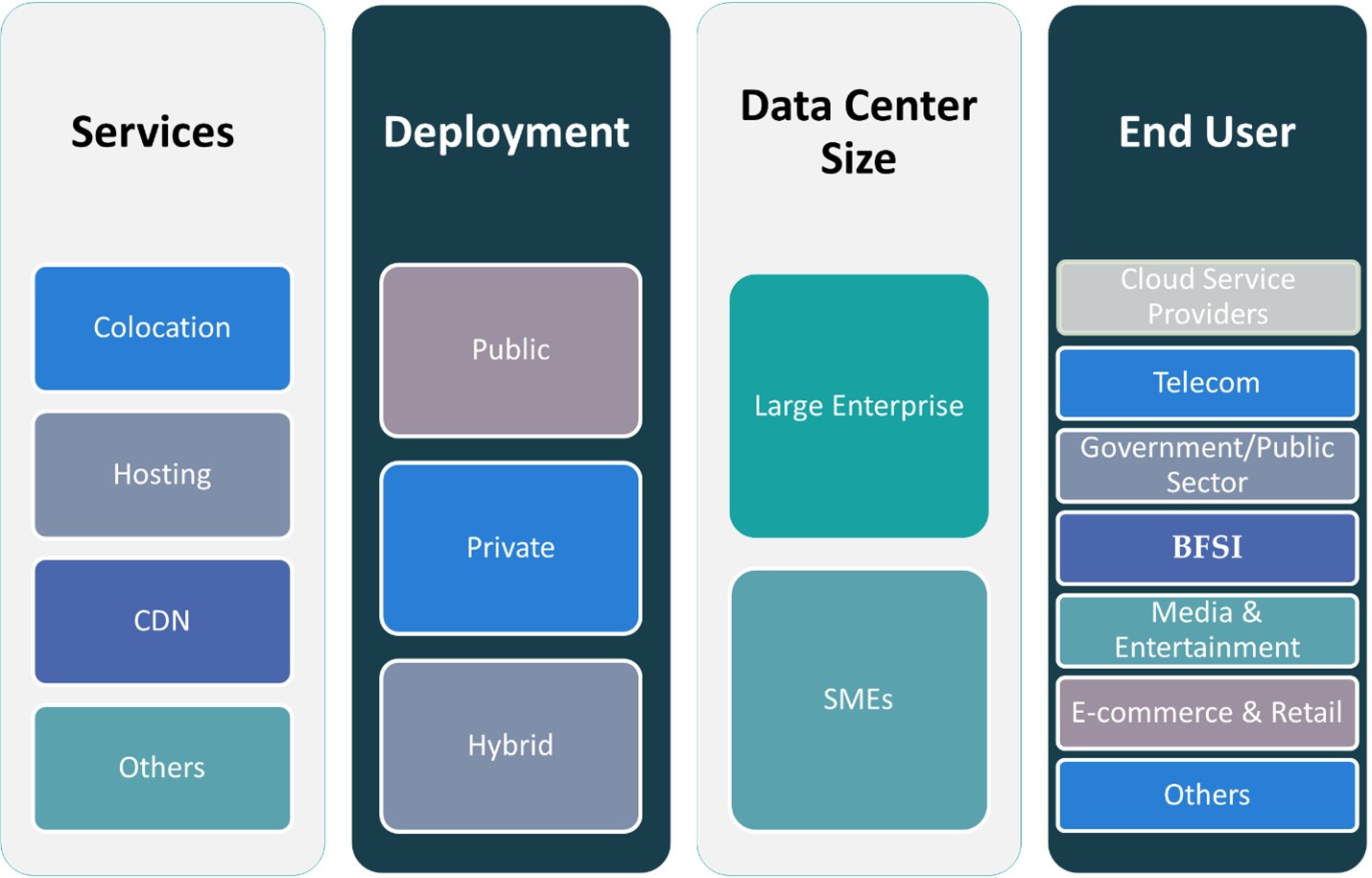
This report segments the Europe Internet Data Center (IDC) Market as follows:
Market Drivers
Accelerated Cloud Migration Increases Infrastructure Demand
Enterprises adopt cloud solutions to handle complex workloads. The Europe Internet Data Center (IDC) Market benefits from rising demand for scalable compute and storage. It supports big data analytics, machine learning, and high-performance computing with minimal upfront cost. Organizations transfer legacy applications to modern data center environments to boost performance and reliability. High availability needs drive expansion of colocation and hyperscale facilities. Service providers allocate capital to increase server capacity and network throughput.
- For instance, between H2 2023 and H2 2024, the operational capacity of EMEA’s data center markets rose by ~9% to reach 9.4GW, reflecting strong infrastructure expansion.
Data Sovereignty Regulations Drive Facility Upgrades
EU data protection rules require local hosting of sensitive information. The Europe Internet Data Center (IDC) Market gains from compliance-driven facility upgrades. It keeps data within jurisdictional boundaries under GDPR and national laws. Operators deploy firewalls, intrusion detection, and encryption modules to meet standards. Security audits prompt regular hardware refresh and software patch cycles. Clients select certified data centers to reduce breach risk.
- For instance, colocation data centers alone contributed €30 billion to European GDP in 2023, with projections reaching €83.8 billion by 2030, highlighting the economic impact of data sovereignty regulations.
5G Rollout Spurs Edge Data Center Expansion
Telecom firms invest in edge data centers to support 5G networks. The Europe Internet Data Center (IDC) Market] expands through reduced latency requirements. It enables real-time video, remote monitoring, and augmented reality services. Companies install micro data centers near end users to optimize bandwidth. Collaborations between operators and hyperscalers accelerate site acquisition and build-out. Demand for modular, prefabricated solutions grows rapidly.
Sustainability Goals Drive Energy-Efficient Operations
Energy costs and environmental targets push operators toward green upgrades. The Europe Internet Data Center (IDC) Market adopts renewable power and advanced cooling. It lowers carbon footprint and operating expenses through efficient design. Governments offer incentives for carbon-neutral construction and renewable energy certificates. Vendors introduce liquid cooling and free-air systems to improve energy efficiency. Investment in energy storage and solar partnerships strengthens sustainable operations.
Market Trends
Emergence of Hyperscale Data Center Deployments
Enterprises deploy hyperscale facilities to support growing digital workloads. The Europe Internet Data Center (IDC) market records expansion of multi-megawatt campuses by major providers. This architecture drives standardized hardware deployment and efficient resource management. Operators scale capacity rapidly to meet demand for cloud services and streaming platforms. Colocation partners invest in high-density power and advanced cooling to host peak loads. Industry players align on modular designs to accelerate site commissioning.
- For instance, the Climate Neutral Data Center Pact commits European operators to 100% renewable energy by 2030, influencing hyperscale facility designs.
Commitment to Renewable Energy and Green Facility Certifications
Operators source renewable power and enhance operational efficiency to meet carbon-neutral targets. The Europe Internet Data Center (IDC) market achieves green certification through strict energy audits. This focus reduces operational cost and strengthens corporate sustainability profiles. Data center designers adopt liquid cooling and free-air systems to cut power use. Investors favor facilities that comply with EU energy regulations and emission goals. Collaboration with local utilities secures long-term access to clean energy and storage.
- For instance, the EU has introduced new sustainability reporting requirements for data centers, mandating energy efficiency disclosures.
Expansion of Edge Computing Infrastructure to Reduce Latency
Telecom operators place micro data centers near users to reduce latency. The Europe Internet Data Center (IDC) market edge nodes that process data on-site. This trend improves user experience for real-time applications and IoT services. Businesses integrate edge facilities with central sites for hybrid compute models. Vendors offer prefabricated enclosures that enable rapid deployment at network edges. Alliances develop standards for interoperability and security at edges.
Adoption of Software-Defined Networking for Operational Agility
Enterprises adopt software-defined networking to enhance traffic control and flexibility. The Europe Internet Data Center (IDC) market leverages virtualization to separate control from hardware. This approach simplifies network management and accelerates service provisioning. IT teams deploy automation tools that optimize bandwidth and reduce manual tasks. Providers integrate network function virtualization to support on-demand services. Standard APIs enable seamless integration with orchestration platforms and cloud environments.
Market Challenges Analysis
Evolving Regulatory Requirements and Security Compliance Burden
Data protection and environmental regulations vary across EU member states and span GDPR, energy efficiency, and carbon emission standards. The Europe Internet Data Center (IDC) Market must navigate complex permit and audit processes. It allocates resources to maintain certification and update security protocols. Frequent policy revisions demand continuous compliance investments in software and staff training. Failure to meet standards risks fines and reputational damage. Providers coordinate with local authorities to streamline approval timelines. Compliance considerations influence site selection and operational planning.
- For instance, the EU’s NIS2 Directive introduces strengthened cybersecurity obligations, requiring data center operators to implement risk-management measures, incident reporting, and governance requirements.
High Upfront Investment and ROI Ambiguity
Data center construction demands significant capital for real estate, power, and cooling infrastructure. The Europe Internet Data Center (IDC) Market faces pressure from investors seeking clear payback timelines. It must justify expenditure through long-term service contracts and utilization guarantees. Rapid technology cycles force frequent hardware refreshes that increase cost unpredictability. Operators negotiate power purchase agreements under uncertain future energy prices. Competition for premium locations drives land and build costs higher. Project budgets require contingency for regulatory delays and permit changes.
Market Opportunities
Expansion of Edge Computing and Hybrid Deployment Models
The Europe Internet Data Center (IDC) Market can capitalize on the rise of edge computing and hybrid architectures to deliver low-latency processing near end users. It reduces network congestion and improves performance for IoT, real-time analytics, and immersive applications. Enterprises embrace hybrid models that link on-premises resources with cloud and edge nodes. Colocation providers partner with telecom operators to deploy micro data centers at network hubs. This approach enhances service agility and supports distributed workloads. It opens avenues for managed edge services tailored to industry-specific needs. Providers integrate orchestration platforms to simplify deployment and management across distributed sites.
Investment in Renewable Energy and Sustainable Infrastructure
Growing pressure for carbon-neutral operations drives demand for green data center solutions. The Europe Internet Data Center (IDC) Market can leverage renewable energy incentives and government grants to reduce operating cost and environmental impact. It adopts solar arrays, wind power purchase agreements, and energy storage systems to meet sustainability targets. Operators retrofit existing facilities with advanced cooling methods that cut energy use. Investors show stronger interest in facilities that hold green certifications and ESG credentials. It paves way for public-private partnerships in renewable projects. Vendors develop modular container units powered by off-grid renewables to serve remote or underserved regions.
Market Segmentation Analysis:
By Services:
Europe Internet Data Center (IDC) market services segment divides into Colocation, Hosting, CDN, and Others. Colocation leads due to cost efficiencies and scalability; it appeals to enterprises seeking reliable power and connectivity. Hosting services segment grows through managed infrastructure adoption by SMEs and large organizations; it delivers turnkey server management and maintenance. Content Delivery Network services maintain robust growth driven by high demand for video streaming and web acceleration; it improves end-user experience across geographies. Others segment encompasses backup, disaster recovery, and security offerings; it diversifies revenue streams and meets specialized requirements. Service providers expand value-added offerings such as remote hands and proactive network monitoring to boost client retention.
By Deployment:
Europe Internet Data Center (IDC) market deployment models include Public, Private, and Hybrid. Public cloud model attracts organizations seeking pay-per-use infrastructure without capital investment; it scales on demand. Private deployments secure sensitive workloads through dedicated environments; it offers strict compliance and performance guarantees. Hybrid architecture unites on-premises assets with public cloud; it provides flexibility and cost optimization. Providers streamline integration through unified management platforms to support workload mobility. Demand for hybrid solutions rises from enterprises pursuing both security and agility. Next-generation orchestration tools simplify resource allocation across multiple environments.
By Data Center Size:
Large enterprises require high-density colocation and hyperscale capacity to support global operations; they need robust power and cooling infrastructure. SMEs seek flexible, cost-effective solutions with pay-per-use billing. The Europe Internet Data Center (IDC) market reflects large enterprises investing in dedicated racks and private clouds to ensure compliance and performance while SMEs adopt modular racks for scalable growth. It encourages providers to offer managed services and security to each cohort. Vendors tailor service-level agreements and technical support to segment needs, driving adoption across both large enterprises and SMEs.
Segments:
Based on Services:
- Colocation
- Hosting
- CDN
- Others
Based on Deployment:
- Public
- Private
- Hybrid
Based on Data Center Size:
- Large Enterprise
- SMEs
Based on End- User:
- Cloud Service Providers
- Telecom
- Government/Public Sector
- BFSI
- Media & Entertainment
- E-commerce & Retail
- Others
Based on the Geography:
- UK
- France
- Germany
- Italy
- Spain
- Russia
- Belgium
- Netherlands
- Austria
- Sweden
- Poland
- Denmark
- Switzerland
- Rest of Europe
Regional Analysis
Western Europe
Western Europe holds the largest share in the Europe Internet Data Center (IDC) Market, accounting for over 60% of the total market. The region benefits from advanced digital infrastructure, high cloud adoption rates, and a mature enterprise IT ecosystem. Countries such as Germany, the United Kingdom, France, and the Netherlands lead the way, driven by strong demand from hyperscale cloud providers, financial institutions, and content delivery networks. Government support for data localization and green energy initiatives also strengthens market growth. It continues to attract investment in both new data centers and the expansion of existing ones. Demand for secure, low-latency services is pushing operators to upgrade facilities with cutting-edge cooling and power systems.
Northern and Central Europe
Northern and Central Europe are gaining momentum, supported by favorable business conditions and rising demand for colocation services. Countries like Sweden, Denmark, and Poland are witnessing increased activity from cloud providers and enterprises seeking cost-effective alternatives to Western Europe. The availability of renewable energy, cooler climates, and stable political environments enhance their appeal. It offers advantages in energy efficiency and scalability, making it attractive for long-term deployments. These regions are becoming key to supporting distributed cloud infrastructure and edge computing requirements. Local governments continue to promote data center investments through tax incentives and simplified regulatory frameworks.
Southern and Eastern Europe
Southern and Eastern Europe represent smaller shares of the Europe Internet Data Center (IDC) Market but show steady growth potential. Countries such as Spain, Italy, Romania, and Bulgaria are expanding their digital infrastructure to meet rising demand from telecom, media, and enterprise sectors. It benefits from ongoing digital transformation initiatives and EU-backed funding aimed at improving connectivity. Local players are increasing capacity to serve regional customers seeking data sovereignty and reliable connectivity. Market competition remains moderate, providing opportunities for both global and regional data center operators to establish a presence. Continued investments in fiber networks and power infrastructure will support long-term growth in these subregions.
Key Player Analysis
- Digital Realty Trust Inc.
- Equinix Inc.
- Interxion
- STT GDC
- Kao Data
Competitive Analysis
The Europe Internet Data Center (IDC) Market features fierce rivalry between hyperscale cloud providers and traditional colocation operators. Major players such as Equinix, Digital Realty Trust, STT GDC and Kao Data compete on capacity, connectivity, security and sustainability credentials. It pushes companies to invest in modular facility designs and renewable power sources to reduce operating expenses. Providers differentiate through custom service-level agreements, managed security offerings and ultra-low-latency network performance. They pursue strategic acquisitions, joint ventures and carrier partnerships to expand footprints and access new customer segments. Emerging operators target niche requirements for edge computing and industry-specific compliance to capture market share. Continuous price competition exerts margin pressure and prompts efficiency improvements across facility operations. Strict data sovereignty rules and energy regulations create significant entry barriers for smaller firms. Large firms leverage scale advantages to secure favorable power contracts and prime real estate deals, reinforcing their market dominance.
Recent Developments
- In 2025, Microsoft plans to invest about $80 billion in AI-enabled data centers, significantly increasing its investment from previous years. Over half of this investment will be directed towards the United States, supporting AI model training and the development of cloud-based applications globally. This investment is part of Microsoft's broader strategy to advance AI technology and infrastructure.
- In September 2023, Google, Microsoft, Schneider Electric, and Danfoss jointly unveiled a collaborative initiative known as the Net Zero Innovation Hub for Data Center. This groundbreaking project is developed in partnership with the Danish Data Center Industry. The proposed location for this innovative center is Fredericia, Denmark.
Market Concentration & Characteristics
The Europe Internet Data Center (IDC) Market exhibits high concentration, with a handful of hyperscale and colocation providers controlling over 60% of total capacity. It features an oligopolistic structure where Equinix, Digital Realty Trust and STT GDC leverage scale advantages to secure prime real estate and power contracts. Large operators maintain diverse service portfolios colocation, managed services and interconnection to meet enterprise and cloud demands. It enforces strict compliance with GDPR and energy regulations, driving standardization of security and sustainability practices. Smaller firms compete by targeting niche segments, such as edge computing and industry-specific certifications. It demands significant capital investment and long-term commitments, which create high entry barriers and reinforce market dominance by established players.
Report Coverage
The research report offers an in-depth analysis based on Services, Deployment, Data Center Size, End-User and Geography. It details leading market players, providing an overview of their business, product offerings, investments, revenue streams, and key applications. Additionally, the report includes insights into the competitive environment, SWOT analysis, current market trends, as well as the primary drivers and constraints. Furthermore, it discusses various factors that have driven market expansion in recent years. The report also explores market dynamics, regulatory scenarios, and technological advancements that are shaping the industry. It assesses the impact of external factors and global economic changes on market growth. Lastly, it provides strategic recommendations for new entrants and established companies to navigate the complexities of the market.
Future Outlook
- The market will grow steadily due to rising demand for cloud services and digital infrastructure.
- Enterprises will continue to adopt hybrid and multi-cloud strategies, driving colocation needs.
- Sustainability will remain a key priority, pushing operators to invest in renewable energy solutions.
- Edge data centers will expand to support low-latency applications in underserved areas.
- Regulatory compliance and data sovereignty requirements will shape facility design and location.
- Demand for AI and high-performance computing will drive investment in advanced infrastructure.
- Countries in Central and Eastern Europe will attract new investments due to cost advantages.
- Automation and AI tools will improve operational efficiency and reduce energy consumption.
- Strategic partnerships between cloud providers and data center operators will strengthen regional coverage.
- Urban centers with strong fiber networks will remain critical for high-density data center deployments.

Request a Free Sample
Fill in your details and we'll send you a free sample report.
- Sample data tables & charts
- Research methodology
Need a Custom Version of This Report?
Tailor the scope, geography, or segments to your exact requirements.
- Custom geography or segment scope
- Direct access to our analyst team
Frequently Asked Questions
What is the current size of the Europe Internet Data Center (IDC) market?
What factors are driving the growth of the Europe Internet Data Center (IDC) market?
What are some challenges faced by the Europe Internet Data Center (IDC) market?
Who are the major players in the Europe Internet Data Center (IDC) market?
Table of Content
Chapter 1. Report Introduction
- 1.1 Report Description & Purpose
- 1.1.1 Report Title & Market Definition
- 1.1.2 Unique Selling Propositions (USP) & Key Differentiators
- 1.1.3 Value Proposition for Stakeholders
- 1.2 Research Objectives
- 1.2.1 Market Sizing Objectives (Volume & Revenue) (Volume Where Applicable)
- 1.2.2 Segmentation Objectives
- 1.2.3 Competitive Intelligence Objectives
- 1.2.4 Forecast & Scenario Objectives
- 1.3 Report Scope
- 1.3.1 Europe Internet Data Center (IDC) Scope – Segments & Subsegments Covered
- 1.3.2 Geographic Scope – Selected Region & Countries Covered
- 1.3.3 Historical Period, Base Year & Forecast Period (2024; forecast to 2032)
- 1.3.4 Inclusions & Exclusions
- 1.4 Industry Classification & Applicable Codes
- 1.5 Currency, Measurement Units & Valuation Basis
- 1.6 Target Stakeholders
- 1.7 Limitations & Assumptions
Chapter 2. Executive Summary
- 2.1 Europe Internet Data Center (IDC) Snapshot
- 2.1.1 Market Size – Historical (2024) & Forecast (2024-2032) (2024: USD 17,238.41 million → 2032: USD 40,028.04 million)
- 2.1.2 Volume & Revenue – Regional Totals (Volume Where Applicable)
- 2.1.3 Key Market Highlights – Top Five Facts
- 2.2 Europe Internet Data Center (IDC) Segmentation Snapshot
- 2.2.1 Market Split by Country – 2024 vs. 2032
- 2.3 Competitive Snapshot
- 2.3.1 Top 10 Players by Revenue Share – 2024
- 2.3.2 Top 10 Players by Volume Share – 2024 (Volume Where Applicable)
- 2.3.3 Recent Strategic Developments (18-Month Summary)
- 2.4 Key Investment Highlights & Strategic Conclusions
Chapter 3. Europe Internet Data Center (IDC) Dynamics & Industry Analysis
- 3.1 Market Overview & Context
- 3.1.1 Europe Internet Data Center (IDC) Position in the Broader Industry Value Chain
- 3.1.2 Demand Structure & Purchasing Dynamics
- 3.1.3 Market Maturity & Development Stage by Country
- 3.2 Europe Internet Data Center (IDC) Drivers
- 3.3 Europe Internet Data Center (IDC) Restraints & Challenges
- 3.4 Europe Internet Data Center (IDC) Opportunities
- 3.5 Porter's Five Forces Analysis
- 3.5.1 Threat of New Entrants
- 3.5.2 Bargaining Power of Suppliers
- 3.5.3 Bargaining Power of Buyers
- 3.5.4 Threat of Substitutes
- 3.5.5 Competitive Rivalry – Intensity Assessment
- 3.6 Europe Internet Data Center (IDC) Value Chain Analysis
- 3.6.1 Upstream – Key Inputs, Resources & Suppliers
- 3.6.1.1 Key Input/Resource 1
- 3.6.1.2 Key Input/Resource 2
- 3.6.1.3 Key Input/Resource 3
- 3.6.2 Midstream – Core Operations & Value Creation
- 3.6.2.1 Operating Model & Process Overview
- 3.6.2.2 Key Operating Locations & Capabilities by Company
- 3.6.3 Downstream – Market Channels & End Users
- 3.6.3.1 Direct Sales & Customer Engagement Channels
- 3.6.3.2 Indirect Sales, Intermediaries & Partner Channels
- 3.6.4 Value Chain Profitability Analysis
- 3.6.1 Upstream – Key Inputs, Resources & Suppliers
- 3.7 PESTEL Analysis
- 3.7.1 Political Factors
- 3.7.2 Economic Factors
- 3.7.3 Social Factors
- 3.7.4 Technological Factors
- 3.7.5 Environmental Factors
- 3.7.6 Legal Factors
- 3.8 Europe Internet Data Center (IDC) Supply Chain Analysis
- 3.8.1 Critical Input & Resource Availability Risk Assessment
- 3.8.2 Supplier & Operational Concentration Risk (Geographic Exposure)
- 3.8.3 Supply & Service Disruption Impact Analysis
- 3.9 Regional & Country Regulatory Landscape
Note: The regulatory and policy landscape section covers regulations based on their applicability to the market, Europe Internet Data Center (IDC) category, geography, and scope of the study. Only regulatory frameworks with a material impact on operations, compliance, trade, sustainability, or market access are analyzed in detail.
Chapter 4. Key Investment Pockets & Opportunity Analysis
- 4.1 Europe Internet Data Center (IDC) Attractiveness Analysis
- 4.1.1 By Country – Investment Attractiveness Matrix (Market Size × CAGR)
- 4.2 Absolute Revenue Growth Opportunity
- 4.2.1 By Country – Absolute Revenue Growth Through 2032
- 4.3 Incremental Demand Opportunity
- 4.3.1 By Country – Incremental Demand Through 2032
- 4.3.2 Segment – Incremental Demand
- 4.4 Emerging Submarket Opportunity Deep Dive (Subject to Applicability)
- 4.5 Priority Country Opportunity Scorecards
- 4.5.1 Priority Country 1
- 4.5.2 Priority Country 2
- 4.5.3 Priority Country 3
- 4.5.4 Priority Country 4
Note: Priority countries are selected from within the region covered by the study. Numbered entries are indicative and are populated with relevant country names based on market size, growth potential, and strategic relevance.
Chapter 5. Europe Internet Data Center (IDC) Cross-Border Trade & Market Access Analysis
- 5.1 Intra-Regional & Extra-Regional Trade Overview
- 5.1.1 Regional Export Value by Country (2024)
- 5.1.2 Regional Export Volume by Country (2024) (Volume Where Applicable)
- 5.1.3 Regional Import Value by Country (2024)
- 5.1.4 Regional Import Volume by Country (2024) (Volume Where Applicable)
- 5.1.5 Net Trade Balance by Country (2024)
- 5.2 Export Analysis – Segment
- 5.2.1 Category 1 (Applicable Classification Code)
- 5.2.2 Category 2 (Applicable Classification Code)
- 5.2.3 Category 3 (Applicable Classification Code)
- 5.2.4 Category 4 (Applicable Classification Code)
- 5.2.5 Category 5 (Applicable Classification Code)
- 5.3 Import Analysis – Segment
- 5.3.1 Category 1 (Applicable Classification Code)
- 5.3.2 Category 2 (Applicable Classification Code)
- 5.3.3 Category 3 (Applicable Classification Code)
- 5.3.4 Category 4 (Applicable Classification Code)
- 5.3.5 Category 5 (Applicable Classification Code)
- 5.4 Cross-Border Pricing & Transaction Benchmarks
- 5.4.1 Export Pricing – Segment & Country
- 5.4.2 Import Pricing – Segment & Source Country
- 5.4.3 Price Trends (2024)
- 5.5 Key Cross-Border Trade & Delivery Routes
- 5.5.1 Cross-Border Trade/Delivery Route 1
- 5.5.2 Cross-Border Trade/Delivery Route 2
- 5.5.3 Cross-Border Trade/Delivery Route 3
- 5.5.4 Cross-Border Trade/Delivery Route 4
- 5.5.5 Cross-Border Trade/Delivery Route 5
- 5.6 Trade Policy & Market Access Impact Assessment
- 5.6.1 Tariff & Non-Tariff Barriers
- 5.6.2 Regional Trade & Economic Integration Frameworks
- 5.6.3 Bilateral & Multilateral Trade Agreements
- 5.6.4 Cross-Border Operating, Licensing & Localization Requirements
Note: Cross-border analysis applies where relevant to Europe Internet Data Center (IDC). Country trade flows distinguish intra-regional activity from trade with markets outside the region. Regional external trade totals exclude intra-regional flows to avoid double counting. Classifications and transaction measures follow the market scope; volume and route analyses apply only where meaningful.
Chapter 6. Competitive Landscape & Company Benchmarking
- 6.1 Europe Internet Data Center (IDC) Concentration & Structure
- 6.1.1 Herfindahl-Hirschman Index (HHI) – vs. 2024
- 6.1.2 Leading, Mid-Sized & Emerging Player Structure
- 6.1.3 Global, Regional & Local Player Dynamics
- 6.2 Europe Internet Data Center (IDC) Share Analysis – 2024
- 6.2.1 Regional Revenue Share by Company
- 6.2.2 Regional Volume Share by Company (Volume Where Applicable)
- 6.2.3 Company Revenue Share by Country
- 6.2.4 Market Share Evolution ( vs. 2024)
- 6.2.5 Company Market Share by Key Segment
- 6.2.6 Company Market Share by Customer Group
- 6.3 Operating Scale, Capacity & Infrastructure Analysis
- 6.3.1 Regional Operating Scale & Supply Capacity
- 6.3.2 Resource Utilization & Operating Efficiency
- 6.3.3 Output, Service Delivery & Activity Metrics
- 6.3.4 Operating Footprint & Infrastructure Map
- 6.3.5 Planned Operational & Capacity Expansion
- 6.4 Europe Internet Data Center (IDC) Competitive Benchmarking Matrix
- 6.4.1 Revenue, Growth, Profitability & Operating Metric Comparison
- 6.4.2 Channel Revenue Mix
- 6.4.3 Revenue Exposure by Country Within the Region
- 6.4.4 R&D Intensity
- 6.4.5 Sustainability Maturity
- 6.5 Strategic Developments in Europe Internet Data Center (IDC) (Last 24 Months)
- 6.5.1 Mergers, Acquisitions & Divestments
- 6.5.2 New Products, Services & Solutions in Europe Internet Data Center (IDC)
- 6.5.3 Operational & Infrastructure Expansions
- 6.5.4 Strategic Alliances, Joint Ventures & Partnerships
- 6.5.5 Distribution Expansion & Market Entry
- 6.5.6 Sustainability & ESG Initiatives
- 6.6 Competitive Strategy Mapping
- 6.6.1 Leader, Challenger, Follower & Niche Classification
- 6.6.2 Pricing Strategy Comparison
- 6.6.3 Channel Strategy Matrix
Note: Strategic developments are included based on their materiality and the availability of reliable information.
Chapter 7. Europe Internet Data Center (IDC) – By Sales & Delivery Channel
- 7.1 Segment Overview
- 7.1.1 Volume & Revenue Split by Channel (2024 & 2032) (Volume Where Applicable)
- 7.1.2 Channel Mix Evolution (2024-2032)
Chapter 8. Country Market Analysis – Regional Overview
- 8.1 Country Market Overview Within the Region
- 8.1.1 Country Volume Share Within the Region (Where Applicable)
- 8.1.2 Country Revenue Share Within the Region
- 8.1.3 Market Volume by Country (Where Applicable)
- 8.1.4 Market Revenue by Country
- 8.1.5 Country Forecasts Through 2032
- 8.2 Cross-Country Segment Analysis
- 8.2.1 By Sales & Delivery Channel
- 8.2.2 By Competitive Positioning & Price Tier
Chapter 9. Europe Internet Data Center (IDC) – Priority Country 1
Chapter 10. Europe Internet Data Center (IDC) – Priority Country 2
Chapter 11. Europe Internet Data Center (IDC) – Priority Country 3
Chapter 12. Europe Internet Data Center (IDC) – Priority Country 4
Chapter 13. Europe Internet Data Center (IDC) Company Profiles
- 13.1 [Company 01]
- 13.1.1 Company Overview
- 13.1.2 Key Management Personnel
- 13.1.3 Products & Services Portfolio
- 13.1.4 Financial Performance
- 13.1.5 Regional Market Focus & Country Presence
- 13.1.6 Recent Developments & Strategic Initiatives
Note: The company profile list is preliminary and may change based on research findings, market developments, data availability, and client requirements.
Chapter 14. Appendices
- Appendix A – List of Abbreviations & Acronyms
- Appendix B – Industry Classification Code Reference – Full Series
- Appendix C – Supply, Output & Operating Capacity Data Tables
- Appendix D – End-Use & Demand Base Tables
- Appendix E – Demand, Adoption & Usage Assumptions
- Appendix F – Pricing & Revenue Metric Reference Tables
- Appendix G – Company Operations & Infrastructure Database
- Appendix H – Cross-Border Trade & Activity Data Tables (Where Applicable)
- Appendix I – Regulatory Summary Tables
- Appendix J – Primary Research Participant List (Anonymized)
- Appendix K – Primary Research Questionnaire Framework
- Appendix L – Data Sources & Bibliography
- Appendix M – Market Size Divergence & Source Comparison
Chapter 15. Research Methodology
- 15.1 Research Framework & Philosophy
- 15.2 Secondary Research – Sources, Hierarchy & Data Extraction
- 15.3 Data Modeling – Country-Level Estimates & Regional Aggregation
- 15.4 Primary Research – Stakeholder Framework, LOI & Sample Sizes
- 15.5 Forecast Methodology – Regression, Scenario & Sensitivity Analysis
- 15.6 Quality Control – Four-Layer Validation Framework
- 15.7 Limitations & Standard Assumptions
- 15.8 Disclaimer