Market Overview:
The E-book reader market is projected to grow from USD 10,776.62 million in 2024 to an estimated USD 17,996.66 million by 2032, with a CAGR of 6.62% from 2024 to 2032.
| REPORT ATTRIBUTE | DETAILS |
|---|---|
| Historical Period | 2020-2023 |
| Base Year | 2024 |
| Forecast Period | 2025-2032 |
| E-Book Reader Market Size 2024 | USD 10,776.62 million |
| E-Book Reader Market, CAGR | 6.62% |
| E-Book Reader Market Size 2032 | USD 17,996.66 million |
Growing adoption of digital books accelerates demand across education, leisure, and professional learning. Publishers expand digital libraries and exclusive e-book releases, which drive higher usage of dedicated readers. Advancements such as improved E-ink displays, faster processors, and integrated lighting enhance user comfort and expand device usage across long reading hours. Expanding digital learning programs across schools and colleges further strengthens market momentum. Major brands also push ecosystem-based content strategies, which broaden user engagement and support sustained demand for specialized e-reading devices.
North America leads due to strong digital content ecosystems, high device penetration, and early adoption of innovative e-reading technologies. Europe follows with rising demand across education, public libraries, and professional domains. Asia Pacific emerges as the fastest-growing region driven by rising digital literacy, affordable device offerings, and expanding e-learning programs across China, India, and Southeast Asia. Latin America and the Middle East show gradual adoption as online publishing expands and retailers strengthen access to digital reading platforms.
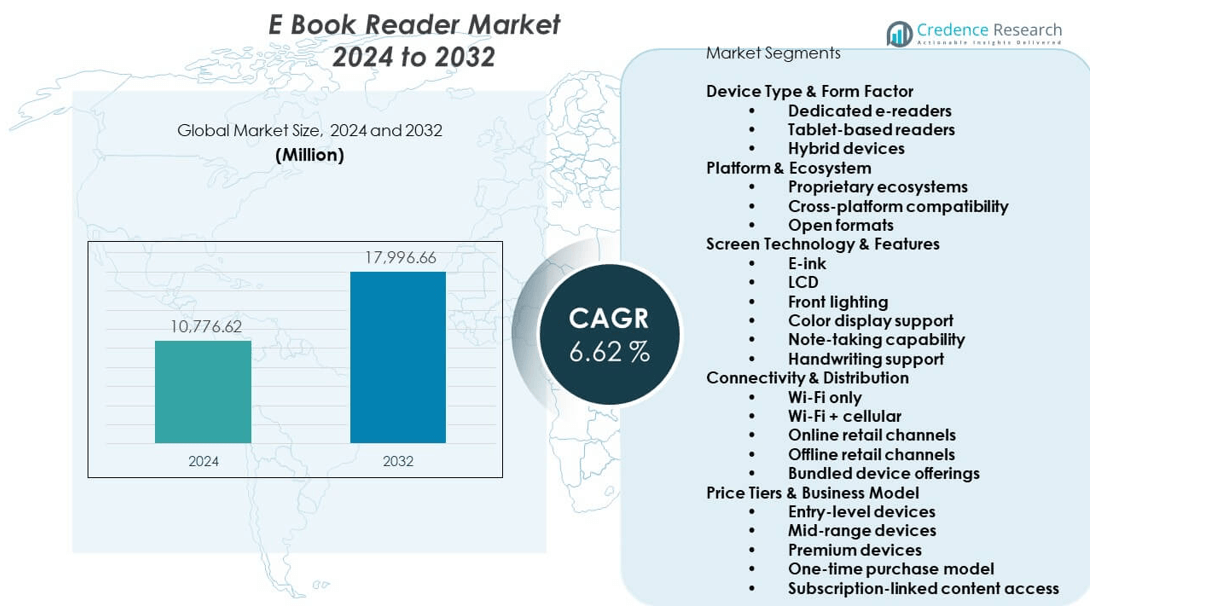
Market Insights:
- The E book reader market stands at USD 10,776.62 million in 2024 and is projected to reach USD 17,996.66 million by 2032, expanding at a 62% CAGR.
- North America (38%), Europe (27%), and Asia Pacific (24%) hold the top shares due to strong digital ecosystems, high reading adoption, and robust retail distribution.
- Asia Pacific, with a 24% share, remains the fastest-growing region driven by rising digital literacy, expanding e-learning usage, and affordable device availability.
- Dedicated e-readers account for 52% of segment share due to demand for long battery life and glare-free displays across consumers and students.
- Proprietary ecosystems hold 58% of platform share due to strong content integration, seamless syncing, and high user retention.
Market Drivers:
Growing Preference For Digital Reading Devices With Purpose-Built Features
Readers shift toward purpose-built devices that offer comfort, long life, and reduced strain. The E book reader market benefits from a clear push toward distraction-free reading habits. Users adopt glare-free displays that support long hours of study or leisure reading. Content libraries expand across major platforms, which boosts device relevance. Publishers release more digital-first titles that bring new users into the ecosystem. Battery performance improves and supports days of uninterrupted reading. Students and professionals choose lightweight models that support mobile learning needs. It encourages wider adoption across diverse reader groups.
- For instance, Amazon’s Kindle Paperwhite uses a 300-ppi glare-free display and delivers up to 10 weeks of reading time per charge, as confirmed in Amazon’s official product specifications.
Expanding Digital Education Programs Across Global Learning Environments
Schools and universities integrate digital books into learning programs at a rapid pace. The E book reader market gains steady demand from classrooms that need stable digital access. Devices support remote learning formats and enhance student engagement. Government-led digital literacy plans promote wider use of digital materials. Educators prefer formats that allow quick annotations and simple device handling. Lower device weight helps young learners manage daily study loads. Wireless access helps institutions update materials without high print costs. It creates a strong pull from academic institutions worldwide.
- For instance, India's National Digital Library (NDLI) platform hosts over 100 million digital resources, a figure which is regularly updated through the Ministry of Education and IIT Kharagpur.
Growing Availability Of Affordable Models And Subscription-Based Content Access
Manufacturers release affordable models that reach a broader buyer base. The E book reader market benefits from flexible pricing that fits mass-market needs. Subscription services expand and offer curated content bundles. Users access thousands of titles without heavy upfront purchases. Retailers run frequent digital promotions that lift device adoption. Compact models attract new readers who want a simple entry option. Competitive pricing pressures push brands to refine value features. It drives consistent penetration in both mature and emerging regions.
Rising Demand For Lightweight Devices That Support Travel And On-The-Go Reading
Frequent travelers adopt portable readers that replace bulky physical books. The E book reader market grows with rising digital content consumption on trips. Devices offer storage that holds extensive libraries for long journeys. Users appreciate models that resist glare in outdoor settings. Waterproof variants support reading at beaches, pools, and outdoor spaces. Compact sizing improves convenience and encourages everyday usage. Multi-format support helps readers switch between genres easily. It strengthens adoption among active and mobile users.
Market Trends:
Increasing Integration Of Color E-Ink Screens And Enhanced Visual Technologies
Brands introduce color E-Ink screens that improve graphic-rich content quality. The E book reader market sees higher interest from users of comics and magazines. Color panels support detailed illustrations without heavy power use. Device makers refine refresh speeds to improve page transitions. Publishers release more content suited for color-capable readers. Designers push for brighter tones that remain easy on the eyes. Children’s content libraries expand due to better visual clarity. It broadens the appeal of next-generation models.
- For instance, PocketBook’s InkPad Color uses E Ink Kaleido Plus technology capable of displaying 4,096 colors, confirmed in PocketBook’s official specifications.
Growing Adoption Of Note-Taking Capabilities And Stylus-Supported Learning Features
Stylus-enabled readers gain traction among students and professionals. The E book reader market benefits from users who need active engagement with texts. Note-taking becomes smoother with improved handwriting recognition. Readers support functions that organize notes for study or research. Productivity-focused users seek distraction-free work environments. File syncing across devices improves workflow efficiency. Hybrid models blend reading and writing tasks in a single tool. It drives demand for multifunction models.
- For instance, reMarkable confirms that the reMarkable 2 tablet offers a 21-millisecond writing latency using its Marker stylus, based on official hardware documentation.
Wider Use Of Artificial Intelligence For Personalization And Reading Behavior Insights
AI tools guide user recommendations based on reading patterns. The E book reader market responds with features that refine discovery and engagement. Smart sorting helps readers manage large libraries faster. Personalized suggestions improve retention across content platforms. AI-backed language tools support users with translation needs. Devices highlight sections based on reader habits and interests. AI improves navigation across long texts. It enhances reading continuity without added complexity.
Expansion Of E-Book Ecosystems Through Direct Author Platforms And Self-Publishing Models
Self-publishing platforms attract new writers and grow content catalogs. The E book reader market gains from rising independent author output. Readers access diverse titles that match niche interests. Platforms simplify publishing steps and encourage entry-level creators. Retailers integrate direct-purchase options for faster distribution. Content diversity improves reader engagement across genres. New authors reach global users through digital channels. It strengthens ecosystem depth and market reach.
Market Challenges Analysis:
Growing Competition From Multi-Functional Devices And Declining Attention Spans
The E book reader market faces pressure from tablets and smartphones. Users lean toward devices that combine reading, gaming, and streaming. Multi-functional models reduce the willingness to buy single-purpose readers. Shorter attention spans limit engagement with long-form reading. App ecosystems on phones shift users toward digital alternatives. Brands struggle to justify premium pricing in saturated environments. Marketing efforts must emphasize unique benefits that multi-use devices lack. It increases the need to innovate display comfort and focus tools.
Complex Content Licensing Restrictions And Regional Access Barriers
Content licensing rules limit access to certain titles across regions. The E book reader market deals with fragmented rights that slow expansion. Publishers negotiate territory-specific rights that restrict availability. Users encounter uneven access to premium content options. Localization demands raise operational complexity for global sellers. Regional rules impact cross-border content delivery. Smaller publishers face hurdles while entering new markets. It delays uniform content growth across regions.
Market Opportunities:
Rising Demand For Digital Libraries And Institutional Deployments Across Education And Public Sectors
Digital libraries expand across schools, universities, and public institutions. The E book reader market benefits from rising interest in organized digital content access. Institutions seek scalable solutions that cut print-related costs. Readers support controlled access models that fit academic needs. Municipal libraries push digital lending services to expand reach. Governments fund literacy and remote learning projects. Higher device durability supports long-term institutional use. It opens strong opportunities for bulk procurement programs.
Growing Adoption Of Eco-Friendly Reading Practices And Shift Away From Print-Based Consumption
Users recognize the environmental benefits of digital reading habits. The E book reader market gains traction from reduced paper consumption trends. Eco-conscious buyers support sustainable digital ecosystems. Brands highlight energy-efficient screens and recyclable components. Readers lower shipping footprints linked to physical books. Green publishing movements promote digital-first releases. Younger audiences value low-impact media access options. It encourages long-term adoption across global user groups.
Market Segmentation Analysis:
Device Type & Form Factor
The E book reader market divides into dedicated e-readers, tablet-based readers, and hybrid devices. Dedicated models attract users who want glare-free screens and long battery performance. Tablet-based readers appeal to buyers who prefer multi-use functions with broader app access. Hybrid devices gain interest from readers who want writing tools and productivity support. Brands refine size, weight, and durability to improve comfort. Users select formats based on mobility needs and reading intensity. It shapes demand across consumer, academic, and professional groups.
- For instance, Kobo confirms that the Clara BW weighs 174 grams and features a Carta 1300 screen with faster page turns and higher contrast, according to its official product listing.
Platform & Ecosystem
This segment includes proprietary ecosystems, cross-platform compatibility, and open formats. Proprietary platforms create loyalty through strong content libraries and exclusive features. Cross-platform systems support flexibility for buyers who switch devices often. Open formats attract users who want broader file access without restrictions. Publishers work with ecosystem partners to expand global reach. Readers choose platforms that support seamless syncing and simple updates. It strengthens long-term engagement within digital reading environments.
- For instance, Amazon states that the Kindle ecosystem offers access to over 5 million titles through Kindle Unlimited and a rotating selection of thousands of titles via Prime Reading, according to its verified service disclosures.
Screen Technology & Features
Key technologies include E-ink, LCD, front lighting, color display support, note-taking capability, and handwriting support. E-ink remains dominant due to comfort and low power use. LCD suits buyers who want richer visuals in magazines or comics. Front lighting improves reading at night without eye strain. Color support brings new value to graphic-heavy content. Note-taking and handwriting functions benefit students and professionals. It broadens usage across diverse content categories.
Connectivity & Distribution / Price Tiers & Business Model
Connectivity options include Wi-Fi only and Wi-Fi + cellular, supported by online and offline channels and bundled offerings. Price tiers span entry-level, mid-range, and premium devices supported by one-time purchase or subscription-linked access. It creates layered adoption across global markets.
Segmentation:
By Device Type & Form Factor
- Dedicated e-readers
- Tablet-based readers
- Hybrid devices
- Proprietary ecosystems
- Cross-platform compatibility
- Open formats
- E-ink
- LCD
- Front lighting
- Color display support
- Note-taking capability
- Handwriting support
- Wi-Fi only
- Wi-Fi + cellular
- Online retail channels
- Offline retail channels
- Bundled device offerings
- Entry-level devices
- Mid-range devices
- Premium devices
- One-time purchase model
- Subscription-linked content access
By Regional
- North America
- U.S.
- Canada
- Mexico
- Europe
- Germany
- France
- U.K.
- Italy
- Spain
- Rest of Europe
- Asia Pacific
- China
- Japan
- India
- South Korea
- South-east Asia
- Rest of Asia Pacific
- Latin America
- Brazil
- Argentina
- Rest of Latin America
- Middle East & Africa
- GCC Countries
- South Africa
- Rest of the Middle East and Africa
Regional Analysis:
North America
North America holds 38% share of the e book reader market, supported by strong digital ecosystems and early adoption. The region benefits from high consumer preference for dedicated e-reading devices and large subscription-driven content libraries. Publishers maintain strong partnerships with device makers, which strengthens platform loyalty. Educational institutions integrate digital books into learning frameworks and drive steady procurement. Retail channels support rapid delivery of devices and expand access for new users. Innovation in E-ink technology finds early traction in this region. It continues to lead due to high digital maturity and strong investment in reading platforms.
Europe
Europe accounts for 27% share and maintains stable growth driven by high reading culture and strong publisher networks. Demand rises across Germany, the U.K., France, and Nordic countries where e-reading habits gain traction. Local ecosystems such as Tolino strengthen regional presence and support competition. Libraries and academic institutions expand digital lending programs that encourage device usage. Regulatory focus on sustainable consumption supports the shift away from print. Retailers promote cross-platform compatibility that suits diverse user preferences. It gains momentum through structured digital adoption across both consumer and institutional segments.
Asia Pacific
Asia Pacific holds 24% share and represents the fastest-growing region due to expanding digital literacy and rising content availability. Countries such as China, India, Japan, and South Korea drive adoption across both education and consumer categories. Affordable device options attract first-time buyers across urban and semi-urban markets. Publishers localize digital content in multiple languages to broaden reach. Retail channels expand through strong e-commerce penetration and subscription-linked formats. Government digital education initiatives strengthen classroom-level deployment. It emerges as a high-potential region with strong long-term growth prospects.
Key Player Analysis:
- Amazon (Kindle)
- Rakuten Kobo
- Barnes & Noble (Nook)
- PocketBook International
- Onyx Boox
- Sony
- Bookeen
- Ectaco
- Aluratek
- Hanvon Technology
- Ematic
- Wexler
- Tolino Alliance
Competitive Analysis:
The E book reader market features strong competition driven by global brands and region-focused suppliers. Amazon leads with a wide device range and a tightly integrated content ecosystem that sustains user loyalty. Rakuten Kobo strengthens its position with open-format support and partnerships with major retailers. Barnes & Noble maintains a steady presence through its Nook line and strong bookstore network. PocketBook and Onyx Boox compete by offering advanced E-ink features, color displays, and handwriting tools that target tech-focused readers. Sony retains relevance through content services and legacy demand in select regions. European players such as Tolino gain traction through localized ecosystems and strong publisher alliances. It encourages each brand to refine hardware design, expand content options, and improve user experience to secure long-term market relevance.
Recent Developments:
- In November 2025, OverDrive, a leader in digital library services, announced a new integration between its Libby app and PocketBook e-readers, strengthening digital library access for PocketBook users.
- In October 2025, Onyx Boox held an international launch event where several new Boox devices were announced for the international market. Highlights included updated Go 7 models earlier in May, and teasers for potential new color and black-and-white reading tablets, with future product launches expected once regulatory clearances are secured for broader availability.
Report Coverage:
The research report offers an in-depth analysis based on Device Type & Form Factor, Platform & Ecosystem, Screen Technology & Features, Connectivity & Distribution, and Price Tiers & Business Model. It details leading market players, providing an overview of their business, product offerings, investments, revenue streams, and key applications. Additionally, the report includes insights into the competitive environment, SWOT analysis, current market trends, as well as the primary drivers and constraints. Furthermore, it discusses various factors that have driven market expansion in recent years. The report also explores market dynamics, regulatory scenarios, and technological advancements that are shaping the industry. It assesses the impact of external factors and global economic changes on market growth. Lastly, it provides strategic recommendations for new entrants and established companies to navigate the complexities of the market.
Future Outlook:
- Demand strengthens as users shift toward distraction-free reading environments supported by advanced E-ink displays.
- Ecosystem-based content models expand reach and reinforce brand loyalty across global user groups.
- Color E-ink and improved lighting features gain traction and attract graphic-heavy content readers.
- AI-driven personalization enhances discovery, retention, and long-term engagement across digital libraries.
- Education-focused deployment grows through large digital learning initiatives and institutional procurement.
- Hybrid and note-taking devices increase adoption among professionals and academic users.
- Subscription-linked platforms strengthen recurring revenue models for device makers and publishers.
- Retail expansion through online and offline channels improves product accessibility across emerging markets.
- Sustainable reading practices support growth as buyers shift away from print-heavy consumption.
- Multi-language content availability accelerates penetration across high-potential regional markets.

Request a Free Sample
Fill in your details and we'll send you a free sample report.
- Sample data tables & charts
- Research methodology
Market Dynamics
Growing Preference for Digital Reading Devices with Purpose-Built Features
Consumers increasingly favor dedicated e-readers for their glare-free displays, long battery life, and distraction-free reading experience, which supports extended study and leisure sessions and drives adoption among students and avid readers.
Expanding Digital Education Programs
Schools and universities are rapidly integrating digital books into curricula, fueling demand for e-book readers that support remote learning, easy annotation, and lightweight portability, especially in regions with government-backed digital literacy initiatives.
Availability of Affordable Models and Subscription-Based Content
Manufacturers are launching cost-effective devices and flexible subscription services, making e-book readers accessible to a broader audience and encouraging mass-market adoption through bundled content and frequent digital promotions.
Rising Demand for Lightweight, Travel-Friendly Devices
Frequent travelers and mobile users are adopting compact, lightweight e-readers that offer extensive storage, glare resistance, and waterproofing, making them ideal for on-the-go reading and supporting market growth among active consumers.
Advancements in Screen Technology and Note-Taking Features
Innovations such as color E-ink displays, improved front lighting, and stylus-enabled note-taking are attracting new user segments, including professionals and students, and expanding the use of e-book readers for graphic-rich and interactive content.
Need a Custom Version of This Report?
Tailor the scope, geography, or segments to your exact requirements.
- Custom geography or segment scope
- Direct access to our analyst team
Frequently Asked Questions
What is the current market size for the E book reader market, and what is its projected size in 2032?
At what Compound Annual Growth Rate is the E book reader market projected to grow between 2024 and 2032?
Which segment is leading the market in terms of distribution channel?
Which region is driving the E-Book Reader industry's expansion?
Who are the top market participants in the global E-Book Reader market?
What are the primary market factors driving the E-Book Reader industry?
What are the primary market constraints in the E-Book Reader industry?
What are the most significant market opportunities in the E-Book Reader industry?
Who are the leading companies in the E book reader market?
Table of Content
Chapter 1 Market Segmentation
- 1.1 Segmentation Framework
- 1.1.1 Product and Service Classification
- 1.1.2 Application and End-Use Classification
- 1.1.3 Technology and Solution Classification
- 1.1.4 Customer and Distribution Channel Classification
- 1.1.5 Geographic Segmentation
- 1.1.6 Market Segment Definitions and Boundaries
- 1.2 By Platform & Ecosystem
- 1.2.1 Proprietary ecosystems
- 1.2.2 Cross-platform compatibility
- 1.2.3 Open formats
- 1.3 By Device Type & Form Factor
- 1.3.1 Dedicated e-readers
- 1.3.2 Tablet-based readers
- 1.3.3 Hybrid devices
- 1.4 By Price Tiers & Business Model
- 1.4.1 Entry-level devices
- 1.4.2 Mid-range devices
- 1.4.3 Premium devices
- 1.4.4 One-time purchase model
- 1.4.5 Subscription-linked content access
- 1.5 By Screen Technology & Features
- 1.5.1 E-ink
- 1.5.2 LCD
- 1.5.3 Color display support
- 1.5.4 Note-taking capability
- 1.5.5 Handwriting support
Chapter 2 Introduction
- 2.1 Report Objectives and Scope
- 2.2 Product Definition and Industry Terminology
- 2.3 Market Inclusions and Exclusions
- 2.4 Research Process
- 2.4.1 Primary Research and Expert Interviews
- 2.4.2 Secondary Research and Source Review
- 2.4.3 Top-Down and Bottom-Up Estimation
- 2.4.4 Data Triangulation and Verification
- 2.5 Market Size Measurement Basis
- 2.5.1 2024: USD 10,776.62 million → 2032: USD 17,996.66 million
- 2.6 Historical and Forecast Reference Periods
- 2.6.1 Base Year: 2024
- 2.6.2 Forecast Period: 2024-2032
- 2.7 Research Assumptions and Limitations
Chapter 3 Executive Summary
- 3.1 Market Snapshot and Key Findings
- 3.2 Base-Year Market Size, 2024
- 3.3 Forecast Market Size, 2032
- 3.4 Revenue and Volume Growth Outlook
- 3.5 Key Demand and Supply Indicators
- 3.6 Leading Market Segments
- 3.7 Fastest-Growing Market Opportunities
- 3.8 Regional Performance Highlights
- 3.9 Technology and Industry Transformation
- 3.10 Competitive Landscape Summary
- 3.11 Analyst View and Strategic Implications
Chapter 4 Global E-Book Reader Market Trends and Developments
- 4.1 Historical Industry Development
- 4.2 Recent Market Trends and Developments
- 4.3 Demand and Customer Behavior Trends
- 4.4 Technology and Product Innovation
- 4.5 Artificial Intelligence, Automation and Digitalization
- 4.6 Local Manufacturing and Supply Chain Realignment
- 4.7 Industry Partnerships, Mergers and Acquisitions
- 4.8 Sustainability and Circular Economy Developments
- 4.9 Government and Private Sector Investment Trends
- 4.10 Emerging Business Models and Commercialization
- 4.11 Industry Developments and Announcements
Chapter 5 Global E-Book Reader Market Production, Supply and Demand Analysis
- 5.1 Demand Trend and Consumption Analysis
- 5.2 Demand Forecast, 2024-2032
- 5.3 Production and Output Trend
- 5.4 Production and Output Forecast, 2024-2032
- 5.5 Installed Capacity and Capacity Utilization
- 5.6 Company-Wise Production Plants and Statistics
- 5.6.1 Installed Production Capacity
- 5.6.2 Actual Production
- 5.6.3 Planned Capacity and Expansion Targets
- 5.7 Supply Chain Structure and Procurement Trends
- 5.8 Supply-Demand Gap and Bottlenecks
- 5.9 Import Dependence and Sourcing Structure
- 5.10 Contract Manufacturing and Outsourcing
- 5.11 Regional Supply and Demand Concentration
Chapter 6 Global E-Book Reader Market Pricing Analysis
- 6.1 Pricing Structure and Measurement
- 6.2 Historical Pricing Trends
- 6.3 Pricing Outlook, 2024-2032
- 6.4 Average Selling Price and Unit Economics
- 6.5 Pricing by Product and Market Segment
- 6.6 Geographic Pricing Differences
- 6.7 Key Input, Energy, Labor and Logistics Costs
- 6.8 Contract Pricing and Purchasing Models
- 6.9 Pricing Sensitivity and Competitive Positioning
- 6.10 Price, Margin and Profitability Implications
Chapter 7 Global E-Book Reader Market Dynamics
- 7.1 Market Growth Drivers
- 7.1.1 Demand-Side Drivers
- 7.1.2 Technology and Innovation Drivers
- 7.1.3 Infrastructure and Investment Drivers
- 7.1.4 Regulatory and Policy Drivers
- 7.2 Market Restraints
- 7.2.1 Cost and Affordability Constraints
- 7.2.2 Technology and Adoption Barriers
- 7.2.3 Supply Chain and Operational Constraints
- 7.3 Market Challenges
- 7.3.1 Competitive Pressure and Margin Erosion
- 7.3.2 Skills, Infrastructure and Implementation Gaps
- 7.4 Emerging Market Opportunities
- 7.5 Market Dynamics Impact and Time-Horizon Assessment
Chapter 8 Global E-Book Reader Value Chain Analysis
- 8.1 Industry Value Chain Overview
- 8.2 Upstream Suppliers and Critical Inputs
- 8.3 Technology and Component Providers
- 8.4 Manufacturing or Service Delivery
- 8.5 Distribution, Channel Partners and Integrators
- 8.6 Downstream Applications and End Users
- 8.7 Value Addition and Profit Pools
- 8.8 Vertical Integration and Outsourcing
- 8.9 Supplier Concentration and Risk
- 8.10 Supply Chain Localization and Resilience
Chapter 9 Global E-Book Reader Market Regulations and Policies
- 9.1 Relevant Laws, Standards and Compliance Frameworks
- 9.2 Product, Service, Safety and Quality Requirements
- 9.3 Government Policies, Incentives and Subsidies
- 9.4 Imports, Exports and Trade Barriers
- 9.5 Public Procurement and Local Content Requirements
- 9.6 Environmental and Sustainability Compliance
- 9.7 Data Protection, AI and Cybersecurity Compliance
- 9.8 Upcoming Policy Changes and Market Implications
Chapter 10 Global E-Book Reader Market Hotspots and Opportunities
- 10.1 Market Opportunity Mapping and Growth Hotspots
- 10.2 High-Growth Applications and Customer Groups
- 10.3 Underserved Markets and White-Space Opportunities
- 10.4 Emerging Technology and Product Opportunities
- 10.5 New Capacity and Investment Hotspots
- 10.6 Market Entry and Expansion Opportunities
- 10.7 Distribution and Partnership Opportunities
- 10.8 Near-Term and Long-Term Commercial Potential
- 10.9 Opportunity Attractiveness and Execution Risks
Chapter 11 Global E-Book Reader Market Outlook, 2024-2032
- 11.1 Market Size and Analysis
- 11.1.1 Revenue (Market Measurement: 2024: USD 10,776.62 million → 2032: USD 17,996.66 million)
- 11.1.2 Market Volume and Quantity Sold
- 11.1.3 Historical Market Size
- 11.1.4 Base-Year Market Size, 2024
- 11.2 Market Forecast, 2024-2032
- 11.2.1 Revenue Forecast to 2032
- 11.2.2 Volume Forecast to 2032
- 11.2.3 CAGR and Year-on-Year Growth
- 11.2.4 Incremental Revenue Opportunity
- 11.3 Forecast Assumptions and Scenario Analysis
- 11.3.1 Base-Case Forecast
- 11.3.2 Optimistic and Conservative Scenarios
- 11.3.3 Technology, Pricing and Policy Sensitivities
- 11.4 Market Attractiveness and Growth Outlook
Chapter 12 Global E-Book Reader Market Segmentation and Outlook
- 12.1 Segmentation Summary and Market Shares, 2024
- 12.2 Largest and Fastest-Growing Segments
- 12.3 By Platform & Ecosystem - Market Size and Forecast, 2024-2032
- 12.3.1 Segment Definition and Scope
- 12.3.2 Historical Market Size
- 12.3.3 Revenue Forecast, 2024-2032
- 12.3.4 Volume Forecast, 2024-2032
- 12.3.5 Base-Year Market Share, 2024
- 12.3.6 Segment CAGR and Growth Drivers
- 12.3.7 Subsegment Market Size and Forecast
- 12.3.7.1 Proprietary ecosystems
- 12.3.7.2 Cross-platform compatibility
- 12.3.7.3 Open formats
- 12.3.8 Subsegment Pricing and Adoption Trends
- 12.3.9 Leading Suppliers and Competition
- 12.3.10 Regional Demand and Opportunities
- 12.4 By Device Type & Form Factor - Market Size and Forecast, 2024-2032
- 12.4.1 Segment Definition and Scope
- 12.4.2 Historical Market Size
- 12.4.3 Revenue Forecast, 2024-2032
- 12.4.4 Volume Forecast, 2024-2032
- 12.4.5 Base-Year Market Share, 2024
- 12.4.6 Segment CAGR and Growth Drivers
- 12.4.7 Subsegment Market Size and Forecast
- 12.4.7.1 Dedicated e-readers
- 12.4.7.2 Tablet-based readers
- 12.4.7.3 Hybrid devices
- 12.4.8 Subsegment Pricing and Adoption Trends
- 12.4.9 Leading Suppliers and Competition
- 12.4.10 Regional Demand and Opportunities
- 12.5 By Price Tiers & Business Model - Market Size and Forecast, 2024-2032
- 12.5.1 Segment Definition and Scope
- 12.5.2 Historical Market Size
- 12.5.3 Revenue Forecast, 2024-2032
- 12.5.4 Volume Forecast, 2024-2032
- 12.5.5 Base-Year Market Share, 2024
- 12.5.6 Segment CAGR and Growth Drivers
- 12.5.7 Subsegment Market Size and Forecast
- 12.5.7.1 Entry-level devices
- 12.5.7.2 Mid-range devices
- 12.5.7.3 Premium devices
- 12.5.7.4 One-time purchase model
- 12.5.7.5 Subscription-linked content access
- 12.5.8 Subsegment Pricing and Adoption Trends
- 12.5.9 Leading Suppliers and Competition
- 12.5.10 Regional Demand and Opportunities
- 12.6 By Screen Technology & Features - Market Size and Forecast, 2024-2032
- 12.6.1 Segment Definition and Scope
- 12.6.2 Historical Market Size
- 12.6.3 Revenue Forecast, 2024-2032
- 12.6.4 Volume Forecast, 2024-2032
- 12.6.5 Base-Year Market Share, 2024
- 12.6.6 Segment CAGR and Growth Drivers
- 12.6.7 Subsegment Market Size and Forecast
- 12.6.7.1 E-ink
- 12.6.7.2 LCD
- 12.6.7.3 Color display support
- 12.6.7.4 Note-taking capability
- 12.6.7.5 Handwriting support
- 12.6.8 Subsegment Pricing and Adoption Trends
- 12.6.9 Leading Suppliers and Competition
- 12.6.10 Regional Demand and Opportunities
- 12.7 Segment Growth Comparison
- 12.8 Segment Attractiveness and Priority Matrix
Chapter 13 Global E-Book Reader Geographic Market Outlook, 2024-2032
- 13.1 Regional Market Size and Share, 2024
- 13.2 Regional Market Forecast, 2024-2032
- 13.3 Regional Pricing, Production and Demand Differences
- 13.4 North America
- 13.4.1 United States
- 13.4.2 Canada
- 13.4.3 Mexico
- 13.5 Europe
- 13.5.1 Germany
- 13.5.2 France
- 13.5.3 Italy
- 13.5.4 United Kingdom
- 13.5.5 Spain
- 13.5.6 Poland
- 13.5.7 Russia
- 13.5.8 Netherlands
- 13.5.9 Belgium
- 13.5.10 Sweden
- 13.5.11 Denmark
- 13.5.12 Norway
- 13.5.13 Rest of Europe
- 13.6 Asia Pacific
- 13.6.1 China
- 13.6.2 India
- 13.6.3 Japan
- 13.6.4 South Korea
- 13.6.5 Thailand
- 13.6.6 Indonesia
- 13.6.7 Vietnam
- 13.6.8 Malaysia
- 13.6.9 Australia
- 13.6.10 Rest of Asia Pacific
- 13.7 Latin America
- 13.7.1 Brazil
- 13.7.2 Argentina
- 13.7.3 Colombia
- 13.7.4 Chile
- 13.7.5 Rest of Latin America
- 13.8 Middle East
- 13.8.1 Saudi Arabia
- 13.8.2 United Arab Emirates
- 13.8.3 Turkey
- 13.8.4 Israel
- 13.8.5 Iran
- 13.8.6 Rest of the Middle East
- 13.9 Africa
- 13.9.1 South Africa
- 13.9.2 Egypt
- 13.9.3 Nigeria
- 13.9.4 Morocco
- 13.9.5 Rest of Africa
- 13.10 Regional Investment, Policy and Supply Chain Differences
- 13.11 Regional Competitive Landscape
- 13.12 Geographic Growth Hotspots
Chapter 14 Global E-Book Reader Technology, Innovation and Sustainability Outlook
- 14.1 Technology Landscape and Maturity
- 14.2 Product, Process and Service Innovation
- 14.3 AI, Automation and Digital Tools in the Industry
- 14.4 Technology Adoption and Performance Benchmarking
- 14.5 Innovation Pipeline and R&D Investment
- 14.6 Patent and Intellectual Property Trends
- 14.7 Energy Efficiency and Resource Management
- 14.8 Sustainability, Recycling and Circularity
- 14.9 Technology Roadmap, 2024-2032
- 14.10 Risks of Obsolescence and Technology Substitution
Chapter 15 Global E-Book Reader Market Key Strategic Imperatives
- 15.1 Growth and Market Entry Priorities
- 15.2 High-Return Products and Segments
- 15.3 Pricing, Profitability and Cost Optimization
- 15.4 Technology Investment and Product Differentiation
- 15.5 Supply Chain Localization and Resilience
- 15.6 Distribution and Customer Acquisition
- 15.7 Partnership, Acquisition and Capacity Strategy
- 15.8 Regional Expansion Priorities
- 15.9 Short-, Medium- and Long-Term Actions
Chapter 16 Competition Outlook
- 16.1 Industry Competition Characteristics
- 16.2 Market Structure and Concentration
- 16.3 Market Share and Competitive Positioning, 2024
- 16.4 Company-Wise Revenue and Product Benchmarking
- 16.5 Production and Service Capacity Benchmarking
- 16.6 Technology, Pricing and Differentiation
- 16.7 Regional Footprint and Distribution Strength
- 16.8 Mergers, Acquisitions and Strategic Alliances
- 16.9 New Entrants and Competitive Threats
- 16.10 Porter's Five Forces and Industry Attractiveness
- 16.11 Competitive Outlook, 2024-2032
Chapter 17 Company Profiles
- 17.1 Company Coverage and Selection Criteria
- 17.2 Amazon (Kindle)
- 17.2.1 Business Description
- 17.2.2 Company Ownership and Geographic Presence
- 17.2.3 Product and Service Portfolio
- 17.2.4 Manufacturing and Operating Footprint
- 17.2.5 Production Capacity and Expansion Plans
- 17.2.6 Financial Performance and Investment
- 17.2.7 Market Share and Competitive Position
- 17.2.8 Technology and Innovation Capabilities
- 17.2.9 Strategic Alliances or Partnerships
- 17.2.10 Recent Developments
- 17.2.11 Growth Strategy and Outlook
- 17.3 Rakuten Kobo
- 17.4 Barnes & Noble (Nook)
- 17.5 PocketBook International
- 17.6 Onyx Boox
- 17.7 Sony
- 17.8 Tolino Alliance
- 17.9 Bookeen
- 17.10 Ectaco
- 17.11 Hanvon Technology
- 17.12 Other Relevant Market Participants
Note: Every listed company is profiled on the structure shown under the first company. The company list is preliminary and may change based on research findings, market developments, data availability and client requirements.
Chapter 18 Disclaimer
- 18.1 Research and Forecast Disclaimer
- 18.2 Data Source and Estimation Limitations
Note: The depth of individual sections depends on data availability for this market. Volume, capacity, trade and other unit-based metrics are included where applicable.