
Market Overview:
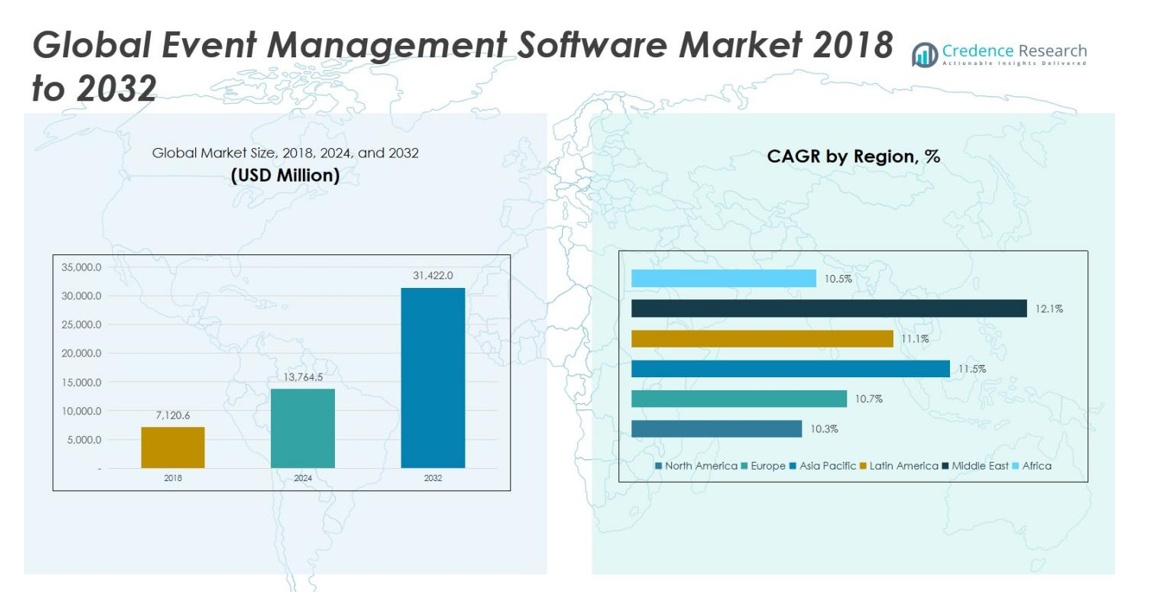
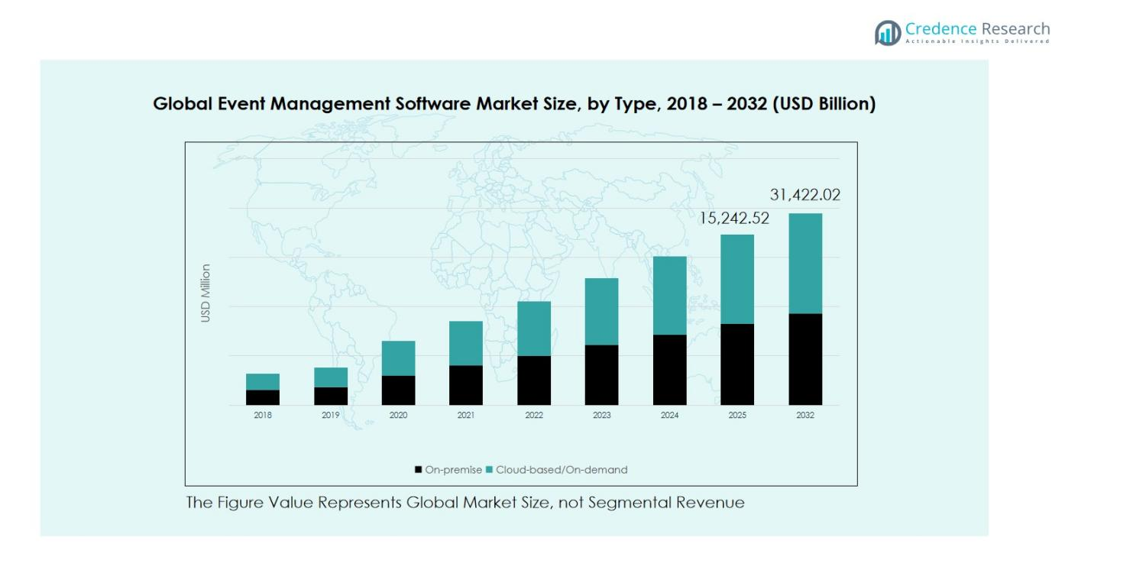
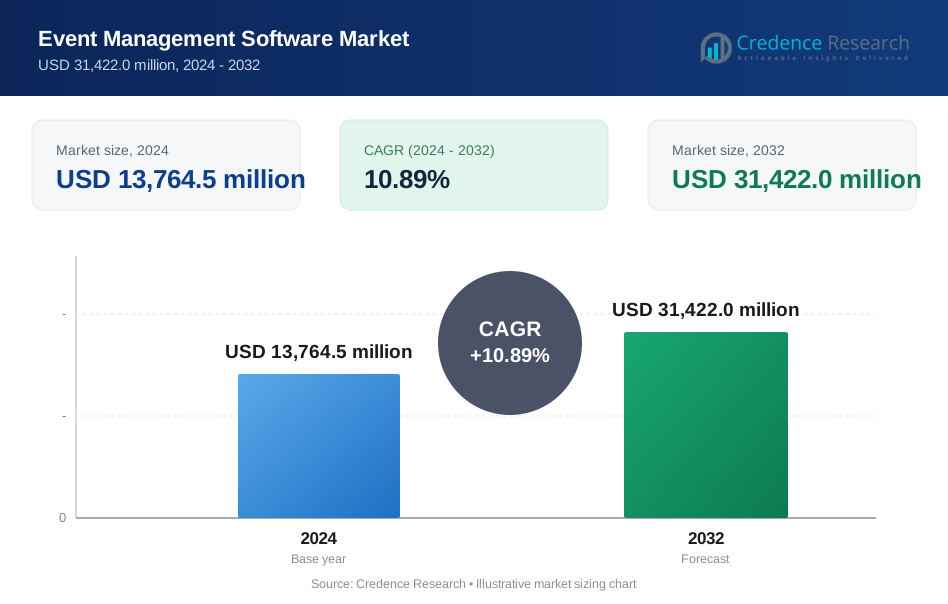
Event Management Software Market size was valued at USD 7,120.6 million in 2018, growing to USD 13,764.5 million in 2024, and is anticipated to reach USD 31,422.0 million by 2032, registering a CAGR of 10.89% during the forecast period.
| REPORT ATTRIBUTE | DETAILS |
|---|---|
| Historical Period | 2020-2023 |
| Base Year | 2024 |
| Forecast Period | 2025-2032 |
| Event Management Software Market Size 2024 | USD 13,764.5 million |
| Event Management Software Market, CAGR | 10.89% |
| Event Management Software Market Size 2032 | USD 31,422.0 million |
The Event Management Software Market is dominated by key players such as Active Network LLC, Eventbrite Inc., Cvent Inc., Social Tables, Eventzilla, Hopin, webMOBI, and Certain, Inc. These companies lead through continuous innovation, cloud-based solutions, AI integration, and mobile-friendly platforms, enabling organizers to efficiently manage virtual, hybrid, and in-person events. Strategic partnerships, product diversification, and expansion into emerging markets further strengthen their competitive positions. Regionally, North America leads the market with a 33.3% share in 2024, driven by high adoption of advanced technologies and a mature event industry, followed by Europe at 26.5% and Asia Pacific at 24.7%, where rapid digitalization and growing MICE activities are fueling growth. Collectively, these top players and leading regions shape the market’s dynamic landscape and drive global expansion in the event management software sector.
Market Insights
- The Event Management Software Market was valued at USD 13,764.5 million in 2024 and is projected to reach USD 31,422.0 million by 2032, growing at a CAGR of 10.89%.
- Growth is driven by rising demand for virtual and hybrid events, increasing adoption of AI and analytics, and expanding usage among SMEs seeking cost-effective, scalable solutions.
- Key trends include the shift toward mobile-compatible solutions, cloud-based platforms, and sustainability-focused features, while event registration and ticketing software holds the largest application share at 38% and cloud-based/on-demand leads type with 67% share.
- The market is highly competitive, dominated by players like Active Network LLC, Eventbrite Inc., Cvent Inc., and Hopin, focusing on innovation, partnerships, and regional expansion to maintain leadership.
- Regionally, North America leads with 33.3% share, followed by Europe at 26.5% and Asia Pacific at 24.7%, while Latin America, Middle East, and Africa collectively account for the remaining share, highlighting strong growth potential in emerging markets.
Market Segmentation Analysis:
By Type:
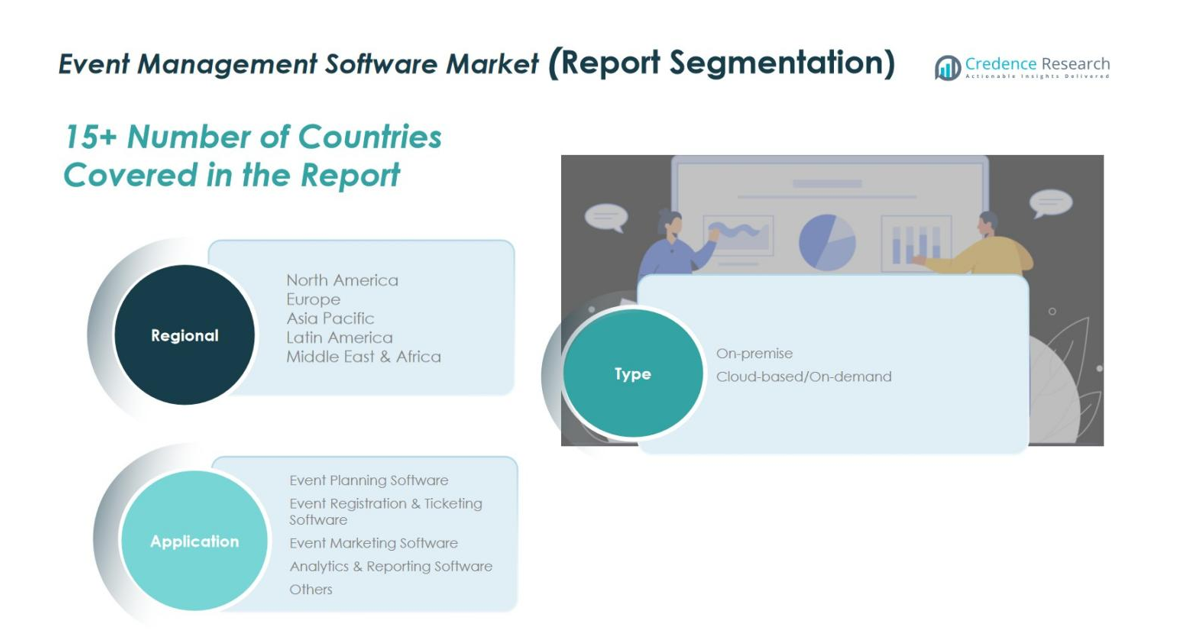
The cloud-based/on-demand segment dominates the Event Management Software Market, accounting for 67% of the total share in 2024. This dominance stems from its scalability, real-time data access, and cost-effectiveness compared to traditional on-premise models. The shift toward remote and hybrid event formats has further strengthened demand for cloud-based platforms, enabling seamless coordination and analytics across multiple locations. Meanwhile, the on-premise segment, with around 33% share, continues to attract enterprises prioritizing data security and customized software deployment within internal IT infrastructures.
- For instance, Bizzabo launched its Event Experience OS in 2022, enabling real-time analytics and automated workflows through cloud technology.
By Application:
The event registration and ticketing software segment leads the market, representing 38% of the total share in 2024. This segment’s growth is driven by the rise in online event registrations, contactless payments, and the adoption of integrated ticketing systems by organizers seeking improved attendee experiences. Event marketing software, holding approximately 24% share, is witnessing rapid expansion as companies leverage automated marketing tools and analytics to boost engagement. Event planning, analytics & reporting, and other software solutions collectively capture the remaining market share, reflecting growing demand for comprehensive, data-driven event management ecosystems.
- For instance, Ticketmaster’s integration of NFC and digital wallet payments has streamlined entry management, improving attendee convenience and security.
Key Growth Drivers
Rising Demand for Virtual and Hybrid Events
The growing preference for virtual and hybrid events has become a primary growth driver for the Event Management Software Market. Businesses and organizations increasingly rely on digital platforms to host global conferences, webinars, and trade shows, enabling broader audience reach and cost savings. Event management software solutions offering live streaming, audience analytics, and real-time engagement tools are gaining strong traction. This shift toward digital formats has encouraged continuous innovation in cloud-based event platforms and expanded the market’s adoption across industries.
- For instance, Hopin’s platform supported over 80,000 virtual events globally in 2022, offering integrated networking and analytics tools for real-time audience insights.
Integration of Artificial Intelligence and Analytics
Artificial intelligence (AI) and data analytics are transforming how event organizers plan, manage, and evaluate events. AI-powered tools enhance personalization, automate registration processes, and improve audience targeting. Predictive analytics helps optimize resource allocation and measure engagement more effectively. As companies increasingly seek data-driven insights to refine event strategies, the integration of AI and analytics into event management software has accelerated. This technology integration not only enhances operational efficiency but also delivers measurable ROI for event organizers.
Growing Adoption by Small and Medium Enterprises (SMEs)
The rapid adoption of event management software by SMEs is driving significant market expansion. Affordable subscription-based cloud models have made these tools accessible to small businesses looking to organize professional events with minimal resources. SMEs benefit from features such as online registration, automated email campaigns, and real-time feedback analytics. This democratization of event technology allows smaller organizations to compete with larger players by enhancing attendee engagement and improving operational efficiency, thus boosting market growth.
- For instance, Hopin (now RingCentral Events) positions its platform as an all-in-one, no-code solution with built-in ticketing, networking, chat, and analytics so organizers can assemble virtual/hybrid events quickly without large technical teams.
Key Trends & Opportunities
Shift Toward Mobile Event Management Solutions
Mobile-first solutions are reshaping the event management landscape, offering flexibility and convenience to organizers and attendees. Mobile apps streamline check-ins, enable instant notifications, and support interactive features like polling and Q&A sessions. With the increasing penetration of smartphones and 5G connectivity, event planners are prioritizing mobile compatibility in their digital ecosystems. This trend creates strong opportunities for developers to integrate cross-platform functionality and enhance user experiences through seamless mobile engagement.
- For instance, Cvent's mobile event app facilitates seamless attendee check-in, real-time push notifications, and interactive Q&A sessions, ensuring a smooth and engaging event experience.
Sustainability and Green Event Practices
Sustainability has emerged as a key opportunity within the Event Management Software Market. Organizers are adopting digital tools to minimize paper usage, track carbon emissions, and manage waste during events. Software solutions that promote eco-friendly practices—such as virtual ticketing and digital agendas—are increasingly favored by corporations committed to environmental goals. As the focus on ESG (Environmental, Social, and Governance) initiatives strengthens, the demand for sustainable event management software continues to rise across global markets.
- For instance, Sweap, a software platform specializing in sustainable event management, enables organizers to manage digital invitations and guest lists, significantly reducing paper waste.
Key Challenges
Data Security and Privacy Concerns
Data protection remains a significant challenge for the Event Management Software Market. These platforms handle sensitive attendee information, including personal details and payment data, which makes them vulnerable to cyberattacks and breaches. Compliance with global data protection regulations such as GDPR and CCPA adds further complexity. Companies must invest in robust encryption, authentication, and access control measures to ensure data integrity and build trust among users while maintaining regulatory compliance across diverse regions.
Integration Complexity with Legacy Systems
Integrating event management software with existing enterprise systems poses ongoing difficulties for many organizations. Legacy infrastructures often lack compatibility with modern cloud-based or AI-driven platforms, leading to workflow disruptions and data silos. Custom integration requires significant technical expertise and financial investment, deterring adoption among traditional enterprises. As a result, vendors are focusing on providing API-based and modular solutions to simplify integration and enhance interoperability across different software ecosystems.
Regional Analysis
North America
North America holds the dominant position in the Event Management Software Market, accounting for 33.3% of the global share in 2024. The regional market expanded from USD 2,437.38 million in 2018 to USD 4,580.06 million in 2024, and it is projected to reach USD 10,055.05 million by 2032, registering a CAGR of 10.3%. Growth is driven by the widespread adoption of cloud-based platforms, a mature event industry, and the presence of leading software providers in the United States. The region’s focus on advanced analytics and virtual event technologies further strengthens its leadership position.
Europe
Europe represents a significant share of the Event Management Software Market, holding 26.5% of the global share in 2024. The market increased from USD 1,903.33 million in 2018 to USD 3,642.10 million in 2024, and is expected to reach USD 8,201.15 million by 2032, at a CAGR of 10.7%. The region benefits from the rapid digitalization of corporate events and the growing emphasis on sustainability in event operations. Demand for automated registration and AI-driven attendee engagement tools continues to rise, particularly across Germany, the UK, and France.
Asia Pacific
Asia Pacific is emerging as the fastest-growing regional market, capturing 24.7% of the global share in 2024. Valued at USD 1,701.11 million in 2018, the market reached USD 3,406.33 million in 2024 and is forecasted to attain USD 8,135.16 million by 2032, expanding at a CAGR of 11.5%. The region’s growth is driven by increasing internet penetration, a booming MICE (Meetings, Incentives, Conferences, and Exhibitions) industry, and strong investments in digital event infrastructure. Countries such as China, India, and Japan are leading the shift toward virtual and hybrid event solutions.
Latin America
Latin America accounts for 8.9% of the global share in 2024, showcasing steady growth across major economies. The market advanced from USD 633.73 million in 2018 to USD 1,236.84 million in 2024, and it is anticipated to reach USD 2,859.40 million by 2032, reflecting a CAGR of 11.1%. The rise of corporate events, entertainment festivals, and educational conferences has spurred adoption of cloud-based event management platforms. Brazil and Mexico are the key contributors, with increasing focus on mobile ticketing, online engagement tools, and localized event marketing technologies.
Middle East
The Middle East represents a smaller yet rapidly expanding market, holding 4.7% of the global share in 2024. The regional market grew from USD 309.03 million in 2018 to USD 642.21 million in 2024, and is projected to reach USD 1,602.52 million by 2032, achieving the highest CAGR of 12.1%. Growth is supported by government investments in tourism, entertainment, and smart city initiatives, particularly in the UAE and Saudi Arabia. The increasing number of international trade fairs and exhibitions is also fueling the demand for efficient digital event management systems.
Africa
Africa contributes 1.9% of the global share in 2024, showing promising growth potential. The market rose from USD 136.00 million in 2018 to USD 257.00 million in 2024, and it is expected to reach USD 568.74 million by 2032, at a CAGR of 10.5%. Expanding internet connectivity and the growing adoption of digital tools in business conferences and educational events are driving market development. South Africa leads the regional landscape, followed by Egypt, where increasing investments in technology infrastructure are fostering broader software adoption for event management.
Market Segmentations:
By Type:
- On-premise
- Cloud-based / On-demand
By Application:
- Event Planning Software
- Event Registration & Ticketing Software
- Event Marketing Software
- Analytics & Reporting Software
- Others
By Region
- North America
- U.S.
- Canada
- Mexico
- Europe
- Germany
- France
- U.K.
- Italy
- Spain
- Rest of Europe
- Asia Pacific
- China
- Japan
- India
- South Korea
- South-east Asia
- Rest of Asia Pacific
- Latin America
- Brazil
- Argentina
- Rest of Latin America
- Middle East & Africa
- GCC Countries
- South Africa
- Rest of the Middle East and Africa
Competitive Landscape
The competitive landscape of the Event Management Software Market is led by key players including Active Network LLC, Eventbrite Inc., Cvent Inc., Social Tables, Eventzilla, Hopin, webMOBI, and Certain, Inc. These companies dominate through product innovation, strategic partnerships, and expansion into emerging markets. Vendors are increasingly focusing on cloud-based solutions, AI integration, and mobile-compatible platforms to enhance user experience and streamline event operations. Competition is also driven by pricing strategies, customization options, and comprehensive service portfolios, enabling companies to address diverse client requirements. Startups and regional players are leveraging niche offerings, such as specialized analytics, hybrid event support, and localized marketing tools, intensifying market rivalry. Continuous technological advancements, coupled with rising adoption of virtual and hybrid events globally, compel established vendors to innovate rapidly. Overall, the market remains highly dynamic, with players investing heavily in R&D, strategic acquisitions, and collaborative solutions to maintain leadership and capture new growth opportunities.
Key Player Analysis
- Active Network LLC
- Eventbrite Inc.
- Xing Events / Cvent Inc.
- Social Tables
- Eventzilla
- Hopin
- webMOBI
- Certain, Inc.
- Other Key Players
Recent Developments
- In 2024, Zoom partnered with Swoogo to integrate Zoom Events' virtual platform with Swoogo’s in-person event management technology, streamlining hybrid events and enhancing engagement.
- In October 2025, ASB GlassFloor launched AES to globally expand its LED sports floors, with 30 million Euro in equity funding secured to accelerate its global growth.
- In July 2025, Wowza acquired AVA Intellect to accelerate its AI-driven video platform strategy.
- In January 2024, MasterControl launched advanced quality event management software offering customizable processes and enhanced data capture for professional events.
Report Coverage
The research report offers an in-depth analysis based on Type, Application and Region. It details leading market players, providing an overview of their business, product offerings, investments, revenue streams, and key applications. Additionally, the report includes insights into the competitive environment, SWOT analysis, current market trends, as well as the primary drivers and constraints. Furthermore, it discusses various factors that have driven market expansion in recent years. The report also explores market dynamics, regulatory scenarios, and technological advancements that are shaping the industry. It assesses the impact of external factors and global economic changes on market growth. Lastly, it provides strategic recommendations for new entrants and established companies to navigate the complexities of the market.
Future Outlook
- The Event Management Software Market is expected to continue strong growth driven by the adoption of cloud-based solutions.
- Increasing demand for virtual and hybrid events will create new opportunities for advanced event management platforms.
- Integration of artificial intelligence and analytics will enhance personalized experiences and improve operational efficiency.
- Mobile-compatible solutions will gain prominence as organizers and attendees seek seamless on-the-go access.
- Small and medium enterprises will increasingly adopt software to streamline event planning and reduce costs.
- Sustainability-focused features will become more important as organizations prioritize eco-friendly event management practices.
- Expansion into emerging markets in Asia Pacific, the Middle East, and Africa will drive regional growth.
- Enhanced cybersecurity measures will be critical to ensure data protection and regulatory compliance.
- Collaboration tools and real-time engagement features will shape software development trends.
- Continuous innovation and strategic partnerships will define competitive positioning in the market.
Request a Free Sample
Fill in your details and we'll send you a free sample report.
- Sample data tables & charts
- Research methodology
Need a Custom Version of This Report?
Tailor the scope, geography, or segments to your exact requirements.
- Custom geography or segment scope
- Direct access to our analyst team
Frequently Asked Questions
What is the current market size for Event Management Software Market, and what is its projected size in 2032?
At what Compound Annual Growth Rate is the Event Management Software Market projected to grow between 2025 and 2032?
Who are the major players in this market?
Which Event Management Software Market segment held the largest share in 2024?
What are the primary factors fueling the growth of the Event Management Software Market?
Who are the leading companies in the Event Management Software Market?
Table of Content
Chapter 1. Report Introduction
- 1.1 Report Description & Purpose
- 1.1.1 Report Title & Market Definition
- 1.1.2 Unique Selling Propositions (USP) & Key Differentiators
- 1.1.3 Value Proposition for Stakeholders
- 1.2 Research Objectives
- 1.2.1 Market Sizing Objectives (Volume & Revenue)
- 1.2.2 Segmentation Objectives
- 1.2.3 Competitive Intelligence Objectives
- 1.2.4 Forecast & Scenario Objectives
- 1.3 Report Scope
- 1.3.1 Event Management Software Scope – Types & Subtypes Covered
- 1.3.2 Geographic Scope – Regions & Countries Covered
- 1.3.3 Historical Period, Base Year & Forecast Period (2024; forecast to 2032)
- 1.3.4 Inclusions & Exclusions
- 1.4 HS Code & Classification Framework
- 1.5 Currency, Units & Pricing Basis
- 1.6 Target Stakeholders
- 1.7 Limitations & Assumptions
Chapter 2. Executive Summary
- 2.1 Global Event Management Software Market Snapshot
- 2.1.1 Market Size – Historical (2024) & Forecast (2024-2032) (2024: USD 13,764.5 million → 2032: USD 31,422.0 million)
- 2.1.2 Volume & Revenue – Global Totals
- 2.1.3 Key Market Highlights – Top Five Facts
- 2.2 Event Management Software Market Segmentation Snapshot
- 2.2.1 Market Split by Region – 2024 vs. 2032
- 2.3 Competitive Snapshot
- 2.3.1 Top 10 Players by Revenue Share – 2024
- 2.3.2 Top 10 Players by Volume Share – 2024
- 2.3.3 Recent Strategic Developments (18-Month Summary)
- 2.4 Key Investment Highlights & Strategic Conclusions
Chapter 3. Event Management Software Market Dynamics & Industry Analysis
- 3.1 Market Overview & Context
- 3.1.1 Event Management Software Market Position in the Broader Automotive Value Chain
- 3.1.2 OEM vs. Replacement Market Dynamics
- 3.1.3 Market Maturity & Development Stage by Region
- 3.2 Event Management Software Market Drivers
- 3.3 Event Management Software Market Restraints & Challenges
- 3.4 Event Management Software Market Opportunities
- 3.5 Porter's Five Forces Analysis
- 3.5.1 Threat of New Entrants
- 3.5.2 Bargaining Power of Suppliers
- 3.5.3 Bargaining Power of Buyers
- 3.5.4 Threat of Substitutes
- 3.5.5 Competitive Rivalry – Intensity Assessment
- 3.6 Event Management Software Value Chain Analysis
- 3.6.1 Upstream – Raw Material/Input Suppliers
- 3.6.1.1 Raw Material/Input 1
- 3.6.1.2 Raw Material/Input 2
- 3.6.1.3 Raw Material/Input 3
- 3.6.2 Midstream – Production/Manufacturing/Service Delivery
- 3.6.2.1 Production/Process Overview
- 3.6.2.2 Key Facility Locations & Capacity by Manufacturer
- 3.6.3 Downstream – Distribution & End Consumer
- 3.6.3.1 Primary Channel – B2B/OEM
- 3.6.3.2 Secondary Channels – Dealer, Retail, Online, Direct
- 3.6.4 Value Chain Profitability Analysis
- 3.6.1 Upstream – Raw Material/Input Suppliers
- 3.7 PESTEL Analysis
- 3.7.1 Political Factors
- 3.7.2 Economic Factors
- 3.7.3 Social Factors
- 3.7.4 Technological Factors
- 3.7.5 Environmental Factors
- 3.7.6 Legal Factors
- 3.8 Event Management Software Supply Chain Analysis
- 3.8.1 Raw Material/Input Supply Risk Assessment
- 3.8.2 Manufacturing Concentration Risk (Geographic Exposure)
- 3.8.3 Trade Disruption Impact Analysis
- 3.9 Regulatory & Policy Landscape
Note: The regulatory and policy landscape section covers regulations based on their applicability to the market, Event Management Software category, geography, and scope of the study. Only regulatory frameworks with a material impact on operations, compliance, trade, sustainability, or market access are analyzed in detail.
Chapter 4. Key Investment Pockets & Opportunity Analysis
- 4.1 Event Management Software Market Attractiveness Analysis
- 4.1.1 By Region – Investment Attractiveness Matrix (Volume × CAGR)
- 4.2 Absolute Revenue Growth Opportunity
- 4.2.1 By Region – Absolute USD Growth Through 2032
- 4.3 Incremental Volume Opportunity
- 4.3.1 By Region – Incremental Volume Through 2032
- 4.3.2 Segment – Incremental Volume
- 4.4 Emerging Submarket Opportunity Deep Dive (Subject to Applicability)
- 4.5 Emerging Market Opportunity Scorecards
- 4.5.1 United States
- 4.5.2 Europe
- 4.5.3 Asia
- 4.5.4 Middle East & Africa
Note: Emerging Market Opportunity Scorecards will be included based on relevance and strategic importance. Regions listed are indicative and may vary depending on data availability and market dynamics.
Chapter 5. Event Management Software Import-Export Analysis & Trade Flows
- 5.1 Global Trade Overview
- 5.1.1 Global Export Value by Country (2024)
- 5.1.2 Global Export Volume by Country (2024)
- 5.1.3 Global Import Value by Country (2024)
- 5.1.4 Global Import Volume by Country (2024)
- 5.1.5 Net Trade Balance by Country (2024)
- 5.2 Export Analysis – Segment
- 5.2.1 Type 1 (HS Code)
- 5.2.2 Type 2 (HS Code)
- 5.2.3 Type 3 (HS Code)
- 5.2.4 Type 4 (HS Code)
- 5.2.5 Type 5 (HS Code)
- 5.3 Import Analysis – Segment
- 5.3.1 Type 1 (HS Code)
- 5.3.2 Type 2 (HS Code)
- 5.3.3 Type 3 (HS Code)
- 5.3.4 Type 4 (HS Code)
- 5.3.5 Type 5 (HS Code)
- 5.4 Average Unit Trade Prices
- 5.4.1 Average Export Price – Segment & Country
- 5.4.2 Average Import Price – Segment & Source Country
- 5.4.3 Price Trends (2024)
- 5.5 Key Trade Route Analysis
- 5.5.1 Trade Route 1
- 5.5.2 Trade Route 2
- 5.5.3 Trade Route 3
- 5.5.4 Trade Route 4
- 5.5.5 Trade Route 5
- 5.6 Trade Policy Impact Assessment
- 5.6.1 US Anti-Dumping & Section 301 Tariffs
- 5.6.2 EU Customs Union Impact
- 5.6.3 Major Free Trade Agreements
- 5.6.4 USMCA Rules of Origin
Note: Trade policy analysis will be included only where relevant to the Event Management Software market.
Chapter 6. Competitive Landscape & Company Benchmarking
- 6.1 Event Management Software Market Concentration & Structure
- 6.1.1 Herfindahl-Hirschman Index (HHI) – vs. 2024
- 6.1.2 Tier 1, Tier 2 & Tier 3 Market Structure
- 6.1.3 Global, Regional & Local Player Dynamics
- 6.2 Event Management Software Market Share Analysis – 2024
- 6.2.1 Global Revenue Share by Company
- 6.2.2 Global Volume Share by Company
- 6.2.3 Regional Revenue Share
- 6.2.4 Market Share Evolution ( vs. 2024)
- 6.2.5 OEM Segment Share by Company
- 6.2.6 Replacement Segment Share by Company
- 6.3 Production/Delivery Capacity & Facility Analysis
- 6.3.1 Global Installed Capacity
- 6.3.2 Capacity Utilization Rates
- 6.3.3 Production/Output Volume
- 6.3.4 Facility Locations & Capacity Map
- 6.3.5 Planned Capacity Additions
- 6.4 Event Management Software Competitive Benchmarking Matrix
- 6.4.1 Revenue, Volume, CAGR & Profitability Comparison
- 6.4.2 Channel Revenue Mix
- 6.4.3 Geographic Revenue Exposure
- 6.4.4 R&D Intensity
- 6.4.5 Sustainability Maturity
- 6.5 Strategic Developments in Event Management Software (Last 24 Months)
- 6.5.1 Mergers, Acquisitions & Divestments
- 6.5.2 New Event Management Software Launches
- 6.5.3 Facility Expansions
- 6.5.4 Strategic Alliances, Joint Ventures & Partnerships
- 6.5.5 Distribution Expansion & Market Entry
- 6.5.6 Sustainability & ESG Initiatives
- 6.6 Competitive Strategy Mapping
- 6.6.1 Leader, Challenger, Follower & Niche Classification
- 6.6.2 Pricing Strategy Comparison
- 6.6.3 Channel Strategy Matrix
Note: Strategic developments are included based on their materiality and the availability of reliable information.
Chapter 7. Global Event Management Software Market – By Distribution Channel
- 7.1 Segment Overview
- 7.1.1 Volume & Revenue Split by Channel (2024 & 2032)
- 7.1.2 Channel Mix Evolution (2024-2032)
Chapter 8. Regional Market Analysis – Global Overview
- 8.1 Global Regional Overview
- 8.1.1 Regional Volume Share
- 8.1.2 Regional Revenue Share
- 8.1.3 Regional Volume by Region
- 8.1.4 Regional Revenue by Region
- 8.1.5 Regional Forecast Through 2032
- 8.2 Cross-Regional Segment Analysis
- 8.2.1 By Distribution Channel
- 8.2.2 By Brand/Price Tier
Chapter 9. North America Event Management Software Market
- 9.1 United States
- 9.2 Canada
- 9.3 Mexico
Chapter 10. Europe Event Management Software Market
- 10.1 Germany
- 10.2 France
- 10.3 Italy
- 10.4 United Kingdom
- 10.5 Spain
- 10.6 Poland
- 10.7 Russia
- 10.8 Netherlands
- 10.9 Belgium
- 10.10 Sweden
- 10.11 Denmark
- 10.12 Norway
- 10.13 Rest of Europe
Chapter 11. Asia Pacific Event Management Software Market
- 11.1 China
- 11.2 India
- 11.3 Japan
- 11.4 South Korea
- 11.5 Thailand
- 11.6 Indonesia
- 11.7 Vietnam
- 11.8 Malaysia
- 11.9 Australia
- 11.10 Rest of Asia Pacific
Chapter 12. Latin America Event Management Software Market
- 12.1 Brazil
- 12.2 Argentina
- 12.3 Colombia
- 12.4 Chile
- 12.5 Rest of Latin America
Chapter 13. Middle East Event Management Software Market
- 13.1 Saudi Arabia
- 13.2 United Arab Emirates
- 13.3 Turkey
- 13.4 Israel
- 13.5 Iran
- 13.6 Rest of the Middle East
Chapter 14. Africa Event Management Software Market
- 14.1 South Africa
- 14.2 Egypt
- 14.3 Nigeria
- 14.4 Morocco
- 14.5 Rest of Africa
Chapter 15. Event Management Software Company Profiles
- 15.1 [Company 01]
- 15.1.1 Company Overview
- 15.1.2 Key Management Personnel
- 15.1.3 Products & Services Portfolio
- 15.1.4 Financial Performance
- 15.1.5 Key Market Focus & Geographic Presence
- 15.1.6 Recent Developments & Strategic Initiatives
Note: The company profile list is preliminary and may change based on research findings, market developments, data availability, and client requirements.
Chapter 16. Appendices
- Appendix A – List of Abbreviations & Acronyms
- Appendix B – Industry Classification Code Reference – Full Series
- Appendix C – Production & Capacity Data Tables
- Appendix D – End-Use & Demand Base Tables
- Appendix E – Consumption & Replacement Rate Assumptions
- Appendix F – ASP Reference Tables
- Appendix G – Manufacturing & Facility Database
- Appendix H – Import-Export Data Tables
- Appendix I – Regulatory Summary Tables
- Appendix J – Primary Research Participant List (Anonymized)
- Appendix K – Primary Research Questionnaire Framework
- Appendix L – Data Sources & Bibliography
- Appendix M – Market Size Divergence & Source Comparison
Chapter 17. Research Methodology
- 17.1 Research Framework & Philosophy
- 17.2 Secondary Research – Sources, Hierarchy & Data Extraction
- 17.3 Data Modeling – Bottom-Up & Top-Down Market Sizing
- 17.4 Primary Research – Stakeholder Framework, LOI & Sample Sizes
- 17.5 Forecast Methodology – Regression, Scenario & Sensitivity Analysis
- 17.6 Quality Control – Four-Layer Validation Framework
- 17.7 Limitations & Standard Assumptions
- 17.8 Disclaimer
