
Market overview
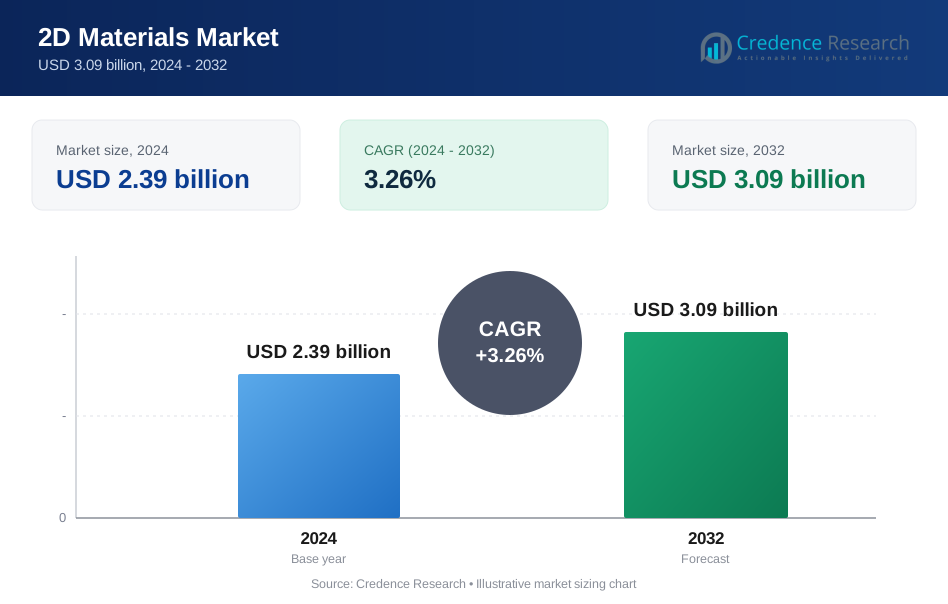
2d Materials Market size was valued USD 2.39 billion in 2024 and is anticipated to reach USD 3.09 billion by 2032, at a CAGR of 3.26% during the forecast period.| REPORT ATTRIBUTE | DETAILS |
|---|---|
| Historical Period | 2020-2023 |
| Base Year | 2024 |
| Forecast Period | 2025-2032 |
| 2D Materials Market Size 2024 | USD 2.39 billion |
| 2D Materials Market, CAGR | 3.26% |
| 2D Materials MarketSize 2032 | USD 3.09 billion |
Market Insights
- The 2D Materials Market reached USD 2.39 billion in 2024 and is projected to hit USD 3.09 billion by 2032, reflecting a steady CAGR of 3.26% throughout the forecast period.
- Market growth accelerates as industries adopt advanced graphene and TMD-based solutions, supported by improved material purity, scalable synthesis methods, and rising demand from electronics, composites, and energy storage applications.
- Strong trends emerge in semiconductor integration, flexible electronics, and high-performance batteries, with companies prioritizing proprietary exfoliation technologies and high-conductivity material grades.
- Competitive intensity rises as global players expand R&D capabilities, invest in pilot-scale manufacturing, and form research partnerships, while market restraints stem from production complexity, high processing costs, and challenges in achieving consistent large-area material quality.
- North America leads the market with 38% regional share, followed by Asia-Pacific as the fastest-growing region, while graphene remains the dominant segment with over 45% share, driven by broad commercial scalability and expanding industrial applicability.
Key Growth Drivers
Rising Demand for High-Performance and Lightweight Materials
The 2D materials market expands rapidly as industries adopt lightweight, durable, and high-strength materials to enhance product performance across construction, electronics, energy, and automotive applications. Graphene, MXenes, and other 2D nanomaterials support superior tensile strength, conductivity, and corrosion resistance, enabling next-generation structural components and protective coatings. Manufacturers increasingly rely on these materials to reduce weight, improve energy efficiency, and extend operational life cycles. This demand accelerates commercialization efforts, broadens industrial usage, and strengthens investment in advanced material engineering and high-performance nanocomposite solutions.- For instance, ACS Material, LLC sells single-layer CVD graphene films and emphasizes performance scalability for industrial use. The films reliably deliver an optical transmittance of approximately 95% to 97%, which is standard for high-quality monolayer graphene.
Expansion of Smart Building and Energy-Efficient Construction
Growing emphasis on sustainable and energy-efficient buildings drives the adoption of 2D materials in insulation systems, thermal regulation layers, infrared-reflective coatings, and moisture-barrier membranes. Their ability to enhance structural resilience while reducing energy loss positions them as essential components in modern construction technologies. Governments support these innovations through green-building mandates and carbon-reduction policies that encourage integration of advanced materials. The trend significantly boosts demand for graphene-based coatings, MXene thermal films, and 2D-embedded composites used in facades, wall panels, roofing, and insulation systems across commercial and residential projects.- For instance, Sixth Element has published detailed specifications for its “Electrical Conduction Type Graphene” powders (types SE1231, SE1232, SE1233-S, SE1233-L, SE1234). These powders are described with specific metrics such as: tap density less than 0.1 g/cm³, BET specific surface area ranging from 180 to 900 m²/g depending on grade, and D₅₀ median particle sizes of up to 50 µm for SE1233-L.
Advancements in Scalable Production and Material Functionalization
Continued progress in large-area synthesis, liquid exfoliation, chemical vapor deposition, and functionalization techniques supports broader industrial uptake of 2D materials. Manufacturers now achieve better layer uniformity, higher purity levels, and improved integration with polymers, metals, and cement-based systems. These advancements reduce production costs and make 2D materials more accessible for high-volume applications in construction, electronics, and industrial manufacturing. Expanded R&D investment, coupled with commercialization of pilot-scale manufacturing systems, strengthens market scalability and encourages development of multi-functional 2D composites tailored for end-use performance requirements.Key Trends & Opportunities
Growing Use of 2D Nanomaterials in Structural Reinforcement
A major trend involves using graphene and related 2D additives in concrete, steel, and polymer composites to significantly enhance compressive strength, crack resistance, and durability. Construction companies integrate small quantities of 2D materials to achieve notable improvements in structural performance, creating opportunities for high-strength, low-weight building components. This trend aligns with increasing demand for resilient infrastructure capable of withstanding climate stress, heavy load cycles, and long-term wear. New application areas such as prefabricated building modules and advanced façade systems further expand opportunities for structural-grade 2D composites.- For instance, Thomas Swan’s Elicarb® Graphene Materials Grade Powder (PR0953) features a typical lateral flake size of ~5 µm, a sheet resistance of 15-25 Ω/□ when cast as a 35 mm-diameter film (30 mg graphene powder) and a sp² carbon content of ~98 % by weight.
Rising Adoption of 2D Coatings for Surface Protection
The market sees substantial opportunity in ultra-thin protective coatings made from graphene, hexagonal boron nitride, and other 2D materials. Their exceptional barrier properties against moisture, chemicals, abrasion, and UV degradation make them valuable for flooring, wall panels, roofing, and industrial equipment. These coatings extend the lifespan of building materials while reducing maintenance costs, appealing to both commercial and infrastructure developers. Growing interest in antimicrobial, self-cleaning, and thermal-responsive coatings broadens prospective applications and encourages investment in targeted formulations for specific end-use environments.- For instance, Aerogel Technologies’ Airloy® composite panels offer both structural and insulating performance in one component. Airloy X103 material with a density of 0.20 g/cm³ can support compressive loads up to 2 MPa and maintains a low thermal conductivity of 26-29 mW/m·K.
Integration of 2D Materials in Smart and Sustainable Infrastructure
As infrastructure modernization accelerates, 2D materials gain attention for their applicability in sensors, conductive pathways, energy-harvesting layers, and structural health-monitoring systems. Their unique electrical and mechanical characteristics enable smart bridges, buildings, and roadways that continuously monitor stress levels, temperature variations, and material degradation. Opportunities strengthen as governments prioritize resilient, digitalized infrastructure. Additionally, 2D materials support integration of renewable-energy components such as thin-film photovoltaics and thermal-management solutions, positioning them as core enablers of next-generation, sustainable infrastructure planning.Key Challenges
High Production Costs and Limited Large-Scale Commercialization
Despite strong potential, many 2D materials face high production costs due to complex synthesis processes, stringent purity requirements, and limited availability of industrial-scale manufacturing facilities. Achieving consistent layer quality and defect control remains technically challenging, restricting widespread market adoption. Manufacturers must invest heavily in R&D and scaling technologies, slowing commercialization for cost-sensitive construction and industrial applications. These limitations hinder price competitiveness compared to conventional materials, reducing adoption in large-volume segments such as concrete reinforcement and building composites.Regulatory Uncertainty and Environmental Safety Concerns
The market encounters challenges related to evolving regulatory frameworks and limited long-term environmental safety data for various 2D nanomaterials. Concerns regarding toxicity, occupational exposure, waste disposal, and environmental persistence necessitate extensive testing and compliance with emerging global standards. These regulatory gaps create uncertainty for manufacturers and delay product approvals, particularly in construction and industrial applications where safety validation is critical. Addressing these concerns requires coordinated initiatives focused on lifecycle assessment, standardized testing protocols, and transparent safety guidelines for responsible commercialization.Regional Analysis
North America
North America holds approximately 32% market share in the 2D materials market, supported by strong adoption of graphene-based composites, advanced coatings, and high-performance nanomaterials across construction, aerospace, and industrial sectors. The region benefits from robust R&D ecosystems, extensive government funding, and early commercialization of 2D-enabled structural materials and insulation technologies. Construction firms increasingly integrate MXene-enhanced coatings, graphene cement additives, and nano-barrier layers in high-efficiency building projects. Rising sustainability mandates, durable material requirements, and smart building initiatives further accelerate demand, while leading universities and startups continue driving technological advancements and scalable production methods.Europe
Europe captures nearly 28% of the global market, driven by strong sustainability frameworks, strict building regulations, and rapid integration of energy-efficient materials in residential and commercial construction. The region sees widespread adoption of graphene-reinforced concrete, ultra-thin barrier coatings, and advanced insulation films due to growing environmental compliance pressures. Countries such as Germany, the U.K., and France lead in large-scale R&D programs focused on functional 2D composites and eco-friendly building materials. Expansion of smart infrastructure, combined with increasing public investments in green construction technologies, strengthens Europe’s position as a major hub for 2D material innovation and deployment.Asia-Pacific
Asia-Pacific dominates the 2D materials market with approximately 38% share, supported by extensive construction activity, rapid urbanization, and strong government-backed nanotechnology programs. China, South Korea, and Japan lead in large-scale production of graphene, hBN, and MXenes, enabling cost advantages and broader industrial adoption. Construction companies increasingly deploy 2D-reinforced concrete, thermal conductive films, and nanocoatings to enhance structural resilience and longevity. Expanding smart city projects and infrastructure modernization efforts amplify demand across commercial, residential, and industrial applications. The region’s vast manufacturing base and accelerating R&D commercialization further solidify its leadership.Latin America
Latin America accounts for nearly 7% market share, with adoption of 2D materials gradually increasing across infrastructure upgrades, commercial construction, and industrial applications. Countries such as Brazil, Mexico, and Chile integrate graphene-enhanced cement additives, protective coatings, and thermal regulation films in new building designs to improve durability and structure life span. The region benefits from growing foreign investments, government-backed modernization programs, and rising demand for cost-effective high-performance materials. Although production capabilities remain limited, partnerships with global suppliers and expanding pilot projects in sustainable construction are enhancing regional market penetration.Middle East & Africa
The Middle East & Africa region holds around 5% of the market, influenced by growing interest in high-performance materials for large-scale infrastructure, smart city initiatives, and extreme-environment construction needs. Developers increasingly adopt 2D-based thermal barriers, anti-corrosion coatings, and lightweight reinforcement materials to address high temperatures and long-term structural stress. Countries such as the UAE, Saudi Arabia, and South Africa explore applications of graphene-enhanced concretes and coatings to improve resilience and reduce maintenance costs. While adoption is emerging, ongoing mega-projects and technology partnerships create strong opportunities for wider deployment of 2D materials.Competitive Landscape
The 2D materials market features a competitive landscape shaped by leading innovators, including XG Sciences, Inc., Graphenea S.A., Alcoa Inc., Versarien plc, ACS Material, LLC, NanoXplore Inc., 2D Semiconductors Inc., Sixth Element Materials Technology Co., Ltd., Thomas Swan & Co. Ltd., and 2D Layer Materials Pte. Ltd. The 2D materials market is defined by rapid technological advancement, strong research collaboration, and increasing commercialization across construction, electronics, industrial manufacturing, and energy applications. Companies focus on scaling high-quality graphene, MXenes, and hBN production while improving cost efficiency, material uniformity, and functionalization capabilities. The market remains innovation-driven, with significant investment in chemical vapor deposition, liquid-phase exfoliation, and hybrid composite development to meet performance requirements such as enhanced strength, conductivity, and corrosion resistance. Partnerships with universities, government research programs, and industry end users accelerate product validation and support broader adoption. As demand grows for lightweight, durable, and energy-efficient materials, competition intensifies around proprietary processing technologies, application-specific product lines, and global expansion strategies to serve emerging and advanced markets.Key Player Analysis
- XG Sciences, Inc.
- Graphenea S.A.
- Alcoa Inc.
- Versarien plc
- ACS Material, LLC
- NanoXplore Inc.
- 2D Semiconductors Inc.
- Sixth Element Materials Technology Co., Ltd.
- Thomas Swan & Co. Ltd.
- 2D Layer Materials Pte. Ltd.
Recent Developments
- In June 2025, Pennsylvania State University scientists constructed the first CMOS-based computer made completely of two-dimensional materials, and not silicon. This breakthrough demonstrated the promise of nanoscale materials to overcome traditional semiconductors, a key advance toward smaller, faster, and more energy-efficient electronic devices in the technological applications of the future.
- In November 2024, the 2D-Pilot Line (2D-PL), a new European Commission-funded project, was launched to build upon the earlier 2D-EPL program. The 2D-PL project aims to mature and integrate 2D materials like graphene and transition metal dichalcogenides (TMDCs) into semiconductor devices for photonics and electronics, thereby creating a robust European ecosystem for this technology.
- In November 2024, BASF inaugurated a new production line in Heerenveen, the Netherlands. This expansion underscores BASF's dedication to bolstering its manufacturing capabilities in the region. It aligns with the company's strategy to address the surging demand for innovative and sustainable solutions.
- In August 2024, Alcoa Corporation acquired Alumina Limited. With the acquisition, Alcoa now fully owns the Alcoa World Alumina and Chemicals (AWAC) joint venture, previously held at a 60% stake, which includes several bauxite mines and alumina refineries across key regions such as Australia, Brazil, and Guinea
Future Outlook
- The market will expand as construction, electronics, and energy sectors increase adoption of high-performance graphene, MXenes, and related 2D materials.
- Advancements in scalable synthesis and cost-efficient production will accelerate commercialization across large-volume applications.
- Demand for durable, lightweight composites will rise as smart building and infrastructure projects integrate 2D-enhanced structural materials.
- Protective coatings using 2D nanomaterials will gain traction due to superior barrier, thermal, and anti-corrosion properties.
- Integration of 2D materials in sensors and monitoring systems will strengthen as smart infrastructure initiatives accelerate.
- Regulatory clarity and standardized safety assessments will improve global market confidence and adoption.
- Industrial users will increasingly adopt 2D-reinforced materials to extend equipment lifespan and reduce maintenance cycles.
- R&D in multifunctional 2D composites will expand, enabling tailored performance for specific end-use industries.
- Technological collaboration between research institutes and manufacturers will support faster innovation cycles.
- Growing sustainability goals will drive demand for energy-efficient and environmentally resilient 2D material solutions.
Request a Free Sample
Fill in your details and we'll send you a free sample report.
- Sample data tables & charts
- Research methodology
Need a Custom Version of This Report?
Tailor the scope, geography, or segments to your exact requirements.
- Custom geography or segment scope
- Direct access to our analyst team
Frequently Asked Questions
What is the current market size for the 2D Materials Market, and what is its projected size in 2032?
At what Compound Annual Growth Rate is the 2D Materials Market projected to grow between 2025 and 2032?
Which is the leading region of the market for 2D Materials?
What are the key drivers for the growth of the 2D Materials market?
Who are the leading companies in the 2D Materials Market?
Table of Content
Chapter 1. Report Introduction
- 1.1 Report Description & Purpose
- 1.1.1 Report Title & Market Definition
- 1.1.2 Unique Selling Propositions (USP) & Key Differentiators
- 1.1.3 Value Proposition for Stakeholders
- 1.2 Research Objectives
- 1.2.1 Market Sizing Objectives (Volume & Revenue)
- 1.2.2 Segmentation Objectives
- 1.2.3 Competitive Intelligence Objectives
- 1.2.4 Forecast & Scenario Objectives
- 1.3 Report Scope
- 1.3.1 2D Materials Scope – Types & Subtypes Covered
- 1.3.2 Geographic Scope – Regions & Countries Covered
- 1.3.3 Historical Period, Base Year & Forecast Period (2024; forecast to 2032)
- 1.3.4 Inclusions & Exclusions
- 1.4 HS Code & Classification Framework
- 1.5 Currency, Units & Pricing Basis
- 1.6 Target Stakeholders
- 1.7 Limitations & Assumptions
Chapter 2. Executive Summary
- 2.1 Global 2D Materials Market Snapshot
- 2.1.1 Market Size – Historical (2024) & Forecast (2024-2032) (2024: USD 2.39 billion → 2032: USD 3.09 billion)
- 2.1.2 Volume & Revenue – Global Totals
- 2.1.3 Key Market Highlights – Top Five Facts
- 2.2 2D Materials Market Segmentation Snapshot
- 2.2.1 Market Split by Region – 2024 vs. 2032
- 2.3 Competitive Snapshot
- 2.3.1 Top 10 Players by Revenue Share – 2024
- 2.3.2 Top 10 Players by Volume Share – 2024
- 2.3.3 Recent Strategic Developments (18-Month Summary)
- 2.4 Key Investment Highlights & Strategic Conclusions
Chapter 3. 2D Materials Market Dynamics & Industry Analysis
- 3.1 Market Overview & Context
- 3.1.1 2D Materials Market Position in the Broader Automotive Value Chain
- 3.1.2 OEM vs. Replacement Market Dynamics
- 3.1.3 Market Maturity & Development Stage by Region
- 3.2 2D Materials Market Drivers
- 3.3 2D Materials Market Restraints & Challenges
- 3.4 2D Materials Market Opportunities
- 3.5 Porter's Five Forces Analysis
- 3.5.1 Threat of New Entrants
- 3.5.2 Bargaining Power of Suppliers
- 3.5.3 Bargaining Power of Buyers
- 3.5.4 Threat of Substitutes
- 3.5.5 Competitive Rivalry – Intensity Assessment
- 3.6 2D Materials Value Chain Analysis
- 3.6.1 Upstream – Raw Material/Input Suppliers
- 3.6.1.1 Raw Material/Input 1
- 3.6.1.2 Raw Material/Input 2
- 3.6.1.3 Raw Material/Input 3
- 3.6.2 Midstream – Production/Manufacturing/Service Delivery
- 3.6.2.1 Production/Process Overview
- 3.6.2.2 Key Facility Locations & Capacity by Manufacturer
- 3.6.3 Downstream – Distribution & End Consumer
- 3.6.3.1 Primary Channel – B2B/OEM
- 3.6.3.2 Secondary Channels – Dealer, Retail, Online, Direct
- 3.6.4 Value Chain Profitability Analysis
- 3.6.1 Upstream – Raw Material/Input Suppliers
- 3.7 PESTEL Analysis
- 3.7.1 Political Factors
- 3.7.2 Economic Factors
- 3.7.3 Social Factors
- 3.7.4 Technological Factors
- 3.7.5 Environmental Factors
- 3.7.6 Legal Factors
- 3.8 2D Materials Supply Chain Analysis
- 3.8.1 Raw Material/Input Supply Risk Assessment
- 3.8.2 Manufacturing Concentration Risk (Geographic Exposure)
- 3.8.3 Trade Disruption Impact Analysis
- 3.9 Regulatory & Policy Landscape
Note: The regulatory and policy landscape section covers regulations based on their applicability to the market, 2D Materials category, geography, and scope of the study. Only regulatory frameworks with a material impact on operations, compliance, trade, sustainability, or market access are analyzed in detail.
Chapter 4. Key Investment Pockets & Opportunity Analysis
- 4.1 2D Materials Market Attractiveness Analysis
- 4.1.1 By Region – Investment Attractiveness Matrix (Volume × CAGR)
- 4.2 Absolute Revenue Growth Opportunity
- 4.2.1 By Region – Absolute USD Growth Through 2032
- 4.3 Incremental Volume Opportunity
- 4.3.1 By Region – Incremental Volume Through 2032
- 4.3.2 Segment – Incremental Volume
- 4.4 Emerging Submarket Opportunity Deep Dive (Subject to Applicability)
- 4.5 Emerging Market Opportunity Scorecards
- 4.5.1 United States
- 4.5.2 Europe
- 4.5.3 Asia
- 4.5.4 Middle East & Africa
Note: Emerging Market Opportunity Scorecards will be included based on relevance and strategic importance. Regions listed are indicative and may vary depending on data availability and market dynamics.
Chapter 5. 2D Materials Import-Export Analysis & Trade Flows
- 5.1 Global Trade Overview
- 5.1.1 Global Export Value by Country (2024)
- 5.1.2 Global Export Volume by Country (2024)
- 5.1.3 Global Import Value by Country (2024)
- 5.1.4 Global Import Volume by Country (2024)
- 5.1.5 Net Trade Balance by Country (2024)
- 5.2 Export Analysis – Segment
- 5.2.1 Type 1 (HS Code)
- 5.2.2 Type 2 (HS Code)
- 5.2.3 Type 3 (HS Code)
- 5.2.4 Type 4 (HS Code)
- 5.2.5 Type 5 (HS Code)
- 5.3 Import Analysis – Segment
- 5.3.1 Type 1 (HS Code)
- 5.3.2 Type 2 (HS Code)
- 5.3.3 Type 3 (HS Code)
- 5.3.4 Type 4 (HS Code)
- 5.3.5 Type 5 (HS Code)
- 5.4 Average Unit Trade Prices
- 5.4.1 Average Export Price – Segment & Country
- 5.4.2 Average Import Price – Segment & Source Country
- 5.4.3 Price Trends (2024)
- 5.5 Key Trade Route Analysis
- 5.5.1 Trade Route 1
- 5.5.2 Trade Route 2
- 5.5.3 Trade Route 3
- 5.5.4 Trade Route 4
- 5.5.5 Trade Route 5
- 5.6 Trade Policy Impact Assessment
- 5.6.1 US Anti-Dumping & Section 301 Tariffs
- 5.6.2 EU Customs Union Impact
- 5.6.3 Major Free Trade Agreements
- 5.6.4 USMCA Rules of Origin
Note: Trade policy analysis will be included only where relevant to the 2D Materials market.
Chapter 6. Competitive Landscape & Company Benchmarking
- 6.1 2D Materials Market Concentration & Structure
- 6.1.1 Herfindahl-Hirschman Index (HHI) – vs. 2024
- 6.1.2 Tier 1, Tier 2 & Tier 3 Market Structure
- 6.1.3 Global, Regional & Local Player Dynamics
- 6.2 2D Materials Market Share Analysis – 2024
- 6.2.1 Global Revenue Share by Company
- 6.2.2 Global Volume Share by Company
- 6.2.3 Regional Revenue Share
- 6.2.4 Market Share Evolution ( vs. 2024)
- 6.2.5 OEM Segment Share by Company
- 6.2.6 Replacement Segment Share by Company
- 6.3 Production/Delivery Capacity & Facility Analysis
- 6.3.1 Global Installed Capacity
- 6.3.2 Capacity Utilization Rates
- 6.3.3 Production/Output Volume
- 6.3.4 Facility Locations & Capacity Map
- 6.3.5 Planned Capacity Additions
- 6.4 2D Materials Competitive Benchmarking Matrix
- 6.4.1 Revenue, Volume, CAGR & Profitability Comparison
- 6.4.2 Channel Revenue Mix
- 6.4.3 Geographic Revenue Exposure
- 6.4.4 R&D Intensity
- 6.4.5 Sustainability Maturity
- 6.5 Strategic Developments in 2D Materials (Last 24 Months)
- 6.5.1 Mergers, Acquisitions & Divestments
- 6.5.2 New 2D Materials Launches
- 6.5.3 Facility Expansions
- 6.5.4 Strategic Alliances, Joint Ventures & Partnerships
- 6.5.5 Distribution Expansion & Market Entry
- 6.5.6 Sustainability & ESG Initiatives
- 6.6 Competitive Strategy Mapping
- 6.6.1 Leader, Challenger, Follower & Niche Classification
- 6.6.2 Pricing Strategy Comparison
- 6.6.3 Channel Strategy Matrix
Note: Strategic developments are included based on their materiality and the availability of reliable information.
Chapter 7. Global 2D Materials Market – By Distribution Channel
- 7.1 Segment Overview
- 7.1.1 Volume & Revenue Split by Channel (2024 & 2032)
- 7.1.2 Channel Mix Evolution (2024-2032)
Chapter 8. Regional Market Analysis – Global Overview
- 8.1 Global Regional Overview
- 8.1.1 Regional Volume Share
- 8.1.2 Regional Revenue Share
- 8.1.3 Regional Volume by Region
- 8.1.4 Regional Revenue by Region
- 8.1.5 Regional Forecast Through 2032
- 8.2 Cross-Regional Segment Analysis
- 8.2.1 By Distribution Channel
- 8.2.2 By Brand/Price Tier
Chapter 9. North America 2D Materials Market
- 9.1 United States
- 9.2 Canada
- 9.3 Mexico
Chapter 10. Europe 2D Materials Market
- 10.1 Germany
- 10.2 France
- 10.3 Italy
- 10.4 United Kingdom
- 10.5 Spain
- 10.6 Poland
- 10.7 Russia
- 10.8 Netherlands
- 10.9 Belgium
- 10.10 Sweden
- 10.11 Denmark
- 10.12 Norway
- 10.13 Rest of Europe
Chapter 11. Asia Pacific 2D Materials Market
- 11.1 China
- 11.2 India
- 11.3 Japan
- 11.4 South Korea
- 11.5 Thailand
- 11.6 Indonesia
- 11.7 Vietnam
- 11.8 Malaysia
- 11.9 Australia
- 11.10 Rest of Asia Pacific
Chapter 12. Latin America 2D Materials Market
- 12.1 Brazil
- 12.2 Argentina
- 12.3 Colombia
- 12.4 Chile
- 12.5 Rest of Latin America
Chapter 13. Middle East 2D Materials Market
- 13.1 Saudi Arabia
- 13.2 United Arab Emirates
- 13.3 Turkey
- 13.4 Israel
- 13.5 Iran
- 13.6 Rest of the Middle East
Chapter 14. Africa 2D Materials Market
- 14.1 South Africa
- 14.2 Egypt
- 14.3 Nigeria
- 14.4 Morocco
- 14.5 Rest of Africa
Chapter 15. 2D Materials Company Profiles
- 15.1 [Company 01]
- 15.1.1 Company Overview
- 15.1.2 Key Management Personnel
- 15.1.3 Products & Services Portfolio
- 15.1.4 Financial Performance
- 15.1.5 Key Market Focus & Geographic Presence
- 15.1.6 Recent Developments & Strategic Initiatives
Note: The company profile list is preliminary and may change based on research findings, market developments, data availability, and client requirements.
Chapter 16. Appendices
- Appendix A – List of Abbreviations & Acronyms
- Appendix B – Industry Classification Code Reference – Full Series
- Appendix C – Production & Capacity Data Tables
- Appendix D – End-Use & Demand Base Tables
- Appendix E – Consumption & Replacement Rate Assumptions
- Appendix F – ASP Reference Tables
- Appendix G – Manufacturing & Facility Database
- Appendix H – Import-Export Data Tables
- Appendix I – Regulatory Summary Tables
- Appendix J – Primary Research Participant List (Anonymized)
- Appendix K – Primary Research Questionnaire Framework
- Appendix L – Data Sources & Bibliography
- Appendix M – Market Size Divergence & Source Comparison
Chapter 17. Research Methodology
- 17.1 Research Framework & Philosophy
- 17.2 Secondary Research – Sources, Hierarchy & Data Extraction
- 17.3 Data Modeling – Bottom-Up & Top-Down Market Sizing
- 17.4 Primary Research – Stakeholder Framework, LOI & Sample Sizes
- 17.5 Forecast Methodology – Regression, Scenario & Sensitivity Analysis
- 17.6 Quality Control – Four-Layer Validation Framework
- 17.7 Limitations & Standard Assumptions
- 17.8 Disclaimer
