
Market Overview:
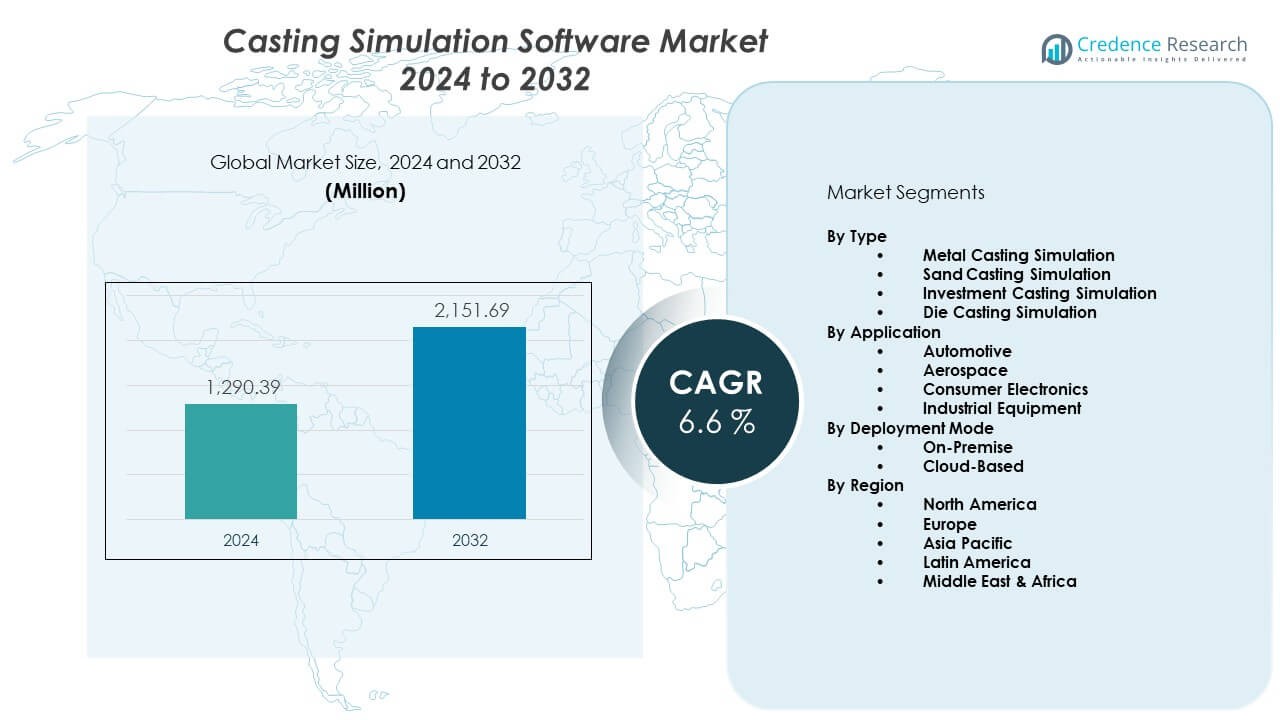
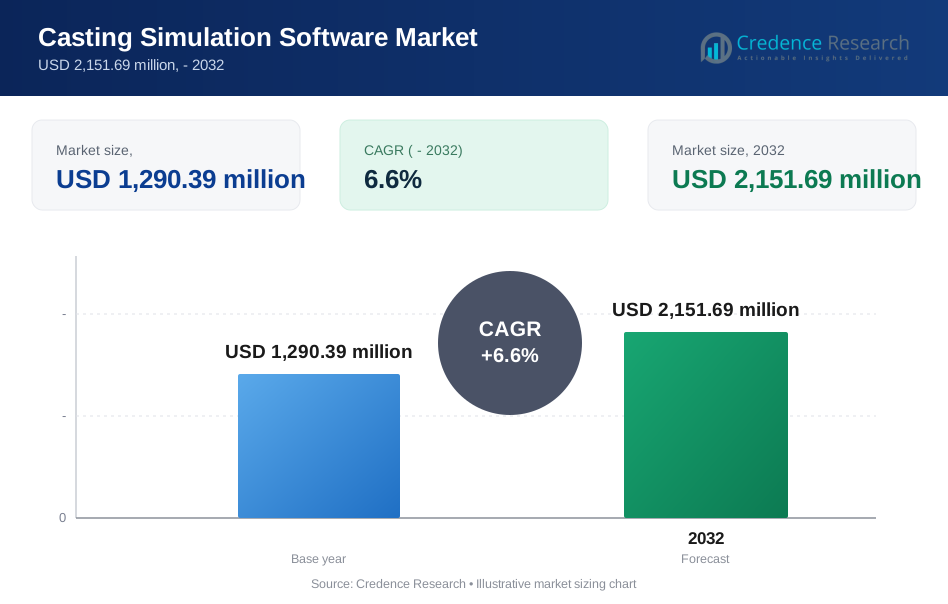
The Casting Simulation Software Market is projected to grow from USD 1,290.39 million in 2024 to an estimated USD 2,151.69 million by 2032, with a compound annual growth rate (CAGR) of 6.6% from 2024 to 2032.
| REPORT ATTRIBUTE | DETAILS |
|---|---|
| Historical Period | 2020-2023 |
| Base Year | 2024 |
| Forecast Period | 2025-2032 |
| Casting Simulation Software Market Size 2024 | USD 1,290.39 Million |
| Casting Simulation Software Market, CAGR | 6.6% |
| Casting Simulation Software Market Size 2032 | USD 2,151.69 Million |
Growing demand for defect-free metal components drives wider use of advanced casting tools. Manufacturers adopt digital systems to predict shrinkage, porosity, and flow issues during production. Automotive suppliers rely on simulation to shorten design cycles and reduce waste. Aerospace firms use virtual testing to improve part integrity. Foundries upgrade operations to avoid rework and raise process efficiency. Engineers prefer platforms that support faster iterations. The rise of complex alloy structures increases software adoption. Digital design goals encourage broader integration across industries.
North America leads the adoption due to strong use across automotive and aerospace plants. Europe follows with high uptake from advanced manufacturing clusters. Asia Pacific emerges as the fastest-growing region due to rapid industrial expansion. Countries with rising metalworking output increase their focus on design accuracy. Growing investment in digital tools pushes wider acceptance across local foundries. Mature markets show stable growth due to steady upgrades. Emerging regions raise demand as industries shift toward precision casting.
Market Insights:
- The Casting simulation software market reached USD 1,290.39 million in 2024 and is projected to hit USD 2,151.69 million by 2032, supported by a steady 6% CAGR driven by rising digital adoption in casting operations.
- North America (34%), Europe (29%), and Asia Pacific (28%) dominate the market due to strong manufacturing bases, advanced simulation adoption, and high demand for defect-free metal components.
- Asia Pacific, holding 28%, remains the fastest-growing region as automotive, electronics, and industrial equipment producers accelerate digital manufacturing and invest in precise simulation workflows.
- Metal Casting Simulation accounted for the largest share at around 40%, supported by its heavy use across automotive, aerospace, and industrial machinery applications.
- On-Premise deployment held about 60% share, driven by demand for secure high-performance computing environments in large manufacturing and engineering organizations.
Market Drivers:
Growing Need for Defect-Free Metal Components
The Casting simulation software market gains strength from rising pressure to improve component quality. Firms in automotive and aerospace sectors use simulation to predict defects early in the design stage. Engineers focus on reducing porosity, shrinkage, and thermal stress. The shift toward lighter alloys increases the need for accurate modelling. Manufacturers push digital workflows to avoid waste during tooling. Simulation supports faster validation cycles across foundries. Teams rely on advanced solvers to meet tighter tolerance demands. It helps industries maintain efficiency during high-volume production.
- For instance, a MAGMASOFT project for a two-cylinder compressor part helped a manufacturer (WEG) reduce the scrap rate from an initial 25% to 4% after modifying the overflows. The scrap rate was further cut to 0.5% after implementing additional cooling channels in the side cores.
Expanding Role of Digital Manufacturing Ecosystems
Digital manufacturing adoption drives broader interest in simulation platforms. Industries shift toward virtual testing to shorten development schedules. The Casting simulation software market benefits from strong investment in modelling tools. Engineers depend on automated functions to optimize gating and riser design. Digital twins influence real-time decision workflows. Software vendors enhance integration with CAD and PLM systems. Production units need improved accuracy during alloy transitions. It strengthens process control across multiple stages of casting.
- For instance, Shiva Tool Tech reported an 80% reduction in die design time after adopting Altair Inspire Cast for method development.
Strong Push for Cost Reduction Across Foundries
Foundries adopt simulation to reduce scrap and rework. Teams use data-driven models to predict performance issues. The Casting simulation software market supports efforts to cut operational waste. Simulation lowers the number of physical trials. Tooling suppliers depend on accurate flow and solidification studies. Digital insights help stabilize large-batch production. Predictive capability limits failures during complex jobs. It drives measurable cost savings across metal-processing units.
Rising Adoption in Complex and High-Precision Applications
Demand grows in aerospace, medical, and energy components. Firms require highly precise structures that demand strong predictive capabilities. The Casting simulation software market supports modelling for complex geometries. Simulation enhances structural analysis during advanced part development. High-precision sectors rely on strong metallurgical prediction features. Engineers look for software that simulates microstructural behavior. It enables better decision-making in temperature-intensive tasks. Industries choose advanced tools to handle next-generation components.
Market Trends:
Growing Integration of Cloud-Based Simulation Platforms
Vendors shift toward cloud deployment to support distributed teams. Users gain flexible access without heavy local hardware. The Casting simulation software market sees steady adoption of cloud modules. Remote collaboration enables faster design reviews. Cloud platforms offer improved scalability during intensive workloads. Teams share simulation data across multi-site operations. Centralized storage supports traceable design workflows. It improves project visibility throughout development.
- For instance, MAGMASOFT users have reported scrap reductions of up to 70% and weight savings of 8% after digitally optimizing casting geometry, benefits that scale well across multi-site teams.
Increased Use of AI and Automation in Simulation Tasks
AI-driven solvers reduce manual setup effort. Automated mesh generation speeds routine tasks. The Casting simulation software market benefits from AI-enabled optimization. Predictive tools guide parameter selection. Intelligent algorithms increase accuracy during flow and cooling prediction. Engineers use automation to validate multiple design changes. AI supports faster identification of defect zones. It strengthens consistency in simulation output.
- For instance, studies on Flow-3D Cast show shrinkage defects reduced by up to 40% and casting yield improved to 85% when gating systems are optimized through automated simulation workflows.
Growing Demand for High-Fidelity Metallurgical Modelling
Industries require deeper insight into metal behavior. Vendors improve microstructure prediction features. The Casting simulation software market expands with advanced metallurgical modules. Simulation now captures detailed grain evolution. High-fidelity models support stricter quality standards. Engineers analyze cooling paths with greater precision. Foundries adopt advanced tools to meet certification requirements. It supports better reliability in safety-critical components.
Rising Adoption of Integrated Simulation-to-Production Workflows
Manufacturers move toward unified design-to-casting pipelines. Simulation integrates with process monitoring tools. The Casting simulation software market grows as firms seek seamless workflows. Digital twins support continuous improvement across production lines. Integrated solutions reduce gaps between tooling and shop-floor execution. Teams track process deviation more effectively. Data exchange standards improve system compatibility. It enhances operational transparency in casting environments.
Market Challenges Analysis:
High Software Costs and Skilled Workforce Requirements
The Casting simulation software market faces issues tied to pricing. Many firms struggle with initial licensing and training expenses. Smaller foundries delay adoption due to limited budget flexibility. Engineers require advanced computational knowledge to run accurate simulations. Talent shortages slow broader implementation. Frequent version upgrades add cost pressure. Integration needs specialized IT support across facilities. It limits adoption among resource-constrained organizations.
Complexity in Modelling Advanced Materials and Geometries
Growing demand for intricate components introduces modelling challenges. High-performance alloys require advanced thermal and metallurgical predictions. The Casting simulation software market must address accuracy gaps in extreme conditions. Engineers face difficulty validating simulations for unusual designs. Limited material databases affect prediction precision. Complex geometry increases solver load during analysis. Long simulation times reduce workflow speed. It creates barriers during fast-paced production cycles.
Market Opportunities:
Emerging Demand from Rapidly Industrializing Regions
Growing metalworking activity in developing economies creates wide scope. The Casting simulation software market can expand through localized support models. Regional manufacturers seek modern tools to replace outdated methods. Digitalization initiatives encourage stronger simulation usage. Energy and automotive plants adopt advanced casting methods. Growing supplier networks raise demand for predictive platforms. It supports stronger penetration across new industrial clusters.
Rising Interest in Sustainable and Energy-Efficient Casting Processes
Industries shift toward processes that reduce material waste. The Casting simulation software market benefits from tools supporting low-energy designs. Teams analyze thermal patterns to cut fuel demand. Simulated trials limit scrap generation. Sustainable production goals encourage deeper reliance on virtual testing. Vendors offer modules that optimize resource use. It strengthens alignment with global environmental standards.
Market Segmentation Analysis:
By Type
Metal casting simulation leads adoption due to strong use in high-precision metal component development. Sand casting simulation holds steady demand across foundries that run large-batch production. Investment casting simulation gains traction in aerospace and medical parts that require tight structural control. Die casting simulation shows fast growth where lightweight alloys and complex molds remain essential. The Casting simulation software market benefits from rising complexity across all casting methods. It supports improved accuracy across flow, solidification, and defect prediction. Type-based expansion stays strong across modern manufacturing units. It encourages wider use of predictive tools in varied casting workflows.
- For instance, ESI ProCAST covers sand, die, and investment casting processes and helps users ensure right-first-time casting by predicting filling, solidification, and porosity with high accuracy.
By Application
Automotive holds the largest share due to high need for error-free metal components. Aerospace depends on strong simulation features for critical parts in engines and structural systems. Consumer electronics uses simulation to support compact and lightweight housing parts. Industrial equipment demands stable modelling accuracy for heavy-duty components. Each application group depends on reliable prediction tools to cut rework and gain better efficiency. Software vendors design specialized modules for sector-specific tasks. It supports precise design cycles across complex shapes. Adoption trends remain strong across diverse end-user clusters.
- For instance, a U-Shin case study showed porosity in zamak castings reduced from 0.45 mm³ to 0.03 mm³ after using Altair Inspire Cast, directly supporting quality targets in automotive supply chains.
By Deployment Mode
On-premise deployment dominates where firms require high data control and secure internal workflows. Large manufacturers prefer on-site systems for extensive simulation loads. Cloud-based deployment grows fast due to flexible access and lower setup costs. Remote teams benefit from scalable computing and shared design environments. Cloud tools reduce hardware strain during high-intensity simulation tasks. It allows teams to speed collaboration across sites. Deployment trends show a shift toward hybrid usage patterns. Growth aligns with stronger digital adoption across industries.
Segmentation:
By Type
- Metal Casting Simulation
- Sand Casting Simulation
- Investment Casting Simulation
- Die Casting Simulation
By Application
- Automotive
- Aerospace
- Consumer Electronics
- Industrial Equipment
By Deployment Mode
- On-Premise
- Cloud-Based
By Region
- North America
- U.S.
- Canada
- Mexico
- Europe
- Germany
- France
- U.K.
- Italy
- Spain
- Rest of Europe
- Asia Pacific
- China
- Japan
- India
- South Korea
- South-east Asia
- Rest of Asia Pacific
- Latin America
- Brazil
- Argentina
- Rest of Latin America
- Middle East & Africa
- GCC Countries
- South Africa
- Rest of the Middle East and Africa
Regional Analysis:
North America (Market Share ~34%)
North America holds the largest share due to strong technology adoption across major manufacturing hubs. The Casting simulation software market benefits from steady demand in automotive and aerospace clusters that prioritize defect-free metal parts. Regional firms invest in advanced simulation to reduce waste and improve operational accuracy. Cloud-based platforms gain traction as engineering teams expand remote collaboration. High digital maturity enables faster integration of simulation-to-production workflows. Vendors strengthen support services across the U.S. and Canada to meet rising customization needs. It maintains stable leadership through consistent upgrades in industrial design practices.
Europe (Market Share ~29%)
Europe follows with robust use among advanced metalworking and machining industries. Strong regulatory standards encourage deeper adoption of simulation tools for quality assurance tasks. The Casting simulation software market sees reliable growth due to high investment in precision casting for automotive and industrial machinery. Germany, France, and the U.K. lead deployment due to strong engineering capabilities. Industry players adopt digital twins to streamline process optimization and tooling validation. Regional manufacturers show preference for high-fidelity metallurgical simulation modules. It sustains momentum through strong focus on sustainability and energy-efficient casting processes.
Asia Pacific (Market Share ~28%)
Asia Pacific emerges as the fastest-growing region due to rapid industrial expansion. China, Japan, India, and South Korea increase adoption to support rising output in automotive, electronics, and machinery sectors. The Casting simulation software market gains strong traction as manufacturers shift toward digital manufacturing ecosystems. Local firms invest in simulation to reduce scrap and support high-volume metal component production. Demand accelerates where export-driven manufacturing requires strict quality checks. Regional governments support industrial digitalization, boosting the need for simulation tools. It expands quickly as industries prefer scalable and cost-efficient platforms.
Key Player Analysis:
- Magmasoft
- Flow3D
- Anycasting
- ESI ProCAST
- Capccast
- Huazhu Software
- Altair Engineering Inc.
- Signicast (CIREX)
- SOLIDCast
- Finite Solutions
Competitive Analysis:
The Casting simulation software market features strong competition among global and regional developers focused on precision modeling and advanced process control. Vendors invest in deeper metallurgical simulation, improved solvers, and AI-based automation to support high-performance workflows. Firms strengthen partnerships with automotive, aerospace, and heavy-industry users to expand long-term adoption. Market leaders differentiate on accuracy, integration capability, and cloud scalability. Smaller players gain ground by offering cost-efficient tools tailored for specific casting processes. Software providers compete through upgrades that support complex alloys and multi-stage casting paths. It maintains a competitive landscape shaped by innovation and strong customer service networks across key regions.
Recent Developments:
- In 2025, Magmasoft showcased its leadership in casting process optimization at GIFA Southeast Asia 2025, held in October in Bangkok. The company presented real customer case studies, casting defects discussions, and live demonstrations of simulation in various casting methods, emphasizing how Magmasoft’s simulation software helps reduce scrap and improve yield by linking virtual simulations with real production results.
- Magmasoft also participated in BUTECH 2025 in Busan during May, where they introduced the latest features of MAGMASOFT®, including digital prediction and analysis of complex phenomena in casting such as porosity, shrinkage, and heat treatment. The focus was on demonstrating economic benefits and ease of use for diverse casting methods, enabling foundries to improve product design and production processes early on.
Report Coverage:
The research report offers an in-depth analysis based on By Type and By Application. It details leading market players, providing an overview of their business, product offerings, investments, revenue streams, and key applications. Additionally, the report includes insights into the competitive environment, SWOT analysis, current market trends, as well as the primary drivers and constraints. Furthermore, it discusses various factors that have driven market expansion in recent years. The report also explores market dynamics, regulatory scenarios, and technological advancements that are shaping the industry. It assesses the impact of external factors and global economic changes on market growth. Lastly, it provides strategic recommendations for new entrants and established companies to navigate the complexities of the market.
Future Outlook:
- AI-driven simulation tools will expand automated defect prediction.
- Cloud platforms will gain wider use among distributed engineering teams.
- Integration with digital twins will drive faster design-to-production workflows.
- High-precision sectors will adopt deeper metallurgical modeling functions.
- Regional vendors will grow through cost-effective localized tools.
- Sustainability goals will raise demand for waste-reduction simulation modules.
- Hybrid deployment models will strengthen due to security and flexibility needs.
- Advanced solvers will support complex geometries and multi-alloy tasks.
- User demand for real-time process insights will increase integration with shop-floor systems.
- Simulation adoption will rise in emerging manufacturing clusters across Asia and Latin America.
Request a Free Sample
Fill in your details and we'll send you a free sample report.
- Sample data tables & charts
- Research methodology
Need a Custom Version of This Report?
Tailor the scope, geography, or segments to your exact requirements.
- Custom geography or segment scope
- Direct access to our analyst team
Frequently Asked Questions
What is the current market size for the Casting simulation software market, and what is its projected size in 2032?
At what Compound Annual Growth Rate is the Casting simulation software market projected to grow between 2024 and 2032?
Which segment of the Casting simulation software market held the largest share in 2024?
What are the primary factors fueling growth in the Casting simulation software market?
Who are the leading companies in the Casting simulation software market?
Which region commanded the largest share of the Casting simulation software market in 2024?
Table of Content
Chapter 1. Report Introduction
- 1.1 Report Description & Purpose
- 1.1.1 Report Title & Market Definition
- 1.1.2 Unique Selling Propositions (USP) & Key Differentiators
- 1.1.3 Value Proposition for Stakeholders
- 1.2 Research Objectives
- 1.2.1 Market Sizing Objectives (Volume & Revenue)
- 1.2.2 Segmentation Objectives
- 1.2.3 Competitive Intelligence Objectives
- 1.2.4 Forecast & Scenario Objectives
- 1.3 Report Scope
- 1.3.1 Casting Simulation Software Scope – Types & Subtypes Covered
- 1.3.2 Geographic Scope – Regions & Countries Covered
- 1.3.3 Historical Period, Base Year & Forecast Period (the historical period; forecast to 2032)
- 1.3.4 Inclusions & Exclusions
- 1.4 HS Code & Classification Framework
- 1.5 Currency, Units & Pricing Basis
- 1.6 Target Stakeholders
- 1.7 Limitations & Assumptions
Chapter 2. Executive Summary
- 2.1 Global Casting Simulation Software Market Snapshot
- 2.1.1 Market Size – Historical (the historical period) & Forecast (2032) (base year: USD 1,290.39 million → 2032: USD 2,151.69 million)
- 2.1.2 Volume & Revenue – Global Totals
- 2.1.3 Key Market Highlights – Top Five Facts
- 2.2 Casting Simulation Software Market Segmentation Snapshot
- 2.2.1 Market Split by Region – vs. 2032
- 2.3 Competitive Snapshot
- 2.3.1 Top 10 Players by Revenue Share –
- 2.3.2 Top 10 Players by Volume Share –
- 2.3.3 Recent Strategic Developments (18-Month Summary)
- 2.4 Key Investment Highlights & Strategic Conclusions
Chapter 3. Casting Simulation Software Market Dynamics & Industry Analysis
- 3.1 Market Overview & Context
- 3.1.1 Casting Simulation Software Market Position in the Broader Automotive Value Chain
- 3.1.2 OEM vs. Replacement Market Dynamics
- 3.1.3 Market Maturity & Development Stage by Region
- 3.2 Casting Simulation Software Market Drivers
- 3.3 Casting Simulation Software Market Restraints & Challenges
- 3.4 Casting Simulation Software Market Opportunities
- 3.5 Porter's Five Forces Analysis
- 3.5.1 Threat of New Entrants
- 3.5.2 Bargaining Power of Suppliers
- 3.5.3 Bargaining Power of Buyers
- 3.5.4 Threat of Substitutes
- 3.5.5 Competitive Rivalry – Intensity Assessment
- 3.6 Casting Simulation Software Value Chain Analysis
- 3.6.1 Upstream – Raw Material/Input Suppliers
- 3.6.1.1 Raw Material/Input 1
- 3.6.1.2 Raw Material/Input 2
- 3.6.1.3 Raw Material/Input 3
- 3.6.2 Midstream – Production/Manufacturing/Service Delivery
- 3.6.2.1 Production/Process Overview
- 3.6.2.2 Key Facility Locations & Capacity by Manufacturer
- 3.6.3 Downstream – Distribution & End Consumer
- 3.6.3.1 Primary Channel – B2B/OEM
- 3.6.3.2 Secondary Channels – Dealer, Retail, Online, Direct
- 3.6.4 Value Chain Profitability Analysis
- 3.6.1 Upstream – Raw Material/Input Suppliers
- 3.7 PESTEL Analysis
- 3.7.1 Political Factors
- 3.7.2 Economic Factors
- 3.7.3 Social Factors
- 3.7.4 Technological Factors
- 3.7.5 Environmental Factors
- 3.7.6 Legal Factors
- 3.8 Casting Simulation Software Supply Chain Analysis
- 3.8.1 Raw Material/Input Supply Risk Assessment
- 3.8.2 Manufacturing Concentration Risk (Geographic Exposure)
- 3.8.3 Trade Disruption Impact Analysis
- 3.9 Regulatory & Policy Landscape
Note: The regulatory and policy landscape section covers regulations based on their applicability to the market, Casting Simulation Software category, geography, and scope of the study. Only regulatory frameworks with a material impact on operations, compliance, trade, sustainability, or market access are analyzed in detail.
Chapter 4. Key Investment Pockets & Opportunity Analysis
- 4.1 Casting Simulation Software Market Attractiveness Analysis
- 4.1.1 By Region – Investment Attractiveness Matrix (Volume × CAGR)
- 4.2 Absolute Revenue Growth Opportunity
- 4.2.1 By Region – Absolute USD Growth Through 2032
- 4.3 Incremental Volume Opportunity
- 4.3.1 By Region – Incremental Volume Through 2032
- 4.3.2 Segment – Incremental Volume
- 4.4 Emerging Submarket Opportunity Deep Dive (Subject to Applicability)
- 4.5 Emerging Market Opportunity Scorecards
- 4.5.1 United States
- 4.5.2 Europe
- 4.5.3 Asia
- 4.5.4 Middle East & Africa
Note: Emerging Market Opportunity Scorecards will be included based on relevance and strategic importance. Regions listed are indicative and may vary depending on data availability and market dynamics.
Chapter 5. Casting Simulation Software Import-Export Analysis & Trade Flows
- 5.1 Global Trade Overview
- 5.1.1 Global Export Value by Country (the historical period)
- 5.1.2 Global Export Volume by Country (the historical period)
- 5.1.3 Global Import Value by Country (the historical period)
- 5.1.4 Global Import Volume by Country (the historical period)
- 5.1.5 Net Trade Balance by Country (the historical period)
- 5.2 Export Analysis – Segment
- 5.2.1 Type 1 (HS Code)
- 5.2.2 Type 2 (HS Code)
- 5.2.3 Type 3 (HS Code)
- 5.2.4 Type 4 (HS Code)
- 5.2.5 Type 5 (HS Code)
- 5.3 Import Analysis – Segment
- 5.3.1 Type 1 (HS Code)
- 5.3.2 Type 2 (HS Code)
- 5.3.3 Type 3 (HS Code)
- 5.3.4 Type 4 (HS Code)
- 5.3.5 Type 5 (HS Code)
- 5.4 Average Unit Trade Prices
- 5.4.1 Average Export Price – Segment & Country
- 5.4.2 Average Import Price – Segment & Source Country
- 5.4.3 Price Trends (the historical period)
- 5.5 Key Trade Route Analysis
- 5.5.1 Trade Route 1
- 5.5.2 Trade Route 2
- 5.5.3 Trade Route 3
- 5.5.4 Trade Route 4
- 5.5.5 Trade Route 5
- 5.6 Trade Policy Impact Assessment
- 5.6.1 US Anti-Dumping & Section 301 Tariffs
- 5.6.2 EU Customs Union Impact
- 5.6.3 Major Free Trade Agreements
- 5.6.4 USMCA Rules of Origin
Note: Trade policy analysis will be included only where relevant to the Casting Simulation Software market.
Chapter 6. Competitive Landscape & Company Benchmarking
- 6.1 Casting Simulation Software Market Concentration & Structure
- 6.1.1 Herfindahl-Hirschman Index (HHI) – vs.
- 6.1.2 Tier 1, Tier 2 & Tier 3 Market Structure
- 6.1.3 Global, Regional & Local Player Dynamics
- 6.2 Casting Simulation Software Market Share Analysis –
- 6.2.1 Global Revenue Share by Company
- 6.2.2 Global Volume Share by Company
- 6.2.3 Regional Revenue Share
- 6.2.4 Market Share Evolution ( vs. )
- 6.2.5 OEM Segment Share by Company
- 6.2.6 Replacement Segment Share by Company
- 6.3 Production/Delivery Capacity & Facility Analysis
- 6.3.1 Global Installed Capacity
- 6.3.2 Capacity Utilization Rates
- 6.3.3 Production/Output Volume
- 6.3.4 Facility Locations & Capacity Map
- 6.3.5 Planned Capacity Additions
- 6.4 Casting Simulation Software Competitive Benchmarking Matrix
- 6.4.1 Revenue, Volume, CAGR & Profitability Comparison
- 6.4.2 Channel Revenue Mix
- 6.4.3 Geographic Revenue Exposure
- 6.4.4 R&D Intensity
- 6.4.5 Sustainability Maturity
- 6.5 Strategic Developments in Casting Simulation Software (Last 24 Months)
- 6.5.1 Mergers, Acquisitions & Divestments
- 6.5.2 New Casting Simulation Software Launches
- 6.5.3 Facility Expansions
- 6.5.4 Strategic Alliances, Joint Ventures & Partnerships
- 6.5.5 Distribution Expansion & Market Entry
- 6.5.6 Sustainability & ESG Initiatives
- 6.6 Competitive Strategy Mapping
- 6.6.1 Leader, Challenger, Follower & Niche Classification
- 6.6.2 Pricing Strategy Comparison
- 6.6.3 Channel Strategy Matrix
Note: Strategic developments are included based on their materiality and the availability of reliable information.
Chapter 7. Global Casting Simulation Software Market – By Distribution Channel
- 7.1 Segment Overview
- 7.1.1 Volume & Revenue Split by Channel ( & 2032)
- 7.1.2 Channel Mix Evolution (2032)
Chapter 8. Regional Market Analysis – Global Overview
- 8.1 Global Regional Overview
- 8.1.1 Regional Volume Share
- 8.1.2 Regional Revenue Share
- 8.1.3 Regional Volume by Region
- 8.1.4 Regional Revenue by Region
- 8.1.5 Regional Forecast Through 2032
- 8.2 Cross-Regional Segment Analysis
- 8.2.1 By Distribution Channel
- 8.2.2 By Brand/Price Tier
Chapter 9. North America Casting Simulation Software Market
- 9.1 United States
- 9.2 Canada
- 9.3 Mexico
Chapter 10. Europe Casting Simulation Software Market
- 10.1 Germany
- 10.2 France
- 10.3 Italy
- 10.4 United Kingdom
- 10.5 Spain
- 10.6 Poland
- 10.7 Russia
- 10.8 Netherlands
- 10.9 Belgium
- 10.10 Sweden
- 10.11 Denmark
- 10.12 Norway
- 10.13 Rest of Europe
Chapter 11. Asia Pacific Casting Simulation Software Market
- 11.1 China
- 11.2 India
- 11.3 Japan
- 11.4 South Korea
- 11.5 Thailand
- 11.6 Indonesia
- 11.7 Vietnam
- 11.8 Malaysia
- 11.9 Australia
- 11.10 Rest of Asia Pacific
Chapter 12. Latin America Casting Simulation Software Market
- 12.1 Brazil
- 12.2 Argentina
- 12.3 Colombia
- 12.4 Chile
- 12.5 Rest of Latin America
Chapter 13. Middle East Casting Simulation Software Market
- 13.1 Saudi Arabia
- 13.2 United Arab Emirates
- 13.3 Turkey
- 13.4 Israel
- 13.5 Iran
- 13.6 Rest of the Middle East
Chapter 14. Africa Casting Simulation Software Market
- 14.1 South Africa
- 14.2 Egypt
- 14.3 Nigeria
- 14.4 Morocco
- 14.5 Rest of Africa
Chapter 15. Casting Simulation Software Company Profiles
- 15.1 [Company 01]
- 15.1.1 Company Overview
- 15.1.2 Key Management Personnel
- 15.1.3 Products & Services Portfolio
- 15.1.4 Financial Performance
- 15.1.5 Key Market Focus & Geographic Presence
- 15.1.6 Recent Developments & Strategic Initiatives
Note: The company profile list is preliminary and may change based on research findings, market developments, data availability, and client requirements.
Chapter 16. Appendices
- Appendix A – List of Abbreviations & Acronyms
- Appendix B – Industry Classification Code Reference – Full Series
- Appendix C – Production & Capacity Data Tables
- Appendix D – End-Use & Demand Base Tables
- Appendix E – Consumption & Replacement Rate Assumptions
- Appendix F – ASP Reference Tables
- Appendix G – Manufacturing & Facility Database
- Appendix H – Import-Export Data Tables
- Appendix I – Regulatory Summary Tables
- Appendix J – Primary Research Participant List (Anonymized)
- Appendix K – Primary Research Questionnaire Framework
- Appendix L – Data Sources & Bibliography
- Appendix M – Market Size Divergence & Source Comparison
Chapter 17. Research Methodology
- 17.1 Research Framework & Philosophy
- 17.2 Secondary Research – Sources, Hierarchy & Data Extraction
- 17.3 Data Modeling – Bottom-Up & Top-Down Market Sizing
- 17.4 Primary Research – Stakeholder Framework, LOI & Sample Sizes
- 17.5 Forecast Methodology – Regression, Scenario & Sensitivity Analysis
- 17.6 Quality Control – Four-Layer Validation Framework
- 17.7 Limitations & Standard Assumptions
- 17.8 Disclaimer
