
| REPORT ATTRIBUTE | DETAILS |
|---|---|
| Historical Period | 2020-2023 |
| Base Year | 2024 |
| Forecast Period | 2025-2032 |
| Explosion Proof Camera Systems Market Size 2024 | USD 4,135.42 million |
| Explosion Proof Camera Systems Market, CAGR | 7.45% |
| Explosion Proof Camera Systems Market Size 2032 | USD 7,652.13 million |
Market Overview:
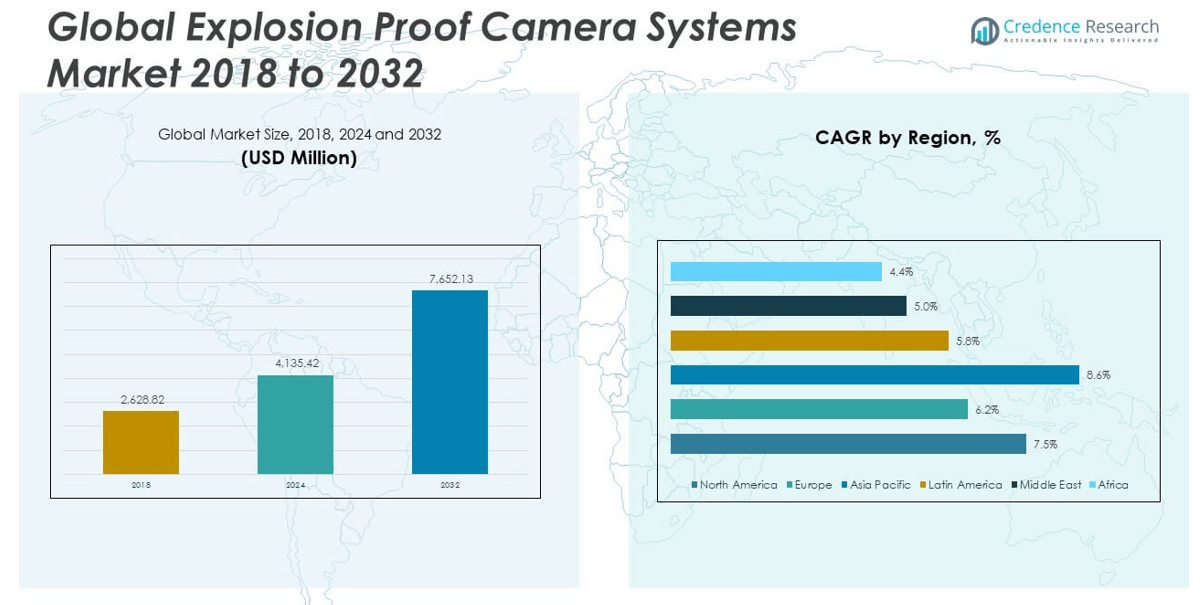
The Global Explosion Proof Camera Systems Market size was valued at USD 2,628.82 million in 2018 to USD 4,135.42 million in 2024 and is anticipated to reach USD 7,652.13 million by 2032, at a CAGR of 7.45% during the forecast period.
The global explosion proof camera systems market is driven by a combination of regulatory mandates, industrial safety concerns, and technological innovation. Regulatory bodies such as OSHA, IECEx, and ATEX require the deployment of certified equipment in hazardous environments, compelling industries like oil and gas, chemicals, mining, and pharmaceuticals to adopt explosion proof surveillance systems. These cameras are critical for monitoring volatile zones, preventing accidents, and ensuring compliance. Additionally, rapid industrialization in emerging economies has led to increased demand for robust safety solutions, especially in high-risk sectors. Technological advancements such as 4K resolution, thermal imaging, night vision, AI-driven analytics, and IoT-enabled surveillance have further enhanced the functionality and reliability of explosion proof cameras. Their integration with Industry 4.0 frameworks and SCADA systems enables centralized monitoring and real-time alerts, thereby improving operational efficiency and reducing human error.
North America holds the largest share of the global explosion proof camera systems market, led by the United States, which has a well-established industrial infrastructure and strict regulatory enforcement for worker and site safety. The region benefits from substantial investments in the oil and gas, mining, and chemical sectors, where hazardous operational conditions demand robust monitoring systems. Europe follows closely, with countries like Germany, the UK, and France emphasizing industrial safety through strong compliance frameworks and widespread use of explosion proof technologies in manufacturing and energy production. Asia Pacific is anticipated to witness the fastest growth during the forecast period due to rapid industrial expansion, especially in China, India, South Korea, and Southeast Asia. Increasing awareness of safety standards and growing government regulations are driving significant uptake of explosion proof surveillance systems in the region. Meanwhile, the Middle East and Africa, along with Latin America, are emerging as promising markets owing to the growth of oil and gas infrastructure and mining operations, particularly in countries like the UAE, Saudi Arabia, Brazil, and South Africa.
Market Insights:
- The market was valued at USD 4,135.42 million in 2024 and is projected to reach USD 7,652.13 million by 2032, growing at a CAGR of 7.45%.
- Regulatory enforcement by OSHA, IECEx, and ATEX drives demand for certified explosion proof surveillance in hazardous industries.
- Oil and gas, chemical, mining, and manufacturing sectors remain the core application areas due to continuous safety monitoring needs.
- Advanced technologies such as AI, 4K resolution, night vision, and thermal imaging enhance camera performance and real-time response.
- North America leads the market due to strict safety regulations and well-developed industrial infrastructure, followed by Europe.
- Asia Pacific is the fastest-growing region, driven by industrial expansion in China, India, and Southeast Asia and rising safety awareness.
- High initial cost, integration complexity, and lack of technical expertise limit adoption among SMEs and legacy operations.
Market Drivers:
Stringent Regulatory Frameworks and Safety Compliance Mandates Are Increasing System Adoption
The Global Explosion Proof Camera Systems Market is witnessing significant growth due to tightening safety regulations across hazardous industrial environments. Regulatory authorities such as OSHA, IECEx, and ATEX enforce strict compliance standards for operations in explosive-prone areas, making certified explosion proof cameras a mandatory safety requirement. These systems allow for continuous visual monitoring in high-risk zones without compromising safety. Industries such as oil and gas, petrochemicals, mining, and pharmaceuticals rely on these solutions to prevent operational hazards and reduce liability. Compliance with these regulations ensures uninterrupted operations and shields companies from legal and financial consequences. This environment of enforced compliance directly drives the demand for robust, explosion-resistant surveillance equipment.
Industrial Growth in Hazardous Sectors Supports Surveillance Infrastructure Investment
Growing investment in industries with volatile operational conditions contributes to rising deployment of explosion proof camera systems. Refineries, offshore platforms, underground mines, and chemical processing plants present continuous safety risks that require active visual monitoring. The Global Explosion Proof Camera Systems Market benefits from the increasing number of such installations globally, especially in regions with expanding infrastructure. These industries seek to safeguard personnel, reduce equipment damage, and enable quick response in case of accidents. Implementation of durable and tamper-resistant cameras minimizes equipment downtime and improves safety outcomes. This push for advanced infrastructure in risk-intensive sectors sustains steady market demand.
- For instance, Hikvision’s EXIR Explosion-Proof IP Camera, model DS-2XE6222F-IS, is specifically designed for offshore oil platforms and chemical plants, featuring a 2 MP progressive scan CMOS sensor and a 304 stainless steel enclosure with a 7J impact resistance rating.
Technological Advancements Enhance Monitoring Accuracy and Broaden Application Scope
Integration of advanced imaging technologies has transformed explosion proof cameras from basic safety tools into intelligent monitoring systems. Features such as 4K resolution, thermal imaging, night vision, and AI-enabled analytics have increased their relevance in complex industrial environments. The Global Explosion Proof Camera Systems Market benefits from innovations that allow real-time incident detection, behavioral analysis, and predictive maintenance. Smart cameras integrated with SCADA and IoT systems provide centralized control and remote access, improving situational awareness. These capabilities enable firms to optimize performance, reduce manual supervision, and minimize risk. Technology continues to play a pivotal role in making these systems indispensable in modern industrial operations.
- For instance, Hanwha Vision’s TNU-6322E explosion-proof camera, launched in 2023, delivers 2MP 32x optical zoom, 360° endless pan, and 255 preset positions, allowing comprehensive monitoring in hazardous areas. The camera supports H.265/H.264/MJPEG compression, reducing bandwidth usage compared to previous models.
Cost Efficiency and Operational Reliability Drive Long-Term Adoption Across Industries
Although the initial investment for explosion proof camera systems is high, businesses recognize their long-term cost efficiency. These systems prevent major operational disruptions, reduce downtime, and enhance asset protection, delivering measurable financial returns. The Global Explosion Proof Camera Systems Market benefits from increased awareness of these advantages among facility operators and decision-makers. Manufacturers are offering modular, scalable solutions that meet diverse budgetary and operational needs, encouraging broader adoption. By improving reliability and minimizing the need for frequent maintenance, these systems ensure consistent performance in harsh environments. This economic value proposition strengthens the case for long-term implementation in both large and mid-sized industrial settings.
Market Trends:
Growing Preference for Wireless and IP-Based Explosion Proof Camera Installations
The transition from traditional analog systems to wireless and IP-based camera solutions is reshaping the Global Explosion Proof Camera Systems Market. Wireless installations eliminate the need for extensive cabling, reducing installation time and minimizing exposure to hazardous environments during setup. IP-based systems offer scalability, flexibility, and remote accessibility, aligning with modern industrial automation needs. These cameras support higher resolution, advanced analytics, and seamless integration with cloud platforms and control centers. Industries value the ease of upgrading and maintaining IP-based systems without compromising explosion proof integrity. It reflects a clear trend toward decentralized, adaptable surveillance infrastructures.
- For example, Axis Communicationshas reported that its explosion-protected cameras, such as the Axis XPQ1785, utilize Power over Ethernet (PoE) to enable single-cable installations, reducing setup time by up to 40% compared to traditional analog systems.
Rising Adoption of Compact and Modular Camera Designs for Diverse Industrial Use
Industrial users are increasingly seeking compact and modular explosion proof cameras that fit into limited spaces without compromising performance. The Global Explosion Proof Camera Systems Market is responding to this demand with solutions engineered for easy installation in confined or mobile setups, such as portable rigs, mobile containers, or tunnel networks. Compact models allow for discreet surveillance while maintaining high durability and certification standards. Modular designs simplify maintenance and component replacement, enhancing system uptime and serviceability. This trend supports greater customization and expands use cases across varied operational conditions. It creates new opportunities for deployment in previously underserved applications.
Increased Integration with AI-Based Edge Analytics and Smart Monitoring Features
The market is experiencing a steady shift toward smart surveillance systems that incorporate AI-based edge computing and analytics directly within the camera units. The Global Explosion Proof Camera Systems Market now features models capable of real-time object detection, temperature monitoring, smoke recognition, and behavioral pattern analysis without relying solely on centralized servers. These features enable faster incident detection and improve situational awareness in high-risk environments. Edge-based intelligence reduces bandwidth consumption and enhances response times in remote or bandwidth-limited locations. This advancement brings explosion proof surveillance closer to real-time decision-making. It also aligns with broader trends in autonomous and intelligent industrial monitoring.
- For instance, Bosch Security Systems’ MIC IP fusion 9000i explosion-protected camera integrates a built-in AI processor capable of real-time object classification, temperature anomaly detection, and smoke recognition at the edge, processing up to 20 analytics streams simultaneously. The system can detect and classify up to 200 objects per frame and trigger alerts within 500 milliseconds of an event.
Growing Emphasis on Multi-Environment Certifications to Expand Global Reach
Manufacturers are increasingly seeking multi-environment certifications to expand their reach across geographies and industries. The Global Explosion Proof Camera Systems Market includes systems certified under multiple global standards, such as ATEX (Europe), IECEx (international), NEC (North America), and INMETRO (Brazil). These multi-certified products simplify cross-border deployment and allow for consistent procurement across global operations. It reduces the burden on industrial buyers to verify compatibility with local regulations. This trend supports large multinational corporations in standardizing safety infrastructure across sites. It highlights the need for globally compliant solutions in an interconnected industrial landscape.
Market Challenges Analysis:
High Initial Investment and Maintenance Costs Restrict Wider Adoption Across Small and Medium Enterprises
The Global Explosion Proof Camera Systems Market faces a significant barrier in the form of high upfront costs and long-term maintenance requirements. Explosion proof cameras require specialized materials, rigorous testing, and compliance with global certifications, which increase the overall production cost. Many small and medium-sized enterprises (SMEs) hesitate to invest in these systems due to limited budgets, despite understanding their safety value. Ongoing costs for calibration, inspection, and repair further strain operational expenditure, especially in facilities lacking dedicated maintenance teams. The lack of standardized pricing across regions also leads to uncertainty during procurement. It limits widespread adoption in price-sensitive markets and delays modernization efforts in smaller industrial setups.
Limited Technical Expertise and Integration Challenges in Harsh Environments Impede Performance Optimization
A persistent challenge for the Global Explosion Proof Camera Systems Market lies in the complexity of integrating these systems into legacy industrial infrastructures. Explosion proof cameras often require precise positioning, environmental calibration, and integration with existing SCADA or surveillance networks, which demands specialized technical knowledge. Many operators lack the in-house expertise to manage system configuration, software updates, or troubleshooting. In high-risk environments such as oil rigs or chemical plants, restricted access and safety protocols complicate installation and servicing. It creates delays in system deployment and increases reliance on third-party service providers. These factors reduce operational efficiency and limit the full utilization of advanced features embedded in modern camera solutions.
Market Opportunities:
Rising Infrastructure Development in Emerging Economies Offers New Deployment Avenues
The Global Explosion Proof Camera Systems Market stands to benefit from growing industrialization and infrastructure development in emerging regions. Countries in Asia Pacific, the Middle East, and Africa are expanding their oil and gas, mining, and chemical sectors, creating strong demand for advanced safety solutions. Governments are implementing stricter safety regulations, aligning local standards with international benchmarks. These conditions present significant opportunities for vendors offering certified, cost-effective surveillance systems. It enables manufacturers to establish early presence in developing markets and form long-term partnerships. The trend supports sustained revenue growth and market penetration outside traditionally dominant regions.
Increased Demand for Remote and Autonomous Monitoring Supports Technological Expansion
Industries are investing in automation and remote operations, especially in offshore and high-risk environments, to reduce human exposure and enhance safety. The Global Explosion Proof Camera Systems Market can capitalize on this trend by offering AI-enabled, network-integrated, and low-maintenance camera solutions. Demand is growing for systems that support real-time analytics, wireless transmission, and integration with digital twin platforms. These innovations improve decision-making and operational efficiency in hazardous settings. It creates strong demand for smart, autonomous camera technologies designed for complex, unmanned facilities. Companies that prioritize innovation and adaptability can secure a competitive advantage in this evolving market landscape.
Market Segmentation Analysis:
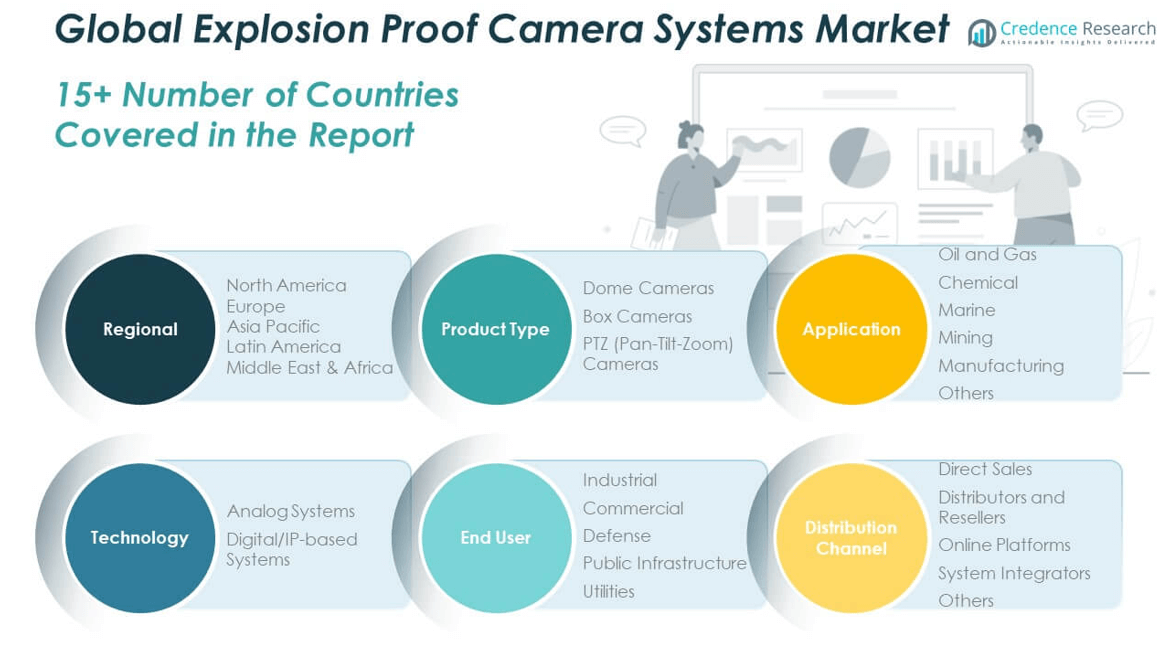
The Global Explosion Proof Camera Systems Market is segmented by product type, application, technology, end user, and distribution channel, each reflecting the evolving safety demands of hazardous industrial environments.
By product type, dome cameras lead in compact installations, while box cameras are favored for fixed-location monitoring. PTZ cameras dominate in large, complex facilities due to their wider field of view and remote control capabilities.
- For example, the Bosch MIC IP fusion 9000iPTZ camera is designed for expansive, high-risk industrial sites. With its 360° continuous rotation, 30x optical zoom, and remote control capabilities, it offers wide-area coverage and rapid response for large oil refineries and chemical plants.
By application, oil and gas remain the largest segment due to high exposure to flammable conditions, followed by chemical and mining sectors where safety compliance is critical. Marine and manufacturing sectors continue to show steady demand for explosion-proof surveillance solutions. It also sees adoption in other areas requiring robust environmental protection.
- For instance, Pelco ExSite Enhanced Seriescameras are used in chemical processing plants and underground mining operations, where their modular, corrosion-resistant housings and compliance with global explosion-proof standards ensure safe and reliable surveillance.
By technology, the shift from analog systems to digital/IP-based solutions is accelerating, driven by better image quality, remote access, and system integration.
By end users, industrial facilities account for the highest market share, while public infrastructure and utilities are emerging growth areas.
By distribution, direct sales and system integrators dominate due to the need for customized and certified installations, while online platforms and resellers support secondary demand channels.
Segmentation:
By Product Type:
- Dome Cameras
- Box Cameras
- PTZ (Pan-Tilt-Zoom) Cameras
By Application:
- Oil and Gas
- Chemical
- Marine
- Mining
- Manufacturing
- Others
By Technology:
- Analog Systems
- Digital/IP-based Systems
By End User:
- Industrial
- Commercial
- Defense
- Public Infrastructure
- Utilities
By Distribution Channel:
- Direct Sales
- Distributors and Resellers
- Online Platforms
- System Integrators
- Others
By Region:
- North America
- U.S.
- Canada
- Mexico
- Europe
- Germany
- France
- U.K.
- Italy
- Spain
- Rest of Europe
- Asia Pacific
- China
- Japan
- India
- South Korea
- South-east Asia
- Rest of Asia Pacific
- Latin America
- Brazil
- Argentina
- Rest of Latin America
- Middle East & Africa
- GCC Countries
- South Africa
- Rest of the Middle East and Africa
Regional Analysis:
North America
The North America Explosion Proof Camera Systems Market size was valued at USD 1,091.56 million in 2018 to USD 1,698.40 million in 2024 and is anticipated to reach USD 3,151.87 million by 2032, at a CAGR of 7.5% during the forecast period. North America holds the largest market share of the Global Explosion Proof Camera Systems Market, accounting for nearly 32% of global revenue. The region's dominance stems from its well-established oil and gas infrastructure, strict workplace safety regulations, and strong industrial automation practices. The United States leads with high adoption rates driven by OSHA compliance mandates and investments in refinery modernization. Canada supports market growth with widespread deployment in mining and petrochemical sectors. It continues to benefit from early adoption of IP-based and AI-enabled explosion proof camera systems. Growth prospects remain strong due to ongoing expansion of industrial IoT networks.
Europe
The Europe Explosion Proof Camera Systems Market size was valued at USD 519.06 million in 2018 to USD 774.24 million in 2024 and is anticipated to reach USD 1,310.22 million by 2032, at a CAGR of 6.2% during the forecast period. Europe commands a 15% share of the Global Explosion Proof Camera Systems Market and maintains consistent demand due to its strong regulatory enforcement under ATEX directives. Countries such as Germany, France, and the UK lead adoption across manufacturing, chemical processing, and energy industries. Industrial modernization initiatives and emphasis on worker safety drive consistent system upgrades. Companies invest in explosion proof surveillance to ensure process integrity and reduce liability in high-risk operations. It gains traction through integration with factory automation and remote monitoring solutions. The region’s structured compliance environment supports steady growth.
Asia Pacific
The Asia Pacific Explosion Proof Camera Systems Market size was valued at USD 781.65 million in 2018 to USD 1,296.35 million in 2024 and is anticipated to reach USD 2,610.26 million by 2032, at a CAGR of 8.6% during the forecast period. Asia Pacific holds a 24% share of the Global Explosion Proof Camera Systems Market and stands as the fastest-growing region. The surge is driven by rapid industrialization in China, India, South Korea, and Southeast Asia. Governments are enforcing safety standards and incentivizing investments in refinery, mining, and manufacturing sectors. Local industries seek reliable safety surveillance as part of broader digital transformation strategies. It benefits from rising demand for compact, affordable, and AI-integrated explosion proof solutions. Market players are expanding local manufacturing and service support to meet regional needs.
Latin America
The Latin America Explosion Proof Camera Systems Market size was valued at USD 126.51 million in 2018 to USD 196.58 million in 2024 and is anticipated to reach USD 322.73 million by 2032, at a CAGR of 5.8% during the forecast period. Latin America contributes roughly 4% to the Global Explosion Proof Camera Systems Market and shows stable growth potential. Brazil and Mexico lead regional demand due to active oil and gas exploration and a growing industrial base. Adoption is further supported by infrastructure expansion and regulatory efforts aimed at improving workplace safety. The region is gradually shifting toward advanced camera systems integrated with centralized control platforms. It presents opportunities for cost-effective and rugged surveillance solutions suited for remote and volatile environments. Limited technical infrastructure remains a challenge but also signals potential for long-term development.
Middle East
The Middle East Explosion Proof Camera Systems Market size was valued at USD 68.66 million in 2018 to USD 98.07 million in 2024 and is anticipated to reach USD 150.85 million by 2032, at a CAGR of 5.0% during the forecast period. The Middle East holds a 3% share of the Global Explosion Proof Camera Systems Market, with demand anchored by oil-rich nations such as Saudi Arabia and the UAE. These countries prioritize explosion proof systems for upstream and downstream oil and gas facilities. Investments in mega-industrial projects and compliance with fire and explosion protection standards fuel adoption. It benefits from rising digitization of energy assets and expansion of smart refinery operations. Surveillance systems with thermal imaging and low-light capabilities see strong uptake. Local partnerships and service agreements enhance long-term market viability.
Africa
The Africa Explosion Proof Camera Systems Market size was valued at USD 41.37 million in 2018 to USD 71.78 million in 2024 and is anticipated to reach USD 106.20 million by 2032, at a CAGR of 4.4% during the forecast period. Africa accounts for approximately 2% of the Global Explosion Proof Camera Systems Market and presents modest but steady growth. Nigeria and South Africa lead demand, primarily in oil exploration and heavy industry. Adoption remains limited by budget constraints and underdeveloped regulatory frameworks. However, foreign investments in energy infrastructure and mining projects are improving surveillance needs. It gains traction in select high-risk operations where safety failures pose significant economic threats. Future growth depends on technology partnerships and increased regulatory alignment with global safety standards.
Key Player Analysis:
- Honeywell
- ZDEX
- Dahua
- SharpEagle
- UNISOL International
- Schneider Electric (Pelco)
- Hanwha Techwin America
Competitive Analysis:
The Global Explosion Proof Camera Systems Market is moderately consolidated, with key players focusing on innovation, certification compliance, and regional expansion. Major companies such as Hikvision, Axis Communications, Bosch Security Systems, Dahua Technology, and Honeywell dominate through advanced product portfolios and strategic partnerships. It sees continuous investment in high-resolution imaging, thermal sensing, and AI-powered analytics to meet evolving industrial requirements. Companies are competing on reliability, cost efficiency, and ease of integration with SCADA and IoT networks. Mergers and acquisitions remain a preferred strategy to expand geographic presence and product capabilities. Emerging players focus on niche applications and modular designs to gain traction in cost-sensitive regions. Competitive intensity is rising with the demand for rugged, intelligent surveillance solutions across multiple hazardous industries.
Recent Developments:
- In April 2025, IDIS launched a new explosion‑proof camera range. IDIS released a comprehensive lineup of ATEX, UL, and IP68‑rated models that include Full‑HD PTZ cameras, QHD mini‑domes, UHD fisheyes, and 36× zoom fixed bullet units. The series offers enhanced night‑vision performance, wide‑area coverage, and rugged designs tailored for industrial and manufacturing environments.
- In March 2025, Motorola Solutions unveiled an enhanced Pelco portfolio. The company introduced rugged, AI‑powered explosion‑proof cameras, such as the ExSite Enhanced Thermal 2 fixed camera and the Esprit Anti‑Corrosion cameras for marine operations. These units carry global explosion‑proof certifications and deliver advanced thermal imaging capabilities.
- In August 2024, Dahua Technology introduced a new explosion-proof camera for dusty and gaseous industrial environments. The camera’s advanced features, including multiple explosion-proof material options and AI functions, are targeted at high-risk industrial applications, aligning it with the explosion proof camera systems market.
Market Concentration & Characteristics:
The Global Explosion Proof Camera Systems Market exhibits a moderate level of concentration, with a mix of global manufacturers and regional specialists competing across industry segments. It features high entry barriers due to stringent certification requirements, advanced technical specifications, and compliance with international safety standards. Leading players maintain a competitive edge through innovation, robust distribution networks, and customized solutions for hazardous environments. The market is characterized by long product lifecycles, high reliability expectations, and strong demand for integration with digital monitoring systems. Buyers prioritize durability, ease of installation, and real-time analytics, which shape product development and procurement decisions.
Report Coverage:
The research report offers an in-depth analysis based on product type, application, technology, end user, and distribution channel. It details leading market players, providing an overview of their business, product offerings, investments, revenue streams, and key applications. Additionally, the report includes insights into the competitive environment, SWOT analysis, current market trends, as well as the primary drivers and constraints. Furthermore, it discusses various factors that have driven market expansion in recent years. The report also explores market dynamics, regulatory scenarios, and technological advancements that are shaping the industry. It assesses the impact of external factors and global economic changes on market growth. Lastly, it provides strategic recommendations for new entrants and established companies to navigate the complexities of the market.
Future Outlook:
- Demand for explosion proof camera systems will rise with expanding industrial automation and hazardous area surveillance needs.
- Growth in offshore oil rigs, petrochemical facilities, and mining operations will drive increased system deployment.
- Integration with AI and edge analytics will transform cameras into intelligent, self-monitoring safety tools.
- Manufacturers will invest in compact, modular designs to suit diverse environments and limited-space installations.
- Wireless and IP-based systems will gain prominence for their flexibility, scalability, and remote accessibility.
- Emerging economies will present strong growth opportunities due to rising safety regulations and industrial investments.
- Product innovation will focus on enhancing thermal imaging, night vision, and data processing capabilities.
- Partnerships with system integrators and IoT solution providers will expand market reach and adoption.
- Growing demand for globally certified systems will favor companies with multi-standard compliant portfolios.
- Competitive pressure will increase as regional players enter with cost-effective and application-specific solutions.

Request a Free Sample
Fill in your details and we'll send you a free sample report.
- Sample data tables & charts
- Research methodology
Market Dynamics
Stringent Regulatory Compliance
Mandates from organizations such as OSHA, IECEx, and ATEX require certified explosion proof camera systems in hazardous environments, compelling industries to invest in compliant surveillance solutions to ensure safety and avoid legal penalties.
Industrial Expansion in High-Risk Sectors
Growth in oil and gas, chemical, mining, and manufacturing industries - especially in emerging economies - drives demand for robust monitoring systems to safeguard personnel and assets in volatile operational zones.
Technological Advancements in Surveillance
Innovations such as 4K resolution, thermal imaging, night vision, and AI-driven analytics have enhanced the performance and reliability of explosion proof cameras, making them indispensable for real-time monitoring and incident prevention.
Shift Toward Digital and Wireless Solutions
The transition from analog to IP-based and wireless camera systems enables easier installation, scalability, and integration with industrial automation platforms, supporting broader adoption in both new and retrofit projects.
Cost Efficiency and Operational Reliability
Despite high initial costs, explosion proof camera systems offer long-term savings by reducing downtime, preventing accidents, and minimizing maintenance needs, which is increasingly recognized by industrial operators seeking reliable safety investments.
Need a Custom Version of This Report?
Tailor the scope, geography, or segments to your exact requirements.
- Custom geography or segment scope
- Direct access to our analyst team
Frequently Asked Questions
What is the current size and growth outlook of the Explosion Proof Camera Systems Market?
What is driving the demand for explosion proof camera systems?
Which region leads the market?
Where is the fastest market growth expected?
Table of Content
Chapter 1 Market Segmentation
- 1.1 Segmentation Framework
- 1.1.1 Product and Service Classification
- 1.1.2 Application and End-Use Classification
- 1.1.3 Technology and Solution Classification
- 1.1.4 Customer and Distribution Channel Classification
- 1.1.5 Geographic Segmentation
- 1.1.6 Market Segment Definitions and Boundaries
- 1.2 By End User
- 1.2.1 Industrial
- 1.2.2 Commercial
- 1.2.3 Defense
- 1.2.4 Public Infrastructure
- 1.2.5 Utilities
- 1.3 By Technology
- 1.3.1 Analog Systems
- 1.3.2 Digital/IP-based Systems
- 1.4 By Application
- 1.4.1 Oil and Gas
- 1.4.2 Chemical
- 1.4.3 Marine
- 1.4.4 Mining
- 1.4.5 Manufacturing
- 1.4.6 Others
- 1.5 By Product Type
- 1.5.1 Dome Cameras
- 1.5.2 Box Cameras
- 1.5.3 PTZ (Pan-Tilt-Zoom) Cameras
Chapter 2 Introduction
- 2.1 Report Objectives and Scope
- 2.2 Product Definition and Industry Terminology
- 2.3 Market Inclusions and Exclusions
- 2.4 Research Process
- 2.4.1 Primary Research and Expert Interviews
- 2.4.2 Secondary Research and Source Review
- 2.4.3 Top-Down and Bottom-Up Estimation
- 2.4.4 Data Triangulation and Verification
- 2.5 Market Size Measurement Basis
- 2.5.1 2024: USD 4,135.42 million → 2032: USD 7,652.13 million
- 2.6 Historical and Forecast Reference Periods
- 2.6.1 Base Year: 2024
- 2.6.2 Forecast Period: 2024-2032
- 2.7 Research Assumptions and Limitations
Chapter 3 Executive Summary
- 3.1 Market Snapshot and Key Findings
- 3.2 Base-Year Market Size, 2024
- 3.3 Forecast Market Size, 2032
- 3.4 Revenue and Volume Growth Outlook
- 3.5 Key Demand and Supply Indicators
- 3.6 Leading Market Segments
- 3.7 Fastest-Growing Market Opportunities
- 3.8 Regional Performance Highlights
- 3.9 Technology and Industry Transformation
- 3.10 Competitive Landscape Summary
- 3.11 Analyst View and Strategic Implications
Chapter 4 Global Explosion Proof Camera Systems Market Trends and Developments
- 4.1 Historical Industry Development
- 4.2 Recent Market Trends and Developments
- 4.3 Demand and Customer Behavior Trends
- 4.4 Technology and Product Innovation
- 4.5 Artificial Intelligence, Automation and Digitalization
- 4.6 Local Manufacturing and Supply Chain Realignment
- 4.7 Industry Partnerships, Mergers and Acquisitions
- 4.8 Sustainability and Circular Economy Developments
- 4.9 Government and Private Sector Investment Trends
- 4.10 Emerging Business Models and Commercialization
- 4.11 Industry Developments and Announcements
Chapter 5 Global Explosion Proof Camera Systems Market Production, Supply and Demand Analysis
- 5.1 Demand Trend and Consumption Analysis
- 5.2 Demand Forecast, 2024-2032
- 5.3 Production and Output Trend
- 5.4 Production and Output Forecast, 2024-2032
- 5.5 Installed Capacity and Capacity Utilization
- 5.6 Company-Wise Production Plants and Statistics
- 5.6.1 Installed Production Capacity
- 5.6.2 Actual Production
- 5.6.3 Planned Capacity and Expansion Targets
- 5.7 Supply Chain Structure and Procurement Trends
- 5.8 Supply-Demand Gap and Bottlenecks
- 5.9 Import Dependence and Sourcing Structure
- 5.10 Contract Manufacturing and Outsourcing
- 5.11 Regional Supply and Demand Concentration
Chapter 6 Global Explosion Proof Camera Systems Market Pricing Analysis
- 6.1 Pricing Structure and Measurement
- 6.2 Historical Pricing Trends
- 6.3 Pricing Outlook, 2024-2032
- 6.4 Average Selling Price and Unit Economics
- 6.5 Pricing by Product and Market Segment
- 6.6 Geographic Pricing Differences
- 6.7 Key Input, Energy, Labor and Logistics Costs
- 6.8 Contract Pricing and Purchasing Models
- 6.9 Pricing Sensitivity and Competitive Positioning
- 6.10 Price, Margin and Profitability Implications
Chapter 7 Global Explosion Proof Camera Systems Market Dynamics
- 7.1 Market Growth Drivers
- 7.1.1 Demand-Side Drivers
- 7.1.2 Technology and Innovation Drivers
- 7.1.3 Infrastructure and Investment Drivers
- 7.1.4 Regulatory and Policy Drivers
- 7.2 Market Restraints
- 7.2.1 Cost and Affordability Constraints
- 7.2.2 Technology and Adoption Barriers
- 7.2.3 Supply Chain and Operational Constraints
- 7.3 Market Challenges
- 7.3.1 Competitive Pressure and Margin Erosion
- 7.3.2 Skills, Infrastructure and Implementation Gaps
- 7.4 Emerging Market Opportunities
- 7.5 Market Dynamics Impact and Time-Horizon Assessment
Chapter 8 Global Explosion Proof Camera Systems Value Chain Analysis
- 8.1 Industry Value Chain Overview
- 8.2 Upstream Suppliers and Critical Inputs
- 8.3 Technology and Component Providers
- 8.4 Manufacturing or Service Delivery
- 8.5 Distribution, Channel Partners and Integrators
- 8.6 Downstream Applications and End Users
- 8.7 Value Addition and Profit Pools
- 8.8 Vertical Integration and Outsourcing
- 8.9 Supplier Concentration and Risk
- 8.10 Supply Chain Localization and Resilience
Chapter 9 Global Explosion Proof Camera Systems Market Regulations and Policies
- 9.1 Relevant Laws, Standards and Compliance Frameworks
- 9.2 Product, Service, Safety and Quality Requirements
- 9.3 Government Policies, Incentives and Subsidies
- 9.4 Imports, Exports and Trade Barriers
- 9.5 Public Procurement and Local Content Requirements
- 9.6 Environmental and Sustainability Compliance
- 9.7 Data Protection, AI and Cybersecurity Compliance
- 9.8 Upcoming Policy Changes and Market Implications
Chapter 10 Global Explosion Proof Camera Systems Market Hotspots and Opportunities
- 10.1 Market Opportunity Mapping and Growth Hotspots
- 10.2 High-Growth Applications and Customer Groups
- 10.3 Underserved Markets and White-Space Opportunities
- 10.4 Emerging Technology and Product Opportunities
- 10.5 New Capacity and Investment Hotspots
- 10.6 Market Entry and Expansion Opportunities
- 10.7 Distribution and Partnership Opportunities
- 10.8 Near-Term and Long-Term Commercial Potential
- 10.9 Opportunity Attractiveness and Execution Risks
Chapter 11 Global Explosion Proof Camera Systems Market Outlook, 2024-2032
- 11.1 Market Size and Analysis
- 11.1.1 Revenue (Market Measurement: 2024: USD 4,135.42 million → 2032: USD 7,652.13 million)
- 11.1.2 Market Volume and Quantity Sold
- 11.1.3 Historical Market Size
- 11.1.4 Base-Year Market Size, 2024
- 11.2 Market Forecast, 2024-2032
- 11.2.1 Revenue Forecast to 2032
- 11.2.2 Volume Forecast to 2032
- 11.2.3 CAGR and Year-on-Year Growth
- 11.2.4 Incremental Revenue Opportunity
- 11.3 Forecast Assumptions and Scenario Analysis
- 11.3.1 Base-Case Forecast
- 11.3.2 Optimistic and Conservative Scenarios
- 11.3.3 Technology, Pricing and Policy Sensitivities
- 11.4 Market Attractiveness and Growth Outlook
Chapter 12 Global Explosion Proof Camera Systems Market Segmentation and Outlook
- 12.1 Segmentation Summary and Market Shares, 2024
- 12.2 Largest and Fastest-Growing Segments
- 12.3 By End User - Market Size and Forecast, 2024-2032
- 12.3.1 Segment Definition and Scope
- 12.3.2 Historical Market Size
- 12.3.3 Revenue Forecast, 2024-2032
- 12.3.4 Volume Forecast, 2024-2032
- 12.3.5 Base-Year Market Share, 2024
- 12.3.6 Segment CAGR and Growth Drivers
- 12.3.7 Subsegment Market Size and Forecast
- 12.3.7.1 Industrial
- 12.3.7.2 Commercial
- 12.3.7.3 Defense
- 12.3.7.4 Public Infrastructure
- 12.3.7.5 Utilities
- 12.3.8 Subsegment Pricing and Adoption Trends
- 12.3.9 Leading Suppliers and Competition
- 12.3.10 Regional Demand and Opportunities
- 12.4 By Technology - Market Size and Forecast, 2024-2032
- 12.4.1 Segment Definition and Scope
- 12.4.2 Historical Market Size
- 12.4.3 Revenue Forecast, 2024-2032
- 12.4.4 Volume Forecast, 2024-2032
- 12.4.5 Base-Year Market Share, 2024
- 12.4.6 Segment CAGR and Growth Drivers
- 12.4.7 Subsegment Market Size and Forecast
- 12.4.7.1 Analog Systems
- 12.4.7.2 Digital/IP-based Systems
- 12.4.8 Subsegment Pricing and Adoption Trends
- 12.4.9 Leading Suppliers and Competition
- 12.4.10 Regional Demand and Opportunities
- 12.5 By Application - Market Size and Forecast, 2024-2032
- 12.5.1 Segment Definition and Scope
- 12.5.2 Historical Market Size
- 12.5.3 Revenue Forecast, 2024-2032
- 12.5.4 Volume Forecast, 2024-2032
- 12.5.5 Base-Year Market Share, 2024
- 12.5.6 Segment CAGR and Growth Drivers
- 12.5.7 Subsegment Market Size and Forecast
- 12.5.7.1 Oil and Gas
- 12.5.7.2 Chemical
- 12.5.7.3 Marine
- 12.5.7.4 Mining
- 12.5.7.5 Manufacturing
- 12.5.7.6 Others
- 12.5.8 Subsegment Pricing and Adoption Trends
- 12.5.9 Leading Suppliers and Competition
- 12.5.10 Regional Demand and Opportunities
- 12.6 By Product Type - Market Size and Forecast, 2024-2032
- 12.6.1 Segment Definition and Scope
- 12.6.2 Historical Market Size
- 12.6.3 Revenue Forecast, 2024-2032
- 12.6.4 Volume Forecast, 2024-2032
- 12.6.5 Base-Year Market Share, 2024
- 12.6.6 Segment CAGR and Growth Drivers
- 12.6.7 Subsegment Market Size and Forecast
- 12.6.7.1 Dome Cameras
- 12.6.7.2 Box Cameras
- 12.6.7.3 PTZ (Pan-Tilt-Zoom) Cameras
- 12.6.8 Subsegment Pricing and Adoption Trends
- 12.6.9 Leading Suppliers and Competition
- 12.6.10 Regional Demand and Opportunities
- 12.7 Segment Growth Comparison
- 12.8 Segment Attractiveness and Priority Matrix
Chapter 13 Global Explosion Proof Camera Systems End-Use and Application Market Outlook
- 13.1 End-Use Industry and Customer Demand Structure
- 13.2 Leading Applications and Customer Groups
- 13.3 End-Use Market Size, Share and Forecast
- 13.4 Major End-Use Industry Deep Dives
- 13.4.1 Customer Requirements and Use Cases
- 13.4.2 Demand and Replacement Cycles
- 13.4.3 Technical and Regulatory Considerations
- 13.4.4 Purchasing and Procurement Models
- 13.4.5 Leading Vendors and Distribution Channels
- 13.4.6 Forecast and Commercial Opportunities
- 13.5 Emerging Applications and Cross-Segment Demand
- 13.6 End-Use Industry Investment Priorities
Chapter 14 Global Explosion Proof Camera Systems Geographic Market Outlook, 2024-2032
- 14.1 Regional Market Size and Share, 2024
- 14.2 Regional Market Forecast, 2024-2032
- 14.3 Regional Pricing, Production and Demand Differences
- 14.4 North America
- 14.4.1 United States
- 14.4.2 Canada
- 14.4.3 Mexico
- 14.5 Europe
- 14.5.1 Germany
- 14.5.2 France
- 14.5.3 Italy
- 14.5.4 United Kingdom
- 14.5.5 Spain
- 14.5.6 Poland
- 14.5.7 Russia
- 14.5.8 Netherlands
- 14.5.9 Belgium
- 14.5.10 Sweden
- 14.5.11 Denmark
- 14.5.12 Norway
- 14.5.13 Rest of Europe
- 14.6 Asia Pacific
- 14.6.1 China
- 14.6.2 India
- 14.6.3 Japan
- 14.6.4 South Korea
- 14.6.5 Thailand
- 14.6.6 Indonesia
- 14.6.7 Vietnam
- 14.6.8 Malaysia
- 14.6.9 Australia
- 14.6.10 Rest of Asia Pacific
- 14.7 Latin America
- 14.7.1 Brazil
- 14.7.2 Argentina
- 14.7.3 Colombia
- 14.7.4 Chile
- 14.7.5 Rest of Latin America
- 14.8 Middle East
- 14.8.1 Saudi Arabia
- 14.8.2 United Arab Emirates
- 14.8.3 Turkey
- 14.8.4 Israel
- 14.8.5 Iran
- 14.8.6 Rest of the Middle East
- 14.9 Africa
- 14.9.1 South Africa
- 14.9.2 Egypt
- 14.9.3 Nigeria
- 14.9.4 Morocco
- 14.9.5 Rest of Africa
- 14.10 Regional Investment, Policy and Supply Chain Differences
- 14.11 Regional Competitive Landscape
- 14.12 Geographic Growth Hotspots
Chapter 15 Global Explosion Proof Camera Systems Technology, Innovation and Sustainability Outlook
- 15.1 Technology Landscape and Maturity
- 15.2 Product, Process and Service Innovation
- 15.3 AI, Automation and Digital Tools in the Industry
- 15.4 Technology Adoption and Performance Benchmarking
- 15.5 Innovation Pipeline and R&D Investment
- 15.6 Patent and Intellectual Property Trends
- 15.7 Energy Efficiency and Resource Management
- 15.8 Sustainability, Recycling and Circularity
- 15.9 Technology Roadmap, 2024-2032
- 15.10 Risks of Obsolescence and Technology Substitution
Chapter 16 Global Explosion Proof Camera Systems Market Key Strategic Imperatives
- 16.1 Growth and Market Entry Priorities
- 16.2 High-Return Products and Segments
- 16.3 Pricing, Profitability and Cost Optimization
- 16.4 Technology Investment and Product Differentiation
- 16.5 Supply Chain Localization and Resilience
- 16.6 Distribution and Customer Acquisition
- 16.7 Partnership, Acquisition and Capacity Strategy
- 16.8 Regional Expansion Priorities
- 16.9 Short-, Medium- and Long-Term Actions
Chapter 17 Competition Outlook
- 17.1 Industry Competition Characteristics
- 17.2 Market Structure and Concentration
- 17.3 Market Share and Competitive Positioning, 2024
- 17.4 Company-Wise Revenue and Product Benchmarking
- 17.5 Production and Service Capacity Benchmarking
- 17.6 Technology, Pricing and Differentiation
- 17.7 Regional Footprint and Distribution Strength
- 17.8 Mergers, Acquisitions and Strategic Alliances
- 17.9 New Entrants and Competitive Threats
- 17.10 Porter's Five Forces and Industry Attractiveness
- 17.11 Competitive Outlook, 2024-2032
Chapter 18 Company Profiles
- 18.1 Company Coverage and Selection Criteria
- 18.2 Honeywell
- 18.2.1 Business Description
- 18.2.2 Company Ownership and Geographic Presence
- 18.2.3 Product and Service Portfolio
- 18.2.4 Manufacturing and Operating Footprint
- 18.2.5 Production Capacity and Expansion Plans
- 18.2.6 Financial Performance and Investment
- 18.2.7 Market Share and Competitive Position
- 18.2.8 Technology and Innovation Capabilities
- 18.2.9 Strategic Alliances or Partnerships
- 18.2.10 Recent Developments
- 18.2.11 Growth Strategy and Outlook
- 18.3 Dahua Technology
- 18.4 Bosch Security Systems
- 18.5 Hikvision
- 18.6 Axis Communications
- 18.7 Hanwha Vision
- 18.8 SharpEagle
- 18.9 Schneider Electric (Pelco)
- 18.10 IDIS
- 18.11 Motorola Solutions (Pelco)
- 18.12 Other Relevant Market Participants
Note: Every listed company is profiled on the structure shown under the first company. The company list is preliminary and may change based on research findings, market developments, data availability and client requirements.
Chapter 19 Disclaimer
- 19.1 Research and Forecast Disclaimer
- 19.2 Data Source and Estimation Limitations
Note: The depth of individual sections depends on data availability for this market. Volume, capacity, trade and other unit-based metrics are included where applicable.

