
| REPORT ATTRIBUTE | DETAILS |
|---|---|
| Historical Period | 2019-2022 |
| Base Year | 2023 |
| Forecast Period | 2024-2032 |
| General Electrical Equipment And Components Market Size 2024 | USD 1,298,763.14 Million |
| General Electrical Equipment And Components Market, CAGR | 10.74% |
| General Electrical Equipment And Components Market Size 2032 | USD 3,252,899.36 Million |
Market Overview
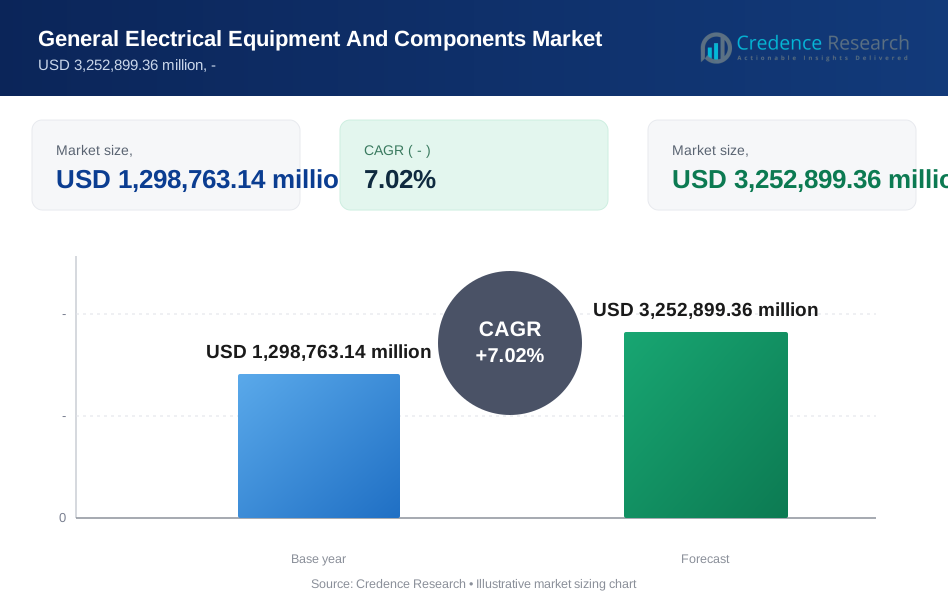
The general electrical equipment and components market is projected to grow from USD 1,298,763.14 million in 2024 to USD 3,252,899.36 million by 2032, at a compound annual growth rate (CAGR) of 10.74% during the period from 2024 to 2032.
The General Electrical Equipment and Components Market encompasses a broad range of products essential for generating, transmitting, and utilizing electricity across various sectors, including residential, commercial, industrial, and utility applications. This market is critical for the global economy, as it underpins the infrastructure for electrical supply and distribution, contributing to the overall development and technological advancement of societies worldwide.
The market includes a diverse array of products such as transformers, switchgear, circuit breakers, cables and wires, relays, and other electrical components. These products are pivotal for the safe and efficient distribution of electricity, ensuring reliable power supply to meet the growing energy demands of the modern world. The sector is characterized by continuous innovation, with significant emphasis on enhancing energy efficiency, reducing environmental impact, and integrating smart technologies.
Driven by factors such as increasing urbanization, industrial growth, and the global shift towards renewable energy sources, the demand for electrical equipment and components has been steadily rising. The transition to green energy, marked by the adoption of solar and wind power, necessitates the expansion of electrical grids and the development of new technologies capable of integrating renewable energy sources with existing infrastructure. Moreover, the advent of smart grids, electric vehicles, and IoT-enabled devices has introduced new dimensions to the market, focusing on energy management, efficiency, and sustainability.
The market is also influenced by regulatory policies aimed at energy conservation and environmental protection, prompting manufacturers to innovate and produce eco-friendly and energy-efficient products. Challenges such as raw material price volatility, international trade dynamics, and competition from low-cost producers remain prevalent. However, opportunities for growth are abundant, particularly in emerging markets with expanding infrastructure projects and in developed markets through the replacement and upgrading of aging electrical infrastructure.
Key market drivers
Technological Innovations and Advancements
Technological advancements play a crucial role in driving the general electrical equipment and component market. Innovations in material science have led to the development of more efficient, reliable, and durable electrical components. For instance, the introduction of silicon carbide (SiC) and gallium nitride (GaN) semiconductors has revolutionized power electronics, enabling devices to operate at higher temperatures, voltages, and frequencies. These advancements not only improve the performance of electrical equipment but also contribute to energy savings and reduced environmental impact.
Moreover, the integration of the Internet of Things (IoT) with electrical equipment has opened new avenues for market growth. IoT-enabled devices offer enhanced connectivity and intelligence, allowing for remote monitoring, predictive maintenance, and improved energy management. This integration is particularly beneficial in industrial and commercial applications, where optimizing energy use and reducing operational costs are critical.
Growing Demand for Renewable Energy
The global shift towards renewable energy sources, such as solar and wind power, has significantly driven the demand for electrical equipment and components. Renewable energy projects require a wide range of electrical components, including inverters, transformers, and switchgear, to convert and distribute electrical power efficiently. The increasing investments in renewable energy infrastructure by governments and private entities worldwide are fueling the growth of this market.
Additionally, the rising awareness of environmental issues and the need to reduce greenhouse gas emissions have prompted both developed and developing countries to invest in clean energy projects. This trend is expected to continue, with renewable energy playing a pivotal role in the global energy mix, thereby driving the demand for electrical equipment and components.
Key market restraints
Despite the positive outlook, the general electrical equipment and components market faces several restraints. One of the primary challenges is the fluctuation in raw material prices, such as copper, aluminum, and steel, which are essential for manufacturing electrical components. These fluctuations can significantly affect production costs, impacting the profitability of manufacturers.
Another restraint is the stringent regulatory standards and compliance requirements across different regions. Electrical equipment and components must meet various safety, quality, and environmental standards. Compliance with these regulations can increase production costs and time to market, potentially hindering market growth.
The COVID-19 pandemic has disrupted global supply chains, causing significant fluctuations in the prices of essential raw materials such as copper, aluminum, and steel. The conflict has exacerbated these disruptions due to Russia's role as a major supplier of raw materials and energy, along with imposed sanctions and geopolitical instability. Additionally, the pandemic and geopolitical tensions have led to a rapid evolution of regulatory standards and compliance requirements, increasing production costs and time to market. These factors not only hinder market growth but also demand adaptability and resilience from manufacturers and stakeholders, navigating through an increasingly complex landscape with amplified challenges in supply chain volatility and regulatory complexities.
Market Opportunities
- With the global shift towards renewable energy to combat climate change, there is a significant demand for electrical equipment and components that can integrate renewable sources such as solar and wind power into the existing grid efficiently. Products like advanced transformers, inverters, and storage solutions offer substantial growth prospects.
- The development of smart grids and the rise of smart cities create a need for intelligent electrical components that can manage electricity distribution more efficiently and reliably. Smart meters, sensors, and IoT-enabled devices that facilitate real-time monitoring and energy management represent a major opportunity for innovation and expansion.
- The rapid adoption of electric vehicles worldwide necessitates the expansion of EV charging infrastructure. This trend offers a considerable market for high-power transformers, charging stations, and related components that are essential for supporting the growing EV ecosystem.
- Regulatory pressures and societal demand for sustainability are driving the need for energy-efficient and eco-friendly electrical components. Products that minimize energy loss, use sustainable materials, or are recyclable at the end of their life cycle are increasingly in demand, opening new avenues for manufacturers to differentiate their offerings.
- In many developed countries, electrical infrastructure is aging and needs upgrading or replacement. This scenario presents a substantial market for modern, more efficient electrical equipment and components, including switchgears, circuit breakers, and transformers.
- Rapid urbanization and industrialization in emerging economies are leading to increased demand for electrical infrastructure development. This presents a significant opportunity for companies to enter new markets with tailored solutions that address local needs and conditions.
- Continuous innovation in materials science and electrical engineering opens up new opportunities for developing more compact, efficient, and reliable electrical components. Advancements in nanotechnology, semiconductor materials, and wireless communication technologies can lead to the next generation of electrical equipment and components.
- The trend towards decentralized power generation, where electricity is produced closer to the point of consumption, requires a different set of electrical components and systems. This shift offers market opportunities for modular, scalable electrical equipment tailored for distributed energy resources.
Interesting Facts About the Market
- The global market for general electrical equipment and components is projected to reach billions of dollars by the end of the decade, growing at a significant CAGR.
- Asia-Pacific is the largest market, driven by the rapid industrialization and urbanization of countries like China and India.
- The adoption of LED lighting technology has significantly reduced energy consumption and costs, impacting the lighting equipment segment.
- Smart meters and grid automation technologies are becoming increasingly prevalent, offering real-time data monitoring and energy management.
- The United States and Europe are leading in the adoption of renewable energy technologies, driving the demand for related electrical equipment.
- Innovations in battery technology have led to improved energy storage solutions, essential for renewable energy systems.
- The electric vehicle market's growth is creating a surge in demand for EV charging stations and related components.
- The COVID-19 pandemic accelerated the adoption of digital and remote monitoring solutions in the electrical equipment sector.
- Environmental regulations and sustainability initiatives are influencing the development and adoption of eco-friendly electrical components.
- The integration of artificial intelligence and machine learning in electrical components is improving efficiency, predictive maintenance, and energy management.
Key Players
- Panasonic Corporation,
- Samsung Electronics Co. Ltd.,
- Preformed Line Products Company,
- Eos Energy Enterprises Inc.,
- Orion Energy Systems Inc.,
- Signify N.V.,
- Ultralife Corporation,
- GrafTech International Ltd.,
- Asia Pacific Wire & Cable Corporation Limited
- Asea Brown Boveri (ABB) Ltd.,
- Sumitomo Electric Industries Ltd.,
- Acuity Brands Inc.,
- Voltronic Power Technology Corp,
- Walsin Lihwa Corp,
- Hongfa Technology Co. Ltd.,
- Ningbo Orient Wires & Cables Co. Ltd.,
- Belden Inc.,
- Shanghai MOONS' Electric Co. Ltd.,
- China XD Electric Co. Ltd.,
- Toshiba Corporation,
- Eaton,
- Emerson Electric,
- Schneider Electric,
- Siemens,
- Automatic Inc.,
- Intel,
- Taiwan Semiconductor Manufacturing Company (TSMC),
- Micron Technology,
- Qualcomm,
- Prysmian S.p.A.,
- Yaskawa Electric Corporation,
- Vertiv Holdings Co.,
- nVent Electric PLC,
- Zhejiang Chint Electrics Co. Ltd.,
- Nexans SA,
Competitive Landscape
The general electrical equipment and components market is highly competitive, with players competing on the basis of product quality, innovation, price, and after-sales service. Companies are increasingly investing in research and development to introduce energy-efficient and advanced products. Strategic partnerships, acquisitions, and expansion into new markets are common strategies adopted by firms to enhance their market presence and meet the diverse needs of customers.
Segmentations:
By Mode:
- Online
- Offline
By Sales Channel:
- OEM
- Aftermarket
By End User:
- Commercial
- Residential
By Region
- North America
- The U.S.
- Canada
- Mexico
- Europe
- Germany
- France
- The U.K.
- Italy
- Spain
- Rest of Europe
- Asia Pacific
- China
- Japan
- India
- South Korea
- South-east Asia
- Rest of Asia Pacific
- Latin America
- Brazil
- Argentina
- Rest of Latin America
- Middle East & Africa
- GCC Countries
- South Africa
- Rest of the Middle East and Africa
Regional Analysis
The General Electrical Equipment and Components Market exhibits significant variation across different regions, influenced by a myriad of factors including economic development, the level of industrialization, and government policies. In the Asia-Pacific region, the market is witnessing substantial growth, emerging as the largest and fastest-growing market globally. This growth is primarily driven by rapid urbanization and industrialization, with countries like China and India playing pivotal roles. The region's commitment to renewable energy and substantial infrastructure development projects are key contributors to its market expansion. Conversely, North America, with the United States at its forefront, represents a mature market. This region is characterized by a high demand for advanced and energy-efficient electrical components. The focus on renewable energy sources and efforts to modernize aging electrical infrastructure are central to driving market growth in North America.
In Europe, the market dynamics are shaped by stringent environmental regulations, a high level of awareness regarding energy efficiency, and significant investments in renewable energy projects. The European Union's ambitious goals to reduce greenhouse gas emissions act as a catalyst, stimulating demand for advanced electrical equipment and components. Meanwhile, the Middle East and Africa are experiencing market growth fueled by infrastructure development projects and increasing access to electricity, particularly in African countries. The investment surge in renewable energy sources, especially solar power in the Middle East, opens new avenues for market opportunities. In Latin America, the market is on a steady growth trajectory, supported by renewable energy investments and initiatives to enhance the electrical infrastructure. Countries such as Brazil and Mexico are at the forefront of adopting renewable energy technologies, further contributing to the market's growth in this region.
Future Outlook
- Continued Growth in Renewable Energy: The market is expected to benefit significantly from the ongoing global shift towards renewable energy sources.
- Technological Advancements: Innovations in materials and digital technologies will continue to improve the efficiency and functionality of electrical equipment.
- Increased Focus on Energy Efficiency: Energy efficiency will remain a key focus area, driving demand for advanced electrical components.
- Smart Grid Development: Investments in smart grid technologies will grow, offering opportunities for market expansion.
- Infrastructure Modernization: The need to modernize and upgrade electrical infrastructure worldwide will drive market growth.
- Electric Vehicle Adoption: As electric vehicle adoption increases, so will the demand for charging infrastructure and related electrical components.
- Energy Storage Advancements: Developments in energy storage technologies will create new opportunities, particularly in integrating renewable energy into the grid.
- Digitalization and IoT Integration: The integration of IoT and digital technologies in electrical equipment will enhance monitoring, control, and energy management capabilities.
- Regulatory and Environmental Standards: Compliance with regulatory and environmental standards will influence product development and market dynamics.
- Expansion in Emerging Markets: Continued urbanization and industrialization in emerging markets will provide significant growth opportunities.
Request a Free Sample
Fill in your details and we'll send you a free sample report.
- Sample data tables & charts
- Research methodology
Need a Custom Version of This Report?
Tailor the scope, geography, or segments to your exact requirements.
- Custom geography or segment scope
- Direct access to our analyst team
Frequently Asked Questions
What is the expected compound annual growth rate (CAGR) for the global high-power transformer market between 2024 and 2032?
What are some of the key factors driving growth in the high-power transformer market?
Which transformer type holds the largest share in the global high-power transformer market?
Which end-use sectors are the major consumers of high-power transformers worldwide?
Table of Content
Chapter 1. Report Introduction
- 1.1 Report Description & Purpose
- 1.1.1 Report Title & Market Definition
- 1.1.2 Unique Selling Propositions (USP) & Key Differentiators
- 1.1.3 Value Proposition for Stakeholders
- 1.2 Research Objectives
- 1.2.1 Market Sizing Objectives (Volume & Revenue)
- 1.2.2 Segmentation Objectives
- 1.2.3 Competitive Intelligence Objectives
- 1.2.4 Forecast & Scenario Objectives
- 1.3 Report Scope
- 1.3.1 General Electrical Equipment And Components Scope – Types & Subtypes Covered
- 1.3.2 Geographic Scope – Regions & Countries Covered
- 1.3.3 Historical Period, Base Year & Forecast Period (the historical period; forecast to the forecast period)
- 1.3.4 Inclusions & Exclusions
- 1.4 HS Code & Classification Framework
- 1.5 Currency, Units & Pricing Basis
- 1.6 Target Stakeholders
- 1.7 Limitations & Assumptions
Chapter 2. Executive Summary
- 2.1 Global General Electrical Equipment And Components Market Snapshot
- 2.1.1 Market Size – Historical (the historical period) & Forecast (the forecast period) (base year: USD 1,298,763.14 million → forecast year: USD 3,252,899.36 million)
- 2.1.2 Volume & Revenue – Global Totals
- 2.1.3 Key Market Highlights – Top Five Facts
- 2.2 General Electrical Equipment And Components Market Segmentation Snapshot
- 2.2.1 Market Split by Region – vs.
- 2.3 Competitive Snapshot
- 2.3.1 Top 10 Players by Revenue Share –
- 2.3.2 Top 10 Players by Volume Share –
- 2.3.3 Recent Strategic Developments (18-Month Summary)
- 2.4 Key Investment Highlights & Strategic Conclusions
Chapter 3. General Electrical Equipment And Components Market Dynamics & Industry Analysis
- 3.1 Market Overview & Context
- 3.1.1 General Electrical Equipment And Components Market Position in the Broader Automotive Value Chain
- 3.1.2 OEM vs. Replacement Market Dynamics
- 3.1.3 Market Maturity & Development Stage by Region
- 3.2 General Electrical Equipment And Components Market Drivers
- 3.3 General Electrical Equipment And Components Market Restraints & Challenges
- 3.4 General Electrical Equipment And Components Market Opportunities
- 3.5 Porter's Five Forces Analysis
- 3.5.1 Threat of New Entrants
- 3.5.2 Bargaining Power of Suppliers
- 3.5.3 Bargaining Power of Buyers
- 3.5.4 Threat of Substitutes
- 3.5.5 Competitive Rivalry – Intensity Assessment
- 3.6 General Electrical Equipment And Components Value Chain Analysis
- 3.6.1 Upstream – Raw Material/Input Suppliers
- 3.6.1.1 Raw Material/Input 1
- 3.6.1.2 Raw Material/Input 2
- 3.6.1.3 Raw Material/Input 3
- 3.6.2 Midstream – Production/Manufacturing/Service Delivery
- 3.6.2.1 Production/Process Overview
- 3.6.2.2 Key Facility Locations & Capacity by Manufacturer
- 3.6.3 Downstream – Distribution & End Consumer
- 3.6.3.1 Primary Channel – B2B/OEM
- 3.6.3.2 Secondary Channels – Dealer, Retail, Online, Direct
- 3.6.4 Value Chain Profitability Analysis
- 3.6.1 Upstream – Raw Material/Input Suppliers
- 3.7 PESTEL Analysis
- 3.7.1 Political Factors
- 3.7.2 Economic Factors
- 3.7.3 Social Factors
- 3.7.4 Technological Factors
- 3.7.5 Environmental Factors
- 3.7.6 Legal Factors
- 3.8 General Electrical Equipment And Components Supply Chain Analysis
- 3.8.1 Raw Material/Input Supply Risk Assessment
- 3.8.2 Manufacturing Concentration Risk (Geographic Exposure)
- 3.8.3 Trade Disruption Impact Analysis
- 3.9 Regulatory & Policy Landscape
Note: The regulatory and policy landscape section covers regulations based on their applicability to the market, General Electrical Equipment And Components category, geography, and scope of the study. Only regulatory frameworks with a material impact on operations, compliance, trade, sustainability, or market access are analyzed in detail.
Chapter 4. Key Investment Pockets & Opportunity Analysis
- 4.1 General Electrical Equipment And Components Market Attractiveness Analysis
- 4.1.1 By Region – Investment Attractiveness Matrix (Volume × CAGR)
- 4.2 Absolute Revenue Growth Opportunity
- 4.2.1 By Region – Absolute USD Growth Through the forecast period
- 4.3 Incremental Volume Opportunity
- 4.3.1 By Region – Incremental Volume Through the forecast period
- 4.3.2 Segment – Incremental Volume
- 4.4 Emerging Submarket Opportunity Deep Dive (Subject to Applicability)
- 4.5 Emerging Market Opportunity Scorecards
- 4.5.1 United States
- 4.5.2 Europe
- 4.5.3 Asia
- 4.5.4 Middle East & Africa
Note: Emerging Market Opportunity Scorecards will be included based on relevance and strategic importance. Regions listed are indicative and may vary depending on data availability and market dynamics.
Chapter 5. General Electrical Equipment And Components Import-Export Analysis & Trade Flows
- 5.1 Global Trade Overview
- 5.1.1 Global Export Value by Country (the historical period)
- 5.1.2 Global Export Volume by Country (the historical period)
- 5.1.3 Global Import Value by Country (the historical period)
- 5.1.4 Global Import Volume by Country (the historical period)
- 5.1.5 Net Trade Balance by Country (the historical period)
- 5.2 Export Analysis – Segment
- 5.2.1 Type 1 (HS Code)
- 5.2.2 Type 2 (HS Code)
- 5.2.3 Type 3 (HS Code)
- 5.2.4 Type 4 (HS Code)
- 5.2.5 Type 5 (HS Code)
- 5.3 Import Analysis – Segment
- 5.3.1 Type 1 (HS Code)
- 5.3.2 Type 2 (HS Code)
- 5.3.3 Type 3 (HS Code)
- 5.3.4 Type 4 (HS Code)
- 5.3.5 Type 5 (HS Code)
- 5.4 Average Unit Trade Prices
- 5.4.1 Average Export Price – Segment & Country
- 5.4.2 Average Import Price – Segment & Source Country
- 5.4.3 Price Trends (the historical period)
- 5.5 Key Trade Route Analysis
- 5.5.1 Trade Route 1
- 5.5.2 Trade Route 2
- 5.5.3 Trade Route 3
- 5.5.4 Trade Route 4
- 5.5.5 Trade Route 5
- 5.6 Trade Policy Impact Assessment
- 5.6.1 US Anti-Dumping & Section 301 Tariffs
- 5.6.2 EU Customs Union Impact
- 5.6.3 Major Free Trade Agreements
- 5.6.4 USMCA Rules of Origin
Note: Trade policy analysis will be included only where relevant to the General Electrical Equipment And Components market.
Chapter 6. Competitive Landscape & Company Benchmarking
- 6.1 General Electrical Equipment And Components Market Concentration & Structure
- 6.1.1 Herfindahl-Hirschman Index (HHI) – vs.
- 6.1.2 Tier 1, Tier 2 & Tier 3 Market Structure
- 6.1.3 Global, Regional & Local Player Dynamics
- 6.2 General Electrical Equipment And Components Market Share Analysis –
- 6.2.1 Global Revenue Share by Company
- 6.2.2 Global Volume Share by Company
- 6.2.3 Regional Revenue Share
- 6.2.4 Market Share Evolution ( vs. )
- 6.2.5 OEM Segment Share by Company
- 6.2.6 Replacement Segment Share by Company
- 6.3 Production/Delivery Capacity & Facility Analysis
- 6.3.1 Global Installed Capacity
- 6.3.2 Capacity Utilization Rates
- 6.3.3 Production/Output Volume
- 6.3.4 Facility Locations & Capacity Map
- 6.3.5 Planned Capacity Additions
- 6.4 General Electrical Equipment And Components Competitive Benchmarking Matrix
- 6.4.1 Revenue, Volume, CAGR & Profitability Comparison
- 6.4.2 Channel Revenue Mix
- 6.4.3 Geographic Revenue Exposure
- 6.4.4 R&D Intensity
- 6.4.5 Sustainability Maturity
- 6.5 Strategic Developments in General Electrical Equipment And Components (Last 24 Months)
- 6.5.1 Mergers, Acquisitions & Divestments
- 6.5.2 New General Electrical Equipment And Components Launches
- 6.5.3 Facility Expansions
- 6.5.4 Strategic Alliances, Joint Ventures & Partnerships
- 6.5.5 Distribution Expansion & Market Entry
- 6.5.6 Sustainability & ESG Initiatives
- 6.6 Competitive Strategy Mapping
- 6.6.1 Leader, Challenger, Follower & Niche Classification
- 6.6.2 Pricing Strategy Comparison
- 6.6.3 Channel Strategy Matrix
Note: Strategic developments are included based on their materiality and the availability of reliable information.
Chapter 7. Global General Electrical Equipment And Components Market – By Distribution Channel
- 7.1 Segment Overview
- 7.1.1 Volume & Revenue Split by Channel ( & )
- 7.1.2 Channel Mix Evolution (the forecast period)
Chapter 8. Regional Market Analysis – Global Overview
- 8.1 Global Regional Overview
- 8.1.1 Regional Volume Share
- 8.1.2 Regional Revenue Share
- 8.1.3 Regional Volume by Region
- 8.1.4 Regional Revenue by Region
- 8.1.5 Regional Forecast Through the forecast period
- 8.2 Cross-Regional Segment Analysis
- 8.2.1 By Distribution Channel
- 8.2.2 By Brand/Price Tier
Chapter 9. North America General Electrical Equipment And Components Market
- 9.1 United States
- 9.2 Canada
- 9.3 Mexico
Chapter 10. Europe General Electrical Equipment And Components Market
- 10.1 Germany
- 10.2 France
- 10.3 Italy
- 10.4 United Kingdom
- 10.5 Spain
- 10.6 Poland
- 10.7 Russia
- 10.8 Netherlands
- 10.9 Belgium
- 10.10 Sweden
- 10.11 Denmark
- 10.12 Norway
- 10.13 Rest of Europe
Chapter 11. Asia Pacific General Electrical Equipment And Components Market
- 11.1 China
- 11.2 India
- 11.3 Japan
- 11.4 South Korea
- 11.5 Thailand
- 11.6 Indonesia
- 11.7 Vietnam
- 11.8 Malaysia
- 11.9 Australia
- 11.10 Rest of Asia Pacific
Chapter 12. Latin America General Electrical Equipment And Components Market
- 12.1 Brazil
- 12.2 Argentina
- 12.3 Colombia
- 12.4 Chile
- 12.5 Rest of Latin America
Chapter 13. Middle East General Electrical Equipment And Components Market
- 13.1 Saudi Arabia
- 13.2 United Arab Emirates
- 13.3 Turkey
- 13.4 Israel
- 13.5 Iran
- 13.6 Rest of the Middle East
Chapter 14. Africa General Electrical Equipment And Components Market
- 14.1 South Africa
- 14.2 Egypt
- 14.3 Nigeria
- 14.4 Morocco
- 14.5 Rest of Africa
Chapter 15. General Electrical Equipment And Components Company Profiles
- 15.1 [Company 01]
- 15.1.1 Company Overview
- 15.1.2 Key Management Personnel
- 15.1.3 Products & Services Portfolio
- 15.1.4 Financial Performance
- 15.1.5 Key Market Focus & Geographic Presence
- 15.1.6 Recent Developments & Strategic Initiatives
Note: The company profile list is preliminary and may change based on research findings, market developments, data availability, and client requirements.
Chapter 16. Appendices
- Appendix A – List of Abbreviations & Acronyms
- Appendix B – Industry Classification Code Reference – Full Series
- Appendix C – Production & Capacity Data Tables
- Appendix D – End-Use & Demand Base Tables
- Appendix E – Consumption & Replacement Rate Assumptions
- Appendix F – ASP Reference Tables
- Appendix G – Manufacturing & Facility Database
- Appendix H – Import-Export Data Tables
- Appendix I – Regulatory Summary Tables
- Appendix J – Primary Research Participant List (Anonymized)
- Appendix K – Primary Research Questionnaire Framework
- Appendix L – Data Sources & Bibliography
- Appendix M – Market Size Divergence & Source Comparison
Chapter 17. Research Methodology
- 17.1 Research Framework & Philosophy
- 17.2 Secondary Research – Sources, Hierarchy & Data Extraction
- 17.3 Data Modeling – Bottom-Up & Top-Down Market Sizing
- 17.4 Primary Research – Stakeholder Framework, LOI & Sample Sizes
- 17.5 Forecast Methodology – Regression, Scenario & Sensitivity Analysis
- 17.6 Quality Control – Four-Layer Validation Framework
- 17.7 Limitations & Standard Assumptions
- 17.8 Disclaimer
