
Market Overview:
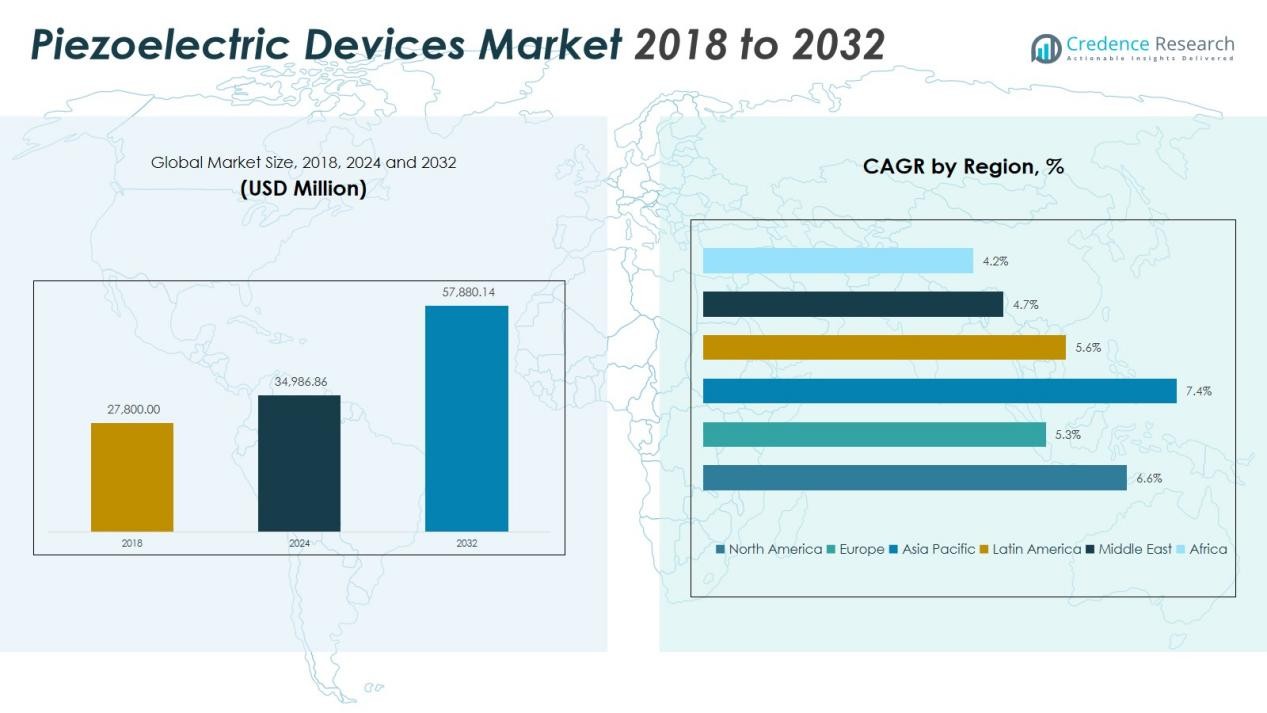
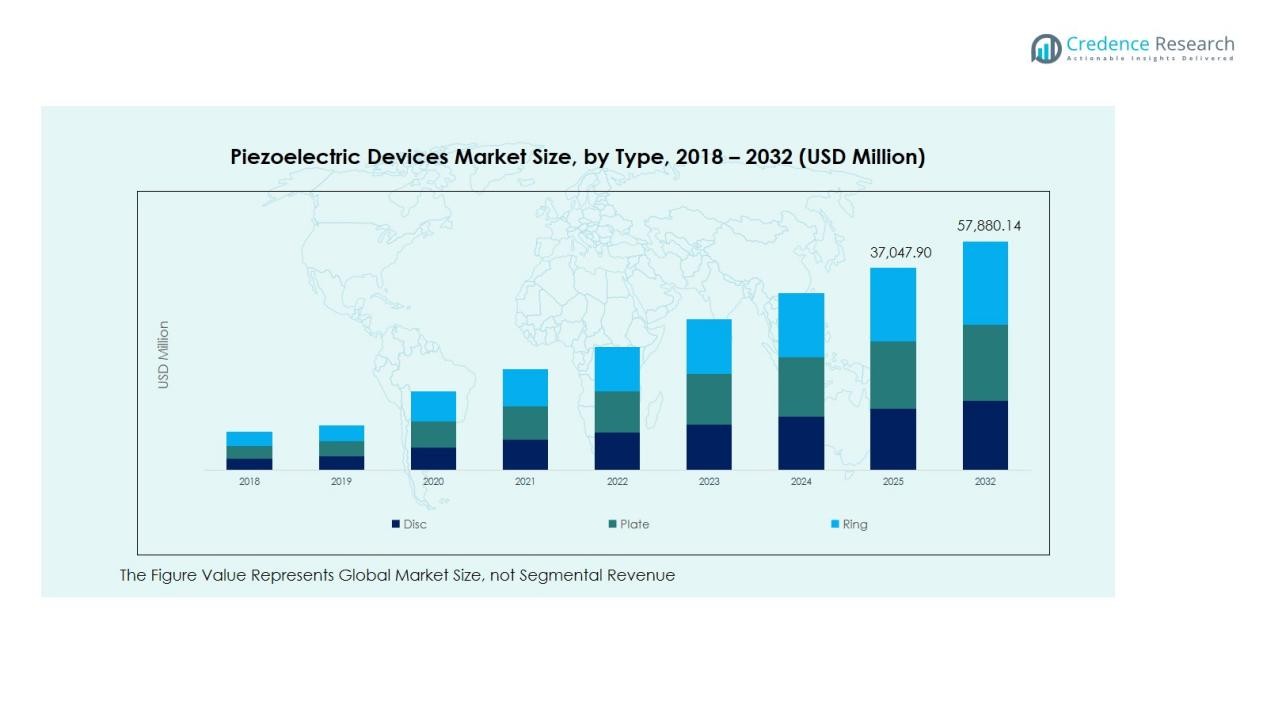
The Global Piezoelectric Devices Market size was valued at USD 27,800 million in 2018 to USD 34,986.86 million in 2024 and is anticipated to reach USD 57,880.14 million by 2032, at a CAGR of 6.58%during the forecast period.
| REPORT ATTRIBUTE | DETAILS |
|---|---|
| Historical Period | 2020-2023 |
| Base Year | 2024 |
| Forecast Period | 2025-2032 |
| Piezoelectric Devices Market Size 2024 | USD 34,986.86 Million |
| Piezoelectric Devices Market, CAGR | 6.58% |
| Piezoelectric Devices Market Size 2032 | USD 57,880.14 Million |
Key growth drivers include the expanding use of piezoelectric devices in automotive, aerospace, defence, healthcare, and consumer electronics industries. The rise in demand for sensors, actuators, and energy-harvesting systems further accelerates adoption. Advancements in materials such as ceramics, composites, and polymers have enhanced device efficiency, durability, and cost-effectiveness. The growing emphasis on automation and miniaturization in industrial and medical applications also boosts market growth.
The Asia-Pacific region dominates the global piezoelectric devices market, accounting for more than half of total revenue in 2024. Countries like China, Japan, South Korea, and India serve as major manufacturing and innovation hubs. North America and Europe follow, supported by strong healthcare, automotive, and industrial automation sectors, though their growth pace remains moderate compared to Asia-Pacific.
Market Insights:
- The Global Piezoelectric Devices Market was valued at USD 27,800 million in 2018, increased to USD 34,986.86 million in 2024, and is projected to reach USD 57,880.14 million by 2032, registering a CAGR of 6.58% during the forecast period.
- Asia Pacific holds the largest share of 42%, driven by strong electronics manufacturing in China, Japan, and South Korea, along with growing automation and semiconductor production.
- North America accounts for 28% of the global share, supported by advanced aerospace, defense, and healthcare industries with high R&D spending.
- Europe captures 22% market share, led by Germany, the U.K., and France, owing to robust automotive manufacturing and sustainable material innovation.
- The Asia Pacific region remains the fastest-growing market due to industrial expansion, government-backed automation programs, and high consumer electronics demand.
Market Drivers:
Rising Adoption in Automotive and Industrial Automation
The Global Piezoelectric Devices Market benefits from the rising use of sensors and actuators in automotive and industrial automation. Piezoelectric components enhance engine management, vibration control, and fuel efficiency in modern vehicles. Their precision and quick response make them ideal for automation systems and process control. Increasing demand for electric vehicles and factory digitalization further expands adoption across manufacturing sectors. It continues to gain traction with the integration of smart sensors into industrial equipment.
- For instance, in automotive applications, Bosch reports piezoelectric actuators enabling multi-injection control with sub-10 microsecond response times in high-pressure fuel systems, improving combustion efficiency by enabling up to 3 precise injections per cycle.
Growing Demand in Healthcare and Medical Diagnostics
Piezoelectric technology is gaining ground in medical imaging, diagnostics, and therapeutic equipment. Devices such as ultrasound transducers, nebulizers, and surgical instruments rely on accurate vibration and frequency control. The Global Piezoelectric Devices Market experiences higher demand as healthcare facilities adopt compact and energy-efficient solutions. Rising investments in portable and wearable medical devices strengthen growth prospects. It finds increased use in diagnostic imaging due to the need for precision and reliability.
- For instance, Philips Healthcare's PureWave crystal technology represents a significant breakthrough, delivering transducers that generate frequencies ranging from 2 to 22 MHz, with the eL18-4 transducer optimized to operate in the clinically relevant range of 4 to 18 MHz, achieving 85% greater efficiency than traditional piezoelectric (PZT) material in converting electrical input into acoustic output.
Technological Advancements and Material Innovation
Continuous innovation in piezoelectric materials supports enhanced performance and cost efficiency. Advancements in lead-free ceramics, polymers, and composite materials improve sensitivity and durability. The market benefits from research focused on miniaturization and integration into microelectromechanical systems (MEMS). It leverages advancements in nanotechnology to expand application scope across consumer electronics and smart devices. Manufacturers are developing materials that enable broader operational ranges and improved energy conversion.
Rising Adoption of Energy Harvesting and Smart Devices
The demand for self-powered electronics and IoT devices is driving the use of piezoelectric energy-harvesting modules. These systems convert mechanical stress into usable electrical energy, reducing dependence on external power sources. The Global Piezoelectric Devices Market gains momentum through applications in sensors, wearables, and remote monitoring systems. Growing trends in smart infrastructure and connected environments accelerate market penetration. It remains vital for creating sustainable, low-power electronic ecosystems.
Market Trends:
Integration of Piezoelectric Technology in Smart and Connected Devices
The Global Piezoelectric Devices Market is witnessing a steady shift toward smart and connected applications across industries. Piezoelectric sensors are now essential in consumer electronics, automotive safety systems, and industrial automation. Their ability to detect pressure, vibration, and acceleration enables real-time data collection in Internet of Things (IoT) ecosystems. Miniaturization and integration with microelectromechanical systems (MEMS) are supporting compact, energy-efficient device designs. It benefits from growing use in smartphones, wearables, and home automation solutions that rely on accurate motion and sound detection. Manufacturers are expanding R&D efforts to improve signal sensitivity, enhance temperature stability, and reduce power consumption. This trend reflects the rising preference for multifunctional sensors that improve performance without adding system complexity.
- For instance, the Bosch Sensortec BMI270 6-axis IMU demonstrates this integration with output data rates spanning from 0.78 Hz to 6.4 kHz across its accelerometer and gyroscope functions, while maintaining ultra-low power consumption of 685 μA in full operation, making it ideal for wearable applications where energy efficiency is critical
Shift Toward Lead-Free Materials and Sustainable Manufacturing
The market is increasingly adopting lead-free and environmentally sustainable piezoelectric materials. Regulations on hazardous substances and rising demand for eco-friendly products are influencing material innovation. Researchers are developing alternatives to lead zirconate titanate (PZT), such as barium titanate and potassium sodium niobate, which provide better compliance with environmental standards. It is driving manufacturers to re-engineer products to maintain high efficiency and mechanical reliability while meeting sustainability goals. Advancements in additive manufacturing and thin-film deposition techniques are enabling mass production of eco-conscious components. The trend toward green production practices aligns with the growing demand for sustainable electronics across automotive, healthcare, and consumer sectors. This evolution reinforces the market’s transition toward cleaner, high-performance material technologies.
- For instance, CeramTec has developed lead-free piezoceramics for medical applications with response times of 100 microseconds for ultrasonic bubble sensors, achieving detection accuracy of ±2mm and enabling bubble detection as small as 1 microliter across diverse liquid flow rates
Market Challenges Analysis:
High Production Costs and Complex Material Processing
The Global Piezoelectric Devices Market faces significant challenges related to high manufacturing costs and material complexity. Producing piezoelectric components requires precision machining, specialized ceramics, and advanced fabrication technologies that increase overall expenses. It encounters limitations in achieving economies of scale, especially for small and mid-sized manufacturers. The dependence on costly materials such as lead zirconate titanate and single crystals adds further strain to production budgets. Complex processing techniques also reduce yield rates and slow production cycles. These factors collectively restrict widespread adoption in cost-sensitive industries like consumer electronics and automotive sensors.
Performance Limitations and Environmental Concerns
The market struggles with technical constraints related to temperature stability, durability, and mechanical fatigue of piezoelectric materials. It faces challenges in maintaining long-term performance under high stress, vibration, or extreme temperature conditions. Environmental regulations restricting the use of lead-based materials create added compliance burdens for manufacturers. Developing reliable lead-free alternatives that match traditional performance remains difficult. The shift toward sustainability increases R&D costs and extends product development timelines. These factors slow innovation cycles and delay commercialization of next-generation piezoelectric technologies.
Market Opportunities:
Emerging Applications in Energy Harvesting and Smart Infrastructure
The Global Piezoelectric Devices Market holds strong opportunities in energy harvesting and smart infrastructure development. Rising demand for self-powered devices in IoT networks is creating new use cases for piezoelectric sensors and actuators. These components can capture mechanical vibrations or movements to generate energy, reducing dependence on traditional batteries. It benefits from rapid adoption in wearable electronics, industrial monitoring systems, and smart city projects. Integration into roads, bridges, and buildings for real-time structural health monitoring presents significant growth potential. Expanding renewable energy initiatives and the drive for energy-efficient solutions will further accelerate market expansion.
Advancements in Healthcare, Aerospace, and Consumer Electronics
The market is set to gain momentum through advancements in healthcare diagnostics, aerospace systems, and next-generation consumer electronics. Piezoelectric technologies are increasingly used in ultrasound imaging, surgical tools, and precision fluid pumps. It offers opportunities for high-precision motion control and sensing in aircraft and spacecraft applications. The growing demand for compact and high-performance electronic devices boosts adoption in smartphones, audio systems, and touch interfaces. Emerging trends in 5G communication and MEMS-based devices also support innovation. These opportunities highlight the expanding application horizon for piezoelectric technology across multiple industries.
Market Segmentation Analysis:
By Type
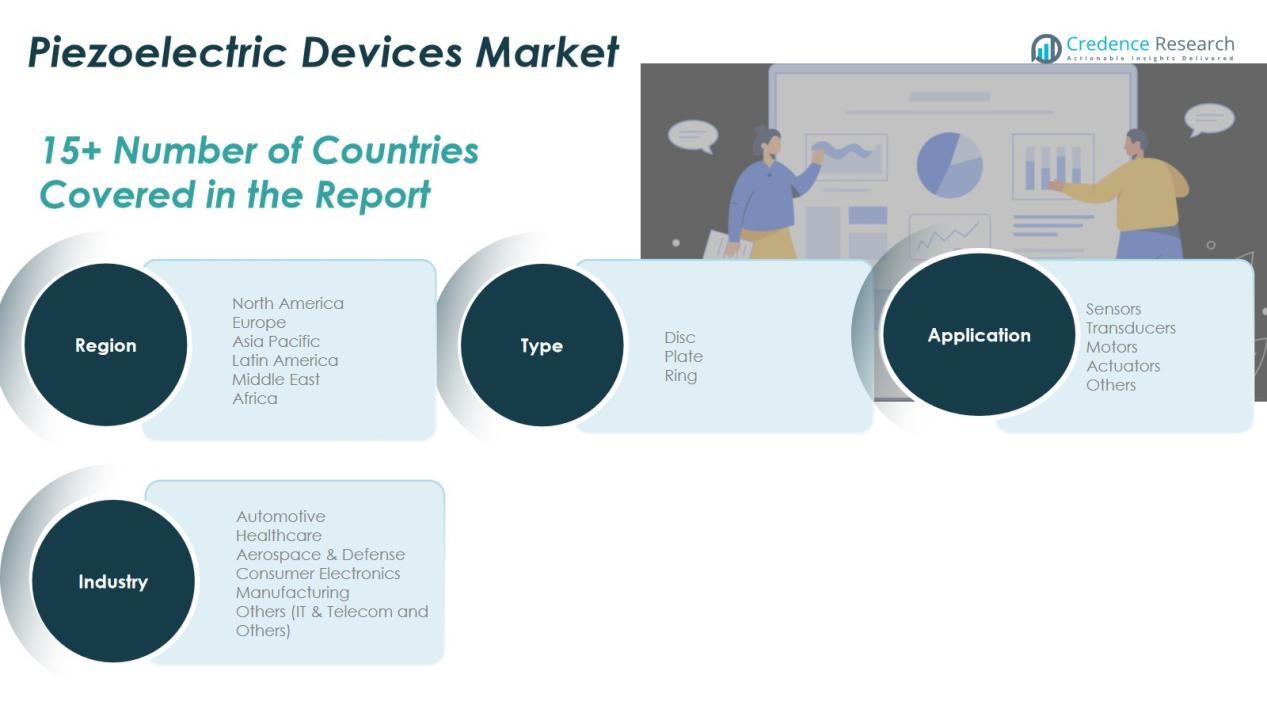
The Global Piezoelectric Devices Market is segmented into disc, plate, and ring types. Disc-type devices hold a significant share due to their compact structure and suitability for medical imaging and ultrasonic applications. Plate configurations are gaining traction in industrial sensors and actuators due to their high energy conversion efficiency. It continues to witness growth in ring-type components, supported by increased adoption in vibration control and high-precision motion systems. The diverse use of each type across industries strengthens the overall market expansion.
- For instance, APC International's disc-type piezoelectric materials (APC 850 and APC 855) utilized in ultrasound medical devices achieve an electromechanical coupling coefficient of 0.68 and 0.72 respectively, with dielectric constants reaching 1900 and 3300, providing high precision and clean frequency response critical for diagnostic ultrasound imaging systems.
By Application
Based on application, the market includes sensors, transducers, motors, actuators, and others. Sensors account for the largest share, driven by rising demand in automotive, aerospace, and healthcare sectors. Transducers show strong potential in ultrasonic imaging and sonar technologies. Motors and actuators are experiencing rapid growth due to increased automation and robotics adoption. It benefits from growing use of piezoelectric components in precision instruments and advanced manufacturing processes.
- For instance, advanced piezoelectric transducers have achieved exceptional performance capabilities in high-frequency medical imaging applications, with researchers successfully developing lithium niobate-based ultrasonic transducers operating at 300 MHz with piezoelectric layer thickness of only 9 micrometers, enabling visualization of internal structures at the cellular level with beam widths as narrow as 6.5 micrometers.
By Industry
The market spans automotive, healthcare, aerospace and defense, consumer electronics, manufacturing, and others. Automotive leads due to growing integration of piezoelectric sensors in engine management and safety systems. Healthcare remains a key growth driver with applications in diagnostics and surgical tools. Consumer electronics and aerospace sectors are expanding adoption for enhanced sensing and control functions. It continues to evolve with industrial automation creating new demand across manufacturing lines.
Segmentations:
By Type
- Disc
- Plate
- Ring
By Application
- Sensors
- Transducers
- Motors
- Actuators
- Others
By Industry
- Automotive
- Healthcare
- Aerospace & Defense
- Consumer Electronics
- Manufacturing
- Others
By Region
North America
- U.S.
- Canada
- Mexico
- Europe
- UK
- France
- Germany
- Italy
- Spain
- Russia
- Rest of Europe
Asia Pacific
- China
- Japan
- South Korea
- India
- Australia
- Southeast Asia
- Rest of Asia Pacific
Latin America
- Brazil
- Argentina
- Rest of Latin America
Middle East
- GCC Countries
- Israel
- Turkey
- Rest of Middle East
Africa
- South Africa
- Egypt
- Rest of Africa
Regional Analysis:
North America
The North America Piezoelectric Devices Market size was valued at USD 8,173.20 million in 2018, reaching USD 10,131.98 million in 2024, and is anticipated to reach USD 16,733.25 million by 2032, at a CAGR of 6.6% during the forecast period. The region accounts for 28% of the global revenue share. The United States dominates due to advanced medical device, aerospace, and defense sectors. The Global Piezoelectric Devices Market in North America benefits from strong R&D investment and high adoption of automation technologies. It is further strengthened by demand for precision sensors and actuators in industrial and healthcare applications. Canada and Mexico support growth with expanding automotive and electronics manufacturing.
Europe
The Europe Piezoelectric Devices Market size was valued at USD 4,531.40 million in 2018, rising to USD 5,345.04 million in 2024, and projected to reach USD 8,031.02 million by 2032, at a CAGR of 5.3%. Europe represents 22% of the global market share. Germany, the U.K., and France lead growth due to strong industrial automation and automotive production. The Global Piezoelectric Devices Market in Europe benefits from regulations promoting sustainable material use and high-efficiency devices. It shows steady progress in precision manufacturing and smart infrastructure development. Companies like CeramTec and Morgan Advanced Materials drive continuous innovation in piezoelectric material engineering.
Asia Pacific
The Asia Pacific Piezoelectric Devices Market size was valued at USD 11,898.40 million in 2018, expanding to USD 15,353.84 million in 2024, and expected to reach USD 26,931.67 million by 2032, at a CAGR of 7.4%. The region commands 42% of the global market share, making it the largest contributor. China, Japan, and South Korea dominate production of sensors, actuators, and transducers used in consumer electronics and automotive systems. The Global Piezoelectric Devices Market gains momentum here through strong industrialization and government-backed automation programs. It benefits from large-scale semiconductor manufacturing and expanding demand for MEMS-based components. India and Southeast Asia are emerging as new growth centers for manufacturing and R&D.
Latin America
The Latin America Piezoelectric Devices Market size was valued at USD 1,812.56 million in 2018, growing to USD 2,259.80 million in 2024, and projected to reach USD 3,476.86 million by 2032, at a CAGR of 5.6%. The region contributes 5% of global revenue. Brazil and Mexico lead with rising demand for automotive sensors and healthcare diagnostics. The Global Piezoelectric Devices Market in Latin America is supported by industrial automation and electronics assembly growth. It benefits from increased investments in renewable energy and manufacturing modernization. Expanding industrial capacity and smart factory initiatives strengthen future market potential.
Middle East
The Middle East Piezoelectric Devices Market size was valued at USD 778.40 million in 2018, increasing to USD 895.44 million in 2024, and forecast to reach USD 1,279.47 million by 2032, at a CAGR of 4.7%. The region holds 2.5% of the total market share. The Global Piezoelectric Devices Market benefits from increased use of sensors in oil and gas operations, industrial systems, and defense projects. It gains support from infrastructure modernization and smart city programs in GCC nations. Growth is further supported by aerospace and healthcare technology investments in the UAE and Saudi Arabia. Expanding industrial automation continues to create long-term opportunities.
Africa
The Africa Piezoelectric Devices Market size was valued at USD 606.04 million in 2018, reaching USD 1,000.77 million in 2024, and projected to reach USD 1,427.86 million by 2032, at a CAGR of 4.2%. The region holds 2% of global market share. The Global Piezoelectric Devices Market in Africa is expanding through adoption of medical diagnostics and renewable energy systems. South Africa and Egypt lead demand for sensors in healthcare and consumer electronics. It benefits from industrialization and foreign investments in manufacturing. Despite limited local production, import-led growth and technological adoption continue to drive steady expansion.
Key Player Analysis:
- Piezo System Jena (Germany)
- Murata (Japan)
- Morgan Advanced Materials (U.K.)
- Mad City Labs, Inc. (U.S.)
- Poliak A/S (Denmark)
- CTS Corporation (U.S.)
- Piezomechanik Dr. Lutz Pickelmann GmbH (Germany)
- Physik Instrumente (Germany)
- CeramTec (Germany)
Competitive Analysis:
The Global Piezoelectric Devices Market is highly competitive with strong participation from multinational and regional manufacturers. Key players include Piezo System Jena, Murata, Morgan Advanced Materials, Mad City Labs, Poliak A/S, CTS Corporation, Piezomechanik Dr. Lutz Pickelmann GmbH, Physik Instrumente, CeramTec, and APC International. Competition centers on product innovation, material development, and integration of high-efficiency piezoelectric components. It focuses on expanding application scope across healthcare, automotive, aerospace, and consumer electronics industries. Companies are strengthening portfolios through R&D investments and collaboration with OEMs for customized piezoelectric solutions. Continuous advancements in lead-free materials, miniaturization, and energy harvesting technologies drive differentiation. The market structure favors established manufacturers with global supply networks, though emerging firms are gaining ground through niche applications and cost-optimized products.
Recent Developments:
- In June 2025, Piezo System Jena announced that its PSH 20/2 and PSH 35/2 tilt-stage systems were nominated as finalists for the Innovation Award 2025 at Laser World of Photonics, highlighting ongoing product enhancements in fast steering mirror technology.
- In October 2025, Piezosystem Jena public updates emphasizes ongoing participation in major industry events (e.g., SEMICON Europa 2025/Laser World of Photonics exhibitions) and continued enhancement of piezo actuators and stages, reflecting sustained product and market engagement.
Report Coverage:
The research report offers an in-depth analysis based on Type, Application, Industry and Region. It details leading market players, providing an overview of their business, product offerings, investments, revenue streams, and key applications. Additionally, the report includes insights into the competitive environment, SWOT analysis, current market trends, as well as the primary drivers and constraints. Furthermore, it discusses various factors that have driven market expansion in recent years. The report also explores market dynamics, regulatory scenarios, and technological advancements that are shaping the industry. It assesses the impact of external factors and global economic changes on market growth. Lastly, it provides strategic recommendations for new entrants and established companies to navigate the complexities of the market.
Future Outlook:
- The Global Piezoelectric Devices Market will expand with growing demand for precision sensors, actuators, and transducers across multiple industries.
- Technological advancements in lead-free materials will enhance environmental compliance and extend device durability.
- Healthcare applications will grow rapidly, driven by innovations in medical imaging, diagnostic tools, and therapeutic devices.
- Automation and robotics integration will increase adoption of piezoelectric motion control and vibration monitoring systems.
- Consumer electronics will remain a strong revenue stream with rising use in smartphones, wearables, and audio devices.
- Energy harvesting applications will gain momentum, supporting the development of self-powered IoT and wireless sensor systems.
- Miniaturization and MEMS-based designs will improve performance and expand use in compact and portable technologies.
- Manufacturers will invest more in advanced ceramics and composites to boost energy conversion efficiency and reliability.
- Strategic collaborations between OEMs and piezoelectric component suppliers will accelerate innovation and market penetration.
- Asia Pacific will continue to dominate global demand, supported by industrial growth and large-scale electronic manufacturing infrastructure.

Request a Free Sample
Fill in your details and we'll send you a free sample report.
- Sample data tables & charts
- Research methodology
Market Dynamics
Expanding Use in Automotive and Industrial Automation
Piezoelectric devices are increasingly integrated into automotive systems for engine management, vibration control, and fuel efficiency, as well as in industrial automation for precision sensing and process control. The shift toward electric vehicles and factory digitalization further accelerates adoption across manufacturing sectors.
Rising Demand in Healthcare and Medical Diagnostics
The adoption of piezoelectric technology in medical imaging, diagnostics, and therapeutic equipment is growing rapidly. Devices such as ultrasound transducers and surgical tools benefit from the precision and efficiency of piezoelectric components, supporting the trend toward portable and wearable medical devices.
Technological Advancements in Materials
Continuous innovation in ceramics, composites, and polymers has improved the efficiency, durability, and cost-effectiveness of piezoelectric devices. The development of lead-free and high-performance materials enables broader operational ranges and compliance with environmental regulations.
Growth of Energy Harvesting and Smart Devices
The proliferation of IoT and self-powered electronics is driving demand for piezoelectric energy-harvesting modules, which convert mechanical stress into electrical energy. This supports the development of sustainable, low-power devices for sensors, wearables, and remote monitoring systems.
Miniaturization and MEMS Integration
Advances in miniaturization and integration with microelectromechanical systems (MEMS) are enabling compact, high-performance piezoelectric devices. This trend supports their use in smartphones, wearables, and advanced industrial and medical applications where space and energy efficiency are critical.
Need a Custom Version of This Report?
Tailor the scope, geography, or segments to your exact requirements.
- Custom geography or segment scope
- Direct access to our analyst team
Frequently Asked Questions
What is the current market size for the Global Piezoelectric Devices Market, and what is its projected size in 2032?
At what compound annual growth rate is the Global Piezoelectric Devices Market expected to grow between 2024 and 2032?
Which segment held the largest share of the Global Piezoelectric Devices Market in 2024?
What are the primary factors fueling the growth of the Global Piezoelectric Devices Market?
Who are the leading companies operating in the Global Piezoelectric Devices Market?
Which region commanded the largest share of the Global Piezoelectric Devices Market in 2024?
Table of Content
Chapter 1 Market Segmentation
- 1.1 Segmentation Framework
- 1.1.1 Product and Service Classification
- 1.1.2 Application and End-Use Classification
- 1.1.3 Technology and Solution Classification
- 1.1.4 Customer and Distribution Channel Classification
- 1.1.5 Geographic Segmentation
- 1.1.6 Market Segment Definitions and Boundaries
- 1.2 By Type
- 1.2.1 Disc
- 1.2.2 Plate
- 1.2.3 Ring
- 1.3 By Industry
- 1.3.1 Automotive
- 1.3.2 Healthcare
- 1.3.3 Aerospace & Defense
- 1.3.4 Consumer Electronics
- 1.3.5 Manufacturing
- 1.3.6 Others
- 1.4 By Application
- 1.4.1 Sensors
- 1.4.2 Transducers
- 1.4.3 Motors
- 1.4.4 Actuators
- 1.4.5 Others
Chapter 2 Introduction
- 2.1 Report Objectives and Scope
- 2.2 Product Definition and Industry Terminology
- 2.3 Market Inclusions and Exclusions
- 2.4 Research Process
- 2.4.1 Primary Research and Expert Interviews
- 2.4.2 Secondary Research and Source Review
- 2.4.3 Top-Down and Bottom-Up Estimation
- 2.4.4 Data Triangulation and Verification
- 2.5 Market Size Measurement Basis
- 2.5.1 2018: USD 27,800 million → 2032: USD 57,880.14 million
- 2.6 Historical and Forecast Reference Periods
- 2.6.1 Base Year: 2018
- 2.6.2 Forecast Period: 2018-2032
- 2.7 Research Assumptions and Limitations
Chapter 3 Executive Summary
- 3.1 Market Snapshot and Key Findings
- 3.2 Base-Year Market Size, 2018
- 3.3 Forecast Market Size, 2032
- 3.4 Revenue and Volume Growth Outlook
- 3.5 Key Demand and Supply Indicators
- 3.6 Leading Market Segments
- 3.7 Fastest-Growing Market Opportunities
- 3.8 Regional Performance Highlights
- 3.9 Technology and Industry Transformation
- 3.10 Competitive Landscape Summary
- 3.11 Analyst View and Strategic Implications
Chapter 4 Global Piezoelectric Devices Market Trends and Developments
- 4.1 Historical Industry Development
- 4.2 Recent Market Trends and Developments
- 4.3 Demand and Customer Behavior Trends
- 4.4 Technology and Product Innovation
- 4.5 Artificial Intelligence, Automation and Digitalization
- 4.6 Local Manufacturing and Supply Chain Realignment
- 4.7 Industry Partnerships, Mergers and Acquisitions
- 4.8 Sustainability and Circular Economy Developments
- 4.9 Government and Private Sector Investment Trends
- 4.10 Emerging Business Models and Commercialization
- 4.11 Industry Developments and Announcements
Chapter 5 Global Piezoelectric Devices Market Production, Supply and Demand Analysis
- 5.1 Demand Trend and Consumption Analysis
- 5.2 Demand Forecast, 2018-2032
- 5.3 Production and Output Trend
- 5.4 Production and Output Forecast, 2018-2032
- 5.5 Installed Capacity and Capacity Utilization
- 5.6 Company-Wise Production Plants and Statistics
- 5.6.1 Installed Production Capacity
- 5.6.2 Actual Production
- 5.6.3 Planned Capacity and Expansion Targets
- 5.7 Supply Chain Structure and Procurement Trends
- 5.8 Supply-Demand Gap and Bottlenecks
- 5.9 Import Dependence and Sourcing Structure
- 5.10 Contract Manufacturing and Outsourcing
- 5.11 Regional Supply and Demand Concentration
Chapter 6 Global Piezoelectric Devices Market Pricing Analysis
- 6.1 Pricing Structure and Measurement
- 6.2 Historical Pricing Trends
- 6.3 Pricing Outlook, 2018-2032
- 6.4 Average Selling Price and Unit Economics
- 6.5 Pricing by Product and Market Segment
- 6.6 Geographic Pricing Differences
- 6.7 Key Input, Energy, Labor and Logistics Costs
- 6.8 Contract Pricing and Purchasing Models
- 6.9 Pricing Sensitivity and Competitive Positioning
- 6.10 Price, Margin and Profitability Implications
Chapter 7 Global Piezoelectric Devices Market Dynamics
- 7.1 Market Growth Drivers
- 7.1.1 Demand-Side Drivers
- 7.1.2 Technology and Innovation Drivers
- 7.1.3 Infrastructure and Investment Drivers
- 7.1.4 Regulatory and Policy Drivers
- 7.2 Market Restraints
- 7.2.1 Cost and Affordability Constraints
- 7.2.2 Technology and Adoption Barriers
- 7.2.3 Supply Chain and Operational Constraints
- 7.3 Market Challenges
- 7.3.1 Competitive Pressure and Margin Erosion
- 7.3.2 Skills, Infrastructure and Implementation Gaps
- 7.4 Emerging Market Opportunities
- 7.5 Market Dynamics Impact and Time-Horizon Assessment
Chapter 8 Global Piezoelectric Devices Value Chain Analysis
- 8.1 Industry Value Chain Overview
- 8.2 Upstream Suppliers and Critical Inputs
- 8.3 Technology and Component Providers
- 8.4 Manufacturing or Service Delivery
- 8.5 Distribution, Channel Partners and Integrators
- 8.6 Downstream Applications and End Users
- 8.7 Value Addition and Profit Pools
- 8.8 Vertical Integration and Outsourcing
- 8.9 Supplier Concentration and Risk
- 8.10 Supply Chain Localization and Resilience
Chapter 9 Global Piezoelectric Devices Market Regulations and Policies
- 9.1 Relevant Laws, Standards and Compliance Frameworks
- 9.2 Product, Service, Safety and Quality Requirements
- 9.3 Government Policies, Incentives and Subsidies
- 9.4 Imports, Exports and Trade Barriers
- 9.5 Public Procurement and Local Content Requirements
- 9.6 Environmental and Sustainability Compliance
- 9.7 Upcoming Policy Changes and Market Implications
Chapter 10 Global Piezoelectric Devices Market Hotspots and Opportunities
- 10.1 Market Opportunity Mapping and Growth Hotspots
- 10.2 High-Growth Applications and Customer Groups
- 10.3 Underserved Markets and White-Space Opportunities
- 10.4 Emerging Technology and Product Opportunities
- 10.5 New Capacity and Investment Hotspots
- 10.6 Market Entry and Expansion Opportunities
- 10.7 Distribution and Partnership Opportunities
- 10.8 Near-Term and Long-Term Commercial Potential
- 10.9 Opportunity Attractiveness and Execution Risks
Chapter 11 Global Piezoelectric Devices Market Outlook, 2018-2032
- 11.1 Market Size and Analysis
- 11.1.1 Revenue (Market Measurement: 2018: USD 27,800 million → 2032: USD 57,880.14 million)
- 11.1.2 Market Volume and Quantity Sold
- 11.1.3 Historical Market Size
- 11.1.4 Base-Year Market Size, 2018
- 11.2 Market Forecast, 2018-2032
- 11.2.1 Revenue Forecast to 2032
- 11.2.2 Volume Forecast to 2032
- 11.2.3 CAGR and Year-on-Year Growth
- 11.2.4 Incremental Revenue Opportunity
- 11.3 Forecast Assumptions and Scenario Analysis
- 11.3.1 Base-Case Forecast
- 11.3.2 Optimistic and Conservative Scenarios
- 11.3.3 Technology, Pricing and Policy Sensitivities
- 11.4 Market Attractiveness and Growth Outlook
Chapter 12 Global Piezoelectric Devices Market Segmentation and Outlook
- 12.1 Segmentation Summary and Market Shares, 2018
- 12.2 Largest and Fastest-Growing Segments
- 12.3 By Type - Market Size and Forecast, 2018-2032
- 12.3.1 Segment Definition and Scope
- 12.3.2 Historical Market Size
- 12.3.3 Revenue Forecast, 2018-2032
- 12.3.4 Volume Forecast, 2018-2032
- 12.3.5 Base-Year Market Share, 2018
- 12.3.6 Segment CAGR and Growth Drivers
- 12.3.7 Subsegment Market Size and Forecast
- 12.3.7.1 Disc
- 12.3.7.2 Plate
- 12.3.7.3 Ring
- 12.3.8 Subsegment Pricing and Adoption Trends
- 12.3.9 Leading Suppliers and Competition
- 12.3.10 Regional Demand and Opportunities
- 12.4 By Industry - Market Size and Forecast, 2018-2032
- 12.4.1 Segment Definition and Scope
- 12.4.2 Historical Market Size
- 12.4.3 Revenue Forecast, 2018-2032
- 12.4.4 Volume Forecast, 2018-2032
- 12.4.5 Base-Year Market Share, 2018
- 12.4.6 Segment CAGR and Growth Drivers
- 12.4.7 Subsegment Market Size and Forecast
- 12.4.7.1 Automotive
- 12.4.7.2 Healthcare
- 12.4.7.3 Aerospace & Defense
- 12.4.7.4 Consumer Electronics
- 12.4.7.5 Manufacturing
- 12.4.7.6 Others
- 12.4.8 Subsegment Pricing and Adoption Trends
- 12.4.9 Leading Suppliers and Competition
- 12.4.10 Regional Demand and Opportunities
- 12.5 By Application - Market Size and Forecast, 2018-2032
- 12.5.1 Segment Definition and Scope
- 12.5.2 Historical Market Size
- 12.5.3 Revenue Forecast, 2018-2032
- 12.5.4 Volume Forecast, 2018-2032
- 12.5.5 Base-Year Market Share, 2018
- 12.5.6 Segment CAGR and Growth Drivers
- 12.5.7 Subsegment Market Size and Forecast
- 12.5.7.1 Sensors
- 12.5.7.2 Transducers
- 12.5.7.3 Motors
- 12.5.7.4 Actuators
- 12.5.7.5 Others
- 12.5.8 Subsegment Pricing and Adoption Trends
- 12.5.9 Leading Suppliers and Competition
- 12.5.10 Regional Demand and Opportunities
- 12.6 Segment Growth Comparison
- 12.7 Segment Attractiveness and Priority Matrix
Chapter 13 Global Piezoelectric Devices End-Use and Application Market Outlook
- 13.1 End-Use Industry and Customer Demand Structure
- 13.2 Leading Applications and Customer Groups
- 13.3 End-Use Market Size, Share and Forecast
- 13.4 Major End-Use Industry Deep Dives
- 13.4.1 Customer Requirements and Use Cases
- 13.4.2 Demand and Replacement Cycles
- 13.4.3 Technical and Regulatory Considerations
- 13.4.4 Purchasing and Procurement Models
- 13.4.5 Leading Vendors and Distribution Channels
- 13.4.6 Forecast and Commercial Opportunities
- 13.5 Emerging Applications and Cross-Segment Demand
- 13.6 End-Use Industry Investment Priorities
Chapter 14 Global Piezoelectric Devices Geographic Market Outlook, 2018-2032
- 14.1 Regional Market Size and Share, 2018
- 14.2 Regional Market Forecast, 2018-2032
- 14.3 Regional Pricing, Production and Demand Differences
- 14.4 North America
- 14.4.1 United States
- 14.4.2 Canada
- 14.4.3 Mexico
- 14.5 Europe
- 14.5.1 Germany
- 14.5.2 France
- 14.5.3 Italy
- 14.5.4 United Kingdom
- 14.5.5 Spain
- 14.5.6 Poland
- 14.5.7 Russia
- 14.5.8 Netherlands
- 14.5.9 Belgium
- 14.5.10 Sweden
- 14.5.11 Denmark
- 14.5.12 Norway
- 14.5.13 Rest of Europe
- 14.6 Asia Pacific
- 14.6.1 China
- 14.6.2 India
- 14.6.3 Japan
- 14.6.4 South Korea
- 14.6.5 Thailand
- 14.6.6 Indonesia
- 14.6.7 Vietnam
- 14.6.8 Malaysia
- 14.6.9 Australia
- 14.6.10 Rest of Asia Pacific
- 14.7 Latin America
- 14.7.1 Brazil
- 14.7.2 Argentina
- 14.7.3 Colombia
- 14.7.4 Chile
- 14.7.5 Rest of Latin America
- 14.8 Middle East
- 14.8.1 Saudi Arabia
- 14.8.2 United Arab Emirates
- 14.8.3 Turkey
- 14.8.4 Israel
- 14.8.5 Iran
- 14.8.6 Rest of the Middle East
- 14.9 Africa
- 14.9.1 South Africa
- 14.9.2 Egypt
- 14.9.3 Nigeria
- 14.9.4 Morocco
- 14.9.5 Rest of Africa
- 14.10 Regional Investment, Policy and Supply Chain Differences
- 14.11 Regional Competitive Landscape
- 14.12 Geographic Growth Hotspots
Chapter 15 Global Piezoelectric Devices Technology, Innovation and Sustainability Outlook
- 15.1 Technology Landscape and Maturity
- 15.2 Product, Process and Service Innovation
- 15.3 AI, Automation and Digital Tools in the Industry
- 15.4 Technology Adoption and Performance Benchmarking
- 15.5 Innovation Pipeline and R&D Investment
- 15.6 Patent and Intellectual Property Trends
- 15.7 Energy Efficiency and Resource Management
- 15.8 Sustainability, Recycling and Circularity
- 15.9 Technology Roadmap, 2018-2032
- 15.10 Risks of Obsolescence and Technology Substitution
Chapter 16 Global Piezoelectric Devices Market Key Strategic Imperatives
- 16.1 Growth and Market Entry Priorities
- 16.2 High-Return Products and Segments
- 16.3 Pricing, Profitability and Cost Optimization
- 16.4 Technology Investment and Product Differentiation
- 16.5 Supply Chain Localization and Resilience
- 16.6 Distribution and Customer Acquisition
- 16.7 Partnership, Acquisition and Capacity Strategy
- 16.8 Regional Expansion Priorities
- 16.9 Short-, Medium- and Long-Term Actions
Chapter 17 Competition Outlook
- 17.1 Industry Competition Characteristics
- 17.2 Market Structure and Concentration
- 17.3 Market Share and Competitive Positioning, 2018
- 17.4 Company-Wise Revenue and Product Benchmarking
- 17.5 Production and Service Capacity Benchmarking
- 17.6 Technology, Pricing and Differentiation
- 17.7 Regional Footprint and Distribution Strength
- 17.8 Mergers, Acquisitions and Strategic Alliances
- 17.9 New Entrants and Competitive Threats
- 17.10 Porter's Five Forces and Industry Attractiveness
- 17.11 Competitive Outlook, 2018-2032
Chapter 18 Company Profiles
- 18.1 Company Coverage and Selection Criteria
- 18.2 Piezo System Jena
- 18.2.1 Business Description
- 18.2.2 Company Ownership and Geographic Presence
- 18.2.3 Product and Service Portfolio
- 18.2.4 Manufacturing and Operating Footprint
- 18.2.5 Production Capacity and Expansion Plans
- 18.2.6 Financial Performance and Investment
- 18.2.7 Market Share and Competitive Position
- 18.2.8 Technology and Innovation Capabilities
- 18.2.9 Strategic Alliances or Partnerships
- 18.2.10 Recent Developments
- 18.2.11 Growth Strategy and Outlook
- 18.3 Murata Manufacturing Co., Ltd.
- 18.4 Morgan Advanced Materials
- 18.5 Mad City Labs, Inc.
- 18.6 Poliak A/S
- 18.7 CTS Corporation
- 18.8 Piezomechanik Dr. Lutz Pickelmann GmbH
- 18.9 Physik Instrumente (PI)
- 18.10 CeramTec
- 18.11 APC International
- 18.12 Other Relevant Market Participants
Note: Every listed company is profiled on the structure shown under the first company. The company list is preliminary and may change based on research findings, market developments, data availability and client requirements.
Chapter 19 Disclaimer
- 19.1 Research and Forecast Disclaimer
- 19.2 Data Source and Estimation Limitations
Note: The depth of individual sections depends on data availability for this market. Volume, capacity, trade and other unit-based metrics are included where applicable.

