
Market Overview:
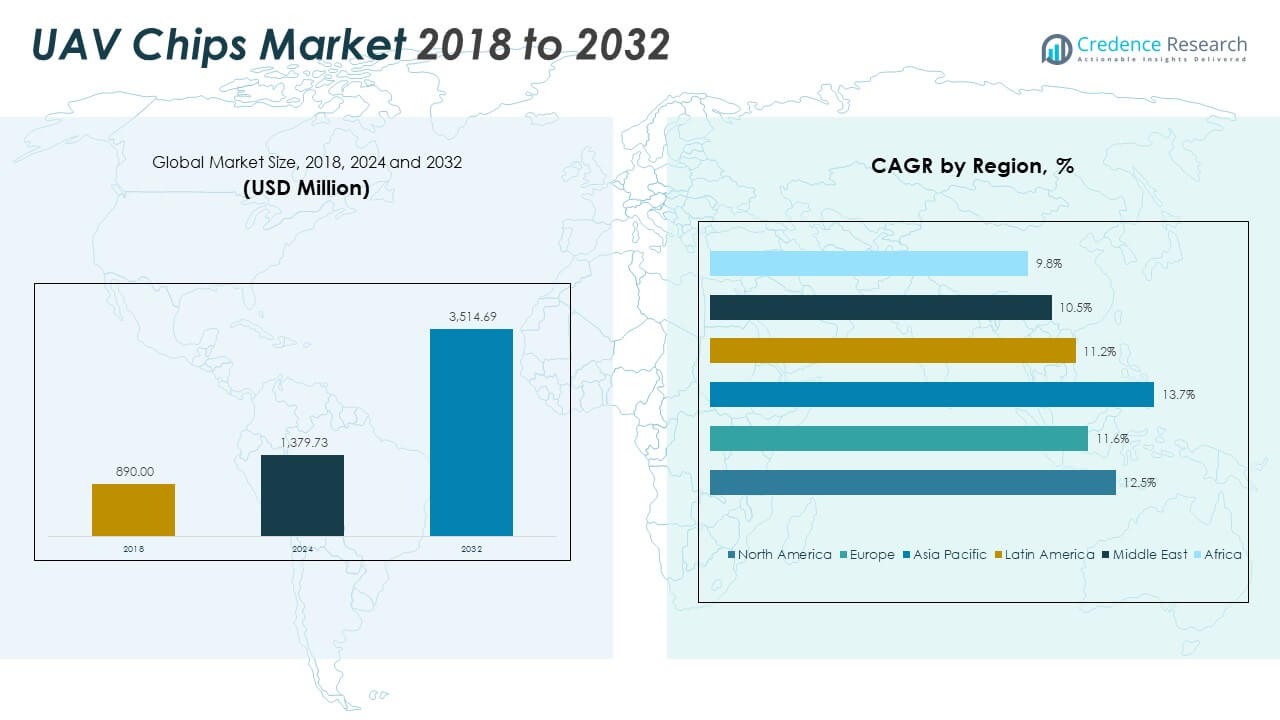
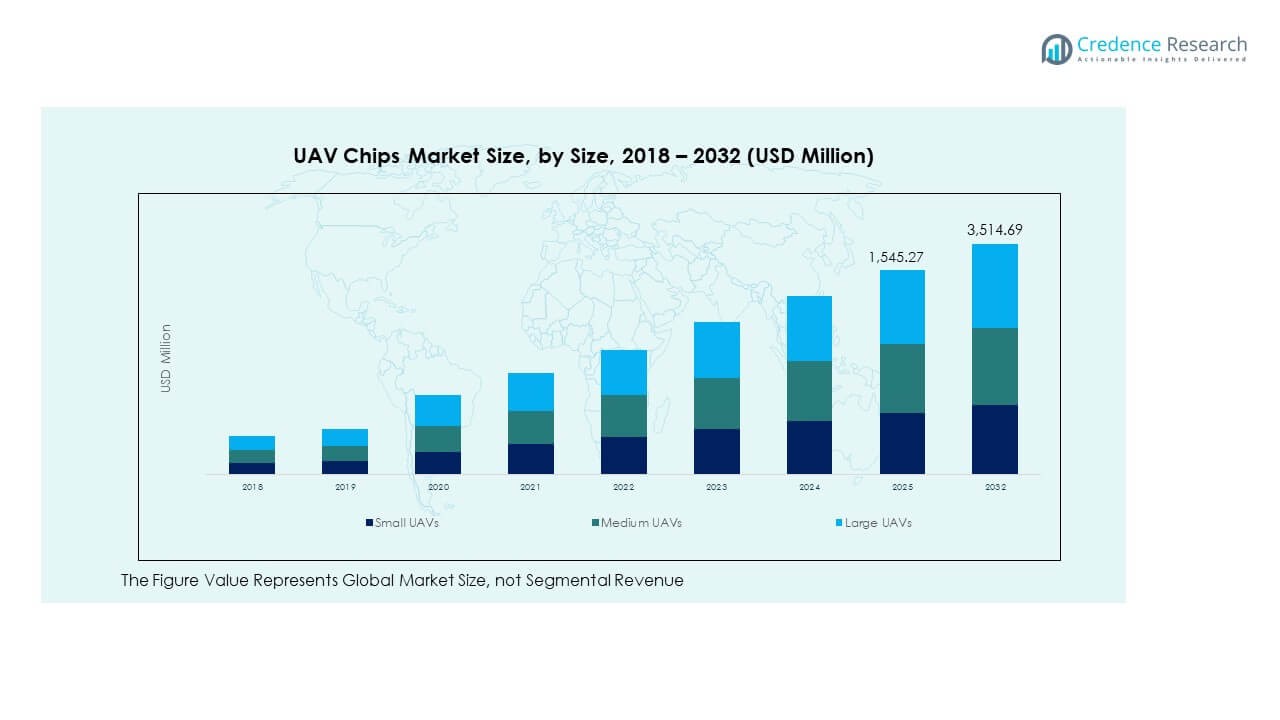
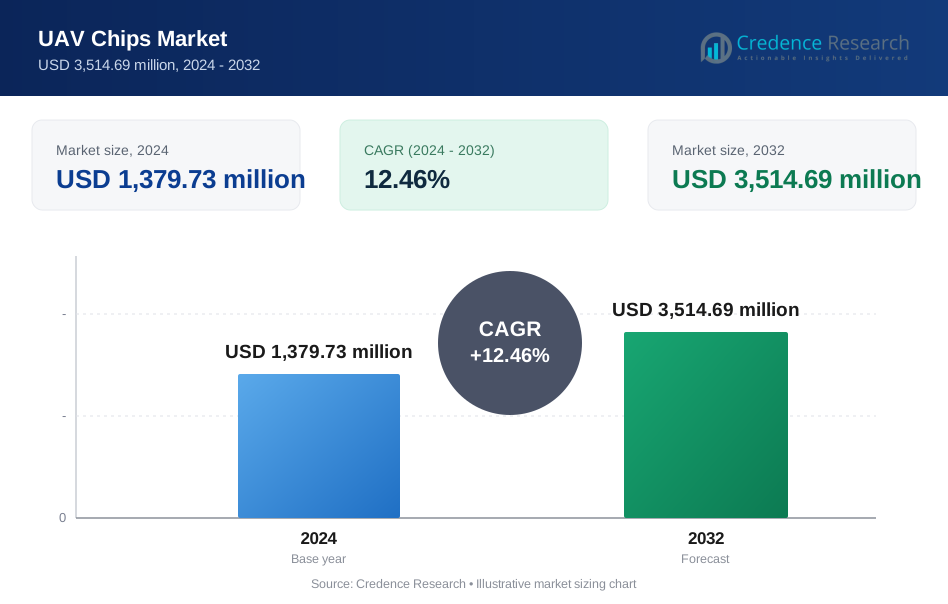
The UAV Chips Market size was valued at USD 890.00 million in 2018 to USD 1,379.73 million in 2024 and is anticipated to reach USD 3,514.69 million by 2032, at a CAGR of 12.46% during the forecast period.
| REPORT ATTRIBUTE | DETAILS |
|---|---|
| Historical Period | 2020-2023 |
| Base Year | 2024 |
| Forecast Period | 2025-2032 |
| UAV Chips Market Size 2024 | USD 1,379.73 Million |
| UAV Chips Market, CAGR | 12.46% |
| UAV Chips Market Size 2032 | USD 3,514.69 Million |
The growing use of unmanned aerial vehicles across defense, commercial, and industrial sectors drives consistent demand for advanced chipsets. Rising adoption of AI-enabled processors, edge computing, and sensor fusion enhances real-time decision-making and flight automation. Manufacturers are focusing on compact, energy-efficient chip designs that enable longer flight durations and reliable communication systems. Increasing investments in 5G connectivity and semiconductor miniaturization further accelerate innovation, creating strong growth prospects for UAV chip developers globally.
North America leads the market due to high defense expenditure, strong R&D ecosystems, and the presence of leading semiconductor companies. Asia-Pacific is emerging rapidly, supported by expanding UAV manufacturing and supportive government programs in China, Japan, and India. Europe maintains steady growth with strong focus on UAV integration into civil airspace and advanced aerospace innovation. Latin America, the Middle East, and Africa are gradually adopting UAV technologies for agriculture, surveillance, and logistics, contributing to global market diversification.
Market Insights:
- The UAV Chips Market was valued at USD 890.00 million in 2018, reaching USD 1,379.73 million in 2024 and projected to hit USD 3,514.69 million by 2032, growing at a CAGR of 12.46%.
- North America leads with a 36% share, supported by strong defense investments and advanced chip manufacturing. Asia-Pacific follows with 31%, driven by large-scale UAV production and government-backed automation programs, while Europe holds 22% due to aerospace innovation and regulatory support.
- Asia-Pacific is the fastest-growing region, fueled by expanding semiconductor fabrication, UAV exports, and integration of AI and 5G technologies across industries.
- Small UAVs represent 38% of the total share, driven by wide commercial and surveillance applications requiring compact and efficient chipsets.
- Medium UAVs account for 34% share, gaining traction in industrial and defense operations where performance and payload balance are crucial.
Market Drivers
Rising Demand for Advanced Drone Applications Across Defense and Commercial Sectors
Defense modernization and expanding commercial drone use are driving strong growth in the UAV Chips Market. Governments invest heavily in intelligence, surveillance, and reconnaissance programs that rely on high-speed chipsets for real-time image processing. Civil and commercial sectors increasingly deploy drones for logistics, agriculture, and infrastructure monitoring. The push toward autonomous operations strengthens demand for chips with AI acceleration and enhanced sensor integration. High-performance computing enables faster decision-making during flight operations. Manufacturers develop custom SoCs and edge computing modules for specific UAV functions. Energy efficiency and low-latency communication have become key differentiators for leading chipmakers. Growing integration of drones into daily operations continues to expand chipset requirements globally.
Integration of AI, Edge Computing, and Sensor Fusion for Enhanced Flight Autonomy
The UAV Chips Market benefits from advancements in AI and machine learning that enhance flight autonomy. AI-integrated processors support real-time obstacle detection, terrain mapping, and adaptive navigation. Edge computing enables onboard data analysis, reducing dependence on remote servers. Sensor fusion technology combines input from radar, LiDAR, and GPS for improved situational awareness. Companies design multicore processors with neural network accelerators for rapid response and low-power operation. Autonomous UAVs in logistics and agriculture require chips capable of parallel data handling. Integration of advanced sensors ensures better accuracy and operational reliability. Strong R&D investment in intelligent chip design is reinforcing the overall market expansion.
- For instance, the NVIDIA Jetson Orin NX module, released in early 2023, delivers up to 100 TOPS of AI performance with a configurable power draw of 10–25 W, enabling advanced 3D perception, multi-sensor fusion (including real-time drone obstacle avoidance, mapping, and inspection), and is actively adopted in commercial drones for logistics and agriculture.
Growing Adoption of 5G Connectivity for High-Speed Drone Communication Networks
The development of 5G infrastructure creates new momentum for chip innovation in UAVs. Low latency and high bandwidth connections support real-time video transmission and command control. The UAV Chips Market witnesses increased adoption of chips optimized for 5G modules, enabling faster communication between UAVs and base stations. Enhanced connectivity improves remote operations, particularly in surveillance and disaster response applications. Network slicing technology ensures stable bandwidth allocation for mission-critical UAV tasks. Telecom partnerships with drone manufacturers promote seamless integration of 5G-compatible chipsets. Cloud-assisted control systems depend on these chips for secure and efficient data exchange. The convergence of telecommunications and UAV ecosystems drives consistent chipset demand.
Technological Advancements in Semiconductor Materials and Power Efficiency Design
Continuous improvements in semiconductor fabrication have strengthened chip performance for UAVs. Manufacturers are introducing smaller nodes and advanced packaging methods that lower heat output and enhance endurance. The UAV Chips Market experiences innovation in gallium nitride and silicon carbide materials that improve voltage tolerance and reduce power loss. These innovations support high-performance drones with extended flight durations. Lightweight chip designs are essential for improving payload efficiency and operational flexibility. Companies emphasize compact integration to optimize computing density within UAV systems. Power management circuits extend battery life without compromising speed or precision. The growing adoption of efficient chip architectures ensures consistent market progress.
- For instance, STMicroelectronics launched its Generation 4 silicon carbide (SiC) MOSFETs in September 2024, offering up to 20% higher power conversion efficiency compared to previous silicon-based solutions, enabling aerospace and UAV manufacturers to reduce weight and extend drone endurance while maintaining stable operation above 175 °C an achievement validated in both automotive and aviation-grade industrial test cycles.
Market Trends
Emergence of AI-Driven UAV Navigation and Predictive Maintenance Systems
AI-driven navigation continues to redefine drone intelligence and reliability. The UAV Chips Market observes rapid integration of AI cores enabling adaptive route planning and automated obstacle avoidance. Predictive maintenance systems analyze real-time performance data to anticipate component wear and optimize flight safety. Chips with deep learning accelerators enhance self-diagnosis and real-time adjustments during flight. Cloud-synced analytics ensure efficient UAV fleet management. Companies are developing AI processors that learn from historical flight data to improve future missions. Real-time object recognition allows drones to operate safely in complex urban environments. The integration of smart analytics in chipsets improves both performance and dependability.
- For instance, NVIDIA’s Jetson Orin Nano Developer Kit, publicly launched in March 2023, delivers up to 40 trillion operations per second (TOPS) of AI performance in a compact module and supports multi-camera input, enabling real-time vision-based navigation, object detection, and predictive maintenance capabilities in UAVs used by research institutes and commercial robotics firms.
Miniaturization of Chip Components Enabling Lightweight and Efficient UAV Designs
Continuous miniaturization of electronic components is reshaping UAV architecture and performance. The UAV Chips Market benefits from reduced chip sizes that allow integration of multiple functions on compact platforms. Shrinking form factors lower energy consumption and weight, extending UAV endurance. System-on-chip innovations merge processing, memory, and communication units into unified modules. Compact semiconductor designs improve drone balance and heat dissipation. Manufacturers emphasize efficiency in circuit layouts for better flight control and communication. Lightweight chips enable smaller UAV models for delivery and environmental monitoring. The trend toward compact, multi-functional designs strengthens operational scalability and market competitiveness.
Increased Focus on Cybersecurity and Data Encryption in UAV Chip Development
Cybersecurity has become a top priority in modern drone systems. The UAV Chips Market sees a rise in hardware-level encryption and secure boot technologies. Chips now integrate tamper detection and isolation zones to protect sensitive data. Manufacturers enhance firmware integrity and data transmission security. Defense and industrial operators demand chipsets with advanced authentication protocols. Encrypted storage and communication prevent external interference during missions. Companies deploy secure element chips for identity management within UAV networks. Hardware-level cybersecurity ensures compliance with global defense and commercial standards. The growing threat of cyberattacks reinforces the need for secure chip infrastructure.
Integration of Thermal Management and Self-Calibration Systems in Chip Design
Thermal control has emerged as a defining trend in UAV chip innovation. The UAV Chips Market experiences strong interest in chips that self-regulate temperature through embedded sensors. Self-calibration modules adjust voltage and current for stable performance in variable conditions. Improved heat dissipation supports longer flight operations and higher processing power. Manufacturers explore graphene and ceramic-based cooling materials to manage thermal loads. Compact heat exchangers within chips extend operational lifespans. Real-time monitoring of core temperature prevents data loss or device malfunction. These advancements ensure UAVs operate efficiently in extreme environments, enhancing reliability and mission success rates.
- For instance, Intel’s Movidius Myriad X VPU, introduced with broad deployment from 2019 onward, achieves high computer vision performance (over 4 trillion operations per second) with a low TDP (thermal design power) of approximately 1.5–7.5 watts, and operating temperature tolerances from -20°C to 60°C, enabling edge drone systems to maintain reliable performance in diverse and extreme physical environments.
Market Challenges Analysis
Complex Semiconductor Supply Chain and Rising Production Costs Restrict Innovation Pace
The semiconductor supply chain remains a major concern for chip manufacturers. The UAV Chips Market faces challenges due to fluctuating raw material availability and high fabrication costs. Complex chip architectures require specialized foundries, limiting production scalability. Supply chain disruptions from geopolitical tensions and regional restrictions affect component sourcing. High R&D expenses constrain small and mid-sized firms from competing effectively. Production of advanced chips involves stringent quality control, extending lead times. Industry reliance on global semiconductor hubs exposes manufacturers to market volatility. Balancing innovation with cost efficiency remains a persistent challenge for chip developers.
Thermal Performance, Power Constraints, and Regulatory Compliance Issues
Thermal performance and energy constraints continue to limit chip design optimization. UAV chips must balance computing speed with efficient cooling to prevent performance drops. The UAV Chips Market encounters technical barriers in achieving low power consumption under high processing demands. Regulatory restrictions on data transmission and frequency bands complicate product certification. Safety standards for UAV electronics differ across regions, slowing global deployment. The lack of standardized protocols affects interoperability between chip systems and UAV platforms. Manufacturers must address these engineering and compliance hurdles to sustain large-scale market adoption. The challenge persists despite ongoing advances in materials and design.
Market Opportunities
Growing Commercial Applications Across Delivery, Agriculture, and Infrastructure Inspection
Expanding use of UAVs in multiple industries presents lucrative opportunities for chip developers. The UAV Chips Market benefits from commercial sectors investing in drones for logistics, mapping, and crop analytics. Demand for high-speed processors and low-latency connectivity supports real-time mission control. Companies design application-specific chips for precision agriculture and industrial monitoring. Smart city initiatives drive adoption of aerial inspection drones that rely on advanced sensor chips. Integration of image processing units enhances visual accuracy and operational safety. Continued urbanization and automation open sustained prospects for next-generation UAV chip adoption.
Expansion of Collaborative Partnerships and Innovation in Chip Fabrication Technologies
Collaborations between semiconductor manufacturers and UAV developers strengthen innovation potential. The UAV Chips Market witnesses strategic alliances focusing on design customization and energy efficiency. Joint ventures encourage integration of cutting-edge fabrication technologies such as 3D packaging and AI-embedded modules. Partnerships with defense and telecommunication sectors drive cross-functional applications. Governments invest in local semiconductor ecosystems to reduce import dependency and ensure supply stability. Open-source chip design frameworks promote faster prototyping for UAV applications. The growing network of industry collaborations positions chipmakers for sustained growth and technological leadership.
Market Segmentation Analysis:
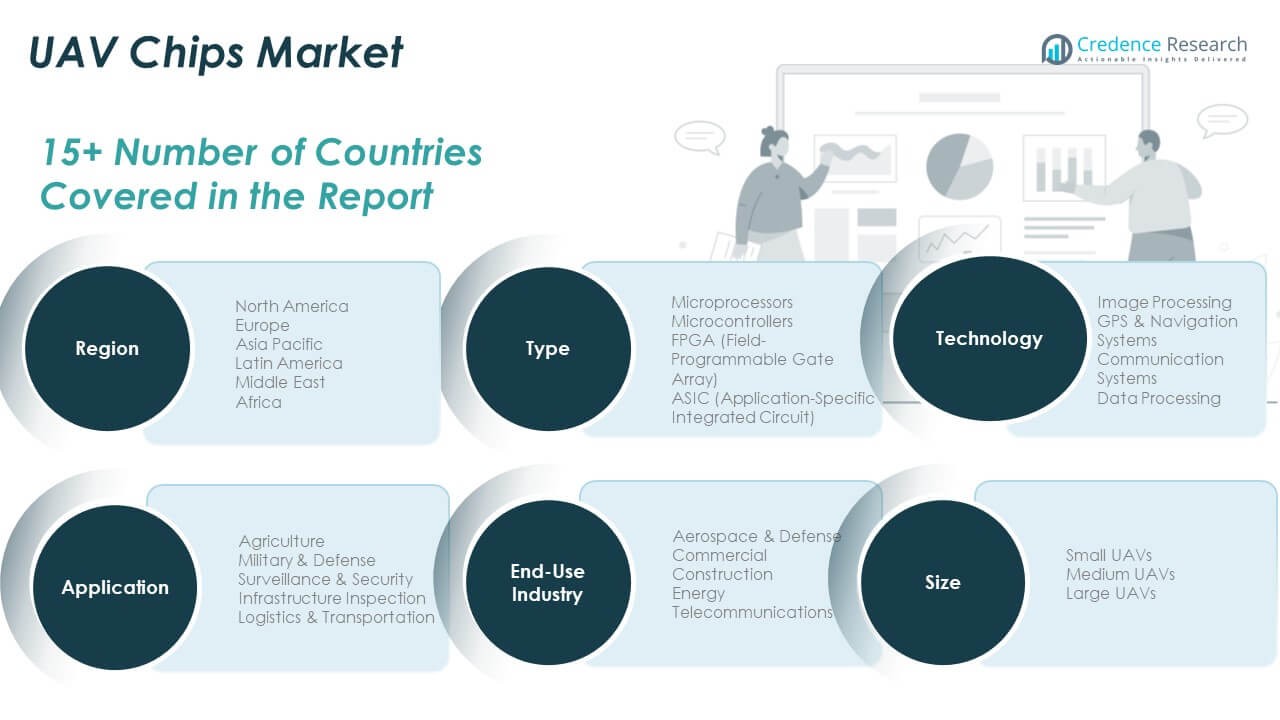
The UAV Chips Market demonstrates strong diversification across multiple segments defined by type, application, end-user, technology, and size.
By type, microprocessors and microcontrollers dominate due to their central role in flight control and navigation systems. FPGA chips gain traction for reconfigurable applications requiring high-speed signal processing, while ASIC chips provide efficiency and precision for mission-specific UAV tasks. Each type supports unique performance needs, enhancing flexibility and scalability across varied drone models.
- For instance, Parrot’s ANAFI USA drone employs the Ambarella H22 processor, Invensense MPU-6000 IMU, and AKM magnetometer for advanced flight control, supporting maximum horizontal speeds of 14.7 m/s and intuitive automated flight modes with sensor accuracy down to ±7°/s.
By application, military and defense sectors lead adoption owing to advanced surveillance and intelligence operations. Agriculture increasingly deploys UAVs for crop monitoring and field analytics, while infrastructure inspection and logistics utilize drones for operational efficiency and cost reduction. Surveillance and security applications maintain consistent demand through expanding urban monitoring and emergency response systems.
- For instance, Northrop Grumman’s RQ-4 Global Hawk executes high-altitude ISR missions for the US Air Force, maintaining surveillance over areas of 40,000 square nautical miles and operates for up to 34 hours at altitudes exceeding 60,000 feet as confirmed in July 2024 defense reviews.
By end-user, aerospace and defense remain dominant, followed by the commercial sector driven by delivery, filming, and industrial inspection. Construction and energy industries adopt UAVs for remote monitoring and maintenance, while telecommunications employs them for network inspection.
By technology, image processing and data processing hold a crucial role in analytics and real-time visualization. GPS and navigation systems enable precision tracking, and communication systems strengthen control reliability across distances.
By size, small UAVs lead the market with their versatility in civil and commercial use, while medium and large UAVs cater to long-range and industrial missions requiring enhanced payload capacity and endurance. The segment composition defines technological depth and operational reach within the UAV ecosystem.
Segmentation:
By Type
- Microprocessors
- Microcontrollers
- FPGA (Field-Programmable Gate Array)
- ASIC (Application-Specific Integrated Circuit)
By Application
- Agriculture
- Military & Defense
- Surveillance & Security
- Infrastructure Inspection
- Logistics & Transportation
By End-User
- Aerospace & Defense
- Commercial
- Construction
- Energy
- Telecommunications
By Technology
- Image Processing
- GPS & Navigation Systems
- Communication Systems
- Data Processing
By Size
- Small UAVs
- Medium UAVs
- Large UAVs
By Region
- North America: U.S., Canada, Mexico
- Europe: UK, France, Germany, Italy, Spain, Russia, Rest of Europe
- Asia Pacific: China, Japan, South Korea, India, Australia, Southeast Asia, Rest of Asia Pacific
- Latin America: Brazil, Argentina, Rest of Latin America
- Middle East: GCC Countries, Israel, Turkey, Rest of Middle East
- Africa: South Africa, Egypt, Rest of Africa
Regional Analysis:
North America
The North America UAV Chips Market size was valued at USD 324.85 million in 2018 to USD 497.52 million in 2024 and is anticipated to reach USD 1,265.65 million by 2032, at a CAGR of 12.5% during the forecast period. North America holds a 36% market share, driven by robust defense investments and widespread commercial drone integration. The U.S. leads the region due to strong funding for autonomous UAV technologies and surveillance systems. It benefits from a mature semiconductor ecosystem supported by major companies such as Qualcomm, NVIDIA, and Intel. Government initiatives for advanced aerial mobility stimulate chip innovation for security, logistics, and mapping. Canada focuses on drone applications in resource exploration and infrastructure inspection. Mexico’s growing electronics manufacturing sector supports component assembly for UAV systems. The region continues to lead in R&D spending, emphasizing chip performance, low latency, and AI-driven data processing.
Europe
The Europe UAV Chips Market size was valued at USD 220.72 million in 2018 to USD 328.06 million in 2024 and is anticipated to reach USD 786.42 million by 2032, at a CAGR of 11.6% during the forecast period. Europe accounts for 22% of the market, with strong industrial adoption in surveillance, logistics, and defense programs. The UK, Germany, and France drive technological advancements through AI-enabled navigation and automation projects. It benefits from active collaboration between aerospace agencies and chip manufacturers. The European Union’s regulatory frameworks support UAV integration into civil airspace, encouraging chipset innovation for safety and compliance. Local companies invest in energy-efficient semiconductors to meet environmental standards. Eastern European countries expand drone production for agricultural monitoring. Growing investments in smart cities and infrastructure inspection reinforce the region’s steady growth momentum.
Asia Pacific
The Asia Pacific UAV Chips Market size was valued at USD 252.76 million in 2018 to USD 406.81 million in 2024 and is anticipated to reach USD 1,129.27 million by 2032, at a CAGR of 13.7% during the forecast period. Asia Pacific dominates with a 31% market share, supported by high UAV production and expanding semiconductor capacity. China leads in large-scale drone manufacturing and chip fabrication, while Japan and South Korea focus on automation and precision technologies. India and Australia rapidly adopt drones for agriculture, logistics, and infrastructure mapping. It benefits from regional government initiatives promoting industrial automation and aerial innovation. Local chipmakers invest in 5G-enabled designs and AI processing modules. Strong supply chain networks and low-cost manufacturing strengthen competitiveness. The region remains the primary innovation hub for compact, high-performance UAV chip architectures.
Latin America
The Latin America UAV Chips Market size was valued at USD 48.06 million in 2018 to USD 73.66 million in 2024 and is anticipated to reach USD 171.76 million by 2032, at a CAGR of 11.2% during the forecast period. Latin America holds a 5% market share, led by Brazil and Mexico’s growing drone adoption across agriculture and logistics. It benefits from expanding demand for UAVs in crop analytics, infrastructure assessment, and public safety. Government projects in Brazil support local assembly of drone components to reduce import dependency. Mexico’s proximity to U.S. technology networks encourages partnerships in electronic component supply. Energy and mining sectors utilize UAVs for environmental monitoring and exploration. Regional manufacturers focus on affordable, multi-functional chip solutions suited for varying operational terrains. Increasing foreign investment in semiconductor assembly plants supports steady market expansion.
Middle East
The Middle East UAV Chips Market size was valued at USD 25.72 million in 2018 to USD 36.55 million in 2024 and is anticipated to reach USD 80.86 million by 2032, at a CAGR of 10.5% during the forecast period. The region commands a 3% market share, driven by UAV deployment in defense, border surveillance, and oil infrastructure monitoring. The UAE and Israel lead in UAV innovation and chip integration for advanced aerial platforms. It gains traction from smart city projects and industrial automation programs. Saudi Arabia invests in UAV technology for logistics and environmental management. Chip demand grows through partnerships between defense contractors and global semiconductor firms. Local initiatives aim to develop regional manufacturing hubs for high-performance UAV components. The focus on AI-based surveillance and data connectivity strengthens regional adoption.
Africa
The Africa UAV Chips Market size was valued at USD 17.89 million in 2018 to USD 37.12 million in 2024 and is anticipated to reach USD 80.73 million by 2032, at a CAGR of 9.8% during the forecast period. Africa represents a 3% share, characterized by rising UAV use in agriculture, wildlife monitoring, and logistics. South Africa and Egypt lead regional adoption through public-sector drone programs. It benefits from projects improving precision agriculture and disaster response. Energy and telecom industries use UAVs for grid and network inspections. Limited chip manufacturing capacity encourages imports from Asia-Pacific suppliers. Governments explore partnerships to establish local UAV assembly facilities. Growing awareness of drone utility across sectors supports moderate market growth, while infrastructure expansion continues to create long-term opportunities.
Key Player Analysis:
- Qualcomm Technologies, Inc.
- Intel Corporation
- STMicroelectronics N.V.
- Texas Instruments Incorporated (TI)
- NVIDIA Corporation
- Samsung Electronics Co., Ltd.
- Nuvoton Technology Corporation
- Rockchip Electronics Co., Ltd.
- Master Control Chips
- Vision Chips
Competitive Analysis:
The UAV Chips Market features intense competition among global semiconductor leaders and specialized UAV component manufacturers. Key players such as Qualcomm, Intel, NVIDIA, STMicroelectronics, and Texas Instruments focus on high-performance processors, AI-enabled designs, and low-power architectures. Samsung and Nuvoton strengthen their presence through compact and energy-efficient chip innovations. Rockchip and Vision Chips emphasize cost-effective solutions for consumer and commercial UAV applications. It reflects a balanced landscape where established firms leverage R&D strength, while emerging companies target niche markets with application-specific designs. Strategic alliances, mergers, and regional production expansions shape the competitive environment. Companies prioritize 5G-ready and edge computing chipsets to meet growing demand for autonomous flight and real-time data processing. The focus on miniaturization, heat management, and multi-core integration defines the next phase of market differentiation and technology leadership.
Recent Developments:
- In October 2025, Nuburu, a blue-laser technology company active in defense and security sectors, completed the first phase of its acquisition of the Italian defense-grade software firm Orbit S.r.l., with an initial $1.5 million investment. Nuburu plans to gain majority ownership through further financial infusions, aiming to integrate Orbit's operational resilience and crisis management software with its UAV technology portfolio.
- In June 2025, Zen Technologies Limited acquired a 55 % majority stake in TISA Aerospace Pvt Ltd., a defence tech company focused on loitering munitions and UAV platforms. The move strengthens Zen Technologies’ position in the unmanned aerial vehicle ecosystem and supports its ambition to supply advanced chip-integrated solutions for flight control, navigation and mission-specific electronics.
Report Coverage:
The research report offers an in-depth analysis based on Type, Application, End-User, Technology and Size. It details leading market players, providing an overview of their business, product offerings, investments, revenue streams, and key applications. Additionally, the report includes insights into the competitive environment, SWOT analysis, current market trends, as well as the primary drivers and constraints. Furthermore, it discusses various factors that have driven market expansion in recent years. The report also explores market dynamics, regulatory scenarios, and technological advancements that are shaping the industry. It assesses the impact of external factors and global economic changes on market growth. Lastly, it provides strategic recommendations for new entrants and established companies to navigate the complexities of the market.
Future Outlook:
- Growing integration of AI, machine learning, and edge computing will define the next evolution of UAV chip architectures.
- The shift toward miniaturized, energy-efficient semiconductors will enhance UAV endurance and payload efficiency.
- Expansion of 5G networks will strengthen real-time communication, control, and data streaming for autonomous drones.
- Advanced chip packaging and thermal control innovations will improve reliability in extreme environmental conditions.
- Strategic collaborations between chipmakers and UAV manufacturers will accelerate customized processor development.
- Defense and security agencies will continue driving demand for high-performance, mission-ready UAV chipsets.
- Increased agricultural automation and infrastructure monitoring will expand commercial chip applications globally.
- Regional semiconductor investments in Asia-Pacific will enhance supply stability and technology innovation.
- Rising cybersecurity standards will promote adoption of secure, encrypted chip architectures across UAV platforms.
- Continuous regulatory alignment will support broader UAV deployment, boosting chipset integration across industries.
Request a Free Sample
Fill in your details and we'll send you a free sample report.
- Sample data tables & charts
- Research methodology
Need a Custom Version of This Report?
Tailor the scope, geography, or segments to your exact requirements.
- Custom geography or segment scope
- Direct access to our analyst team
Frequently Asked Questions
What is the current market size for UAV Chips Market, and what is its projected size in 2032?
At what Compound Annual Growth Rate is the UAV Chips Market projected to grow between 2024 and 2032?
Which UAV Chips Market segment held the largest share in 2024?
What are the primary factors fueling the growth of the UAV Chips Market?
Who are the leading companies in the UAV Chips Market?
Which region commanded the largest share of the UAV Chips Market in 2024?
Table of Content
Chapter 1. Report Introduction
- 1.1 Report Description & Purpose
- 1.1.1 Report Title & Market Definition
- 1.1.2 Unique Selling Propositions (USP) & Key Differentiators
- 1.1.3 Value Proposition for Stakeholders
- 1.2 Research Objectives
- 1.2.1 Market Sizing Objectives (Volume & Revenue) (Volume Where Applicable)
- 1.2.2 Segmentation Objectives
- 1.2.3 Competitive Intelligence Objectives
- 1.2.4 Forecast & Scenario Objectives
- 1.3 Report Scope
- 1.3.1 UAV Chips Scope – Segments & Subsegments Covered
- 1.3.2 Geographic Scope – Regions & Countries Covered
- 1.3.3 Historical Period, Base Year & Forecast Period (2024; forecast to 2032)
- 1.3.4 Inclusions & Exclusions
- 1.4 Industry Classification & Applicable Codes
- 1.5 Currency, Measurement Units & Valuation Basis
- 1.6 Target Stakeholders
- 1.7 Limitations & Assumptions
Chapter 2. Executive Summary
- 2.1 Global UAV Chips Market Snapshot
- 2.1.1 Market Size – Historical (2024) & Forecast (2024-2032) (2024: USD 1,379.73 million → 2032: USD 3,514.69 million)
- 2.1.2 Volume & Revenue – Global Totals (Volume Where Applicable)
- 2.1.3 Key Market Highlights – Top Five Facts
- 2.2 UAV Chips Market Segmentation Snapshot
- 2.2.1 Market Split by Region – 2024 vs. 2032
- 2.3 Competitive Snapshot
- 2.3.1 Top 10 Players by Revenue Share – 2024
- 2.3.2 Top 10 Players by Volume Share – 2024 (Volume Where Applicable)
- 2.3.3 Recent Strategic Developments (18-Month Summary)
- 2.4 Key Investment Highlights & Strategic Conclusions
Chapter 3. UAV Chips Market Dynamics & Industry Analysis
- 3.1 Market Overview & Context
- 3.1.1 UAV Chips Market Position in the Broader Industry Value Chain
- 3.1.2 Demand Structure & Purchasing Dynamics
- 3.1.3 Market Maturity & Development Stage by Region
- 3.2 UAV Chips Market Drivers
- 3.3 UAV Chips Market Restraints & Challenges
- 3.4 UAV Chips Market Opportunities
- 3.5 Porter's Five Forces Analysis
- 3.5.1 Threat of New Entrants
- 3.5.2 Bargaining Power of Suppliers
- 3.5.3 Bargaining Power of Buyers
- 3.5.4 Threat of Substitutes
- 3.5.5 Competitive Rivalry – Intensity Assessment
- 3.6 UAV Chips Value Chain Analysis
- 3.6.1 Upstream – Key Inputs, Resources & Suppliers
- 3.6.1.1 Key Input/Resource 1
- 3.6.1.2 Key Input/Resource 2
- 3.6.1.3 Key Input/Resource 3
- 3.6.2 Midstream – Core Operations & Value Creation
- 3.6.2.1 Operating Model & Process Overview
- 3.6.2.2 Key Operating Locations & Capabilities by Company
- 3.6.3 Downstream – Market Channels & End Users
- 3.6.3.1 Direct Sales & Customer Engagement Channels
- 3.6.3.2 Indirect Sales, Intermediaries & Partner Channels
- 3.6.4 Value Chain Profitability Analysis
- 3.6.1 Upstream – Key Inputs, Resources & Suppliers
- 3.7 PESTEL Analysis
- 3.7.1 Political Factors
- 3.7.2 Economic Factors
- 3.7.3 Social Factors
- 3.7.4 Technological Factors
- 3.7.5 Environmental Factors
- 3.7.6 Legal Factors
- 3.8 UAV Chips Supply Chain Analysis
- 3.8.1 Critical Input & Resource Availability Risk Assessment
- 3.8.2 Supplier & Operational Concentration Risk (Geographic Exposure)
- 3.8.3 Supply & Service Disruption Impact Analysis
- 3.9 Regulatory & Policy Landscape
Note: The regulatory and policy landscape section covers regulations based on their applicability to the market, UAV Chips category, geography, and scope of the study. Only regulatory frameworks with a material impact on operations, compliance, trade, sustainability, or market access are analyzed in detail.
Chapter 4. Key Investment Pockets & Opportunity Analysis
- 4.1 UAV Chips Market Attractiveness Analysis
- 4.1.1 By Region – Investment Attractiveness Matrix (Market Size × CAGR)
- 4.2 Absolute Revenue Growth Opportunity
- 4.2.1 By Region – Absolute Revenue Growth Through 2032
- 4.3 Incremental Demand Opportunity
- 4.3.1 By Region – Incremental Demand Through 2032
- 4.3.2 Segment – Incremental Demand
- 4.4 Emerging Submarket Opportunity Deep Dive (Subject to Applicability)
- 4.5 Priority Market Opportunity Scorecards
- 4.5.1 United States
- 4.5.2 Europe
- 4.5.3 Asia
- 4.5.4 Middle East & Africa
Note: Priority market opportunity scorecards reflect the geographic scope and strategic relevance of the study. Listed markets are indicative and may be adapted to the industry.
Chapter 5. UAV Chips Cross-Border Trade & Market Access Analysis
- 5.1 International Trade & Cross-Border Activity Overview
- 5.1.1 Global Export Value by Country (2024)
- 5.1.2 Global Export Volume by Country (2024) (Volume Where Applicable)
- 5.1.3 Global Import Value by Country (2024)
- 5.1.4 Global Import Volume by Country (2024) (Volume Where Applicable)
- 5.1.5 Net Trade Balance by Country (2024)
- 5.2 Export Analysis – Segment
- 5.2.1 Category 1 (Applicable Classification Code)
- 5.2.2 Category 2 (Applicable Classification Code)
- 5.2.3 Category 3 (Applicable Classification Code)
- 5.2.4 Category 4 (Applicable Classification Code)
- 5.2.5 Category 5 (Applicable Classification Code)
- 5.3 Import Analysis – Segment
- 5.3.1 Category 1 (Applicable Classification Code)
- 5.3.2 Category 2 (Applicable Classification Code)
- 5.3.3 Category 3 (Applicable Classification Code)
- 5.3.4 Category 4 (Applicable Classification Code)
- 5.3.5 Category 5 (Applicable Classification Code)
- 5.4 Cross-Border Pricing & Transaction Benchmarks
- 5.4.1 Export Pricing – Segment & Country
- 5.4.2 Import Pricing – Segment & Source Country
- 5.4.3 Price Trends (2024)
- 5.5 Key Cross-Border Trade & Delivery Routes
- 5.5.1 Cross-Border Trade/Delivery Route 1
- 5.5.2 Cross-Border Trade/Delivery Route 2
- 5.5.3 Cross-Border Trade/Delivery Route 3
- 5.5.4 Cross-Border Trade/Delivery Route 4
- 5.5.5 Cross-Border Trade/Delivery Route 5
- 5.6 Trade Policy & Market Access Impact Assessment
- 5.6.1 Tariff & Non-Tariff Barriers
- 5.6.2 Regional Trade & Economic Integration Frameworks
- 5.6.3 Bilateral & Multilateral Trade Agreements
- 5.6.4 Cross-Border Operating, Licensing & Localization Requirements
Note: This chapter applies where cross-border trade or delivery is relevant to UAV Chips. Goods, services, and digital offerings are assessed using applicable classifications and transaction measures. Import-export volumes, trade balances, and route analyses are included only where meaningful to the market.
Chapter 6. Competitive Landscape & Company Benchmarking
- 6.1 UAV Chips Market Concentration & Structure
- 6.1.1 Herfindahl-Hirschman Index (HHI) – the historical period vs. 2024
- 6.1.2 Leading, Mid-Sized & Emerging Player Structure
- 6.1.3 Global, Regional & Local Player Dynamics
- 6.2 UAV Chips Market Share Analysis – 2024
- 6.2.1 Global Revenue Share by Company
- 6.2.2 Global Volume Share by Company (Volume Where Applicable)
- 6.2.3 Regional Revenue Share
- 6.2.4 Market Share Evolution (the historical period vs. 2024)
- 6.2.5 Company Market Share by Key Segment
- 6.2.6 Company Market Share by Customer Group
- 6.3 Operating Scale, Capacity & Infrastructure Analysis
- 6.3.1 Global Operating Scale & Supply Capacity
- 6.3.2 Resource Utilization & Operating Efficiency
- 6.3.3 Output, Service Delivery & Activity Metrics
- 6.3.4 Operating Footprint & Infrastructure Map
- 6.3.5 Planned Operational & Capacity Expansion
- 6.4 UAV Chips Competitive Benchmarking Matrix
- 6.4.1 Revenue, Growth, Profitability & Operating Metric Comparison
- 6.4.2 Channel Revenue Mix
- 6.4.3 Geographic Revenue Exposure
- 6.4.4 R&D Intensity
- 6.4.5 Sustainability Maturity
- 6.5 Strategic Developments in UAV Chips (Last 24 Months)
- 6.5.1 Mergers, Acquisitions & Divestments
- 6.5.2 New Products, Services & Solutions in UAV Chips
- 6.5.3 Operational & Infrastructure Expansions
- 6.5.4 Strategic Alliances, Joint Ventures & Partnerships
- 6.5.5 Distribution Expansion & Market Entry
- 6.5.6 Sustainability & ESG Initiatives
- 6.6 Competitive Strategy Mapping
- 6.6.1 Leader, Challenger, Follower & Niche Classification
- 6.6.2 Pricing Strategy Comparison
- 6.6.3 Channel Strategy Matrix
Note: Strategic developments are included based on their materiality and the availability of reliable information.
Chapter 7. Global UAV Chips Market – By Sales & Delivery Channel
- 7.1 Segment Overview
- 7.1.1 Volume & Revenue Split by Channel (2024 & 2032) (Volume Where Applicable)
- 7.1.2 Channel Mix Evolution (2024-2032)
Chapter 8. Regional Market Analysis – Global Overview
- 8.1 Global Regional Overview
- 8.1.1 Regional Volume Share (Volume Where Applicable)
- 8.1.2 Regional Revenue Share
- 8.1.3 Regional Volume by Region (Volume Where Applicable)
- 8.1.4 Regional Revenue by Region
- 8.1.5 Regional Forecast Through 2032
- 8.2 Cross-Regional Segment Analysis
- 8.2.1 By Sales & Delivery Channel
- 8.2.2 By Competitive Positioning & Price Tier
Chapter 9. North America UAV Chips Market
- 9.1 United States
- 9.2 Canada
- 9.3 Mexico
Chapter 10. Europe UAV Chips Market
- 10.1 Germany
- 10.2 France
- 10.3 Italy
- 10.4 United Kingdom
- 10.5 Spain
- 10.6 Poland
- 10.7 Russia
- 10.8 Netherlands
- 10.9 Belgium
- 10.10 Sweden
- 10.11 Denmark
- 10.12 Norway
- 10.13 Rest of Europe
Chapter 11. Asia Pacific UAV Chips Market
- 11.1 China
- 11.2 India
- 11.3 Japan
- 11.4 South Korea
- 11.5 Thailand
- 11.6 Indonesia
- 11.7 Vietnam
- 11.8 Malaysia
- 11.9 Australia
- 11.10 Rest of Asia Pacific
Chapter 12. Latin America UAV Chips Market
- 12.1 Brazil
- 12.2 Argentina
- 12.3 Colombia
- 12.4 Chile
- 12.5 Rest of Latin America
Chapter 13. Middle East UAV Chips Market
- 13.1 Saudi Arabia
- 13.2 United Arab Emirates
- 13.3 Turkey
- 13.4 Israel
- 13.5 Iran
- 13.6 Rest of the Middle East
Chapter 14. Africa UAV Chips Market
- 14.1 South Africa
- 14.2 Egypt
- 14.3 Nigeria
- 14.4 Morocco
- 14.5 Rest of Africa
Chapter 15. UAV Chips Company Profiles
- 15.1 [Company 01]
- 15.1.1 Company Overview
- 15.1.2 Key Management Personnel
- 15.1.3 Products & Services Portfolio
- 15.1.4 Financial Performance
- 15.1.5 Key Market Focus & Geographic Presence
- 15.1.6 Recent Developments & Strategic Initiatives
Note: The company profile list is preliminary and may change based on research findings, market developments, data availability, and client requirements.
Chapter 16. Appendices
- Appendix A – List of Abbreviations & Acronyms
- Appendix B – Industry Classification Code Reference – Full Series
- Appendix C – Supply, Output & Operating Capacity Data Tables
- Appendix D – End-Use & Demand Base Tables
- Appendix E – Demand, Adoption & Usage Assumptions
- Appendix F – Pricing & Revenue Metric Reference Tables
- Appendix G – Company Operations & Infrastructure Database
- Appendix H – Cross-Border Trade & Activity Data Tables (Where Applicable)
- Appendix I – Regulatory Summary Tables
- Appendix J – Primary Research Participant List (Anonymized)
- Appendix K – Primary Research Questionnaire Framework
- Appendix L – Data Sources & Bibliography
- Appendix M – Market Size Divergence & Source Comparison
Chapter 17. Research Methodology
- 17.1 Research Framework & Philosophy
- 17.2 Secondary Research – Sources, Hierarchy & Data Extraction
- 17.3 Data Modeling – Bottom-Up & Top-Down Market Sizing
- 17.4 Primary Research – Stakeholder Framework, LOI & Sample Sizes
- 17.5 Forecast Methodology – Regression, Scenario & Sensitivity Analysis
- 17.6 Quality Control – Four-Layer Validation Framework
- 17.7 Limitations & Standard Assumptions
- 17.8 Disclaimer
