
| REPORT ATTRIBUTE | DETAILS |
|---|---|
| Historical Period | 2019-2022 |
| Base Year | 2023 |
| Forecast Period | 2024-2032 |
| Germany Data Center Physical Security Market Size 2023 | USD 113.65 million |
| Germany Data Center Physical Security Market, CAGR | 14.86% |
| Germany Data Center Physical Security Market Size 2032 | USD 344.20 million |
Market Overview
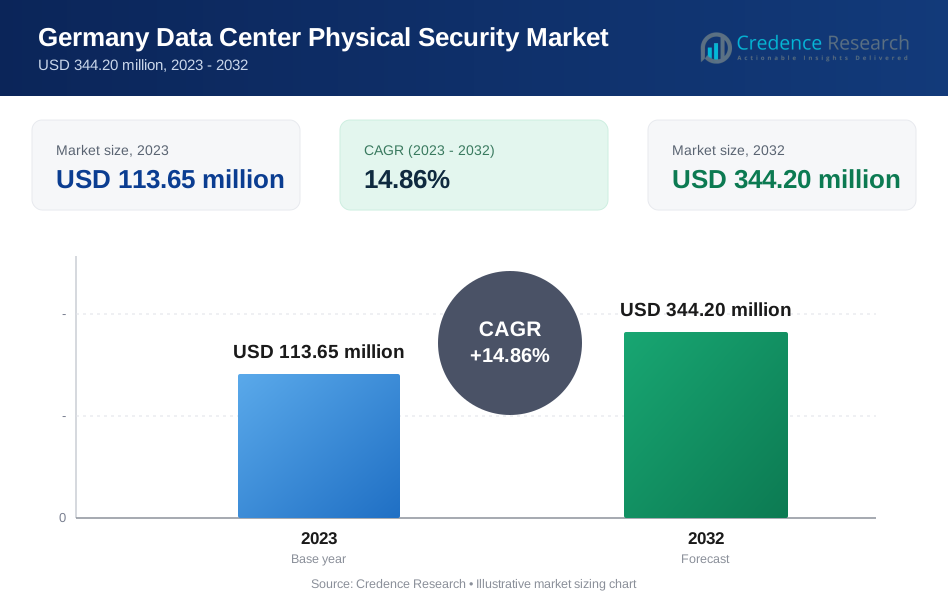
The Germany Data Center Physical Security Market is projected to grow from USD 113.65 million in 2023 to an estimated USD 344.20 million by 2032, with a compound annual growth rate (CAGR) of 14.86% from 2024 to 2032. This growth is driven by the increasing demand for data center services, which has led to a stronger emphasis on safeguarding these critical infrastructure assets.
Key drivers of the Germany Data Center Physical Security Market include the rising importance of data protection regulations, technological advancements in security systems, and the growing need for uninterrupted data center operations. Trends such as the integration of AI and IoT-based surveillance solutions, as well as the use of biometric and multi-factor authentication for access control, are reshaping security strategies. Additionally, the rapid digitalization across industries and the increasing reliance on cloud computing services are contributing to the demand for robust physical security measures.
Geographically, Germany stands as a leader in the European data center sector, owing to its strong industrial base and advanced technological infrastructure. The country’s central location in Europe and robust cybersecurity regulations further enhance its appeal as a hub for data centers. Leading players in the market include global security solution providers such as Johnson Controls, Honeywell, and Bosch, along with local companies offering specialized services tailored to the needs of the German market.
Market Insights
- The Germany Data Center Physical Security Market is projected to grow from USD 113.65 million in 2023 to USD 344.20 million by 2032, at a CAGR of 14.86% from 2024 to 2032.
- Key drivers include the rising demand for data center services, technological advancements in security systems, and increasing regulatory pressure on data protection.
- The integration of AI, machine learning, IoT-based surveillance solutions, and biometric access control is reshaping security strategies in data centers.
- Stringent regulations like GDPR are driving investments in physical security solutions to ensure compliance and safeguard sensitive data.
- High capital expenditure and operational costs associated with implementing advanced security systems may pose challenges for small to medium-sized data centers.
- Frankfurt, Munich, and Berlin are key regions leading the market due to their role as major tech and financial hubs with high demand for data center infrastructure.
- The market is highly competitive, with major players like Johnson Controls, Honeywell, Bosch, and emerging regional companies focusing on innovative, integrated security solutions.
Market Drivers
Increasing Demand for Data Centers and Cloud Services
The demand for data center services in Germany has significantly risen in recent years, driven by the rapid adoption of cloud computing, big data, artificial intelligence (AI), and the Internet of Things (IoT). These technologies have reshaped business operations and led to a surge in the volume of data being generated and stored, necessitating the development of more secure and scalable data centers. For instance, in 2023, Virtus Data Centers announced plans for a new 300 MW campus outside Berlin, Germany, covering 350,000 square meters and expected to be operational by 2026. This development reflects the growing need for secure storage solutions to accommodate the surge in data generated by businesses adopting AI and IoT technologies. Data centers are vital for supporting businesses, government agencies, and technology companies in their quest to securely store and process large volumes of data. Consequently, the need to protect these critical facilities from physical threats has become paramount. Physical security solutions such as surveillance cameras, access control systems, and perimeter fencing are now essential components of data center operations to ensure service continuity and prevent potential breaches.
Regulatory Pressure and Compliance Requirements
Data protection regulations, particularly the General Data Protection Regulation (GDPR) implemented by the European Union, have heightened the need for robust physical security measures in data centers. GDPR mandates strict requirements for securing personal data, making it imperative for organizations to implement stringent security protocols to protect both physical and digital assets. This regulatory framework has compelled businesses to adopt comprehensive security systems to comply with legal requirements and mitigate risks of data breaches. For instance, CyrusOne's acquisition of a complex in Frankfurt for conversion into a data center campus illustrates how organizations are responding to regulatory pressures by enhancing their physical security measures to protect sensitive information. Compliance with these regulations has prompted data center operators in Germany to prioritize physical security measures such as biometric authentication, video surveillance, and intrusion detection systems. As data privacy concerns become more central to global business operations, the pressure on data centers to meet compliance standards continues to grow, further driving the demand for physical security solutions.
Technological Advancements in Physical Security Solutions
The evolution of physical security technologies plays a crucial role in driving the growth of the Germany Data Center Physical Security Market. Innovations in surveillance systems, biometric access control, and automated threat detection are enabling more sophisticated protection of data centers. For example, advancements in AI and machine learning are now being integrated into security systems to provide real-time monitoring and predictive threat analysis. IoT-enabled devices such as smart sensors and intelligent cameras enhance security capabilities by detecting anomalies and recognizing faces within data centers. Moreover, integrated security platforms that combine physical security with IT infrastructure monitoring are gaining popularity as they offer centralized control systems for operators. These technological advancements not only improve security but also enhance operational efficiency, reducing manual intervention while providing a higher level of protection. As these technologies continue to evolve, the demand for modern and intelligent physical security solutions will only increase, further driving market growth.
Increasing Threats and Risk of Physical Attacks on Data Centers
The growing threats to data center infrastructure from internal and external sources significantly drive the market. Physical security breaches such as theft, vandalism, and sabotage can disrupt critical operations and compromise sensitive information. Cyberattacks are becoming more sophisticated; thus, there is an increasing convergence between physical and cyber threats. For instance, unauthorized access to a data center could allow malicious actors to gain entry into critical systems or steal physical assets like servers. Furthermore, the risk of natural disasters, terrorist attacks, and geopolitical tensions has made it more critical than ever for data centers to implement comprehensive physical security measures. The increasing frequency of such threats has heightened awareness regarding enhanced protection needs within these facilities. This urgency creates strong demand for robust security infrastructure. As a result, investments in cutting-edge physical security technologies are essential for safeguarding operations against potential incidents that could disrupt service continuity or lead to significant financial losses.
Market Trends
Integration of Artificial Intelligence and Machine Learning for Threat Detection
One of the prominent trends in the Germany Data Center Physical Security Market is the integration of Artificial Intelligence (AI) and Machine Learning (ML) technologies in security systems. These technologies enhance data centers' ability to detect and respond to threats in real time, moving beyond traditional security measures. For instance, AI-driven video surveillance systems can analyze footage, recognize unusual patterns, and automatically alert security personnel to potential breaches. This includes identifying unauthorized personnel attempting to access restricted areas or flagging suspicious behavior such as tailgating or loitering. Machine learning algorithms improve security by learning from past incidents, continuously refining detection capabilities, and identifying new types of threats. This proactive approach is critical in preventing security breaches before they occur, making AI and ML invaluable assets for securing data centers. As the demand for sophisticated security grows, these technologies are becoming essential for creating more intelligent, automated, and responsive security systems, ultimately improving both effectiveness and operational efficiency.
Increased Adoption of Biometric Access Control Systems
Biometric access control systems are becoming a major trend in the German data center physical security market. These systems offer a higher level of security compared to traditional card-based access control methods by utilizing unique biometric identifiers such as fingerprints, retina scans, and facial recognition. For instance, organizations implementing biometric systems can ensure that only authorized personnel are allowed into sensitive areas, significantly reducing the risk of unauthorized access or impersonation. Furthermore, biometric technologies enhance convenience for authorized users by speeding up entry processes while maintaining high security standards. The European Union’s General Data Protection Regulation (GDPR) has also contributed to the increased demand for biometric systems, as these technologies help ensure compliance with data privacy regulations by controlling physical access to data storage and processing areas. As the threat landscape becomes more complex and security measures evolve to meet growing demands for data protection, the adoption of biometric access control systems in data centers is expected to continue rising.
Shift Towards Fully Integrated Security Solutions
Another significant trend in the Germany Data Center Physical Security Market is the shift toward fully integrated security solutions. Historically, data centers relied on disparate security systems—such as surveillance cameras, alarms, and access control systems—that operated independently. However, there is now a growing move toward integrated security platforms that combine various measures into a cohesive system. For instance, these platforms can include video surveillance, access control, intrusion detection, environmental monitoring, and even fire and water leak detection—all managed from a centralized control system. This integration enables data center operators to monitor and manage security operations more effectively and respond to threats efficiently since all information is accessible in real time from one interface. Additionally, integrated systems offer scalability, allowing data centers to expand their security infrastructure without disrupting existing operations. The increasing complexity of modern data centers and heightened risks of physical and cyber threats make integrated solutions crucial for maintaining secure environments.
Focus on Redundancy and Physical Resilience
As data center services are critical for various industries—from healthcare to finance—ensuring continuous operations has become a key focus. Consequently, the physical resilience of data centers, including robust security infrastructure, is paramount. Redundancy in physical security measures is a growing trend; this includes employing multiple surveillance systems, backup power supplies, and dual layers of physical access control. For example, integrating backup power solutions like uninterruptible power supplies (UPS) ensures that critical security infrastructure remains operational during power failures. Additionally, geo-redundant systems that deploy backup measures at different locations are gaining popularity. This trend is driven by rising demands for business continuity and safeguarding both physical and digital assets from various threats. As such, ensuring that data centers remain resilient against physical security breaches and disruptions is increasingly prioritized in today’s complex threat landscape.
Market Challenges
Balancing Security with Operational Efficiency
One of the key challenges faced by the Germany Data Center Physical Security Market is the need to balance stringent security measures with operational efficiency. While data centers are critical infrastructure, ensuring their physical security without hindering day-to-day operations can be complex. For instance, many data centers in Germany are increasingly adopting automated access control systems that streamline entry processes. This approach not only enhances security but also minimizes delays during peak access times, particularly when employees or maintenance personnel frequently require entry to secure areas. Implementing high-level security protocols, such as multi-factor authentication and biometric access controls, can sometimes lead to increased operational friction. The installation of advanced security systems may also result in higher capital expenditures and additional maintenance costs, potentially increasing operational budgets. As data centers scale up and the number of visitors, employees, and contractors increases, managing this balance becomes even more challenging. Striking the right equilibrium between maintaining tight security and ensuring smooth access for authorized personnel requires careful planning, resource allocation, and advanced security solutions. This challenge is particularly pronounced in Germany, where stringent data privacy regulations like the GDPR demand a high standard of security, further complicating operational management.
Rapidly Evolving Threat Landscape
Another significant challenge in the Germany Data Center Physical Security Market is the rapidly evolving threat landscape. As technology advances, so do the methods and sophistication of both physical and cyber threats. Data centers are increasingly becoming prime targets for malicious activities, ranging from physical break-ins to more complex coordinated attacks that blend cyber and physical security risks. For instance, data center operators are now facing threats not only from external hackers exploiting digital vulnerabilities but also from insiders who may take advantage of weaknesses in physical security measures.The growing trend of hybrid and multi-cloud environments introduces more entry points and increases the complexity of securing physical access to distributed infrastructure. In response to this dynamic environment, operators must continuously update their security measures to defend against emerging threats, including terrorism and geopolitical conflicts. This includes integrating advanced technologies such as AI-powered surveillance systems that can adapt to new threats effectively. The constant need for agility in security protocols places a strain on resources and budgets, highlighting the importance of investing in scalable solutions that can respond to unforeseen challenges while maintaining robust protection for critical data assets.
Market Opportunities
Rising Demand for Advanced Security Solutions Driven by Digital Transformation
The ongoing digital transformation across industries presents a significant opportunity for growth in the Germany Data Center Physical Security Market. As businesses increasingly rely on cloud computing, big data, and AI-driven applications, the demand for data centers continues to rise. This growth amplifies the need for advanced physical security systems to protect critical infrastructure. For instance, organizations are adopting AI-based video surveillance systems and biometric access controls that not only enhance protection against physical breaches but also improve operational efficiency. The implementation of these sophisticated technologies is essential as data privacy regulations, such as GDPR, become more stringent. Businesses are prioritizing robust physical security measures to ensure compliance and prevent potential data breaches. Furthermore, the demand for integrated security platforms is increasing, allowing for comprehensive monitoring and management of security protocols. This trend presents a valuable opportunity for security solution providers to innovate and cater to the evolving needs of data centers in Germany, ensuring that they are equipped with cutting-edge technology that meets both security and operational requirements.
Expansion of Data Centers and Focus on Sustainability Initiatives
Another significant opportunity lies in the expansion of data centers in Germany and their increasing focus on sustainability. With a growing emphasis on green data centers that incorporate energy-efficient practices and renewable energy sources, there is a unique chance to integrate physical security solutions that align with these sustainability goals. For example, the deployment of solar-powered security cameras allows data centers to minimize energy consumption while maintaining high standards for physical protection. This market trend opens up opportunities for vendors offering eco-friendly, energy-efficient security technologies that contribute to the sustainability objectives of data center operators. Additionally, the increasing investment in data center infrastructure across Germany positions the market for sustained growth. As companies seek to enhance their operational capabilities while adhering to environmental standards, security providers have a robust opportunity to capture significant market share by offering innovative solutions that meet both security and sustainability criteria. This dual focus not only enhances the attractiveness of data center operations but also supports broader corporate responsibility initiatives within the industry.
Market Segmentation Analysis
By Component
The solution segment includes Access Control, Video Surveillance, Monitoring and Detection, and Other security technologies. Among these, video surveillance and access control are the most widely adopted due to their essential role in securing data centers against physical breaches. Video surveillance systems equipped with AI and analytics capabilities are increasingly in demand, offering advanced monitoring and threat detection. Access control systems, especially biometric and multi-factor authentication technologies, are gaining traction for their ability to ensure only authorized personnel gain access to sensitive areas.The services segment consists of Consulting, System Integration, and Maintenance & Support. Consulting services help organizations design and implement comprehensive physical security strategies tailored to their specific needs. System integration services are crucial for the seamless deployment of integrated security systems, ensuring the smooth operation of security infrastructure across data centers. Maintenance and support services ensure the continuous operation of security systems, with regular updates and troubleshooting to address any operational or technical issues that may arise.
By Data Center Size
Small data centers often have limited budgets and may prioritize cost-effective security solutions. However, the increasing complexity of security threats means even small data centers require robust protection. These facilities tend to adopt scalable security solutions that offer both affordability and the flexibility to expand as their infrastructure grows.Medium-sized data centers have a growing need for comprehensive security solutions due to their expanding operations. These centers tend to implement more advanced access control and surveillance systems, with a focus on maintaining compliance with data protection regulations such as GDPR.Large data centers require highly sophisticated, integrated security systems to protect vast amounts of data and infrastructure. These facilities prioritize cutting-edge solutions, including AI-powered video analytics, real-time monitoring, and multi-layered access control. Given their size and complexity, large data centers also require tailored maintenance and support services to ensure operational continuity.
Segments
Based on Component
- Solution
- Access Control
- Video Surveillance
- Monitoring and Detection
- Others
- Services
- Consulting
- System Integration
- Maintenance and Support
Based on Data Center size
- Small Data Centers
- Medium Data Centers
- Large Data Centers
Based on End Use
- BFSI
- Government & Defense
- IT & Telecom
- Healthcare & Life Sciences
- Others
Based on Region
- Frankfurt
- Munich
- Berlin
Regional Analysis
Frankfurt (35%)
Frankfurt is the leading region in Germany for data center infrastructure, hosting the largest concentration of data centers in the country. As the financial capital of Germany and one of Europe's key financial hubs, Frankfurt is home to numerous data centers that support both local and international financial institutions. The region is expected to hold the largest market share in the Germany Data Center Physical Security Market, accounting for approximately 35% of the total market. The growing demand for data processing and storage solutions in this region is driven by the high volume of sensitive financial and banking data, which requires stringent physical security measures. Consequently, Frankfurt is a prime area for the adoption of advanced security solutions such as AI-driven surveillance, biometric access control, and integrated security systems.
Munich (28%)
Munich, a major technology and industrial hub in Germany, is another key region for data center development. The city serves as the center for various tech companies, including cloud service providers, telecom operators, and IT infrastructure firms. As digital transformation accelerates across industries, the demand for secure data centers in Munich continues to rise. The region is estimated to contribute around 28% to the overall market share. Munich's market growth is fueled by its strong presence in the IT, automotive, and engineering sectors, which require robust data management and protection solutions. The increased need for physical security measures in data centers ensures the demand for innovative security technologies continues to grow.
Key players
- Axis Communications
- ABB Ltd
- Securitas Technology
- Bosch Sicherheitssysteme GmbH
- Johnson Controls
- Honeywell International Inc.
- Siemens AG
- Schneider Electric
- Cisco Systems Inc.
- ASSA ABLOY
- AMAG Technology, Inc.
- Dahua Technology Co., Ltd
Competitive Analysis
The Germany Data Center Physical Security Market is highly competitive, with a mix of global and local players offering a range of solutions. Axis Communications, Bosch Sicherheitssysteme GmbH, and Siemens AG are some of the prominent players, providing advanced video surveillance systems and integrated security solutions. Companies like Johnson Controls, Honeywell International, and ABB Ltd focus on combining physical security with building management systems, offering comprehensive solutions for data centers. Securitas Technology and Dahua Technology are driving innovation in AI and machine learning, providing automated threat detection and real-time monitoring capabilities. Additionally, ASSA ABLOY and AMAG Technology specialize in advanced access control systems, leveraging biometric and multi-factor authentication technologies. With continuous advancements in security technology and the growing need for compliance with data protection regulations like GDPR, these companies are competing to offer scalable, efficient, and robust security solutions to meet the evolving demands of the market.
Recent Developments
- In 2023–2024, Axis Communications expanded its video surveillance solutions in German data centers, focusing on IP-based cameras with AI-driven analytics for perimeter security. Partnered with local integrators to deploy HD security systems with 90-day retention periods.
- In 2024, ABB Ltd enhanced power infrastructure security integration in German data centers, combining PDUs with biometric access controls. Highlighted in Grandview Research’s 2024 report for automation solutions in decentralized facilities.
- In 2023, Securitas Technology implemented multi-factor authentication systems (retinal scans + PINs) in hyperscale data centers, aligning with GDPR compliance demands.
- In 2024, Bosch Sicherheitssysteme GmbH rolled out intrusion detection systems with radar and thermal imaging for perimeter security in Frankfurt and Berlin facilities.
- In 2024, Honeywell International Inc integrated cybersecurity protocols with physical security layers (e.g., smart cameras with threat detection algorithms) for enterprise data centers.
- In 2025, Siemens AG announced investments in IoT-enabled surveillance for modular data centers, leveraging partnerships with Schneider Electric for energy-efficient security solutions.
- In 2023–2024, Schneider Electric dominated the large data center segment (USD 850M in 2023) with holistic security platforms combining video surveillance, access control, and environmental monitoring.
- In 2024, Cisco Systems Inc strengthened network access control solutions in colocation facilities, addressing hybrid cloud security challenges.
Market Concentration and Characteristics
The Germany Data Center Physical Security Market is characterized by moderate concentration, with a mix of established global players and specialized local firms dominating the market. Major multinational companies such as Axis Communications, Honeywell International, Bosch Sicherheitssysteme GmbH, and Johnson Controls hold significant market share due to their broad portfolios and advanced security technologies. These companies offer a range of integrated solutions, including video surveillance, access control, and monitoring systems. However, the market also sees increasing competition from regional players like Securitas Technology and AMAG Technology, which focus on tailored solutions for specific sectors. The market’s competitive landscape is driven by innovation in AI, machine learning, and IoT-based security systems, as well as the rising demand for compliance with data protection regulations such as GDPR. This results in a dynamic environment where both global and local companies continually enhance their offerings to meet the growing security needs of data centers across Germany
Report Coverage
The research report offers an in-depth analysis based on Component, Data Center Size, End user and Region. It details leading market players, providing an overview of their business, product offerings, investments, revenue streams, and key applications. Additionally, the report includes insights into the competitive environment, SWOT analysis, current market trends, as well as the primary drivers and constraints. Furthermore, it discusses various factors that have driven market expansion in recent years. The report also explores market dynamics, regulatory scenarios, and technological advancements that are shaping the industry. It assesses the impact of external factors and global economic changes on market growth. Lastly, it provides strategic recommendations for new entrants and established companies to navigate the complexities of the market.
Future Outlook
- AI and machine learning technologies will continue to transform security systems, enabling real-time threat detection and predictive analytics for data centers. These technologies will enhance the ability to identify and respond to security incidents before they escalate.
- As data protection becomes more critical, biometric access control systems, such as facial recognition and fingerprint scanning, will see widespread adoption for their ability to ensure secure and convenient access to sensitive data center areas.
- The convergence of physical and cybersecurity will become more pronounced, allowing data centers to create holistic, integrated security frameworks that address both physical and digital threats simultaneously.
- Data centers will increasingly prioritize energy-efficient security technologies, aligning with the growing trend of sustainable data center operations. Eco-friendly solutions will become a key focus area for security providers.
- With stringent data protection regulations like GDPR in place, data centers will invest heavily in advanced physical security systems to ensure compliance, spurring further innovation in security technologies and solutions.
- As data centers continue to scale, there will be a rising demand for flexible and scalable physical security solutions that can grow with the expanding needs of these facilities.
- The increase in cyber-physical attacks, where physical access breaches lead to cyber vulnerabilities, will drive the need for more robust and multi-layered physical security measures across all data center sizes.
- The continued expansion of cloud computing and edge data centers will create new security requirements, particularly in remote and smaller facilities, driving demand for tailored security solutions.
- Advancements in remote monitoring technologies will allow security teams to manage data center security from anywhere, improving response times and reducing operational costs.
- The adoption of IoT-enabled security devices and smart sensors will rise, providing real-time monitoring and automated incident response capabilities, further elevating security standards across the sector.
Request a Free Sample
Fill in your details and we'll send you a free sample report.
- Sample data tables & charts
- Research methodology
Need a Custom Version of This Report?
Tailor the scope, geography, or segments to your exact requirements.
- Custom geography or segment scope
- Direct access to our analyst team
Frequently Asked Questions
What is the market size of the Germany Data Center Physical Security Market in 2023 and 2032, and what is its projected CAGR?
What are the key drivers of the Germany Data Center Physical Security Market?
How is AI transforming the data center physical security landscape?
What role does biometric access control play in data center security
Which regions are key for the growth of the Germany Data Center Physical Security Market?
Table of Content
Chapter 1. Report Introduction
- 1.1 Report Description & Purpose
- 1.1.1 Report Title & Market Definition
- 1.1.2 Unique Selling Propositions (USP) & Key Differentiators
- 1.1.3 Value Proposition for Stakeholders
- 1.2 Research Objectives
- 1.2.1 Market Sizing Objectives (Volume & Revenue)
- 1.2.2 Segmentation Objectives
- 1.2.3 Competitive Intelligence Objectives
- 1.2.4 Forecast & Scenario Objectives
- 1.3 Report Scope
- 1.3.1 Germany Data Center Physical Security Scope – Types & Subtypes Covered
- 1.3.2 Geographic Scope – Regions & Countries Covered
- 1.3.3 Historical Period, Base Year & Forecast Period (2023; forecast to 2032)
- 1.3.4 Inclusions & Exclusions
- 1.4 HS Code & Classification Framework
- 1.5 Currency, Units & Pricing Basis
- 1.6 Target Stakeholders
- 1.7 Limitations & Assumptions
Chapter 2. Executive Summary
- 2.1 Global Germany Data Center Physical Security Market Snapshot
- 2.1.1 Market Size – Historical (2023) & Forecast (2023-2032) (2023: USD 113.65 million → 2032: USD 344.20 million)
- 2.1.2 Volume & Revenue – Global Totals
- 2.1.3 Key Market Highlights – Top Five Facts
- 2.2 Germany Data Center Physical Security Market Segmentation Snapshot
- 2.2.1 Market Split by Region – 2023 vs. 2032
- 2.3 Competitive Snapshot
- 2.3.1 Top 10 Players by Revenue Share – 2023
- 2.3.2 Top 10 Players by Volume Share – 2023
- 2.3.3 Recent Strategic Developments (18-Month Summary)
- 2.4 Key Investment Highlights & Strategic Conclusions
Chapter 3. Germany Data Center Physical Security Market Dynamics & Industry Analysis
- 3.1 Market Overview & Context
- 3.1.1 Germany Data Center Physical Security Market Position in the Broader Automotive Value Chain
- 3.1.2 OEM vs. Replacement Market Dynamics
- 3.1.3 Market Maturity & Development Stage by Region
- 3.2 Germany Data Center Physical Security Market Drivers
- 3.3 Germany Data Center Physical Security Market Restraints & Challenges
- 3.4 Germany Data Center Physical Security Market Opportunities
- 3.5 Porter's Five Forces Analysis
- 3.5.1 Threat of New Entrants
- 3.5.2 Bargaining Power of Suppliers
- 3.5.3 Bargaining Power of Buyers
- 3.5.4 Threat of Substitutes
- 3.5.5 Competitive Rivalry – Intensity Assessment
- 3.6 Germany Data Center Physical Security Value Chain Analysis
- 3.6.1 Upstream – Raw Material/Input Suppliers
- 3.6.1.1 Raw Material/Input 1
- 3.6.1.2 Raw Material/Input 2
- 3.6.1.3 Raw Material/Input 3
- 3.6.2 Midstream – Production/Manufacturing/Service Delivery
- 3.6.2.1 Production/Process Overview
- 3.6.2.2 Key Facility Locations & Capacity by Manufacturer
- 3.6.3 Downstream – Distribution & End Consumer
- 3.6.3.1 Primary Channel – B2B/OEM
- 3.6.3.2 Secondary Channels – Dealer, Retail, Online, Direct
- 3.6.4 Value Chain Profitability Analysis
- 3.6.1 Upstream – Raw Material/Input Suppliers
- 3.7 PESTEL Analysis
- 3.7.1 Political Factors
- 3.7.2 Economic Factors
- 3.7.3 Social Factors
- 3.7.4 Technological Factors
- 3.7.5 Environmental Factors
- 3.7.6 Legal Factors
- 3.8 Germany Data Center Physical Security Supply Chain Analysis
- 3.8.1 Raw Material/Input Supply Risk Assessment
- 3.8.2 Manufacturing Concentration Risk (Geographic Exposure)
- 3.8.3 Trade Disruption Impact Analysis
- 3.9 Regulatory & Policy Landscape
Note: The regulatory and policy landscape section covers regulations based on their applicability to the market, Germany Data Center Physical Security category, geography, and scope of the study. Only regulatory frameworks with a material impact on operations, compliance, trade, sustainability, or market access are analyzed in detail.
Chapter 4. Key Investment Pockets & Opportunity Analysis
- 4.1 Germany Data Center Physical Security Market Attractiveness Analysis
- 4.1.1 By Region – Investment Attractiveness Matrix (Volume × CAGR)
- 4.2 Absolute Revenue Growth Opportunity
- 4.2.1 By Region – Absolute USD Growth Through 2032
- 4.3 Incremental Volume Opportunity
- 4.3.1 By Region – Incremental Volume Through 2032
- 4.3.2 Segment – Incremental Volume
- 4.4 Emerging Submarket Opportunity Deep Dive (Subject to Applicability)
- 4.5 Emerging Market Opportunity Scorecards
- 4.5.1 United States
- 4.5.2 Europe
- 4.5.3 Asia
- 4.5.4 Middle East & Africa
Note: Emerging Market Opportunity Scorecards will be included based on relevance and strategic importance. Regions listed are indicative and may vary depending on data availability and market dynamics.
Chapter 5. Germany Data Center Physical Security Import-Export Analysis & Trade Flows
- 5.1 Global Trade Overview
- 5.1.1 Global Export Value by Country (2023)
- 5.1.2 Global Export Volume by Country (2023)
- 5.1.3 Global Import Value by Country (2023)
- 5.1.4 Global Import Volume by Country (2023)
- 5.1.5 Net Trade Balance by Country (2023)
- 5.2 Export Analysis – Segment
- 5.2.1 Type 1 (HS Code)
- 5.2.2 Type 2 (HS Code)
- 5.2.3 Type 3 (HS Code)
- 5.2.4 Type 4 (HS Code)
- 5.2.5 Type 5 (HS Code)
- 5.3 Import Analysis – Segment
- 5.3.1 Type 1 (HS Code)
- 5.3.2 Type 2 (HS Code)
- 5.3.3 Type 3 (HS Code)
- 5.3.4 Type 4 (HS Code)
- 5.3.5 Type 5 (HS Code)
- 5.4 Average Unit Trade Prices
- 5.4.1 Average Export Price – Segment & Country
- 5.4.2 Average Import Price – Segment & Source Country
- 5.4.3 Price Trends (2023)
- 5.5 Key Trade Route Analysis
- 5.5.1 Trade Route 1
- 5.5.2 Trade Route 2
- 5.5.3 Trade Route 3
- 5.5.4 Trade Route 4
- 5.5.5 Trade Route 5
- 5.6 Trade Policy Impact Assessment
- 5.6.1 US Anti-Dumping & Section 301 Tariffs
- 5.6.2 EU Customs Union Impact
- 5.6.3 Major Free Trade Agreements
- 5.6.4 USMCA Rules of Origin
Note: Trade policy analysis will be included only where relevant to the Germany Data Center Physical Security market.
Chapter 6. Competitive Landscape & Company Benchmarking
- 6.1 Germany Data Center Physical Security Market Concentration & Structure
- 6.1.1 Herfindahl-Hirschman Index (HHI) – vs. 2023
- 6.1.2 Tier 1, Tier 2 & Tier 3 Market Structure
- 6.1.3 Global, Regional & Local Player Dynamics
- 6.2 Germany Data Center Physical Security Market Share Analysis – 2023
- 6.2.1 Global Revenue Share by Company
- 6.2.2 Global Volume Share by Company
- 6.2.3 Regional Revenue Share
- 6.2.4 Market Share Evolution ( vs. 2023)
- 6.2.5 OEM Segment Share by Company
- 6.2.6 Replacement Segment Share by Company
- 6.3 Production/Delivery Capacity & Facility Analysis
- 6.3.1 Global Installed Capacity
- 6.3.2 Capacity Utilization Rates
- 6.3.3 Production/Output Volume
- 6.3.4 Facility Locations & Capacity Map
- 6.3.5 Planned Capacity Additions
- 6.4 Germany Data Center Physical Security Competitive Benchmarking Matrix
- 6.4.1 Revenue, Volume, CAGR & Profitability Comparison
- 6.4.2 Channel Revenue Mix
- 6.4.3 Geographic Revenue Exposure
- 6.4.4 R&D Intensity
- 6.4.5 Sustainability Maturity
- 6.5 Strategic Developments in Germany Data Center Physical Security (Last 24 Months)
- 6.5.1 Mergers, Acquisitions & Divestments
- 6.5.2 New Germany Data Center Physical Security Launches
- 6.5.3 Facility Expansions
- 6.5.4 Strategic Alliances, Joint Ventures & Partnerships
- 6.5.5 Distribution Expansion & Market Entry
- 6.5.6 Sustainability & ESG Initiatives
- 6.6 Competitive Strategy Mapping
- 6.6.1 Leader, Challenger, Follower & Niche Classification
- 6.6.2 Pricing Strategy Comparison
- 6.6.3 Channel Strategy Matrix
Note: Strategic developments are included based on their materiality and the availability of reliable information.
Chapter 7. Global Germany Data Center Physical Security Market – By Distribution Channel
- 7.1 Segment Overview
- 7.1.1 Volume & Revenue Split by Channel (2023 & 2032)
- 7.1.2 Channel Mix Evolution (2023-2032)
Chapter 8. Regional Market Analysis – Global Overview
- 8.1 Global Regional Overview
- 8.1.1 Regional Volume Share
- 8.1.2 Regional Revenue Share
- 8.1.3 Regional Volume by Region
- 8.1.4 Regional Revenue by Region
- 8.1.5 Regional Forecast Through 2032
- 8.2 Cross-Regional Segment Analysis
- 8.2.1 By Distribution Channel
- 8.2.2 By Brand/Price Tier
Chapter 9. North America Germany Data Center Physical Security Market
- 9.1 United States
- 9.2 Canada
- 9.3 Mexico
Chapter 10. Europe Germany Data Center Physical Security Market
- 10.1 Germany
- 10.2 France
- 10.3 Italy
- 10.4 United Kingdom
- 10.5 Spain
- 10.6 Poland
- 10.7 Russia
- 10.8 Netherlands
- 10.9 Belgium
- 10.10 Sweden
- 10.11 Denmark
- 10.12 Norway
- 10.13 Rest of Europe
Chapter 11. Asia Pacific Germany Data Center Physical Security Market
- 11.1 China
- 11.2 India
- 11.3 Japan
- 11.4 South Korea
- 11.5 Thailand
- 11.6 Indonesia
- 11.7 Vietnam
- 11.8 Malaysia
- 11.9 Australia
- 11.10 Rest of Asia Pacific
Chapter 12. Latin America Germany Data Center Physical Security Market
- 12.1 Brazil
- 12.2 Argentina
- 12.3 Colombia
- 12.4 Chile
- 12.5 Rest of Latin America
Chapter 13. Middle East Germany Data Center Physical Security Market
- 13.1 Saudi Arabia
- 13.2 United Arab Emirates
- 13.3 Turkey
- 13.4 Israel
- 13.5 Iran
- 13.6 Rest of the Middle East
Chapter 14. Africa Germany Data Center Physical Security Market
- 14.1 South Africa
- 14.2 Egypt
- 14.3 Nigeria
- 14.4 Morocco
- 14.5 Rest of Africa
Chapter 15. Germany Data Center Physical Security Company Profiles
- 15.1 [Company 01]
- 15.1.1 Company Overview
- 15.1.2 Key Management Personnel
- 15.1.3 Products & Services Portfolio
- 15.1.4 Financial Performance
- 15.1.5 Key Market Focus & Geographic Presence
- 15.1.6 Recent Developments & Strategic Initiatives
Note: The company profile list is preliminary and may change based on research findings, market developments, data availability, and client requirements.
Chapter 16. Appendices
- Appendix A – List of Abbreviations & Acronyms
- Appendix B – Industry Classification Code Reference – Full Series
- Appendix C – Production & Capacity Data Tables
- Appendix D – End-Use & Demand Base Tables
- Appendix E – Consumption & Replacement Rate Assumptions
- Appendix F – ASP Reference Tables
- Appendix G – Manufacturing & Facility Database
- Appendix H – Import-Export Data Tables
- Appendix I – Regulatory Summary Tables
- Appendix J – Primary Research Participant List (Anonymized)
- Appendix K – Primary Research Questionnaire Framework
- Appendix L – Data Sources & Bibliography
- Appendix M – Market Size Divergence & Source Comparison
Chapter 17. Research Methodology
- 17.1 Research Framework & Philosophy
- 17.2 Secondary Research – Sources, Hierarchy & Data Extraction
- 17.3 Data Modeling – Bottom-Up & Top-Down Market Sizing
- 17.4 Primary Research – Stakeholder Framework, LOI & Sample Sizes
- 17.5 Forecast Methodology – Regression, Scenario & Sensitivity Analysis
- 17.6 Quality Control – Four-Layer Validation Framework
- 17.7 Limitations & Standard Assumptions
- 17.8 Disclaimer
