
Market Overview
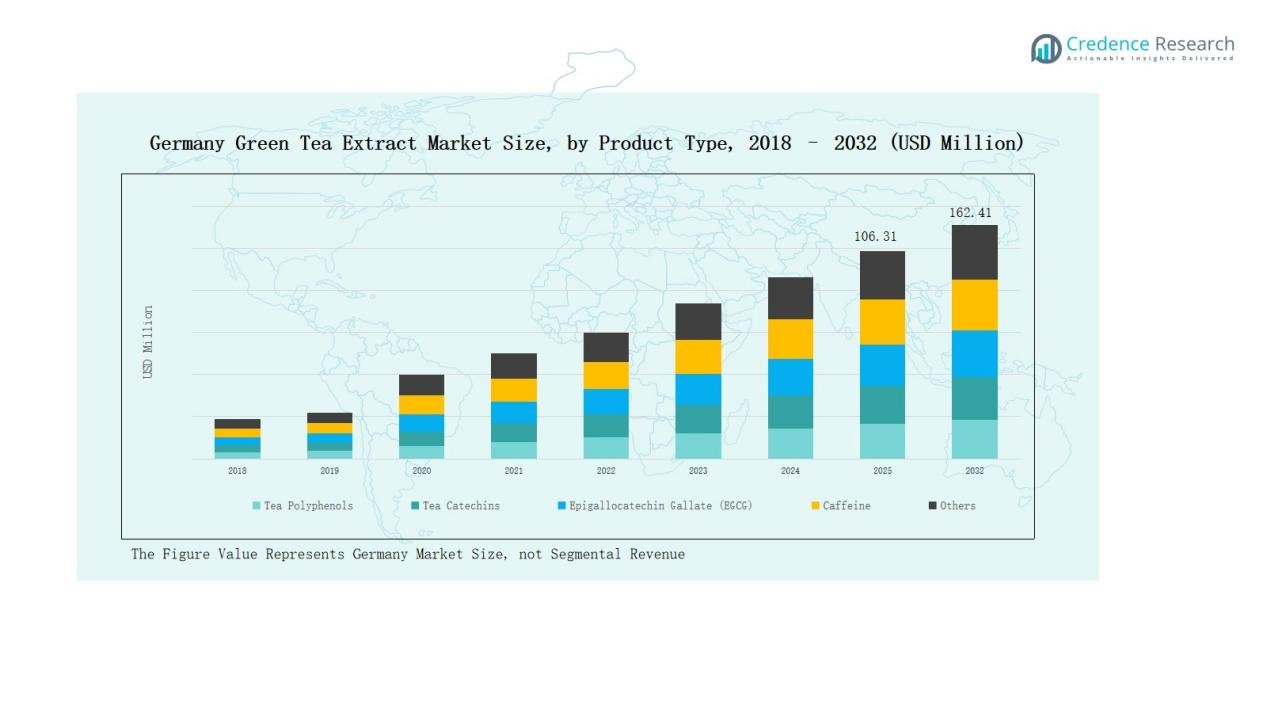
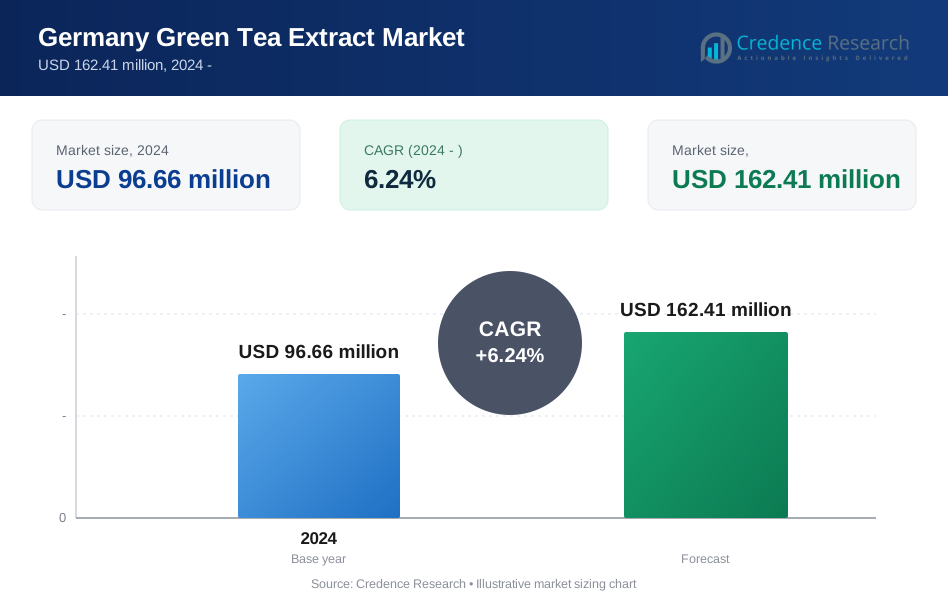
Germany Green Tea Extract Market size was valued at USD 65.44 million in 2018, reaching USD 96.66 million in 2024, and is anticipated to attain USD 162.41 million by 2032, at a CAGR of 6.24% during the forecast period (2024–2032).
| REPORT ATTRIBUTE | DETAILS |
|---|---|
| Historical Period | 2020-2023 |
| Base Year | 2024 |
| Forecast Period | 2025-2032 |
| Germany Green Tea Extract Market Size 2024 | USD 96.66 Million |
| Germany Green Tea Extract Market, CAGR | 6.24% |
| Germany Green Tea Extract Market Size 2032 | USD 162.41 Million |
The Germany Green Tea Extract Market is shaped by prominent players including MartinBauer Group, BASF SE, Symrise AG, Döhler Group, Bayer AG, Evonik Industries, Flavex Naturextrakte GmbH, Hopfenveredlung St. Johann GmbH, Sensient Technologies, and Dr. Willmar Schwabe GmbH & Co. KG. These companies strengthen market presence through advanced formulations, sustainable sourcing, and strategic partnerships across pharmaceuticals, nutraceuticals, and functional foods. Northern Germany leads the market with a 34% share in 2024, supported by strong consumer adoption of nutraceuticals, robust retail infrastructure, and increasing demand for premium, clean-label green tea extract products.
Market Insights
- The Germany Green Tea Extract Market reached USD 96.66 million in 2024 and is projected to attain USD 162.41 million by 2032 at 6.24% CAGR.
- Tea Catechins lead with 38% share in 2024, supported by strong demand in nutraceuticals and functional foods, while EGCG sees increasing pharmaceutical integration.
- Powder form dominates with 52% share in 2024, driven by stability, cost-efficiency, and strong use in supplements and fortified food applications.
- Pharmaceuticals hold 41% share in 2024, supported by clinical evidence and growing integration in treatments for cardiovascular, metabolic, and cognitive health conditions.
- Northern Germany leads with 34% share in 2024, supported by strong nutraceutical adoption, robust retail infrastructure, and growing demand for clean-label green tea products.
Market Segment Insights
By Product Type
Tea Catechins dominate the Germany Green Tea Extract Market with a 38% share in 2024, driven by their strong role in functional foods and nutraceuticals. Catechins are valued for antioxidant properties that support cardiovascular and metabolic health, aligning with consumer demand for natural wellness solutions. EGCG holds a significant position due to clinical adoption in pharmaceuticals and supplements. Tea Polyphenols contribute steadily through broad applications in skincare and dietary products, while caffeine-based extracts find niche use in energy formulations. The “Others” category covers minor bioactive compounds that enhance specialized formulations.
For instance, Taiyo GmbH expanded its Sunphenon range of green tea catechin extracts in Germany, highlighting EGCG-based solutions for dietary supplements and functional beverages.
By Form
Powder form leads the market with a 52% share in 2024, reflecting its wide integration in dietary supplements, capsules, and functional foods. The powdered format is cost-efficient, easy to transport, and offers higher stability, making it attractive for manufacturers. Liquid extracts account for growing demand in beverages, especially RTD teas and concentrated health drinks. Soft gels, while smaller in share, cater to consumers seeking convenience and precision dosage in nutraceuticals. Market adoption is influenced by innovation in formulation technologies that improve bioavailability and consumer experience.
For instance, Glanbia Nutritionals expanded its Solmiko whey protein powder portfolio, highlighting improved solubility for functional food use.
By Application
Pharmaceuticals dominate with a 41% share in 2024, supported by rising use of green tea extract in cardiovascular, metabolic, and cognitive health applications. Strong clinical evidence for EGCG and catechins has driven integration into prescription and over-the-counter products. Food & Beverages follow closely, with consumers adopting fortified snacks, confectionery, and teas for daily health benefits. RTD teas hold a rising share due to demand for convenience among younger demographics. Functional foods also expand with protein bars and fortified cereals, while “Others” contribute through cosmetics and personal care uses.
 Key Growth Drivers
Rising Consumer Demand for Natural Health Products
The Germany Green Tea Extract Market benefits from increasing consumer preference for natural and plant-based health solutions. Growing awareness of antioxidants, polyphenols, and catechins strengthens adoption in supplements and functional foods. Consumers view green tea extract as a safe and effective alternative for supporting cardiovascular, metabolic, and cognitive health. This shift is reinforced by lifestyle changes that emphasize preventive healthcare. Retail channels highlight green tea extract-based products, enhancing accessibility and visibility. These factors collectively drive steady demand across multiple consumer groups and industry applications.
Expansion in Pharmaceutical Applications
Green tea extract is witnessing strong uptake in the pharmaceutical sector, supported by clinical studies on its therapeutic benefits. Epigallocatechin Gallate (EGCG) in particular has demonstrated potential in treating cardiovascular issues, diabetes, and neurodegenerative conditions. German pharmaceutical companies integrate standardized extracts into prescription and over-the-counter formulations. Increasing research collaborations with biotech firms accelerate product development pipelines. Regulatory approval of health claims further strengthens market confidence. The established German healthcare system provides a robust framework for expanding extract-based medicines, securing long-term growth momentum in this segment.
For instance, Schwabe Group in Germany reported the use of green tea extract in clinical trials for cognitive health formulations, highlighting its neuroprotective role documented in peer-reviewed studies.
Growing Popularity of Functional Foods and Beverages
The rising demand for fortified foods and beverages is a key driver for the market. German consumers increasingly seek products that combine nutrition and convenience, such as protein bars, energy drinks, and fortified teas. Green tea extract’s antioxidant properties align with consumer interest in immunity and wellness. Ready-to-drink teas infused with green tea extract are popular among younger demographics seeking on-the-go health solutions. Food manufacturers actively innovate with clean-label, organic, and EGCG-rich ingredients. This trend supports diversification of applications and sustains growth in food and beverage integration.
For instance, Fuze Tea uses sustainably sourced tea extracts and is available in Germany. It offers a green tea with citrus and mango chamomile varieties, but there is no widely published information about a version with 30% higher catechin levels.

Key Trends & Opportunities
Shift Toward Clean-Label and Organic Products
The market is experiencing a strong trend toward clean-label, organic, and sustainably sourced green tea extracts. German consumers increasingly prioritize transparency in sourcing, production, and labeling. Manufacturers respond by introducing eco-friendly extraction processes and organic-certified formulations. This shift creates opportunities for premium positioning in dietary supplements and beverages. Regulatory frameworks encouraging natural and organic products also support adoption. Companies that align with this sustainability-driven consumer preference can capture higher-value market segments and strengthen brand credibility in both domestic and export markets.
For instance, MartinBauer Group introduced a line of organic-certified green tea extracts in 2023, produced using water-based extraction that reduces solvent use by 40%, meeting EU organic standards and strengthening its premium nutraceutical portfolio.
R&D Innovation for Enhanced Bioavailability
An important opportunity lies in advancing extraction and formulation technologies to improve bioavailability. Traditional green tea extracts often face absorption limitations, reducing their effectiveness. German companies are investing in nanotechnology, encapsulation, and advanced delivery systems to enhance functional outcomes. These innovations attract pharmaceutical firms seeking more efficient active ingredients and food producers aiming for stable integration. By addressing efficacy concerns, R&D developments expand the scope of high-performance applications in both healthcare and consumer goods. This innovation-driven approach strengthens Germany’s role as a hub for advanced nutraceutical solutions.
For instance, Evonik launched its Eudratec SoluFlow technology, which boosts solubility of poorly water‑soluble bioactives by up to 10 times, enabling higher absorption efficiency in nutraceutical formulations.
Key Challenges
Regulatory Complexity and Compliance Costs
The market faces challenges due to stringent EU and German regulations on nutraceuticals and health supplements. Obtaining approvals for health claims linked to green tea extract requires extensive clinical evidence, which demands high investment. Smaller companies struggle to meet compliance standards, limiting their ability to compete with larger firms. Complex labeling and safety standards further increase production costs. While regulations ensure product safety, they also slow down the speed of innovation and market entry. This environment creates barriers for emerging players and restricts faster expansion.
Intense Competitive Landscape
The Germany Green Tea Extract Market is highly competitive, with global leaders and domestic firms vying for share. Multinational players leverage economies of scale, established distribution networks, and broad product portfolios to maintain dominance. Smaller local firms differentiate through specialized formulations or organic certifications but face pricing pressures. Continuous innovation in product design and marketing further intensifies rivalry. The presence of substitutes such as herbal extracts and functional ingredients adds to competition. This saturated environment challenges companies to balance differentiation, cost, and scalability effectively.
Price Sensitivity and Supply Chain Risks
Market growth is constrained by supply chain volatility and raw material price fluctuations. Dependence on imported tea leaves exposes companies to geopolitical uncertainties, currency changes, and climatic variations in producing countries. High production costs for premium organic extracts increase retail pricing, limiting adoption among price-sensitive consumers. German buyers often weigh cost against perceived benefits, creating hurdles for premium-positioned products. Supply disruptions also affect consistency in quality and availability. These challenges force manufacturers to explore alternative sourcing strategies and cost optimization measures to sustain competitiveness.
Regional Analysis
Northern Germany
Northern Germany accounts for 34% share in 2024, driven by strong adoption of nutraceuticals and functional beverages. The region has a well-established retail and distribution infrastructure that enhances product reach. Consumers in Hamburg and Bremen display high awareness of preventive healthcare, encouraging use of green tea extracts in dietary supplements. Pharmaceutical applications also gain traction through partnerships with local biotech firms. The Germany Green Tea Extract Market in this region benefits from premium positioning of organic and clean-label products. It maintains steady growth supported by increasing health-conscious lifestyles.
Western Germany
Western Germany holds a 27% share in 2024, supported by its concentration of leading food and beverage manufacturers. Cities like Cologne and Düsseldorf serve as hubs for product innovation, particularly in fortified foods and ready-to-drink teas. Demand is reinforced by younger demographics seeking convenience-oriented wellness products. The Germany Green Tea Extract Market in this region also benefits from proximity to neighboring European markets, boosting export opportunities. Strong research activity in pharmaceutical companies ensures greater integration of catechins and EGCG in medical formulations. It demonstrates solid long-term growth prospects.
Southern Germany
Southern Germany captures a 22% share in 2024, supported by a strong pharmaceutical and biotechnology cluster in Munich and Stuttgart. The region emphasizes advanced formulations, including encapsulated extracts that enhance bioavailability. Food manufacturers in Bavaria integrate green tea extracts into confectionery and functional foods. The Germany Green Tea Extract Market here reflects growing consumer demand for natural and herbal products in premium categories. Its healthcare sector further drives usage of extracts for therapeutic purposes. It continues to expand with innovation and supportive regulatory environments.
Eastern Germany
Eastern Germany contributes 17% share in 2024, showing steady adoption of green tea extract across food, beverage, and wellness sectors. Retail penetration is growing in cities like Leipzig and Dresden, though at a slower pace compared to other regions. The Germany Green Tea Extract Market in this region benefits from government initiatives promoting healthier dietary habits. Pharmaceutical usage is emerging, with smaller firms experimenting in specialized applications. Functional beverages remain the fastest-growing segment. It shows strong potential as awareness and infrastructure continue to improve across this part of the country.
 Market Segmentations:
By Product Type
- Tea Polyphenols
- Tea Catechins
- Epigallocatechin Gallate (EGCG)
- Caffeine
- Others
By Form
- Powder
- Liquid
- Soft Gel
By Application
- Pharmaceuticals
- Food & Beverages
- Ready-to-Drink (RTD) Teas
- Functional Foods
- Others
By Region
- Northern Germany
- Western Germany
- Southern Germany
- Eastern Germany
Competitive Landscape
The Germany Green Tea Extract Market is characterized by strong competition among multinational corporations and domestic players, each leveraging distinct strengths to secure market presence. Leading companies such as MartinBauer Group, BASF SE, Symrise AG, and Döhler Group dominate with broad product portfolios, established supply chains, and strong global networks. These players focus on R&D to develop high-purity extracts and advanced formulations with enhanced bioavailability, catering to pharmaceutical and nutraceutical demand. Domestic firms like Flavex Naturextrakte GmbH and Hopfenveredlung St. Johann GmbH emphasize organic certifications and sustainable sourcing, targeting the growing clean-label segment. Pharmaceutical firms such as Dr. Willmar Schwabe GmbH & Co. KG and Bayer AG integrate green tea extract into clinical applications, reinforcing market credibility. Intense rivalry encourages continuous innovation, partnerships, and acquisitions, while price sensitivity and strict EU regulations shape strategic approaches. Overall, the competitive environment balances global leadership with local specialization, driving both innovation and market expansion.
Key Players
- MartinBauer Group
- Flavex Naturextrakte GmbH
- Hopfenveredlung St. Johann GmbH
- Symrise AG
- Evonik Industries
- Sensient Technologies
- BASF SE
- Willmar Schwabe GmbH & Co. KG
- Döhler Group
- Bayer AG
Recent Developments
- In October 2024, PLT Health Solutions launched Cellflo6, a patented green tea extract designed to support energy and wellness, featured in products like 7-Select Fusion Energy at retail outlets, which could impact the European market including Germany.
- In August 2024, Firmenich signed a partnership agreement to market Finlay's tea and coffee extracts portfolio across Europe, which includes Germany, enhancing the availability of high-quality natural tea extracts in the region.
- In March 2025, Schwabe Group increased its stake in Braineffect, enhancing its portfolio in natural and science-based dietary supplements and functional foods.
Report Coverage
The research report offers an in-depth analysis based on Product Type, Form, Application and Region. It details leading market players, providing an overview of their business, product offerings, investments, revenue streams, and key applications. Additionally, the report includes insights into the competitive environment, SWOT analysis, current market trends, as well as the primary drivers and constraints. Furthermore, it discusses various factors that have driven market expansion in recent years. The report also explores market dynamics, regulatory scenarios, and technological advancements that are shaping the industry. It assesses the impact of external factors and global economic changes on market growth. Lastly, it provides strategic recommendations for new entrants and established companies to navigate the complexities of the market.
Future Outlook
- Demand for green tea extract will expand with rising consumer focus on preventive health.
- Pharmaceutical adoption will strengthen as clinical studies validate therapeutic benefits of EGCG and catechins.
- Functional foods and beverages will see higher integration of extracts for daily wellness.
- Ready-to-drink teas infused with green tea extract will attract younger demographics.
- Clean-label and organic-certified products will gain preference among health-conscious consumers.
- Innovation in encapsulation and delivery systems will improve bioavailability and effectiveness.
- Strategic collaborations between pharmaceutical and nutraceutical firms will accelerate product development.
- Supply chain resilience and sustainable sourcing will become a competitive differentiator.
- Local players will expand market share through specialized formulations and targeted niches.
- Regulatory clarity will encourage investment in advanced extract-based health solutions.
Request a Free Sample
Fill in your details and we'll send you a free sample report.
- Sample data tables & charts
- Research methodology
Need a Custom Version of This Report?
Tailor the scope, geography, or segments to your exact requirements.
- Custom geography or segment scope
- Direct access to our analyst team
Frequently Asked Questions
What is the current market size for Germany Green Tea Extract Market, and what is its projected size in 2032?
At what Compound Annual Growth Rate is the Germany Green Tea Extract Market projected to grow between 2025 and 2032?
Which Germany Green Tea Extract Market segment held the largest share in 2024?
What are the primary factors fueling the growth of the Germany Green Tea Extract Market?
Who are the leading companies in the Germany Green Tea Extract Market?
Which region commanded the largest share of the Germany Green Tea Extract Market in 2024?
Table of Content
Chapter 1. Report Introduction
- 1.1 Report Description & Purpose
- 1.1.1 Report Title & Market Definition
- 1.1.2 Unique Selling Propositions (USP) & Key Differentiators
- 1.1.3 Value Proposition for Stakeholders
- 1.2 Research Objectives
- 1.2.1 Market Sizing Objectives (Volume & Revenue)
- 1.2.2 Segmentation Objectives
- 1.2.3 Competitive Intelligence Objectives
- 1.2.4 Forecast & Scenario Objectives
- 1.3 Report Scope
- 1.3.1 Germany Green Tea Extract Scope – Types & Subtypes Covered
- 1.3.2 Geographic Scope – Regions & Countries Covered
- 1.3.3 Historical Period, Base Year & Forecast Period (2024; forecast to the forecast period)
- 1.3.4 Inclusions & Exclusions
- 1.4 HS Code & Classification Framework
- 1.5 Currency, Units & Pricing Basis
- 1.6 Target Stakeholders
- 1.7 Limitations & Assumptions
Chapter 2. Executive Summary
- 2.1 Global Germany Green Tea Extract Market Snapshot
- 2.1.1 Market Size – Historical (2024) & Forecast (the forecast period) (2024: USD 96.66 million → forecast year: USD 162.41 million)
- 2.1.2 Volume & Revenue – Global Totals
- 2.1.3 Key Market Highlights – Top Five Facts
- 2.2 Germany Green Tea Extract Market Segmentation Snapshot
- 2.2.1 Market Split by Region – 2024 vs.
- 2.3 Competitive Snapshot
- 2.3.1 Top 10 Players by Revenue Share – 2024
- 2.3.2 Top 10 Players by Volume Share – 2024
- 2.3.3 Recent Strategic Developments (18-Month Summary)
- 2.4 Key Investment Highlights & Strategic Conclusions
Chapter 3. Germany Green Tea Extract Market Dynamics & Industry Analysis
- 3.1 Market Overview & Context
- 3.1.1 Germany Green Tea Extract Market Position in the Broader Automotive Value Chain
- 3.1.2 OEM vs. Replacement Market Dynamics
- 3.1.3 Market Maturity & Development Stage by Region
- 3.2 Germany Green Tea Extract Market Drivers
- 3.3 Germany Green Tea Extract Market Restraints & Challenges
- 3.4 Germany Green Tea Extract Market Opportunities
- 3.5 Porter's Five Forces Analysis
- 3.5.1 Threat of New Entrants
- 3.5.2 Bargaining Power of Suppliers
- 3.5.3 Bargaining Power of Buyers
- 3.5.4 Threat of Substitutes
- 3.5.5 Competitive Rivalry – Intensity Assessment
- 3.6 Germany Green Tea Extract Value Chain Analysis
- 3.6.1 Upstream – Raw Material/Input Suppliers
- 3.6.1.1 Raw Material/Input 1
- 3.6.1.2 Raw Material/Input 2
- 3.6.1.3 Raw Material/Input 3
- 3.6.2 Midstream – Production/Manufacturing/Service Delivery
- 3.6.2.1 Production/Process Overview
- 3.6.2.2 Key Facility Locations & Capacity by Manufacturer
- 3.6.3 Downstream – Distribution & End Consumer
- 3.6.3.1 Primary Channel – B2B/OEM
- 3.6.3.2 Secondary Channels – Dealer, Retail, Online, Direct
- 3.6.4 Value Chain Profitability Analysis
- 3.6.1 Upstream – Raw Material/Input Suppliers
- 3.7 PESTEL Analysis
- 3.7.1 Political Factors
- 3.7.2 Economic Factors
- 3.7.3 Social Factors
- 3.7.4 Technological Factors
- 3.7.5 Environmental Factors
- 3.7.6 Legal Factors
- 3.8 Germany Green Tea Extract Supply Chain Analysis
- 3.8.1 Raw Material/Input Supply Risk Assessment
- 3.8.2 Manufacturing Concentration Risk (Geographic Exposure)
- 3.8.3 Trade Disruption Impact Analysis
- 3.9 Regulatory & Policy Landscape
Note: The regulatory and policy landscape section covers regulations based on their applicability to the market, Germany Green Tea Extract category, geography, and scope of the study. Only regulatory frameworks with a material impact on operations, compliance, trade, sustainability, or market access are analyzed in detail.
Chapter 4. Key Investment Pockets & Opportunity Analysis
- 4.1 Germany Green Tea Extract Market Attractiveness Analysis
- 4.1.1 By Region – Investment Attractiveness Matrix (Volume × CAGR)
- 4.2 Absolute Revenue Growth Opportunity
- 4.2.1 By Region – Absolute USD Growth Through the forecast period
- 4.3 Incremental Volume Opportunity
- 4.3.1 By Region – Incremental Volume Through the forecast period
- 4.3.2 Segment – Incremental Volume
- 4.4 Emerging Submarket Opportunity Deep Dive (Subject to Applicability)
- 4.5 Emerging Market Opportunity Scorecards
- 4.5.1 United States
- 4.5.2 Europe
- 4.5.3 Asia
- 4.5.4 Middle East & Africa
Note: Emerging Market Opportunity Scorecards will be included based on relevance and strategic importance. Regions listed are indicative and may vary depending on data availability and market dynamics.
Chapter 5. Germany Green Tea Extract Import-Export Analysis & Trade Flows
- 5.1 Global Trade Overview
- 5.1.1 Global Export Value by Country (2024)
- 5.1.2 Global Export Volume by Country (2024)
- 5.1.3 Global Import Value by Country (2024)
- 5.1.4 Global Import Volume by Country (2024)
- 5.1.5 Net Trade Balance by Country (2024)
- 5.2 Export Analysis – Segment
- 5.2.1 Type 1 (HS Code)
- 5.2.2 Type 2 (HS Code)
- 5.2.3 Type 3 (HS Code)
- 5.2.4 Type 4 (HS Code)
- 5.2.5 Type 5 (HS Code)
- 5.3 Import Analysis – Segment
- 5.3.1 Type 1 (HS Code)
- 5.3.2 Type 2 (HS Code)
- 5.3.3 Type 3 (HS Code)
- 5.3.4 Type 4 (HS Code)
- 5.3.5 Type 5 (HS Code)
- 5.4 Average Unit Trade Prices
- 5.4.1 Average Export Price – Segment & Country
- 5.4.2 Average Import Price – Segment & Source Country
- 5.4.3 Price Trends (2024)
- 5.5 Key Trade Route Analysis
- 5.5.1 Trade Route 1
- 5.5.2 Trade Route 2
- 5.5.3 Trade Route 3
- 5.5.4 Trade Route 4
- 5.5.5 Trade Route 5
- 5.6 Trade Policy Impact Assessment
- 5.6.1 US Anti-Dumping & Section 301 Tariffs
- 5.6.2 EU Customs Union Impact
- 5.6.3 Major Free Trade Agreements
- 5.6.4 USMCA Rules of Origin
Note: Trade policy analysis will be included only where relevant to the Germany Green Tea Extract market.
Chapter 6. Competitive Landscape & Company Benchmarking
- 6.1 Germany Green Tea Extract Market Concentration & Structure
- 6.1.1 Herfindahl-Hirschman Index (HHI) – vs. 2024
- 6.1.2 Tier 1, Tier 2 & Tier 3 Market Structure
- 6.1.3 Global, Regional & Local Player Dynamics
- 6.2 Germany Green Tea Extract Market Share Analysis – 2024
- 6.2.1 Global Revenue Share by Company
- 6.2.2 Global Volume Share by Company
- 6.2.3 Regional Revenue Share
- 6.2.4 Market Share Evolution ( vs. 2024)
- 6.2.5 OEM Segment Share by Company
- 6.2.6 Replacement Segment Share by Company
- 6.3 Production/Delivery Capacity & Facility Analysis
- 6.3.1 Global Installed Capacity
- 6.3.2 Capacity Utilization Rates
- 6.3.3 Production/Output Volume
- 6.3.4 Facility Locations & Capacity Map
- 6.3.5 Planned Capacity Additions
- 6.4 Germany Green Tea Extract Competitive Benchmarking Matrix
- 6.4.1 Revenue, Volume, CAGR & Profitability Comparison
- 6.4.2 Channel Revenue Mix
- 6.4.3 Geographic Revenue Exposure
- 6.4.4 R&D Intensity
- 6.4.5 Sustainability Maturity
- 6.5 Strategic Developments in Germany Green Tea Extract (Last 24 Months)
- 6.5.1 Mergers, Acquisitions & Divestments
- 6.5.2 New Germany Green Tea Extract Launches
- 6.5.3 Facility Expansions
- 6.5.4 Strategic Alliances, Joint Ventures & Partnerships
- 6.5.5 Distribution Expansion & Market Entry
- 6.5.6 Sustainability & ESG Initiatives
- 6.6 Competitive Strategy Mapping
- 6.6.1 Leader, Challenger, Follower & Niche Classification
- 6.6.2 Pricing Strategy Comparison
- 6.6.3 Channel Strategy Matrix
Note: Strategic developments are included based on their materiality and the availability of reliable information.
Chapter 7. Global Germany Green Tea Extract Market – By Distribution Channel
- 7.1 Segment Overview
- 7.1.1 Volume & Revenue Split by Channel (2024 & )
- 7.1.2 Channel Mix Evolution (the forecast period)
Chapter 8. Regional Market Analysis – Global Overview
- 8.1 Global Regional Overview
- 8.1.1 Regional Volume Share
- 8.1.2 Regional Revenue Share
- 8.1.3 Regional Volume by Region
- 8.1.4 Regional Revenue by Region
- 8.1.5 Regional Forecast Through the forecast period
- 8.2 Cross-Regional Segment Analysis
- 8.2.1 By Distribution Channel
- 8.2.2 By Brand/Price Tier
Chapter 9. North America Germany Green Tea Extract Market
- 9.1 United States
- 9.2 Canada
- 9.3 Mexico
Chapter 10. Europe Germany Green Tea Extract Market
- 10.1 Germany
- 10.2 France
- 10.3 Italy
- 10.4 United Kingdom
- 10.5 Spain
- 10.6 Poland
- 10.7 Russia
- 10.8 Netherlands
- 10.9 Belgium
- 10.10 Sweden
- 10.11 Denmark
- 10.12 Norway
- 10.13 Rest of Europe
Chapter 11. Asia Pacific Germany Green Tea Extract Market
- 11.1 China
- 11.2 India
- 11.3 Japan
- 11.4 South Korea
- 11.5 Thailand
- 11.6 Indonesia
- 11.7 Vietnam
- 11.8 Malaysia
- 11.9 Australia
- 11.10 Rest of Asia Pacific
Chapter 12. Latin America Germany Green Tea Extract Market
- 12.1 Brazil
- 12.2 Argentina
- 12.3 Colombia
- 12.4 Chile
- 12.5 Rest of Latin America
Chapter 13. Middle East Germany Green Tea Extract Market
- 13.1 Saudi Arabia
- 13.2 United Arab Emirates
- 13.3 Turkey
- 13.4 Israel
- 13.5 Iran
- 13.6 Rest of the Middle East
Chapter 14. Africa Germany Green Tea Extract Market
- 14.1 South Africa
- 14.2 Egypt
- 14.3 Nigeria
- 14.4 Morocco
- 14.5 Rest of Africa
Chapter 15. Germany Green Tea Extract Company Profiles
- 15.1 [Company 01]
- 15.1.1 Company Overview
- 15.1.2 Key Management Personnel
- 15.1.3 Products & Services Portfolio
- 15.1.4 Financial Performance
- 15.1.5 Key Market Focus & Geographic Presence
- 15.1.6 Recent Developments & Strategic Initiatives
Note: The company profile list is preliminary and may change based on research findings, market developments, data availability, and client requirements.
Chapter 16. Appendices
- Appendix A – List of Abbreviations & Acronyms
- Appendix B – Industry Classification Code Reference – Full Series
- Appendix C – Production & Capacity Data Tables
- Appendix D – End-Use & Demand Base Tables
- Appendix E – Consumption & Replacement Rate Assumptions
- Appendix F – ASP Reference Tables
- Appendix G – Manufacturing & Facility Database
- Appendix H – Import-Export Data Tables
- Appendix I – Regulatory Summary Tables
- Appendix J – Primary Research Participant List (Anonymized)
- Appendix K – Primary Research Questionnaire Framework
- Appendix L – Data Sources & Bibliography
- Appendix M – Market Size Divergence & Source Comparison
Chapter 17. Research Methodology
- 17.1 Research Framework & Philosophy
- 17.2 Secondary Research – Sources, Hierarchy & Data Extraction
- 17.3 Data Modeling – Bottom-Up & Top-Down Market Sizing
- 17.4 Primary Research – Stakeholder Framework, LOI & Sample Sizes
- 17.5 Forecast Methodology – Regression, Scenario & Sensitivity Analysis
- 17.6 Quality Control – Four-Layer Validation Framework
- 17.7 Limitations & Standard Assumptions
- 17.8 Disclaimer
