
Market Overview
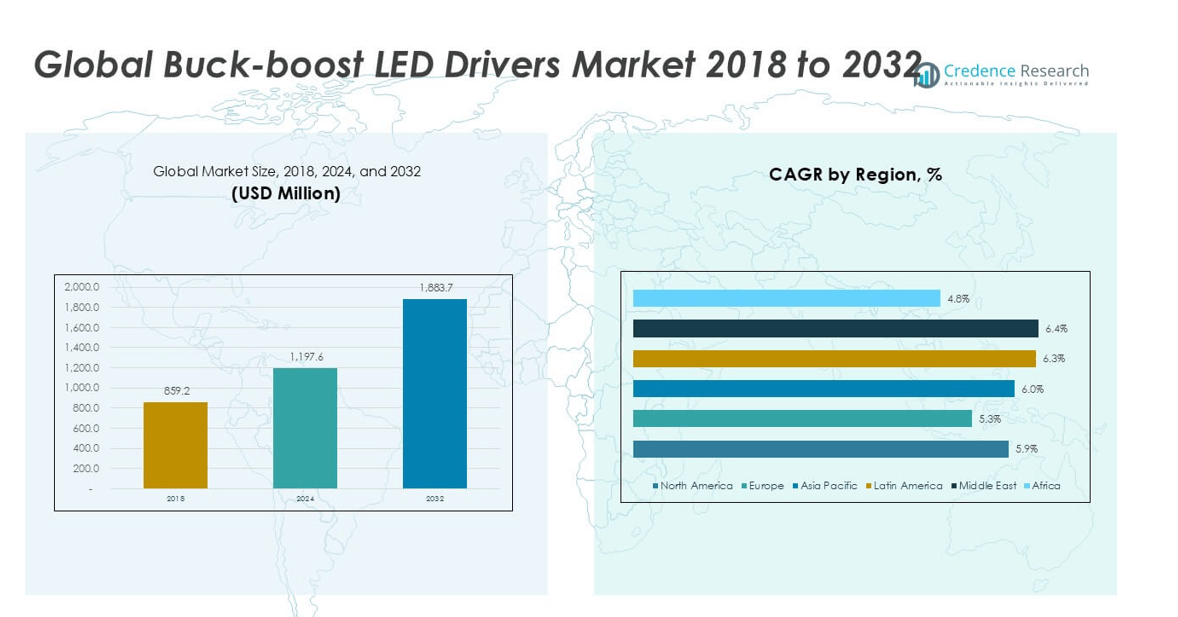
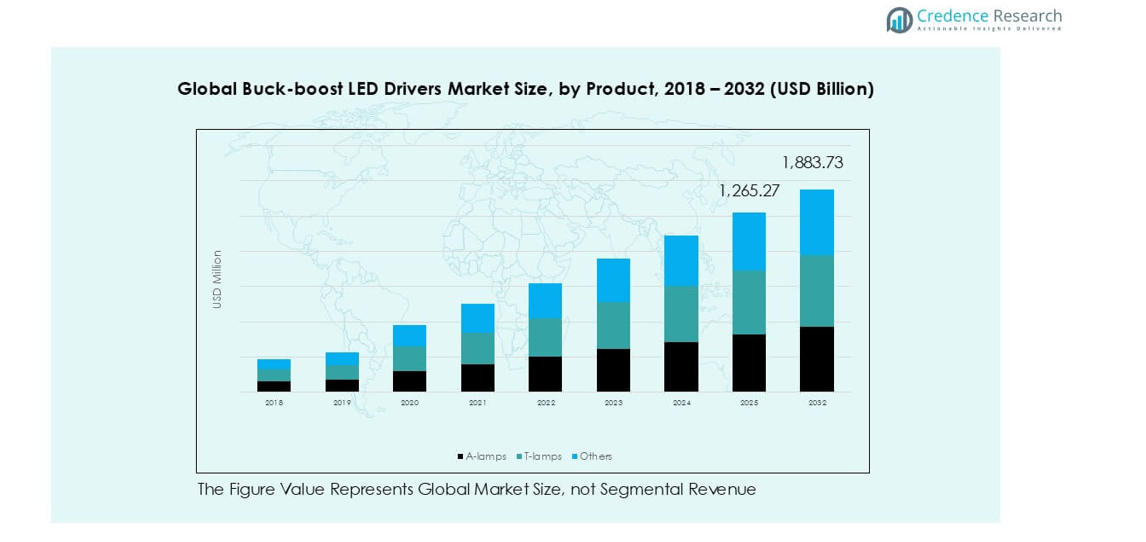
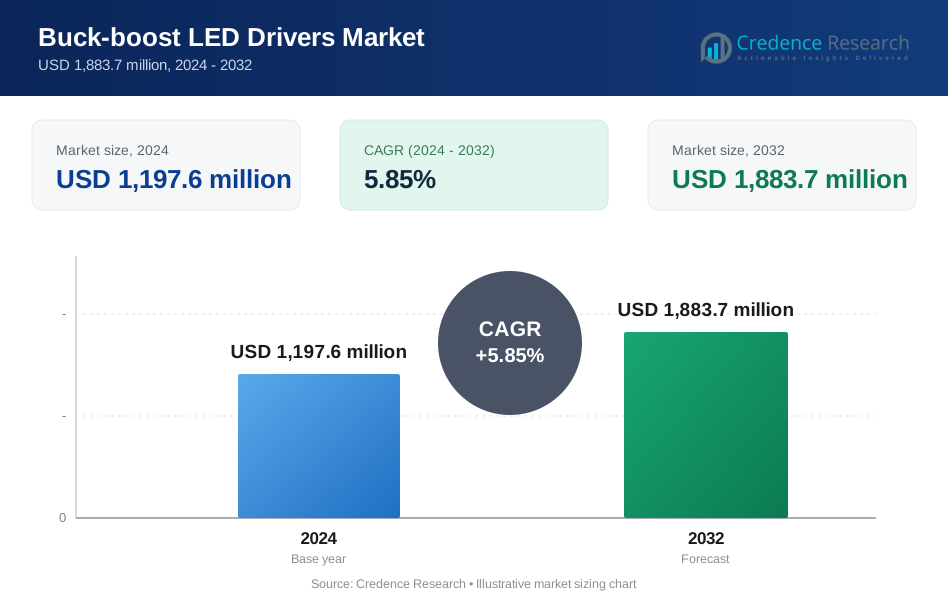
Global Buck-boost LED Drivers market size was valued at USD 859.2 million in 2018 to USD 1,197.6 million in 2024 and is anticipated to reach USD 1,883.7 million by 2032, at a CAGR of 5.85% during the forecast period.
| REPORT ATTRIBUTE | DETAILS |
|---|---|
| Historical Period | 2020-2023 |
| Base Year | 2024 |
| Forecast Period | 2025-2032 |
| Buck-Boost LED Drivers Market Size 2024 | USD 1,197.6 million |
| Buck-Boost LED Drivers Market, CAGR | 5..85% |
| Buck-Boost LED Drivers Market Size 2032 | USD 1,883.7 million |
Top players in the global buck-boost LED drivers market include Texas Instruments, Infineon, STMicroelectronics, and ON Semiconductor. NXP, ROHM, Toshiba, Macroblock, Maxim Lighting International, and Linear Technology also compete strongly. These firms win designs through efficiency gains and wide input-voltage support. They also focus on compact packages and longer lifetime performance. Regionally, Asia Pacific leads with 34.2% market share (2018), driven by large LED production and fast building growth. Europe follows with 26.7% share (2018), supported by strict efficiency rules. North America holds 22.9% share (2018), backed by retrofit demand and smart lighting adoption.
Market Insights
- The Global buck-boost LED drivers market reached USD 1,197.6 million (2024) and targets USD 1,883.7 million (2032) at 5.85% CAGR.
- Demand rises from LED retrofits and voltage-fluctuation protection in grids.
- Smart lighting growth supports buck-boost drivers with dimming and controls.
- Major players include TI, Infineon, STMicroelectronics, ON Semiconductor, and ROHM, with cost and efficiency competition.
- Asia Pacific led 34.2% share (2018), followed by Europe 26.7% and North America 22.9%; A-lamps led by product share and commercial led by application share.
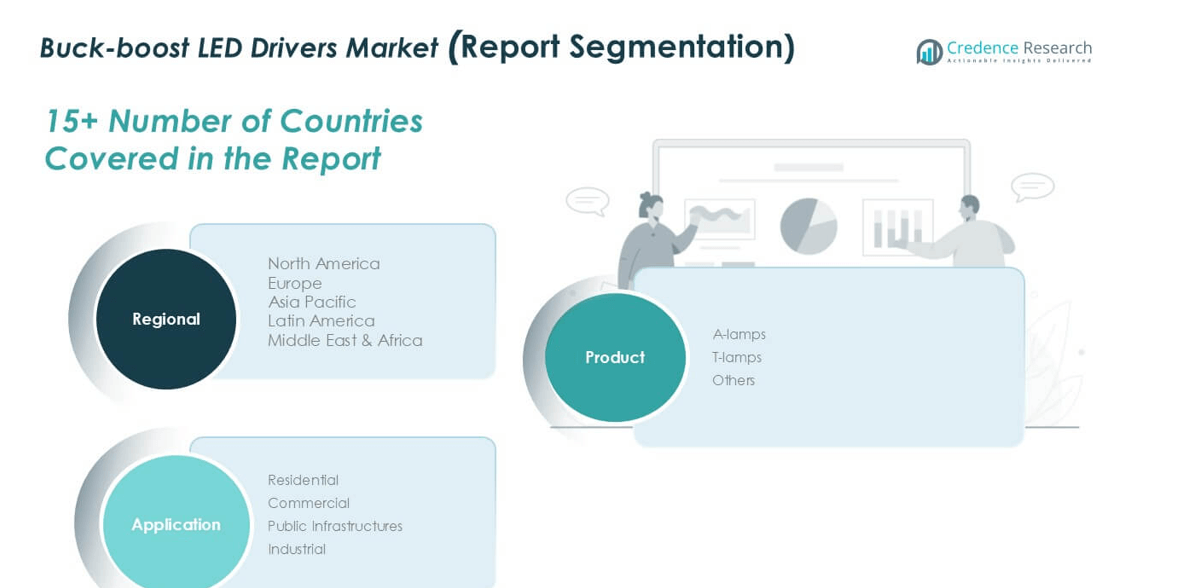
Market Segmentation Analysis:
By Product
The Product segment shows clear dominance from A-lamps in the global buck-boost LED driver’s market. A-lamps hold the largest market share due to widespread residential and commercial adoption. These lamps support stable light output under fluctuating voltage conditions. High replacement rates of incandescent bulbs strengthen demand. Manufacturers prefer A-lamps for standardized designs and cost efficiency. T-lamps follow with steady uptake in offices and retail spaces. The Others category serves niche fixtures and decorative lighting. Product demand grows from energy rules and longer LED lifetimes.
- For instance, Philips A19 LED lamps operate across an input range of around 120V while delivering 800 lumens.
By Application
The Application segment is led by the commercial sub-segment, holding the highest market share. Commercial buildings require stable lighting across variable power conditions. Buck-boost LED drivers ensure consistent illumination in offices and retail spaces. Energy efficiency targets drive upgrades in malls and business parks. Residential applications show strong volume growth from home lighting retrofits. Public infrastructures adopt these drivers for streetlights and transit areas. Industrial usage remains steady in factories with voltage fluctuations. Reliability and compliance standards support broad application demand.
- For instance, many Cree Lighting commercial fixtures utilize an integral, high-efficiency driver with a universal input voltage range of 120-277V for indoor application.
Key Growth Drivers
Rising Adoption of Energy-Efficient Lighting Systems
Energy efficiency mandates strongly drive the global buck-boost LED drivers market. Governments enforce strict lighting efficiency standards worldwide. LEDs replace incandescent and fluorescent lamps across applications. Buck-boost drivers ensure stable output under voltage variation. This capability improves energy savings and lighting quality. Commercial buildings demand consistent illumination to meet safety norms. Residential users prefer LEDs for lower power bills. Utilities promote efficient lighting through rebate programs. Buck-boost designs reduce power loss in unstable grids. Emerging economies benefit from voltage regulation features. These drivers extend LED lifespan and reduce maintenance costs. Manufacturers integrate them into standard lamp designs. Energy audits further accelerate LED upgrades. This driver sustains long-term demand growth globally.
- For instance, many commercial GE Lighting LED drivers operate between 100 and 277 volts (or similar universal voltage ranges) and are designed to provide stable, flicker-free power output to LEDs.
Expansion of Commercial and Public Infrastructure Projects
Commercial construction activity supports strong demand for buck-boost LED drivers. Offices, malls, and hotels require reliable lighting systems. Voltage fluctuations remain common in large buildings. Buck-boost drivers maintain consistent brightness across loads. Public infrastructure projects also boost adoption levels. Street lighting and transit hubs demand stable performance. Governments invest in smart city lighting upgrades. These projects favor efficient and durable driver solutions. Long operating hours increase focus on reliability. Maintenance cost reduction remains a key priority. Buck-boost drivers support centralized lighting control systems. Their flexibility suits diverse fixture types. Infrastructure spending directly strengthens market demand.
- For instance, Siemens smart building lighting systems use LED components and associated drivers that are typically rated for a long operational lifespan, often exceeding 50,000 operating hours.
Increasing Focus on Power Quality and Voltage Stability
Power quality concerns push adoption of buck-boost LED drivers. Many regions face unstable grid conditions. Voltage dips and surges affect LED performance. Buck-boost drivers correct input voltage variations. This feature prevents flicker and lumen loss. Industrial facilities require stable lighting for safety. Warehouses and factories operate under heavy electrical loads. Lighting reliability improves operational efficiency. Commercial users value consistent visual comfort. Driver designs support wide input voltage ranges. This reduces the need for external regulators. Improved power quality drives specification preference. This factor supports steady global adoption.
Key Trends & Opportunities
Integration with Smart and Connected Lighting Systems
Smart lighting integration creates strong opportunities for buck-boost LED drivers. Buildings increasingly deploy connected lighting platforms. These systems require precise power regulation. Buck-boost drivers support digital dimming and control. Compatibility with sensors improves energy management. Offices use adaptive lighting to reduce consumption. Public lighting adopts remote monitoring features. Smart cities demand flexible driver architectures. Manufacturers develop compact and intelligent designs. Integration improves system efficiency and uptime. Data-driven lighting control enhances user experience. This trend opens value-added product opportunities. Advanced drivers gain preference in premium installations.
- For instance, Signify’s Interact-enabled luminaires use Advance Xitanium and CertaDrive LED drivers supporting 0–10 V and DALI control with input ranges of 120–277 volts.
Growing Demand from Emerging Markets
Emerging markets offer significant growth opportunities. Rapid urbanization increases lighting demand. Infrastructure expansion raises installation volumes. Power supply instability remains common in these regions. Buck-boost LED drivers address this challenge effectively. Affordable housing projects drive residential demand. Governments promote LED adoption for energy savings. Local manufacturers expand LED assembly capacity. Cost-optimized driver solutions gain traction. Distribution networks improve product availability. This trend supports long-term volume growth. Emerging economies strengthen the global demand base.
Key Challenges
Price Sensitivity and Cost Pressure
Price sensitivity presents a key challenge in the market. End users often focus on upfront costs. Buck-boost drivers cost more than basic drivers. Budget-constrained projects limit advanced driver adoption. Residential buyers prefer low-cost lighting options. Competitive pricing pressures reduce supplier margins. Manufacturers face rising component costs. Power electronics require quality materials. Balancing cost and performance remains difficult. Local low-cost producers increase competition. Differentiation becomes harder in mass segments. This challenge affects profitability across regions.
Design Complexity and Thermal Management Issues
Design complexity challenges buck-boost LED driver adoption. These drivers require advanced circuit design. Thermal management remains a critical concern. High power density increases heat generation. Poor thermal control reduces driver lifespan. Compact fixtures limit heat dissipation options. Designers must meet safety and efficiency standards. Certification processes increase development time. Reliability testing adds to production costs. Smaller manufacturers face technical barriers. Continuous innovation is required to address these issues. Design challenges can slow product rollout.
Regional Analysis
North America
North America represented about 22.9% of the global buck-boost LED drivers market in 2018, valued at USD 196.68 million. Strong adoption of LED-based lighting solutions in commercial buildings and residential retrofits boosted early demand. Utilities encouraged upgrades through incentive programs, while infrastructure modernization projects strengthened product utilization. The market is projected to reach USD 275.21 million in 2024 and USD 435.14 million by 2032, reflecting a 5.9% CAGR. Growing focus on smart lighting systems and power quality improvements continues to support stable regional growth.
Europe
Europe accounted for nearly 26.7% of the total market in 2018, reaching USD 229.67 million. The region benefits from stringent EU energy-efficiency directives that promote advanced lighting drivers. Retrofit programs across public buildings and industrial facilities accelerate adoption. The market is expected to reach USD 311.24 million by 2024 and USD 470.93 million by 2032, expanding at a 5.3% CAGR. Continuous investment in sustainable urban lighting and compliance with Ecodesign standards drive consistent replacement cycles across major European economies.
Asia Pacific
Asia Pacific dominated the global market with approximately 34.2% share in 2018, valued at USD 294.11 million. Expanding construction activity, rapid industrialization, and unstable grid conditions drive strong demand for buck-boost LED drivers. Manufacturers in China, Japan, and South Korea lead large-scale production and integration. The market is expected to grow to USD 413.95 million by 2024 and USD 659.50 million by 2032, registering a 6.0% CAGR. Continuous investment in smart city lighting and infrastructure upgrades sustains regional leadership.
Latin America
Latin America captured around 9.7% market share in 2018, valued at USD 83.09 million. Urbanization and commercial infrastructure expansion support LED lighting adoption. Buck-boost drivers are increasingly used to counter power fluctuations across developing grids. Government programs promoting energy-efficient public lighting further drive installations. The market is forecast to reach USD 119.25 million in 2024 and USD 194.78 million by 2032, growing at a 6.3% CAGR. Regional growth remains steady, supported by modernization of transportation and retail infrastructure.
Middle East
The Middle East held approximately 4.3% market share in 2018, with a value of USD 37.29 million. Rising commercial and hospitality construction drives regional demand. Harsh environmental conditions require thermally stable and reliable driver designs. Investments in smart lighting across public facilities enhance deployment. The market is projected to reach USD 53.67 million by 2024 and USD 87.97 million by 2032, advancing at a 6.4% CAGR. Large-scale infrastructure and smart city programs continue to create long-term market potential.
Africa
Africa accounted for about 2.1% of the global market in 2018, valued at USD 18.39 million. Growing electrification and urban expansion support the shift toward LED lighting. Power supply instability increases preference for buck-boost driver solutions. The market is expected to reach USD 24.29 million in 2024 and USD 35.41 million by 2032, expanding at a 4.8% CAGR. Public infrastructure development and off-grid lighting initiatives enhance market opportunities, though affordability and import dependency remain key challenges.
Market Segmentations:
By Product
- A-lamps
- T-lamps
- Others
By Application
- Residential
- Commercial
- Public Infrastructures
- Industrial
By Geography
- North America
- U.S.
- Canada
- Mexico
- Europe
- Germany
- France
- U.K.
- Italy
- Spain
- Rest of Europe
- Asia Pacific
- China
- Japan
- India
- South Korea
- South-east Asia
- Rest of Asia Pacific
- Latin America
- Brazil
- Argentina
- Rest of Latin America
- Middle East & Africa
- GCC Countries
- South Africa
- Rest of the Middle East and Africa
Competitive Landscape
The competitive landscape in the global buck-boost LED drivers market remains moderately consolidated, led by diversified analog and power-management suppliers. Companies compete through efficiency improvement, wide input-voltage support, and compact designs for lamps and luminaires. Market leaders strengthen positions by expanding reference designs and application notes that shorten customer design cycles. Suppliers also prioritize high reliability for long operating hours in commercial and infrastructure lighting. Pricing pressure shapes portfolio tiering, with entry products targeting retrofit bulbs and premium products serving smart lighting needs. Partnerships with OEMs and lighting module makers support faster design wins. Firms invest in advanced packaging and thermal performance to improve lifetime under high ambient conditions. Regulatory compliance and quality certifications remain key differentiators across regions and applications.
Key Player Analysis
- NXP Semiconductors N.V.
- Macroblock, Inc.
- Texas Instruments Incorporated
- Linear Technology
- Toshiba Corporation
- Infineon Technologies AG
- ROHM Semiconductors
- STMicroelectronics
- ON Semiconductor Corporation
- Maxim Lighting International, Inc.
Recent Developments
- In 2025, Texas Instruments Inc. TI revised the TPS92365x evaluation module manual for its 65 V boost / buck-boost LED driver family, updating design data and test conditions for dimmable lighting systems.
- In 2024, Onsemi revised Revision 4 of the NCP5030 datasheet, a fixed-frequency buck-boost DC-DC converter tailored to drive a single high-power LED from Li-ion or three NiMH cells.
- In 2023, Articles on Infineon’s LITIX Power Flex TLD5541 and related TLD5xxx family promoted their ability to operate in boost, buck, buck-boost, and SEPIC modes for flexible automotive LED headlights and rear lights.
Report Coverage
The research report offers an in-depth analysis based on Product, Application and Geography. It details leading market players, providing an overview of their business, product offerings, investments, revenue streams, and key applications. Additionally, the report includes insights into the competitive environment, SWOT analysis, current market trends, as well as the primary drivers and constraints. Furthermore, it discusses various factors that have driven market expansion in recent years. The report also explores market dynamics, regulatory scenarios, and technological advancements that are shaping the industry. It assesses the impact of external factors and global economic changes on market growth. Lastly, it provides strategic recommendations for new entrants and established companies to navigate the complexities of the market.
Future Outlook
- Manufacturers expand buck-boost designs with higher efficiency across wide input ranges.
- Smart lighting adoption increases demand for dimming-ready driver architectures.
- Commercial retrofits keep leading installations in offices and retail buildings.
- Public infrastructure upgrades lift demand in street and transit lighting.
- Grid fluctuation tolerance becomes a core buying factor in emerging economies.
- Compact, thermally robust packages gain preference in enclosed luminaires.
- OEM partnerships and reference designs speed up new design wins.
- Regulatory pressure pushes higher power factor and lower harmonic distortion.
- Supply chains diversify to reduce component risk and lead-time volatility.
- Competition intensifies as suppliers improve features while controlling costs.
Request a Free Sample
Fill in your details and we'll send you a free sample report.
- Sample data tables & charts
- Research methodology
Need a Custom Version of This Report?
Tailor the scope, geography, or segments to your exact requirements.
- Custom geography or segment scope
- Direct access to our analyst team
Frequently Asked Questions
What is the current market size for Buck-Boost LED Drivers Market, and what is its projected size in 202?
At what Compound Annual Growth Rate is the Buck-Boost LED Drivers Market projected to grow between 2025 and 2032?
Who are the major players in this market?
Who are the leading companies in the Buck-Boost LED Drivers Market?
Which region commanded the largest share of the Buck-Boost LED Drivers Market in 2024?
Table of Content
Chapter 1. Report Introduction
- 1.1 Report Description & Purpose
- 1.1.1 Report Title & Market Definition
- 1.1.2 Unique Selling Propositions (USP) & Key Differentiators
- 1.1.3 Value Proposition for Stakeholders
- 1.2 Research Objectives
- 1.2.1 Market Sizing Objectives (Volume & Revenue)
- 1.2.2 Segmentation Objectives
- 1.2.3 Competitive Intelligence Objectives
- 1.2.4 Forecast & Scenario Objectives
- 1.3 Report Scope
- 1.3.1 Buck-boost LED Drivers Scope – Types & Subtypes Covered
- 1.3.2 Geographic Scope – Regions & Countries Covered
- 1.3.3 Historical Period, Base Year & Forecast Period (2024; forecast to 2032)
- 1.3.4 Inclusions & Exclusions
- 1.4 HS Code & Classification Framework
- 1.5 Currency, Units & Pricing Basis
- 1.6 Target Stakeholders
- 1.7 Limitations & Assumptions
Chapter 2. Executive Summary
- 2.1 Global Buck-boost LED Drivers Market Snapshot
- 2.1.1 Market Size – Historical (2024) & Forecast (2024-2032) (2024: USD 1,197.6 million → 2032: USD 1,883.7 million)
- 2.1.2 Volume & Revenue – Global Totals
- 2.1.3 Key Market Highlights – Top Five Facts
- 2.2 Buck-boost LED Drivers Market Segmentation Snapshot
- 2.2.1 Market Split by Region – 2024 vs. 2032
- 2.3 Competitive Snapshot
- 2.3.1 Top 10 Players by Revenue Share – 2024
- 2.3.2 Top 10 Players by Volume Share – 2024
- 2.3.3 Recent Strategic Developments (18-Month Summary)
- 2.4 Key Investment Highlights & Strategic Conclusions
Chapter 3. Buck-boost LED Drivers Market Dynamics & Industry Analysis
- 3.1 Market Overview & Context
- 3.1.1 Buck-boost LED Drivers Market Position in the Broader Automotive Value Chain
- 3.1.2 OEM vs. Replacement Market Dynamics
- 3.1.3 Market Maturity & Development Stage by Region
- 3.2 Buck-boost LED Drivers Market Drivers
- 3.3 Buck-boost LED Drivers Market Restraints & Challenges
- 3.4 Buck-boost LED Drivers Market Opportunities
- 3.5 Porter's Five Forces Analysis
- 3.5.1 Threat of New Entrants
- 3.5.2 Bargaining Power of Suppliers
- 3.5.3 Bargaining Power of Buyers
- 3.5.4 Threat of Substitutes
- 3.5.5 Competitive Rivalry – Intensity Assessment
- 3.6 Buck-boost LED Drivers Value Chain Analysis
- 3.6.1 Upstream – Raw Material/Input Suppliers
- 3.6.1.1 Raw Material/Input 1
- 3.6.1.2 Raw Material/Input 2
- 3.6.1.3 Raw Material/Input 3
- 3.6.2 Midstream – Production/Manufacturing/Service Delivery
- 3.6.2.1 Production/Process Overview
- 3.6.2.2 Key Facility Locations & Capacity by Manufacturer
- 3.6.3 Downstream – Distribution & End Consumer
- 3.6.3.1 Primary Channel – B2B/OEM
- 3.6.3.2 Secondary Channels – Dealer, Retail, Online, Direct
- 3.6.4 Value Chain Profitability Analysis
- 3.6.1 Upstream – Raw Material/Input Suppliers
- 3.7 PESTEL Analysis
- 3.7.1 Political Factors
- 3.7.2 Economic Factors
- 3.7.3 Social Factors
- 3.7.4 Technological Factors
- 3.7.5 Environmental Factors
- 3.7.6 Legal Factors
- 3.8 Buck-boost LED Drivers Supply Chain Analysis
- 3.8.1 Raw Material/Input Supply Risk Assessment
- 3.8.2 Manufacturing Concentration Risk (Geographic Exposure)
- 3.8.3 Trade Disruption Impact Analysis
- 3.9 Regulatory & Policy Landscape
Note: The regulatory and policy landscape section covers regulations based on their applicability to the market, Buck-boost LED Drivers category, geography, and scope of the study. Only regulatory frameworks with a material impact on operations, compliance, trade, sustainability, or market access are analyzed in detail.
Chapter 4. Key Investment Pockets & Opportunity Analysis
- 4.1 Buck-boost LED Drivers Market Attractiveness Analysis
- 4.1.1 By Region – Investment Attractiveness Matrix (Volume × CAGR)
- 4.2 Absolute Revenue Growth Opportunity
- 4.2.1 By Region – Absolute USD Growth Through 2032
- 4.3 Incremental Volume Opportunity
- 4.3.1 By Region – Incremental Volume Through 2032
- 4.3.2 Segment – Incremental Volume
- 4.4 Emerging Submarket Opportunity Deep Dive (Subject to Applicability)
- 4.5 Emerging Market Opportunity Scorecards
- 4.5.1 United States
- 4.5.2 Europe
- 4.5.3 Asia
- 4.5.4 Middle East & Africa
Note: Emerging Market Opportunity Scorecards will be included based on relevance and strategic importance. Regions listed are indicative and may vary depending on data availability and market dynamics.
Chapter 5. Buck-boost LED Drivers Import-Export Analysis & Trade Flows
- 5.1 Global Trade Overview
- 5.1.1 Global Export Value by Country (2024)
- 5.1.2 Global Export Volume by Country (2024)
- 5.1.3 Global Import Value by Country (2024)
- 5.1.4 Global Import Volume by Country (2024)
- 5.1.5 Net Trade Balance by Country (2024)
- 5.2 Export Analysis – Segment
- 5.2.1 Type 1 (HS Code)
- 5.2.2 Type 2 (HS Code)
- 5.2.3 Type 3 (HS Code)
- 5.2.4 Type 4 (HS Code)
- 5.2.5 Type 5 (HS Code)
- 5.3 Import Analysis – Segment
- 5.3.1 Type 1 (HS Code)
- 5.3.2 Type 2 (HS Code)
- 5.3.3 Type 3 (HS Code)
- 5.3.4 Type 4 (HS Code)
- 5.3.5 Type 5 (HS Code)
- 5.4 Average Unit Trade Prices
- 5.4.1 Average Export Price – Segment & Country
- 5.4.2 Average Import Price – Segment & Source Country
- 5.4.3 Price Trends (2024)
- 5.5 Key Trade Route Analysis
- 5.5.1 Trade Route 1
- 5.5.2 Trade Route 2
- 5.5.3 Trade Route 3
- 5.5.4 Trade Route 4
- 5.5.5 Trade Route 5
- 5.6 Trade Policy Impact Assessment
- 5.6.1 US Anti-Dumping & Section 301 Tariffs
- 5.6.2 EU Customs Union Impact
- 5.6.3 Major Free Trade Agreements
- 5.6.4 USMCA Rules of Origin
Note: Trade policy analysis will be included only where relevant to the Buck-boost LED Drivers market.
Chapter 6. Competitive Landscape & Company Benchmarking
- 6.1 Buck-boost LED Drivers Market Concentration & Structure
- 6.1.1 Herfindahl-Hirschman Index (HHI) – vs. 2024
- 6.1.2 Tier 1, Tier 2 & Tier 3 Market Structure
- 6.1.3 Global, Regional & Local Player Dynamics
- 6.2 Buck-boost LED Drivers Market Share Analysis – 2024
- 6.2.1 Global Revenue Share by Company
- 6.2.2 Global Volume Share by Company
- 6.2.3 Regional Revenue Share
- 6.2.4 Market Share Evolution ( vs. 2024)
- 6.2.5 OEM Segment Share by Company
- 6.2.6 Replacement Segment Share by Company
- 6.3 Production/Delivery Capacity & Facility Analysis
- 6.3.1 Global Installed Capacity
- 6.3.2 Capacity Utilization Rates
- 6.3.3 Production/Output Volume
- 6.3.4 Facility Locations & Capacity Map
- 6.3.5 Planned Capacity Additions
- 6.4 Buck-boost LED Drivers Competitive Benchmarking Matrix
- 6.4.1 Revenue, Volume, CAGR & Profitability Comparison
- 6.4.2 Channel Revenue Mix
- 6.4.3 Geographic Revenue Exposure
- 6.4.4 R&D Intensity
- 6.4.5 Sustainability Maturity
- 6.5 Strategic Developments in Buck-boost LED Drivers (Last 24 Months)
- 6.5.1 Mergers, Acquisitions & Divestments
- 6.5.2 New Buck-boost LED Drivers Launches
- 6.5.3 Facility Expansions
- 6.5.4 Strategic Alliances, Joint Ventures & Partnerships
- 6.5.5 Distribution Expansion & Market Entry
- 6.5.6 Sustainability & ESG Initiatives
- 6.6 Competitive Strategy Mapping
- 6.6.1 Leader, Challenger, Follower & Niche Classification
- 6.6.2 Pricing Strategy Comparison
- 6.6.3 Channel Strategy Matrix
Note: Strategic developments are included based on their materiality and the availability of reliable information.
Chapter 7. Global Buck-boost LED Drivers Market – By Distribution Channel
- 7.1 Segment Overview
- 7.1.1 Volume & Revenue Split by Channel (2024 & 2032)
- 7.1.2 Channel Mix Evolution (2024-2032)
Chapter 8. Regional Market Analysis – Global Overview
- 8.1 Global Regional Overview
- 8.1.1 Regional Volume Share
- 8.1.2 Regional Revenue Share
- 8.1.3 Regional Volume by Region
- 8.1.4 Regional Revenue by Region
- 8.1.5 Regional Forecast Through 2032
- 8.2 Cross-Regional Segment Analysis
- 8.2.1 By Distribution Channel
- 8.2.2 By Brand/Price Tier
Chapter 9. North America Buck-boost LED Drivers Market
- 9.1 United States
- 9.2 Canada
- 9.3 Mexico
Chapter 10. Europe Buck-boost LED Drivers Market
- 10.1 Germany
- 10.2 France
- 10.3 Italy
- 10.4 United Kingdom
- 10.5 Spain
- 10.6 Poland
- 10.7 Russia
- 10.8 Netherlands
- 10.9 Belgium
- 10.10 Sweden
- 10.11 Denmark
- 10.12 Norway
- 10.13 Rest of Europe
Chapter 11. Asia Pacific Buck-boost LED Drivers Market
- 11.1 China
- 11.2 India
- 11.3 Japan
- 11.4 South Korea
- 11.5 Thailand
- 11.6 Indonesia
- 11.7 Vietnam
- 11.8 Malaysia
- 11.9 Australia
- 11.10 Rest of Asia Pacific
Chapter 12. Latin America Buck-boost LED Drivers Market
- 12.1 Brazil
- 12.2 Argentina
- 12.3 Colombia
- 12.4 Chile
- 12.5 Rest of Latin America
Chapter 13. Middle East Buck-boost LED Drivers Market
- 13.1 Saudi Arabia
- 13.2 United Arab Emirates
- 13.3 Turkey
- 13.4 Israel
- 13.5 Iran
- 13.6 Rest of the Middle East
Chapter 14. Africa Buck-boost LED Drivers Market
- 14.1 South Africa
- 14.2 Egypt
- 14.3 Nigeria
- 14.4 Morocco
- 14.5 Rest of Africa
Chapter 15. Buck-boost LED Drivers Company Profiles
- 15.1 [Company 01]
- 15.1.1 Company Overview
- 15.1.2 Key Management Personnel
- 15.1.3 Products & Services Portfolio
- 15.1.4 Financial Performance
- 15.1.5 Key Market Focus & Geographic Presence
- 15.1.6 Recent Developments & Strategic Initiatives
Note: The company profile list is preliminary and may change based on research findings, market developments, data availability, and client requirements.
Chapter 16. Appendices
- Appendix A – List of Abbreviations & Acronyms
- Appendix B – Industry Classification Code Reference – Full Series
- Appendix C – Production & Capacity Data Tables
- Appendix D – End-Use & Demand Base Tables
- Appendix E – Consumption & Replacement Rate Assumptions
- Appendix F – ASP Reference Tables
- Appendix G – Manufacturing & Facility Database
- Appendix H – Import-Export Data Tables
- Appendix I – Regulatory Summary Tables
- Appendix J – Primary Research Participant List (Anonymized)
- Appendix K – Primary Research Questionnaire Framework
- Appendix L – Data Sources & Bibliography
- Appendix M – Market Size Divergence & Source Comparison
Chapter 17. Research Methodology
- 17.1 Research Framework & Philosophy
- 17.2 Secondary Research – Sources, Hierarchy & Data Extraction
- 17.3 Data Modeling – Bottom-Up & Top-Down Market Sizing
- 17.4 Primary Research – Stakeholder Framework, LOI & Sample Sizes
- 17.5 Forecast Methodology – Regression, Scenario & Sensitivity Analysis
- 17.6 Quality Control – Four-Layer Validation Framework
- 17.7 Limitations & Standard Assumptions
- 17.8 Disclaimer
