
| REPORT ATTRIBUTE | DETAILS |
|---|---|
| Historical Period | 2020-2023 |
| Base Year | 2024 |
| Forecast Period | 2025-2032 |
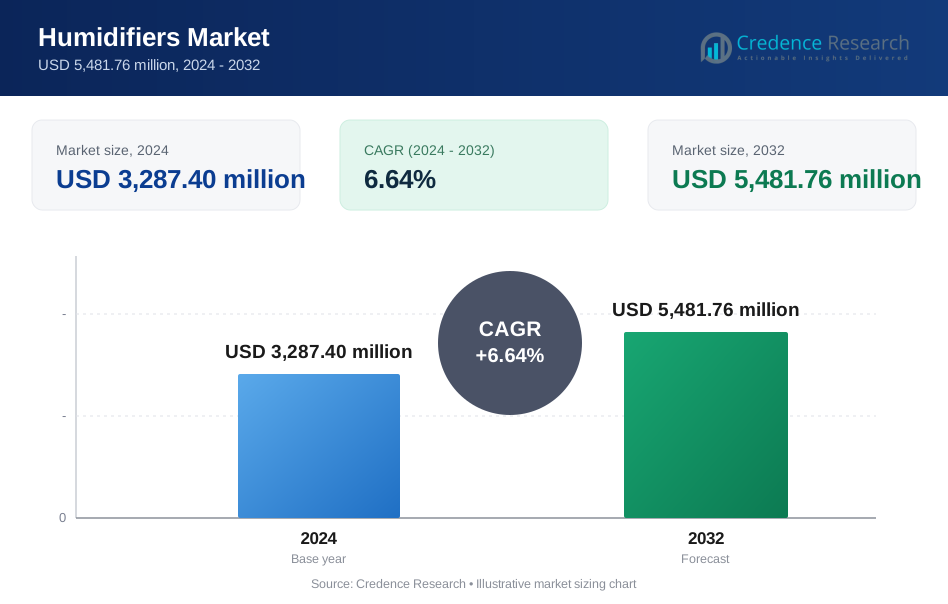
| Humidifiers Market Size 2024 | USD 3,287.40 million |
| Humidifiers Market, CAGR | 6.64% |
| Humidifiers Market Size 2032 | USD 5,481.76 million |
Market Overview:
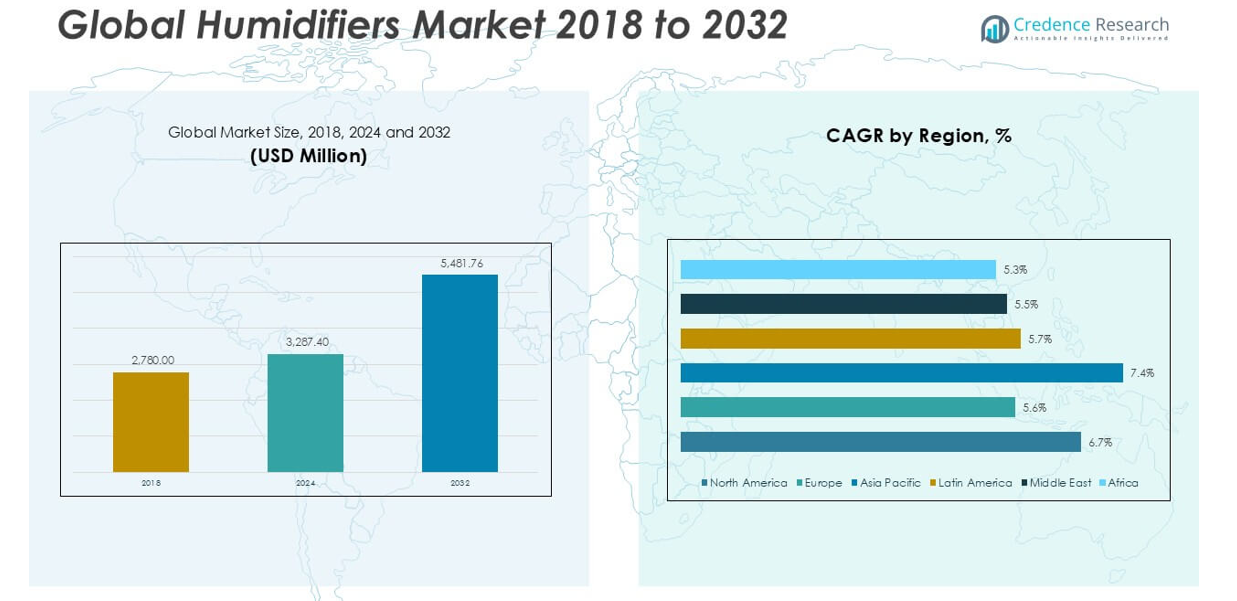
The Humidifiers market size was valued at USD 2,780.00 million in 2018, reached USD 3,287.40 million in 2024, and is anticipated to reach USD 5,481.76 million by 2032, at a CAGR of 6.64% during the forecast period.
The humidifiers market is highly competitive, with key players including General Electric, Honeywell International Inc., Dyson Ltd, Philips, Condair Group, Boneco AG, Guardian Technologies, Carel Industries, Neptronic, Smart Fog Inc, Armstrong International, Air Innovations, Inc., Sharp Corporation, and Vornado Air LLC. These companies drive market growth through product innovation, smart technology integration, and global distribution strategies. Asia Pacific leads the humidifiers market, holding approximately 38.0% of the global market share in 2024, driven by rapid urbanization, increasing healthcare infrastructure, and strong consumer demand in countries like China, Japan, and India. North America and Europe follow as significant regional markets.
Market Insights
- The humidifiers market was valued at USD 2,780.00 million in 2018, reached USD 3,287.40 million in 2024, and is expected to reach USD 5,481.76 million by 2032, growing at a CAGR of 6.64% during the forecast period.
- Rising awareness about indoor air quality and increasing cases of respiratory issues are major drivers boosting demand across residential and healthcare sectors, especially for ultrasonic humidifiers, which hold the largest segment share.
- The market is witnessing trends toward smart, energy-efficient, and portable humidifiers, with growing consumer preference for Wi-Fi-enabled and low-maintenance devices supporting segment growth.
- Competitive intensity is high, with key players like Honeywell, Dyson, Philips, and Condair Group focusing on product innovation and expansion through e-commerce channels, while smaller players target affordability and niche applications.
- Asia Pacific leads the market with a 38.0% share in 2024, followed by North America at 28.5% and Europe at 22.0%, while high maintenance costs and operational challenges act as key restraints.
Market Segmentation Analysis:
By Type:
In the Humidifiers market, Ultrasonic Humidifiers hold the largest market share within the type segment, driven by their energy efficiency, quiet operation, and affordability. These humidifiers use ultrasonic vibrations to produce a fine mist, making them suitable for residential and commercial spaces. The growing preference for low-maintenance and noise-free humidifiers supports their dominance. Evaporative Humidifiers also show considerable demand due to their self-regulating properties and cost-effectiveness. Steam Vaporizers and Impeller Humidifiers capture smaller shares, mainly used in specific applications where warm mist or budget solutions are preferred. The "Others" category includes emerging technologies with limited market impact.
- For instance, Dyson’s AM10 ultrasonic humidifier uses Ultraviolet Cleanse technology to eliminate 99.9% of bacteria in just 3 minutes, and its integrated humidistat enables up to 18 hours of uninterrupted use on a single fill.
By Application:
Within the application segment, the Residential sector dominates the Humidifiers market, accounting for the largest market share. Increasing consumer awareness regarding indoor air quality and the health benefits of humidity control are key drivers for this segment. Residential demand is further fueled by rising cases of respiratory issues and skin dryness, especially in regions with dry climates or during winter months. The Healthcare sector follows, as hospitals and clinics require controlled humidity for patient comfort and equipment protection. Industrial and Commercial applications are growing steadily due to expanding HVAC installations and the need for optimal environmental conditions in various facilities.
- For instance, Philips’ Series 2000 humidifier delivers 225 mL of mist per hour, covering rooms up to 269 sq ft, and operates quietly at 26 dB ideal for bedrooms and offices.
By Installation Type
In terms of installation type, Portable Humidifiers lead the Humidifiers market, capturing the largest market share. Their dominance is attributed to flexibility, ease of use, and cost efficiency, making them highly popular in residential and small commercial spaces. Portable humidifiers offer consumers the convenience of moving units across rooms and require minimal installation effort, which enhances their market appeal. Fixed Humidifiers, though holding a smaller market share, are steadily gaining traction in large-scale commercial, healthcare, and industrial settings where centralized humidity control is essential. The rising construction of smart buildings and modern healthcare infrastructure supports the fixed segment’s gradual growth.
Market Overview
Increasing Awareness of Indoor Air Quality
The growing awareness about the importance of maintaining healthy indoor air quality significantly drives the humidifiers market. Consumers are increasingly concerned about the effects of dry air on respiratory health, skin conditions, and overall well-being. This awareness is prompting a surge in demand for humidifiers across residential, healthcare, and commercial spaces. Seasonal factors like winter dryness and air conditioning in summer further contribute to year-round product adoption. Rising incidences of asthma, allergies, and sinusitis are encouraging consumers to invest in humidity control solutions to create healthier indoor environments.
- For instance, Honeywell’s HCM350W Germ-Free Cool Mist Humidifier is clinically proven to reduce up to 99.9% of bacteria, mold, and spores from water, effectively supporting health-conscious consumers.
Expansion of the Healthcare Infrastructure
The global expansion of healthcare facilities is a critical growth driver for the humidifiers market. Hospitals, clinics, and rehabilitation centers require precise humidity control to maintain patient comfort, prevent the spread of airborne infections, and protect sensitive medical equipment. The increasing number of healthcare projects, especially in emerging economies, directly contributes to the rising demand for humidifiers. Advanced humidification solutions are also being integrated into HVAC systems to meet strict air quality standards. This infrastructure growth is fueling steady market expansion across the healthcare sector.
- For instance, Condair’s RS steam humidifier is widely used in hospital operating rooms, capable of delivering up to 180 kg of steam per hour to maintain precise humidity levels in critical healthcare environments.
Rising Demand from Industrial and Commercial Sectors
The humidifiers market is benefiting from the growing need for controlled environments in industrial and commercial sectors. Industries such as electronics, pharmaceuticals, textiles, and data centers require optimal humidity levels to protect products, enhance process efficiency, and maintain operational stability. Commercial spaces like offices, hotels, and shopping centers are also increasingly adopting humidifiers to improve occupant comfort and air quality. This rising demand across diverse applications is broadening the market’s customer base and encouraging manufacturers to offer advanced, large-capacity humidification systems.
Key Trends and Opportunities
Technological Advancements in Smart Humidifiers
The emergence of smart humidifiers with advanced features presents significant growth opportunities. Integration of Wi-Fi connectivity, mobile app control, automatic humidity adjustment, and air purification functions is enhancing product appeal. Consumers are seeking convenient, energy-efficient, and user-friendly devices, driving innovation in the market. These smart solutions are gaining traction, especially in urban households and commercial buildings with smart home ecosystems. Manufacturers focusing on technological upgrades and multi-functional designs can capitalize on this growing consumer preference for connected and intelligent humidification devices.
- For instance, Levoit’s LV600S Smart Hybrid Ultrasonic Humidifier offers precise humidity control via the VeSync app and voice assistants like Alexa and Google Assistant, with a large 6-liter tank enabling up to 50 hours of continuous operation.
Rising Popularity of Portable and Low-Maintenance Devices
The trend towards compact, portable, and easy-to-maintain humidifiers is shaping consumer preferences. Portable humidifiers, with their flexibility and low initial investment, are becoming increasingly popular in residential and small commercial spaces. Additionally, there is growing demand for ultrasonic and evaporative humidifiers that offer quiet operation and minimal maintenance. This shift towards convenience and affordability is encouraging market players to develop lightweight, efficient, and user-centric designs. The rising interest in on-the-go and travel-friendly humidification solutions presents an untapped market opportunity.
- For instance, Boneco’s U7146 Travel Humidifier is a portable device that operates with a standard water bottle and can provide humidification for up to 7 hours on a single bottle, catering to travel-specific needs.
Key Challenges
High Maintenance Requirements and Operational Costs
One of the major challenges in the humidifiers market is the high maintenance required for certain types, such as steam vaporizers and impeller humidifiers. Regular cleaning is essential to prevent mold growth, bacterial contamination, and mineral build-up, which can impact performance and indoor air quality. For industrial humidifiers, operational costs related to energy consumption and water use can be significant. These maintenance concerns and long-term costs may discourage potential buyers and limit adoption, particularly among cost-sensitive consumers and smaller businesses.
Risk of Over-Humidification and Product Safety Issues
Over-humidification can lead to condensation, mold growth, and deterioration of indoor materials, posing health risks and structural concerns. Improperly selected or poorly maintained humidifiers can contribute to these problems, especially in tightly sealed modern buildings. Additionally, some low-quality humidifiers may pose safety risks such as electrical faults or overheating. These factors can undermine consumer confidence and create hesitation in adopting humidification solutions, especially in markets where awareness of proper usage and maintenance practices is limited.
Limited Consumer Awareness in Developing Regions
The humidifiers market faces a challenge in penetrating developing regions due to limited consumer awareness and purchasing power. Many potential users are not fully informed about the health benefits of maintaining optimal humidity levels or the availability of affordable humidification options. This knowledge gap, combined with competing spending priorities in emerging economies, restricts market expansion. Manufacturers and retailers need to invest in educational marketing strategies to increase awareness and unlock potential growth in these untapped markets.
Regional Analysis
North America
North America accounted for a significant share of the humidifiers market, valued at USD 792.30 million in 2018, reaching USD 924.50 million in 2024. It is projected to grow to USD 1,551.64 million by 2032 at a CAGR of 6.7%. The region holds approximately 28.5% of the global market share in 2024, supported by rising awareness about indoor air quality and increasing residential demand. The healthcare sector in North America also contributes significantly due to strict air quality regulations. The growing adoption of smart home devices further accelerates market expansion across the region.
Europe
Europe held a stable position in the humidifiers market, with a value of USD 636.34 million in 2018, increasing to USD 718.86 million in 2024. It is expected to reach USD 1,111.00 million by 2032, growing at a CAGR of 5.6%. The region captures around 22.0% of the global market share in 2024. Europe’s growth is driven by rising health consciousness, a strong focus on energy-efficient appliances, and consistent residential demand. Cold climatic conditions across several countries further boost humidifier usage, particularly during the winter season, contributing to sustained product adoption.
Asia Pacific
Asia Pacific dominates the humidifiers market, holding the largest regional share. The market was valued at USD 1,023.04 million in 2018 and grew to USD 1,245.42 million in 2024. It is projected to reach USD 2,208.70 million by 2032, registering the fastest CAGR of 7.4%. Asia Pacific accounts for approximately 38.0% of the global market share in 2024, driven by rapid urbanization, growing consumer awareness, and increasing healthcare infrastructure. The expanding middle-class population and rising demand for residential humidifiers, especially in China, Japan, and India, support the region's strong market position.
Latin America
Latin America represents a smaller yet steadily growing part of the humidifiers market. It was valued at USD 161.24 million in 2018, increasing to USD 188.66 million in 2024, and is projected to reach USD 292.56 million by 2032 at a CAGR of 5.7%. The region holds nearly 5.8% of the global market share in 2024. Growth in Latin America is supported by expanding residential construction, gradual improvement in healthcare facilities, and rising interest in indoor air quality solutions. Economic development in countries like Brazil and Mexico contributes to increasing product demand.
Middle East
The Middle East humidifiers market was valued at USD 102.86 million in 2018, reaching USD 113.72 million in 2024. It is expected to grow to USD 173.19 million by 2032, with a CAGR of 5.5%. The region holds an estimated 3.5% of the global market share in 2024. Growth is influenced by the rising adoption of humidifiers in commercial and healthcare sectors, where maintaining optimal air quality is essential. The demand for indoor air management solutions is gradually increasing across urban centers in the Middle East, supported by the development of modern infrastructure.
Africa
Africa’s humidifiers market was valued at USD 64.22 million in 2018 and increased to USD 96.23 million in 2024. It is projected to reach USD 144.66 million by 2032, growing at a CAGR of 5.3%. The region accounts for approximately 2.9% of the global market share in 2024. Market growth in Africa is driven by improving urbanization, rising health awareness, and gradual expansion of healthcare services. Increasing demand for affordable and portable humidifiers in residential spaces is also contributing to the market’s steady development, particularly in countries experiencing rising disposable incomes.
Market Segmentations:
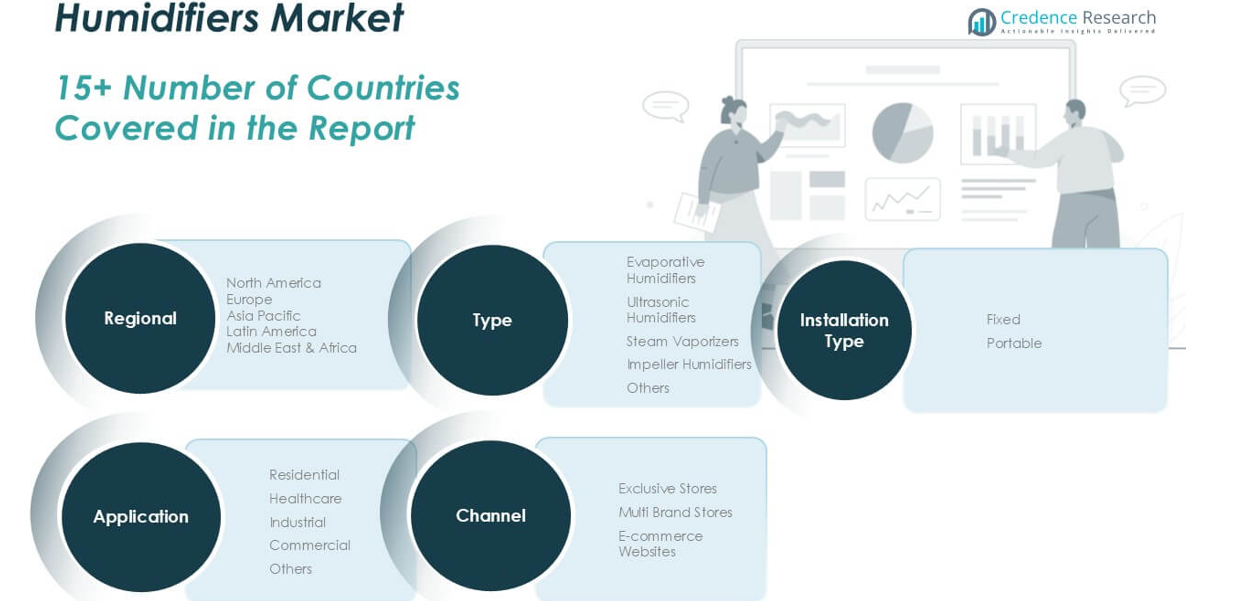
By Type
- Evaporative Humidifiers
- Ultrasonic Humidifiers
- Steam Vaporizers
- Impeller Humidifiers
- Others
By Application
- Residential
- Healthcare
- Industrial
- Commercial
- Others
By Installation Type
- Fixed
- Portable
By Channel
- Exclusive Stores
- Multi Brand Stores
- E-commerce Websites
By Geography:
- North America
- U.S.
- Canada
- Mexico
- Europe
- Germany
- France
- U.K.
- Italy
- Spain
- Rest of Europe
- Asia Pacific
- China
- Japan
- India
- South Korea
- South-east Asia
- Rest of Asia Pacific
- Latin America
- Brazil
- Argentina
- Rest of Latin America
- Middle East & Africa
- GCC Countries
- South Africa
- Rest of the Middle East and Africa
Competitive Landscape
The competitive landscape of the humidifiers market is characterized by the presence of several established players focusing on innovation, product diversification, and strategic partnerships to strengthen their market positions. Key companies such as General Electric, Honeywell International Inc., Dyson Ltd, Philips, and Condair Group dominate the market with extensive product portfolios and strong global distribution networks. These companies consistently invest in research and development to introduce energy-efficient, smart, and user-friendly humidifiers that meet evolving consumer demands. Mid-sized players like Boneco AG, Guardian Technologies, and Carel Industries contribute to market competitiveness by offering specialized and affordable humidification solutions. Companies are increasingly focusing on technological advancements, such as Wi-Fi-enabled and multi-functional humidifiers, to capture the growing smart home segment. Additionally, partnerships with e-commerce platforms and expansion into emerging markets remain key strategies to increase market reach. The industry’s competitive intensity is further driven by rising consumer expectations for high-quality, low-maintenance, and health-focused humidification products.
Key Player Analysis
- General Electric
- Honeywell International Inc.
- Dyson Ltd
- Philips
- Condair Group
- Boneco AG
- Guardian Technologies
- Carel Industries
- Neptronic
- Smart Fog Inc
- Armstrong International
- Air Innovations, Inc.
- Sharp Corporation
- Vornado Air LLC
Recent Developments
- In April 2024, Condair announced that Konvekta, an energy recovery specialist, is utilizing the Condair ME evaporative humidifier as a standard adiabatic cooling solution in its exhaust air cooling systems. The company aims to achieve up to 92% annual energy recovery for its clients' buildings.
- In February 2024, Canopy, a beauty and wellness brand, launched its Canopy Portable humidifier, a dermatologist-approved hybrid cool mist humidifier. The humidifier's 500-milliliter tank can run for up to 24 hours without needing a refill. It has three adjustable settings, and Canopy's proprietary dry-out mode technology prevents mold growth by keeping air flowing until there's no water left, ensuring hydration.
- In September 2023, Smartmi introduced its High-Capacity Evaporative humidifier 3, designed to improve air quality and convenience. This product offers mist-free natural humidification, a 350ml/h humidity output, and a large 5L tank. It features smart controls and ultra-quiet operation, making it ideal for individuals with respiratory issues, the elderly, infants, vocal performers, and those in homes with dry climates and forced air heating.
- In October 2022, Medtronic separated its Patient Monitoring and Respiratory Interventions businesses into a new entity, NewCo. This strategic move aimed to enhance value for Medtronic and its shareholders by allowing the company to concentrate on long-term strategies for innovation-driven growth. The separation was expected to optimize focus and capital allocation, positioning NewCo to unlock its value.
- In March 2022, Hamilton Medical announced the production of a HAMILTON-H900 humidifier at its facility in Reno, Nevada, catering to the U.S. market. The facility would expand its manufacturing capabilities to include heated breathing circuit sets and chambers. This strategic initiative was expected to enhance efficiency in delivering products to customers in the U.S.
Market Concentration & Characteristics
The Humidifiers Market is moderately fragmented, with the presence of both global and regional players competing on product innovation, technology, and pricing. It features a mix of large corporations with established brand recognition and smaller companies offering cost-effective solutions. The market shows strong demand across residential, healthcare, and industrial sectors, with ultrasonic humidifiers dominating due to their energy efficiency and quiet operation. It is marked by growing consumer preference for portable, low-maintenance, and smart humidifiers. Companies focus on expanding their product portfolios to meet varying consumer needs. E-commerce channels significantly support product accessibility and market expansion across different regions.
Report Coverage
The research report offers an in-depth analysis based on Type, Application, and Geography. It details leading market players, providing an overview of their business, product offerings, investments, revenue streams, and key applications. Additionally, the report includes insights into the competitive environment, SWOT analysis, current market trends, as well as the primary drivers and constraints. Furthermore, it discusses various factors that have driven market expansion in recent years. The report also explores market dynamics, regulatory scenarios, and technological advancements that are shaping the industry. It assesses the impact of external factors and global economic changes on market growth. Lastly, it provides strategic recommendations for new entrants and established companies to navigate the complexities of the market.
Future Outlook
- The humidifiers market is expected to witness steady growth driven by increasing awareness of indoor air quality and its impact on health.
- Demand for smart humidifiers with features like Wi-Fi connectivity and app-based control is likely to increase in residential and commercial spaces.
- Ultrasonic humidifiers will continue to lead the market due to their energy efficiency, silent operation, and compact design.
- Portable humidifiers are expected to dominate as consumers prefer flexible, easy-to-use, and cost-effective solutions.
- The healthcare sector will remain a key growth area as hospitals and clinics focus on maintaining optimal humidity levels.
- Asia Pacific is anticipated to retain the largest market share, supported by urbanization, growing middle-class population, and rising healthcare infrastructure.
- Manufacturers will increasingly invest in product innovations that combine humidification with air purification and aromatherapy functions.
- E-commerce sales channels are projected to grow, improving product availability and consumer access across global markets.
- Increasing adoption of humidifiers in industrial sectors will support market expansion, particularly in electronics, textiles, and data centers.
- Rising demand for low-maintenance and energy-efficient humidifiers will influence product development and purchasing decisions in the coming years.
Request a Free Sample
Fill in your details and we'll send you a free sample report.
- Sample data tables & charts
- Research methodology
Need a Custom Version of This Report?
Tailor the scope, geography, or segments to your exact requirements.
- Custom geography or segment scope
- Direct access to our analyst team
Frequently Asked Questions
What is the current size of the Humidifiers Market?
What are the key segments within the Humidifiers Market?
What are some challenges faced by the Humidifiers Market?
Who are the major players in the Humidifiers Market?
Table of Content
Chapter 1. Report Introduction
- 1.1 Report Description & Purpose
- 1.1.1 Report Title & Market Definition
- 1.1.2 Unique Selling Propositions (USP) & Key Differentiators
- 1.1.3 Value Proposition for Stakeholders
- 1.2 Research Objectives
- 1.2.1 Market Sizing Objectives (Volume & Revenue)
- 1.2.2 Segmentation Objectives
- 1.2.3 Competitive Intelligence Objectives
- 1.2.4 Forecast & Scenario Objectives
- 1.3 Report Scope
- 1.3.1 Humidifiers Scope – Types & Subtypes Covered
- 1.3.2 Geographic Scope – Regions & Countries Covered
- 1.3.3 Historical Period, Base Year & Forecast Period (2024; forecast to 2032)
- 1.3.4 Inclusions & Exclusions
- 1.4 HS Code & Classification Framework
- 1.5 Currency, Units & Pricing Basis
- 1.6 Target Stakeholders
- 1.7 Limitations & Assumptions
Chapter 2. Executive Summary
- 2.1 Global Humidifiers Market Snapshot
- 2.1.1 Market Size – Historical (2024) & Forecast (2024-2032) (2024: USD 3,287.40 million → 2032: USD 5,481.76 million)
- 2.1.2 Volume & Revenue – Global Totals
- 2.1.3 Key Market Highlights – Top Five Facts
- 2.2 Humidifiers Market Segmentation Snapshot
- 2.2.1 Market Split by Region – 2024 vs. 2032
- 2.3 Competitive Snapshot
- 2.3.1 Top 10 Players by Revenue Share – 2024
- 2.3.2 Top 10 Players by Volume Share – 2024
- 2.3.3 Recent Strategic Developments (18-Month Summary)
- 2.4 Key Investment Highlights & Strategic Conclusions
Chapter 3. Humidifiers Market Dynamics & Industry Analysis
- 3.1 Market Overview & Context
- 3.1.1 Humidifiers Market Position in the Broader Automotive Value Chain
- 3.1.2 OEM vs. Replacement Market Dynamics
- 3.1.3 Market Maturity & Development Stage by Region
- 3.2 Humidifiers Market Drivers
- 3.3 Humidifiers Market Restraints & Challenges
- 3.4 Humidifiers Market Opportunities
- 3.5 Porter's Five Forces Analysis
- 3.5.1 Threat of New Entrants
- 3.5.2 Bargaining Power of Suppliers
- 3.5.3 Bargaining Power of Buyers
- 3.5.4 Threat of Substitutes
- 3.5.5 Competitive Rivalry – Intensity Assessment
- 3.6 Humidifiers Value Chain Analysis
- 3.6.1 Upstream – Raw Material/Input Suppliers
- 3.6.1.1 Raw Material/Input 1
- 3.6.1.2 Raw Material/Input 2
- 3.6.1.3 Raw Material/Input 3
- 3.6.2 Midstream – Production/Manufacturing/Service Delivery
- 3.6.2.1 Production/Process Overview
- 3.6.2.2 Key Facility Locations & Capacity by Manufacturer
- 3.6.3 Downstream – Distribution & End Consumer
- 3.6.3.1 Primary Channel – B2B/OEM
- 3.6.3.2 Secondary Channels – Dealer, Retail, Online, Direct
- 3.6.4 Value Chain Profitability Analysis
- 3.6.1 Upstream – Raw Material/Input Suppliers
- 3.7 PESTEL Analysis
- 3.7.1 Political Factors
- 3.7.2 Economic Factors
- 3.7.3 Social Factors
- 3.7.4 Technological Factors
- 3.7.5 Environmental Factors
- 3.7.6 Legal Factors
- 3.8 Humidifiers Supply Chain Analysis
- 3.8.1 Raw Material/Input Supply Risk Assessment
- 3.8.2 Manufacturing Concentration Risk (Geographic Exposure)
- 3.8.3 Trade Disruption Impact Analysis
- 3.9 Regulatory & Policy Landscape
Note: The regulatory and policy landscape section covers regulations based on their applicability to the market, Humidifiers category, geography, and scope of the study. Only regulatory frameworks with a material impact on operations, compliance, trade, sustainability, or market access are analyzed in detail.
Chapter 4. Key Investment Pockets & Opportunity Analysis
- 4.1 Humidifiers Market Attractiveness Analysis
- 4.1.1 By Region – Investment Attractiveness Matrix (Volume × CAGR)
- 4.2 Absolute Revenue Growth Opportunity
- 4.2.1 By Region – Absolute USD Growth Through 2032
- 4.3 Incremental Volume Opportunity
- 4.3.1 By Region – Incremental Volume Through 2032
- 4.3.2 Segment – Incremental Volume
- 4.4 Emerging Submarket Opportunity Deep Dive (Subject to Applicability)
- 4.5 Emerging Market Opportunity Scorecards
- 4.5.1 United States
- 4.5.2 Europe
- 4.5.3 Asia
- 4.5.4 Middle East & Africa
Note: Emerging Market Opportunity Scorecards will be included based on relevance and strategic importance. Regions listed are indicative and may vary depending on data availability and market dynamics.
Chapter 5. Humidifiers Import-Export Analysis & Trade Flows
- 5.1 Global Trade Overview
- 5.1.1 Global Export Value by Country (2024)
- 5.1.2 Global Export Volume by Country (2024)
- 5.1.3 Global Import Value by Country (2024)
- 5.1.4 Global Import Volume by Country (2024)
- 5.1.5 Net Trade Balance by Country (2024)
- 5.2 Export Analysis – Segment
- 5.2.1 Type 1 (HS Code)
- 5.2.2 Type 2 (HS Code)
- 5.2.3 Type 3 (HS Code)
- 5.2.4 Type 4 (HS Code)
- 5.2.5 Type 5 (HS Code)
- 5.3 Import Analysis – Segment
- 5.3.1 Type 1 (HS Code)
- 5.3.2 Type 2 (HS Code)
- 5.3.3 Type 3 (HS Code)
- 5.3.4 Type 4 (HS Code)
- 5.3.5 Type 5 (HS Code)
- 5.4 Average Unit Trade Prices
- 5.4.1 Average Export Price – Segment & Country
- 5.4.2 Average Import Price – Segment & Source Country
- 5.4.3 Price Trends (2024)
- 5.5 Key Trade Route Analysis
- 5.5.1 Trade Route 1
- 5.5.2 Trade Route 2
- 5.5.3 Trade Route 3
- 5.5.4 Trade Route 4
- 5.5.5 Trade Route 5
- 5.6 Trade Policy Impact Assessment
- 5.6.1 US Anti-Dumping & Section 301 Tariffs
- 5.6.2 EU Customs Union Impact
- 5.6.3 Major Free Trade Agreements
- 5.6.4 USMCA Rules of Origin
Note: Trade policy analysis will be included only where relevant to the Humidifiers market.
Chapter 6. Competitive Landscape & Company Benchmarking
- 6.1 Humidifiers Market Concentration & Structure
- 6.1.1 Herfindahl-Hirschman Index (HHI) – vs. 2024
- 6.1.2 Tier 1, Tier 2 & Tier 3 Market Structure
- 6.1.3 Global, Regional & Local Player Dynamics
- 6.2 Humidifiers Market Share Analysis – 2024
- 6.2.1 Global Revenue Share by Company
- 6.2.2 Global Volume Share by Company
- 6.2.3 Regional Revenue Share
- 6.2.4 Market Share Evolution ( vs. 2024)
- 6.2.5 OEM Segment Share by Company
- 6.2.6 Replacement Segment Share by Company
- 6.3 Production/Delivery Capacity & Facility Analysis
- 6.3.1 Global Installed Capacity
- 6.3.2 Capacity Utilization Rates
- 6.3.3 Production/Output Volume
- 6.3.4 Facility Locations & Capacity Map
- 6.3.5 Planned Capacity Additions
- 6.4 Humidifiers Competitive Benchmarking Matrix
- 6.4.1 Revenue, Volume, CAGR & Profitability Comparison
- 6.4.2 Channel Revenue Mix
- 6.4.3 Geographic Revenue Exposure
- 6.4.4 R&D Intensity
- 6.4.5 Sustainability Maturity
- 6.5 Strategic Developments in Humidifiers (Last 24 Months)
- 6.5.1 Mergers, Acquisitions & Divestments
- 6.5.2 New Humidifiers Launches
- 6.5.3 Facility Expansions
- 6.5.4 Strategic Alliances, Joint Ventures & Partnerships
- 6.5.5 Distribution Expansion & Market Entry
- 6.5.6 Sustainability & ESG Initiatives
- 6.6 Competitive Strategy Mapping
- 6.6.1 Leader, Challenger, Follower & Niche Classification
- 6.6.2 Pricing Strategy Comparison
- 6.6.3 Channel Strategy Matrix
Note: Strategic developments are included based on their materiality and the availability of reliable information.
Chapter 7. Global Humidifiers Market – By Distribution Channel
- 7.1 Segment Overview
- 7.1.1 Volume & Revenue Split by Channel (2024 & 2032)
- 7.1.2 Channel Mix Evolution (2024-2032)
Chapter 8. Regional Market Analysis – Global Overview
- 8.1 Global Regional Overview
- 8.1.1 Regional Volume Share
- 8.1.2 Regional Revenue Share
- 8.1.3 Regional Volume by Region
- 8.1.4 Regional Revenue by Region
- 8.1.5 Regional Forecast Through 2032
- 8.2 Cross-Regional Segment Analysis
- 8.2.1 By Distribution Channel
- 8.2.2 By Brand/Price Tier
Chapter 9. North America Humidifiers Market
- 9.1 United States
- 9.2 Canada
- 9.3 Mexico
Chapter 10. Europe Humidifiers Market
- 10.1 Germany
- 10.2 France
- 10.3 Italy
- 10.4 United Kingdom
- 10.5 Spain
- 10.6 Poland
- 10.7 Russia
- 10.8 Netherlands
- 10.9 Belgium
- 10.10 Sweden
- 10.11 Denmark
- 10.12 Norway
- 10.13 Rest of Europe
Chapter 11. Asia Pacific Humidifiers Market
- 11.1 China
- 11.2 India
- 11.3 Japan
- 11.4 South Korea
- 11.5 Thailand
- 11.6 Indonesia
- 11.7 Vietnam
- 11.8 Malaysia
- 11.9 Australia
- 11.10 Rest of Asia Pacific
Chapter 12. Latin America Humidifiers Market
- 12.1 Brazil
- 12.2 Argentina
- 12.3 Colombia
- 12.4 Chile
- 12.5 Rest of Latin America
Chapter 13. Middle East Humidifiers Market
- 13.1 Saudi Arabia
- 13.2 United Arab Emirates
- 13.3 Turkey
- 13.4 Israel
- 13.5 Iran
- 13.6 Rest of the Middle East
Chapter 14. Africa Humidifiers Market
- 14.1 South Africa
- 14.2 Egypt
- 14.3 Nigeria
- 14.4 Morocco
- 14.5 Rest of Africa
Chapter 15. Humidifiers Company Profiles
- 15.1 [Company 01]
- 15.1.1 Company Overview
- 15.1.2 Key Management Personnel
- 15.1.3 Products & Services Portfolio
- 15.1.4 Financial Performance
- 15.1.5 Key Market Focus & Geographic Presence
- 15.1.6 Recent Developments & Strategic Initiatives
Note: The company profile list is preliminary and may change based on research findings, market developments, data availability, and client requirements.
Chapter 16. Appendices
- Appendix A – List of Abbreviations & Acronyms
- Appendix B – Industry Classification Code Reference – Full Series
- Appendix C – Production & Capacity Data Tables
- Appendix D – End-Use & Demand Base Tables
- Appendix E – Consumption & Replacement Rate Assumptions
- Appendix F – ASP Reference Tables
- Appendix G – Manufacturing & Facility Database
- Appendix H – Import-Export Data Tables
- Appendix I – Regulatory Summary Tables
- Appendix J – Primary Research Participant List (Anonymized)
- Appendix K – Primary Research Questionnaire Framework
- Appendix L – Data Sources & Bibliography
- Appendix M – Market Size Divergence & Source Comparison
Chapter 17. Research Methodology
- 17.1 Research Framework & Philosophy
- 17.2 Secondary Research – Sources, Hierarchy & Data Extraction
- 17.3 Data Modeling – Bottom-Up & Top-Down Market Sizing
- 17.4 Primary Research – Stakeholder Framework, LOI & Sample Sizes
- 17.5 Forecast Methodology – Regression, Scenario & Sensitivity Analysis
- 17.6 Quality Control – Four-Layer Validation Framework
- 17.7 Limitations & Standard Assumptions
- 17.8 Disclaimer
