
Market Overview
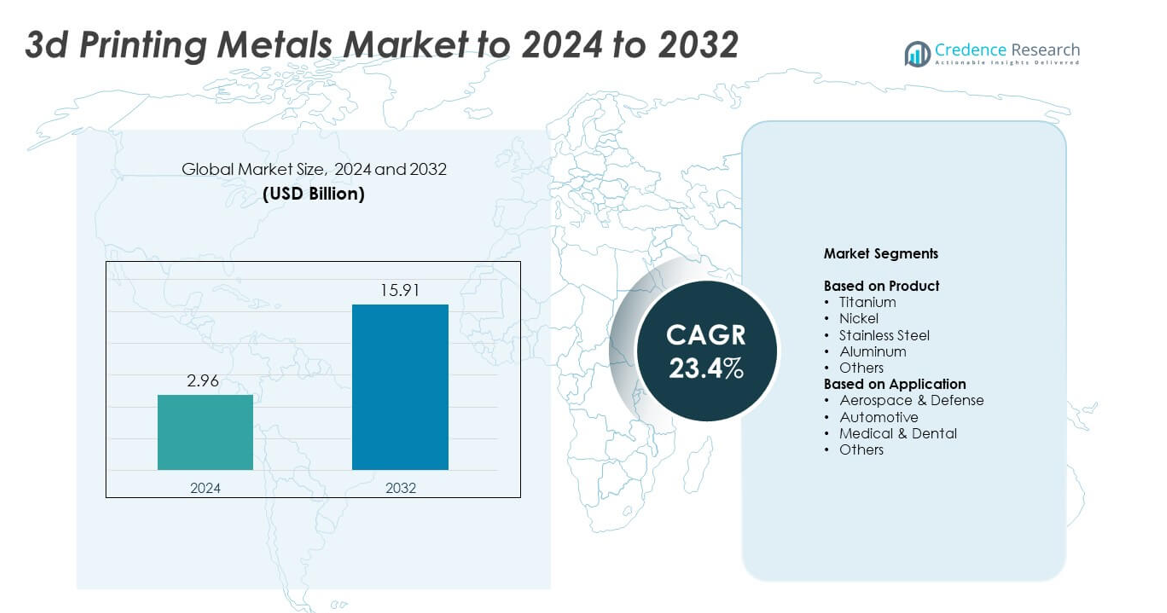
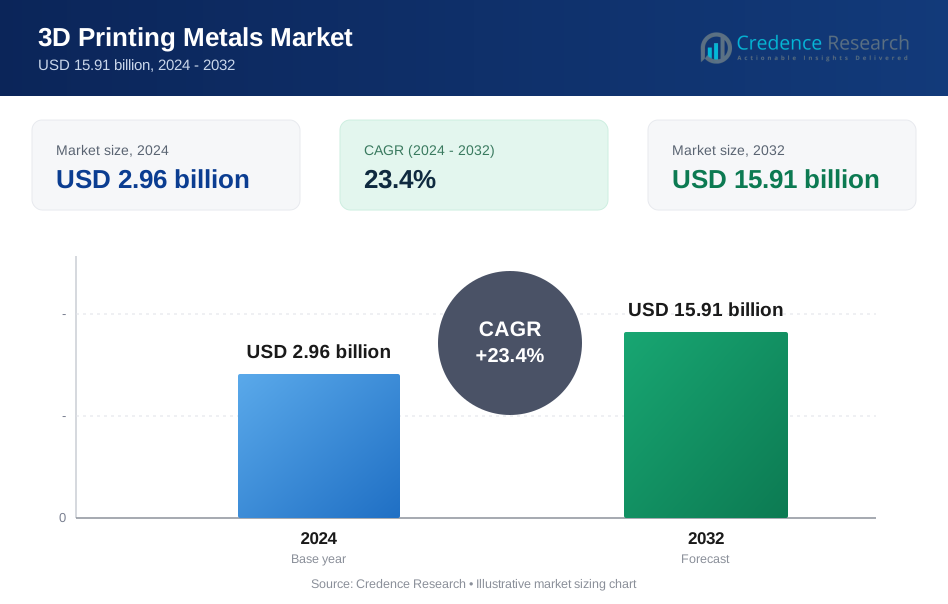
3D printing metals market size was valued at USD 2.96 billion in 2024 and is anticipated to reach USD 15.91 billion by 2032, at a CAGR of 23.4% during the forecast period.
| REPORT ATTRIBUTE | DETAILS |
|---|---|
| Historical Period | 2020-2023 |
| Base Year | 2024 |
| Forecast Period | 2025-2032 |
| 3D Printing Metals Market Size 2024 | USD 2.96 billion |
| 3D Printing Metals Market, CAGR | 23.4% |
| 3D Printing Metals Market Size 2032 | USD 15.91 billion |
The 3D printing metals market features major participants such as INDO-MIM, ATI, Outokumpu, Colibrium Additive (GE Aerospace), Höganäs AB, POLEMA, Materialise NV, GKN Powder Metallurgy, CNPC Powders, CRS Holdings, LLC., and OC Oerlikon Management AG. These companies shape the competitive environment through advances in metal powders, precision alloys, and industrial additive systems. North America leads the market with about 38% share due to strong aerospace and medical adoption, followed by Europe with nearly 32% share supported by advanced automotive and industrial manufacturing. Asia Pacific holds around 24% share, driven by rapid expansion in production hubs across China, Japan, and South Korea.
Market Insights
- The 3D printing metals market reached USD 2.96 billion in 2024 and is expected to hit USD 15.91 billion by 2032, growing at a CAGR of 23.4%.
- Growth is driven by rising demand from aerospace, which held about 41% share in 2024, as manufacturers use titanium and nickel alloys to cut weight and improve performance.
- Key trends include the shift toward titanium, which led the product segment with nearly 34% share, supported by high strength, biocompatibility, and wider use in medical and aerospace parts.
- Competition intensifies as major producers invest in high-purity metal powders, AI-enabled process control, and larger printing systems to strengthen capabilities and reduce production costs.
- North America led the market with about 38% share, followed by Europe at nearly 32% and Asia Pacific at around 24%, while Latin America and Middle East & Africa held smaller shares but continue to expand through industrial upgrades.
Market Segmentation Analysis:
By Product
Titanium held the dominant share in 2024 with about 34% of the 3D printing metals market. Titanium stayed ahead due to its strong strength-to-weight ratio, biocompatibility, and corrosion resistance, which made the metal ideal for aerospace components and medical implants. Demand increased as aircraft manufacturers adopted titanium powders for lightweight structural parts and fuel-efficient designs. Stainless steel and aluminum also expanded as industries used these metals for prototypes, fixtures, and end-use custom parts that require durability and cost control.
- For instance, Rolls-Royce 3D printed a titanium front bearing housing for its Trent XWB-97 engine. The structure measures 1.5 meters in diameter and 0.5 meters thick and contains 48 aerofoils.
By Application
Aerospace and defense led the application segment in 2024 with nearly 41% share of the 3D printing metals market. Growth rose as aircraft and defense suppliers shifted toward additive manufacturing for engine parts, structural brackets, and complex components that reduce weight and improve performance. Adoption accelerated because 3D-printed metal parts cut material waste and shorten production cycles. The medical and dental sector also gained traction as hospitals and device makers used metal printing to produce custom implants and surgical tools.- For instance, Airbus produced over 1,000 3D-printed flight parts for its first A350 XWB. These parts supported serial aircraft production by replacing conventionally manufactured components on the delivered aircraft.
Key Growth Drivers
Rising Adoption in Aerospace and Defense
Aerospace and defense companies boosted demand for 3D printing metals because the process supports lightweight structures and complex geometries. Aircraft makers used titanium and nickel alloys to reduce weight and improve fuel efficiency. Defense programs adopted metal additive manufacturing to speed part production and cut supply delays. Growing interest in on-demand manufacturing strengthened the segment’s expansion. These factors made aerospace and defense a major driver of market growth.
- For instance, GE Aviation shipped its 100,000th 3D-printed fuel nozzle tip for the LEAP engine.
Expansion of Medical and Dental Applications
Hospitals and device makers increased their use of metal 3D printing to create patient-specific implants and surgical instruments. Titanium’s biocompatibility improved implant performance and reduced recovery time, which encouraged wider adoption. Dental labs adopted metal printing for crowns, bridges, and orthodontic components with higher accuracy and lower material waste. Strong demand for personalized healthcare supported the rapid rise of metal additive manufacturing in medical settings, establishing this field as a key growth driver.
- For instance, Stryker reported producing well over 2,000,000 3D-printed Tritanium implants cumulatively since 2013
Shift Toward Lightweight Automotive Components
Automakers accelerated their use of metal additive manufacturing to reduce component weight and improve fuel efficiency. Stainless steel and aluminum powders gained popularity for prototype parts, custom brackets, and structural elements. The industry used 3D printing to shorten development cycles and reduce tooling costs, which supported faster model launches. Interest in electric vehicles increased demand for optimized metal components with improved strength. These factors positioned automotive innovation as a key growth driver.
Key Trends and Opportunities
Growth of High-Performance Metal Powders
Manufacturers increased investment in advanced metal powders with tighter grain control and improved purity. These powders enhanced the reliability of aerospace and medical components, which boosted adoption in regulated industries. Titanium, nickel, and aluminum powders saw major upgrades that improved part density and mechanical strength. This shift created opportunities for specialized powder suppliers and expanded the market for high-performance materials.
- For instance, Höganäs supplies forAM TS-CF1 tool steel powder with 15 to 45 micrometer particles. Heat-treated parts from this powder can reach hardness values up to 52 HRC.
Advances in Large-Format Metal 3D Printers
Producers introduced large-format metal printers to support bigger aerospace, defense, and industrial components. These systems enabled manufacturers to produce complex structures in fewer steps, reducing assembly needs and production time. Growth in this area opened opportunities for companies offering large-scale manufacturing solutions. Industries used these machines to redesign heavy parts with lighter lattice structures, expanding adoption across high-value sectors.
- For instance, Titomic operates a metal 3D printer in Melbourne for large-format builds using its proprietary Titomic Kinetic Fusion (TKF) technology. The system’s build envelope measures 9 meters long, 3 meters wide, and 1.5 meters high.
Integration of AI-Driven Process Optimization
AI-enabled software improved print accuracy, reduced defects, and optimized powder usage. Manufacturers adopted automated monitoring systems to ensure consistent quality in metal parts. This trend helped companies cut production costs and increase throughput. Wider use of AI tools created opportunities for software and hardware providers supporting advanced quality control in additive manufacturing.
Key Challenges
High Cost of Metal Powders and Equipment
Metal additive manufacturing remained costly due to the high price of titanium, nickel, and specialized alloy powders. Industrial metal printers required large upfront investments and regular maintenance, which limited adoption for smaller manufacturers. The cost barrier slowed market penetration in price-sensitive industries and restricted large-scale deployment. Companies struggled to balance performance benefits with budget constraints, making cost pressure a major challenge.
Quality Variability and Certification Barriers
Manufacturers faced difficulties in achieving consistent part quality across batches, especially in aerospace and medical applications. Strict regulatory requirements demanded extensive testing, documentation, and certification, which slowed production timelines. Variability in powder quality and machine calibration created reliability concerns. These challenges limited the pace of adoption in highly regulated sectors and increased operational complexity for many producers.
Regional Analysis
North America
North America held the largest share in 2024 with about 38% of the 3D printing metals market. Strong adoption came from aerospace and defense companies that used titanium and nickel alloys for lightweight and high-performance parts. The medical sector also expanded metal printing for implants and orthopedic devices. Growth increased as manufacturers invested in advanced printers, powder production, and design optimization tools. Supportive regulatory standards and strong R&D activity helped the region maintain leadership. Rising demand for large-format systems and customized production continued to strengthen market growth across the United States and Canada.
Europe
Europe accounted for nearly 32% share in 2024, supported by strong industrial adoption in aerospace, automotive, and medical device manufacturing. Countries such as Germany, France, and the United Kingdom advanced metal printing through investments in research centers and production facilities. Automotive suppliers used aluminum and steel powders to reduce vehicle weight and improve component efficiency. Medical companies broadened their use of titanium implants, which increased demand for high-purity metal powders. Sustainability programs and strict quality requirements encouraged development of advanced additive technologies, helping Europe sustain its position as a leading regional market.
Asia Pacific
Asia Pacific captured about 24% share in 2024, driven by rapid expansion in manufacturing hubs across China, Japan, South Korea, and India. Aerospace and automotive sectors adopted metal additive manufacturing to improve part precision and reduce tooling costs. Medical and dental applications grew as hospitals increased the use of patient-specific implants. Regional governments supported investment in advanced manufacturing parks and metal powder facilities. Rising demand for cost-efficient production and strong growth in industrial machinery strengthened the region's momentum. Expanding domestic printer manufacturers also helped Asia Pacific emerge as a fast-growing market.
Latin America
Latin America held nearly 4% share in 2024, with growing adoption in automotive, aerospace maintenance, and medical applications. Brazil and Mexico led regional demand as manufacturers explored metal printing to reduce import dependence and shorten production cycles. Interest grew in stainless steel and aluminum powders for industrial equipment and custom parts. Limited availability of large-scale printers slowed expansion, yet ongoing investments in manufacturing modernization supported gradual growth. Training programs and partnerships with global additive manufacturing firms helped build technical capabilities across key industries in the region.
Middle East and Africa
Middle East and Africa accounted for around 2% share in 2024, supported by early adoption in aerospace, energy, and healthcare sectors. The UAE and Saudi Arabia invested in additive manufacturing centers focused on metal materials and industrial components. Demand increased for lightweight printed parts in aviation and oil and gas equipment. Hospitals in the region also explored titanium implants, boosting medical usage. Market expansion remained steady but moderate due to limited local manufacturing capacity. Ongoing diversification efforts and government-backed technology programs continued to encourage adoption of metal 3D printing solutions.
Market Segmentations:
By Product
- Titanium
- Nickel
- Stainless Steel
- Aluminum
- Others
By Application
- Aerospace & Defense
- Automotive
- Medical & Dental
- Others
By Geography
- North America
- U.S.
- Canada
- Mexico
- Europe
- Germany
- France
- U.K.
- Italy
- Spain
- Rest of Europe
- Asia Pacific
- China
- Japan
- India
- South Korea
- South-east Asia
- Rest of Asia Pacific
- Latin America
- Brazil
- Argentina
- Rest of Latin America
- Middle East & Africa
- GCC Countries
- South Africa
- Rest of the Middle East and Africa
Competitive Landscape
The competitive landscape of the 3D printing metals market includes INDO-MIM, ATI, Outokumpu, Colibrium Additive (GE Aerospace), Höganäs AB, POLEMA, Materialise NV, GKN Powder Metallurgy, CNPC Powders, CRS Holdings, LLC., and OC Oerlikon Management AG. The market features strong competition driven by advancements in metal powders, expansion of large-format printers, and rising demand from aerospace, medical, and automotive sectors. Companies focus on high-purity alloys, improved powder consistency, and standardized certification processes to meet strict industry requirements. Investments in automation, AI-driven quality monitoring, and distributed production networks strengthen their global presence. Strategic mergers, technology partnerships, and capacity expansions support faster delivery of complex metal components. The shift toward lightweight structures, custom implants, and rapid prototyping continues to shape competitive strategies across major suppliers.
Key Player Analysis
- INDO-MIM
- ATI
- Outokumpu
- Colibrium Additive (GE Aerospace)
- Höganäs AB
- POLEMA
- Materialise NV
- GKN Powder Metallurgy
- CNPC Powders
- CRS Holdings, LLC.
- OC Oerlikon Management AG
Recent Developments
- In February 2025, ATI commissioned a new Additive Manufacturing Products facility in Margate, Florida, which integrates design, printing, heat treatment, machining, and inspection phases for metal additive manufacturing.
- In 2025, INDO-MIM filed for an IPO to expand its metal operations including 3D printing technologies at its Bangalore.
- In 2025, Outokumpu launched a new stainless steel powder grade specifically designed for aerospace additive manufacturing applications.
Report Coverage
The research report offers an in-depth analysis based on Product, Application and Geography. It details leading market players, providing an overview of their business, product offerings, investments, revenue streams, and key applications. Additionally, the report includes insights into the competitive environment, SWOT analysis, current market trends, as well as the primary drivers and constraints. Furthermore, it discusses various factors that have driven market expansion in recent years. The report also explores market dynamics, regulatory scenarios, and technological advancements that are shaping the industry. It assesses the impact of external factors and global economic changes on market growth. Lastly, it provides strategic recommendations for new entrants and established companies to navigate the complexities of the market.
Future Outlook
- The market will expand as aerospace and defense increase use of titanium and nickel alloys.
- Medical and dental adoption will rise with stronger demand for patient-specific implants.
- Automotive companies will use metal printing to reduce weight and enhance component strength.
- High-performance metal powders will gain traction due to improved purity and reliability.
- Large-format metal printers will support production of bigger industrial and aerospace parts.
- AI-driven optimization will improve print accuracy and reduce material waste.
- Costs will decline as powder production and printer technologies become more efficient.
- Certification frameworks will evolve to support wider use in regulated sectors.
- Defense agencies will expand on-demand printing capabilities for mission-critical components.
- Global supply chains will integrate metal additive manufacturing to reduce dependency on traditional tooling.
Request a Free Sample
Fill in your details and we'll send you a free sample report.
- Sample data tables & charts
- Research methodology
Need a Custom Version of This Report?
Tailor the scope, geography, or segments to your exact requirements.
- Custom geography or segment scope
- Direct access to our analyst team
Frequently Asked Questions
What is the current market size for 3d Printing Metals Market, and what is its projected size in 2032?
At what Compound Annual Growth Rate is the 3d Printing Metals Market projected to grow between 2025 and 2032?
Which is the leading region of the market for 3D Printing Metals?
What are the key drivers for the growth of the 3D Printing Metals market?
Which is the major segment in the 3D Printing Metals market by Product?
Who are the leading companies in the 3d Printing Metals Market?
Table of Content
Chapter 1. Report Introduction
- 1.1 Report Description & Purpose
- 1.1.1 Report Title & Market Definition
- 1.1.2 Unique Selling Propositions (USP) & Key Differentiators
- 1.1.3 Value Proposition for Stakeholders
- 1.2 Research Objectives
- 1.2.1 Market Sizing Objectives (Volume & Revenue)
- 1.2.2 Segmentation Objectives
- 1.2.3 Competitive Intelligence Objectives
- 1.2.4 Forecast & Scenario Objectives
- 1.3 Report Scope
- 1.3.1 3D Printing Metals Scope – Types & Subtypes Covered
- 1.3.2 Geographic Scope – Regions & Countries Covered
- 1.3.3 Historical Period, Base Year & Forecast Period (2024; forecast to 2032)
- 1.3.4 Inclusions & Exclusions
- 1.4 HS Code & Classification Framework
- 1.5 Currency, Units & Pricing Basis
- 1.6 Target Stakeholders
- 1.7 Limitations & Assumptions
Chapter 2. Executive Summary
- 2.1 Global 3D Printing Metals Market Snapshot
- 2.1.1 Market Size – Historical (2024) & Forecast (2024-2032) (2024: USD 2.96 billion → 2032: USD 15.91 billion)
- 2.1.2 Volume & Revenue – Global Totals
- 2.1.3 Key Market Highlights – Top Five Facts
- 2.2 3D Printing Metals Market Segmentation Snapshot
- 2.2.1 Market Split by Region – 2024 vs. 2032
- 2.3 Competitive Snapshot
- 2.3.1 Top 10 Players by Revenue Share – 2024
- 2.3.2 Top 10 Players by Volume Share – 2024
- 2.3.3 Recent Strategic Developments (18-Month Summary)
- 2.4 Key Investment Highlights & Strategic Conclusions
Chapter 3. 3D Printing Metals Market Dynamics & Industry Analysis
- 3.1 Market Overview & Context
- 3.1.1 3D Printing Metals Market Position in the Broader Automotive Value Chain
- 3.1.2 OEM vs. Replacement Market Dynamics
- 3.1.3 Market Maturity & Development Stage by Region
- 3.2 3D Printing Metals Market Drivers
- 3.3 3D Printing Metals Market Restraints & Challenges
- 3.4 3D Printing Metals Market Opportunities
- 3.5 Porter's Five Forces Analysis
- 3.5.1 Threat of New Entrants
- 3.5.2 Bargaining Power of Suppliers
- 3.5.3 Bargaining Power of Buyers
- 3.5.4 Threat of Substitutes
- 3.5.5 Competitive Rivalry – Intensity Assessment
- 3.6 3D Printing Metals Value Chain Analysis
- 3.6.1 Upstream – Raw Material/Input Suppliers
- 3.6.1.1 Raw Material/Input 1
- 3.6.1.2 Raw Material/Input 2
- 3.6.1.3 Raw Material/Input 3
- 3.6.2 Midstream – Production/Manufacturing/Service Delivery
- 3.6.2.1 Production/Process Overview
- 3.6.2.2 Key Facility Locations & Capacity by Manufacturer
- 3.6.3 Downstream – Distribution & End Consumer
- 3.6.3.1 Primary Channel – B2B/OEM
- 3.6.3.2 Secondary Channels – Dealer, Retail, Online, Direct
- 3.6.4 Value Chain Profitability Analysis
- 3.6.1 Upstream – Raw Material/Input Suppliers
- 3.7 PESTEL Analysis
- 3.7.1 Political Factors
- 3.7.2 Economic Factors
- 3.7.3 Social Factors
- 3.7.4 Technological Factors
- 3.7.5 Environmental Factors
- 3.7.6 Legal Factors
- 3.8 3D Printing Metals Supply Chain Analysis
- 3.8.1 Raw Material/Input Supply Risk Assessment
- 3.8.2 Manufacturing Concentration Risk (Geographic Exposure)
- 3.8.3 Trade Disruption Impact Analysis
- 3.9 Regulatory & Policy Landscape
Note: The regulatory and policy landscape section covers regulations based on their applicability to the market, 3D Printing Metals category, geography, and scope of the study. Only regulatory frameworks with a material impact on operations, compliance, trade, sustainability, or market access are analyzed in detail.
Chapter 4. Key Investment Pockets & Opportunity Analysis
- 4.1 3D Printing Metals Market Attractiveness Analysis
- 4.1.1 By Region – Investment Attractiveness Matrix (Volume × CAGR)
- 4.2 Absolute Revenue Growth Opportunity
- 4.2.1 By Region – Absolute USD Growth Through 2032
- 4.3 Incremental Volume Opportunity
- 4.3.1 By Region – Incremental Volume Through 2032
- 4.3.2 Segment – Incremental Volume
- 4.4 Emerging Submarket Opportunity Deep Dive (Subject to Applicability)
- 4.5 Emerging Market Opportunity Scorecards
- 4.5.1 United States
- 4.5.2 Europe
- 4.5.3 Asia
- 4.5.4 Middle East & Africa
Note: Emerging Market Opportunity Scorecards will be included based on relevance and strategic importance. Regions listed are indicative and may vary depending on data availability and market dynamics.
Chapter 5. 3D Printing Metals Import-Export Analysis & Trade Flows
- 5.1 Global Trade Overview
- 5.1.1 Global Export Value by Country (2024)
- 5.1.2 Global Export Volume by Country (2024)
- 5.1.3 Global Import Value by Country (2024)
- 5.1.4 Global Import Volume by Country (2024)
- 5.1.5 Net Trade Balance by Country (2024)
- 5.2 Export Analysis – Segment
- 5.2.1 Type 1 (HS Code)
- 5.2.2 Type 2 (HS Code)
- 5.2.3 Type 3 (HS Code)
- 5.2.4 Type 4 (HS Code)
- 5.2.5 Type 5 (HS Code)
- 5.3 Import Analysis – Segment
- 5.3.1 Type 1 (HS Code)
- 5.3.2 Type 2 (HS Code)
- 5.3.3 Type 3 (HS Code)
- 5.3.4 Type 4 (HS Code)
- 5.3.5 Type 5 (HS Code)
- 5.4 Average Unit Trade Prices
- 5.4.1 Average Export Price – Segment & Country
- 5.4.2 Average Import Price – Segment & Source Country
- 5.4.3 Price Trends (2024)
- 5.5 Key Trade Route Analysis
- 5.5.1 Trade Route 1
- 5.5.2 Trade Route 2
- 5.5.3 Trade Route 3
- 5.5.4 Trade Route 4
- 5.5.5 Trade Route 5
- 5.6 Trade Policy Impact Assessment
- 5.6.1 US Anti-Dumping & Section 301 Tariffs
- 5.6.2 EU Customs Union Impact
- 5.6.3 Major Free Trade Agreements
- 5.6.4 USMCA Rules of Origin
Note: Trade policy analysis will be included only where relevant to the 3D Printing Metals market.
Chapter 6. Competitive Landscape & Company Benchmarking
- 6.1 3D Printing Metals Market Concentration & Structure
- 6.1.1 Herfindahl-Hirschman Index (HHI) – vs. 2024
- 6.1.2 Tier 1, Tier 2 & Tier 3 Market Structure
- 6.1.3 Global, Regional & Local Player Dynamics
- 6.2 3D Printing Metals Market Share Analysis – 2024
- 6.2.1 Global Revenue Share by Company
- 6.2.2 Global Volume Share by Company
- 6.2.3 Regional Revenue Share
- 6.2.4 Market Share Evolution ( vs. 2024)
- 6.2.5 OEM Segment Share by Company
- 6.2.6 Replacement Segment Share by Company
- 6.3 Production/Delivery Capacity & Facility Analysis
- 6.3.1 Global Installed Capacity
- 6.3.2 Capacity Utilization Rates
- 6.3.3 Production/Output Volume
- 6.3.4 Facility Locations & Capacity Map
- 6.3.5 Planned Capacity Additions
- 6.4 3D Printing Metals Competitive Benchmarking Matrix
- 6.4.1 Revenue, Volume, CAGR & Profitability Comparison
- 6.4.2 Channel Revenue Mix
- 6.4.3 Geographic Revenue Exposure
- 6.4.4 R&D Intensity
- 6.4.5 Sustainability Maturity
- 6.5 Strategic Developments in 3D Printing Metals (Last 24 Months)
- 6.5.1 Mergers, Acquisitions & Divestments
- 6.5.2 New 3D Printing Metals Launches
- 6.5.3 Facility Expansions
- 6.5.4 Strategic Alliances, Joint Ventures & Partnerships
- 6.5.5 Distribution Expansion & Market Entry
- 6.5.6 Sustainability & ESG Initiatives
- 6.6 Competitive Strategy Mapping
- 6.6.1 Leader, Challenger, Follower & Niche Classification
- 6.6.2 Pricing Strategy Comparison
- 6.6.3 Channel Strategy Matrix
Note: Strategic developments are included based on their materiality and the availability of reliable information.
Chapter 7. Global 3D Printing Metals Market – By Distribution Channel
- 7.1 Segment Overview
- 7.1.1 Volume & Revenue Split by Channel (2024 & 2032)
- 7.1.2 Channel Mix Evolution (2024-2032)
Chapter 8. Regional Market Analysis – Global Overview
- 8.1 Global Regional Overview
- 8.1.1 Regional Volume Share
- 8.1.2 Regional Revenue Share
- 8.1.3 Regional Volume by Region
- 8.1.4 Regional Revenue by Region
- 8.1.5 Regional Forecast Through 2032
- 8.2 Cross-Regional Segment Analysis
- 8.2.1 By Distribution Channel
- 8.2.2 By Brand/Price Tier
Chapter 9. North America 3D Printing Metals Market
- 9.1 United States
- 9.2 Canada
- 9.3 Mexico
Chapter 10. Europe 3D Printing Metals Market
- 10.1 Germany
- 10.2 France
- 10.3 Italy
- 10.4 United Kingdom
- 10.5 Spain
- 10.6 Poland
- 10.7 Russia
- 10.8 Netherlands
- 10.9 Belgium
- 10.10 Sweden
- 10.11 Denmark
- 10.12 Norway
- 10.13 Rest of Europe
Chapter 11. Asia Pacific 3D Printing Metals Market
- 11.1 China
- 11.2 India
- 11.3 Japan
- 11.4 South Korea
- 11.5 Thailand
- 11.6 Indonesia
- 11.7 Vietnam
- 11.8 Malaysia
- 11.9 Australia
- 11.10 Rest of Asia Pacific
Chapter 12. Latin America 3D Printing Metals Market
- 12.1 Brazil
- 12.2 Argentina
- 12.3 Colombia
- 12.4 Chile
- 12.5 Rest of Latin America
Chapter 13. Middle East 3D Printing Metals Market
- 13.1 Saudi Arabia
- 13.2 United Arab Emirates
- 13.3 Turkey
- 13.4 Israel
- 13.5 Iran
- 13.6 Rest of the Middle East
Chapter 14. Africa 3D Printing Metals Market
- 14.1 South Africa
- 14.2 Egypt
- 14.3 Nigeria
- 14.4 Morocco
- 14.5 Rest of Africa
Chapter 15. 3D Printing Metals Company Profiles
- 15.1 [Company 01]
- 15.1.1 Company Overview
- 15.1.2 Key Management Personnel
- 15.1.3 Products & Services Portfolio
- 15.1.4 Financial Performance
- 15.1.5 Key Market Focus & Geographic Presence
- 15.1.6 Recent Developments & Strategic Initiatives
Note: The company profile list is preliminary and may change based on research findings, market developments, data availability, and client requirements.
Chapter 16. Appendices
- Appendix A – List of Abbreviations & Acronyms
- Appendix B – Industry Classification Code Reference – Full Series
- Appendix C – Production & Capacity Data Tables
- Appendix D – End-Use & Demand Base Tables
- Appendix E – Consumption & Replacement Rate Assumptions
- Appendix F – ASP Reference Tables
- Appendix G – Manufacturing & Facility Database
- Appendix H – Import-Export Data Tables
- Appendix I – Regulatory Summary Tables
- Appendix J – Primary Research Participant List (Anonymized)
- Appendix K – Primary Research Questionnaire Framework
- Appendix L – Data Sources & Bibliography
- Appendix M – Market Size Divergence & Source Comparison
Chapter 17. Research Methodology
- 17.1 Research Framework & Philosophy
- 17.2 Secondary Research – Sources, Hierarchy & Data Extraction
- 17.3 Data Modeling – Bottom-Up & Top-Down Market Sizing
- 17.4 Primary Research – Stakeholder Framework, LOI & Sample Sizes
- 17.5 Forecast Methodology – Regression, Scenario & Sensitivity Analysis
- 17.6 Quality Control – Four-Layer Validation Framework
- 17.7 Limitations & Standard Assumptions
- 17.8 Disclaimer
