
| REPORT ATTRIBUTE | DETAILS |
|---|---|
| Historical Period | 2020-2023 |
| Base Year | 2024 |
| Forecast Period | 2025-2032 |
| India Medical Device Contract Manufacturing Market Size 2024 | USD 4,116.71 million |
| India Medical Device Contract Manufacturing Market, CAGR | 13.25% |
| India Medical Device Contract Manufacturing Market Size 2032 | USD 11,137.32 million |
Market Overview
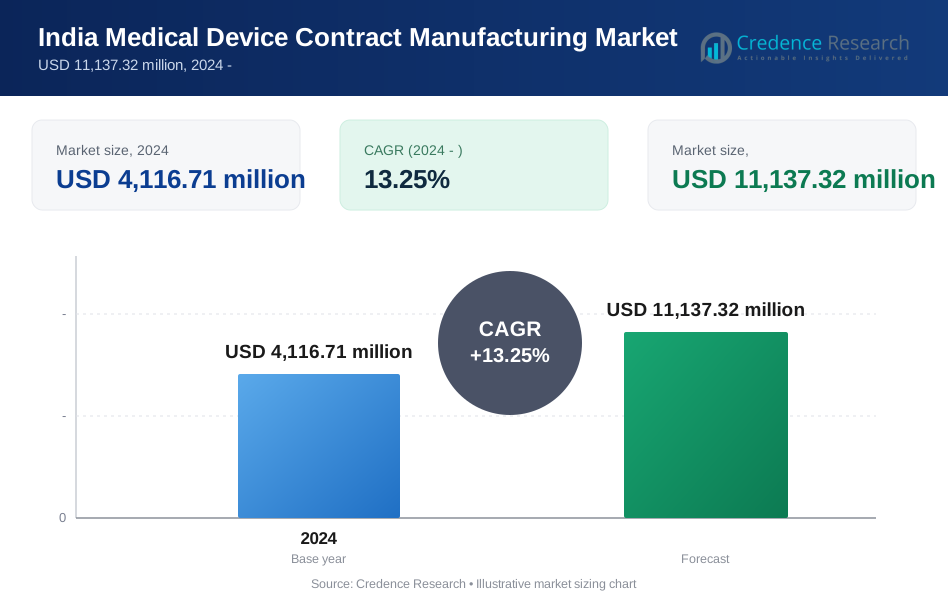
India Medical Device Contract Manufacturing market size was valued at USD 4,116.71 million in 2024 and is anticipated to reach USD 11,137.32 million by 2032, at a CAGR of 13.25% during the forecast period (2024-2032).
The India Medical Device Contract Manufacturing market is driven by the increasing demand for high-quality medical devices, fueled by the rising healthcare needs of a growing population. India’s cost-effective manufacturing capabilities, skilled workforce, and favorable government initiatives, such as the Production Linked Incentive (PLI) scheme, are attracting global players to outsource production. The market also benefits from advancements in technology, including the adoption of automation and AI in manufacturing processes, enhancing product precision and efficiency. Moreover, India’s robust supply chain infrastructure and regulatory compliance with international standards make it a preferred destination for medical device manufacturing. The rise of chronic diseases, aging populations, and the growing focus on preventive care are further propelling demand for medical devices. Trends such as the shift towards minimally invasive procedures and the increasing prevalence of remote healthcare are also fostering market growth and innovation within the contract manufacturing sector.
Geographically, India’s medical device contract manufacturing market is driven by key regions such as the North, West, South, and East, each offering unique advantages. Northern India, with hubs in Haryana and Uttar Pradesh, benefits from strong industrial infrastructure and proximity to major healthcare centers. Western India, including Maharashtra and Gujarat, is a key manufacturing base with advanced technological capabilities and a strong export market. Southern India, especially cities like Chennai and Bengaluru, is known for its medical device innovation and specialized manufacturing, while Eastern India, with emerging centers like Kolkata, offers cost-effective labor and growing infrastructure. Key players in the market include Celestica HealthTech, known for its broad product portfolio and global reach, and other companies such as Soma Medical Manufacturing, Precision ADM, Microbonds Inc., and Aradatum. These companies contribute to India’s position as a competitive global hub for medical device production and innovation.
Market Insights
- The India Medical Device Contract Manufacturing market was valued at USD 4,116.71 million in 2024 and is projected to reach USD 11,137.32 million by 2032, growing at a CAGR of 13.25%.
- The global medical device contract manufacturing market was valued at USD 79,181.52 million in 2024 and is expected to reach USD 1,90,413.88 million by 2032, growing at a CAGR of 11.59% during the forecast period (2024-2032).
- The market is driven by increasing healthcare demand, a growing population, and rising prevalence of chronic diseases, creating a higher need for medical devices.
- Technological advancements, such as automation, AI, and 3D printing, are enhancing manufacturing efficiency and product quality.
- Government initiatives, including the Production Linked Incentive (PLI) scheme, are boosting domestic manufacturing and attracting global investment.
- Key market players, including Celestica HealthTech, Precision ADM, and Microbonds Inc., are enhancing competitive dynamics by offering diverse and innovative solutions.
- Regulatory complexities and supply chain inefficiencies continue to hinder market growth, affecting production timelines and costs.
- Regionally, Northern and Western India dominate the market, with growing manufacturing hubs in Southern and Eastern India contributing to overall market expansion.
Report Scope
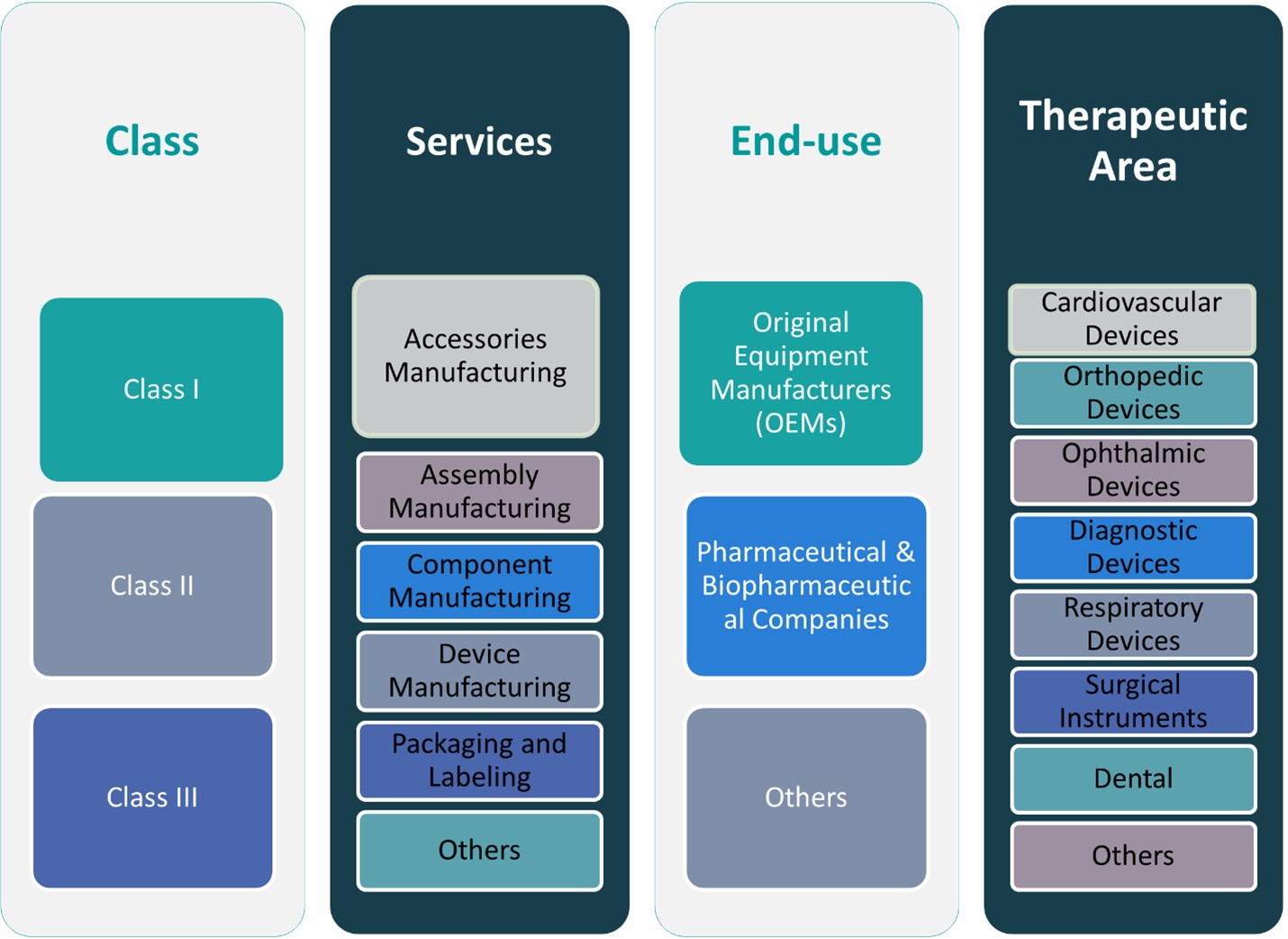
This report segments the India Medical Device Contract Manufacturing market as follows:
Market Drivers
Growing Healthcare Demand and Infrastructure Development
India's healthcare sector is experiencing rapid growth, driven by an expanding population, rising health awareness, and an increasing prevalence of chronic diseases. The demand for medical devices, such as diagnostic tools, surgical instruments, and implants, is consequently rising. For instance, the Indian government has launched initiatives such as the National Health Mission (NHM) and Ayushman Bharat to improve healthcare accessibility. These programs aim to provide affordable healthcare to underserved populations and are driving the need for cost-effective medical devices. As demand surges, medical device companies are increasingly turning to contract manufacturing to scale production quickly and efficiently, ensuring timely supply while adhering to quality standards.
Cost-Effective Manufacturing and Skilled Workforce
India’s competitive manufacturing costs, coupled with an extensive skilled labor pool, make it a preferred destination for medical device contract manufacturing. For instance, India's medical device sector benefits from competitive labor costs and advanced engineering expertise, which allows companies to produce medical devices at a fraction of the cost compared to other regions like North America and Europe. This is especially attractive to international players looking to reduce production costs without compromising on quality. Furthermore, India's manufacturing sector has made significant strides in adopting modern technologies, such as automation and precision engineering, enhancing the country’s capability to produce high-quality medical devices at scale. This cost efficiency is a major driver for the market’s expansion, positioning India as a key player in global medical device manufacturing.
Government Support and Regulatory Compliance
The Indian government has implemented various policies aimed at strengthening the medical device manufacturing sector, including the Production Linked Incentive (PLI) scheme, which provides financial incentives to companies that increase production in certain sectors, including medical devices. These policies are designed to boost domestic manufacturing, reduce dependency on imports, and attract foreign investment. Additionally, India’s adherence to international regulatory standards, such as ISO and CE certifications, ensures that products manufactured within the country meet the quality expectations of global markets. This regulatory alignment makes India an attractive hub for multinational companies looking to outsource production while maintaining compliance with strict global standards. The government’s focus on developing a strong regulatory framework further enhances the country’s reputation as a reliable partner for contract manufacturing.
Technological Advancements and Innovation in Healthcare
Technological innovation is a key driver for the growth of India’s medical device contract manufacturing market. The increasing adoption of cutting-edge technologies, such as artificial intelligence (AI), automation, and robotics, is transforming the production process. These technologies not only improve the efficiency and precision of manufacturing but also facilitate the development of advanced medical devices that cater to evolving healthcare needs, including wearable health monitors, minimally invasive surgical instruments, and telemedicine devices. The growing trend of personalized healthcare is also influencing the demand for more specialized and customized medical devices, which further fuels the need for innovative manufacturing capabilities. As India’s manufacturing industry continues to integrate these advanced technologies, the country is expected to maintain its competitive edge in the global medical device supply chain.
Market Trends
Integration of Advanced Technologies
The India medical device contract manufacturing market is increasingly adopting advanced technologies such as Internet of Things (IoT), Artificial Intelligence (AI), 3D printing, and robotics. These innovations enhance device functionality, enable real-time monitoring, and improve manufacturing precision. For instance, collaborations like that between NVIDIA and Medtronic aim to accelerate AI development in healthcare systems. Additionally, partnerships between EOS Precision ADM, Orthopedic Innovation Centre, and TECO are providing end-to-end solutions for medical device additive manufacturing.
Government Initiatives and Policy Support
The Indian government has introduced several initiatives to bolster the medical device manufacturing sector. For instance, the National Medical Device Policy 2023 aims to accelerate medical device manufacturing, particularly in Bengaluru. Additionally, the Production Linked Incentive (PLI) scheme offers financial incentives to companies that increase production in certain sectors, including medical devices. These policies are designed to boost domestic manufacturing, reduce dependency on imports, and attract foreign investment.
Focus on Regulatory Compliance and Quality Standards
There is a growing emphasis on adhering to international regulatory standards and quality certifications. For instance, Wipro GE Healthcare's investment in a greenfield manufacturing unit in Bengaluru aims to produce high-end medical devices like PET CT scanners and MR breast coils, aligning with international quality standards. This focus ensures that products manufactured in India meet the quality expectations of global markets. Such initiatives enhance the credibility of Indian manufacturers and facilitate access to international markets.
Expansion of Manufacturing Hubs
India is witnessing the establishment and expansion of dedicated medical device manufacturing hubs. The Andhra Pradesh MedTech Zone (AMTZ) in Visakhapatnam, for example, houses over 10 manufacturing units and serves as a center for medical technology innovation . Similarly, the Medical Devices Park in Hyderabad, spread over 250 acres, supports medical technology innovation and manufacturing. These hubs foster collaboration, reduce production costs, and enhance the competitiveness of Indian manufacturers in the global market.
Market Challenges Analysis
Regulatory and Compliance Hurdles
India’s medical device manufacturing industry faces challenges related to complex and evolving regulatory requirements. Although the country has made strides in aligning with international standards, navigating the regulatory landscape can still be cumbersome. For instance, the Indian government has identified medical devices as a priority sector under the 'Make in India' program, encouraging technological advancements. The approval processes for new devices can be time-consuming and subject to frequent changes, leading to delays in market entry. Additionally, ensuring compliance with international certifications such as ISO, CE, and FDA standards adds another layer of complexity for manufacturers, especially those aiming to export their products. These regulatory hurdles often increase costs and extend timelines, making it challenging for manufacturers to remain competitive in a fast-paced global market.
Supply Chain and Infrastructure Issues
Despite significant improvements in India’s infrastructure, challenges related to supply chain inefficiencies and logistics remain prevalent in the medical device contract manufacturing sector. Fluctuating raw material costs, delays in sourcing components, and limited access to specialized materials can disrupt production timelines and inflate operational costs. Furthermore, inconsistencies in the transportation and distribution networks, especially in remote areas, hinder timely deliveries. While major manufacturing hubs like Hyderabad and Visakhapatnam are improving, the overall infrastructure across the country still requires significant investment to meet the growing demand for medical devices. These supply chain challenges can impact the scalability and responsiveness of manufacturers, particularly when dealing with high-demand products or global distribution networks.
Market Opportunities
The India Medical Device Contract Manufacturing market presents significant opportunities driven by the increasing global demand for cost-effective, high-quality medical devices. As the healthcare sector continues to expand, both domestically and internationally, India’s competitive advantage in manufacturing costs, skilled labor, and technological capabilities makes it an attractive destination for contract manufacturing. International companies are increasingly looking to India to optimize their supply chains, reduce production costs, and maintain quality standards. The government’s support through initiatives like the Production Linked Incentive (PLI) scheme further strengthens this opportunity, as it incentivizes domestic manufacturing and reduces reliance on imports. India’s strong healthcare infrastructure and its ability to produce a wide range of medical devices, from diagnostic tools to implants, enhance its position in the global market, creating ample opportunities for expansion.
Additionally, the rising adoption of advanced manufacturing technologies such as automation, robotics, and 3D printing offers further potential for innovation in the medical device sector. These technologies enable manufacturers to produce complex and customized devices with greater precision and efficiency, which is increasingly in demand as the healthcare industry shifts toward personalized and minimally invasive treatments. The growth of telemedicine, wearable devices, and remote patient monitoring also presents new opportunities for contract manufacturers to cater to evolving market needs. As healthcare continues to embrace digital transformation, India’s medical device contract manufacturers are well-positioned to capitalize on the demand for technologically advanced, cost-effective solutions, providing a significant growth avenue for the sector in the coming years.
Market Segmentation Analysis:
By Class:
The India Medical Device Contract Manufacturing market is segmented by device classification, which plays a crucial role in determining the manufacturing process, regulatory requirements, and market dynamics. Class I devices, which include low-risk products like bandages, examination gloves, and some dental products, represent a significant portion of the market due to their widespread use and relatively straightforward manufacturing processes. These devices typically have minimal regulatory oversight, which makes them easier to bring to market and cost-effective to produce. Class II devices, which include medium-risk products such as surgical drapes, infusion pumps, and diagnostic imaging devices, require more stringent regulatory compliance and quality assurance protocols. Manufacturers in this segment face a higher demand for precision and consistency to meet international standards. Finally, Class III devices, which include high-risk products such as pacemakers, defibrillators, and orthopedic implants, are subject to the most stringent regulatory scrutiny. These devices demand advanced manufacturing technologies and quality controls, representing a high-value segment with significant growth potential. The diverse needs across these classifications offer opportunities for contract manufacturers to cater to various segments with tailored services and expertise.
By Services:
The India Medical Device Contract Manufacturing market is also segmented based on services, which include accessories manufacturing, assembly manufacturing, component manufacturing, device manufacturing, packaging and labeling, and others. Accessories manufacturing focuses on producing peripheral items that complement primary medical devices, such as connectors, sensors, and cables. Assembly manufacturing involves putting together the components of medical devices into finished products, which requires skilled labor and precision assembly lines. Component manufacturing, which includes producing individual parts like valves, chips, and membranes, is essential for creating the building blocks of more complex devices. Device manufacturing is the core service, where manufacturers produce the final medical device ready for distribution. This segment requires advanced technologies and strict adherence to regulatory standards. Packaging and labeling services are crucial for ensuring that medical devices are packaged securely and labeled with accurate, compliant information. As healthcare regulations evolve, this service is increasingly important to ensure product traceability and safety. Other services, including research and development, maintenance, and sterilization, also represent growing segments as the market moves toward more customized and specialized medical solutions. These service segments provide contract manufacturers with opportunities to cater to various needs in the medical device supply chain.
Segments:
Based on Class:
- Class I
- Class II
- Class III
Based on Services:
- Accessories Manufacturing
- Assembly Manufacturing
- Component Manufacturing
- Device Manufacturing
- Packaging and Labelling
- Others
Based on End- Use:
- Original Equipment Manufacturers (OEMs)
- Pharmaceutical & Biopharmaceutical Companies
- Others
Based on Therapeutic Area:
- Cardiovascular Devices
- Orthopedic Devices
- Ophthalmic Devices
- Diagnostic Devices
- Respiratory Devices
- Surgical Instruments
- Dental
- Others
Based on the Geography:
- Northern
- Western
- Southern
- Eastern
Regional Analysis
Northern
Northern region holds the largest market share at approximately 30%. This is primarily due to the presence of key manufacturing hubs in states like Haryana, Punjab, and Uttar Pradesh, which are well-established in the production of medical devices and components. The Northern region benefits from proximity to major industrial corridors, advanced infrastructure, and a large pool of skilled labor. Additionally, the region's growing healthcare demands, especially in cities like Delhi and Chandigarh, further fuel the growth of contract manufacturing activities. The increasing adoption of new technologies and favorable government policies also contribute to the market's dominance in this region.
Western
The Western region follows closely, contributing around 28% to the India Medical Device Contract Manufacturing market. Maharashtra, Gujarat, and Rajasthan are major players in this region, with Mumbai and Pune being key industrial centers for medical device manufacturing. Western India is known for its robust industrial ecosystem, large-scale production facilities, and well-established regulatory frameworks, making it an attractive destination for both domestic and international medical device companies. The region's proximity to the global markets, especially the Middle East and Southeast Asia, further enhances its appeal. Additionally, significant investments in infrastructure, such as the development of the Gujarat Medical Devices Park, continue to drive growth in this region.
Southern
The Southern region holds a market share of approximately 25%, driven by the presence of leading medical device manufacturers in Tamil Nadu, Karnataka, and Andhra Pradesh. Chennai, often referred to as the "healthcare capital" of India, plays a central role in medical device production, particularly for Class II and Class III devices. The Southern region is also home to a large number of medical device parks, including the Andhra Pradesh MedTech Zone, which fosters innovation and promotes industry growth. The region benefits from a strong IT and tech-savvy workforce, allowing for the integration of advanced technologies like AI and robotics into the manufacturing process.
Eastern
Eastern India contributes around 17% to the market, with significant manufacturing activities occurring in West Bengal, Odisha, and Bihar. Though smaller in market share compared to other regions, Eastern India has witnessed growing interest from both domestic and international companies due to its cost-effective labor force and emerging healthcare infrastructure. Cities like Kolkata are becoming increasingly important hubs for medical device manufacturing and assembly. Additionally, government initiatives aimed at boosting industrialization in the region are expected to drive growth. As the healthcare infrastructure improves and regional manufacturing capabilities strengthen, Eastern India is poised to increase its share of the contract manufacturing market in the coming years.
Key Player Analysis
- Celestica HealthTech
- Soma Medical Manufacturing
- Precision ADM
- Microbonds Inc.
- Aradatum
Competitive Analysis
The India Medical Device Contract Manufacturing market is highly competitive, with several key players driving innovation and growth. Leading companies include Celestica HealthTech, Soma Medical Manufacturing, Precision ADM, Microbonds Inc., and Aradatum. These companies leverage their expertise in manufacturing, advanced technologies, and strong distribution networks to cater to a wide range of medical device needs. Key players focus on providing a wide range of services, including component manufacturing, assembly, device production, packaging, and labeling, catering to diverse medical device needs across different classes. Competition is intensified by the increasing demand for high-quality, cost-effective medical devices, both domestically and internationally. Companies are also leveraging government incentives, such as the Production Linked Incentive (PLI) scheme, to boost their manufacturing capabilities and attract foreign investments. Strategic partnerships and collaborations are common as companies aim to expand their market reach and enhance product offerings. Despite this, challenges such as regulatory compliance, supply chain inefficiencies, and the rising costs of raw materials persist. Manufacturers must navigate these hurdles while maintaining quality standards and ensuring timely production to remain competitive. Overall, the market's growth is fueled by the continued demand for medical devices, technological advancements, and evolving industry regulations.
Recent Developments
- In February 2025, Jabil completed the acquisition of Pii, a contract development and manufacturing organization (CDMO) specializing in aseptic filling, lyophilization, and oral solid dose manufacturing.
- In November 2024, Integer completed the sale of its non-medical Electrochem business for $50 million, making it a pure-play medical technology company and allowing it to redeploy capital into high-growth medtech markets.
- In October 2024, At CPHI Milan 2024, Thermo Fisher launched its Accelerator Drug Development platform, a 360° CDMO and CRO offering. This service provides customizable manufacturing, clinical research, and supply chain solutions for small molecules, biologics, and cell and gene therapies, covering the full drug development lifecycle.
Market Concentration & Characteristics
The India Medical Device Contract Manufacturing market exhibits a moderate level of concentration, with several large players and a growing number of small to medium-sized enterprises (SMEs) actively participating. Large multinational companies tend to dominate the higher-end segments, such as Class II and Class III medical devices, leveraging their established global networks and advanced technologies. Smaller companies, however, play a crucial role in meeting the demand for Class I devices and specialized components, often focusing on cost efficiency and niche products. The market is characterized by rapid technological advancements, including automation, AI, and 3D printing, which are becoming essential for maintaining competitiveness. Companies also emphasize quality control, regulatory compliance, and supply chain optimization to meet the stringent standards of both domestic and international markets. As the healthcare sector continues to expand, the market is expected to witness increasing fragmentation, with more players entering to capitalize on the growing demand for medical devices.
Report Coverage
The research report offers an in-depth analysis based on Class, Services, End-Use, Therapeutic Area and Geography. It details leading market players, providing an overview of their business, product offerings, investments, revenue streams, and key applications. Additionally, the report includes insights into the competitive environment, SWOT analysis, current market trends, as well as the primary drivers and constraints. Furthermore, it discusses various factors that have driven market expansion in recent years. The report also explores market dynamics, regulatory scenarios, and technological advancements that are shaping the industry. It assesses the impact of external factors and global economic changes on market growth. Lastly, it provides strategic recommendations for new entrants and established companies to navigate the complexities of the market.
Future Outlook
- The India Medical Device Contract Manufacturing market is expected to continue its strong growth, driven by increasing demand for medical devices both domestically and globally.
- The market will benefit from ongoing technological advancements, including automation, AI, and 3D printing, which will enhance manufacturing capabilities.
- Government initiatives like the Production Linked Incentive (PLI) scheme will further incentivize domestic manufacturing and attract foreign investments.
- The growing focus on personalized medicine and customized devices will create new opportunities for contract manufacturers to offer specialized products.
- The rising prevalence of chronic diseases and an aging population will continue to drive the demand for medical devices.
- India’s cost-effective manufacturing capabilities will make it an attractive outsourcing hub for global medical device companies.
- Stringent regulatory standards will push manufacturers to invest in quality control and compliance to maintain competitiveness in international markets.
- The expansion of manufacturing hubs in regions like the South and East will help meet growing demand and reduce logistics costs.
- Increased investments in healthcare infrastructure will stimulate the need for advanced medical devices and create new growth opportunities.
- The shift towards minimally invasive and digital health devices will lead to innovation and growth in the medical device manufacturing sector.
Request a Free Sample
Fill in your details and we'll send you a free sample report.
- Sample data tables & charts
- Research methodology
Need a Custom Version of This Report?
Tailor the scope, geography, or segments to your exact requirements.
- Custom geography or segment scope
- Direct access to our analyst team
Frequently Asked Questions
What is the current size of the India Medical Device Contract Manufacturing?
What factors are driving the growth of the India Medical Device Contract Manufacturing?
What are some challenges faced by the India Medical Device Contract Manufacturing?
Who are the major players in the India Medical Device Contract Manufacturing?
Table of Content
Chapter 1. Report Introduction
- 1.1 Report Description & Purpose
- 1.1.1 Report Title & Market Definition
- 1.1.2 Unique Selling Propositions (USP) & Key Differentiators
- 1.1.3 Value Proposition for Stakeholders
- 1.2 Research Objectives
- 1.2.1 Market Sizing Objectives (Volume & Revenue)
- 1.2.2 Segmentation Objectives
- 1.2.3 Competitive Intelligence Objectives
- 1.2.4 Forecast & Scenario Objectives
- 1.3 Report Scope
- 1.3.1 India Medical Device Contract Manufacturing Scope – Types & Subtypes Covered
- 1.3.2 Geographic Scope – Regions & Countries Covered
- 1.3.3 Historical Period, Base Year & Forecast Period (2024; forecast to the forecast period)
- 1.3.4 Inclusions & Exclusions
- 1.4 HS Code & Classification Framework
- 1.5 Currency, Units & Pricing Basis
- 1.6 Target Stakeholders
- 1.7 Limitations & Assumptions
Chapter 2. Executive Summary
- 2.1 Global India Medical Device Contract Manufacturing Market Snapshot
- 2.1.1 Market Size – Historical (2024) & Forecast (the forecast period) (2024: USD 4,116.71 million → forecast year: USD 11,137.32 million)
- 2.1.2 Volume & Revenue – Global Totals
- 2.1.3 Key Market Highlights – Top Five Facts
- 2.2 India Medical Device Contract Manufacturing Market Segmentation Snapshot
- 2.2.1 Market Split by Region – 2024 vs.
- 2.3 Competitive Snapshot
- 2.3.1 Top 10 Players by Revenue Share – 2024
- 2.3.2 Top 10 Players by Volume Share – 2024
- 2.3.3 Recent Strategic Developments (18-Month Summary)
- 2.4 Key Investment Highlights & Strategic Conclusions
Chapter 3. India Medical Device Contract Manufacturing Market Dynamics & Industry Analysis
- 3.1 Market Overview & Context
- 3.1.1 India Medical Device Contract Manufacturing Market Position in the Broader Automotive Value Chain
- 3.1.2 OEM vs. Replacement Market Dynamics
- 3.1.3 Market Maturity & Development Stage by Region
- 3.2 India Medical Device Contract Manufacturing Market Drivers
- 3.3 India Medical Device Contract Manufacturing Market Restraints & Challenges
- 3.4 India Medical Device Contract Manufacturing Market Opportunities
- 3.5 Porter's Five Forces Analysis
- 3.5.1 Threat of New Entrants
- 3.5.2 Bargaining Power of Suppliers
- 3.5.3 Bargaining Power of Buyers
- 3.5.4 Threat of Substitutes
- 3.5.5 Competitive Rivalry – Intensity Assessment
- 3.6 India Medical Device Contract Manufacturing Value Chain Analysis
- 3.6.1 Upstream – Raw Material/Input Suppliers
- 3.6.1.1 Raw Material/Input 1
- 3.6.1.2 Raw Material/Input 2
- 3.6.1.3 Raw Material/Input 3
- 3.6.2 Midstream – Production/Manufacturing/Service Delivery
- 3.6.2.1 Production/Process Overview
- 3.6.2.2 Key Facility Locations & Capacity by Manufacturer
- 3.6.3 Downstream – Distribution & End Consumer
- 3.6.3.1 Primary Channel – B2B/OEM
- 3.6.3.2 Secondary Channels – Dealer, Retail, Online, Direct
- 3.6.4 Value Chain Profitability Analysis
- 3.6.1 Upstream – Raw Material/Input Suppliers
- 3.7 PESTEL Analysis
- 3.7.1 Political Factors
- 3.7.2 Economic Factors
- 3.7.3 Social Factors
- 3.7.4 Technological Factors
- 3.7.5 Environmental Factors
- 3.7.6 Legal Factors
- 3.8 India Medical Device Contract Manufacturing Supply Chain Analysis
- 3.8.1 Raw Material/Input Supply Risk Assessment
- 3.8.2 Manufacturing Concentration Risk (Geographic Exposure)
- 3.8.3 Trade Disruption Impact Analysis
- 3.9 Regulatory & Policy Landscape
Note: The regulatory and policy landscape section covers regulations based on their applicability to the market, India Medical Device Contract Manufacturing category, geography, and scope of the study. Only regulatory frameworks with a material impact on operations, compliance, trade, sustainability, or market access are analyzed in detail.
Chapter 4. Key Investment Pockets & Opportunity Analysis
- 4.1 India Medical Device Contract Manufacturing Market Attractiveness Analysis
- 4.1.1 By Region – Investment Attractiveness Matrix (Volume × CAGR)
- 4.2 Absolute Revenue Growth Opportunity
- 4.2.1 By Region – Absolute USD Growth Through the forecast period
- 4.3 Incremental Volume Opportunity
- 4.3.1 By Region – Incremental Volume Through the forecast period
- 4.3.2 Segment – Incremental Volume
- 4.4 Emerging Submarket Opportunity Deep Dive (Subject to Applicability)
- 4.5 Emerging Market Opportunity Scorecards
- 4.5.1 United States
- 4.5.2 Europe
- 4.5.3 Asia
- 4.5.4 Middle East & Africa
Note: Emerging Market Opportunity Scorecards will be included based on relevance and strategic importance. Regions listed are indicative and may vary depending on data availability and market dynamics.
Chapter 5. India Medical Device Contract Manufacturing Import-Export Analysis & Trade Flows
- 5.1 Global Trade Overview
- 5.1.1 Global Export Value by Country (2024)
- 5.1.2 Global Export Volume by Country (2024)
- 5.1.3 Global Import Value by Country (2024)
- 5.1.4 Global Import Volume by Country (2024)
- 5.1.5 Net Trade Balance by Country (2024)
- 5.2 Export Analysis – Segment
- 5.2.1 Type 1 (HS Code)
- 5.2.2 Type 2 (HS Code)
- 5.2.3 Type 3 (HS Code)
- 5.2.4 Type 4 (HS Code)
- 5.2.5 Type 5 (HS Code)
- 5.3 Import Analysis – Segment
- 5.3.1 Type 1 (HS Code)
- 5.3.2 Type 2 (HS Code)
- 5.3.3 Type 3 (HS Code)
- 5.3.4 Type 4 (HS Code)
- 5.3.5 Type 5 (HS Code)
- 5.4 Average Unit Trade Prices
- 5.4.1 Average Export Price – Segment & Country
- 5.4.2 Average Import Price – Segment & Source Country
- 5.4.3 Price Trends (2024)
- 5.5 Key Trade Route Analysis
- 5.5.1 Trade Route 1
- 5.5.2 Trade Route 2
- 5.5.3 Trade Route 3
- 5.5.4 Trade Route 4
- 5.5.5 Trade Route 5
- 5.6 Trade Policy Impact Assessment
- 5.6.1 US Anti-Dumping & Section 301 Tariffs
- 5.6.2 EU Customs Union Impact
- 5.6.3 Major Free Trade Agreements
- 5.6.4 USMCA Rules of Origin
Note: Trade policy analysis will be included only where relevant to the India Medical Device Contract Manufacturing market.
Chapter 6. Competitive Landscape & Company Benchmarking
- 6.1 India Medical Device Contract Manufacturing Market Concentration & Structure
- 6.1.1 Herfindahl-Hirschman Index (HHI) – vs. 2024
- 6.1.2 Tier 1, Tier 2 & Tier 3 Market Structure
- 6.1.3 Global, Regional & Local Player Dynamics
- 6.2 India Medical Device Contract Manufacturing Market Share Analysis – 2024
- 6.2.1 Global Revenue Share by Company
- 6.2.2 Global Volume Share by Company
- 6.2.3 Regional Revenue Share
- 6.2.4 Market Share Evolution ( vs. 2024)
- 6.2.5 OEM Segment Share by Company
- 6.2.6 Replacement Segment Share by Company
- 6.3 Production/Delivery Capacity & Facility Analysis
- 6.3.1 Global Installed Capacity
- 6.3.2 Capacity Utilization Rates
- 6.3.3 Production/Output Volume
- 6.3.4 Facility Locations & Capacity Map
- 6.3.5 Planned Capacity Additions
- 6.4 India Medical Device Contract Manufacturing Competitive Benchmarking Matrix
- 6.4.1 Revenue, Volume, CAGR & Profitability Comparison
- 6.4.2 Channel Revenue Mix
- 6.4.3 Geographic Revenue Exposure
- 6.4.4 R&D Intensity
- 6.4.5 Sustainability Maturity
- 6.5 Strategic Developments in India Medical Device Contract Manufacturing (Last 24 Months)
- 6.5.1 Mergers, Acquisitions & Divestments
- 6.5.2 New India Medical Device Contract Manufacturing Launches
- 6.5.3 Facility Expansions
- 6.5.4 Strategic Alliances, Joint Ventures & Partnerships
- 6.5.5 Distribution Expansion & Market Entry
- 6.5.6 Sustainability & ESG Initiatives
- 6.6 Competitive Strategy Mapping
- 6.6.1 Leader, Challenger, Follower & Niche Classification
- 6.6.2 Pricing Strategy Comparison
- 6.6.3 Channel Strategy Matrix
Note: Strategic developments are included based on their materiality and the availability of reliable information.
Chapter 7. Global India Medical Device Contract Manufacturing Market – By Distribution Channel
- 7.1 Segment Overview
- 7.1.1 Volume & Revenue Split by Channel (2024 & )
- 7.1.2 Channel Mix Evolution (the forecast period)
Chapter 8. Regional Market Analysis – Global Overview
- 8.1 Global Regional Overview
- 8.1.1 Regional Volume Share
- 8.1.2 Regional Revenue Share
- 8.1.3 Regional Volume by Region
- 8.1.4 Regional Revenue by Region
- 8.1.5 Regional Forecast Through the forecast period
- 8.2 Cross-Regional Segment Analysis
- 8.2.1 By Distribution Channel
- 8.2.2 By Brand/Price Tier
Chapter 9. North America India Medical Device Contract Manufacturing Market
- 9.1 United States
- 9.2 Canada
- 9.3 Mexico
Chapter 10. Europe India Medical Device Contract Manufacturing Market
- 10.1 Germany
- 10.2 France
- 10.3 Italy
- 10.4 United Kingdom
- 10.5 Spain
- 10.6 Poland
- 10.7 Russia
- 10.8 Netherlands
- 10.9 Belgium
- 10.10 Sweden
- 10.11 Denmark
- 10.12 Norway
- 10.13 Rest of Europe
Chapter 11. Asia Pacific India Medical Device Contract Manufacturing Market
- 11.1 China
- 11.2 India
- 11.3 Japan
- 11.4 South Korea
- 11.5 Thailand
- 11.6 Indonesia
- 11.7 Vietnam
- 11.8 Malaysia
- 11.9 Australia
- 11.10 Rest of Asia Pacific
Chapter 12. Latin America India Medical Device Contract Manufacturing Market
- 12.1 Brazil
- 12.2 Argentina
- 12.3 Colombia
- 12.4 Chile
- 12.5 Rest of Latin America
Chapter 13. Middle East India Medical Device Contract Manufacturing Market
- 13.1 Saudi Arabia
- 13.2 United Arab Emirates
- 13.3 Turkey
- 13.4 Israel
- 13.5 Iran
- 13.6 Rest of the Middle East
Chapter 14. Africa India Medical Device Contract Manufacturing Market
- 14.1 South Africa
- 14.2 Egypt
- 14.3 Nigeria
- 14.4 Morocco
- 14.5 Rest of Africa
Chapter 15. India Medical Device Contract Manufacturing Company Profiles
- 15.1 [Company 01]
- 15.1.1 Company Overview
- 15.1.2 Key Management Personnel
- 15.1.3 Products & Services Portfolio
- 15.1.4 Financial Performance
- 15.1.5 Key Market Focus & Geographic Presence
- 15.1.6 Recent Developments & Strategic Initiatives
Note: The company profile list is preliminary and may change based on research findings, market developments, data availability, and client requirements.
Chapter 16. Appendices
- Appendix A – List of Abbreviations & Acronyms
- Appendix B – Industry Classification Code Reference – Full Series
- Appendix C – Production & Capacity Data Tables
- Appendix D – End-Use & Demand Base Tables
- Appendix E – Consumption & Replacement Rate Assumptions
- Appendix F – ASP Reference Tables
- Appendix G – Manufacturing & Facility Database
- Appendix H – Import-Export Data Tables
- Appendix I – Regulatory Summary Tables
- Appendix J – Primary Research Participant List (Anonymized)
- Appendix K – Primary Research Questionnaire Framework
- Appendix L – Data Sources & Bibliography
- Appendix M – Market Size Divergence & Source Comparison
Chapter 17. Research Methodology
- 17.1 Research Framework & Philosophy
- 17.2 Secondary Research – Sources, Hierarchy & Data Extraction
- 17.3 Data Modeling – Bottom-Up & Top-Down Market Sizing
- 17.4 Primary Research – Stakeholder Framework, LOI & Sample Sizes
- 17.5 Forecast Methodology – Regression, Scenario & Sensitivity Analysis
- 17.6 Quality Control – Four-Layer Validation Framework
- 17.7 Limitations & Standard Assumptions
- 17.8 Disclaimer
