
India Outdoor Clothing Market Overview:
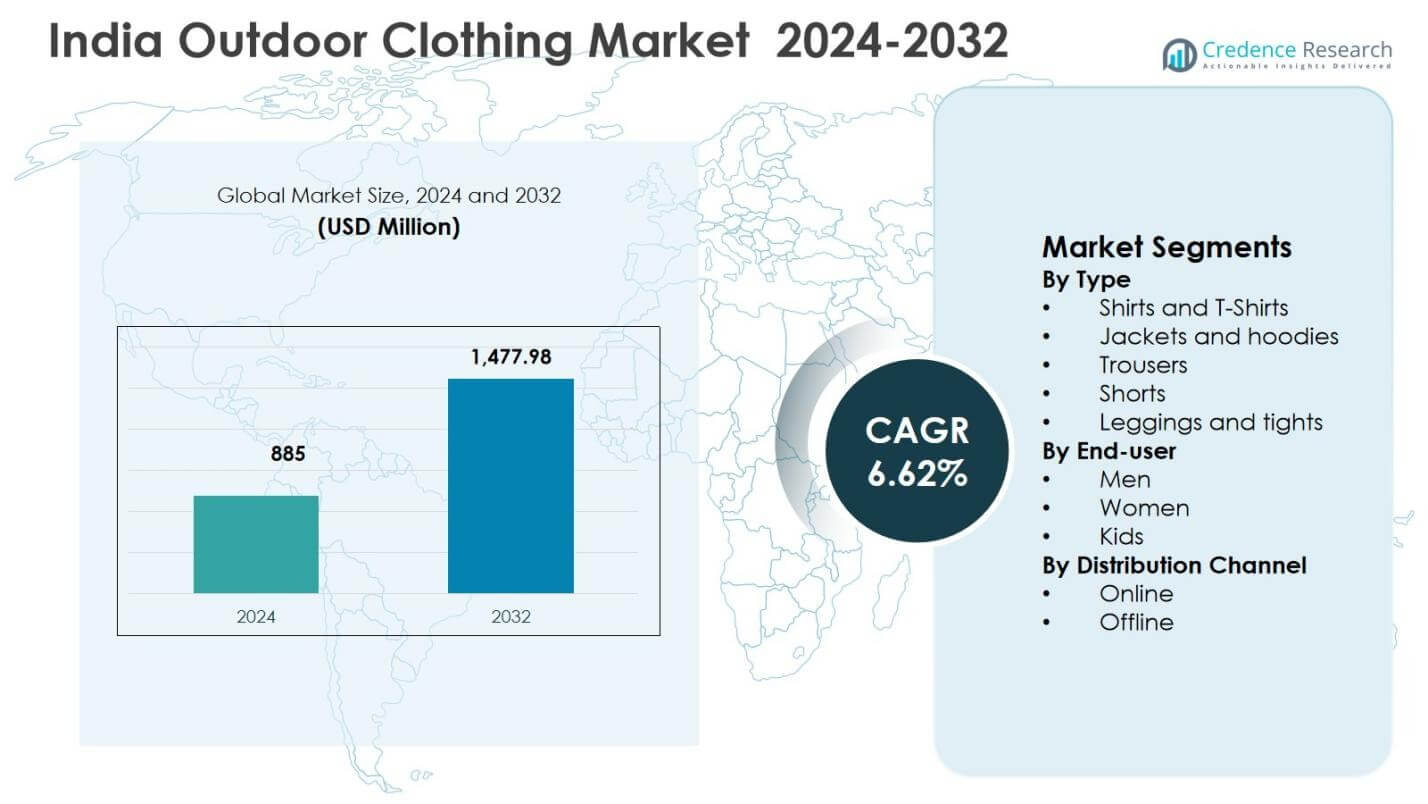
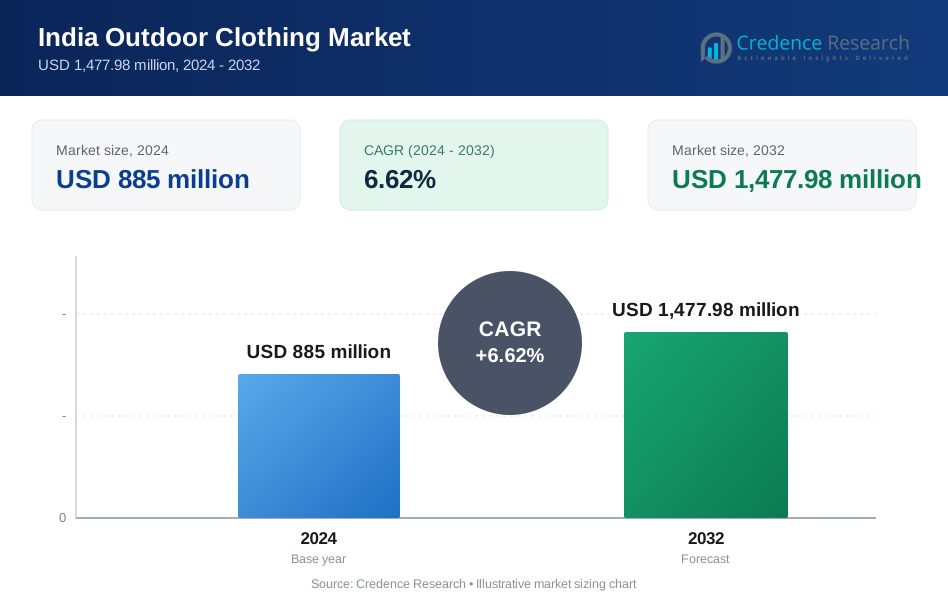
India Outdoor Clothing Market size was valued USD 885 million in 2024 and is anticipated to reach USD 1,477.98 million by 2032, at a CAGR of 6.62% during the forecast period.
| REPORT ATTRIBUTE | DETAILS |
|---|---|
| Historical Period | 2020-2023 |
| Base Year | 2024 |
| Forecast Period | 2025-2032 |
| India Outdoor Clothing Market Size 2024 | USD 885 million |
| India Outdoor Clothing Market, CAGR | 6.62% |
| India Outdoor Clothing Market Size 2032 | USD 1,477.98 million |
India Outdoor Clothing Market Insights
- Market growth is driven by rising adventure tourism, trekking, hiking, and outdoor recreation, with jackets and hoodies dominating the type segment at 34.6% share in 2024, followed by shirts and T-shirts at 27.1% and trousers at 19.4%.
- Key market trends include increasing adoption of outdoor and athleisure wear for daily use, rapid e-commerce penetration, and higher demand for lightweight, weather-resistant, and multifunctional apparel, while the men end-user segment led with a 52.8% share in 2024.
- The market landscape features strong participation from international and domestic brands focusing on product innovation, omnichannel retailing, and pricing strategies, while high price sensitivity and seasonal demand fluctuations act as key restraints.
- Regionally, North India led the market with a 34.8% share in 2024, followed by West India at 26.3% and South India at 21.7%, supported by outdoor tourism, fitness adoption, and growing urban consumer demand.
India Outdoor Clothing Market Segmentation Analysis:
By Type:
By type, the India Outdoor Clothing Market is led by jackets and hoodies, which accounted for 34.6% of the market share in 2024, driven by rising participation in trekking, hiking, and adventure tourism across hill and cold-climate regions. Growing consumer preference for weather-resistant, insulated, and multifunctional outerwear has strengthened demand for this segment. Shirts and T-shirts followed with a 27.1% share, supported by everyday outdoor and travel use, while trousers held 19.4%, reflecting demand for durable and stretchable fabrics. Shorts and leggings collectively contributed 18.9%, supported by fitness-driven outdoor activities.
- For instance, Decathlon's MT100 Puffer Jacket for trekking provides warmth from 5°C to -5°C with 125g/m² wadding fill power and weighs 370g in size L, making it compact and ideal for Himalayan treks in cold regions.
By End-user:
By end-user, men dominated the India Outdoor Clothing Market with a 52.8% share in 2024, supported by higher participation in adventure sports, trekking, and recreational travel. Increased disposable income and strong brand penetration in men’s performance wear further reinforced this dominance. Women represented 31.6% of the market, driven by rising female participation in outdoor fitness, camping, and travel activities, along with the expansion of women-specific product lines. The kids segment accounted for 15.6%, supported by growing family-oriented outdoor tourism and increasing demand for durable, protective, and comfortable outdoor apparel for children.
- For instance, Wildcraft India's Wiki Essentials line offers kid and teen gear for hiking, camping, and backpacking, designed for family explorations.
By Distribution Channel:
By distribution channel, offline retail remained dominant with a 58.3% market share in 2024, driven by consumers’ preference to physically evaluate fabric quality, fit, and comfort before purchase. Specialty outdoor stores and branded outlets significantly contributed to this dominance. Online channels accounted for 41.7%, supported by rapid e-commerce adoption, wider product availability, competitive pricing, and frequent promotional offers. The growing influence of digital marketing, easy return policies, and increasing smartphone penetration continue to strengthen online sales, especially among younger and urban consumers purchasing outdoor clothing products.
Key Growth Drivers
Rising Adventure Tourism and Outdoor Recreation
The growth of adventure tourism across India is a primary driver of the India Outdoor Clothing Market. Increasing participation in trekking, hiking, camping, mountaineering, and nature-based travel has significantly expanded demand for functional outdoor apparel. Government initiatives promoting eco-tourism and adventure destinations, along with improved access to hill stations and national parks, have further accelerated outdoor participation. Consumers increasingly seek clothing that offers thermal insulation, water resistance, UV protection, and durability across diverse climatic conditions. This shift from casual wear to performance-oriented outdoor clothing has directly contributed to sustained market expansion.
- For instance, Gokyo's Sherpa series delivers extreme cold-weather apparel like down suits for high-altitude expeditions above 7,000 meters, using thicker fabrics tailored to Indian body fits for mountaineering safety.
Increasing Health, Fitness, and Lifestyle Awareness
Rising awareness of physical fitness and active lifestyles is strongly influencing outdoor clothing consumption in India. Urban consumers are increasingly engaging in outdoor fitness activities such as trail running, cycling, yoga retreats, and weekend hiking, driving demand for breathable, lightweight, and moisture-wicking apparel. Social media influence and exposure to global fitness trends have further normalized outdoor and athleisure wear as everyday clothing. This behavioral shift has expanded the usage of outdoor clothing beyond extreme adventure sports, supporting consistent demand across both metropolitan and emerging urban centers.
- For instance, Decathlon launched an activewear collection in India using CELLIANT technology integrated with REPREVE Recycled Polyester, converting body heat into infrared energy to boost blood circulation and aid recovery during training.
Growing Disposable Income and Premiumization
Improving disposable income levels and changing spending patterns have enabled Indian consumers to invest in premium and branded outdoor clothing. Middle- and upper-income households increasingly prioritize quality, durability, and brand value over low-cost alternatives. The growing aspirational mindset, particularly among younger consumers, has strengthened demand for technologically advanced fabrics and stylish outdoor apparel. Premium product positioning, combined with seasonal collections and performance guarantees, has enhanced consumer willingness to spend, making income growth a critical driver of market expansion.
Key Trends & Opportunities
Expansion of E-commerce and Omnichannel Retailing
Rapid growth of e-commerce platforms is reshaping how outdoor clothing is marketed and sold in India. Online channels offer broader product selection, access to global brands, and detailed product information, enabling informed purchasing decisions. The integration of omnichannel strategies combining online visibility with offline experience stores has improved brand reach and customer engagement. Digital-first launches, influencer marketing, and data-driven personalization present strong opportunities for manufacturers and retailers to scale quickly, particularly in tier-II and tier-III cities with rising internet penetration.
- For instance, Decathlon launched a two-hour quick-commerce delivery service across seven major Indian cities via its app, allowing customers to receive outdoor gear like hiking apparel rapidly.
Innovation in Sustainable and Performance Fabrics
Sustainability-focused innovation represents a major opportunity in the India Outdoor Clothing Market. Consumers increasingly favor products made from recycled materials, organic fibers, and low-impact manufacturing processes. At the same time, demand for advanced performance features such as temperature regulation, antimicrobial properties, and lightweight insulation continues to rise. Brands investing in eco-friendly yet high-performance fabrics can differentiate themselves and capture environmentally conscious consumers. This convergence of sustainability and functionality is expected to unlock long-term growth opportunities.
- For instance, Alcis Sports crafts its Wonder Tee from recycled PET bottles, equivalent to eight per shirt, yielding lightweight, breathable fabric that saves 27 liters of water per unit compared to virgin materials.
Key Challenges
High Price Sensitivity and Limited Mass Adoption
Despite rising demand, high price sensitivity remains a key challenge in the India Outdoor Clothing Market. Premium outdoor apparel often carries higher price points due to specialized materials and technology, limiting adoption among cost-conscious consumers. A large portion of the population continues to rely on low-cost or unbranded alternatives, particularly for occasional outdoor use. This price barrier restricts market penetration in rural and lower-income segments, challenging brands to balance affordability with performance and quality.
Climate Diversity and Seasonal Demand Fluctuations
India’s diverse climate presents operational and demand-related challenges for outdoor clothing manufacturers. Seasonal dependency, particularly for cold-weather apparel, leads to uneven sales cycles and inventory management complexities. Demand for insulated jackets and thermal wear is concentrated in specific regions and months, while other product categories face inconsistent traction. Adapting product portfolios to regional climate variations while maintaining efficient supply chains remains a persistent challenge, impacting profitability and forecasting accuracy.
Regional Analysis
North India
North India accounted for 34.8% of the India Outdoor Clothing Market in 2024, making it the leading regional contributor. The region’s dominance is driven by strong participation in trekking, mountaineering, skiing, and winter tourism across Himachal Pradesh, Uttarakhand, Jammu & Kashmir, and Ladakh. Demand for insulated jackets, thermal layers, and weather-resistant outerwear remains high due to prolonged cold seasons and snow-prone terrains. Additionally, the presence of established adventure tourism hubs, growing disposable income, and higher brand awareness among urban consumers in Delhi NCR and Chandigarh continue to support sustained regional market growth.
West India
West India held 26.3% of the market share in 2024, supported by rising outdoor lifestyle adoption in Maharashtra, Gujarat, and Rajasthan. Urban centers such as Mumbai, Pune, and Ahmedabad contribute significantly through demand for lightweight, breathable, and multipurpose outdoor apparel suitable for hiking, cycling, and travel. The region benefits from strong retail penetration, both offline and online, along with increasing weekend adventure activities in coastal and desert terrains. Growing fitness awareness and fashion-oriented outdoor wear usage further strengthen demand across this region.
South India
South India represented 21.7% of the India Outdoor Clothing Market in 2024, driven by increasing participation in trekking, trail running, and eco-tourism across Karnataka, Tamil Nadu, and Kerala. Hill stations such as Coorg, Ooty, and Munnar support consistent demand for outdoor clothing designed for mild cold and high-humidity conditions. The region shows strong adoption of performance-based shirts, T-shirts, and trousers rather than heavy winter wear. High internet penetration, a young population, and strong e-commerce usage continue to support steady regional growth.
East India
East India accounted for 10.2% of the market share in 2024, supported by gradual growth in outdoor activities across West Bengal, Odisha, and the Northeastern states. Trekking, wildlife tourism, and nature exploration in regions such as Sikkim, Arunachal Pradesh, and Assam are increasing demand for durable and protective outdoor apparel. While overall market penetration remains lower compared to other regions, improving infrastructure, rising disposable income, and growing awareness of branded outdoor clothing are strengthening regional consumption patterns, particularly among younger consumers.
Central India
Central India captured 7.0% of the India Outdoor Clothing Market in 2024, reflecting emerging but comparatively lower adoption levels. States such as Madhya Pradesh and Chhattisgarh contribute through growing interest in camping, wildlife tourism, and outdoor fitness activities. Demand is primarily driven by affordable and mid-range outdoor clothing rather than premium products. Limited retail presence and lower awareness of specialized outdoor apparel constrain faster growth; however, increasing urbanization, tourism development, and expanding online retail access are expected to gradually improve regional market performance.
India Outdoor Clothing Market Segmentations:
By Type
- Shirts and T-Shirts
- Jackets and hoodies
- Trousers
- Shorts
- Leggings and tights
By End-user
- Men
- Women
- Kids
By Distribution Channel
- Online
- Offline
By Geography
- North India
- South India
- West India
- East India
- Central India
Competitive Landscape
Competitive landscape analysis of the India Outdoor Clothing Market reflects a moderately fragmented structure with strong competition among both international and domestic brands, including Decathlon India, Wildcraft, Columbia Sportswear Company, The North Face, Quechua (by Decathlon), Patagonia, Adidas Outdoor, The Timberland Company, Mountain Hardwear, and Jack Wolfskin. These players compete primarily on product performance, pricing, durability, and brand recognition. International brands focus on premium positioning and advanced fabric technologies, while domestic players emphasize affordability and localization to capture a wider consumer base. Expansion of exclusive brand outlets, aggressive e-commerce strategies, and partnerships with adventure tourism platforms are central to competitive positioning. Continuous product innovation, including weather-resistant and lightweight apparel, strengthens differentiation. Marketing through digital platforms and influencer-led campaigns further intensifies competition, while efficient supply chains and omnichannel presence remain critical for sustaining market share.
Key Player Analysis
- Jack Wolfskin
- Patagonia
- Decathlon India
- Mountain Hardwear
- The Timberland Company
- Quechua (by Decathlon)
- Columbia Sportswear Company
- Adidas Outdoor
- Wildcraft
- The North Face
Recent Developments
- In August 2025, Decathlon Sports India outlined its expanded vision at the FashionXP Summit 2025, focusing on diversified retail formats, enhanced omnichannel capabilities, and increased R&D investment to tailor outdoor and technical products for Indian consumers.
- In May 2024, Wildcraft India announced a strategic partnership with Apparel Group to expand its outdoor clothing and gear presence across the Gulf Cooperation Council (GCC) region through flagship stores and enhanced online listings.
- In May 2024, Wildcraft India launched a new content campaign titled “Adventure Ready” along with its Wildcraft Storyboard content series to engage and inspire outdoor enthusiasts across India.
Report Coverage
The research report offers an in-depth analysis based on Type, End User, Distribution Channel and Geography. It details leading market players, providing an overview of their business, product offerings, investments, revenue streams, and key applications. Additionally, the report includes insights into the competitive environment, SWOT analysis, current market trends, as well as the primary drivers and constraints. Furthermore, it discusses various factors that have driven market expansion in recent years. The report also explores market dynamics, regulatory scenarios, and technological advancements that are shaping the industry. It assesses the impact of external factors and global economic changes on market growth. Lastly, it provides strategic recommendations for new entrants and established companies to navigate the complexities of the market.
Future Outlook
- The India outdoor clothing market is expected to maintain steady growth driven by rising participation in adventure tourism and outdoor recreational activities.
- Increasing adoption of outdoor and athleisure wear for everyday use will continue to expand the consumer base across urban and semi-urban areas.
- Product innovation focused on lightweight, weather-resistant, and multifunctional apparel will remain a key growth catalyst.
- Expanding e-commerce penetration and omnichannel retail strategies will improve product accessibility across tier-II and tier-III cities.
- Growing awareness of health, fitness, and active lifestyles will support consistent demand for performance-oriented outdoor clothing.
- Sustainability-focused manufacturing and the use of eco-friendly fabrics will gain stronger acceptance among environmentally conscious consumers.
- Premiumization trends will accelerate as disposable incomes rise and brand consciousness strengthens among younger demographics.
- Women-specific and kids-focused outdoor apparel lines will witness faster adoption due to changing lifestyle preferences.
- Strategic collaborations with adventure tourism operators and sports communities will enhance brand visibility and customer engagement.
- Regional product customization aligned with diverse climatic conditions will become increasingly important for long-term market competitiveness.
Request a Free Sample
Fill in your details and we'll send you a free sample report.
- Sample data tables & charts
- Research methodology
Need a Custom Version of This Report?
Tailor the scope, geography, or segments to your exact requirements.
- Custom geography or segment scope
- Direct access to our analyst team
Frequently Asked Questions
What is the current market size for India Outdoor Clothing Market, and what is its projected size in 2032?
At what Compound Annual Growth Rate is the India Outdoor Clothing Market projected to grow between 2024 and 2032?
Which India Outdoor Clothing Market segment held the largest share in 2024?
What are the primary factors fueling the growth of the India Outdoor Clothing Market?
Who are the leading companies in the India Outdoor Clothing Market?
Which region commanded the largest share of the India Outdoor Clothing Market in 2024?
Table of Content
Chapter 1. Report Introduction
- 1.1 Report Description & Purpose
- 1.1.1 Report Title & Market Definition
- 1.1.2 Unique Selling Propositions (USP) & Key Differentiators
- 1.1.3 Value Proposition for Stakeholders
- 1.2 Research Objectives
- 1.2.1 Market Sizing Objectives (Volume & Revenue)
- 1.2.2 Segmentation Objectives
- 1.2.3 Competitive Intelligence Objectives
- 1.2.4 Forecast & Scenario Objectives
- 1.3 Report Scope
- 1.3.1 India Outdoor Clothing Scope – Types & Subtypes Covered
- 1.3.2 Geographic Scope – Regions & Countries Covered
- 1.3.3 Historical Period, Base Year & Forecast Period (2024; forecast to 2032)
- 1.3.4 Inclusions & Exclusions
- 1.4 HS Code & Classification Framework
- 1.5 Currency, Units & Pricing Basis
- 1.6 Target Stakeholders
- 1.7 Limitations & Assumptions
Chapter 2. Executive Summary
- 2.1 Global India Outdoor Clothing Market Snapshot
- 2.1.1 Market Size – Historical (2024) & Forecast (2024-2032) (2024: USD 885 million → 2032: USD 1,477.98 million)
- 2.1.2 Volume & Revenue – Global Totals
- 2.1.3 Key Market Highlights – Top Five Facts
- 2.2 India Outdoor Clothing Market Segmentation Snapshot
- 2.2.1 Market Split by Region – 2024 vs. 2032
- 2.3 Competitive Snapshot
- 2.3.1 Top 10 Players by Revenue Share – 2024
- 2.3.2 Top 10 Players by Volume Share – 2024
- 2.3.3 Recent Strategic Developments (18-Month Summary)
- 2.4 Key Investment Highlights & Strategic Conclusions
Chapter 3. India Outdoor Clothing Market Dynamics & Industry Analysis
- 3.1 Market Overview & Context
- 3.1.1 India Outdoor Clothing Market Position in the Broader Automotive Value Chain
- 3.1.2 OEM vs. Replacement Market Dynamics
- 3.1.3 Market Maturity & Development Stage by Region
- 3.2 India Outdoor Clothing Market Drivers
- 3.3 India Outdoor Clothing Market Restraints & Challenges
- 3.4 India Outdoor Clothing Market Opportunities
- 3.5 Porter's Five Forces Analysis
- 3.5.1 Threat of New Entrants
- 3.5.2 Bargaining Power of Suppliers
- 3.5.3 Bargaining Power of Buyers
- 3.5.4 Threat of Substitutes
- 3.5.5 Competitive Rivalry – Intensity Assessment
- 3.6 India Outdoor Clothing Value Chain Analysis
- 3.6.1 Upstream – Raw Material/Input Suppliers
- 3.6.1.1 Raw Material/Input 1
- 3.6.1.2 Raw Material/Input 2
- 3.6.1.3 Raw Material/Input 3
- 3.6.2 Midstream – Production/Manufacturing/Service Delivery
- 3.6.2.1 Production/Process Overview
- 3.6.2.2 Key Facility Locations & Capacity by Manufacturer
- 3.6.3 Downstream – Distribution & End Consumer
- 3.6.3.1 Primary Channel – B2B/OEM
- 3.6.3.2 Secondary Channels – Dealer, Retail, Online, Direct
- 3.6.4 Value Chain Profitability Analysis
- 3.6.1 Upstream – Raw Material/Input Suppliers
- 3.7 PESTEL Analysis
- 3.7.1 Political Factors
- 3.7.2 Economic Factors
- 3.7.3 Social Factors
- 3.7.4 Technological Factors
- 3.7.5 Environmental Factors
- 3.7.6 Legal Factors
- 3.8 India Outdoor Clothing Supply Chain Analysis
- 3.8.1 Raw Material/Input Supply Risk Assessment
- 3.8.2 Manufacturing Concentration Risk (Geographic Exposure)
- 3.8.3 Trade Disruption Impact Analysis
- 3.9 Regulatory & Policy Landscape
Note: The regulatory and policy landscape section covers regulations based on their applicability to the market, India Outdoor Clothing category, geography, and scope of the study. Only regulatory frameworks with a material impact on operations, compliance, trade, sustainability, or market access are analyzed in detail.
Chapter 4. Key Investment Pockets & Opportunity Analysis
- 4.1 India Outdoor Clothing Market Attractiveness Analysis
- 4.1.1 By Region – Investment Attractiveness Matrix (Volume × CAGR)
- 4.2 Absolute Revenue Growth Opportunity
- 4.2.1 By Region – Absolute USD Growth Through 2032
- 4.3 Incremental Volume Opportunity
- 4.3.1 By Region – Incremental Volume Through 2032
- 4.3.2 Segment – Incremental Volume
- 4.4 Emerging Submarket Opportunity Deep Dive (Subject to Applicability)
- 4.5 Emerging Market Opportunity Scorecards
- 4.5.1 United States
- 4.5.2 Europe
- 4.5.3 Asia
- 4.5.4 Middle East & Africa
Note: Emerging Market Opportunity Scorecards will be included based on relevance and strategic importance. Regions listed are indicative and may vary depending on data availability and market dynamics.
Chapter 5. India Outdoor Clothing Import-Export Analysis & Trade Flows
- 5.1 Global Trade Overview
- 5.1.1 Global Export Value by Country (2024)
- 5.1.2 Global Export Volume by Country (2024)
- 5.1.3 Global Import Value by Country (2024)
- 5.1.4 Global Import Volume by Country (2024)
- 5.1.5 Net Trade Balance by Country (2024)
- 5.2 Export Analysis – Segment
- 5.2.1 Type 1 (HS Code)
- 5.2.2 Type 2 (HS Code)
- 5.2.3 Type 3 (HS Code)
- 5.2.4 Type 4 (HS Code)
- 5.2.5 Type 5 (HS Code)
- 5.3 Import Analysis – Segment
- 5.3.1 Type 1 (HS Code)
- 5.3.2 Type 2 (HS Code)
- 5.3.3 Type 3 (HS Code)
- 5.3.4 Type 4 (HS Code)
- 5.3.5 Type 5 (HS Code)
- 5.4 Average Unit Trade Prices
- 5.4.1 Average Export Price – Segment & Country
- 5.4.2 Average Import Price – Segment & Source Country
- 5.4.3 Price Trends (2024)
- 5.5 Key Trade Route Analysis
- 5.5.1 Trade Route 1
- 5.5.2 Trade Route 2
- 5.5.3 Trade Route 3
- 5.5.4 Trade Route 4
- 5.5.5 Trade Route 5
- 5.6 Trade Policy Impact Assessment
- 5.6.1 US Anti-Dumping & Section 301 Tariffs
- 5.6.2 EU Customs Union Impact
- 5.6.3 Major Free Trade Agreements
- 5.6.4 USMCA Rules of Origin
Note: Trade policy analysis will be included only where relevant to the India Outdoor Clothing market.
Chapter 6. Competitive Landscape & Company Benchmarking
- 6.1 India Outdoor Clothing Market Concentration & Structure
- 6.1.1 Herfindahl-Hirschman Index (HHI) – vs. 2024
- 6.1.2 Tier 1, Tier 2 & Tier 3 Market Structure
- 6.1.3 Global, Regional & Local Player Dynamics
- 6.2 India Outdoor Clothing Market Share Analysis – 2024
- 6.2.1 Global Revenue Share by Company
- 6.2.2 Global Volume Share by Company
- 6.2.3 Regional Revenue Share
- 6.2.4 Market Share Evolution ( vs. 2024)
- 6.2.5 OEM Segment Share by Company
- 6.2.6 Replacement Segment Share by Company
- 6.3 Production/Delivery Capacity & Facility Analysis
- 6.3.1 Global Installed Capacity
- 6.3.2 Capacity Utilization Rates
- 6.3.3 Production/Output Volume
- 6.3.4 Facility Locations & Capacity Map
- 6.3.5 Planned Capacity Additions
- 6.4 India Outdoor Clothing Competitive Benchmarking Matrix
- 6.4.1 Revenue, Volume, CAGR & Profitability Comparison
- 6.4.2 Channel Revenue Mix
- 6.4.3 Geographic Revenue Exposure
- 6.4.4 R&D Intensity
- 6.4.5 Sustainability Maturity
- 6.5 Strategic Developments in India Outdoor Clothing (Last 24 Months)
- 6.5.1 Mergers, Acquisitions & Divestments
- 6.5.2 New India Outdoor Clothing Launches
- 6.5.3 Facility Expansions
- 6.5.4 Strategic Alliances, Joint Ventures & Partnerships
- 6.5.5 Distribution Expansion & Market Entry
- 6.5.6 Sustainability & ESG Initiatives
- 6.6 Competitive Strategy Mapping
- 6.6.1 Leader, Challenger, Follower & Niche Classification
- 6.6.2 Pricing Strategy Comparison
- 6.6.3 Channel Strategy Matrix
Note: Strategic developments are included based on their materiality and the availability of reliable information.
Chapter 7. Global India Outdoor Clothing Market – By Distribution Channel
- 7.1 Segment Overview
- 7.1.1 Volume & Revenue Split by Channel (2024 & 2032)
- 7.1.2 Channel Mix Evolution (2024-2032)
Chapter 8. Regional Market Analysis – Global Overview
- 8.1 Global Regional Overview
- 8.1.1 Regional Volume Share
- 8.1.2 Regional Revenue Share
- 8.1.3 Regional Volume by Region
- 8.1.4 Regional Revenue by Region
- 8.1.5 Regional Forecast Through 2032
- 8.2 Cross-Regional Segment Analysis
- 8.2.1 By Distribution Channel
- 8.2.2 By Brand/Price Tier
Chapter 9. North America India Outdoor Clothing Market
- 9.1 United States
- 9.2 Canada
- 9.3 Mexico
Chapter 10. Europe India Outdoor Clothing Market
- 10.1 Germany
- 10.2 France
- 10.3 Italy
- 10.4 United Kingdom
- 10.5 Spain
- 10.6 Poland
- 10.7 Russia
- 10.8 Netherlands
- 10.9 Belgium
- 10.10 Sweden
- 10.11 Denmark
- 10.12 Norway
- 10.13 Rest of Europe
Chapter 11. Asia Pacific India Outdoor Clothing Market
- 11.1 China
- 11.2 India
- 11.3 Japan
- 11.4 South Korea
- 11.5 Thailand
- 11.6 Indonesia
- 11.7 Vietnam
- 11.8 Malaysia
- 11.9 Australia
- 11.10 Rest of Asia Pacific
Chapter 12. Latin America India Outdoor Clothing Market
- 12.1 Brazil
- 12.2 Argentina
- 12.3 Colombia
- 12.4 Chile
- 12.5 Rest of Latin America
Chapter 13. Middle East India Outdoor Clothing Market
- 13.1 Saudi Arabia
- 13.2 United Arab Emirates
- 13.3 Turkey
- 13.4 Israel
- 13.5 Iran
- 13.6 Rest of the Middle East
Chapter 14. Africa India Outdoor Clothing Market
- 14.1 South Africa
- 14.2 Egypt
- 14.3 Nigeria
- 14.4 Morocco
- 14.5 Rest of Africa
Chapter 15. India Outdoor Clothing Company Profiles
- 15.1 [Company 01]
- 15.1.1 Company Overview
- 15.1.2 Key Management Personnel
- 15.1.3 Products & Services Portfolio
- 15.1.4 Financial Performance
- 15.1.5 Key Market Focus & Geographic Presence
- 15.1.6 Recent Developments & Strategic Initiatives
Note: The company profile list is preliminary and may change based on research findings, market developments, data availability, and client requirements.
Chapter 16. Appendices
- Appendix A – List of Abbreviations & Acronyms
- Appendix B – Industry Classification Code Reference – Full Series
- Appendix C – Production & Capacity Data Tables
- Appendix D – End-Use & Demand Base Tables
- Appendix E – Consumption & Replacement Rate Assumptions
- Appendix F – ASP Reference Tables
- Appendix G – Manufacturing & Facility Database
- Appendix H – Import-Export Data Tables
- Appendix I – Regulatory Summary Tables
- Appendix J – Primary Research Participant List (Anonymized)
- Appendix K – Primary Research Questionnaire Framework
- Appendix L – Data Sources & Bibliography
- Appendix M – Market Size Divergence & Source Comparison
Chapter 17. Research Methodology
- 17.1 Research Framework & Philosophy
- 17.2 Secondary Research – Sources, Hierarchy & Data Extraction
- 17.3 Data Modeling – Bottom-Up & Top-Down Market Sizing
- 17.4 Primary Research – Stakeholder Framework, LOI & Sample Sizes
- 17.5 Forecast Methodology – Regression, Scenario & Sensitivity Analysis
- 17.6 Quality Control – Four-Layer Validation Framework
- 17.7 Limitations & Standard Assumptions
- 17.8 Disclaimer
