
| REPORT ATTRIBUTE | DETAILS |
|---|---|
| Historical Period | 2019-2022 |
| Base Year | 2023 |
| Forecast Period | 2024-2032 |
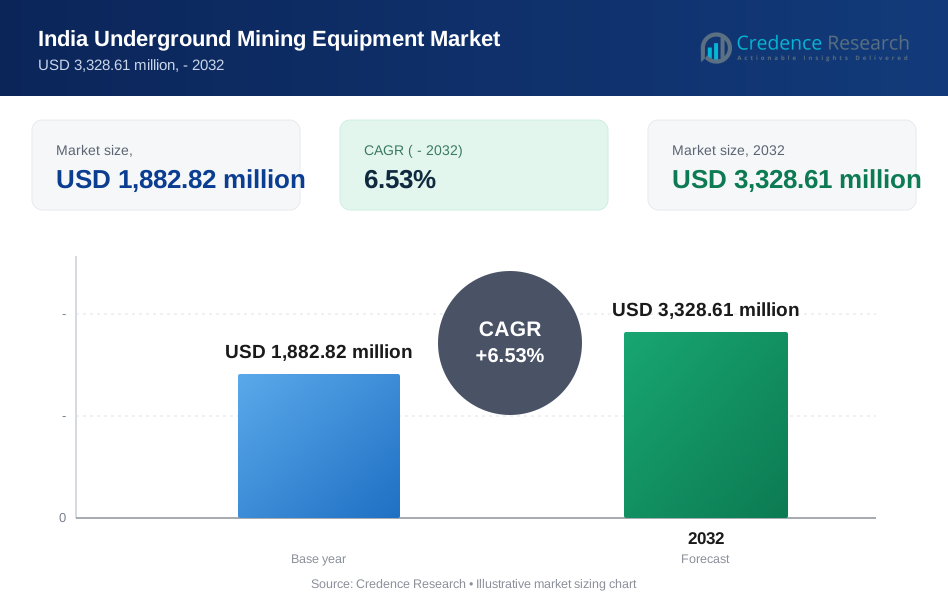
| India Underground Mining Equipment Market Size 2023 | USD 1,882.82 million |
| India Underground Mining Equipment Market, CAGR | 6.53% |
| India Underground Mining Equipment Market Size 2032 | USD 3,328.61 million |
Market Overview
The India Underground Mining Equipment Market is projected to grow from USD 1,882.82 million in 2023 to an estimated USD 3,328.61 million by 2032, reflecting a compound annual growth rate (CAGR) of 6.53% from 2024 to 2032. This growth is driven by the increasing demand for minerals and metals, bolstered by India's expanding infrastructure and industrialization initiatives. Significant investments in mining activities, supported by government reforms and favorable policies such as privatization of the coal sector, further enhance the market's outlook. The adoption of advanced technologies in mining operations, including automation and digitalization, also contributes to market expansion.
Key market drivers include rising demand for coal and metal ores, driven by energy and manufacturing sectors, and the ongoing transition toward mechanized mining for improved safety and productivity. Trends such as the integration of IoT and smart technologies in underground equipment, along with a focus on sustainability through energy-efficient solutions, are shaping the market's trajectory. Increasing focus on worker safety and environmental compliance is encouraging the development of innovative equipment.
Geographically, India's underground mining activities are concentrated in resource-rich regions such as Jharkhand, Odisha, Chhattisgarh, and Madhya Pradesh, which collectively house substantial reserves of coal, iron ore, and other minerals. Key players in the market include Caterpillar Inc., Komatsu Ltd., Sandvik AB, Epiroc AB, and Hitachi Construction Machinery, which are leveraging advanced technologies to enhance operational efficiency and sustainability, thereby meeting the rising demand for underground mining equipment.
Market Drivers
Increasing Demand for Minerals and Metals
India's burgeoning infrastructure and industrial sectors are major contributors to the rising demand for minerals and metals, such as coal, iron ore, and bauxite. These materials serve as foundational inputs for various industries, including construction, automotive, energy, and manufacturing. The growing energy needs of the country, particularly driven by coal-fired power plants, necessitate efficient and large-scale mining operations. For instance, India's increasing demand for minerals and metals is underscored by its ambitious infrastructure projects, which require substantial quantities of raw materials. The "Make in India" initiative and the "Smart Cities Mission" are significant contributors to this demand, as they necessitate large-scale mining operations to support construction and manufacturing industries. As a result, mining companies are compelled to explore deeper underground reserves due to the depletion of surface deposits, driving the need for advanced underground mining equipment such as longwall miners and continuous miners. Additionally, underground mining plays a vital role in accessing these deeper mineral reserves that surface mining cannot reach. The depletion of near-surface reserves is pushing mining companies to explore underground deposits, further propelling market growth.
Technological Advancements in Mining Operations
The adoption of advanced technologies in mining operations is revolutionizing the industry and is a significant driver of the underground mining equipment market in India. Automation, digitalization, and the integration of Internet of Things (IoT) technologies are enabling mining companies to enhance operational efficiency, reduce costs, and improve safety standards. Smart sensors, predictive maintenance, and real-time monitoring systems are allowing companies to make data-driven decisions and optimize their mining processes. Furthermore, the use of electric and battery-operated mining equipment is gaining traction due to their lower environmental impact and reduced operating costs. Companies are increasingly focusing on sustainable mining practices, which include the deployment of energy-efficient machinery and systems. The push toward environmentally friendly mining solutions is not only a regulatory necessity but also a market trend driving innovation and adoption of advanced underground mining equipment.
Supportive Government Policies and Reforms
Government initiatives and policy reforms in India have significantly boosted mining activities, providing a strong impetus to the underground mining equipment market. Key reforms, such as the opening up of the coal mining sector to private players and the auction-based allocation of mineral resources, have created a competitive and investment-friendly environment. The introduction of the National Mineral Policy (NMP) 2019 further emphasizes sustainable mining practices and aims to increase the contribution of the mining sector to India's GDP. Additionally, the government has been investing in infrastructure development, such as roads and railways, to improve connectivity to mining regions. Schemes like "Atmanirbhar Bharat" (Self-Reliant India) are encouraging domestic production of mining equipment, reducing dependency on imports and fostering indigenous manufacturing capabilities. These reforms not only attract foreign direct investments (FDI) but also create opportunities for domestic and global players to expand their operations in India.
Growing Focus on Worker Safety and Environmental Compliance
The mining industry in India is placing an increasing emphasis on worker safety and environmental compliance, driving the adoption of modern underground mining equipment. Traditional mining practices often pose significant safety risks to workers, including exposure to hazardous conditions and accidents. To address these concerns, companies are investing in advanced equipment equipped with safety features such as remote operation capabilities, collision avoidance systems, and emergency response mechanisms.
Environmental regulations are becoming stricter, compelling mining companies to adopt eco-friendly and energy-efficient technologies. The push for sustainability has led to the development of low-emission mining equipment and practices that minimize ecological disruption. Equipment manufacturers are focusing on creating machines that reduce energy consumption and adhere to stringent environmental norms. The convergence of safety and sustainability requirements is driving innovation in the underground mining equipment market.
Market Trends
Increased Adoption of Automation and Smart Technologies
The India Underground Mining Equipment Market is experiencing a rapid shift towards automation and the integration of smart technologies. Mining companies are increasingly deploying automated machinery, such as robotic drilling systems, autonomous haulage trucks, and smart sensors, to enhance operational efficiency and reduce downtime. The integration of Internet of Things (IoT) and Artificial Intelligence (AI) technologies is enabling real-time monitoring, predictive maintenance, and data-driven decision-making. These advancements improve safety by minimizing human exposure to hazardous environments and optimizing resource utilization. For instance, the integration of automation and smart technologies is exemplified by mining companies deploying robotic drilling systems and autonomous haulage trucks, which enhance operational efficiency and minimize downtime. The use of IoT and AI technologies facilitates real-time monitoring and predictive maintenance, significantly improving safety by reducing human exposure to hazardous environments while optimizing resource utilization. Additionally, the adoption of digital twins-virtual replicas of mining systems-allows operators to simulate mining processes, leading to better decision-making and increased productivity. Moreover, companies are investing in cloud-based platforms and advanced analytics tools to streamline operations and improve mine productivity. These technological advancements not only increase profitability but also address the industry's growing focus on sustainability and regulatory compliance.
Shift Toward Electric and Battery-Operated Equipment
With increasing environmental concerns and stringent regulations, the market is witnessing a notable shift toward electric and battery-operated underground mining equipment. Traditional diesel-powered machinery is being replaced with electric-powered alternatives to reduce greenhouse gas emissions and lower operating costs. Equipment such as battery-electric load-haul-dump (LHD) machines and underground mining trucks are becoming popular, especially in coal and metal mining applications. This trend aligns with India’s broader push toward sustainability, as mining companies seek to adopt cleaner and energy-efficient solutions. The reduced maintenance requirements and longer lifespan of electric equipment also contribute to their growing adoption. For instance, a shift toward electric and battery-operated equipment is evident as mining companies replace traditional diesel-powered machinery with electric alternatives, such as battery-electric load-haul-dump (LHD) machines. This transition not only helps reduce greenhouse gas emissions but also aligns with India's sustainability goals. Additionally, international equipment manufacturers are collaborating with Indian firms to introduce cutting-edge electric mining technologies tailored to local requirements. This transition marks a significant step forward in India's journey toward eco-friendly and sustainable mining operations.
Market Restraints and Challenges
High Initial Investment and Operating Costs
One of the primary challenges facing the India Underground Mining Equipment Market is the significant capital investment required for procuring advanced machinery and technologies. Underground mining equipment, such as longwall systems, continuous miners, and battery-powered vehicles, often comes with high upfront costs, making it a substantial financial burden for smaller mining companies. Additionally, the cost of maintenance and operation, especially for technologically advanced and automated systems, can further strain budgets. Limited access to financing and credit for smaller players exacerbates this issue. Moreover, the lack of domestic manufacturing capacity for sophisticated underground equipment results in dependency on expensive imports, increasing overall costs. These financial barriers can delay modernization efforts and slow down the adoption of advanced equipment, thereby restricting market growth.
Challenges in Infrastructure and Resource Accessibility
India's mining industry faces significant infrastructural and logistical challenges, particularly in remote and resource-rich regions. Poor connectivity, lack of adequate transportation facilities, and unreliable power supply make it difficult to deploy and operate advanced underground mining equipment efficiently. Mining operations in these areas are further hindered by the uneven terrain and challenging geological conditions, which increase operational risks and reduce productivity. In addition, regulatory and environmental hurdles pose challenges to mining operations. Delays in obtaining permits, coupled with stringent compliance requirements, can slow down project timelines. Resource accessibility issues, such as land acquisition disputes and opposition from local communities, also create operational bottlenecks. These factors collectively impede the growth of the underground mining equipment market by limiting opportunities for expansion and innovation. Addressing these challenges requires coordinated efforts between the government and industry stakeholders to improve infrastructure, streamline regulations, and ensure equitable resource allocation.
Market Segmentation Analysis
By Product Type
The India Underground Equipment Market is segmented by product type, with key equipment including mining loaders, mining trucks, mining drills, mining bolters, and mining shearers. Mining loaders are essential for efficient material handling and transport in confined underground spaces, often incorporating advanced automation for increased productivity and safety. Mining trucks are designed for the haulage of minerals and materials in underground environments, with demand growing due to rising mining activities and the need to move large quantities of extracted minerals. Mining drills are crucial for excavation and extraction, with technological advancements leading to highly efficient, automated drilling solutions gaining popularity in various mining projects. Mining bolters provide critical ground support to ensure structural stability and worker safety in underground mines, driven by increasing mining activity and a focus on safety. Finally, mining shearers, primarily used in soft rock mining, are gaining traction due to rising coal and mineral extraction projects requiring continuous rock cutting.
By Mining Technique
The India Underground Equipment Market is driven by two primary mining techniques: soft rock and hard rock mining. The soft rock mining segment focuses on extracting materials like coal and certain minerals, with growing demand for underground equipment driven by India’s vast coal reserves and the expansion of coal mining operations. On the other hand, hard rock mining, which involves extracting metal ores such as iron, copper, and zinc, has seen increased investments in specialized underground equipment to meet the rising demand for these essential metals. Both segments are critical to the market’s growth as mining activities expand across the country.
Segments
Based on Product Type
- Mining Loaders
- Mining Trucks
- Mining Drills
- Mining Bolters
- Mining Shearer
Based on Mining Technique
- Soft Rock Mining
- Hard Rock Mining
Based on End User
- Mining Operators
- Rental Service Providers
Based on Region
- Northern India
- Southern India
- Eastern India
- Western India
Regional Analysis
Eastern India (40%)
Eastern India, encompassing states such as Jharkhand, Odisha, and West Bengal, dominates the India Underground Mining Equipment Market with a market share of approximately 40%. This region is rich in coal reserves, accounting for a significant portion of the country's coal production. Jharkhand and Odisha are prominent mining hubs, hosting large-scale underground mining operations for coal, iron ore, and bauxite. The concentration of state-owned enterprises and private sector investments in this region fuels the demand for advanced underground mining equipment. Additionally, government policies encouraging mechanization and modernization of coal mines further bolster equipment adoption in this region. The region's infrastructure, including rail and road connectivity to ports, supports the efficient transport of mined resources, enhancing its prominence in the market.
Western India (10%)
Western India, including Rajasthan and Gujarat, accounts for a smaller market share of approximately 10%. The region’s mining activities are primarily focused on limestone, zinc, and lead, which require less reliance on underground mining operations compared to coal or iron ore. Despite its smaller contribution, the region is gaining attention for its potential in mineral exploration and the adoption of advanced mining equipment. State-specific incentives and industrial development initiatives may support future growth in Western India.
Key players
- Larsen & Toubro Limited (L&T)
- Caterpillar Inc.
- Komatsu Ltd.
- Sandvik AB
- JCB India Limited
- Hitachi Construction Machinery Co., Ltd.
- Epiroc AB
- Volvo Construction Equipment
- Doosan Infracore
- Terex Corporation
Competitive Analysis
The India Underground Mining Equipment Market is highly competitive, with prominent players offering diverse products and solutions to cater to evolving mining demands. Larsen & Toubro Limited (L&T) holds a significant position through its extensive portfolio and strong local presence. Caterpillar Inc. and Komatsu Ltd. leverage their global expertise and advanced technologies, dominating in automation and energy-efficient equipment. Sandvik AB and Epiroc AB focus on innovative solutions for drilling and rock excavation, enhancing productivity and safety. Hitachi Construction Machinery Co., Ltd. and JCB India Limited cater to niche markets with cost-effective and adaptable equipment tailored to Indian conditions. Volvo Construction Equipment emphasizes sustainable and electric-powered solutions, appealing to environmentally-conscious buyers. Doosan Infracore and Terex Corporation compete by offering versatile machinery with a focus on durability and affordability. These players engage in continuous innovation, partnerships, and localized strategies to maintain their competitive edge in India's dynamic mining equipment landscape.
Recent Developments
- In September 2024, L&T's Power Transmission & Distribution (PT&D) vertical won new orders to expand and strengthen electricity grids in the Middle East. While this is not directly related to underground equipment in Europe, it reflects L&T's ongoing involvement in large infrastructure projects.
- In November 2024, Caterpillar launched the fully autonomous Cat 777 Off In Highway Truck at Luck Stone Quarry, demonstrating advancements in autonomous mining technology that could be applied to underground operations.
- In September 2024, At MIN Expo 2024, Komatsu introduced new products for underground hard rock mining, strengthening its presence in the underground mining equipment market.
- In July 2024, Sandvik received a major order for underground mining equipment from Almina Minas do Alentejo S.A., a Portuguese mining company. The order includes Toro trucks and loaders equipped with Sandvik's Auto Mine® automation system. Deliveries will continue through 2025.
- In September 2024, Hitachi announced a collaboration with Dimaag In AI to develop an electrified compact hydraulic excavator, with plans to unveil it at Bauma 2025 in Munich, Germany. This marks a significant step towards electrification in construction machinery.
- In November 2024, Epiroc showcased several new electrified and digitalized products at MIN Expo 2024, including a large Incapacity mine truck with an all In electric driveline and the Scooptram ST18 SG battery Inelectric loader. These innovations are aimed at enhancing underground mining operations.
- In October 2024, Doosan Infracore Europe launched new wheeled loaders (DL220In7 and DL250In7), which are part of its redesigned DIn7 series. These models are designed for higher productivity and fuel efficiency, though they are not specifically for underground mining.
- In October 2024, Terex acquired Environmental Solutions Group (ESG), which includes brands that provide waste management solutions. While this acquisition is not directly related to underground mining, it reflects Terex's strategy of expanding its product portfolio.
Market Concentration and Characteristics
The India Underground Mining Equipment Market is moderately concentrated, with a mix of global and domestic players competing in a dynamic and evolving landscape. Global giants such as Caterpillar Inc., Komatsu Ltd., and Sandvik AB dominate the market with their advanced technologies, robust product portfolios, and focus on automation and energy efficiency. Domestic companies like Larsen & Toubro Limited (L&T) and JCB India Limited provide cost-effective and region-specific solutions, leveraging their strong local presence. The market is characterized by increasing adoption of electric and battery-powered equipment, technological advancements such as IoT integration and real-time monitoring systems, and a growing emphasis on sustainability and worker safety. While large players dominate through economies of scale and R&D capabilities, smaller companies focus on catering to niche requirements and regional demands. The market's competitive nature drives innovation, partnerships, and strategic expansions, shaping its growth trajectory.
Report Coverage
The research report offers an in-depth analysis based on Product Type, Mining Technique, End User, and Region. It details leading market players, providing an overview of their business, product offerings, investments, revenue streams, and key applications. Additionally, the report includes insights into the competitive environment, SWOT analysis, current market trends, as well as the primary drivers and constraints. Furthermore, it discusses various factors that have driven market expansion in recent years. The report also explores market dynamics, regulatory scenarios, and technological advancements that are shaping the industry. It assesses the impact of external factors and global economic changes on market growth. Lastly, it provides strategic recommendations for new entrants and established companies to navigate the complexities of the market.
Future Outlook
- The India Underground Mining Equipment Market is expected to grow steadily, driven by increasing demand for minerals and government initiatives supporting mining sector development.
- Automation and digital technologies, including IoT and AI, will continue to transform mining operations, enhancing safety, efficiency, and productivity across the sector.
- The market will see a significant shift towards electric and battery-powered equipment, aligned with sustainability goals and regulatory mandates for lower emissions.
- Growing exploration activities for deeper mineral deposits will increase the demand for advanced underground mining equipment capable of operating in challenging geological conditions.
- Investments in equipment with enhanced safety features, such as remote operation and real-time monitoring, will rise to address safety concerns in hazardous mining environments.
- Government policies promoting "Make in India" will encourage the development of indigenous manufacturing capabilities, reducing reliance on imports and lowering costs for mining companies.
- Innovations such as smart sensors, predictive maintenance systems, and digital twins will drive the adoption of advanced equipment, optimizing operations and minimizing downtime.
- Improved infrastructure, including transportation and power supply in resource-rich areas, will facilitate smoother mining operations and equipment deployment.
- As coal continues to be a major energy source and demand for metals grows in industrial applications, the need for efficient underground mining equipment will remain robust.
- International companies will expand their presence in India through collaborations, joint ventures, and investments, leveraging India's growing mining sector and favorable market conditions.
Request a Free Sample
Fill in your details and we'll send you a free sample report.
- Sample data tables & charts
- Research methodology
Need a Custom Version of This Report?
Tailor the scope, geography, or segments to your exact requirements.
- Custom geography or segment scope
- Direct access to our analyst team
Frequently Asked Questions
What is the market size of the India Underground Mining Equipment Market in 2023 and 2032, and what is the CAGR?
What are the key drivers of growth in the India Underground Mining Equipment Market?
How are technological advancements influencing the market?
Which regions are leading in underground mining activities in India?
Who are the major players in the India Underground Mining Equipment Market?
Table of Content
Chapter 1. Report Introduction
- 1.1 Report Description & Purpose
- 1.1.1 Report Title & Market Definition
- 1.1.2 Unique Selling Propositions (USP) & Key Differentiators
- 1.1.3 Value Proposition for Stakeholders
- 1.2 Research Objectives
- 1.2.1 Market Sizing Objectives (Volume & Revenue)
- 1.2.2 Segmentation Objectives
- 1.2.3 Competitive Intelligence Objectives
- 1.2.4 Forecast & Scenario Objectives
- 1.3 Report Scope
- 1.3.1 India Underground Mining Equipment Scope – Types & Subtypes Covered
- 1.3.2 Geographic Scope – Regions & Countries Covered
- 1.3.3 Historical Period, Base Year & Forecast Period (the historical period; forecast to 2032)
- 1.3.4 Inclusions & Exclusions
- 1.4 HS Code & Classification Framework
- 1.5 Currency, Units & Pricing Basis
- 1.6 Target Stakeholders
- 1.7 Limitations & Assumptions
Chapter 2. Executive Summary
- 2.1 Global India Underground Mining Equipment Market Snapshot
- 2.1.1 Market Size – Historical (the historical period) & Forecast (2032) (base year: USD 1,882.82 million → 2032: USD 3,328.61 million)
- 2.1.2 Volume & Revenue – Global Totals
- 2.1.3 Key Market Highlights – Top Five Facts
- 2.2 India Underground Mining Equipment Market Segmentation Snapshot
- 2.2.1 Market Split by Region – vs. 2032
- 2.3 Competitive Snapshot
- 2.3.1 Top 10 Players by Revenue Share –
- 2.3.2 Top 10 Players by Volume Share –
- 2.3.3 Recent Strategic Developments (18-Month Summary)
- 2.4 Key Investment Highlights & Strategic Conclusions
Chapter 3. India Underground Mining Equipment Market Dynamics & Industry Analysis
- 3.1 Market Overview & Context
- 3.1.1 India Underground Mining Equipment Market Position in the Broader Automotive Value Chain
- 3.1.2 OEM vs. Replacement Market Dynamics
- 3.1.3 Market Maturity & Development Stage by Region
- 3.2 India Underground Mining Equipment Market Drivers
- 3.3 India Underground Mining Equipment Market Restraints & Challenges
- 3.4 India Underground Mining Equipment Market Opportunities
- 3.5 Porter's Five Forces Analysis
- 3.5.1 Threat of New Entrants
- 3.5.2 Bargaining Power of Suppliers
- 3.5.3 Bargaining Power of Buyers
- 3.5.4 Threat of Substitutes
- 3.5.5 Competitive Rivalry – Intensity Assessment
- 3.6 India Underground Mining Equipment Value Chain Analysis
- 3.6.1 Upstream – Raw Material/Input Suppliers
- 3.6.1.1 Raw Material/Input 1
- 3.6.1.2 Raw Material/Input 2
- 3.6.1.3 Raw Material/Input 3
- 3.6.2 Midstream – Production/Manufacturing/Service Delivery
- 3.6.2.1 Production/Process Overview
- 3.6.2.2 Key Facility Locations & Capacity by Manufacturer
- 3.6.3 Downstream – Distribution & End Consumer
- 3.6.3.1 Primary Channel – B2B/OEM
- 3.6.3.2 Secondary Channels – Dealer, Retail, Online, Direct
- 3.6.4 Value Chain Profitability Analysis
- 3.6.1 Upstream – Raw Material/Input Suppliers
- 3.7 PESTEL Analysis
- 3.7.1 Political Factors
- 3.7.2 Economic Factors
- 3.7.3 Social Factors
- 3.7.4 Technological Factors
- 3.7.5 Environmental Factors
- 3.7.6 Legal Factors
- 3.8 India Underground Mining Equipment Supply Chain Analysis
- 3.8.1 Raw Material/Input Supply Risk Assessment
- 3.8.2 Manufacturing Concentration Risk (Geographic Exposure)
- 3.8.3 Trade Disruption Impact Analysis
- 3.9 Regulatory & Policy Landscape
Note: The regulatory and policy landscape section covers regulations based on their applicability to the market, India Underground Mining Equipment category, geography, and scope of the study. Only regulatory frameworks with a material impact on operations, compliance, trade, sustainability, or market access are analyzed in detail.
Chapter 4. Key Investment Pockets & Opportunity Analysis
- 4.1 India Underground Mining Equipment Market Attractiveness Analysis
- 4.1.1 By Region – Investment Attractiveness Matrix (Volume × CAGR)
- 4.2 Absolute Revenue Growth Opportunity
- 4.2.1 By Region – Absolute USD Growth Through 2032
- 4.3 Incremental Volume Opportunity
- 4.3.1 By Region – Incremental Volume Through 2032
- 4.3.2 Segment – Incremental Volume
- 4.4 Emerging Submarket Opportunity Deep Dive (Subject to Applicability)
- 4.5 Emerging Market Opportunity Scorecards
- 4.5.1 United States
- 4.5.2 Europe
- 4.5.3 Asia
- 4.5.4 Middle East & Africa
Note: Emerging Market Opportunity Scorecards will be included based on relevance and strategic importance. Regions listed are indicative and may vary depending on data availability and market dynamics.
Chapter 5. India Underground Mining Equipment Import-Export Analysis & Trade Flows
- 5.1 Global Trade Overview
- 5.1.1 Global Export Value by Country (the historical period)
- 5.1.2 Global Export Volume by Country (the historical period)
- 5.1.3 Global Import Value by Country (the historical period)
- 5.1.4 Global Import Volume by Country (the historical period)
- 5.1.5 Net Trade Balance by Country (the historical period)
- 5.2 Export Analysis – Segment
- 5.2.1 Type 1 (HS Code)
- 5.2.2 Type 2 (HS Code)
- 5.2.3 Type 3 (HS Code)
- 5.2.4 Type 4 (HS Code)
- 5.2.5 Type 5 (HS Code)
- 5.3 Import Analysis – Segment
- 5.3.1 Type 1 (HS Code)
- 5.3.2 Type 2 (HS Code)
- 5.3.3 Type 3 (HS Code)
- 5.3.4 Type 4 (HS Code)
- 5.3.5 Type 5 (HS Code)
- 5.4 Average Unit Trade Prices
- 5.4.1 Average Export Price – Segment & Country
- 5.4.2 Average Import Price – Segment & Source Country
- 5.4.3 Price Trends (the historical period)
- 5.5 Key Trade Route Analysis
- 5.5.1 Trade Route 1
- 5.5.2 Trade Route 2
- 5.5.3 Trade Route 3
- 5.5.4 Trade Route 4
- 5.5.5 Trade Route 5
- 5.6 Trade Policy Impact Assessment
- 5.6.1 US Anti-Dumping & Section 301 Tariffs
- 5.6.2 EU Customs Union Impact
- 5.6.3 Major Free Trade Agreements
- 5.6.4 USMCA Rules of Origin
Note: Trade policy analysis will be included only where relevant to the India Underground Mining Equipment market.
Chapter 6. Competitive Landscape & Company Benchmarking
- 6.1 India Underground Mining Equipment Market Concentration & Structure
- 6.1.1 Herfindahl-Hirschman Index (HHI) – vs.
- 6.1.2 Tier 1, Tier 2 & Tier 3 Market Structure
- 6.1.3 Global, Regional & Local Player Dynamics
- 6.2 India Underground Mining Equipment Market Share Analysis –
- 6.2.1 Global Revenue Share by Company
- 6.2.2 Global Volume Share by Company
- 6.2.3 Regional Revenue Share
- 6.2.4 Market Share Evolution ( vs. )
- 6.2.5 OEM Segment Share by Company
- 6.2.6 Replacement Segment Share by Company
- 6.3 Production/Delivery Capacity & Facility Analysis
- 6.3.1 Global Installed Capacity
- 6.3.2 Capacity Utilization Rates
- 6.3.3 Production/Output Volume
- 6.3.4 Facility Locations & Capacity Map
- 6.3.5 Planned Capacity Additions
- 6.4 India Underground Mining Equipment Competitive Benchmarking Matrix
- 6.4.1 Revenue, Volume, CAGR & Profitability Comparison
- 6.4.2 Channel Revenue Mix
- 6.4.3 Geographic Revenue Exposure
- 6.4.4 R&D Intensity
- 6.4.5 Sustainability Maturity
- 6.5 Strategic Developments in India Underground Mining Equipment (Last 24 Months)
- 6.5.1 Mergers, Acquisitions & Divestments
- 6.5.2 New India Underground Mining Equipment Launches
- 6.5.3 Facility Expansions
- 6.5.4 Strategic Alliances, Joint Ventures & Partnerships
- 6.5.5 Distribution Expansion & Market Entry
- 6.5.6 Sustainability & ESG Initiatives
- 6.6 Competitive Strategy Mapping
- 6.6.1 Leader, Challenger, Follower & Niche Classification
- 6.6.2 Pricing Strategy Comparison
- 6.6.3 Channel Strategy Matrix
Note: Strategic developments are included based on their materiality and the availability of reliable information.
Chapter 7. Global India Underground Mining Equipment Market – By Distribution Channel
- 7.1 Segment Overview
- 7.1.1 Volume & Revenue Split by Channel ( & 2032)
- 7.1.2 Channel Mix Evolution (2032)
Chapter 8. Regional Market Analysis – Global Overview
- 8.1 Global Regional Overview
- 8.1.1 Regional Volume Share
- 8.1.2 Regional Revenue Share
- 8.1.3 Regional Volume by Region
- 8.1.4 Regional Revenue by Region
- 8.1.5 Regional Forecast Through 2032
- 8.2 Cross-Regional Segment Analysis
- 8.2.1 By Distribution Channel
- 8.2.2 By Brand/Price Tier
Chapter 9. North America India Underground Mining Equipment Market
- 9.1 United States
- 9.2 Canada
- 9.3 Mexico
Chapter 10. Europe India Underground Mining Equipment Market
- 10.1 Germany
- 10.2 France
- 10.3 Italy
- 10.4 United Kingdom
- 10.5 Spain
- 10.6 Poland
- 10.7 Russia
- 10.8 Netherlands
- 10.9 Belgium
- 10.10 Sweden
- 10.11 Denmark
- 10.12 Norway
- 10.13 Rest of Europe
Chapter 11. Asia Pacific India Underground Mining Equipment Market
- 11.1 China
- 11.2 India
- 11.3 Japan
- 11.4 South Korea
- 11.5 Thailand
- 11.6 Indonesia
- 11.7 Vietnam
- 11.8 Malaysia
- 11.9 Australia
- 11.10 Rest of Asia Pacific
Chapter 12. Latin America India Underground Mining Equipment Market
- 12.1 Brazil
- 12.2 Argentina
- 12.3 Colombia
- 12.4 Chile
- 12.5 Rest of Latin America
Chapter 13. Middle East India Underground Mining Equipment Market
- 13.1 Saudi Arabia
- 13.2 United Arab Emirates
- 13.3 Turkey
- 13.4 Israel
- 13.5 Iran
- 13.6 Rest of the Middle East
Chapter 14. Africa India Underground Mining Equipment Market
- 14.1 South Africa
- 14.2 Egypt
- 14.3 Nigeria
- 14.4 Morocco
- 14.5 Rest of Africa
Chapter 15. India Underground Mining Equipment Company Profiles
- 15.1 [Company 01]
- 15.1.1 Company Overview
- 15.1.2 Key Management Personnel
- 15.1.3 Products & Services Portfolio
- 15.1.4 Financial Performance
- 15.1.5 Key Market Focus & Geographic Presence
- 15.1.6 Recent Developments & Strategic Initiatives
Note: The company profile list is preliminary and may change based on research findings, market developments, data availability, and client requirements.
Chapter 16. Appendices
- Appendix A – List of Abbreviations & Acronyms
- Appendix B – Industry Classification Code Reference – Full Series
- Appendix C – Production & Capacity Data Tables
- Appendix D – End-Use & Demand Base Tables
- Appendix E – Consumption & Replacement Rate Assumptions
- Appendix F – ASP Reference Tables
- Appendix G – Manufacturing & Facility Database
- Appendix H – Import-Export Data Tables
- Appendix I – Regulatory Summary Tables
- Appendix J – Primary Research Participant List (Anonymized)
- Appendix K – Primary Research Questionnaire Framework
- Appendix L – Data Sources & Bibliography
- Appendix M – Market Size Divergence & Source Comparison
Chapter 17. Research Methodology
- 17.1 Research Framework & Philosophy
- 17.2 Secondary Research – Sources, Hierarchy & Data Extraction
- 17.3 Data Modeling – Bottom-Up & Top-Down Market Sizing
- 17.4 Primary Research – Stakeholder Framework, LOI & Sample Sizes
- 17.5 Forecast Methodology – Regression, Scenario & Sensitivity Analysis
- 17.6 Quality Control – Four-Layer Validation Framework
- 17.7 Limitations & Standard Assumptions
- 17.8 Disclaimer
