| REPORT ATTRIBUTE | DETAILS |
|---|---|
| Historical Period | 2019-2022 |
| Base Year | 2023 |
| Forecast Period | 2024-2032 |
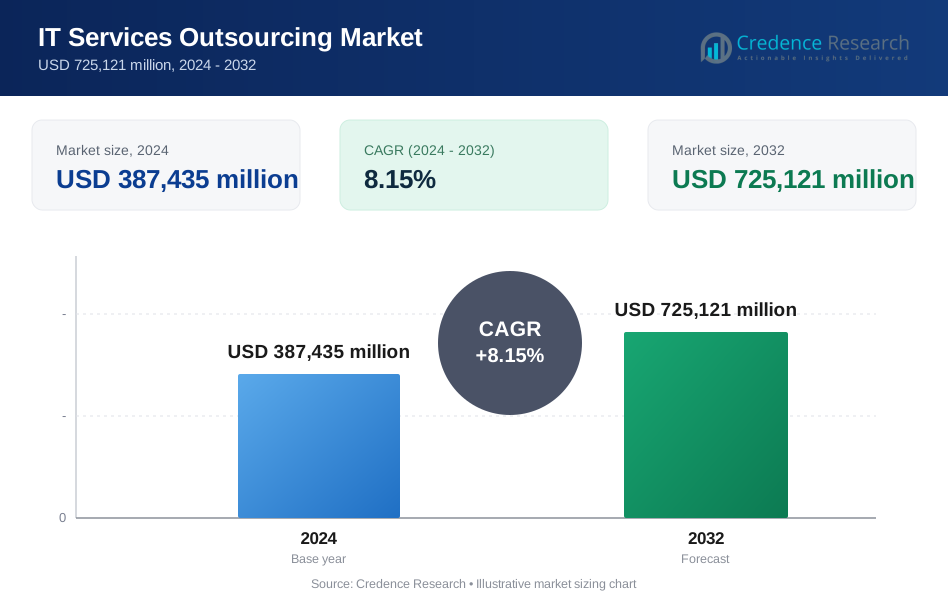
| IT Services Outsourcing Market Size 2024 | USD 387435 Million |
| IT Services Outsourcing Market, CAGR | 8.15% |
| IT Services Outsourcing Market Size 2032 | USD 725121 Million |
Market Overview:
The IT Services Outsourcing Market is projected to grow from USD 387435 million in 2024 to an estimated USD 725121 million by 2032, with a compound annual growth rate (CAGR) of 8.15% from 2024 to 2032.
Key drivers of the IT services outsourcing market include the rising need for digital transformation, cost reduction, and access to specialized technical expertise. As businesses face growing pressure to remain competitive in a rapidly evolving technological landscape, outsourcing IT services allows them to focus on core competencies while leveraging advanced technologies such as cloud computing, artificial intelligence (AI), and data analytics. Additionally, the growing complexity of managing IT infrastructure and cybersecurity concerns are pushing organizations to seek third-party service providers that offer robust solutions. Outsourcing also enables organizations to scale their IT operations quickly in response to market changes, offering flexibility and efficiency. The post-pandemic surge in remote work and cloud adoption has further accelerated the demand for IT services outsourcing.
Regionally, North America holds the largest share of the IT services outsourcing market, driven by the presence of major technology firms and widespread adoption of advanced IT infrastructure. Europe is also a key market, with growing investments in digital transformation and cloud-based services across various sectors. The Asia-Pacific region, particularly India and China, is expected to witness the fastest growth due to a large pool of IT professionals, competitive pricing, and an increasing focus on innovation and technology development. Moreover, government initiatives aimed at fostering IT growth and the rapid expansion of digital services in these regions are fueling demand for outsourced IT services.
Market Drivers:
Rising Demand for Digital Transformation:
The increasing need for digital transformation is a primary driver of the IT services outsourcing market. As businesses across various industries recognize the importance of adopting digital technologies to remain competitive, they are turning to outsourcing to access specialized expertise and resources. For instance, Kodak outsourced its IT system to IBM in 1989, allowing IBM to design, build, and implement a large data center specifically for Kodak’s needs. According to a Deloitte Global Outsourcing Survey 2022, 44% of businesses are accelerating their digital transformation efforts. Digital transformation initiatives often require advanced solutions such as cloud computing, artificial intelligence (AI), and big data analytics. Outsourcing IT services allows companies to leverage these technologies without the need for significant internal investment. This trend is particularly prominent among businesses that lack in-house expertise or wish to avoid the complexities of managing large-scale digital projects. By outsourcing, companies can accelerate their digital transformation processes while maintaining focus on their core operations.
Cost Reduction and Efficiency:
Cost optimization remains a key driver in the IT services outsourcing market. Many organizations seek to reduce operational expenses by outsourcing non-core IT functions to external service providers. Outsourcing allows businesses to save on hiring, training, and maintaining an in-house IT team while gaining access to experienced professionals and advanced infrastructure. Furthermore, outsourcing providers often operate in regions with lower labor costs, allowing companies to achieve substantial savings. The ability to manage resources more effectively and scale IT operations based on demand also drives efficiency. This cost-benefit is especially important for small and medium-sized enterprises (SMEs) that seek to access cutting-edge technologies without incurring the high costs associated with internal IT departments.
Access to Specialized Expertise:
Another major factor contributing to the growth of the IT services outsourcing market is the increasing need for specialized technical expertise. As the IT landscape becomes more complex, companies are struggling to find the right talent in-house. Technologies such as cybersecurity, AI, blockchain, and data science require highly skilled professionals who are often difficult to recruit and retain. Outsourcing provides a solution to this talent gap by offering access to a global pool of experts who can address specific challenges and ensure the successful execution of projects. For instance, Google has outsourced various IT functions to access specialized skills and improve efficiency. According to a 2024 report, 81% of companies outsource cybersecurity functions to external service providers. This trend is particularly relevant for businesses seeking to implement emerging technologies or handle complex IT infrastructures that demand specialized skills.
Scalability and Flexibility:
The growing demand for scalable and flexible IT solutions is also driving the outsourcing market. In today’s fast-paced business environment, companies need to be able to quickly adapt to changes in market conditions and technological advancements. Outsourcing IT services enables organizations to scale their operations up or down based on current needs without the burden of managing additional resources. This flexibility allows businesses to respond to evolving customer demands, market fluctuations, and technological disruptions with agility. Furthermore, outsourcing partners can provide continuous support, helping companies maintain operational efficiency and keep up with industry trends. The need for this agility and scalability is becoming increasingly crucial for businesses aiming to stay competitive in a dynamic global marketplace.
Market Trends:
Increasing Adoption of Cloud-Based Services:
One of the most prominent trends in the IT services outsourcing market is the growing adoption of cloud-based services. As businesses continue to shift from traditional on-premise IT infrastructure to cloud solutions, they increasingly rely on outsourcing providers to manage this transition. Cloud platforms offer scalability, flexibility, and cost-efficiency, making them an attractive option for organizations of all sizes. Outsourcing companies are helping businesses move their operations to the cloud, offering services such as cloud migration, infrastructure management, and ongoing maintenance. This trend is particularly strong in industries such as finance, healthcare, and retail, where cloud-based solutions can improve efficiency and support digital transformation initiatives.
Growing Focus on Cybersecurity:
As cybersecurity threats become more sophisticated and frequent, businesses are placing greater emphasis on securing their digital assets. This has led to a surge in demand for outsourced IT services specializing in cybersecurity. Companies are increasingly outsourcing their cybersecurity needs to ensure that their systems are protected against data breaches, ransomware attacks, and other cyber threats. Outsourcing providers offer comprehensive cybersecurity solutions, including threat detection, vulnerability management, and data protection services. This trend is expected to continue growing as organizations across industries prioritize security and compliance, particularly in sectors that handle sensitive data, such as banking, healthcare, and government.
Rise of Artificial Intelligence and Automation:
The integration of artificial intelligence (AI) and automation is transforming the IT services outsourcing market. Businesses are increasingly outsourcing services that leverage AI and machine learning technologies to optimize processes, reduce manual tasks, and improve decision-making. For example, Google uses AI to enhance its IT support and customer service functions1. According to a 2024 report by Connectbit, the role of AI in IT outsourcing expanded 99 times from 2019 to 2024. Outsourcing providers are incorporating AI into various functions, including IT support, customer service, and data analytics, offering clients more efficient and intelligent solutions. Automation is also playing a significant role in enhancing operational efficiency, with robotic process automation (RPA) being used to streamline repetitive tasks4. This trend is driving the demand for outsourcing services that can deliver advanced AI-driven solutions, enabling companies to stay competitive in an increasingly technology-driven marketplace.
Expansion of Managed Services:
The demand for managed services is another key trend in the IT services outsourcing market. Companies are increasingly outsourcing the management of their IT infrastructure, networks, and applications to external providers. Managed service providers (MSPs) offer businesses ongoing support, maintenance, and optimization of their IT systems, allowing companies to focus on core business activities while ensuring their technology operates efficiently. For example, IBM offers a wide range of managed services, including IT infrastructure management and cloud services. According to a 2023 survey, 89% of partners expect their managed services revenue to grow, with 56% expecting growth of more than 10%. This trend is particularly appealing to small and medium-sized enterprises (SMEs) that may lack the internal resources to manage complex IT environments. The shift towards managed services also aligns with the growing need for businesses to adopt proactive IT management, ensuring system reliability, security, and performance. As more organizations recognize the benefits of managed services, this segment of the outsourcing market is expected to expand further.
Market Restraints and Challenges:
Data Security and Privacy Concerns:
One of the major restraints in the IT services outsourcing market is the growing concern over data security and privacy. As companies outsource critical IT functions, they must share sensitive information with third-party providers, increasing the risk of data breaches and unauthorized access. The complexity of managing compliance with various data protection regulations, such as GDPR in Europe or CCPA in California, further exacerbates this challenge. For industries like healthcare, finance, and government, where strict confidentiality is required, outsourcing IT services can pose significant risks if the provider does not implement robust security measures. These concerns can make businesses hesitant to fully adopt outsourcing solutions, limiting market growth.
Loss of Control Over IT Operations:
Another challenge faced by companies in the IT services outsourcing market is the potential loss of control over their IT operations. Outsourcing critical technology functions to external providers can lead to reduced oversight and flexibility in decision-making. Companies may struggle with managing the performance and accountability of their outsourcing partners, especially when operating across different time zones and regions. This lack of control can result in slower response times to business needs, limited customization, and potential misalignment between the outsourcing provider's services and the company’s strategic objectives. For organizations that require high levels of control and adaptability, this challenge can deter them from outsourcing more complex IT services.
Vendor Lock-In and Dependency:
Vendor lock-in is a significant challenge in the IT services outsourcing market, where businesses may become overly dependent on a single provider for critical IT functions. When companies rely heavily on one outsourcing partner, they may face difficulties switching vendors or bringing services back in-house due to incompatible technologies, processes, or high transition costs. This dependency can lead to reduced flexibility, higher costs over time, and increased vulnerability to service disruptions. Additionally, negotiating favorable terms in long-term contracts can be challenging, leaving companies with limited options to adapt to changing business needs or technological advancements. Addressing vendor lock-in requires careful planning and strategic partnerships to ensure businesses retain flexibility in their IT operations.
Market Segmentation Analysis:
By Service, the market includes application services, emerging technology services, data center operations, helpdesk services, infrastructure capacity services, managed security operations, network operations, and others. Application services, which involve software development, maintenance, and support, account for a significant portion of the market due to the growing demand for digital solutions. Emerging technology services, such as artificial intelligence (AI) and blockchain, are also experiencing rapid growth, driven by businesses seeking innovative solutions to stay competitive. Managed security operations and data center operations are critical due to increasing cybersecurity concerns and the growing adoption of cloud-based infrastructure.
By Location, IT outsourcing can be classified into on-shore and off-shore services. Off-shore outsourcing remains popular due to cost advantages and access to skilled labor in regions like Asia-Pacific, while on-shore services are favored for tasks that require closer collaboration and compliance with local regulations.
By End-use, industries such as aerospace & defense, BFSI (banking, financial services, and insurance), healthcare, retail & e-commerce, and telecom & media dominate the market. The BFSI sector, in particular, relies heavily on outsourcing to manage large-scale data processing and security needs. Healthcare and retail sectors are also experiencing increased outsourcing, driven by the need for digital transformation and enhanced customer experiences. These segments highlight the growing reliance on outsourcing to enhance operational efficiency and focus on core business activities across industries.
Segmentation:
By Service
- Application Services
- Emerging Technology Services
- Data Center Operations
- Helpdesk Services
- Infrastructure Capacity Services
- Managed Security Operations
- Network Operations
- Others
By Location
- On-shore
- Off-shore
By End-use
- Aerospace & Defense
- BFSI
- Healthcare
- Retail & E-commerce
- Telecom & Media
- Others
- North America
- The U.S
- Canada
- Mexico
- Europe
- Germany
- France
- The U.K.
- Italy
- Spain
- Rest of Europe
- Asia Pacific
- China
- Japan
- India
- South Korea
- South-east Asia
- Rest of Asia Pacific
- Latin America
- Brazil
- Argentina
- Rest of Latin America
- Middle East & Africa
- GCC Countries
- South Africa
- Rest of Middle East and Africa
Regional Analysis:
North America
North America holds the largest share of the IT services outsourcing market, accounting for approximately 35% of the global market in 2023. This dominance is driven by the presence of a highly developed technology infrastructure and the widespread adoption of digital transformation initiatives. The United States, in particular, leads the region in IT outsourcing due to its strong demand for advanced IT services such as cloud computing, artificial intelligence (AI), and cybersecurity. Large enterprises in sectors like healthcare, finance, and manufacturing are increasingly turning to outsourcing providers to enhance operational efficiency, reduce costs, and gain access to specialized expertise. Additionally, the post-pandemic shift towards remote work has further accelerated the demand for outsourced IT services in North America, as businesses seek to optimize their IT systems for distributed workforces.
Europe
Europe holds around 30% of the global IT services outsourcing market, driven by the region’s strong focus on digital transformation and innovation. Countries such as the United Kingdom, Germany, and France are key contributors to the market, with businesses across these nations increasingly relying on IT outsourcing to streamline operations and implement new technologies. The European Union’s emphasis on data protection through regulations like the General Data Protection Regulation (GDPR) has also increased demand for outsourced cybersecurity services. Additionally, the rise of cloud-based services and AI-driven solutions has fueled growth in IT outsourcing across the continent. While Western Europe remains the largest sub-region for IT outsourcing, Eastern European countries such as Poland and Romania are emerging as attractive outsourcing destinations due to their skilled IT workforces and competitive pricing.
Asia-Pacific
The Asia-Pacific region is expected to witness the fastest growth in the IT services outsourcing market, with a projected market share of 25% by 2032. Countries such as India, China, and the Philippines are leading this growth due to their large pool of highly skilled IT professionals, competitive labor costs, and increasing investments in technology infrastructure. India, in particular, has established itself as a global hub for IT outsourcing, offering a wide range of services including software development, technical support, and data management. The growing demand for digital transformation solutions, particularly in industries like banking, retail, and telecommunications, is driving market expansion in this region. Additionally, government initiatives to promote IT development and foster innovation in countries like China and Singapore are contributing to the region’s rapid growth in IT outsourcing services.
Rest of the World
The Rest of the World, including regions such as Latin America, the Middle East, and Africa, accounts for the remaining 10% of the global IT services outsourcing market. These regions are experiencing moderate growth, driven by increasing investments in digital infrastructure and the growing demand for cost-effective IT solutions. Countries like Brazil, Mexico, and South Africa are emerging as key outsourcing destinations, offering competitive pricing and a skilled workforce. While the adoption of IT outsourcing in these regions is slower compared to North America and Europe, the potential for future growth remains strong as businesses continue to seek innovative solutions to improve efficiency and reduce operational costs.
Key Player Analysis:
- Accenture
- Capgemini
- Cognizant
- Fujitsu
- Hewlett Packard Enterprise Development LP
- IBM
- Infosys Limited
- NTT Data Corporation
- Oracle
- SAP SE
Competitive Analysis:
The IT services outsourcing market is highly competitive, with a mix of global players and regional providers offering a broad range of services. Key global players such as Accenture, IBM, Tata Consultancy Services (TCS), and Infosys dominate the market due to their extensive service portfolios, global presence, and ability to deliver end-to-end IT solutions. These companies leverage their scale and expertise to serve large enterprises across industries, offering services that range from cloud computing and cybersecurity to AI-driven solutions and digital transformation. Regional players, particularly in Asia-Pacific and Eastern Europe, are also gaining traction due to competitive pricing and access to skilled talent pools. Companies such as Wipro and Cognizant are establishing a strong presence in emerging markets while expanding their offerings globally. As demand for specialized services like AI, automation, and cybersecurity continues to grow, the competitive landscape is expected to intensify, with both global and regional providers focusing on innovation and customer-centric solutions.
Recent Developments:
- In June 2023, Accenture announced plans to significantly invest in its Data & AI practice over the next three years. This investment aims to help clients across various industries achieve rapid and sustainable transformation by leveraging artificial intelligence for growth, efficiency, and resilience. Accenture's Data & AI practice will also offer more industry-specific solutions and pre-built models to support its clients' needs.
- In June 2023, Hewlett Packard Enterprise (HPE) expanded its partnership with Amazon Web Services (AWS) to simplify hybrid cloud transformation. This collaboration will provide customers with a seamless experience in managing and moving workloads between HPE's on-premises infrastructure and AWS.
- In June 2023, IBM and Adobe strengthened their partnership to help brands streamline content supply chains using artificial intelligence. By utilizing Adobe's AI-driven services, such as Adobe Sensei GenAI and Adobe Firefly, the partnership aims to enhance the efficiency of content creation, management, and delivery.
- In June 2023, Sonata Software partnered with SAP Commerce to accelerate digital transformation for companies. The collaboration pairs SAP Commerce's enterprise e-commerce platform with Sonata Software's expertise in digital commerce, offering end-to-end solutions including storefront design, implementation, and maintenance.
- In April 2023, Fujitsu expanded its digital transformation consulting services across Europe, opening two new Near Response Centers (NRCs) in Spain and Estonia. These centers provide clients with access to highly skilled experts to support their digital transformation efforts.
- In March 2023, Cohesity and IBM formed a partnership to enhance data security and resiliency in hybrid cloud environments. Their combined technologies, including IBM Storage Defender, will offer comprehensive data protection, cyber resilience, and data management solutions to defend against threats like malware, ransomware, and data exfiltration across cloud, on-premises, and hybrid settings.
Market Concentration & Characteristics:
The IT services outsourcing market is moderately concentrated, with a few dominant global players alongside numerous regional and specialized providers. Major companies such as Accenture, IBM, Tata Consultancy Services (TCS), and Infosys hold a significant share of the market, benefiting from their broad service offerings, global reach, and established client relationships. These firms cater to large enterprises with comprehensive IT solutions, including cloud services, cybersecurity, and digital transformation. However, the market also includes a growing number of regional players, particularly in Asia-Pacific and Eastern Europe, offering competitive pricing and access to skilled IT professionals. These providers are gaining traction by focusing on niche areas such as software development, technical support, and specific industry verticals. The market is characterized by increasing demand for specialized services, such as AI and automation, alongside a growing emphasis on scalability and flexibility. This diverse landscape ensures ongoing competition and opportunities for both global and regional players.
Report Coverage:
The research report offers an in-depth analysis based on By Service, By Location and By End-use. It details leading market players, providing an overview of their business, product offerings, investments, revenue streams, and key applications. Additionally, the report includes insights into the competitive environment, SWOT analysis, current market trends, as well as the primary drivers and constraints. Furthermore, it discusses various factors that have driven market expansion in recent years. The report also explores market dynamics, regulatory scenarios, and technological advancements that are shaping the industry. It assesses the impact of external factors and global economic changes on market growth. Lastly, it provides strategic recommendations for new entrants and established companies to navigate the complexities of the market.
Future Outlook:
- The IT services outsourcing market is expected to continue growing as businesses increasingly prioritize digital transformation.
- Demand for cloud-based services will rise, driving further outsourcing of infrastructure and software management.
- Cybersecurity outsourcing will grow significantly, driven by rising cyber threats and stricter data protection regulations.
- The integration of AI and automation into outsourced services will enhance efficiency and reduce operational costs.
- Small and medium-sized enterprises (SMEs) will increasingly adopt IT outsourcing to access advanced technology at lower costs.
- Asia-Pacific, particularly India and China, will continue to lead as key outsourcing destinations due to their skilled workforce and competitive pricing.
- North America and Europe will maintain strong demand for high-end IT services, including AI and cloud solutions.
- Managed services will see increased adoption as companies seek ongoing support for IT infrastructure and application management.
- Talent shortages in advanced technologies will push businesses to rely more on outsourcing for specialized expertise.
- The market will witness intensifying competition, with providers focusing on innovation and value-added services to stay competitive.
Request a Free Sample
Fill in your details and we'll send you a free sample report.
- Sample data tables & charts
- Research methodology
Market Dynamics
Digital Transformation Initiatives
Organizations are accelerating digital transformation to remain competitive, driving demand for outsourced IT services that provide access to advanced technologies like cloud computing, AI, and data analytics without heavy internal investment.
Cost Optimization and Efficiency
Outsourcing IT services enables companies to reduce operational costs by leveraging external expertise and infrastructure, particularly in regions with lower labor costs, while allowing internal teams to focus on core business activities.
Access to Specialized Technical Expertise
The increasing complexity of IT, especially in areas like cybersecurity, AI, and data science, is pushing companies to outsource to providers with deep technical skills that are difficult and expensive to maintain in-house.
Scalability and Flexibility
Outsourcing allows businesses to rapidly scale IT operations up or down in response to market changes, providing agility and operational flexibility that is critical in a fast-evolving technological landscape.
Rising Cybersecurity Concerns
With the growing sophistication of cyber threats and stricter data protection regulations, companies are outsourcing cybersecurity functions to specialized providers to ensure robust protection and compliance.
Need a Custom Version of This Report?
Tailor the scope, geography, or segments to your exact requirements.
- Custom geography or segment scope
- Direct access to our analyst team
Frequently Asked Questions
What is the projected growth of the IT services outsourcing market?
What are the key drivers of market growth?
Which regions lead the market?
What challenges does the IT services outsourcing market face?
Table of Content
Chapter 1 Market Segmentation
- 1.1 Segmentation Framework
- 1.1.1 Product and Service Classification
- 1.1.2 Application and End-Use Classification
- 1.1.3 Technology and Solution Classification
- 1.1.4 Customer and Distribution Channel Classification
- 1.1.5 Geographic Segmentation
- 1.1.6 Market Segment Definitions and Boundaries
- 1.2 By End-use
- 1.2.1 Aerospace & Defense
- 1.2.2 BFSI
- 1.2.3 Healthcare
- 1.2.4 Retail & E-commerce
- 1.2.5 Telecom & Media
- 1.2.6 Others
- 1.3 By Service
- 1.3.1 Application Services
- 1.3.2 Emerging Technology Services
- 1.3.3 Data Center Operations
- 1.3.4 Helpdesk Services
- 1.3.5 Infrastructure Capacity Services
- 1.3.6 Managed Security Operations
- 1.3.7 Network Operations
- 1.3.8 Others
- 1.4 By Location
- 1.4.1 On-shore
- 1.4.2 Off-shore
Chapter 2 Introduction
- 2.1 Report Objectives and Scope
- 2.2 Product Definition and Industry Terminology
- 2.3 Market Inclusions and Exclusions
- 2.4 Research Process
- 2.4.1 Primary Research and Expert Interviews
- 2.4.2 Secondary Research and Source Review
- 2.4.3 Top-Down and Bottom-Up Estimation
- 2.4.4 Data Triangulation and Verification
- 2.5 Market Size Measurement Basis
- 2.5.1 2024: USD 387,435 million → 2032: USD 725,121 million
- 2.6 Historical and Forecast Reference Periods
- 2.6.1 Base Year: 2024
- 2.6.2 Forecast Period: 2024-2032
- 2.7 Research Assumptions and Limitations
Chapter 3 Executive Summary
- 3.1 Market Snapshot and Key Findings
- 3.2 Base-Year Market Size, 2024
- 3.3 Forecast Market Size, 2032
- 3.4 Revenue and Volume Growth Outlook
- 3.5 Key Demand and Supply Indicators
- 3.6 Leading Market Segments
- 3.7 Fastest-Growing Market Opportunities
- 3.8 Regional Performance Highlights
- 3.9 Technology and Industry Transformation
- 3.10 Competitive Landscape Summary
- 3.11 Analyst View and Strategic Implications
Chapter 4 Global IT Services Outsourcing Market Trends and Developments
- 4.1 Historical Industry Development
- 4.2 Recent Market Trends and Developments
- 4.3 Demand and Customer Behavior Trends
- 4.4 Technology and Product Innovation
- 4.5 Artificial Intelligence, Automation and Digitalization
- 4.6 Local Manufacturing and Supply Chain Realignment
- 4.7 Industry Partnerships, Mergers and Acquisitions
- 4.8 Sustainability and Circular Economy Developments
- 4.9 Government and Private Sector Investment Trends
- 4.10 Emerging Business Models and Commercialization
- 4.11 Industry Developments and Announcements
Chapter 5 Global IT Services Outsourcing Market Supply and Demand Analysis
- 5.1 Demand Trend and Consumption Analysis
- 5.2 Demand Forecast, 2024-2032
- 5.3 Supply Chain Structure and Procurement Trends
- 5.4 Supply-Demand Gap and Bottlenecks
- 5.5 Import Dependence and Sourcing Structure
- 5.6 Regional Supply and Demand Concentration
Chapter 6 Global IT Services Outsourcing Market Pricing Analysis
- 6.1 Pricing Structure and Measurement
- 6.2 Historical Pricing Trends
- 6.3 Pricing Outlook, 2024-2032
- 6.4 Pricing by Product and Market Segment
- 6.5 Geographic Pricing Differences
- 6.6 Key Input, Energy, Labor and Logistics Costs
- 6.7 Contract Pricing and Purchasing Models
- 6.8 Pricing Sensitivity and Competitive Positioning
- 6.9 Price, Margin and Profitability Implications
Chapter 7 Global IT Services Outsourcing Market Dynamics
- 7.1 Market Growth Drivers
- 7.1.1 Demand-Side Drivers
- 7.1.2 Technology and Innovation Drivers
- 7.1.3 Infrastructure and Investment Drivers
- 7.1.4 Regulatory and Policy Drivers
- 7.2 Market Restraints
- 7.2.1 Cost and Affordability Constraints
- 7.2.2 Technology and Adoption Barriers
- 7.2.3 Supply Chain and Operational Constraints
- 7.3 Market Challenges
- 7.3.1 Competitive Pressure and Margin Erosion
- 7.3.2 Skills, Infrastructure and Implementation Gaps
- 7.4 Emerging Market Opportunities
- 7.5 Market Dynamics Impact and Time-Horizon Assessment
Chapter 8 Global IT Services Outsourcing Value Chain Analysis
- 8.1 Industry Value Chain Overview
- 8.2 Upstream Suppliers and Critical Inputs
- 8.3 Technology and Component Providers
- 8.4 Manufacturing or Service Delivery
- 8.5 Distribution, Channel Partners and Integrators
- 8.6 Downstream Applications and End Users
- 8.7 Value Addition and Profit Pools
- 8.8 Vertical Integration and Outsourcing
- 8.9 Supplier Concentration and Risk
- 8.10 Supply Chain Localization and Resilience
Chapter 9 Global IT Services Outsourcing Market Regulations and Policies
- 9.1 Relevant Laws, Standards and Compliance Frameworks
- 9.2 Product, Service, Safety and Quality Requirements
- 9.3 Government Policies, Incentives and Subsidies
- 9.4 Imports, Exports and Trade Barriers
- 9.5 Public Procurement and Local Content Requirements
- 9.6 Data Protection, AI and Cybersecurity Compliance
- 9.7 Upcoming Policy Changes and Market Implications
Chapter 10 Global IT Services Outsourcing Market Hotspots and Opportunities
- 10.1 Market Opportunity Mapping and Growth Hotspots
- 10.2 High-Growth Applications and Customer Groups
- 10.3 Underserved Markets and White-Space Opportunities
- 10.4 Emerging Technology and Product Opportunities
- 10.5 New Capacity and Investment Hotspots
- 10.6 Market Entry and Expansion Opportunities
- 10.7 Distribution and Partnership Opportunities
- 10.8 Near-Term and Long-Term Commercial Potential
- 10.9 Opportunity Attractiveness and Execution Risks
Chapter 11 Global IT Services Outsourcing Market Outlook, 2024-2032
- 11.1 Market Size and Analysis
- 11.1.1 Revenue (Market Measurement: 2024: USD 387,435 million → 2032: USD 725,121 million)
- 11.1.2 Historical Market Size
- 11.1.3 Base-Year Market Size, 2024
- 11.2 Market Forecast, 2024-2032
- 11.2.1 Revenue Forecast to 2032
- 11.2.2 CAGR and Year-on-Year Growth
- 11.2.3 Incremental Revenue Opportunity
- 11.3 Forecast Assumptions and Scenario Analysis
- 11.3.1 Base-Case Forecast
- 11.3.2 Optimistic and Conservative Scenarios
- 11.3.3 Technology, Pricing and Policy Sensitivities
- 11.4 Market Attractiveness and Growth Outlook
Chapter 12 Global IT Services Outsourcing Market Segmentation and Outlook
- 12.1 Segmentation Summary and Market Shares, 2024
- 12.2 Largest and Fastest-Growing Segments
- 12.3 By End-use - Market Size and Forecast, 2024-2032
- 12.3.1 Segment Definition and Scope
- 12.3.2 Historical Market Size
- 12.3.3 Revenue Forecast, 2024-2032
- 12.3.4 Base-Year Market Share, 2024
- 12.3.5 Segment CAGR and Growth Drivers
- 12.3.6 Subsegment Market Size and Forecast
- 12.3.6.1 Aerospace & Defense
- 12.3.6.2 BFSI
- 12.3.6.3 Healthcare
- 12.3.6.4 Retail & E-commerce
- 12.3.6.5 Telecom & Media
- 12.3.6.6 Others
- 12.3.7 Subsegment Pricing and Adoption Trends
- 12.3.8 Leading Suppliers and Competition
- 12.3.9 Regional Demand and Opportunities
- 12.4 By Service - Market Size and Forecast, 2024-2032
- 12.4.1 Segment Definition and Scope
- 12.4.2 Historical Market Size
- 12.4.3 Revenue Forecast, 2024-2032
- 12.4.4 Base-Year Market Share, 2024
- 12.4.5 Segment CAGR and Growth Drivers
- 12.4.6 Subsegment Market Size and Forecast
- 12.4.6.1 Application Services
- 12.4.6.2 Emerging Technology Services
- 12.4.6.3 Data Center Operations
- 12.4.6.4 Helpdesk Services
- 12.4.6.5 Infrastructure Capacity Services
- 12.4.6.6 Managed Security Operations
- 12.4.6.7 Network Operations
- 12.4.6.8 Others
- 12.4.7 Subsegment Pricing and Adoption Trends
- 12.4.8 Leading Suppliers and Competition
- 12.4.9 Regional Demand and Opportunities
- 12.5 By Location - Market Size and Forecast, 2024-2032
- 12.5.1 Segment Definition and Scope
- 12.5.2 Historical Market Size
- 12.5.3 Revenue Forecast, 2024-2032
- 12.5.4 Base-Year Market Share, 2024
- 12.5.5 Segment CAGR and Growth Drivers
- 12.5.6 Subsegment Market Size and Forecast
- 12.5.6.1 On-shore
- 12.5.6.2 Off-shore
- 12.5.7 Subsegment Pricing and Adoption Trends
- 12.5.8 Leading Suppliers and Competition
- 12.5.9 Regional Demand and Opportunities
- 12.6 Segment Growth Comparison
- 12.7 Segment Attractiveness and Priority Matrix
Chapter 13 Global IT Services Outsourcing End-Use and Application Market Outlook
- 13.1 End-Use Industry and Customer Demand Structure
- 13.2 Leading Applications and Customer Groups
- 13.3 End-Use Market Size, Share and Forecast
- 13.4 Major End-Use Industry Deep Dives
- 13.4.1 Customer Requirements and Use Cases
- 13.4.2 Demand and Replacement Cycles
- 13.4.3 Technical and Regulatory Considerations
- 13.4.4 Purchasing and Procurement Models
- 13.4.5 Leading Vendors and Distribution Channels
- 13.4.6 Forecast and Commercial Opportunities
- 13.5 Emerging Applications and Cross-Segment Demand
- 13.6 End-Use Industry Investment Priorities
Chapter 14 Global IT Services Outsourcing Geographic Market Outlook, 2024-2032
- 14.1 Regional Market Size and Share, 2024
- 14.2 Regional Market Forecast, 2024-2032
- 14.3 Regional Pricing, Production and Demand Differences
- 14.4 North America
- 14.4.1 United States
- 14.4.2 Canada
- 14.4.3 Mexico
- 14.5 Europe
- 14.5.1 Germany
- 14.5.2 France
- 14.5.3 Italy
- 14.5.4 United Kingdom
- 14.5.5 Spain
- 14.5.6 Poland
- 14.5.7 Russia
- 14.5.8 Netherlands
- 14.5.9 Belgium
- 14.5.10 Sweden
- 14.5.11 Denmark
- 14.5.12 Norway
- 14.5.13 Rest of Europe
- 14.6 Asia Pacific
- 14.6.1 China
- 14.6.2 India
- 14.6.3 Japan
- 14.6.4 South Korea
- 14.6.5 Thailand
- 14.6.6 Indonesia
- 14.6.7 Vietnam
- 14.6.8 Malaysia
- 14.6.9 Australia
- 14.6.10 Rest of Asia Pacific
- 14.7 Latin America
- 14.7.1 Brazil
- 14.7.2 Argentina
- 14.7.3 Colombia
- 14.7.4 Chile
- 14.7.5 Rest of Latin America
- 14.8 Middle East
- 14.8.1 Saudi Arabia
- 14.8.2 United Arab Emirates
- 14.8.3 Turkey
- 14.8.4 Israel
- 14.8.5 Iran
- 14.8.6 Rest of the Middle East
- 14.9 Africa
- 14.9.1 South Africa
- 14.9.2 Egypt
- 14.9.3 Nigeria
- 14.9.4 Morocco
- 14.9.5 Rest of Africa
- 14.10 Regional Investment, Policy and Supply Chain Differences
- 14.11 Regional Competitive Landscape
- 14.12 Geographic Growth Hotspots
Chapter 15 Global IT Services Outsourcing Technology, Innovation and Sustainability Outlook
- 15.1 Technology Landscape and Maturity
- 15.2 Product, Process and Service Innovation
- 15.3 AI, Automation and Digital Tools in the Industry
- 15.4 Technology Adoption and Performance Benchmarking
- 15.5 Innovation Pipeline and R&D Investment
- 15.6 Energy Efficiency and Resource Management
- 15.7 Sustainability, Recycling and Circularity
- 15.8 Technology Roadmap, 2024-2032
- 15.9 Risks of Obsolescence and Technology Substitution
Chapter 16 Global IT Services Outsourcing Market Key Strategic Imperatives
- 16.1 Growth and Market Entry Priorities
- 16.2 High-Return Products and Segments
- 16.3 Pricing, Profitability and Cost Optimization
- 16.4 Technology Investment and Product Differentiation
- 16.5 Supply Chain Localization and Resilience
- 16.6 Distribution and Customer Acquisition
- 16.7 Partnership, Acquisition and Capacity Strategy
- 16.8 Regional Expansion Priorities
- 16.9 Short-, Medium- and Long-Term Actions
Chapter 17 Competition Outlook
- 17.1 Industry Competition Characteristics
- 17.2 Market Structure and Concentration
- 17.3 Market Share and Competitive Positioning, 2024
- 17.4 Company-Wise Revenue and Product Benchmarking
- 17.5 Production and Service Capacity Benchmarking
- 17.6 Technology, Pricing and Differentiation
- 17.7 Regional Footprint and Distribution Strength
- 17.8 Mergers, Acquisitions and Strategic Alliances
- 17.9 New Entrants and Competitive Threats
- 17.10 Porter's Five Forces and Industry Attractiveness
- 17.11 Competitive Outlook, 2024-2032
Chapter 18 Company Profiles
- 18.1 Company Coverage and Selection Criteria
- 18.2 Accenture
- 18.2.1 Business Description
- 18.2.2 Company Ownership and Geographic Presence
- 18.2.3 Product and Service Portfolio
- 18.2.4 Manufacturing and Operating Footprint
- 18.2.5 Financial Performance and Investment
- 18.2.6 Market Share and Competitive Position
- 18.2.7 Technology and Innovation Capabilities
- 18.2.8 Strategic Alliances or Partnerships
- 18.2.9 Recent Developments
- 18.2.10 Growth Strategy and Outlook
- 18.3 IBM
- 18.4 Capgemini
- 18.5 Cognizant
- 18.6 Fujitsu
- 18.7 Hewlett Packard Enterprise Development LP
- 18.8 Infosys Limited
- 18.9 NTT Data Corporation
- 18.10 Oracle
- 18.11 SAP SE
- 18.12 Other Relevant Market Participants
Note: Every listed company is profiled on the structure shown under the first company. The company list is preliminary and may change based on research findings, market developments, data availability and client requirements.
Chapter 19 Disclaimer
- 19.1 Research and Forecast Disclaimer
- 19.2 Data Source and Estimation Limitations
Note: The depth of individual sections depends on data availability for this market. Volume, capacity, trade and other unit-based metrics are included where applicable.