
| REPORT ATTRIBUTE | DETAILS |
|---|---|
| Historical Period | 2020-2023 |
| Base Year | 2024 |
| Forecast Period | 2025-2032 |
| Italy Electrodeposited Copper Foils Market Size 2024 | USD 352.52 million |
| Italy Electrodeposited Copper Foils Market, CAGR | 10.24% |
| Italy Electrodeposited Copper Foils Market Size 2032 | USD 769.19 million |
Market Overview:
The Italy Electrodeposited Copper Foils Market is projected to grow from USD 352.52 million in 2024 to an estimated USD 769.19 million by 2032, with a compound annual growth rate (CAGR) of 10.24% from 2024 to 2032.
The primary drivers of market growth include the rapid expansion of electric mobility, with Italy witnessing a rise in EV battery production and related supply chain investments. The increasing adoption of lithium-ion and solid-state batteries has fueled demand for electrodeposited copper foils used as anode current collectors, improving battery efficiency and energy storage capacity. Additionally, the electronics industry, particularly in printed circuit boards (PCBs), semiconductor fabrication, and miniaturized electronic components, is creating sustained demand for high-performance copper foils. The rise of 5G networks, IoT (Internet of Things), and next-generation smart devices is further strengthening the market. Italy’s commitment to green energy transition and government incentives for solar power, smart grids, and energy storage solutions are also contributing to market expansion.
Regionally, northern Italy remains the dominant market for electrodeposited copper foils, driven by its well-established automotive, electronics, and industrial sectors. Regions such as Lombardy, Emilia-Romagna, and Piedmont are major hubs for EV production, battery technology, and high-end manufacturing, fostering significant demand for high-purity copper foils. Additionally, central and southern Italy are emerging as key players in renewable energy infrastructure, where copper foils are critical for solar panel connectivity, energy storage, and transmission applications. With Italy’s strategic location in the European supply chain and its focus on technological innovation, localized production, and sustainable materials, the market for electrodeposited copper foils is expected to witness continued growth, strengthening its role within Europe’s battery and electronics industries.
Market Insights:
- The Italy electrodeposited copper foils market is projected to grow from USD 352.52 million in 2024 to USD 769.19 million by 2032, with a CAGR of 10.24%, driven by EV adoption, electronics expansion, and renewable energy investments.
- The electric vehicle sector remains a key driver, with increasing demand for lithium-ion and solid-state batteries, requiring high-performance copper foils for energy storage and efficiency enhancement.
- The electronics and semiconductor industries are expanding, with growing applications in PCBs, 5G networks, IoT devices, and miniaturized electronic components, boosting demand for ultra-thin copper foils.
- Government incentives for green energy and investments in solar power, smart grids, and energy storage are accelerating the use of copper foils in battery systems and transmission networks.
- Northern Italy dominates the market, accounting for 55% of demand, driven by strong automotive, electronics, and industrial manufacturing sectors, with Lombardy, Emilia-Romagna, and Piedmont leading EV production.
- Sustainability trends are shaping the market, with increasing adoption of recycled copper foils and eco-friendly refining techniques to align with EU environmental regulations and circular economy goals.
- Competitive pressures from Asian manufacturers and fluctuating raw material costs pose challenges, prompting Italian firms to focus on localized production, innovation, and strategic collaborations to maintain market strength.
Market Drivers:
Rising Demand from the Electric Vehicle (EV) Industry
Italy’s growing focus on sustainable transportation is significantly driving the demand for electrodeposited copper foils, particularly in the electric vehicle (EV) sector. As the country accelerates its transition towards low-emission and zero-emission mobility, automakers and battery manufacturers are investing in next-generation lithium-ion and solid-state batteries. For instance, in 2023, electric vehicles accounted for approximately 18% of total car sales globally, up from 14% the previous year, reflecting a substantial increase in demand for EV-related components like copper foils. Electrodeposited copper foils are essential in EV battery anodes, improving conductivity and energy efficiency. Government incentives, including subsidies for EV production and infrastructure development, are further boosting demand. The increasing number of charging stations, battery production facilities, and partnerships between automakers and energy firms is reinforcing the role of high-performance copper foils in Italy’s evolving EV supply chain.
Expanding Electronics and Semiconductor Industry
The electronics and semiconductor industry is another major driver of the Italy electrodeposited copper foils market. The country has a strong presence in PCB manufacturing, microelectronics, and semiconductor packaging, which require high-purity copper foils for superior electrical conductivity. With the increasing adoption of 5G networks, smart devices, and Internet of Things (IoT) applications, demand for ultra-thin copper foils is on the rise. Italy’s role in European semiconductor initiatives, including collaborations with global chip manufacturers, is further strengthening the electronics sector’s reliance on high-performance copper materials. The trend toward miniaturization in electronics, requiring thinner and more flexible components, is also expanding market opportunities for precision-engineered electrodeposited copper foils.
Growth in Renewable Energy and Energy Storage Solutions
Italy’s commitment to renewable energy expansion is fueling the demand for electrodeposited copper foils in battery storage and energy grid applications. As the country increases its reliance on solar and wind energy, efficient energy storage solutions are required to balance power distribution and optimize grid performance. Copper foils play a crucial role in energy storage batteries, improving the longevity and efficiency of solar panel storage systems and grid-stabilizing battery units. The Italian government’s push for decarbonization and investment in smart grid technologies is further increasing the need for high-quality copper foils to support energy transmission and storage. With global advancements in solid-state and next-generation battery materials, Italy’s focus on localized battery production and energy storage development will continue to drive market growth.
Technological Advancements and Sustainable Manufacturing Initiatives
The increasing emphasis on sustainability and advanced manufacturing is shaping the Italian electrodeposited copper foils market. Companies are investing in energy-efficient production processes and adopting recycled copper materials to align with European Union environmental regulations. For instance, Azienda Metalli Laminati is expanding its production capacity with a new copper-foil rolling mill, set to start operations in autumn 2025, which will add an annual production capacity of approximately 10,000 tons per year. The shift towards circular economy principles, where copper recovery and refining technologies allow for the reuse of materials, is reducing manufacturing costs and carbon footprints. Additionally, advancements in electrochemical deposition techniques are enabling the production of ultra-thin, high-performance foils for specialized electronics and automotive applications. As Italy strengthens its role in sustainable material development and next-generation manufacturing, the market for electrodeposited copper foils is expected to expand, supported by continuous innovation and regulatory backing.
Market Trends:
Increasing Investments in Domestic Copper Foil Production
Italy is witnessing a growing trend toward domestic production of electrodeposited copper foils, driven by rising demand in automotive, electronics, and renewable energy sectors. To reduce dependency on imports and strengthen supply chain resilience, local manufacturers are expanding their production capacities and refining technologies. The government is supporting initiatives that promote localized material sourcing, ensuring stability in battery and semiconductor supply chains. With Italy playing a key role in Europe’s electric vehicle (EV) and energy storage market, the establishment of copper foil processing facilities is becoming a strategic priority for industrial players looking to maintain cost efficiency and meet sustainability goals.
Rising Adoption of Ultra-Thin and High-Performance Copper Foils
The demand for ultra-thin, high-strength copper foils is increasing as industries shift toward lightweight, energy-efficient, and high-performance components. In the electronics and semiconductor sectors, manufacturers require precision-engineered copper foils for printed circuit boards (PCBs), semiconductor packaging, and advanced communication systems. This trend is particularly strong in Italy’s telecommunications and high-speed data processing industries, where miniaturization of electronic devices is critical. Additionally, the push for flexible and wearable electronics, including smart textiles and foldable displays, is driving demand for thin, durable, and highly conductive copper foils that enhance product efficiency.
Integration of Sustainable and Recycled Copper Foils
Sustainability is shaping the electrodeposited copper foils market in Italy, with manufacturers increasingly adopting recycled copper foils to align with European Union environmental regulations. Companies are investing in advanced refining techniques that allow for high-purity copper recovery, reducing raw material costs and carbon footprints. For instance, manufacturers are utilizing hydrometallurgical processes to recover copper from electronic waste, achieving purity levels of up to 99.99%, which is suitable for high-performance applications. The push for circular economy models in Italy’s manufacturing sector is encouraging businesses to implement eco-friendly production processes that minimize industrial waste. This shift is particularly evident in renewable energy applications, where recycled copper foils are being integrated into solar energy storage systems and smart grid technologies.
Growing Strategic Collaborations in the Automotive and Electronics Sectors
Partnerships between Italian automotive manufacturers, battery producers, and electronics firms are becoming more common as companies seek to optimize supply chains and technology integration. The EV industry is at the forefront of this collaboration, with automakers working closely with copper foil manufacturers to develop high-performance anode materials that improve battery efficiency and lifespan. For instance, events like E-TECH EUROPE 2025 highlight the importance of advanced battery technologies and innovative solutions for the automotive sector, fostering collaboration among industry players. Additionally, electronics firms are forming alliances with semiconductor manufacturers to advance high-speed computing and 5G network infrastructure, increasing demand for high-conductivity copper foils. These strategic partnerships are accelerating market innovation and strengthening Italy’s position as a key player in Europe’s advanced materials sector.
Market Challenges Analysis:
Fluctuating Raw Material Costs and Supply Chain Volatility
One of the biggest challenges facing the Italy electrodeposited copper foils market is the fluctuation in raw material prices, particularly copper. As a globally traded commodity, copper prices are influenced by geopolitical tensions, mining production levels, and global demand. These price variations create cost uncertainties for manufacturers, making it difficult to maintain stable profit margins. Additionally, supply chain disruptions caused by logistical bottlenecks, trade restrictions, and limited domestic copper production further impact the availability of high-purity copper foils, leading to delays and increased costs for end-users in the electronics, automotive, and energy sectors.
High Production Costs and Technological Limitations
The production of high-performance electrodeposited copper foils requires advanced electrochemical deposition techniques and stringent quality control, leading to high manufacturing costs. Italian manufacturers face challenges in competing with low-cost producers from Asia, where economies of scale allow for more cost-effective production. Moreover, ultra-thin and high-conductivity foils used in EV batteries, semiconductor packaging, and flexible electronics require precision engineering and R&D investments, creating a barrier for smaller manufacturers to enter the market. The need for continuous process optimization and innovation increases operational expenses, making it difficult for companies to maintain competitive pricing.
Stringent Environmental Regulations and Sustainability Challenges
Italy, in alignment with European Union environmental policies, enforces strict regulations on industrial emissions, waste disposal, and sustainable manufacturing. While these regulations promote eco-friendly production, they also impose compliance costs and operational constraints on manufacturers. For instance, companies are required to adopt green production techniques, such as recycled copper foils and energy-efficient refining processes, which demand additional capital investments. Failure to meet sustainability standards could lead to regulatory fines and limitations on production capacity, creating long-term challenges for industry players.
Intense Competition and Market Consolidation
The Italy electrodeposited copper foils market faces strong competition from global suppliers, particularly from China, South Korea, and Japan, where manufacturers have well-established supply chains and advanced production capabilities. Italian firms must differentiate through quality, innovation, and localized production, rather than competing on price. Additionally, the market is experiencing consolidation, with mergers and acquisitions shaping industry dynamics, potentially limiting opportunities for new entrants and smaller manufacturers. To remain competitive, Italian companies must invest in technology, sustainability, and strategic partnerships to strengthen their market position and ensure long-term growth.
Market Opportunities:
The Italy electrodeposited copper foils market presents significant growth opportunities, particularly in the electric vehicle (EV) and renewable energy sectors. As Italy accelerates its transition toward sustainable mobility, the demand for high-performance lithium-ion and solid-state batteries is rising, driving the need for electrodeposited copper foils as critical components in battery anodes. With increasing government incentives for EV production, charging infrastructure, and battery manufacturing, domestic and international manufacturers have the opportunity to expand their presence in the Italian automotive supply chain. The growing emphasis on energy-efficient transportation also supports innovation in ultra-thin copper foils that enhance battery performance and durability. Additionally, as Italy strengthens its role in the European Union's semiconductor strategy, investments in microelectronics and PCB manufacturing further contribute to the demand for high-purity copper foils used in miniaturized and high-frequency electronic components.
Beyond automotive and electronics, the renewable energy sector offers another major opportunity for copper foil manufacturers. Italy’s investments in solar and wind power generation are increasing the demand for energy storage solutions, where copper foils play a crucial role in battery efficiency and grid stabilization. The push for smart grids and decentralized energy storage systems presents opportunities for companies specializing in high-conductivity and durable copper foils. Additionally, the rising adoption of recycled copper materials aligns with sustainability goals and European regulations, providing a competitive edge for manufacturers that focus on eco-friendly production processes. As Italy continues to invest in next-generation battery technologies and advanced manufacturing, the electrodeposited copper foils market is expected to expand, creating long-term growth potential for industry players.
Market Segmentation Analysis:
The Italy electrodeposited copper foils market is segmented based on material type, process, and end-use industry, each playing a critical role in shaping market demand and applications.
By Material Type, the market is classified into ferrous, non-ferrous, and others. The non-ferrous segment dominates, driven by the widespread use of copper-based foils in electric vehicles (EVs), semiconductors, and energy storage solutions. Copper’s high conductivity, durability, and corrosion resistance make it the preferred material for batteries, PCBs, and renewable energy storage systems. The ferrous segment holds a smaller share but remains relevant in industrial and aerospace applications, where durability and high strength are critical.
By Process, the market includes press-and-sinter, metal injection molding, and additive manufacturing. Press-and-sinter technology is widely used due to its cost efficiency and scalability in mass production. Metal injection molding is gaining traction in aerospace and miniaturized electronics, offering precision and lightweight components. Additive manufacturing is emerging as a key innovation, enabling the production of customized, high-performance copper foils tailored for advanced electronics and energy storage applications.
By End-Use Industry, the market serves automotive, aerospace, healthcare, electrical & electronics, and industrial sectors. The automotive sector is the largest consumer, driven by the growth of EVs and battery technologies. The electrical & electronics industry follows, with increasing demand for high-purity copper foils in semiconductors, PCBs, and 5G networks. The aerospace and healthcare sectors are expanding, requiring lightweight, high-performance materials. The industrial segment benefits from copper foils in machinery, energy storage, and power transmission applications, contributing to market growth.
Segmentation:
By Material Type Segment
- Ferrous
- Non-Ferrous
- Others
By Process Segment
- Press-and-Sinter
- Metal Injection Molding
- Additive Manufacturing
By End-Use Industry Segment
- Automotive
- Aerospace
- Healthcare
- Electrical & Electronics
- Industrial
Regional Analysis:
The Italy electrodeposited copper foils market is regionally segmented into northern, central, and southern Italy, each contributing differently based on their industrial strengths and economic focus. The market is primarily driven by demand from automotive, electronics, and renewable energy industries, with regional disparities in manufacturing capacity and investment levels.
Northern Italy holds the largest market share, accounting for approximately 55% of the total demand for electrodeposited copper foils. This region is the hub of Italy’s automotive, electronics, and industrial manufacturing sectors, with key cities such as Milan, Turin, and Bologna playing a central role in the country’s technological advancements. Lombardy, Emilia-Romagna, and Piedmont are home to leading automobile manufacturers, battery producers, and PCB manufacturers, driving the demand for high-performance copper foils used in electric vehicles (EVs), energy storage solutions, and microelectronics. The presence of major R&D centers and innovation hubs in northern Italy further strengthens its market dominance, with investments in next-generation battery technologies and semiconductor packaging solutions supporting long-term growth.
Central Italy accounts for roughly 25% of the market, with Rome and Florence leading in high-tech manufacturing and aerospace applications. This region has seen increasing demand for electrodeposited copper foils in aerospace electronics, defense systems, and renewable energy applications. As Italy expands its solar and wind energy infrastructure, energy storage solutions are becoming a crucial focus, leading to higher consumption of high-conductivity copper foils in grid stabilization technologies. Additionally, government-backed projects aimed at modernizing Italy’s power distribution network and smart grid integration are further fueling market expansion in central Italy.
Southern Italy, including regions such as Sicily, Campania, and Apulia, contributes approximately 20% to the electrodeposited copper foils market. While this region has a smaller industrial base compared to the north, it is experiencing rapid growth in renewable energy investments and sustainable manufacturing initiatives. Southern Italy is becoming a key player in solar panel manufacturing, offshore wind energy projects, and battery storage solutions, creating new opportunities for copper foil manufacturers catering to energy infrastructure applications. The Italian government’s focus on regional economic development and foreign investment incentives is also attracting new industrial projects in battery production and advanced material technologies, gradually increasing the market share of southern Italy.
With northern Italy leading in automotive and electronics manufacturing, central Italy focusing on high-tech and energy solutions, and southern Italy expanding in renewable energy storage, the Italy electrodeposited copper foils market is set to experience balanced regional growth, supported by technological advancements and sustainability-driven investments.
Key Player Analysis:
- Höganäs AB
- GKN Powder Metallurgy Italy Operations
- Sandvik AB
- Miba AG
- Carpenter Technology Corporation Italy Division
- Rio Tinto Italy Operations
- Aubert & Duval
- CEAC Group
- BASF SE
- Plansee Group
Competitive Analysis:
The Italy electrodeposited copper foils market is moderately competitive, with a mix of global leaders and domestic manufacturers striving for market share. Leading international players, including JX Nippon Mining & Metals, Doosan Corporation Electro-Materials, SKC Co., Ltd., and Mitsui Mining & Smelting, dominate the industry by leveraging advanced production capabilities and strong supply chains. These companies cater to Italy’s growing demand for high-performance copper foils used in electric vehicles (EVs), semiconductor packaging, and energy storage applications. Italian and European manufacturers are strengthening their market position by focusing on sustainable production, ultra-thin foil technologies, and partnerships with local battery producers and electronics firms. The push for localized supply chains, driven by EU regulations and government incentives, is creating opportunities for domestic companies to expand their presence. As demand for high-purity and energy-efficient copper foils continues to rise, competition is expected to intensify, with companies prioritizing technological advancements and strategic collaborations.
Recent Developments:
- In January 2024, Azienda Metalli Laminati S.p.A., a prominent European supplier of rolled copper foil, announced a significant expansion at its Quargnento, Alessandria plant. The company has commissioned Danieli Fröhling to supply a new four-high reversing mill, enhancing its annual production capacity by approximately 10,000 tons.
Market Concentration & Characteristics:
The Italy electrodeposited copper foils market is moderately concentrated, with a mix of global manufacturers and regional suppliers catering to automotive, electronics, and renewable energy applications. Leading international players such as JX Nippon Mining & Metals, SKC Co., Ltd., Doosan Corporation Electro-Materials, and Mitsui Mining & Smelting dominate the market due to their advanced manufacturing capabilities and established supply chains. However, increasing local production efforts and EU-backed initiatives are encouraging domestic manufacturers to expand their footprint. The market is characterized by high demand for ultra-thin, high-purity copper foils, particularly in EV battery production, semiconductor packaging, and renewable energy storage. Sustainability trends are driving the adoption of recycled copper foils, while advancements in electrochemical deposition techniques are enhancing product efficiency. As Italy strengthens its role in the European battery and semiconductor ecosystem, competition is expected to intensify, fostering innovation and localized production growth.
Report Coverage:
The research report offers an in-depth analysis based on material type, process, and end-use industry. It details leading market players, providing an overview of their business, product offerings, investments, revenue streams, and key applications. Additionally, the report includes insights into the competitive environment, SWOT analysis, current market trends, as well as the primary drivers and constraints. Furthermore, it discusses various factors that have driven market expansion in recent years. The report also explores market dynamics, regulatory scenarios, and technological advancements that are shaping the industry. It assesses the impact of external factors and global economic changes on market growth. Lastly, it provides strategic recommendations for new entrants and established companies to navigate the complexities of the market.
Future Outlook:
- The Italy electrodeposited copper foils market is expected to experience steady growth, driven by increasing applications in electric vehicles (EVs), electronics, and renewable energy storage.
- Advancements in lithium-ion and solid-state battery technologies will continue to boost demand for high-performance copper foils, particularly in Italy’s EV and energy storage sectors.
- The electronics industry, including 5G infrastructure, IoT devices, and high-speed computing, will create sustained demand for ultra-thin, high-purity copper foils.
- Government incentives and EU policies promoting localized battery production and semiconductor manufacturing will encourage investment in domestic copper foil production.
- Rising adoption of sustainable and recycled copper foils will align with Italy’s circular economy goals and carbon reduction targets, enhancing market sustainability.
- Increasing regional competition from Asian manufacturers may challenge Italian producers, pushing them to focus on innovation and quality differentiation.
- Smart grid expansion and renewable energy projects will drive copper foil applications in solar energy storage and power transmission.
- The miniaturization of electronics and the rise of wearable technology will increase demand for flexible, ultra-thin copper foils with high conductivity.
- Strengthening Italy’s role in the European supply chain for battery and semiconductor materials will attract foreign investments and industrial collaborations.
- Technological advancements in electrochemical deposition will enhance production efficiency and cost-effectiveness, ensuring market competitiveness and long-term growth.
Request a Free Sample
Fill in your details and we'll send you a free sample report.
- Sample data tables & charts
- Research methodology
Need a Custom Version of This Report?
Tailor the scope, geography, or segments to your exact requirements.
- Custom geography or segment scope
- Direct access to our analyst team
Frequently Asked Questions
What is the current size of the Asia Pacific Electrodeposited Copper Foils Market?
What factors are driving the growth of the Asia Pacific Electrodeposited Copper Foils Market?
What are the key segments within the Asia Pacific Electrodeposited Copper Foils Market?
Who are the major players in the Asia Pacific Electrodeposited Copper Foils Market?
Table of Content
Chapter 1. Report Introduction
- 1.1 Report Description & Purpose
- 1.1.1 Report Title & Market Definition
- 1.1.2 Unique Selling Propositions (USP) & Key Differentiators
- 1.1.3 Value Proposition for Stakeholders
- 1.2 Research Objectives
- 1.2.1 Market Sizing Objectives (Volume & Revenue)
- 1.2.2 Segmentation Objectives
- 1.2.3 Competitive Intelligence Objectives
- 1.2.4 Forecast & Scenario Objectives
- 1.3 Report Scope
- 1.3.1 Italy Electrodeposited Copper Foils Scope – Types & Subtypes Covered
- 1.3.2 Geographic Scope – Regions & Countries Covered
- 1.3.3 Historical Period, Base Year & Forecast Period (2024; forecast to 2032)
- 1.3.4 Inclusions & Exclusions
- 1.4 HS Code & Classification Framework
- 1.5 Currency, Units & Pricing Basis
- 1.6 Target Stakeholders
- 1.7 Limitations & Assumptions
Chapter 2. Executive Summary
- 2.1 Global Italy Electrodeposited Copper Foils Market Snapshot
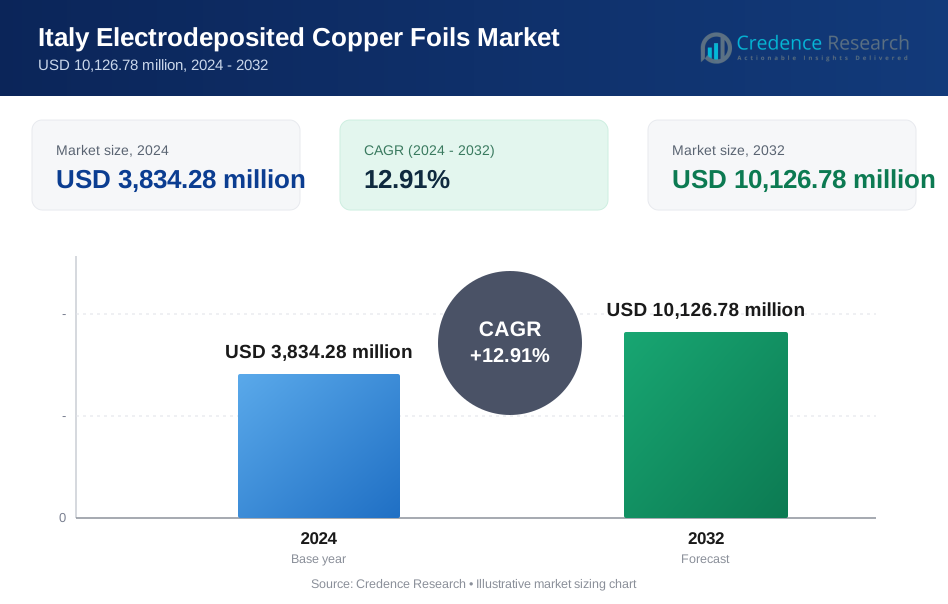
- 2.1.1 Market Size – Historical (2024) & Forecast (2024-2032) (2024: USD 3,834.28 million → 2032: USD 10,126.78 million)
- 2.1.2 Volume & Revenue – Global Totals
- 2.1.3 Key Market Highlights – Top Five Facts
- 2.2 Italy Electrodeposited Copper Foils Market Segmentation Snapshot
- 2.2.1 Market Split by Region – 2024 vs. 2032
- 2.3 Competitive Snapshot
- 2.3.1 Top 10 Players by Revenue Share – 2024
- 2.3.2 Top 10 Players by Volume Share – 2024
- 2.3.3 Recent Strategic Developments (18-Month Summary)
- 2.4 Key Investment Highlights & Strategic Conclusions
Chapter 3. Italy Electrodeposited Copper Foils Market Dynamics & Industry Analysis
- 3.1 Market Overview & Context
- 3.1.1 Italy Electrodeposited Copper Foils Market Position in the Broader Automotive Value Chain
- 3.1.2 OEM vs. Replacement Market Dynamics
- 3.1.3 Market Maturity & Development Stage by Region
- 3.2 Italy Electrodeposited Copper Foils Market Drivers
- 3.3 Italy Electrodeposited Copper Foils Market Restraints & Challenges
- 3.4 Italy Electrodeposited Copper Foils Market Opportunities
- 3.5 Porter's Five Forces Analysis
- 3.5.1 Threat of New Entrants
- 3.5.2 Bargaining Power of Suppliers
- 3.5.3 Bargaining Power of Buyers
- 3.5.4 Threat of Substitutes
- 3.5.5 Competitive Rivalry – Intensity Assessment
- 3.6 Italy Electrodeposited Copper Foils Value Chain Analysis
- 3.6.1 Upstream – Raw Material/Input Suppliers
- 3.6.1.1 Raw Material/Input 1
- 3.6.1.2 Raw Material/Input 2
- 3.6.1.3 Raw Material/Input 3
- 3.6.2 Midstream – Production/Manufacturing/Service Delivery
- 3.6.2.1 Production/Process Overview
- 3.6.2.2 Key Facility Locations & Capacity by Manufacturer
- 3.6.3 Downstream – Distribution & End Consumer
- 3.6.3.1 Primary Channel – B2B/OEM
- 3.6.3.2 Secondary Channels – Dealer, Retail, Online, Direct
- 3.6.4 Value Chain Profitability Analysis
- 3.6.1 Upstream – Raw Material/Input Suppliers
- 3.7 PESTEL Analysis
- 3.7.1 Political Factors
- 3.7.2 Economic Factors
- 3.7.3 Social Factors
- 3.7.4 Technological Factors
- 3.7.5 Environmental Factors
- 3.7.6 Legal Factors
- 3.8 Italy Electrodeposited Copper Foils Supply Chain Analysis
- 3.8.1 Raw Material/Input Supply Risk Assessment
- 3.8.2 Manufacturing Concentration Risk (Geographic Exposure)
- 3.8.3 Trade Disruption Impact Analysis
- 3.9 Regulatory & Policy Landscape
Note: The regulatory and policy landscape section covers regulations based on their applicability to the market, Italy Electrodeposited Copper Foils category, geography, and scope of the study. Only regulatory frameworks with a material impact on operations, compliance, trade, sustainability, or market access are analyzed in detail.
Chapter 4. Key Investment Pockets & Opportunity Analysis
- 4.1 Italy Electrodeposited Copper Foils Market Attractiveness Analysis
- 4.1.1 By Region – Investment Attractiveness Matrix (Volume × CAGR)
- 4.2 Absolute Revenue Growth Opportunity
- 4.2.1 By Region – Absolute USD Growth Through 2032
- 4.3 Incremental Volume Opportunity
- 4.3.1 By Region – Incremental Volume Through 2032
- 4.3.2 Segment – Incremental Volume
- 4.4 Emerging Submarket Opportunity Deep Dive (Subject to Applicability)
- 4.5 Emerging Market Opportunity Scorecards
- 4.5.1 United States
- 4.5.2 Europe
- 4.5.3 Asia
- 4.5.4 Middle East & Africa
Note: Emerging Market Opportunity Scorecards will be included based on relevance and strategic importance. Regions listed are indicative and may vary depending on data availability and market dynamics.
Chapter 5. Italy Electrodeposited Copper Foils Import-Export Analysis & Trade Flows
- 5.1 Global Trade Overview
- 5.1.1 Global Export Value by Country (2024)
- 5.1.2 Global Export Volume by Country (2024)
- 5.1.3 Global Import Value by Country (2024)
- 5.1.4 Global Import Volume by Country (2024)
- 5.1.5 Net Trade Balance by Country (2024)
- 5.2 Export Analysis – Segment
- 5.2.1 Type 1 (HS Code)
- 5.2.2 Type 2 (HS Code)
- 5.2.3 Type 3 (HS Code)
- 5.2.4 Type 4 (HS Code)
- 5.2.5 Type 5 (HS Code)
- 5.3 Import Analysis – Segment
- 5.3.1 Type 1 (HS Code)
- 5.3.2 Type 2 (HS Code)
- 5.3.3 Type 3 (HS Code)
- 5.3.4 Type 4 (HS Code)
- 5.3.5 Type 5 (HS Code)
- 5.4 Average Unit Trade Prices
- 5.4.1 Average Export Price – Segment & Country
- 5.4.2 Average Import Price – Segment & Source Country
- 5.4.3 Price Trends (2024)
- 5.5 Key Trade Route Analysis
- 5.5.1 Trade Route 1
- 5.5.2 Trade Route 2
- 5.5.3 Trade Route 3
- 5.5.4 Trade Route 4
- 5.5.5 Trade Route 5
- 5.6 Trade Policy Impact Assessment
- 5.6.1 US Anti-Dumping & Section 301 Tariffs
- 5.6.2 EU Customs Union Impact
- 5.6.3 Major Free Trade Agreements
- 5.6.4 USMCA Rules of Origin
Note: Trade policy analysis will be included only where relevant to the Italy Electrodeposited Copper Foils market.
Chapter 6. Competitive Landscape & Company Benchmarking
- 6.1 Italy Electrodeposited Copper Foils Market Concentration & Structure
- 6.1.1 Herfindahl-Hirschman Index (HHI) – vs. 2024
- 6.1.2 Tier 1, Tier 2 & Tier 3 Market Structure
- 6.1.3 Global, Regional & Local Player Dynamics
- 6.2 Italy Electrodeposited Copper Foils Market Share Analysis – 2024
- 6.2.1 Global Revenue Share by Company
- 6.2.2 Global Volume Share by Company
- 6.2.3 Regional Revenue Share
- 6.2.4 Market Share Evolution ( vs. 2024)
- 6.2.5 OEM Segment Share by Company
- 6.2.6 Replacement Segment Share by Company
- 6.3 Production/Delivery Capacity & Facility Analysis
- 6.3.1 Global Installed Capacity
- 6.3.2 Capacity Utilization Rates
- 6.3.3 Production/Output Volume
- 6.3.4 Facility Locations & Capacity Map
- 6.3.5 Planned Capacity Additions
- 6.4 Italy Electrodeposited Copper Foils Competitive Benchmarking Matrix
- 6.4.1 Revenue, Volume, CAGR & Profitability Comparison
- 6.4.2 Channel Revenue Mix
- 6.4.3 Geographic Revenue Exposure
- 6.4.4 R&D Intensity
- 6.4.5 Sustainability Maturity
- 6.5 Strategic Developments in Italy Electrodeposited Copper Foils (Last 24 Months)
- 6.5.1 Mergers, Acquisitions & Divestments
- 6.5.2 New Italy Electrodeposited Copper Foils Launches
- 6.5.3 Facility Expansions
- 6.5.4 Strategic Alliances, Joint Ventures & Partnerships
- 6.5.5 Distribution Expansion & Market Entry
- 6.5.6 Sustainability & ESG Initiatives
- 6.6 Competitive Strategy Mapping
- 6.6.1 Leader, Challenger, Follower & Niche Classification
- 6.6.2 Pricing Strategy Comparison
- 6.6.3 Channel Strategy Matrix
Note: Strategic developments are included based on their materiality and the availability of reliable information.
Chapter 7. Global Italy Electrodeposited Copper Foils Market – By Distribution Channel
- 7.1 Segment Overview
- 7.1.1 Volume & Revenue Split by Channel (2024 & 2032)
- 7.1.2 Channel Mix Evolution (2024-2032)
Chapter 8. Regional Market Analysis – Global Overview
- 8.1 Global Regional Overview
- 8.1.1 Regional Volume Share
- 8.1.2 Regional Revenue Share
- 8.1.3 Regional Volume by Region
- 8.1.4 Regional Revenue by Region
- 8.1.5 Regional Forecast Through 2032
- 8.2 Cross-Regional Segment Analysis
- 8.2.1 By Distribution Channel
- 8.2.2 By Brand/Price Tier
Chapter 9. North America Italy Electrodeposited Copper Foils Market
- 9.1 United States
- 9.2 Canada
- 9.3 Mexico
Chapter 10. Europe Italy Electrodeposited Copper Foils Market
- 10.1 Germany
- 10.2 France
- 10.3 Italy
- 10.4 United Kingdom
- 10.5 Spain
- 10.6 Poland
- 10.7 Russia
- 10.8 Netherlands
- 10.9 Belgium
- 10.10 Sweden
- 10.11 Denmark
- 10.12 Norway
- 10.13 Rest of Europe
Chapter 11. Asia Pacific Italy Electrodeposited Copper Foils Market
- 11.1 China
- 11.2 India
- 11.3 Japan
- 11.4 South Korea
- 11.5 Thailand
- 11.6 Indonesia
- 11.7 Vietnam
- 11.8 Malaysia
- 11.9 Australia
- 11.10 Rest of Asia Pacific
Chapter 12. Latin America Italy Electrodeposited Copper Foils Market
- 12.1 Brazil
- 12.2 Argentina
- 12.3 Colombia
- 12.4 Chile
- 12.5 Rest of Latin America
Chapter 13. Middle East Italy Electrodeposited Copper Foils Market
- 13.1 Saudi Arabia
- 13.2 United Arab Emirates
- 13.3 Turkey
- 13.4 Israel
- 13.5 Iran
- 13.6 Rest of the Middle East
Chapter 14. Africa Italy Electrodeposited Copper Foils Market
- 14.1 South Africa
- 14.2 Egypt
- 14.3 Nigeria
- 14.4 Morocco
- 14.5 Rest of Africa
Chapter 15. Italy Electrodeposited Copper Foils Company Profiles
- 15.1 [Company 01]
- 15.1.1 Company Overview
- 15.1.2 Key Management Personnel
- 15.1.3 Products & Services Portfolio
- 15.1.4 Financial Performance
- 15.1.5 Key Market Focus & Geographic Presence
- 15.1.6 Recent Developments & Strategic Initiatives
Note: The company profile list is preliminary and may change based on research findings, market developments, data availability, and client requirements.
Chapter 16. Appendices
- Appendix A – List of Abbreviations & Acronyms
- Appendix B – Industry Classification Code Reference – Full Series
- Appendix C – Production & Capacity Data Tables
- Appendix D – End-Use & Demand Base Tables
- Appendix E – Consumption & Replacement Rate Assumptions
- Appendix F – ASP Reference Tables
- Appendix G – Manufacturing & Facility Database
- Appendix H – Import-Export Data Tables
- Appendix I – Regulatory Summary Tables
- Appendix J – Primary Research Participant List (Anonymized)
- Appendix K – Primary Research Questionnaire Framework
- Appendix L – Data Sources & Bibliography
- Appendix M – Market Size Divergence & Source Comparison
Chapter 17. Research Methodology
- 17.1 Research Framework & Philosophy
- 17.2 Secondary Research – Sources, Hierarchy & Data Extraction
- 17.3 Data Modeling – Bottom-Up & Top-Down Market Sizing
- 17.4 Primary Research – Stakeholder Framework, LOI & Sample Sizes
- 17.5 Forecast Methodology – Regression, Scenario & Sensitivity Analysis
- 17.6 Quality Control – Four-Layer Validation Framework
- 17.7 Limitations & Standard Assumptions
- 17.8 Disclaimer
