
Market Overview
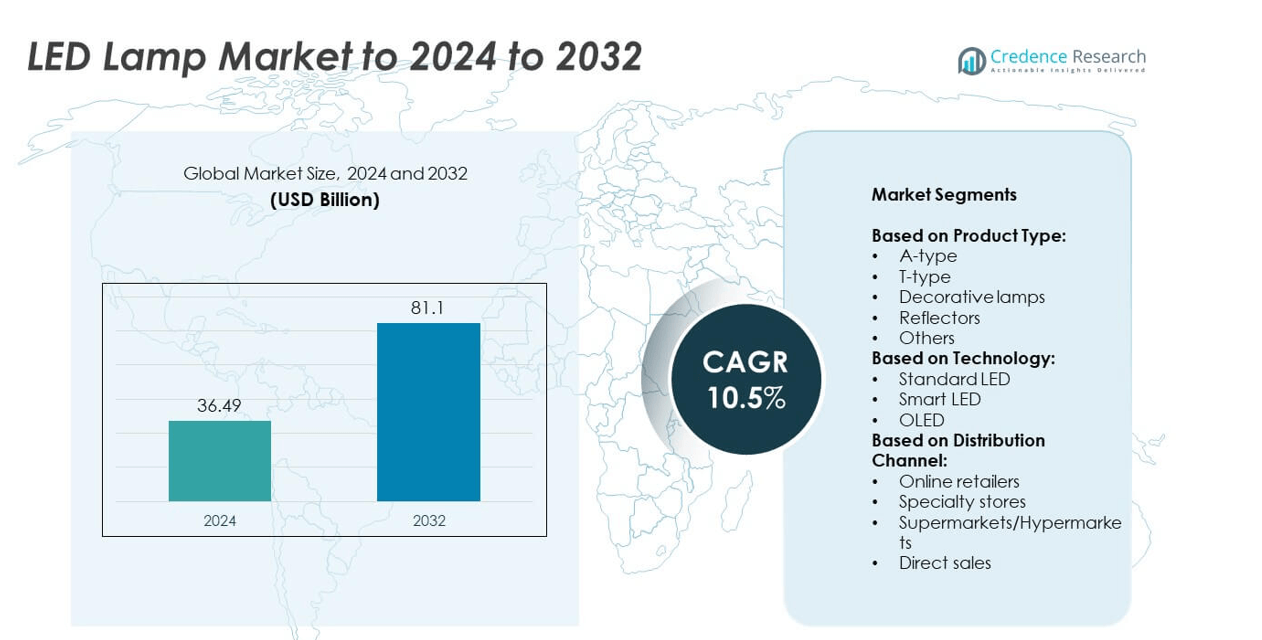
LED Lamp Market size was valued at USD 36.49 Billion in 2024 and is anticipated to reach USD 81.1 Billion by 2032, at a CAGR of 10.5% during the forecast period.
| REPORT ATTRIBUTE | DETAILS |
|---|---|
| Historical Period | 2020-2023 |
| Base Year | 2024 |
| Forecast Period | 2025-2032 |
| LED Lamps Market Size 2024 | USD 36.49 Billion |
| LED Lamps Market, CAGR | 10.5% |
| LED Lamps Market Size 2032 | USD 81.1 Billion |
The LED lamp market is shaped by major players such as Samsung Electronics, Acuity Brands, Cree, Signify, Eaton Corporation, LG Innotek, GE Lighting, and Osram, who focus on energy-efficient technologies, innovative designs, and integration with smart lighting solutions to expand their global footprint. These companies leverage strong distribution networks, strategic collaborations, and sustainable practices to strengthen competitiveness. Regionally, Asia Pacific dominated the market in 2024 with a 34% share, driven by large-scale manufacturing, government subsidies, and rapid urbanization. North America followed with a 32% share, supported by strict energy regulations and smart home adoption, while Europe accounted for 28%, backed by stringent environmental policies and retrofit projects.
Market Insights
- The LED Lamp Market was valued at USD 36.49 Billion in 2024 and is projected to reach USD 81.1 Billion by 2032, growing at a CAGR of 10.5% between 2025 and 2032.
- Rising demand for energy-efficient lighting, supportive government incentives, and growing smart home integration are the key drivers fueling market growth across residential, commercial, and industrial sectors.
- Market trends highlight the increasing adoption of smart LEDs, sustainability-focused innovations, and rising popularity of decorative and specialty lighting solutions in hospitality and retail environments.
- The competitive landscape is shaped by leading players focusing on product innovation, eco-friendly manufacturing, and expanding distribution channels, while price competition from low-cost alternatives remains a restraint in emerging markets.
- Regionally, Asia Pacific led with 34% share in 2024 due to large-scale manufacturing and infrastructure projects, followed by North America with 32% supported by energy regulations, and Europe with 28% driven by strong retrofit initiatives.
Market Segmentation Analysis:
By Product Type
The LED lamp market by product type is led by A-type lamps, which accounted for the largest share in 2024 due to their widespread residential and commercial adoption. These lamps are cost-effective, energy-efficient, and widely compatible with traditional fixtures, making them the preferred choice for households and offices. Decorative lamps and reflectors are also gaining traction, supported by demand in hospitality and retail sectors. The segment growth is driven by rising replacement of incandescent bulbs, affordability of A-type LEDs, and continuous improvements in lumen output and durability.
- For instance, Cree TW Series A19 delivers 800 lumens and 25,000-hour life at 8.5 W.
By Technology
Standard LED technology dominated the market in 2024 with the highest share, primarily due to its affordability and widespread use across residential and commercial applications. Smart LEDs, however, are gaining significant momentum, fueled by smart home adoption, voice-control integration, and energy management features. OLEDs hold a smaller niche, mainly in high-end decorative and specialty lighting. The dominance of standard LEDs is driven by declining costs, high efficiency, and global regulations promoting energy-saving technologies, ensuring they remain the primary choice across emerging and developed economies.
- For instance, the Samsung LM281B+ (2835) LED is rated for a luminous efficacy of 165 lm/W. It delivers 73 lm when operated at 150 mA, which corresponds to 0.45 W under typical conditions.
By Distribution Channel
Specialty stores emerged as the leading distribution channel in 2024, capturing the largest market share as consumers prefer professional guidance and a wide product selection for lighting solutions. Online retailers are expanding quickly, fueled by rising e-commerce penetration, competitive pricing, and ease of doorstep delivery. Supermarkets and hypermarkets continue to serve as key outlets for bulk and general purchases, while direct sales appeal to industrial and commercial buyers. The dominance of specialty stores is driven by the trust factor, personalized service, and availability of advanced lighting solutions under one roof.
Key Growth Drivers
Energy Efficiency and Cost Savings
Energy efficiency remains the strongest growth driver in the LED lamp market. LED lamps consume significantly less power than traditional lighting and offer longer lifespans, reducing replacement costs. Governments worldwide are implementing stricter energy efficiency standards, accelerating the adoption of LED solutions. Consumers and businesses are motivated by both environmental benefits and lower electricity bills. This dual advantage positions energy efficiency as the primary factor sustaining market growth and ensuring widespread replacement of incandescent and fluorescent lamps with LEDs.
- For instance, Cree’s LED A19 60W-equivalent bulb delivers 800 lumens at just 9.5 W, reducing energy use by 84 %.
Government Policies and Incentives
Supportive government initiatives and incentives strongly drive LED adoption. Many countries have phased out incandescent lamps, encouraging LED use through rebates, tax benefits, and large-scale replacement programs. These policies not only increase awareness but also make LED lighting affordable for mass consumers. Public infrastructure projects, such as smart city development and roadway modernization, increasingly prioritize LED lighting. This regulatory push continues to create large-scale demand across both developed and developing economies, enhancing the market’s overall momentum and penetration rate.
- For instance, Signify publishes that connected LEDs plus controls can reduce lighting energy use by as much as 80%.
Smart Home and IoT Integration
The rise of smart homes and IoT-enabled ecosystems is a major growth driver. Smart LED lamps with features like remote control, dimming, and voice assistant compatibility are attracting tech-savvy consumers. Businesses and households alike adopt smart LEDs to optimize energy use and personalize lighting environments. Their integration with connected devices enhances demand and aligns with global digitalization trends. This convergence of lighting with smart technologies accelerates innovation, creating sustained growth opportunities for manufacturers and reshaping consumer preferences in the LED lamp market.
Key Trends & Opportunities
Expansion of Smart LED Adoption
Smart LED lamps are gaining momentum as consumers embrace convenience, automation, and personalized lighting. Integration with mobile applications and AI-based platforms enables energy tracking and seamless control. This trend is strongly supported by rising urbanization and increasing disposable incomes in emerging markets. Opportunities exist for manufacturers to provide innovative features, such as adaptive brightness and color-changing modes, further enhancing adoption. With global demand for smart homes increasing, this trend will continue creating high-value opportunities within the LED lamp segment.
- For instance, ams OSRAM announced in August 2025 a new UV-C LED technology demonstrating 200 mW output at 265 nm with a wall-plug efficiency of over 10% and a lifespan exceeding 20,000 hours.
Shift Toward Sustainable and Decorative Lighting
Sustainability is shaping purchasing decisions, with eco-friendly LED lamps replacing toxic, non-recyclable lighting solutions. Decorative LEDs are also experiencing rising demand across hospitality, retail, and residential sectors, where aesthetics and ambiance are key. Manufacturers offering recyclable materials and reduced carbon footprint gain a competitive advantage. This trend creates opportunities for premium and design-centric products, particularly in urban markets. Combining sustainability with decorative appeal not only strengthens brand value but also meets evolving consumer expectations for responsible and stylish lighting solutions.
- For instance, Samsung said 155 Philips Hue products now integrate with SmartThings, evidencing broader interoperability.
Key Challenges
High Initial Purchase Costs
Despite falling prices, the initial cost of LED lamps remains higher compared to traditional lighting solutions. This upfront expense continues to be a barrier in price-sensitive markets, particularly in rural and developing regions. Although long-term savings offset these costs, consumers often prioritize immediate affordability. The challenge is more pronounced for advanced technologies like smart LEDs and OLEDs, which remain premium-priced. Overcoming this challenge requires awareness programs, government subsidies, and technological advancements that further reduce production costs.
Competition from Low-Quality Alternatives
The market faces growing competition from low-cost, poor-quality LED lamps produced by unorganized manufacturers. These products compromise performance, durability, and safety, damaging consumer confidence in LEDs. Such alternatives hinder adoption in key regions, especially where price sensitivity is high. They also create warranty and replacement challenges for distributors and retailers. To address this challenge, leading players emphasize quality certifications, brand trust, and innovation while governments enforce stricter regulations. Ensuring product reliability remains critical to sustaining long-term market growth.
Regional Analysis
North America
North America held a 32% share of the LED lamp market in 2024, driven by strict energy efficiency standards and widespread replacement of traditional lighting. The United States leads the region with rapid adoption across residential, commercial, and industrial applications, supported by government initiatives such as rebates and infrastructure modernization. Canada is also contributing with strong demand from sustainable building projects and smart city programs. Rising adoption of smart home technologies and eco-friendly solutions further boosts market penetration, positioning North America as a key growth hub throughout the forecast period.
Europe
Europe accounted for 28% of the global LED lamp market in 2024, with demand supported by strong environmental policies and the EU’s stringent energy efficiency directives. Countries such as Germany, France, and the UK are leading in adoption due to high sustainability awareness and large-scale retrofit projects. Decorative and smart LED segments are gaining significant traction, especially in the hospitality and retail industries. Government-backed programs promoting carbon neutrality are further encouraging the transition toward LED solutions, ensuring consistent growth across both Western and Eastern European countries.
Asia Pacific
Asia Pacific dominated the LED lamp market with a 34% share in 2024, supported by massive urbanization and infrastructure development. China remains the largest market, benefiting from large-scale manufacturing, government subsidies, and export growth. India and Southeast Asian countries are witnessing increasing adoption due to rapid electrification, falling LED prices, and government-led energy efficiency initiatives. Rising smart home adoption and strong demand in commercial construction projects further strengthen market expansion. With both cost competitiveness and growing local demand, Asia Pacific continues to be the fastest-growing and most influential region.
Latin America
Latin America captured a 4% share of the LED lamp market in 2024, with demand growing steadily across urban centers. Brazil and Mexico are the leading contributors, supported by smart city projects and rising electricity costs that push consumers toward energy-efficient solutions. Awareness campaigns by governments and international organizations are fostering adoption in residential and commercial spaces. However, market penetration remains slower in rural areas due to affordability concerns. Ongoing infrastructure modernization, combined with increasing availability of low-cost LED options, is expected to support future growth across the region.
Middle East and Africa
The Middle East and Africa region accounted for 2% of the LED lamp market in 2024, with growth fueled by large-scale infrastructure and construction projects. The Gulf countries are leading adoption, supported by smart city initiatives and government-led sustainability programs aimed at reducing energy consumption. Africa is gradually embracing LED lamps, particularly in urban areas, though challenges such as high upfront costs limit adoption in rural markets. Increasing investment in energy-efficient public lighting and the growing influence of global manufacturers will enhance long-term market opportunities across the region.
Market Segmentations:
By Product Type:
- A-type
- T-type
- Decorative lamps
- Reflectors
- Others
By Technology:
- Standard LED
- Smart LED
- OLED
By Distribution Channel:
- Online retailers
- Specialty stores
- Supermarkets/Hypermarkets
- Direct sales
By Geography:
- North America
- U.S.
- Canada
- Mexico
- Europe
- UK
- France
- Germany
- Italy
- Spain
- Russia
- Belgium
- Netherlands
- Austria
- Sweden
- Poland
- Denmark
- Switzerland
- Rest of Europe
- Asia Pacific
- China
- Japan
- South Korea
- India
- Australia
- Thailand
- Indonesia
- Vietnam
- Malaysia
- Philippines
- Taiwan
- Rest of Asia Pacific
- Latin America
- Brazil
- Argentina
- Peru
- Chile
- Colombia
- Rest of Latin America
- Middle East
- UAE
- KSA
- Israel
- Turkey
- Iran
- Rest of Middle East
- Africa
- Egypt
- Nigeria
- Algeria
- Morocco
- Rest of Africa
Competitive Landscape
Samsung Electronics, Acuity Brands, Cree, Inc., Signify, Eaton Corporation, LG Innotek, GE Lighting, and Osram are among the leading players shaping the competitive landscape of the LED lamp market. The industry is characterized by continuous innovation, with companies focusing on energy efficiency, advanced designs, and integration with smart home systems to strengthen market presence. Strategic investments in research and development are driving advancements in durability, light quality, and digital connectivity, enabling firms to meet diverse consumer needs. Strong distribution networks across both offline and online channels enhance accessibility, while partnerships with construction, automotive, and infrastructure sectors expand end-use applications. Competitive rivalry is further heightened by sustainability initiatives, with leading manufacturers increasingly adopting eco-friendly materials and recyclable packaging to align with global environmental standards. Price competition and brand differentiation remain central strategies, as companies aim to balance affordability with performance to capture greater consumer loyalty and expand global reach.
Key Player Analysis
- Samsung Electronics
- Acuity Brands
- Cree, Inc.
- Signify
- Eaton Corporation
- LG Innotek
- GE Lighting
- Osram
Recent Developments
- In 2023, Signify introduces Philips Ultra Efficient LED bulbs, delivering 3x the lifetime usage with 40% less energy when compared to standard bulbs.
- In 2023, ams OSRAM AG released a new family of LEDs specifically designed for horticulture lighting (indoor farming/grow lights), focusing on high efficiency and reliable performance for optimal plant growth.
- In 2022, Acuity Brands launched its Verjure Pro Series, a professional-grade LED horticulture solution designed to compete with and outperform traditional High-Pressure Sodium (HPS) lights
Report Coverage
The research report offers an in-depth analysis based on Product Type, Technology, Distribution Channel and Geography. It details leading market players, providing an overview of their business, product offerings, investments, revenue streams, and key applications. Additionally, the report includes insights into the competitive environment, SWOT analysis, current market trends, as well as the primary drivers and constraints. Furthermore, it discusses various factors that have driven market expansion in recent years. The report also explores market dynamics, regulatory scenarios, and technological advancements that are shaping the industry. It assesses the impact of external factors and global economic changes on market growth. Lastly, it provides strategic recommendations for new entrants and established companies to navigate the complexities of the market.
Future Outlook
- The LED lamp market will continue expanding with rising global demand for energy-efficient lighting.
- Standard LED lamps will maintain dominance, while smart LEDs will grow at a faster pace.
- Decorative and specialty LED products will gain popularity in retail and hospitality sectors.
- Asia Pacific will remain the fastest-growing region, supported by large-scale infrastructure projects.
- North America and Europe will see strong adoption driven by energy regulations and retrofitting programs.
- Online retail channels will expand rapidly due to convenience and competitive pricing.
- Smart home integration will boost demand for connected and app-controlled LED lamps.
- Sustainability will drive innovation with recyclable materials and eco-friendly manufacturing practices.
- Falling production costs will make advanced LED technologies more affordable for mass consumers.
- Competition will intensify as global brands and local manufacturers expand product portfolios and presence.

Request a Free Sample
Fill in your details and we'll send you a free sample report.
- Sample data tables & charts
- Research methodology
Market Dynamics
Energy Efficiency and Cost Savings
LED lamps consume significantly less power and have longer lifespans than traditional lighting, resulting in lower electricity bills and reduced replacement costs. This dual benefit is driving widespread replacement of incandescent and fluorescent lamps with LEDs across residential, commercial, and industrial sectors.
Government Policies and Incentives
Many governments have implemented strict energy efficiency standards, phased out incandescent bulbs, and introduced rebates and tax incentives for LED adoption. These policies make LED lamps more affordable and accelerate their penetration in both developed and developing markets.
Smart Home and IoT Integration
The growing adoption of smart homes and IoT ecosystems is fueling demand for smart LED lamps with features like remote control, dimming, and voice assistant compatibility. Integration with connected devices enhances convenience and energy management, driving innovation and market growth.
Sustainability and Eco-Friendly Innovations
Increasing consumer and regulatory focus on sustainability is pushing manufacturers to develop recyclable, non-toxic, and energy-efficient LED lamps. Eco-friendly products are gaining traction, especially in regions with strong environmental policies, supporting long-term market expansion.
Declining Production Costs and Technological Advancements
Continuous improvements in LED technology and economies of scale are reducing production costs, making advanced LED lamps more accessible to mass consumers. Enhanced performance, durability, and design flexibility further boost adoption across diverse applications.
Need a Custom Version of This Report?
Tailor the scope, geography, or segments to your exact requirements.
- Custom geography or segment scope
- Direct access to our analyst team
Frequently Asked Questions
What is the current market size for LED Lamp Market, and what is its projected size in 2032?
At what Compound Annual Growth Rate is the LED Lamp Market projected to grow between 2025 and 2032?
Which LED Lamp Market segment held the largest share in 2024?
What are the primary factors fueling the growth of the LED Lamp Market?
Who are the leading companies in the LED Lamp Market?
Table of Content
Chapter 1 Market Segmentation
- 1.1 Segmentation Framework
- 1.1.1 Product and Service Classification
- 1.1.2 Application and End-Use Classification
- 1.1.3 Technology and Solution Classification
- 1.1.4 Customer and Distribution Channel Classification
- 1.1.5 Geographic Segmentation
- 1.1.6 Market Segment Definitions and Boundaries
- 1.2 By Technology
- 1.2.1 Standard LED
- 1.2.2 Smart LED
- 1.2.3 OLED
- 1.3 By Product Type
- 1.3.1 A-type
- 1.3.2 T-type
- 1.3.3 Decorative lamps
- 1.3.4 Reflectors
- 1.3.5 Others
Chapter 2 Introduction
- 2.1 Report Objectives and Scope
- 2.2 Product Definition and Industry Terminology
- 2.3 Market Inclusions and Exclusions
- 2.4 Research Process
- 2.4.1 Primary Research and Expert Interviews
- 2.4.2 Secondary Research and Source Review
- 2.4.3 Top-Down and Bottom-Up Estimation
- 2.4.4 Data Triangulation and Verification
- 2.5 Market Size Measurement Basis
- 2.5.1 2024: USD 36.49 Billion → 2032: USD 81.1 Billion
- 2.6 Historical and Forecast Reference Periods
- 2.6.1 Base Year: 2024
- 2.6.2 Forecast Period: 2024-2032
- 2.7 Research Assumptions and Limitations
Chapter 3 Executive Summary
- 3.1 Market Snapshot and Key Findings
- 3.2 Base-Year Market Size, 2024
- 3.3 Forecast Market Size, 2032
- 3.4 Revenue and Volume Growth Outlook
- 3.5 Key Demand and Supply Indicators
- 3.6 Leading Market Segments
- 3.7 Fastest-Growing Market Opportunities
- 3.8 Regional Performance Highlights
- 3.9 Technology and Industry Transformation
- 3.10 Competitive Landscape Summary
- 3.11 Analyst View and Strategic Implications
Chapter 4 Global LED Lamps Market Trends and Developments
- 4.1 Historical Industry Development
- 4.2 Recent Market Trends and Developments
- 4.3 Demand and Customer Behavior Trends
- 4.4 Technology and Product Innovation
- 4.5 Artificial Intelligence, Automation and Digitalization
- 4.6 Local Manufacturing and Supply Chain Realignment
- 4.7 Industry Partnerships, Mergers and Acquisitions
- 4.8 Sustainability and Circular Economy Developments
- 4.9 Government and Private Sector Investment Trends
- 4.10 Emerging Business Models and Commercialization
- 4.11 Industry Developments and Announcements
Chapter 5 Global LED Lamps Market Production, Supply and Demand Analysis
- 5.1 Demand Trend and Consumption Analysis
- 5.2 Demand Forecast, 2024-2032
- 5.3 Production and Output Trend
- 5.4 Production and Output Forecast, 2024-2032
- 5.5 Installed Capacity and Capacity Utilization
- 5.6 Company-Wise Production Plants and Statistics
- 5.6.1 Installed Production Capacity
- 5.6.2 Actual Production
- 5.6.3 Planned Capacity and Expansion Targets
- 5.7 Supply Chain Structure and Procurement Trends
- 5.8 Supply-Demand Gap and Bottlenecks
- 5.9 Import Dependence and Sourcing Structure
- 5.10 Contract Manufacturing and Outsourcing
- 5.11 Regional Supply and Demand Concentration
Chapter 6 Global LED Lamps Market Pricing Analysis
- 6.1 Pricing Structure and Measurement
- 6.2 Historical Pricing Trends
- 6.3 Pricing Outlook, 2024-2032
- 6.4 Average Selling Price and Unit Economics
- 6.5 Pricing by Product and Market Segment
- 6.6 Geographic Pricing Differences
- 6.7 Key Input, Energy, Labor and Logistics Costs
- 6.8 Contract Pricing and Purchasing Models
- 6.9 Pricing Sensitivity and Competitive Positioning
- 6.10 Price, Margin and Profitability Implications
Chapter 7 Global LED Lamps Market Dynamics
- 7.1 Market Growth Drivers
- 7.1.1 Demand-Side Drivers
- 7.1.2 Technology and Innovation Drivers
- 7.1.3 Infrastructure and Investment Drivers
- 7.1.4 Regulatory and Policy Drivers
- 7.2 Market Restraints
- 7.2.1 Cost and Affordability Constraints
- 7.2.2 Technology and Adoption Barriers
- 7.2.3 Supply Chain and Operational Constraints
- 7.3 Market Challenges
- 7.3.1 Competitive Pressure and Margin Erosion
- 7.3.2 Skills, Infrastructure and Implementation Gaps
- 7.4 Emerging Market Opportunities
- 7.5 Market Dynamics Impact and Time-Horizon Assessment
Chapter 8 Global LED Lamps Value Chain Analysis
- 8.1 Industry Value Chain Overview
- 8.2 Upstream Suppliers and Critical Inputs
- 8.3 Technology and Component Providers
- 8.4 Manufacturing or Service Delivery
- 8.5 Distribution, Channel Partners and Integrators
- 8.6 Downstream Applications and End Users
- 8.7 Value Addition and Profit Pools
- 8.8 Vertical Integration and Outsourcing
- 8.9 Supplier Concentration and Risk
- 8.10 Supply Chain Localization and Resilience
Chapter 9 Global LED Lamps Market Regulations and Policies
- 9.1 Relevant Laws, Standards and Compliance Frameworks
- 9.2 Product, Service, Safety and Quality Requirements
- 9.3 Government Policies, Incentives and Subsidies
- 9.4 Imports, Exports and Trade Barriers
- 9.5 Public Procurement and Local Content Requirements
- 9.6 Environmental and Sustainability Compliance
- 9.7 Upcoming Policy Changes and Market Implications
Chapter 10 Global LED Lamps Market Hotspots and Opportunities
- 10.1 Market Opportunity Mapping and Growth Hotspots
- 10.2 High-Growth Applications and Customer Groups
- 10.3 Underserved Markets and White-Space Opportunities
- 10.4 Emerging Technology and Product Opportunities
- 10.5 New Capacity and Investment Hotspots
- 10.6 Market Entry and Expansion Opportunities
- 10.7 Distribution and Partnership Opportunities
- 10.8 Near-Term and Long-Term Commercial Potential
- 10.9 Opportunity Attractiveness and Execution Risks
Chapter 11 Global LED Lamps Market Outlook, 2024-2032
- 11.1 Market Size and Analysis
- 11.1.1 Revenue (Market Measurement: 2024: USD 36.49 Billion → 2032: USD 81.1 Billion)
- 11.1.2 Market Volume and Quantity Sold
- 11.1.3 Historical Market Size
- 11.1.4 Base-Year Market Size, 2024
- 11.2 Market Forecast, 2024-2032
- 11.2.1 Revenue Forecast to 2032
- 11.2.2 Volume Forecast to 2032
- 11.2.3 CAGR and Year-on-Year Growth
- 11.2.4 Incremental Revenue Opportunity
- 11.3 Forecast Assumptions and Scenario Analysis
- 11.3.1 Base-Case Forecast
- 11.3.2 Optimistic and Conservative Scenarios
- 11.3.3 Technology, Pricing and Policy Sensitivities
- 11.4 Market Attractiveness and Growth Outlook
Chapter 12 Global LED Lamps Market Segmentation and Outlook
- 12.1 Segmentation Summary and Market Shares, 2024
- 12.2 Largest and Fastest-Growing Segments
- 12.3 By Technology - Market Size and Forecast, 2024-2032
- 12.3.1 Segment Definition and Scope
- 12.3.2 Historical Market Size
- 12.3.3 Revenue Forecast, 2024-2032
- 12.3.4 Volume Forecast, 2024-2032
- 12.3.5 Base-Year Market Share, 2024
- 12.3.6 Segment CAGR and Growth Drivers
- 12.3.7 Subsegment Market Size and Forecast
- 12.3.7.1 Standard LED
- 12.3.7.2 Smart LED
- 12.3.7.3 OLED
- 12.3.8 Subsegment Pricing and Adoption Trends
- 12.3.9 Leading Suppliers and Competition
- 12.3.10 Regional Demand and Opportunities
- 12.4 By Product Type - Market Size and Forecast, 2024-2032
- 12.4.1 Segment Definition and Scope
- 12.4.2 Historical Market Size
- 12.4.3 Revenue Forecast, 2024-2032
- 12.4.4 Volume Forecast, 2024-2032
- 12.4.5 Base-Year Market Share, 2024
- 12.4.6 Segment CAGR and Growth Drivers
- 12.4.7 Subsegment Market Size and Forecast
- 12.4.7.1 A-type
- 12.4.7.2 T-type
- 12.4.7.3 Decorative lamps
- 12.4.7.4 Reflectors
- 12.4.7.5 Others
- 12.4.8 Subsegment Pricing and Adoption Trends
- 12.4.9 Leading Suppliers and Competition
- 12.4.10 Regional Demand and Opportunities
- 12.5 Segment Growth Comparison
- 12.6 Segment Attractiveness and Priority Matrix
Chapter 13 Global LED Lamps Geographic Market Outlook, 2024-2032
- 13.1 Regional Market Size and Share, 2024
- 13.2 Regional Market Forecast, 2024-2032
- 13.3 Regional Pricing, Production and Demand Differences
- 13.4 North America
- 13.4.1 United States
- 13.4.2 Canada
- 13.4.3 Mexico
- 13.5 Europe
- 13.5.1 Germany
- 13.5.2 France
- 13.5.3 Italy
- 13.5.4 United Kingdom
- 13.5.5 Spain
- 13.5.6 Poland
- 13.5.7 Russia
- 13.5.8 Netherlands
- 13.5.9 Belgium
- 13.5.10 Sweden
- 13.5.11 Denmark
- 13.5.12 Norway
- 13.5.13 Rest of Europe
- 13.6 Asia Pacific
- 13.6.1 China
- 13.6.2 India
- 13.6.3 Japan
- 13.6.4 South Korea
- 13.6.5 Thailand
- 13.6.6 Indonesia
- 13.6.7 Vietnam
- 13.6.8 Malaysia
- 13.6.9 Australia
- 13.6.10 Rest of Asia Pacific
- 13.7 Latin America
- 13.7.1 Brazil
- 13.7.2 Argentina
- 13.7.3 Colombia
- 13.7.4 Chile
- 13.7.5 Rest of Latin America
- 13.8 Middle East
- 13.8.1 Saudi Arabia
- 13.8.2 United Arab Emirates
- 13.8.3 Turkey
- 13.8.4 Israel
- 13.8.5 Iran
- 13.8.6 Rest of the Middle East
- 13.9 Africa
- 13.9.1 South Africa
- 13.9.2 Egypt
- 13.9.3 Nigeria
- 13.9.4 Morocco
- 13.9.5 Rest of Africa
- 13.10 Regional Investment, Policy and Supply Chain Differences
- 13.11 Regional Competitive Landscape
- 13.12 Geographic Growth Hotspots
Chapter 14 Global LED Lamps Technology, Innovation and Sustainability Outlook
- 14.1 Technology Landscape and Maturity
- 14.2 Product, Process and Service Innovation
- 14.3 AI, Automation and Digital Tools in the Industry
- 14.4 Technology Adoption and Performance Benchmarking
- 14.5 Innovation Pipeline and R&D Investment
- 14.6 Patent and Intellectual Property Trends
- 14.7 Energy Efficiency and Resource Management
- 14.8 Sustainability, Recycling and Circularity
- 14.9 Technology Roadmap, 2024-2032
- 14.10 Risks of Obsolescence and Technology Substitution
Chapter 15 Global LED Lamps Market Key Strategic Imperatives
- 15.1 Growth and Market Entry Priorities
- 15.2 High-Return Products and Segments
- 15.3 Pricing, Profitability and Cost Optimization
- 15.4 Technology Investment and Product Differentiation
- 15.5 Supply Chain Localization and Resilience
- 15.6 Distribution and Customer Acquisition
- 15.7 Partnership, Acquisition and Capacity Strategy
- 15.8 Regional Expansion Priorities
- 15.9 Short-, Medium- and Long-Term Actions
Chapter 16 Competition Outlook
- 16.1 Industry Competition Characteristics
- 16.2 Market Structure and Concentration
- 16.3 Market Share and Competitive Positioning, 2024
- 16.4 Company-Wise Revenue and Product Benchmarking
- 16.5 Production and Service Capacity Benchmarking
- 16.6 Technology, Pricing and Differentiation
- 16.7 Regional Footprint and Distribution Strength
- 16.8 Mergers, Acquisitions and Strategic Alliances
- 16.9 New Entrants and Competitive Threats
- 16.10 Porter's Five Forces and Industry Attractiveness
- 16.11 Competitive Outlook, 2024-2032
Chapter 17 Company Profiles
- 17.1 Company Coverage and Selection Criteria
- 17.2 Samsung Electronics
- 17.2.1 Business Description
- 17.2.2 Company Ownership and Geographic Presence
- 17.2.3 Product and Service Portfolio
- 17.2.4 Manufacturing and Operating Footprint
- 17.2.5 Production Capacity and Expansion Plans
- 17.2.6 Financial Performance and Investment
- 17.2.7 Market Share and Competitive Position
- 17.2.8 Technology and Innovation Capabilities
- 17.2.9 Strategic Alliances or Partnerships
- 17.2.10 Recent Developments
- 17.2.11 Growth Strategy and Outlook
- 17.3 Acuity Brands
- 17.4 Cree, Inc.
- 17.5 Signify
- 17.6 Eaton Corporation
- 17.7 LG Innotek
- 17.8 GE Lighting
- 17.9 Osram
- 17.10 ams OSRAM AG
- 17.11 Philips Lighting
- 17.12 Other Relevant Market Participants
Note: Every listed company is profiled on the structure shown under the first company. The company list is preliminary and may change based on research findings, market developments, data availability and client requirements.
Chapter 18 Disclaimer
- 18.1 Research and Forecast Disclaimer
- 18.2 Data Source and Estimation Limitations
Note: The depth of individual sections depends on data availability for this market. Volume, capacity, trade and other unit-based metrics are included where applicable.

