
Market Overview:
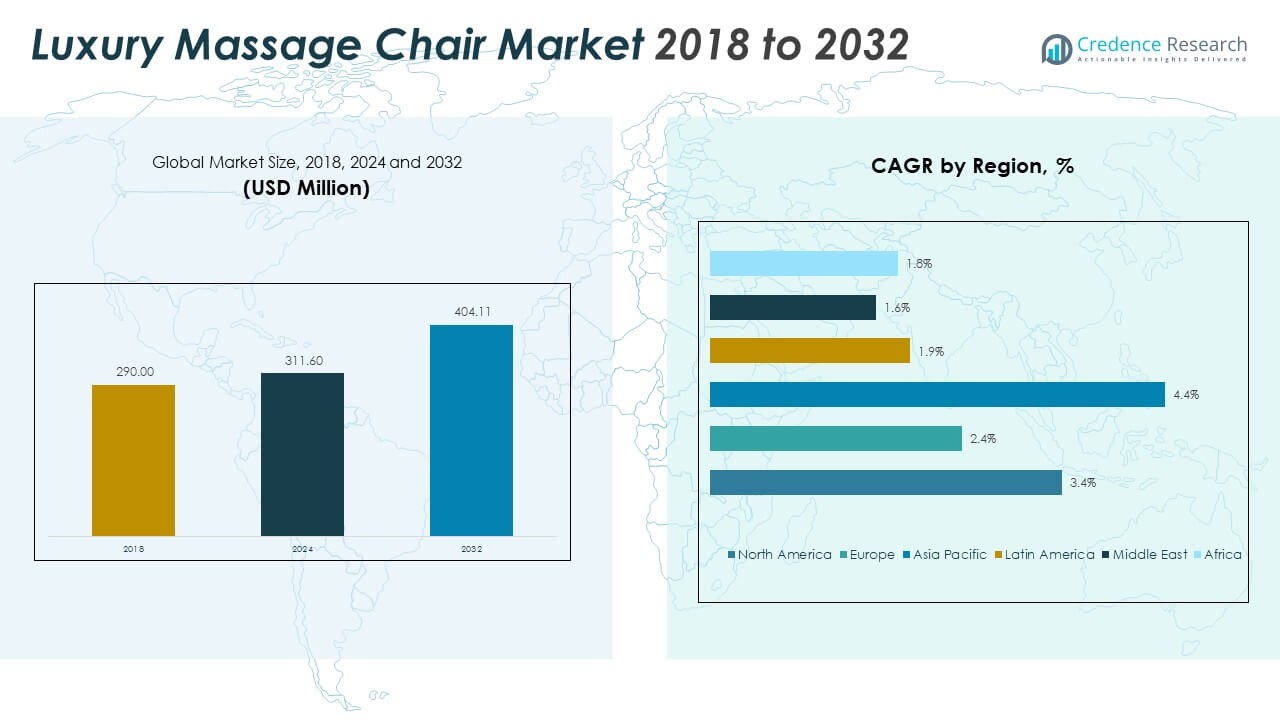
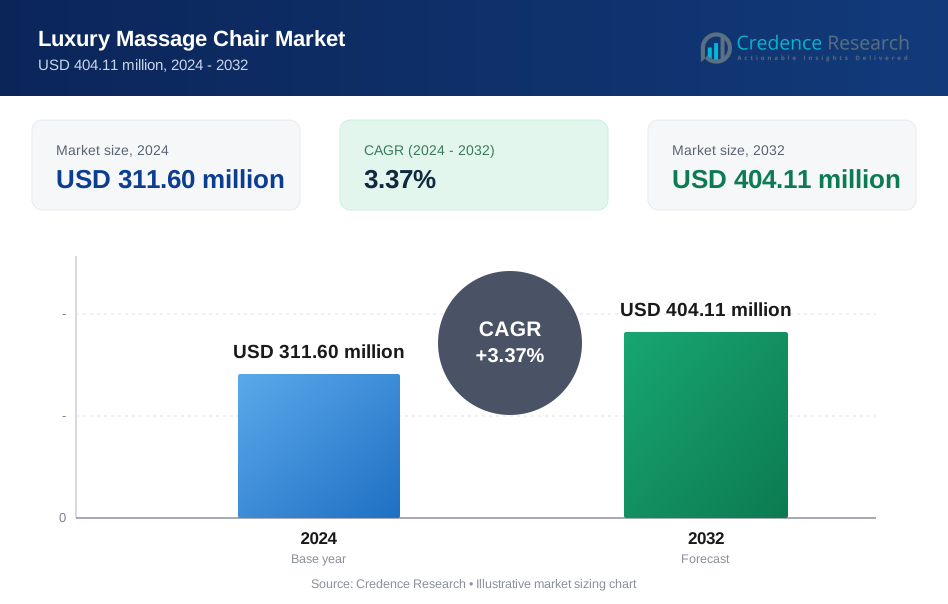
The Global Luxury Massage Chair Market size was valued at USD 290 million in 2018, increased to USD 311.60 million in 2024, and is anticipated to reach USD 404.11 million by 2032, growing at a CAGR of 3.37% during the forecast period.
| REPORT ATTRIBUTE | DETAILS |
|---|---|
| Historical Period | 2020-2023 |
| Base Year | 2024 |
| Forecast Period | 2025-2032 |
| Luxury Massage Chair Market Size 2024 | USD 311.60 Million |
| Luxury Massage Chair Market, CAGR | 3.37% |
| Luxury Massage Chair Market Size 2032 | USD 404.11 Million |
The market growth is driven by rising demand for premium wellness products, growing awareness of stress relief benefits, and the popularity of in-home relaxation solutions. Advancements in massage technologies such as AI-based body scanning, heat therapy, and zero-gravity designs are improving user experience. Increasing disposable income, urban lifestyles, and the rising focus on mental and physical wellness also support product adoption among luxury consumers and health-conscious individuals.
Regionally, North America and Asia-Pacific lead the Global Luxury Massage Chair Market. North America dominates due to high spending on home wellness equipment and strong brand presence. Asia-Pacific is rapidly emerging, led by Japan, China, and South Korea, where traditional massage culture combines with advanced technology. Europe shows steady growth driven by spa and hospitality applications, while the Middle East and Latin America represent untapped opportunities as luxury wellness trends expand.
Market Insights:
- The Global Luxury Massage Chair Market was valued at USD 290 million in 2018, reached USD 311.60 million in 2024, and is projected to hit USD 404.11 million by 2032, growing at a CAGR of 3.37% during the forecast period.
- North America (36.9%), Asia Pacific (34.8%), and Europe (17.9%) held the top three regional shares in 2024. These regions dominate due to advanced retail presence, high disposable income, and strong technological integration in consumer wellness products.
- Asia Pacific emerges as the fastest-growing region with a 4% CAGR, driven by increasing urbanization, wellness awareness, and rapid expansion of local manufacturing in Japan, China, and South Korea.
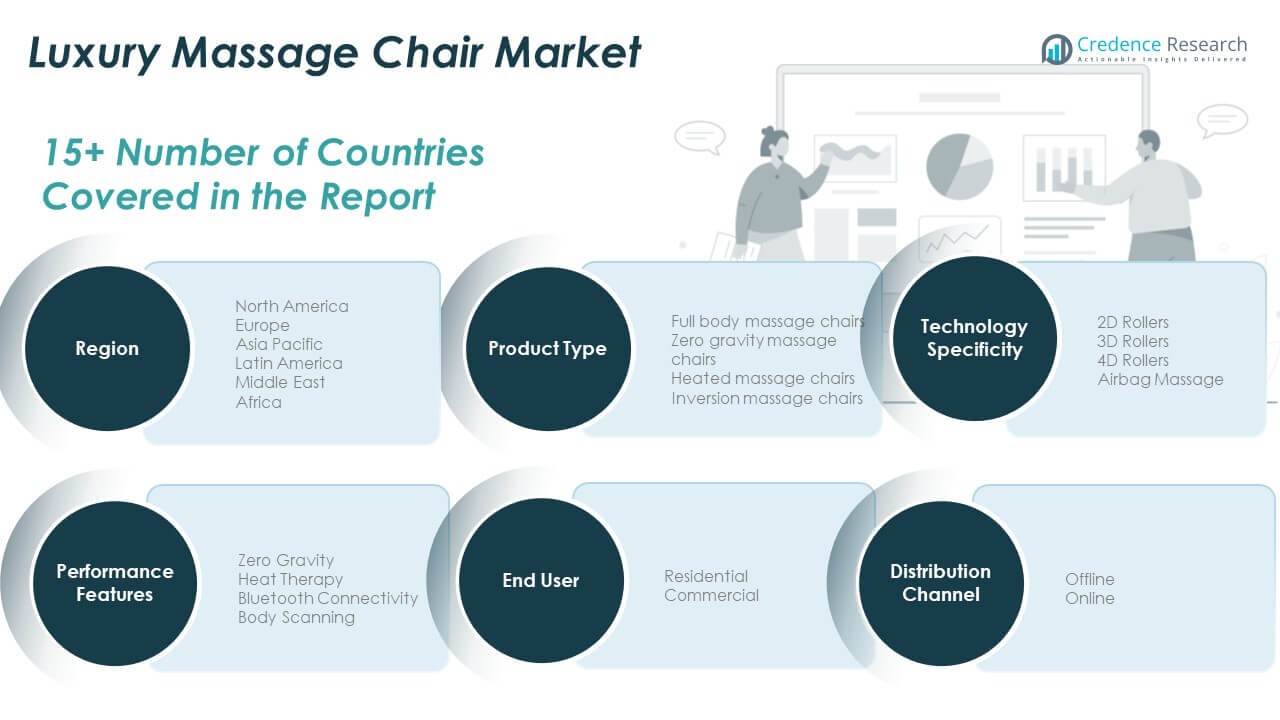
- The offline channel accounted for approximately 55% of total sales in 2024, supported by in-store experiences and trial-based purchases preferred by premium customers.
- The online channel represented about 45% of the market share, gaining momentum through digital marketing, e-commerce expansion, and global consumer accessibility to luxury wellness products.
Market Drivers:
Rising Consumer Focus on Health, Relaxation, and Home-Based Wellness Solutions
The Global Luxury Massage Chair Market is driven by growing consumer preference for home-based wellness. Rising stress levels, longer working hours, and sedentary lifestyles are pushing individuals to invest in advanced relaxation solutions. Premium massage chairs now serve both therapeutic and luxury purposes. Consumers seek comfort, body pain relief, and improved sleep through automated massage technology. It is also influenced by increased awareness of holistic health benefits. Expanding urban populations and higher disposable income strengthen demand. The integration of health and wellness into daily living drives market adoption globally.
- For instance, Bodyfriend’s 733 Robot Massage Chair, launched at CES 2025, features independently controlled arm and leg movements that enable a range of exercises and rehabilitation activities. It includes over 50 automatic massage programs and AI healthcare service functions, such as a wireless ECG holter for monitoring biometric data like heart rate and stress levels.
Advancements in Smart Massage Technology and Artificial Intelligence Integration
Continuous technological upgrades are fueling the market’s expansion. Smart luxury chairs now feature AI-based body scanning, adjustable massage patterns, and real-time posture tracking. These innovations personalize the experience for each user. Bluetooth connectivity and app-controlled operations increase user convenience. It is benefiting from collaborations between furniture brands and tech firms. Enhanced product efficiency also boosts customer satisfaction. This integration of luxury with intelligent design redefines the modern wellness experience.
- For instance, the OSIM uDream Pro chair, demonstrated at events like CES, utilizes advanced AI Biometric Sensors based on electrocardiogram (ECG) technology to measure heart rate, respiratory rate, and heart rate variability, which are then used to calculate a personalized "Body Tension Score". This data is used to enable precise, personalized, and multi-sensory massage experiences through its companion app, which also monitors the user's well-being trends over time.
Expansion of E-Commerce and Retail Distribution Networks
The market benefits significantly from growing online retail accessibility. Luxury massage chair brands are leveraging e-commerce platforms to reach global customers. Improved digital marketing and immersive online demonstrations drive purchase intent. Offline stores continue to attract customers through in-person trials and showroom experiences. It is seeing hybrid sales models where customers browse online and finalize purchases offline. The increasing presence of wellness and electronics retailers supports the trend. Global distribution partnerships enhance reach across emerging regions.
Growing Hospitality, Corporate, and Healthcare Adoption of Premium Chairs
Commercial use is becoming a major growth driver. Hotels, spas, airports, and corporate wellness centers increasingly install premium massage chairs for relaxation services. Healthcare institutions adopt them for rehabilitation and therapeutic use. It supports better recovery and reduces stress among patients and employees. The rising emphasis on employee wellness programs also creates new opportunities. Increasing hospitality and healthcare spending globally fuels consistent demand. These applications broaden the market beyond personal users.
Market Trends:
Integration of AI, IoT, and Cloud Connectivity Enhancing User Experience
Smart technology defines the evolving trend in luxury massage chairs. AI algorithms personalize massage pressure and rhythm to user preference. IoT connectivity allows real-time monitoring and updates through cloud integration. It transforms a static product into a smart, adaptive wellness system. App-based control and remote settings improve convenience. Voice command and automation further enhance usability. This convergence of technology and comfort is creating a strong market differentiator.
- For instance, Bodyfriend’s 733 Chair features Wi-Fi and voice-command functions, supports more than 100 custom massage programs, and streams real-time user health data to the cloud for analytics and monitoring.
Rising Demand for Compact and Ergonomic Home Wellness Furniture
Manufacturers are focusing on space-saving, ergonomic models suitable for urban homes. Compact chairs fit smaller living spaces without compromising performance. It reflects the shift toward functional luxury. Modern designs use lightweight materials and sleek aesthetics appealing to young consumers. Foldable models with mobility features also gain traction. Aesthetic integration with smart home interiors drives design innovation. Urbanization continues to shape product development in key regions.
Sustainability and Eco-Friendly Manufacturing Practices in Luxury Segment
The industry is moving toward sustainable production and energy-efficient systems. Brands adopt eco-friendly leather alternatives, recyclable materials, and low-energy motors. It aligns with rising environmental awareness among consumers. Manufacturing units implement green processes to minimize carbon footprints. Consumers value ethical sourcing and durability over short-term luxury. This trend is shaping long-term competitive positioning. Companies emphasizing sustainability gain stronger brand trust globally.
Growing Popularity of Massage Chairs in Corporate and Public Relaxation Zones
Corporate wellness initiatives are creating a new demand segment. Offices integrate massage chairs in lounges to enhance employee well-being. Airports and malls also install them as pay-per-use relaxation points. It demonstrates how luxury wellness products penetrate everyday environments. The model generates recurring revenue for providers. Demand from co-working spaces and hospitality sectors continues to grow. This adoption trend enhances visibility and long-term market potential.
Market Challenges Analysis:
High Product Cost and Limited Affordability Among Middle-Income Consumers
The Global Luxury Massage Chair Market faces challenges related to high pricing. Premium models often exceed affordability for middle-income consumers. High import duties and shipping costs increase retail prices further. It limits accessibility in price-sensitive regions. Financing options remain limited in developing markets. Consumers often opt for traditional massage services or low-cost alternatives. Manufacturers struggle to balance innovation with cost-effectiveness. Price-sensitive segmentation remains a barrier to market expansion.
Technical Complexity, Maintenance Costs, and Lack of Product Awareness
The market also struggles with product education and servicing limitations. Luxury chairs require skilled installation and periodic maintenance. Technical issues, sensor calibration, and software failures increase post-purchase costs. It reduces long-term customer satisfaction and brand loyalty. In emerging regions, awareness of advanced features remains low. After-sales support and warranty programs are still developing. Limited training for service professionals creates reliability gaps. These challenges restrain faster market penetration.
Market Opportunities:
Expansion Across Emerging Economies and Rising Home Wellness Spending
The Luxury Massage Chair Market holds strong opportunities across emerging regions. Rising disposable income and awareness of relaxation benefits boost adoption. Urban consumers in Asia-Pacific and Latin America show strong demand growth. It benefits from government wellness initiatives and rising e-commerce access. Collaborations with lifestyle and fitness brands strengthen brand reach. Localized production can help reduce costs and expand market entry.
Innovation in Multifunctional and Aesthetic Smart Chair Designs
Manufacturers are exploring multifunctional chairs blending luxury, therapy, and technology. Integration of AR-based control and biometric sensors offers new value. It allows users to track health data alongside relaxation. Customizable colors, upholstery, and body fit designs enhance personalization. Partnerships with tech innovators expand future applications. The fusion of design, comfort, and data-driven wellness defines the next growth phase.
Market Segmentation Analysis:
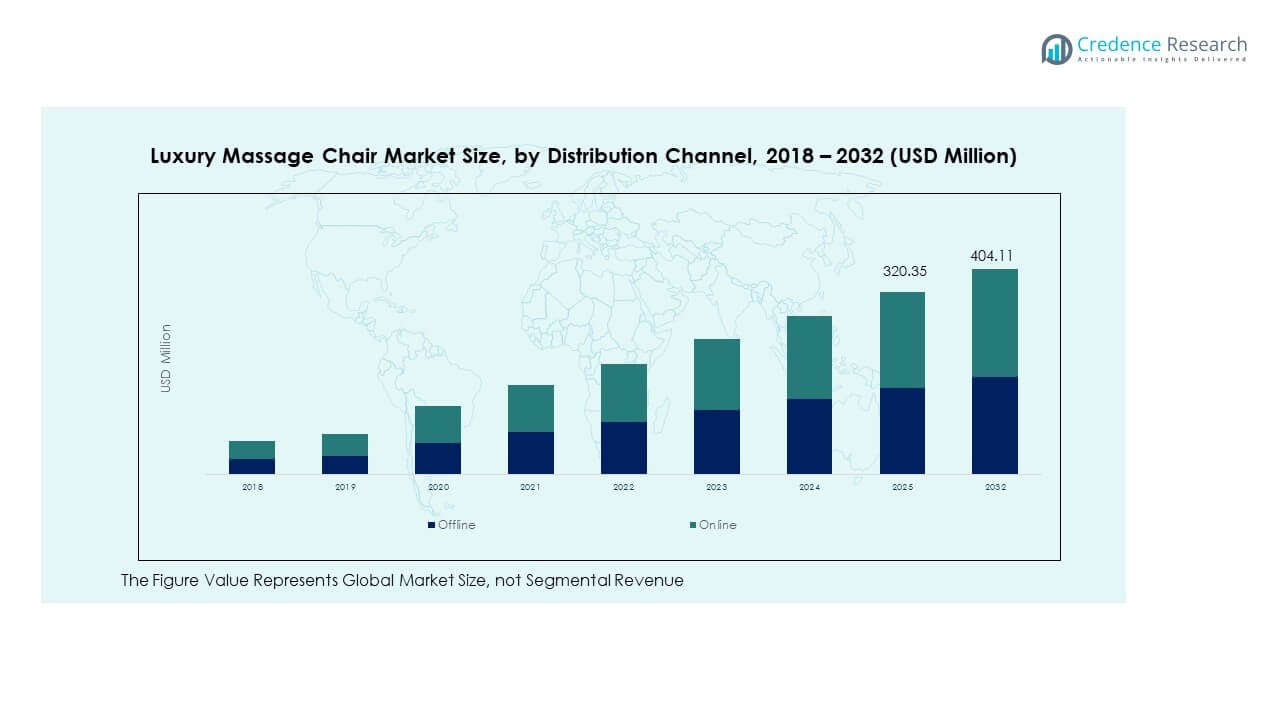
By Product Type
The Global Luxury Massage Chair Market is segmented into full body, zero gravity, heated, and inversion massage chairs. Full body chairs dominate due to comprehensive coverage and high comfort levels. Zero gravity models attract premium buyers seeking pressure-free relaxation. Heated massage chairs gain traction among users with muscle pain and circulation needs. Inversion chairs find a niche in spinal therapy applications. It continues to evolve with advanced ergonomics and design aesthetics meeting user comfort and wellness preferences.
- For instance, the OSIM uInfinity Luxe model-which was initially introduced around 2015-offers a zero-gravity recline feature (up to 150 degrees) and incorporates soothing warmth functions in the back and leg areas, designed for comfort and support.
By Technology Specificity
The market includes 2D, 3D, and 4D rollers along with airbag massage systems. 4D roller chairs lead the segment with superior flexibility and human-like massage experience. 3D variants remain popular in mid-range categories. Airbag systems enhance coverage and balance pressure distribution. It is driven by increasing use of AI-assisted control and smart sensors improving massage precision and customization.
- For instance, Bodyfriend's 2025 CES flagship massage chair, the 733 Robot Massage Chair (or SR-733), is a next-generation healthcare robot that features independently controlled arm and leg movements to facilitate exercises and rehabilitation activities. It also incorporates AI healthcare services and a wireless ECG holter to monitor biometric data, such as cardiac conditions and stress levels, and provide personalized wellness recommendations.
By End-User
The market serves residential and commercial users. Residential users dominate due to home wellness adoption and online accessibility. Commercial spaces such as hotels, spas, and offices expand installations for relaxation amenities. It reflects growing awareness of luxury health investments in both personal and professional environments.
By Performance Features
The key features include zero gravity, heat therapy, Bluetooth connectivity, and body scanning. Zero gravity enhances comfort, while body scanning ensures accurate alignment. Heat therapy supports muscle recovery, and Bluetooth adds entertainment integration. It enhances user satisfaction through technology-enabled relaxation.
By Distribution Channel
The market operates through offline and online channels. Offline retail maintains strength with experiential buying. Online platforms expand reach through product visualization and virtual demos. It benefits from global digital retail growth and changing consumer behavior.
Segmentation:
By Product Type
- Full Body Massage Chairs
- Zero Gravity Massage Chairs
- Heated Massage Chairs
- Inversion Massage Chairs
By Technology Specificity
- 2D Rollers
- 3D Rollers
- 4D Rollers
- Airbag Massage
By End-User
- Residential
- Commercial
By Performance Features
- Zero Gravity
- Heat Therapy
- Bluetooth Connectivity
- Body Scanning
By Distribution Channel
- Offline
- Online
By Region
- North America:S., Canada, Mexico
- Europe: UK, France, Germany, Italy, Spain, Russia, Rest of Europe
- Asia-Pacific: China, Japan, South Korea, India, Australia, Southeast Asia, Rest of Asia-Pacific
- Latin America: Brazil, Argentina, Rest of Latin America
- Middle East: GCC Countries, Israel, Turkey, Rest of Middle East
- Africa: South Africa, Egypt, Rest of Africa
Regional Analysis:
North America
The North America Luxury Massage Chair Market size was valued at USD 108.61 million in 2018, reached USD 115.32 million in 2024, and is anticipated to reach USD 149.36 million by 2032, at a CAGR of 3.4% during the forecast period. North America holds a 36.9% share of the Global Luxury Massage Chair Market. The region leads due to high consumer spending on premium wellness and home relaxation products. Advanced retail infrastructure and strong brand presence drive sustained demand. The United States dominates the regional landscape with a focus on comfort technology and connected home devices. It benefits from increasing adoption in spas, hotels, and corporate offices. Canada shows growing interest through expanding e-commerce platforms. Demand for AI-integrated models is also increasing. The region continues to set standards for luxury and innovation in wellness furniture.
Europe
The Europe Luxury Massage Chair Market size was valued at USD 59.16 million in 2018, reached USD 60.38 million in 2024, and is anticipated to reach USD 72.64 million by 2032, at a CAGR of 2.4% during the forecast period. Europe accounts for a 17.9% market share globally. The market is driven by growing consumer inclination toward stress management and therapeutic relaxation. Countries such as Germany, the UK, and France are the leading contributors. It is expanding across wellness resorts, health clinics, and home use. Rising awareness about ergonomic wellness supports adoption across urban regions. Manufacturers focus on sleek, design-oriented models suited for modern interiors. Online retailing and cross-border trade further enhance accessibility. The region maintains steady growth driven by lifestyle enhancement and wellness awareness.
Asia Pacific
The Asia Pacific Luxury Massage Chair Market size was valued at USD 91.64 million in 2018, reached USD 101.84 million in 2024, and is anticipated to reach USD 142.77 million by 2032, at a CAGR of 4.4% during the forecast period. Asia Pacific holds a 34.8% share of the Global Luxury Massage Chair Market. The region is the fastest-growing due to deep cultural integration of massage therapy and rapid technological innovation. Japan, China, and South Korea dominate production and consumption. It benefits from rising income levels and preference for smart home wellness devices. Local manufacturers introduce compact and cost-efficient designs catering to diverse user needs. India and Southeast Asia are emerging as new growth frontiers. Growing urbanization and expanding retail penetration strengthen regional performance. The region leads innovation through integration of AI and robotics in massage technology.
Latin America
The Latin America Luxury Massage Chair Market size was valued at USD 12.18 million in 2018, reached USD 12.90 million in 2024, and is anticipated to reach USD 14.90 million by 2032, at a CAGR of 1.9% during the forecast period. Latin America contributes about 3.6% market share globally. The market is at a developing stage with growing urban wellness awareness. Brazil remains the largest market supported by rising disposable income and urban lifestyle changes. It is witnessing steady demand from residential users and hospitality sectors. Limited product availability and high import duties constrain expansion. Local distributors are partnering with global brands to improve accessibility. Mexico and Argentina are emerging with retail and online growth potential. The market outlook remains positive due to expanding middle-class spending on comfort products.
Middle East
The Middle East Luxury Massage Chair Market size was valued at USD 8.41 million in 2018, reached USD 8.29 million in 2024, and is anticipated to reach USD 9.34 million by 2032, at a CAGR of 1.6% during the forecast period. The region represents about 2.3% share of the Global Luxury Massage Chair Market. Rising hospitality investments and luxury wellness centers are key growth factors. The UAE and Saudi Arabia lead demand with premium relaxation products in hotels and offices. It benefits from expanding tourism and wellness retreats. High-income consumers in urban centers drive niche luxury purchases. Limited manufacturing base remains a challenge, increasing reliance on imports. Online retail channels are gaining traction among tech-savvy consumers. The region shows potential for long-term growth with rising wellness awareness.
Africa
The Africa Luxury Massage Chair Market size was valued at USD 10.01 million in 2018, reached USD 12.87 million in 2024, and is anticipated to reach USD 15.10 million by 2032, at a CAGR of 1.8% during the forecast period. Africa accounts for about 4.5% market share globally. The market remains nascent but shows gradual improvement in awareness and accessibility. South Africa and Egypt are leading markets supported by growing upper-middle-class spending. It benefits from increasing wellness tourism and commercial adoption in hotels and spas. Local distribution and retail expansion help improve product reach. Rising healthcare awareness supports therapeutic applications of massage chairs. Limited affordability and product servicing remain barriers to faster growth. The region holds future promise with urbanization and lifestyle transformation driving adoption.
Key Player Analysis:
- OSIM International Pte Ltd.
- Panasonic Corporation
- Human Touch LLC
- Infinity Massage Chairs
- Cozzia USA
- Kahuna Massage Chair
- Bodyfriend Co. Ltd.
- Luraco Technologies Inc.
- Ogawa World USA
- Fujiiryoki Co. Ltd.
- Inada Co. Ltd.
- Titan Chair LLC
- Synca Wellness
Competitive Analysis:
The Global Luxury Massage Chair Market is moderately consolidated with the presence of several leading brands offering advanced wellness products. Key players such as OSIM International, Panasonic Corporation, Human Touch LLC, and Bodyfriend Co. Ltd. dominate through technological innovation and brand reputation. It is driven by continuous product upgrades, smart connectivity, and personalized comfort solutions. Companies invest in AI-enabled massage systems and ergonomic designs to attract premium customers. Regional expansion, e-commerce integration, and wellness partnerships strengthen global positioning. Competitive differentiation focuses on design aesthetics, automation precision, and long-term reliability.
Recent Developments:
- In January 2025, OSIM showcased its latest wellness technology products at CES 2025. This launch received strong coverage in mainstream business and tech news, with visitors and media highlighting OSIM’s innovative wellbeing chairs and massage products designed to enhance relaxation through smart, user-centric features. The company continues to expand by leveraging technology upgrades and collaborations unveiled at global expos.
- In January 2025, Bodyfriend Co. Ltd. unveiled its next-generation 733 Robot Massage Chair at CES 2025 in Las Vegas. Major media sources confirm this chair features independent arm and leg movement, AI-powered health management, and holistic rehabilitation functions. This news is verified by global news coverage and recognized as a significant technological advancement at CES 2025.
Report Coverage:
The research report offers an in-depth analysis based on product type, technology specificity, end-user, performance features, and distribution channel. It details leading market players, providing an overview of their business, product offerings, investments, revenue streams, and key applications. Additionally, the report includes insights into the competitive environment, SWOT analysis, current market trends, as well as the primary drivers and constraints. Furthermore, it discusses various factors that have driven market expansion in recent years. The report also explores market dynamics, regulatory scenarios, and technological advancements that are shaping the industry. It assesses the impact of external factors and global economic changes on market growth. Lastly, it provides strategic recommendations for new entrants and established companies to navigate the complexities of the market.
Future Outlook:
- Rising integration of AI and IoT will redefine product personalization.
- Growing adoption in home wellness and luxury hospitality sectors.
- Manufacturers to focus on eco-friendly and sustainable materials.
- Increasing demand for compact and ergonomic models in urban homes.
- Expansion of online retail to enhance global consumer reach.
- Advancements in biometric sensors for precision massage mapping.
- Strategic collaborations to improve brand positioning across regions.
- Product design to emphasize minimalism and multifunctional utility.
- Enhanced after-sales service networks to build customer retention.
- Long-term growth supported by health consciousness and premium wellness trends.
Request a Free Sample
Fill in your details and we'll send you a free sample report.
- Sample data tables & charts
- Research methodology
Need a Custom Version of This Report?
Tailor the scope, geography, or segments to your exact requirements.
- Custom geography or segment scope
- Direct access to our analyst team
Frequently Asked Questions
What is the current market size for the Global Luxury Massage Chair Market, and what is its projected size in 2032?
At what Compound Annual Growth Rate is the Global Luxury Massage Chair Market projected to grow between 2025 and 2032?
Which Global Luxury Massage Chair Market segment held the largest share in 2024?
What are the primary factors fueling the growth of the Global Luxury Massage Chair Market?
Who are the leading companies in the Global Luxury Massage Chair Market?
Which region commanded the largest share of the Global Luxury Massage Chair Market in 2024?
Table of Content
Chapter 1. Report Introduction
- 1.1 Report Description & Purpose
- 1.1.1 Report Title & Market Definition
- 1.1.2 Unique Selling Propositions (USP) & Key Differentiators
- 1.1.3 Value Proposition for Stakeholders
- 1.2 Research Objectives
- 1.2.1 Market Sizing Objectives (Volume & Revenue) (Volume Where Applicable)
- 1.2.2 Segmentation Objectives
- 1.2.3 Competitive Intelligence Objectives
- 1.2.4 Forecast & Scenario Objectives
- 1.3 Report Scope
- 1.3.1 Luxury Massage Chair Scope – Segments & Subsegments Covered
- 1.3.2 Geographic Scope – Regions & Countries Covered
- 1.3.3 Historical Period, Base Year & Forecast Period (2024; forecast to 2032)
- 1.3.4 Inclusions & Exclusions
- 1.4 Industry Classification & Applicable Codes
- 1.5 Currency, Measurement Units & Valuation Basis
- 1.6 Target Stakeholders
- 1.7 Limitations & Assumptions
Chapter 2. Executive Summary
- 2.1 Global Luxury Massage Chair Market Snapshot
- 2.1.1 Market Size – Historical (2024) & Forecast (2024-2032) (2024: USD 311.60 million → 2032: USD 404.11 million)
- 2.1.2 Volume & Revenue – Global Totals (Volume Where Applicable)
- 2.1.3 Key Market Highlights – Top Five Facts
- 2.2 Luxury Massage Chair Market Segmentation Snapshot
- 2.2.1 Market Split by Region – 2024 vs. 2032
- 2.3 Competitive Snapshot
- 2.3.1 Top 10 Players by Revenue Share – 2024
- 2.3.2 Top 10 Players by Volume Share – 2024 (Volume Where Applicable)
- 2.3.3 Recent Strategic Developments (18-Month Summary)
- 2.4 Key Investment Highlights & Strategic Conclusions
Chapter 3. Luxury Massage Chair Market Dynamics & Industry Analysis
- 3.1 Market Overview & Context
- 3.1.1 Luxury Massage Chair Market Position in the Broader Industry Value Chain
- 3.1.2 Demand Structure & Purchasing Dynamics
- 3.1.3 Market Maturity & Development Stage by Region
- 3.2 Luxury Massage Chair Market Drivers
- 3.3 Luxury Massage Chair Market Restraints & Challenges
- 3.4 Luxury Massage Chair Market Opportunities
- 3.5 Porter's Five Forces Analysis
- 3.5.1 Threat of New Entrants
- 3.5.2 Bargaining Power of Suppliers
- 3.5.3 Bargaining Power of Buyers
- 3.5.4 Threat of Substitutes
- 3.5.5 Competitive Rivalry – Intensity Assessment
- 3.6 Luxury Massage Chair Value Chain Analysis
- 3.6.1 Upstream – Key Inputs, Resources & Suppliers
- 3.6.1.1 Key Input/Resource 1
- 3.6.1.2 Key Input/Resource 2
- 3.6.1.3 Key Input/Resource 3
- 3.6.2 Midstream – Core Operations & Value Creation
- 3.6.2.1 Operating Model & Process Overview
- 3.6.2.2 Key Operating Locations & Capabilities by Company
- 3.6.3 Downstream – Market Channels & End Users
- 3.6.3.1 Direct Sales & Customer Engagement Channels
- 3.6.3.2 Indirect Sales, Intermediaries & Partner Channels
- 3.6.4 Value Chain Profitability Analysis
- 3.6.1 Upstream – Key Inputs, Resources & Suppliers
- 3.7 PESTEL Analysis
- 3.7.1 Political Factors
- 3.7.2 Economic Factors
- 3.7.3 Social Factors
- 3.7.4 Technological Factors
- 3.7.5 Environmental Factors
- 3.7.6 Legal Factors
- 3.8 Luxury Massage Chair Supply Chain Analysis
- 3.8.1 Critical Input & Resource Availability Risk Assessment
- 3.8.2 Supplier & Operational Concentration Risk (Geographic Exposure)
- 3.8.3 Supply & Service Disruption Impact Analysis
- 3.9 Regulatory & Policy Landscape
Note: The regulatory and policy landscape section covers regulations based on their applicability to the market, Luxury Massage Chair category, geography, and scope of the study. Only regulatory frameworks with a material impact on operations, compliance, trade, sustainability, or market access are analyzed in detail.
Chapter 4. Key Investment Pockets & Opportunity Analysis
- 4.1 Luxury Massage Chair Market Attractiveness Analysis
- 4.1.1 By Region – Investment Attractiveness Matrix (Market Size × CAGR)
- 4.2 Absolute Revenue Growth Opportunity
- 4.2.1 By Region – Absolute Revenue Growth Through 2032
- 4.3 Incremental Demand Opportunity
- 4.3.1 By Region – Incremental Demand Through 2032
- 4.3.2 Segment – Incremental Demand
- 4.4 Emerging Submarket Opportunity Deep Dive (Subject to Applicability)
- 4.5 Priority Market Opportunity Scorecards
- 4.5.1 United States
- 4.5.2 Europe
- 4.5.3 Asia
- 4.5.4 Middle East & Africa
Note: Priority market opportunity scorecards reflect the geographic scope and strategic relevance of the study. Listed markets are indicative and may be adapted to the industry.
Chapter 5. Luxury Massage Chair Cross-Border Trade & Market Access Analysis
- 5.1 International Trade & Cross-Border Activity Overview
- 5.1.1 Global Export Value by Country (2024)
- 5.1.2 Global Export Volume by Country (2024) (Volume Where Applicable)
- 5.1.3 Global Import Value by Country (2024)
- 5.1.4 Global Import Volume by Country (2024) (Volume Where Applicable)
- 5.1.5 Net Trade Balance by Country (2024)
- 5.2 Export Analysis – Segment
- 5.2.1 Category 1 (Applicable Classification Code)
- 5.2.2 Category 2 (Applicable Classification Code)
- 5.2.3 Category 3 (Applicable Classification Code)
- 5.2.4 Category 4 (Applicable Classification Code)
- 5.2.5 Category 5 (Applicable Classification Code)
- 5.3 Import Analysis – Segment
- 5.3.1 Category 1 (Applicable Classification Code)
- 5.3.2 Category 2 (Applicable Classification Code)
- 5.3.3 Category 3 (Applicable Classification Code)
- 5.3.4 Category 4 (Applicable Classification Code)
- 5.3.5 Category 5 (Applicable Classification Code)
- 5.4 Cross-Border Pricing & Transaction Benchmarks
- 5.4.1 Export Pricing – Segment & Country
- 5.4.2 Import Pricing – Segment & Source Country
- 5.4.3 Price Trends (2024)
- 5.5 Key Cross-Border Trade & Delivery Routes
- 5.5.1 Cross-Border Trade/Delivery Route 1
- 5.5.2 Cross-Border Trade/Delivery Route 2
- 5.5.3 Cross-Border Trade/Delivery Route 3
- 5.5.4 Cross-Border Trade/Delivery Route 4
- 5.5.5 Cross-Border Trade/Delivery Route 5
- 5.6 Trade Policy & Market Access Impact Assessment
- 5.6.1 Tariff & Non-Tariff Barriers
- 5.6.2 Regional Trade & Economic Integration Frameworks
- 5.6.3 Bilateral & Multilateral Trade Agreements
- 5.6.4 Cross-Border Operating, Licensing & Localization Requirements
Note: This chapter applies where cross-border trade or delivery is relevant to Luxury Massage Chair. Goods, services, and digital offerings are assessed using applicable classifications and transaction measures. Import-export volumes, trade balances, and route analyses are included only where meaningful to the market.
Chapter 6. Competitive Landscape & Company Benchmarking
- 6.1 Luxury Massage Chair Market Concentration & Structure
- 6.1.1 Herfindahl-Hirschman Index (HHI) – vs. 2024
- 6.1.2 Leading, Mid-Sized & Emerging Player Structure
- 6.1.3 Global, Regional & Local Player Dynamics
- 6.2 Luxury Massage Chair Market Share Analysis – 2024
- 6.2.1 Global Revenue Share by Company
- 6.2.2 Global Volume Share by Company (Volume Where Applicable)
- 6.2.3 Regional Revenue Share
- 6.2.4 Market Share Evolution ( vs. 2024)
- 6.2.5 Company Market Share by Key Segment
- 6.2.6 Company Market Share by Customer Group
- 6.3 Operating Scale, Capacity & Infrastructure Analysis
- 6.3.1 Global Operating Scale & Supply Capacity
- 6.3.2 Resource Utilization & Operating Efficiency
- 6.3.3 Output, Service Delivery & Activity Metrics
- 6.3.4 Operating Footprint & Infrastructure Map
- 6.3.5 Planned Operational & Capacity Expansion
- 6.4 Luxury Massage Chair Competitive Benchmarking Matrix
- 6.4.1 Revenue, Growth, Profitability & Operating Metric Comparison
- 6.4.2 Channel Revenue Mix
- 6.4.3 Geographic Revenue Exposure
- 6.4.4 R&D Intensity
- 6.4.5 Sustainability Maturity
- 6.5 Strategic Developments in Luxury Massage Chair (Last 24 Months)
- 6.5.1 Mergers, Acquisitions & Divestments
- 6.5.2 New Products, Services & Solutions in Luxury Massage Chair
- 6.5.3 Operational & Infrastructure Expansions
- 6.5.4 Strategic Alliances, Joint Ventures & Partnerships
- 6.5.5 Distribution Expansion & Market Entry
- 6.5.6 Sustainability & ESG Initiatives
- 6.6 Competitive Strategy Mapping
- 6.6.1 Leader, Challenger, Follower & Niche Classification
- 6.6.2 Pricing Strategy Comparison
- 6.6.3 Channel Strategy Matrix
Note: Strategic developments are included based on their materiality and the availability of reliable information.
Chapter 7. Global Luxury Massage Chair Market – By Sales & Delivery Channel
- 7.1 Segment Overview
- 7.1.1 Volume & Revenue Split by Channel (2024 & 2032) (Volume Where Applicable)
- 7.1.2 Channel Mix Evolution (2024-2032)
Chapter 8. Regional Market Analysis – Global Overview
- 8.1 Global Regional Overview
- 8.1.1 Regional Volume Share (Volume Where Applicable)
- 8.1.2 Regional Revenue Share
- 8.1.3 Regional Volume by Region (Volume Where Applicable)
- 8.1.4 Regional Revenue by Region
- 8.1.5 Regional Forecast Through 2032
- 8.2 Cross-Regional Segment Analysis
- 8.2.1 By Sales & Delivery Channel
- 8.2.2 By Competitive Positioning & Price Tier
Chapter 9. North America Luxury Massage Chair Market
- 9.1 United States
- 9.2 Canada
- 9.3 Mexico
Chapter 10. Europe Luxury Massage Chair Market
- 10.1 Germany
- 10.2 France
- 10.3 Italy
- 10.4 United Kingdom
- 10.5 Spain
- 10.6 Poland
- 10.7 Russia
- 10.8 Netherlands
- 10.9 Belgium
- 10.10 Sweden
- 10.11 Denmark
- 10.12 Norway
- 10.13 Rest of Europe
Chapter 11. Asia Pacific Luxury Massage Chair Market
- 11.1 China
- 11.2 India
- 11.3 Japan
- 11.4 South Korea
- 11.5 Thailand
- 11.6 Indonesia
- 11.7 Vietnam
- 11.8 Malaysia
- 11.9 Australia
- 11.10 Rest of Asia Pacific
Chapter 12. Latin America Luxury Massage Chair Market
- 12.1 Brazil
- 12.2 Argentina
- 12.3 Colombia
- 12.4 Chile
- 12.5 Rest of Latin America
Chapter 13. Middle East Luxury Massage Chair Market
- 13.1 Saudi Arabia
- 13.2 United Arab Emirates
- 13.3 Turkey
- 13.4 Israel
- 13.5 Iran
- 13.6 Rest of the Middle East
Chapter 14. Africa Luxury Massage Chair Market
- 14.1 South Africa
- 14.2 Egypt
- 14.3 Nigeria
- 14.4 Morocco
- 14.5 Rest of Africa
Chapter 15. Luxury Massage Chair Company Profiles
- 15.1 [Company 01]
- 15.1.1 Company Overview
- 15.1.2 Key Management Personnel
- 15.1.3 Products & Services Portfolio
- 15.1.4 Financial Performance
- 15.1.5 Key Market Focus & Geographic Presence
- 15.1.6 Recent Developments & Strategic Initiatives
Note: The company profile list is preliminary and may change based on research findings, market developments, data availability, and client requirements.
Chapter 16. Appendices
- Appendix A – List of Abbreviations & Acronyms
- Appendix B – Industry Classification Code Reference – Full Series
- Appendix C – Supply, Output & Operating Capacity Data Tables
- Appendix D – End-Use & Demand Base Tables
- Appendix E – Demand, Adoption & Usage Assumptions
- Appendix F – Pricing & Revenue Metric Reference Tables
- Appendix G – Company Operations & Infrastructure Database
- Appendix H – Cross-Border Trade & Activity Data Tables (Where Applicable)
- Appendix I – Regulatory Summary Tables
- Appendix J – Primary Research Participant List (Anonymized)
- Appendix K – Primary Research Questionnaire Framework
- Appendix L – Data Sources & Bibliography
- Appendix M – Market Size Divergence & Source Comparison
Chapter 17. Research Methodology
- 17.1 Research Framework & Philosophy
- 17.2 Secondary Research – Sources, Hierarchy & Data Extraction
- 17.3 Data Modeling – Bottom-Up & Top-Down Market Sizing
- 17.4 Primary Research – Stakeholder Framework, LOI & Sample Sizes
- 17.5 Forecast Methodology – Regression, Scenario & Sensitivity Analysis
- 17.6 Quality Control – Four-Layer Validation Framework
- 17.7 Limitations & Standard Assumptions
- 17.8 Disclaimer
