
Market Overview:
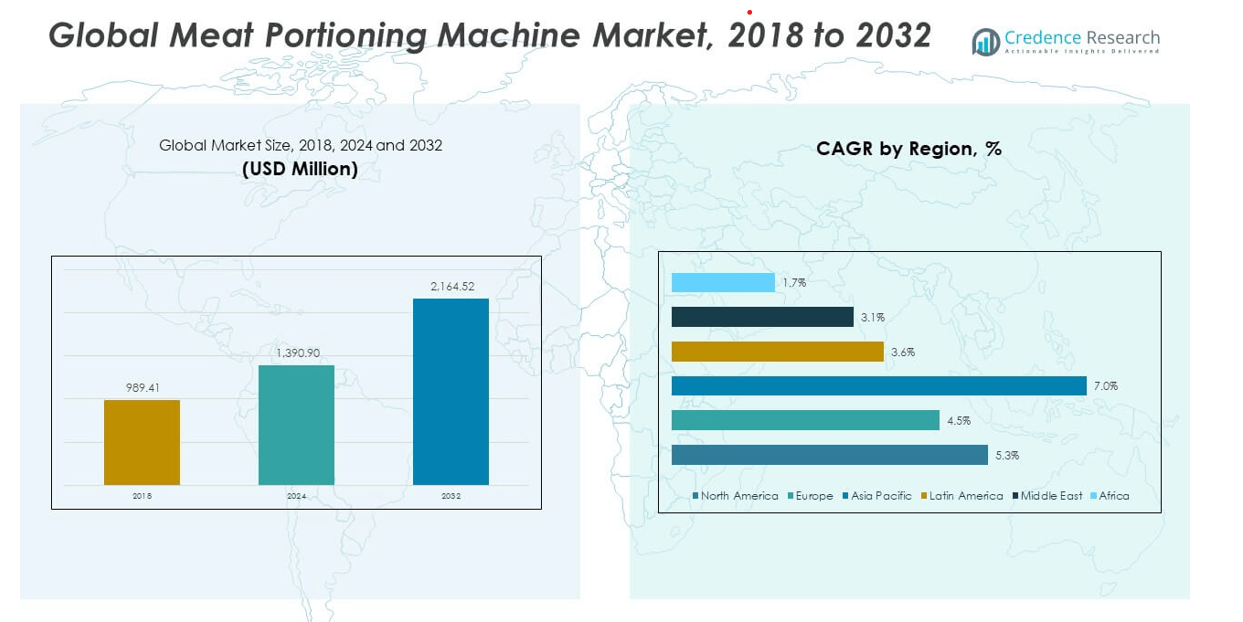
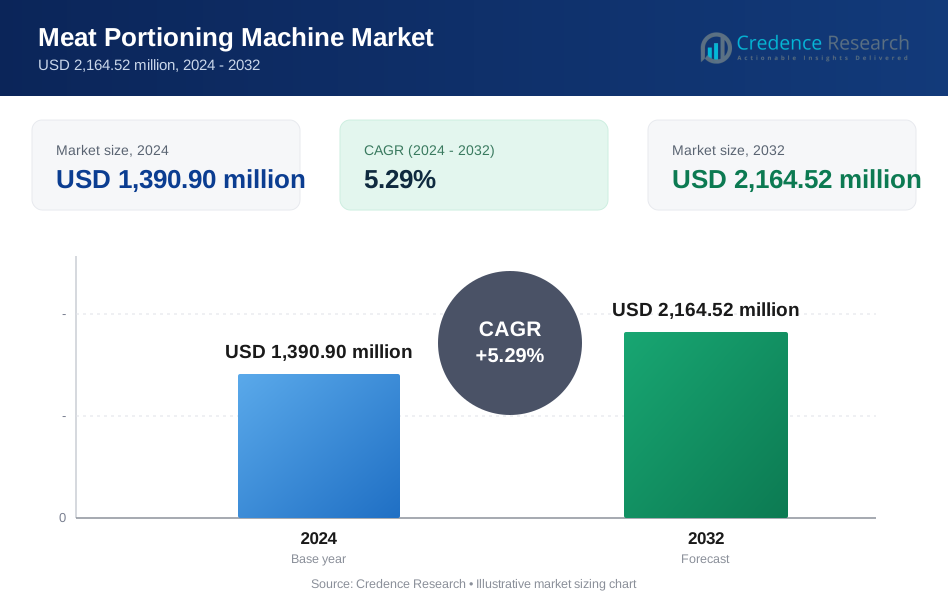
The Global Meat Portioning Machine Market size was valued at USD 989.41 million in 2018, increased to USD 1,390.90 million in 2024, and is anticipated to reach USD 2,164.52 million by 2032, growing at a CAGR of 5.29% during the forecast period.
| REPORT ATTRIBUTE | DETAILS |
|---|---|
| Historical Period | 2020-2023 |
| Base Year | 2024 |
| Forecast Period | 2025-2032 |
| Meat Portioning Machine Market Size 2024 | USD 1,390.90 million |
| Meat Portioning Machine Market, CAGR | 5.29% |
| Meat Portioning Machine Market Size 2032 | USD 2,164.52million |
The market growth is driven by rising automation in the food processing industry and the growing demand for precise portion control in meat production. Manufacturers are adopting advanced technologies such as computer vision, robotics, and sensor integration to enhance cutting accuracy and minimize waste. Increasing global meat consumption and the need for high-speed processing equipment in slaughterhouses and meat plants further support demand. Hygiene regulations and labor shortages are also pushing companies toward automated portioning systems.
North America and Europe lead the Global Meat Portioning Machine Market due to established meat processing industries, technological advancements, and strict hygiene standards. The Asia Pacific region is emerging rapidly, driven by rising meat consumption, expanding food processing infrastructure, and increasing adoption of automation in China and India. Latin America shows steady growth, supported by strong meat exports and modernization efforts in processing facilities. The Middle East and Africa are gradually developing, with growing investments in food production technology.
Market Insights:
- The Global Meat Portioning Machine Market was valued at USD 989.41 million in 2018, reached USD 1,390.90 million in 2024, and is anticipated to hit USD 2,164.52 million by 2032, growing at a CAGR of 5.29% during the forecast period.
- North America (43.7%), Europe (27.8%), and Asia Pacific (20.1%) together account for over 90% of the global share in 2024, supported by advanced processing technologies, strict hygiene regulations, and strong demand for processed meat across industrial and retail sectors.
- Asia Pacific, with a 20.1% share, is the fastest-growing region, fueled by rising meat consumption, modernization of slaughterhouses, and rapid automation adoption in China, India, and Southeast Asia.
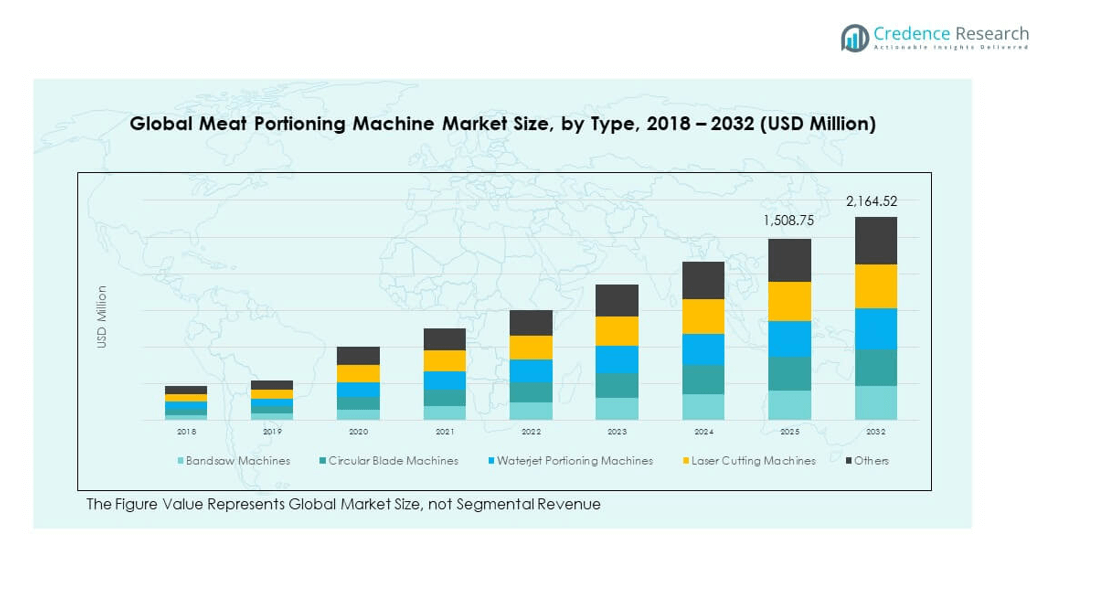
- Based on segment distribution, Bandsaw Machines (30%) and Circular Blade Machines (28%) dominate due to their reliability, ease of operation, and suitability for high-volume meat processing lines.
- Waterjet Portioning Machines (18%), Laser Cutting Machines (14%), and Others (10%) collectively hold the remaining share, driven by demand for precision cutting and customized meat applications.
Market Drivers:
Rising Demand for Automation and Precision in Meat Processing
Automation plays a critical role in improving yield, accuracy, and efficiency across meat production lines. The Global Meat Portioning Machine Market benefits from food processors seeking precise portion sizes to reduce waste and maintain consistent quality. Automated machines reduce manual labor dependency and ensure uniformity in weight and thickness. Demand from industrial slaughterhouses and meat packaging units continues to grow due to labor shortages and hygiene requirements. It is also driven by the increasing need for faster production cycles. Automation helps optimize meat cutting for value-added products like steaks, fillets, and nuggets. Manufacturers integrate sensors and advanced vision systems to improve precision. The overall push toward digitized food processing strengthens global adoption.
- For instance, Marel’s I-Cut 130 portion cutter employs a laser and mirror vision system for high-precision cutting, enabling up to 1,000 cuts per minute while integrating seamlessly with factory software to optimize production and minimize raw material giveaway.
Growing Consumption of Processed and Packaged Meat Products
The shift in consumer lifestyle toward convenience and protein-rich diets drives the use of portioning machines. The Global Meat Portioning Machine Market experiences growth from increased consumption of processed meats, ready-to-eat meals, and frozen food products. Urbanization and rising disposable incomes have fueled demand for pre-packed meat products. Retail and foodservice sectors depend on consistent portion sizes for inventory control and profitability. Portioning technology helps standardize output across high-volume processing plants. Meat brands prefer automated systems to maintain safety and meet consumer expectations for uniformity. The market benefits from global fast-food expansion and retail-ready meat packaging. This growing consumer base directly fuels machine sales worldwide.
- For instance, GEA’s OptiSlicer 6000 enables processors to slice at up to 1,500 revolutions per minute, handling multiple product logs of up to 1,850 mm in length, with intelligent software automatically adjusting slice thickness and cut counts for precise and efficient production.
Stringent Food Safety Regulations and Hygiene Standards
Government and international bodies impose strict regulations to ensure safe meat handling and minimize contamination risks. The Global Meat Portioning Machine Market gains traction as processors invest in machines designed for easy sanitation and compliance. Stainless steel construction, minimal contact surfaces, and automated cleaning systems are now essential features. Companies adopt hygienic design principles to meet global standards such as HACCP and ISO 22000. It encourages innovation in machine design for clean-in-place operations. Compliance with export standards pushes manufacturers to upgrade outdated machinery. Hygiene-focused automation reduces human handling and microbial risks. These initiatives collectively improve product quality and operational reliability.
Integration of Advanced Technologies in Meat Portioning Equipment
Technology integration reshapes the efficiency and accuracy of meat portioning systems. The Global Meat Portioning Machine Market benefits from the adoption of robotics, AI-based vision systems, and digital calibration tools. These systems optimize throughput while minimizing material loss. Real-time monitoring and data analytics help processors track yield and equipment performance. Smart machines can automatically adjust to different meat textures and thicknesses. Connectivity features allow remote diagnostics and predictive maintenance, improving uptime. Technological advancements also support customization in cutting styles. The use of intelligent systems transforms traditional portioning into a precise, data-driven process.
Market Trends:
Rising Adoption of Smart and Connected Portioning Systems
Manufacturers increasingly deploy IoT-enabled portioning machines for predictive maintenance and real-time performance tracking. The Global Meat Portioning Machine Market is shifting toward connected solutions that enhance efficiency and transparency. These smart systems provide detailed insights into yield, downtime, and production flow. Integration with ERP and MES platforms allows seamless data exchange. It improves traceability and helps comply with food safety documentation requirements. Cloud-based analytics support decision-making for process optimization. The trend aligns with Industry 4.0 practices across food processing facilities. Smart connectivity enhances operational visibility, driving competitive advantage.
- For instance, the TREIF Falcon Evolution integrates 4D camera systems and an in-line weighing system to automatically scan, calibrate, and portion meat by required weight or thickness with an output capacity of up to 550 cuts per minute, enabling processors to optimize yield and maintain uniformity across production runs.
Sustainability and Energy-Efficient Equipment Designs
The industry focuses on minimizing energy consumption and reducing material waste. The Global Meat Portioning Machine Market embraces eco-friendly designs featuring energy-efficient motors and recyclable materials. Manufacturers develop machines that reduce water and cleaning agent usage. Sustainable production aligns with food industry commitments to carbon neutrality. Equipment makers adopt modular designs for easier upgrades instead of full replacements. The shift supports cost savings and operational sustainability. Demand for green technologies grows in Europe and North America due to strict environmental norms. These efforts strengthen the long-term viability of the industry.
- For instance, Weber Maschinenbau’s latest automated slicing lines incorporate innovative servo motor designs and camera-supported fat-layer detection to reduce manual trimming and improve production efficiency with automated, precise portion control.
Customization and Flexibility in Portioning Applications
Food processors seek flexible machines capable of handling diverse meat types and formats. The Global Meat Portioning Machine Market is witnessing innovation in modular systems that adapt to product variation. Advanced control interfaces allow quick adjustments in cut size and pattern. Equipment flexibility supports small-batch and large-scale production equally. It helps processors serve both retail and foodservice clients efficiently. Machines now integrate auto-adjust functions to manage different meat densities. This customization trend enhances throughput without compromising precision. Flexibility ensures adaptability to evolving market needs and customer preferences.
Growth of E-Commerce and Direct-to-Consumer Meat Channels
The rise of online meat delivery platforms increases demand for precise and hygienic meat cutting. The Global Meat Portioning Machine Market benefits as processors invest in compact, efficient machines for decentralized facilities. Smaller automated units support regional fulfillment centers serving digital retailers. E-commerce players prefer consistent portioning to maintain brand quality and minimize return rates. It drives higher adoption of easy-to-clean, compact, and low-maintenance designs. Automation improves turnaround time for online orders. The integration of portioning systems into digital supply chains enhances scalability. Growing e-commerce presence expands opportunities for technology adoption.
Market Challenges Analysis:
High Initial Investment and Maintenance Complexity
The cost of advanced portioning machines remains a significant barrier for small and mid-sized processors. The Global Meat Portioning Machine Market faces resistance from price-sensitive buyers in developing economies. Sophisticated technologies like laser-guided cutting and AI vision systems increase equipment costs. Regular calibration and maintenance require skilled operators, raising training expenses. High spare part prices and complex software add to total ownership cost. Limited financing options in emerging regions restrict modernization efforts. It leads many processors to depend on semi-automatic or manual solutions. Balancing affordability and technology access remains a challenge for market expansion.
Technical Limitations and Integration Barriers in Legacy Systems
Integrating new portioning systems with existing production lines is often complex and time-consuming. The Global Meat Portioning Machine Market encounters issues with compatibility and data synchronization. Older processing units lack standardized interfaces for digital connectivity. Software mismatches create inefficiencies and downtime during transitions. Variations in meat texture and temperature also affect cutting precision. Operators require consistent training to manage upgraded systems efficiently. Smaller facilities often lack infrastructure to support high-end machines. Overcoming these integration challenges is essential for achieving full automation potential.
Market Opportunities:
Rising Penetration of Automation Across Emerging Economies
Emerging regions present strong potential due to expanding meat processing infrastructure. The Global Meat Portioning Machine Market can capitalize on growing demand from Asia-Pacific and Latin America. Governments promote food industry modernization through subsidies and technology programs. Automation adoption helps meet export quality standards in developing markets. Local manufacturers partner with global firms to introduce cost-effective machines. Increased urbanization and dietary shifts create steady growth prospects. These economies offer opportunities for mid-range automated solutions. Expanding cold chain logistics further supports wider equipment deployment.
Product Innovation and Technological Advancements for Future Growth
Ongoing innovation creates a favorable landscape for new machine designs and digital features. The Global Meat Portioning Machine Market gains from AI integration, vision-based sorting, and robotic precision systems. Manufacturers invest in research to improve speed, yield, and hygiene efficiency. Development of compact, modular equipment appeals to small processors. Cloud-based data tools enhance performance tracking and maintenance scheduling. Custom software solutions help optimize line productivity. These advancements provide competitive differentiation for technology providers. Rapid product evolution ensures long-term market resilience.
Market Segmentation Analysis:
By Type
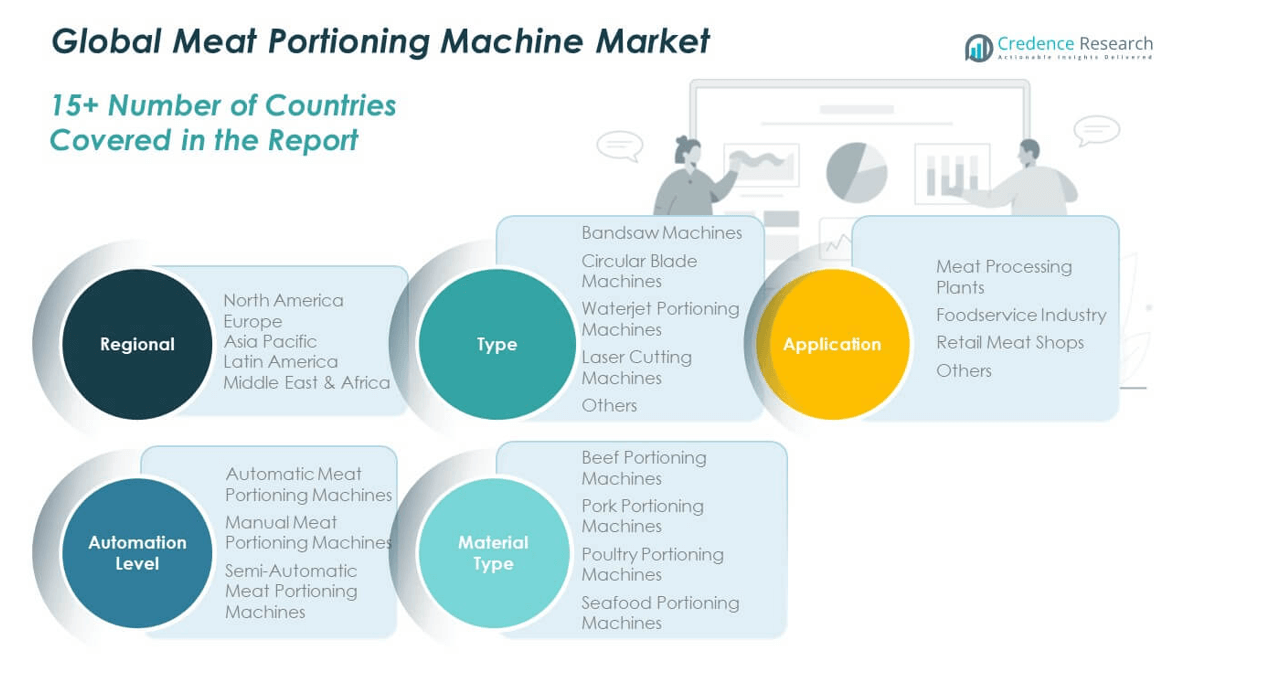
The Global Meat Portioning Machine Market is segmented into bandsaw machines, circular blade machines, waterjet portioning machines, laser cutting machines, and others. Bandsaw machines dominate due to their versatility and widespread use in high-volume meat processing facilities. Circular blade machines are gaining popularity for their precision in cutting uniform meat portions, especially in mid-scale operations. Waterjet portioning machines are expanding their presence due to their ability to deliver clean, residue-free cuts suitable for premium meat segments. Laser cutting machines, though in a niche phase, are emerging as advanced solutions for automated, contactless cutting. The others category includes customized and hybrid machines used in specialized applications across small and medium enterprises. It benefits from continuous innovation focused on speed, safety, and precision enhancement.
- For instance, Frontmatec’s automatic waterjet portioning systems use high-pressure cutters (up to 60,000 psi) to precisely cut premium meat cuts, securing optimum yield and consistent product quality for industrial scale production.
By Application
By application, the market is categorized into meat processing plants, foodservice industry, retail meat shops, and others. Meat processing plants hold the largest share due to large-scale production needs and the growing preference for automation to maintain hygiene and efficiency. The foodservice industry is adopting portioning equipment to ensure uniform serving sizes and reduce manual labor. Retail meat shops are integrating compact, user-friendly machines to improve cutting accuracy and customer satisfaction. The others segment includes catering and institutional kitchens utilizing smaller, portable units. The demand across all applications is supported by hygiene regulations, consistent portion control, and labor optimization trends.
- For instance, Multivac’s GMS 1000 meat portioning line for industry and trade, as showcased at IFFA 2025, enables real-time weight control and target portion adjustments throughout the production process, ensuring accurate portion weight, minimizing giveaway, and boosting process transparency for both large-scale and mid-sized operators.
Segmentation:
By Type
- Bandsaw Machines
- Circular Blade Machines
- Waterjet Portioning Machines
- Laser Cutting Machines
- Others
By Application
- Meat Processing Plants
- Foodservice Industry
- Retail Meat Shops
- Others
By Automation Level
- Automatic Meat Portioning Machines
- Manual Meat Portioning Machines
- Semi-Automatic Meat Portioning Machines
By Material Type
- Beef Portioning Machines
- Pork Portioning Machines
- Poultry Portioning Machines
- Seafood Portioning Machines
By Region
- North America
- U.S.
- Canada
- Mexico
- Europe
- Germany
- France
- U.K.
- Italy
- Spain
- Rest of Europe
- Asia Pacific
- China
- Japan
- India
- South Korea
- South-east Asia
- Rest of Asia Pacific
- Latin America
- Brazil
- Argentina
- Rest of Latin America
- Middle East & Africa
- GCC Countries
- South Africa
- Rest of the Middle East and Africa
Regional Analysis:
North America
The North America Global Meat Portioning Machine Market size was valued at USD 436.56 million in 2018 to USD 607.41 million in 2024 and is anticipated to reach USD 947.84 million by 2032, at a CAGR of 5.3% during the forecast period. Market share (2024): 43.7%. North America dominates due to its advanced meat processing infrastructure, strict food safety standards, and high consumption of processed meat. Manufacturers in the region invest heavily in automation, robotics, and smart portioning systems to improve precision and reduce operational costs. The demand is supported by large-scale foodservice chains, retail packaging operations, and export-oriented meat industries. The U.S. remains the leading market due to high technology adoption and established distribution networks, while Canada and Mexico show steady growth. It continues to benefit from rising investments in equipment modernization and sustainability-driven innovation across the food processing ecosystem.
Europe
The Europe Global Meat Portioning Machine Market size was valued at USD 285.18 million in 2018 to USD 386.68 million in 2024 and is anticipated to reach USD 567.12 million by 2032, at a CAGR of 4.5% during the forecast period. Market share (2024): 27.8%. Europe remains a strong market driven by strict hygiene regulations, premium meat demand, and advanced food technology adoption. Countries like Germany, the UK, and France lead in automation, precision slicing, and energy-efficient equipment use. The market benefits from well-developed cold-chain logistics and growing exports of processed meats. Western Europe focuses on sustainability and compliance with EU food safety frameworks, while Eastern Europe expands capacity with affordable semi-automated solutions. Local manufacturers emphasize modular designs and quick sanitation features to align with evolving consumer and regulatory expectations. It is witnessing steady technology integration, ensuring long-term operational efficiency and competitiveness.
Asia Pacific
The Asia Pacific Global Meat Portioning Machine Market size was valued at USD 183.16 million in 2018 to USD 279.93 million in 2024 and is anticipated to reach USD 495.45 million by 2032, at a CAGR of 7.0% during the forecast period. Market share (2024): 20.1%. Asia Pacific is the fastest-growing regional market, driven by rising protein consumption, expanding retail networks, and rapid urbanization. China dominates production and adoption due to large-scale meat processing facilities and government-led modernization programs. India and Southeast Asian countries are increasingly investing in automated and hygienic systems for poultry and seafood processing. Affordable labor supports flexible automation strategies, while exports drive demand for high-precision equipment. Local partnerships with global brands enhance accessibility and service support. It continues to attract investments from global manufacturers aiming to establish regional assembly and service hubs to meet growing domestic and export needs.
Latin America
The Latin America Global Meat Portioning Machine Market size was valued at USD 43.77 million in 2018 to USD 60.71 million in 2024 and is anticipated to reach USD 82.87 million by 2032, at a CAGR of 3.6% during the forecast period. Market share (2024): 4.4%. Latin America shows stable growth, led by Brazil and Argentina’s expanding beef and poultry industries. The region’s strong export orientation and demand for standardized meat cuts encourage investment in portioning automation. Processors are increasingly adopting durable, energy-efficient machines to meet international hygiene and packaging standards. Government support for modernizing slaughterhouses and packaging facilities further boosts adoption. Technological penetration remains uneven, with smaller players focusing on low-cost semi-automatic systems. It benefits from improving cold-chain infrastructure and trade agreements supporting processed meat exports. Continued modernization in Brazil and Mexico drives incremental market expansion.
Middle East
The Middle East Global Meat Portioning Machine Market size was valued at USD 27.83 million in 2018 to USD 35.77 million in 2024 and is anticipated to reach USD 47.01 million by 2032, at a CAGR of 3.1% during the forecast period. Market share (2024): 2.6%. The Middle East market grows steadily, supported by strong foodservice expansion, population growth, and rising consumption of processed meats. GCC nations like Saudi Arabia and the UAE lead in adopting automated and hygienic meat handling systems. The region prioritizes Halal compliance and consistent portioning standards to meet export and domestic demand. Compact and easy-to-clean machines are preferred for their efficiency and low maintenance. Food manufacturers increasingly adopt automation to address labor shortages and enhance traceability. It benefits from ongoing investments in meat processing plants, hospitality infrastructure, and retail distribution networks.
Africa
The Africa Global Meat Portioning Machine Market size was valued at USD 12.91 million in 2018 to USD 20.41 million in 2024 and is anticipated to reach USD 24.23 million by 2032, at a CAGR of 1.7% during the forecast period. Market share (2024): 1.5%. Africa’s market remains in the early development phase but shows growing potential as modernization initiatives increase. South Africa leads adoption with large-scale processing and export capacity. Countries like Egypt, Nigeria, and Kenya are gradually upgrading meat processing infrastructure to meet hygiene and efficiency targets. Equipment demand focuses on robust, low-maintenance systems suitable for varied environments. International collaborations and government-backed food security programs accelerate equipment adoption. It benefits from the expansion of cold chains and retail packaging sectors, setting the foundation for steady automation growth in the coming years.
Key Player Analysis:
- Marel
- JBT Corporation
- Cabinplant
- Schneider Electric
- TSC (Turatti Group)
- GEA Group
- Multivac
Competitive Analysis:
The Global Meat Portioning Machine Market is moderately consolidated, with major players focusing on innovation, automation, and hygiene compliance to strengthen competitiveness. Key companies such as Marel, JBT Corporation, GEA Group, Schneider Electric, Turatti Group, and Multivac dominate through strong global distribution networks and advanced product portfolios. It is driven by increasing demand for precision, high-speed cutting, and sustainability across meat processing facilities. Manufacturers emphasize technological upgrades like AI-based vision systems and smart sensors to improve accuracy and yield. Mid-tier players expand in developing regions through cost-efficient semi-automatic solutions. Strategic partnerships and acquisitions are central to sustaining market leadership. Continuous R&D investment ensures differentiation in performance, reliability, and design.
Recent Developments:
- In October 2024, Cabinplant entered into a strategic distribution partnership with Harpak-ULMA for the United States and Canada. This agreement means Cabinplant’s advanced portioning and fixed-weight packaging systems will be integrated with Harpak-ULMA’s portfolio, offering highly accurate, automated solutions to North American meat processors.
- In July 2025, GEA Group opened its $20 million New Food Application and Technology Center (ATC) in Janesville, Wisconsin, aimed at scaling up alternative protein production, including cultivated meat.
- On May 5, 2025, Multivac signed a global cooperation agreement with Provisur, specifically to offer integrated slicing lines for bacon and raw ham products. These new solutions feature weight-accurate high-yield slicing and are available worldwide through either company, with Multivac taking on project management and after-sales service.
Report Coverage:
The research report offers an in-depth analysis based on Type, Application, Automation Level, and Material Type. It details leading market players, providing an overview of their business, product offerings, investments, revenue streams, and key applications. Additionally, the report includes insights into the competitive environment, SWOT analysis, current market trends, as well as the primary drivers and constraints. Furthermore, it discusses various factors that have driven market expansion in recent years. The report also explores market dynamics, regulatory scenarios, and technological advancements that are shaping the industry. It assesses the impact of external factors and global economic changes on market growth. Lastly, it provides strategic recommendations for new entrants and established companies to navigate the complexities of the market.
Future Outlook:
- Automation adoption will accelerate to meet efficiency and hygiene requirements in processing facilities.
- Integration of AI and vision-based systems will improve precision and reduce waste.
- Compact and modular designs will gain popularity among small and mid-scale processors.
- Sustainability initiatives will drive the use of energy-efficient and low-maintenance machines.
- Asia Pacific will continue to be the fastest-growing region with expanding food industries.
- Partnerships and acquisitions will enhance technology transfer and regional reach.
- Demand for customized, flexible cutting solutions will increase in retail and foodservice sectors.
- Industry 4.0 integration will enable predictive maintenance and data-driven optimization.
- Global players will focus on developing cost-effective automation for emerging markets.
- Rising meat consumption and modernization of processing infrastructure will sustain long-term growth.
Request a Free Sample
Fill in your details and we'll send you a free sample report.
- Sample data tables & charts
- Research methodology
Need a Custom Version of This Report?
Tailor the scope, geography, or segments to your exact requirements.
- Custom geography or segment scope
- Direct access to our analyst team
Frequently Asked Questions
What is the current market size for Global Meat Portioning Machine Market, and what is its projected size in 2032?
At what Compound Annual Growth Rate is the Global Meat Portioning Machine Market projected to grow between 2025 and 2032?
Which Global Meat Portioning Machine Market segment held the largest share in 2024?
What are the primary factors fueling the growth of the Global Meat Portioning Machine Market?
Who are the leading companies in the Global Meat Portioning Machine Market?
Table of Content
Chapter 1. Report Introduction
- 1.1 Report Description & Purpose
- 1.1.1 Report Title & Market Definition
- 1.1.2 Unique Selling Propositions (USP) & Key Differentiators
- 1.1.3 Value Proposition for Stakeholders
- 1.2 Research Objectives
- 1.2.1 Market Sizing Objectives (Volume & Revenue)
- 1.2.2 Segmentation Objectives
- 1.2.3 Competitive Intelligence Objectives
- 1.2.4 Forecast & Scenario Objectives
- 1.3 Report Scope
- 1.3.1 Meat Portioning Machine Scope – Types & Subtypes Covered
- 1.3.2 Geographic Scope – Regions & Countries Covered
- 1.3.3 Historical Period, Base Year & Forecast Period (2024; forecast to 2032)
- 1.3.4 Inclusions & Exclusions
- 1.4 HS Code & Classification Framework
- 1.5 Currency, Units & Pricing Basis
- 1.6 Target Stakeholders
- 1.7 Limitations & Assumptions
Chapter 2. Executive Summary
- 2.1 Global Meat Portioning Machine Market Snapshot
- 2.1.1 Market Size – Historical (2024) & Forecast (2024-2032) (2024: USD 1,390.90 million → 2032: USD 2,164.52 million)
- 2.1.2 Volume & Revenue – Global Totals
- 2.1.3 Key Market Highlights – Top Five Facts
- 2.2 Meat Portioning Machine Market Segmentation Snapshot
- 2.2.1 Market Split by Region – 2024 vs. 2032
- 2.3 Competitive Snapshot
- 2.3.1 Top 10 Players by Revenue Share – 2024
- 2.3.2 Top 10 Players by Volume Share – 2024
- 2.3.3 Recent Strategic Developments (18-Month Summary)
- 2.4 Key Investment Highlights & Strategic Conclusions
Chapter 3. Meat Portioning Machine Market Dynamics & Industry Analysis
- 3.1 Market Overview & Context
- 3.1.1 Meat Portioning Machine Market Position in the Broader Automotive Value Chain
- 3.1.2 OEM vs. Replacement Market Dynamics
- 3.1.3 Market Maturity & Development Stage by Region
- 3.2 Meat Portioning Machine Market Drivers
- 3.3 Meat Portioning Machine Market Restraints & Challenges
- 3.4 Meat Portioning Machine Market Opportunities
- 3.5 Porter's Five Forces Analysis
- 3.5.1 Threat of New Entrants
- 3.5.2 Bargaining Power of Suppliers
- 3.5.3 Bargaining Power of Buyers
- 3.5.4 Threat of Substitutes
- 3.5.5 Competitive Rivalry – Intensity Assessment
- 3.6 Meat Portioning Machine Value Chain Analysis
- 3.6.1 Upstream – Raw Material/Input Suppliers
- 3.6.1.1 Raw Material/Input 1
- 3.6.1.2 Raw Material/Input 2
- 3.6.1.3 Raw Material/Input 3
- 3.6.2 Midstream – Production/Manufacturing/Service Delivery
- 3.6.2.1 Production/Process Overview
- 3.6.2.2 Key Facility Locations & Capacity by Manufacturer
- 3.6.3 Downstream – Distribution & End Consumer
- 3.6.3.1 Primary Channel – B2B/OEM
- 3.6.3.2 Secondary Channels – Dealer, Retail, Online, Direct
- 3.6.4 Value Chain Profitability Analysis
- 3.6.1 Upstream – Raw Material/Input Suppliers
- 3.7 PESTEL Analysis
- 3.7.1 Political Factors
- 3.7.2 Economic Factors
- 3.7.3 Social Factors
- 3.7.4 Technological Factors
- 3.7.5 Environmental Factors
- 3.7.6 Legal Factors
- 3.8 Meat Portioning Machine Supply Chain Analysis
- 3.8.1 Raw Material/Input Supply Risk Assessment
- 3.8.2 Manufacturing Concentration Risk (Geographic Exposure)
- 3.8.3 Trade Disruption Impact Analysis
- 3.9 Regulatory & Policy Landscape
Note: The regulatory and policy landscape section covers regulations based on their applicability to the market, Meat Portioning Machine category, geography, and scope of the study. Only regulatory frameworks with a material impact on operations, compliance, trade, sustainability, or market access are analyzed in detail.
Chapter 4. Key Investment Pockets & Opportunity Analysis
- 4.1 Meat Portioning Machine Market Attractiveness Analysis
- 4.1.1 By Region – Investment Attractiveness Matrix (Volume × CAGR)
- 4.2 Absolute Revenue Growth Opportunity
- 4.2.1 By Region – Absolute USD Growth Through 2032
- 4.3 Incremental Volume Opportunity
- 4.3.1 By Region – Incremental Volume Through 2032
- 4.3.2 Segment – Incremental Volume
- 4.4 Emerging Submarket Opportunity Deep Dive (Subject to Applicability)
- 4.5 Emerging Market Opportunity Scorecards
- 4.5.1 United States
- 4.5.2 Europe
- 4.5.3 Asia
- 4.5.4 Middle East & Africa
Note: Emerging Market Opportunity Scorecards will be included based on relevance and strategic importance. Regions listed are indicative and may vary depending on data availability and market dynamics.
Chapter 5. Meat Portioning Machine Import-Export Analysis & Trade Flows
- 5.1 Global Trade Overview
- 5.1.1 Global Export Value by Country (2024)
- 5.1.2 Global Export Volume by Country (2024)
- 5.1.3 Global Import Value by Country (2024)
- 5.1.4 Global Import Volume by Country (2024)
- 5.1.5 Net Trade Balance by Country (2024)
- 5.2 Export Analysis – Segment
- 5.2.1 Type 1 (HS Code)
- 5.2.2 Type 2 (HS Code)
- 5.2.3 Type 3 (HS Code)
- 5.2.4 Type 4 (HS Code)
- 5.2.5 Type 5 (HS Code)
- 5.3 Import Analysis – Segment
- 5.3.1 Type 1 (HS Code)
- 5.3.2 Type 2 (HS Code)
- 5.3.3 Type 3 (HS Code)
- 5.3.4 Type 4 (HS Code)
- 5.3.5 Type 5 (HS Code)
- 5.4 Average Unit Trade Prices
- 5.4.1 Average Export Price – Segment & Country
- 5.4.2 Average Import Price – Segment & Source Country
- 5.4.3 Price Trends (2024)
- 5.5 Key Trade Route Analysis
- 5.5.1 Trade Route 1
- 5.5.2 Trade Route 2
- 5.5.3 Trade Route 3
- 5.5.4 Trade Route 4
- 5.5.5 Trade Route 5
- 5.6 Trade Policy Impact Assessment
- 5.6.1 US Anti-Dumping & Section 301 Tariffs
- 5.6.2 EU Customs Union Impact
- 5.6.3 Major Free Trade Agreements
- 5.6.4 USMCA Rules of Origin
Note: Trade policy analysis will be included only where relevant to the Meat Portioning Machine market.
Chapter 6. Competitive Landscape & Company Benchmarking
- 6.1 Meat Portioning Machine Market Concentration & Structure
- 6.1.1 Herfindahl-Hirschman Index (HHI) – vs. 2024
- 6.1.2 Tier 1, Tier 2 & Tier 3 Market Structure
- 6.1.3 Global, Regional & Local Player Dynamics
- 6.2 Meat Portioning Machine Market Share Analysis – 2024
- 6.2.1 Global Revenue Share by Company
- 6.2.2 Global Volume Share by Company
- 6.2.3 Regional Revenue Share
- 6.2.4 Market Share Evolution ( vs. 2024)
- 6.2.5 OEM Segment Share by Company
- 6.2.6 Replacement Segment Share by Company
- 6.3 Production/Delivery Capacity & Facility Analysis
- 6.3.1 Global Installed Capacity
- 6.3.2 Capacity Utilization Rates
- 6.3.3 Production/Output Volume
- 6.3.4 Facility Locations & Capacity Map
- 6.3.5 Planned Capacity Additions
- 6.4 Meat Portioning Machine Competitive Benchmarking Matrix
- 6.4.1 Revenue, Volume, CAGR & Profitability Comparison
- 6.4.2 Channel Revenue Mix
- 6.4.3 Geographic Revenue Exposure
- 6.4.4 R&D Intensity
- 6.4.5 Sustainability Maturity
- 6.5 Strategic Developments in Meat Portioning Machine (Last 24 Months)
- 6.5.1 Mergers, Acquisitions & Divestments
- 6.5.2 New Meat Portioning Machine Launches
- 6.5.3 Facility Expansions
- 6.5.4 Strategic Alliances, Joint Ventures & Partnerships
- 6.5.5 Distribution Expansion & Market Entry
- 6.5.6 Sustainability & ESG Initiatives
- 6.6 Competitive Strategy Mapping
- 6.6.1 Leader, Challenger, Follower & Niche Classification
- 6.6.2 Pricing Strategy Comparison
- 6.6.3 Channel Strategy Matrix
Note: Strategic developments are included based on their materiality and the availability of reliable information.
Chapter 7. Global Meat Portioning Machine Market – By Distribution Channel
- 7.1 Segment Overview
- 7.1.1 Volume & Revenue Split by Channel (2024 & 2032)
- 7.1.2 Channel Mix Evolution (2024-2032)
Chapter 8. Regional Market Analysis – Global Overview
- 8.1 Global Regional Overview
- 8.1.1 Regional Volume Share
- 8.1.2 Regional Revenue Share
- 8.1.3 Regional Volume by Region
- 8.1.4 Regional Revenue by Region
- 8.1.5 Regional Forecast Through 2032
- 8.2 Cross-Regional Segment Analysis
- 8.2.1 By Distribution Channel
- 8.2.2 By Brand/Price Tier
Chapter 9. North America Meat Portioning Machine Market
- 9.1 United States
- 9.2 Canada
- 9.3 Mexico
Chapter 10. Europe Meat Portioning Machine Market
- 10.1 Germany
- 10.2 France
- 10.3 Italy
- 10.4 United Kingdom
- 10.5 Spain
- 10.6 Poland
- 10.7 Russia
- 10.8 Netherlands
- 10.9 Belgium
- 10.10 Sweden
- 10.11 Denmark
- 10.12 Norway
- 10.13 Rest of Europe
Chapter 11. Asia Pacific Meat Portioning Machine Market
- 11.1 China
- 11.2 India
- 11.3 Japan
- 11.4 South Korea
- 11.5 Thailand
- 11.6 Indonesia
- 11.7 Vietnam
- 11.8 Malaysia
- 11.9 Australia
- 11.10 Rest of Asia Pacific
Chapter 12. Latin America Meat Portioning Machine Market
- 12.1 Brazil
- 12.2 Argentina
- 12.3 Colombia
- 12.4 Chile
- 12.5 Rest of Latin America
Chapter 13. Middle East Meat Portioning Machine Market
- 13.1 Saudi Arabia
- 13.2 United Arab Emirates
- 13.3 Turkey
- 13.4 Israel
- 13.5 Iran
- 13.6 Rest of the Middle East
Chapter 14. Africa Meat Portioning Machine Market
- 14.1 South Africa
- 14.2 Egypt
- 14.3 Nigeria
- 14.4 Morocco
- 14.5 Rest of Africa
Chapter 15. Meat Portioning Machine Company Profiles
- 15.1 [Company 01]
- 15.1.1 Company Overview
- 15.1.2 Key Management Personnel
- 15.1.3 Products & Services Portfolio
- 15.1.4 Financial Performance
- 15.1.5 Key Market Focus & Geographic Presence
- 15.1.6 Recent Developments & Strategic Initiatives
Note: The company profile list is preliminary and may change based on research findings, market developments, data availability, and client requirements.
Chapter 16. Appendices
- Appendix A – List of Abbreviations & Acronyms
- Appendix B – Industry Classification Code Reference – Full Series
- Appendix C – Production & Capacity Data Tables
- Appendix D – End-Use & Demand Base Tables
- Appendix E – Consumption & Replacement Rate Assumptions
- Appendix F – ASP Reference Tables
- Appendix G – Manufacturing & Facility Database
- Appendix H – Import-Export Data Tables
- Appendix I – Regulatory Summary Tables
- Appendix J – Primary Research Participant List (Anonymized)
- Appendix K – Primary Research Questionnaire Framework
- Appendix L – Data Sources & Bibliography
- Appendix M – Market Size Divergence & Source Comparison
Chapter 17. Research Methodology
- 17.1 Research Framework & Philosophy
- 17.2 Secondary Research – Sources, Hierarchy & Data Extraction
- 17.3 Data Modeling – Bottom-Up & Top-Down Market Sizing
- 17.4 Primary Research – Stakeholder Framework, LOI & Sample Sizes
- 17.5 Forecast Methodology – Regression, Scenario & Sensitivity Analysis
- 17.6 Quality Control – Four-Layer Validation Framework
- 17.7 Limitations & Standard Assumptions
- 17.8 Disclaimer
