| REPORT ATTRIBUTE | DETAILS |
|---|---|
| Historical Period | 2020-2023 |
| Base Year | 2024 |
| Forecast Period | 2025-2032 |
| Mexico Automotive Smart Keys Market Size 2023 | USD 319.24 million |
| Mexico Automotive Smart Keys Market, CAGR | 7.25% |
| Mexico Automotive Smart Keys Market Size 2032 | USD 599.72 million |
Market Overview
Mexico Automotive Smart Keys market size was valued at USD 319.24 million in 2023 and is anticipated to reach USD 599.72 million by 2032, at a CAGR of 7.25% during the forecast period (2023-2032).
The Mexico automotive smart keys market is driven by rising consumer demand for advanced vehicle security, convenience, and seamless access solutions. Growing adoption of keyless entry and push-start ignition systems, particularly in mid-range and premium vehicles, is fueling market expansion. Additionally, the increasing integration of smart key technology with connected car platforms and mobile applications is enhancing user experience and promoting widespread adoption. Automotive manufacturers are investing in R&D to develop cost-effective and technologically advanced smart key systems, further propelling market growth. Government regulations promoting vehicle safety and theft prevention also support the demand for smart keys. Moreover, Mexico’s evolving automotive sector and increasing vehicle production contribute to the market’s positive outlook. The shift toward electric and hybrid vehicles, which often incorporate advanced digital features including smart keys, presents additional growth opportunities. These factors collectively position smart keys as a key component in the future of Mexico’s automotive innovation landscape.
The geographical landscape of the Mexico automotive smart keys market is shaped by major urban and industrial regions such as Mexico City, Monterrey, Guadalajara, and Tijuana, where high vehicle ownership, advanced infrastructure, and a growing demand for digital automotive technologies are driving adoption. These regions benefit from a strong presence of automotive manufacturing facilities, dealership networks, and a tech-savvy consumer base that favors convenience and innovation in vehicle access systems. Key players operating in the Mexico market include Huf Hulsbeck & Fürst GmbH & Co., Continental AG, ZF Friedrichshafen AG, HELLA GmbH & Co. KGaA, Hyundai Mobis, Silca Group, Tokai Rika Co., Denso Corporation, ALPHA Corporation, and Thales. These companies are actively investing in research, development, and local partnerships to expand their product offerings and meet evolving consumer expectations. Their focus on integrating smart key technology with connected vehicle platforms positions them to capitalize on Mexico’s shift toward digital and secure mobility solutions.
Market Insights
- The Mexico automotive smart keys market was valued at USD 319.24 million in 2023 and is expected to reach USD 599.72 million by 2032, growing at a CAGR of 7.25% during the forecast period.
- The Global Automotive Smart Keys market was valued at USD 12,499.00 million in 2023 and is projected to reach USD 26,481.41 million by 2032, growing at a CAGR of 8.70% from 2023 to 2032.
- Increasing consumer demand for vehicle security and convenience is a key driver fueling market growth.
- Keyless entry, push-start systems, and smartphone integration are becoming standard in mid- and high-end vehicles.
- Competitive activity remains high, with major players like Continental AG, Huf, ZF Friedrichshafen AG, and Hyundai Mobis investing in innovation and localization.
- High system and replacement costs are major restraints, limiting adoption in entry-level and commercial vehicles.
- Urban regions like Mexico City, Monterrey, Guadalajara, and Tijuana are leading in adoption due to better infrastructure and tech-savvy populations.
- The rise of electric and connected vehicles is accelerating demand for multi-functional smart key solutions across vehicle segments.
Report scope
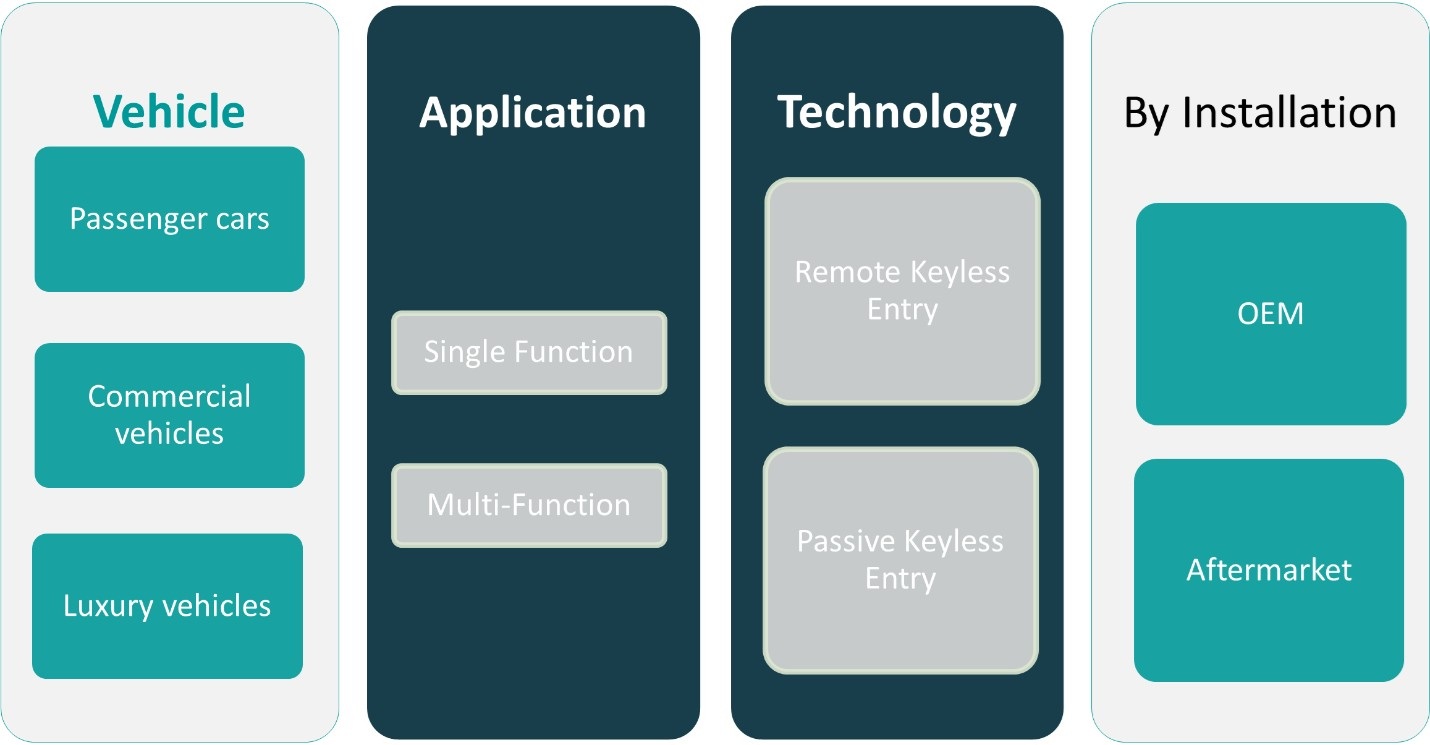
This report segments the Mexico Automotive Smart Keys Market as follows:
Market Drivers
Rising Demand for Vehicle Security and Convenience
One of the primary drivers of the Mexico automotive smart keys market is the increasing consumer emphasis on vehicle security and user convenience. For instance, a report by the Mexican Ministry of Public Security highlights the effectiveness of advanced encryption and authentication technologies in reducing car theft incidents. As urbanization and vehicle ownership continue to rise, car theft and unauthorized access remain significant concerns. Smart key systems, which incorporate advanced encryption and authentication technologies, offer a robust solution by enabling secure and keyless access to vehicles. These systems eliminate the need for traditional mechanical keys and reduce the risk of theft through features such as rolling codes and automatic locking mechanisms. Additionally, the convenience of push-button start and remote unlocking enhances the overall driving experience, attracting tech-savvy consumers who value both functionality and safety.
Technological Advancements and Integration with Connected Vehicles
Technological innovation is a crucial factor propelling the smart keys market in Mexico. For instance, a study by the International Energy Agency (IEA) emphasizes the integration of biometric authentication and vehicle tracking features in smart key systems, enabling users to control and monitor their vehicles remotely. With the growing popularity of connected and autonomous vehicles, smart key systems are evolving beyond simple locking mechanisms to become integral components of the vehicle's digital ecosystem. These smart features appeal to a younger, more connected generation of consumers and align with the broader automotive industry's move toward intelligent mobility. As original equipment manufacturers (OEMs) prioritize digitalization, smart key systems are increasingly seen as essential in offering a competitive and high-tech product portfolio.
Growth in Mid-Range and Premium Vehicle Segments
The expansion of mid-range and premium vehicle segments in Mexico further drives the demand for automotive smart keys. Traditionally considered a luxury feature, smart key technology is now being adopted in mid-tier vehicles due to declining costs of components and increased manufacturing efficiencies. Automakers are leveraging this trend to differentiate their offerings and enhance perceived value, even in more affordable models. This democratization of technology is expanding the market base and encouraging a broader range of consumers to opt for vehicles equipped with smart key systems. The growing purchasing power of Mexico’s middle class, along with rising expectations for vehicle features, is amplifying this trend.
Government Regulations and Automotive Industry Growth
Supportive government regulations aimed at improving vehicle safety standards are also influencing the adoption of smart key systems in Mexico. Authorities are increasingly encouraging the use of advanced security technologies to reduce vehicle-related crimes and improve road safety. Furthermore, Mexico’s automotive industry continues to grow, supported by a strong manufacturing base, favorable trade agreements, and foreign direct investment. As production scales up and more vehicles are exported and sold domestically, the incorporation of smart key systems as a standard or optional feature is becoming more prevalent. The strategic importance of Mexico in the global automotive supply chain ensures that innovations like smart keys will continue to gain traction in the coming years.
Market Trends
Widespread Adoption of Keyless Entry and Push-Start Systems
A significant trend shaping the Mexico automotive smart keys market is the growing adoption of keyless entry and push-start ignition systems across various vehicle segments. For instance, data from the Mexican Automotive Industry Association highlights the increasing integration of these features in mid-range models, driven by consumer demand for convenience and competitive pricing strategies. Originally introduced in luxury vehicles, these features are now becoming standard in mid-range models due to increasing consumer expectations and competitive pricing strategies by automakers. Keyless entry systems offer enhanced convenience and faster vehicle access, while push-start technology contributes to a modern, user-friendly driving experience. This shift is driving manufacturers to integrate these systems into new vehicle designs, making smart key functionality a core part of the vehicle offering in Mexico's dynamic automotive market.
Integration with Smartphone Applications and IoT Platforms
As digital ecosystems continue to expand, automotive smart keys are increasingly being integrated with smartphone applications and Internet of Things (IoT) platforms. For instance, a study by the International Energy Agency (IEA) highlights the growing use of companion apps that allow users to remotely control vehicle functions such as locking, unlocking, and starting the engine. Many automakers now offer companion apps that allow users to lock, unlock, and start their vehicles remotely using their smartphones. This integration enhances user convenience and opens new avenues for personalized vehicle control, including climate pre-conditioning, GPS tracking, and usage monitoring. The trend reflects a broader consumer shift toward connected mobility and digital lifestyles. In Mexico, where smartphone penetration is steadily increasing, this convergence of mobile technology and vehicle access is becoming a key differentiator in the smart key market.
Growing Demand for Enhanced Security and Anti-Theft Solutions
Security remains a top priority for car owners in Mexico, where vehicle theft has been a persistent concern. This trend is influencing the automotive industry to focus on more secure and advanced smart key technologies. Manufacturers are now incorporating features such as encrypted communication, biometric authentication, and motion sensors to prevent unauthorized access. Some smart key systems also include alerts and immobilizers that activate in the event of suspicious activity. As consumer awareness around vehicle safety grows, the demand for reliable and tamper-proof smart key systems is expected to increase, encouraging continued innovation in this area.
Sustainability and the Rise of Electric Vehicles
The growing focus on sustainability and the increasing popularity of electric vehicles (EVs) are also influencing trends in the smart keys market. EVs often come equipped with cutting-edge technology, including fully digital control systems that seamlessly integrate smart key functionality. Automakers are leveraging this platform to introduce features like remote diagnostics, energy usage tracking, and software updates via smart key-enabled apps. As Mexico continues to expand its EV infrastructure and promote greener mobility options, smart keys will play a vital role in supporting the digital backbone of these next-generation vehicles.
Market Challenges Analysis
High Cost of Advanced Technology and Limited Affordability
One of the primary challenges facing the Mexico automotive smart keys market is the high cost associated with the development and integration of advanced smart key technologies. For instance, a report by the Mexican Ministry of Economy highlights the financial burden of incorporating sophisticated components like sensors, microchips, and encryption software into vehicles, which increases production and replacement costs. While the adoption of smart keys is growing in mid-range and premium vehicles, the cost remains a barrier for entry-level models and price-sensitive consumers. For automotive manufacturers operating on tight margins, especially in developing markets, integrating these features without significantly raising vehicle prices poses a significant challenge. Additionally, the cost of repair or replacement of lost or damaged smart keys can be considerably higher than traditional keys, which may deter adoption among cost-conscious consumers.
Infrastructure Limitations and Technological Adaptation Gaps
Another key challenge is the limited infrastructure and technological readiness required to support the widespread use of smart key systems, especially in less urbanized or economically constrained areas of Mexico. While major cities have embraced automotive digitalization, rural regions still face barriers related to digital literacy, mobile connectivity, and access to modern service centers capable of servicing smart key systems. Furthermore, the aftermarket sector, which plays a vital role in Mexico’s automotive landscape, often lacks the tools and expertise to repair or program smart keys, leading to dependence on OEMs for maintenance. This not only limits the convenience and accessibility of smart key systems but also adds to the overall ownership cost. The industry must address these technological and infrastructural gaps to ensure the inclusive growth of smart key adoption across diverse consumer segments in Mexico.
Market Opportunities
The Mexico automotive smart keys market presents significant growth opportunities driven by technological advancement, shifting consumer preferences, and the expansion of the country's automotive manufacturing sector. As demand for connected and digitally enhanced vehicles rises, smart keys are becoming a standard feature, not just in premium models but increasingly in mid-range segments. This trend opens the door for automotive OEMs and technology providers to develop cost-effective, scalable smart key solutions that can be integrated across a wider range of vehicles. The growing interest in contactless, remote vehicle access aligns with evolving customer expectations for convenience, safety, and enhanced user experience. In addition, the increasing penetration of smartphones and mobile internet in Mexico supports the adoption of app-based smart key features, enabling users to control and monitor their vehicles remotely, further enhancing the value proposition of these systems.
Another promising opportunity lies in the country's transition toward electric and hybrid vehicles. These modern vehicles are typically equipped with advanced electronic architectures, making them ideal platforms for the integration of smart key technologies. As Mexico strengthens its EV infrastructure and supports clean mobility initiatives, manufacturers have a chance to position smart key systems as part of the broader digital ecosystem of next-generation vehicles. Moreover, the aftermarket segment offers additional potential for growth, particularly in providing smart key retrofitting solutions for older vehicle models and offering key replacement and programming services. As consumers become more familiar with the benefits of smart key systems, demand for upgrades and support services is expected to rise. These developments, combined with strategic investments in R&D and local manufacturing, create a favorable environment for stakeholders to tap into a rapidly evolving market and gain competitive advantage in the smart mobility space.
Market Segmentation Analysis:
By Vehicle:
In the Mexico automotive smart keys market, segmentation by vehicle type highlights strong growth potential across all categories, with passenger cars leading the market share. The rising production and sales of passenger vehicles, driven by growing urbanization and consumer preference for technologically advanced vehicles, are fueling demand for smart key systems. These systems offer enhanced security and convenience, making them increasingly standard in new passenger models. Commercial vehicles are gradually adopting smart key technology, particularly in fleet operations where security and operational efficiency are critical. However, adoption in this segment remains slower due to cost sensitivity and lower prioritization of advanced features. In contrast, the luxury vehicle segment consistently incorporates smart key systems as standard equipment. High-end brands prioritize innovations such as proximity sensors, remote start, and smartphone integration, contributing to the widespread use of multi-functional smart keys in this category. As purchasing power improves and luxury vehicle sales rise in Mexico, this segment is expected to continue setting the pace in technological adoption.
By Application:
Market segmentation by application reveals a growing preference for multi-function smart keys, which offer a comprehensive range of features including remote locking/unlocking, engine start, climate control, and vehicle tracking. These keys cater to consumer demand for integrated digital experiences and convenience, especially in mid-range and premium vehicles. As automakers seek to differentiate their offerings, the integration of smart keys with mobile apps and in-vehicle infotainment systems is becoming more prevalent. Single-function smart keys, while still relevant in the entry-level segment, primarily serve basic security and access needs. Their lower cost makes them suitable for budget-conscious consumers and commercial vehicles. However, as technology becomes more affordable and expectations rise, the shift toward multi-functional systems is accelerating. This trend presents opportunities for manufacturers to innovate and offer scalable smart key solutions that accommodate both functional and economic considerations across diverse vehicle segments in Mexico’s evolving automotive landscape.
Segments:
Based on Vehicle:
- Passenger cars
- Commercial vehicles
- Luxury vehicles
Based on Application:
- Single Function
- Multi-Function
Based on Technology:
- Remote Keyless Entry
- Passive Keyless Entry
Based on Distribution Channel:
- OEM
- Aftermarket
Based on the Geography:
- Mexico City
- Monterrey
- Guadalajara
- Tijuana
Regional Analysis
Mexico City
Mexico City holds the largest share in the country's automotive smart keys market, accounting for approximately 34% of the total market in 2023. As the capital and most populous city, Mexico City leads in terms of vehicle ownership, infrastructure development, and access to premium automotive technologies. The presence of numerous automotive dealerships, service centers, and a high concentration of middle- to high-income consumers supports rapid adoption of smart key systems. In addition, strong government efforts to enhance vehicle safety and reduce theft have encouraged the uptake of advanced access and security technologies. The city's growing electric vehicle (EV) segment also contributes to the adoption of integrated digital systems, including multi-functional smart keys.
Monterrey
Monterrey contributes around 26% to the overall Mexico automotive smart keys market. As one of the country’s leading industrial and economic hubs, Monterrey boasts a strong automotive manufacturing base, which supports both production and innovation in vehicle technologies. The region’s affluent population and preference for high-end vehicles have contributed to the rising demand for smart key features. Automakers and dealerships in Monterrey are increasingly equipping new models with keyless entry, push-start ignition, and app-integrated access systems to meet consumer expectations. Additionally, the strong presence of automotive suppliers and R&D centers supports localized advancement and customization of smart key solutions for regional needs.
Guadalajara
Guadalajara holds approximately 21% of the national market share for automotive smart keys. Known for its growing tech industry and status as a digital innovation hub, Guadalajara is emerging as a significant market for advanced vehicle technologies. Consumers in the region are becoming more tech-savvy and receptive to connected car features, including smart key functionalities. Increasing sales of mid-range and premium vehicles in the city are pushing dealerships and OEMs to integrate more sophisticated access and security solutions. The region's infrastructure and support for electric and hybrid vehicles are also fostering greater adoption of digital mobility solutions, enhancing Guadalajara’s role in the national smart key landscape.
Tijuana
Tijuana, contributing about 19% to the market, is experiencing steady growth driven by cross-border automotive trade and increasing vehicle sales. The region’s proximity to the United States influences consumer expectations and preferences, particularly for technologically advanced features like smart keys. Tijuana’s expanding middle class and improving urban infrastructure are creating favorable conditions for the integration of digital vehicle access systems. While adoption is currently more prominent in newer and imported vehicles, ongoing investments in dealership networks and service facilities are expected to accelerate market penetration.
Key Player Analysis
- Huf Hulsbeck & Fürst GmbH & Co.
- Continental AG
- ZF Friedrichshafen AG
- HELLA GmbH & Co. KGaA
- Hyundai Mobis
- Silca Group
- Tokai Rika Co.
- Denso Corporation
- ALPHA Corporation
- Thales
- Huf
Competitive Analysis
The competitive landscape of the Mexico automotive smart keys market is characterized by the presence of established global players focusing on innovation, strategic partnerships, and market expansion. Leading companies such as Huf Hulsbeck & Fürst GmbH & Co., Continental AG, ZF Friedrichshafen AG, HELLA GmbH & Co. KGaA, Hyundai Mobis, Silca Group, Tokai Rika Co., Denso Corporation, ALPHA Corporation, and Thales dominate the market with strong product portfolios and technological expertise. These players are investing heavily in research and development to introduce advanced smart key systems featuring multi-functionality, enhanced security, and smartphone integration. To strengthen their market presence in Mexico, many of these companies are forming alliances with local automotive manufacturers and expanding their service networks. Additionally, the focus on producing cost-effective smart key solutions tailored for mid-range vehicles is growing, aiming to widen consumer reach. Players are also leveraging Mexico’s strategic position in the global automotive supply chain to establish local production facilities, ensuring timely delivery and reduced costs. Continuous innovation in areas such as biometric authentication, mobile-based access, and integration with electric vehicles is a key differentiator among competitors. As consumer expectations evolve, these leading players remain committed to delivering smarter, safer, and more convenient vehicle access technologies across the Mexican automotive landscape.
Recent Developments
- In January 2025, Honda Lock, now owned by MinebeaMitsumi, expanded its product line to include advanced keyless entry systems with mobile connectivity and IoT features, aligning with the automotive industry's trend towards electrification and automation.
- In December 2024, Hyundai Mobis announced plans to expand its card-type smart key to major Hyundai models like the Santa Fe and Tucson. This key uses UWB for enhanced functionality and wireless charging capabilities.
- In April 2024, Continental developed a smart device-based access solution for Mercedes-Benz E-Class cars. This system utilizes ultra-wideband (UWB) technology, transceivers, and intelligent software to enhance security and convenience for luxury vehicles.
- In December 2023, Huf introduced a groundbreaking smart key that combines UWB, BLE, and NFC technologies in compliance with Car Connectivity Consortium (CCC) standards. This innovation enhances anti-theft security and convenience while allowing integration with "Phone as a Key" systems.
Market Concentration & Characteristics
The Mexico automotive smart keys market exhibits a moderate to high level of market concentration, with a few global players dominating due to their technological expertise, strong OEM partnerships, and established distribution networks. Leading companies such as Continental AG, Huf Hulsbeck & Fürst, ZF Friedrichshafen AG, and Hyundai Mobis maintain a competitive edge by offering advanced, multi-functional smart key solutions that cater to both luxury and mid-range vehicle segments. The market is characterized by a strong emphasis on innovation, security, and user convenience, with features like remote access, push-start ignition, and smartphone integration becoming increasingly common. While international players hold substantial market share, opportunities for regional suppliers are emerging as demand grows and localized production gains traction. Additionally, the market demonstrates a clear shift toward digital mobility solutions and connected car technologies, prompting manufacturers to develop scalable, cost-effective smart key systems that align with Mexico’s evolving automotive landscape and consumer expectations.
Report Coverage
The research report offers an in-depth analysis based on Vehicle, Application, Technology, Distribution Channel and Geography. It details leading market players, providing an overview of their business, product offerings, investments, revenue streams, and key applications. Additionally, the report includes insights into the competitive environment, SWOT analysis, current market trends, as well as the primary drivers and constraints. Furthermore, it discusses various factors that have driven market expansion in recent years. The report also explores market dynamics, regulatory scenarios, and technological advancements that are shaping the industry. It assesses the impact of external factors and global economic changes on market growth. Lastly, it provides strategic recommendations for new entrants and established companies to navigate the complexities of the market.
Future Outlook
- The Mexico automotive smart keys market is projected to witness significant growth, driven by increasing consumer demand for enhanced vehicle security and convenience features.
- Integration of smart keys with mobile devices is becoming more prevalent, allowing users to unlock and start their vehicles using smartphones, thereby enhancing user experience and convenience.
- Adoption of biometric authentication methods, such as fingerprint and facial recognition, is on the rise, offering higher security levels and reducing the risk of unauthorized vehicle access.
- The expansion of electric and hybrid vehicles in Mexico is expected to boost the demand for advanced smart key systems that seamlessly integrate with these modern vehicle architectures.
- Continuous technological advancements are leading to the development of more sophisticated smart key features, including remote engine start, vehicle tracking, and personalized driver settings.
- The aftermarket segment presents growth opportunities as consumers seek to upgrade existing vehicles with smart key functionalities, driven by the desire for modern conveniences and improved security.
- Collaborations between automotive manufacturers and technology firms are fostering innovation in smart key solutions, resulting in more reliable and user-friendly products.
- Rising concerns over vehicle theft are prompting consumers and manufacturers to prioritize advanced security features, thereby accelerating the adoption of smart keys equipped with robust encryption and anti-theft technologies.
- Urbanization and increasing disposable incomes in Mexico are contributing to higher sales of vehicles equipped with smart key systems, as consumers show a preference for technologically advanced and convenient features.
- Regulatory initiatives aimed at enhancing vehicle safety standards are likely to encourage the integration of smart key systems, supporting market growth in the coming years.

Request a Free Sample
Fill in your details and we'll send you a free sample report.
- Sample data tables & charts
- Research methodology
Market Dynamics
Consumer Focus on Vehicle Security and Convenience
Increasing concerns over vehicle theft and a growing preference for seamless, keyless access are driving Mexican consumers to adopt smart key systems, which offer advanced encryption and authentication for enhanced security and user convenience.
Technological Integration with Connected and Electric Vehicles
The rapid adoption of connected car platforms and the rise of electric and hybrid vehicles in Mexico are fueling demand for smart keys, as these vehicles often require advanced digital access and integration with mobile applications.
Expansion of Mid-Range and Premium Vehicle Segments
Smart key technology, once limited to luxury vehicles, is now being integrated into mid-range models due to declining component costs and consumer expectations, broadening the market base and increasing overall adoption.
Government Regulations and Safety Standards
Supportive government policies aimed at improving vehicle safety and reducing theft are encouraging automakers to include smart key systems as standard or optional features, further propelling market growth.
Urbanization and Regional Automotive Industry Growth
Major urban centers like Mexico City, Monterrey, Guadalajara, and Tijuana, with high vehicle ownership and advanced infrastructure, are leading in smart key adoption, supported by a robust local automotive manufacturing sector.
Need a Custom Version of This Report?
Tailor the scope, geography, or segments to your exact requirements.
- Custom geography or segment scope
- Direct access to our analyst team
Frequently Asked Questions
What is the current size of the Mexico Automotive Smart Keys market?
What factors are driving the growth of the Mexico Automotive Smart Keys market?
What are some challenges faced by the Mexico Automotive Smart Keys market?
Who are the major players in the Mexico Automotive Smart Keys market?
Table of Content
Chapter 1 Market Segmentation
- 1.1 Segmentation Framework
- 1.1.1 Product and Service Classification
- 1.1.2 Application and End-Use Classification
- 1.1.3 Technology and Solution Classification
- 1.1.4 Customer and Distribution Channel Classification
- 1.1.5 Geographic Segmentation
- 1.1.6 Market Segment Definitions and Boundaries
- 1.2 By Vehicle
- 1.2.1 Passenger cars
- 1.2.2 Commercial vehicles
- 1.2.3 Luxury vehicles
- 1.3 By Technology
- 1.3.1 Remote Keyless Entry
- 1.3.2 Passive Keyless Entry
- 1.4 By Application
- 1.4.1 Single Function
- 1.4.2 Multi-Function
Chapter 2 Introduction
- 2.1 Report Objectives and Scope
- 2.2 Product Definition and Industry Terminology
- 2.3 Market Inclusions and Exclusions
- 2.4 Research Process
- 2.4.1 Primary Research and Expert Interviews
- 2.4.2 Secondary Research and Source Review
- 2.4.3 Top-Down and Bottom-Up Estimation
- 2.4.4 Data Triangulation and Verification
- 2.5 Market Size Measurement Basis
- 2.5.1 2023: USD 319.24 million → 2032: USD 599.72 million
- 2.6 Historical and Forecast Reference Periods
- 2.6.1 Base Year: 2023
- 2.6.2 Forecast Period: 2023-2032
- 2.7 Research Assumptions and Limitations
Chapter 3 Executive Summary
- 3.1 Market Snapshot and Key Findings
- 3.2 Base-Year Market Size, 2023
- 3.3 Forecast Market Size, 2032
- 3.4 Revenue and Volume Growth Outlook
- 3.5 Key Demand and Supply Indicators
- 3.6 Leading Market Segments
- 3.7 Fastest-Growing Market Opportunities
- 3.8 Regional Performance Highlights
- 3.9 Technology and Industry Transformation
- 3.10 Competitive Landscape Summary
- 3.11 Analyst View and Strategic Implications
Chapter 4 Mexico Automotive Smart Keys Market Trends and Developments
- 4.1 Historical Industry Development
- 4.2 Recent Market Trends and Developments
- 4.3 Demand and Customer Behavior Trends
- 4.4 Technology and Product Innovation
- 4.5 Artificial Intelligence, Automation and Digitalization
- 4.6 Local Manufacturing and Supply Chain Realignment
- 4.7 Industry Partnerships, Mergers and Acquisitions
- 4.8 Sustainability and Circular Economy Developments
- 4.9 Government and Private Sector Investment Trends
- 4.10 Emerging Business Models and Commercialization
- 4.11 Industry Developments and Announcements
Chapter 5 Mexico Automotive Smart Keys Market Production, Supply and Demand Analysis
- 5.1 Demand Trend and Consumption Analysis
- 5.2 Demand Forecast, 2023-2032
- 5.3 Production and Output Trend
- 5.4 Production and Output Forecast, 2023-2032
- 5.5 Installed Capacity and Capacity Utilization
- 5.6 Company-Wise Production Plants and Statistics
- 5.6.1 Installed Production Capacity
- 5.6.2 Actual Production
- 5.6.3 Planned Capacity and Expansion Targets
- 5.7 Supply Chain Structure and Procurement Trends
- 5.8 Supply-Demand Gap and Bottlenecks
- 5.9 Import Dependence and Sourcing Structure
- 5.10 Contract Manufacturing and Outsourcing
- 5.11 Regional Supply and Demand Concentration
Chapter 6 Mexico Automotive Smart Keys Market Pricing Analysis
- 6.1 Pricing Structure and Measurement
- 6.2 Historical Pricing Trends
- 6.3 Pricing Outlook, 2023-2032
- 6.4 Average Selling Price and Unit Economics
- 6.5 Pricing by Product and Market Segment
- 6.6 Geographic Pricing Differences
- 6.7 Key Input, Energy, Labor and Logistics Costs
- 6.8 Contract Pricing and Purchasing Models
- 6.9 Pricing Sensitivity and Competitive Positioning
- 6.10 Price, Margin and Profitability Implications
Chapter 7 Mexico Automotive Smart Keys Market Dynamics
- 7.1 Market Growth Drivers
- 7.1.1 Demand-Side Drivers
- 7.1.2 Technology and Innovation Drivers
- 7.1.3 Infrastructure and Investment Drivers
- 7.1.4 Regulatory and Policy Drivers
- 7.2 Market Restraints
- 7.2.1 Cost and Affordability Constraints
- 7.2.2 Technology and Adoption Barriers
- 7.2.3 Supply Chain and Operational Constraints
- 7.3 Market Challenges
- 7.3.1 Competitive Pressure and Margin Erosion
- 7.3.2 Skills, Infrastructure and Implementation Gaps
- 7.4 Emerging Market Opportunities
- 7.5 Market Dynamics Impact and Time-Horizon Assessment
Chapter 8 Mexico Automotive Smart Keys Value Chain Analysis
- 8.1 Industry Value Chain Overview
- 8.2 Upstream Suppliers and Critical Inputs
- 8.3 Technology and Component Providers
- 8.4 Manufacturing or Service Delivery
- 8.5 Distribution, Channel Partners and Integrators
- 8.6 Downstream Applications and End Users
- 8.7 Value Addition and Profit Pools
- 8.8 Vertical Integration and Outsourcing
- 8.9 Supplier Concentration and Risk
- 8.10 Supply Chain Localization and Resilience
Chapter 9 Mexico Automotive Smart Keys Market Regulations and Policies
- 9.1 Relevant Laws, Standards and Compliance Frameworks
- 9.2 Product, Service, Safety and Quality Requirements
- 9.3 Government Policies, Incentives and Subsidies
- 9.4 Imports, Exports and Trade Barriers
- 9.5 Public Procurement and Local Content Requirements
- 9.6 Environmental and Sustainability Compliance
- 9.7 Upcoming Policy Changes and Market Implications
Chapter 10 Mexico Automotive Smart Keys Market Hotspots and Opportunities
- 10.1 Market Opportunity Mapping and Growth Hotspots
- 10.2 High-Growth Applications and Customer Groups
- 10.3 Underserved Markets and White-Space Opportunities
- 10.4 Emerging Technology and Product Opportunities
- 10.5 New Capacity and Investment Hotspots
- 10.6 Market Entry and Expansion Opportunities
- 10.7 Distribution and Partnership Opportunities
- 10.8 Near-Term and Long-Term Commercial Potential
- 10.9 Opportunity Attractiveness and Execution Risks
Chapter 11 Mexico Automotive Smart Keys Market Outlook, 2023-2032
- 11.1 Market Size and Analysis
- 11.1.1 Revenue (Market Measurement: 2023: USD 319.24 million → 2032: USD 599.72 million)
- 11.1.2 Market Volume and Quantity Sold
- 11.1.3 Historical Market Size
- 11.1.4 Base-Year Market Size, 2023
- 11.2 Market Forecast, 2023-2032
- 11.2.1 Revenue Forecast to 2032
- 11.2.2 Volume Forecast to 2032
- 11.2.3 CAGR and Year-on-Year Growth
- 11.2.4 Incremental Revenue Opportunity
- 11.3 Forecast Assumptions and Scenario Analysis
- 11.3.1 Base-Case Forecast
- 11.3.2 Optimistic and Conservative Scenarios
- 11.3.3 Technology, Pricing and Policy Sensitivities
- 11.4 Market Attractiveness and Growth Outlook
Chapter 12 Mexico Automotive Smart Keys Market Segmentation and Outlook
- 12.1 Segmentation Summary and Market Shares, 2023
- 12.2 Largest and Fastest-Growing Segments
- 12.3 By Vehicle - Market Size and Forecast, 2023-2032
- 12.3.1 Segment Definition and Scope
- 12.3.2 Historical Market Size
- 12.3.3 Revenue Forecast, 2023-2032
- 12.3.4 Volume Forecast, 2023-2032
- 12.3.5 Base-Year Market Share, 2023
- 12.3.6 Segment CAGR and Growth Drivers
- 12.3.7 Subsegment Market Size and Forecast
- 12.3.7.1 Passenger cars
- 12.3.7.2 Commercial vehicles
- 12.3.7.3 Luxury vehicles
- 12.3.8 Subsegment Pricing and Adoption Trends
- 12.3.9 Leading Suppliers and Competition
- 12.3.10 Regional Demand and Opportunities
- 12.4 By Technology - Market Size and Forecast, 2023-2032
- 12.4.1 Segment Definition and Scope
- 12.4.2 Historical Market Size
- 12.4.3 Revenue Forecast, 2023-2032
- 12.4.4 Volume Forecast, 2023-2032
- 12.4.5 Base-Year Market Share, 2023
- 12.4.6 Segment CAGR and Growth Drivers
- 12.4.7 Subsegment Market Size and Forecast
- 12.4.7.1 Remote Keyless Entry
- 12.4.7.2 Passive Keyless Entry
- 12.4.8 Subsegment Pricing and Adoption Trends
- 12.4.9 Leading Suppliers and Competition
- 12.4.10 Regional Demand and Opportunities
- 12.5 By Application - Market Size and Forecast, 2023-2032
- 12.5.1 Segment Definition and Scope
- 12.5.2 Historical Market Size
- 12.5.3 Revenue Forecast, 2023-2032
- 12.5.4 Volume Forecast, 2023-2032
- 12.5.5 Base-Year Market Share, 2023
- 12.5.6 Segment CAGR and Growth Drivers
- 12.5.7 Subsegment Market Size and Forecast
- 12.5.7.1 Single Function
- 12.5.7.2 Multi-Function
- 12.5.8 Subsegment Pricing and Adoption Trends
- 12.5.9 Leading Suppliers and Competition
- 12.5.10 Regional Demand and Opportunities
- 12.6 Segment Growth Comparison
- 12.7 Segment Attractiveness and Priority Matrix
Chapter 13 Mexico Automotive Smart Keys End-Use and Application Market Outlook
- 13.1 End-Use Industry and Customer Demand Structure
- 13.2 Leading Applications and Customer Groups
- 13.3 End-Use Market Size, Share and Forecast
- 13.4 Major End-Use Industry Deep Dives
- 13.4.1 Customer Requirements and Use Cases
- 13.4.2 Demand and Replacement Cycles
- 13.4.3 Technical and Regulatory Considerations
- 13.4.4 Purchasing and Procurement Models
- 13.4.5 Leading Vendors and Distribution Channels
- 13.4.6 Forecast and Commercial Opportunities
- 13.5 Emerging Applications and Cross-Segment Demand
- 13.6 End-Use Industry Investment Priorities
Chapter 14 Mexico Automotive Smart Keys Geographic Market Outlook, 2023-2032
- 14.1 Domestic Market Distribution and Demand Clusters
- 14.2 State- or Province-Wise Market Size and Forecast, 2023-2032
- 14.3 City and Metropolitan Market Outlook
- 14.4 Industrial, Manufacturing and Commercial Clusters
- 14.5 Geographic Concentration of Key End Users
- 14.6 Local Pricing and Purchasing Differences
- 14.7 Domestic Production Facilities and Capacity Map
- 14.8 Local Infrastructure and Project Pipeline
- 14.9 State-Level Policy and Incentive Differences
- 14.10 Subnational Investment Hotspots and Opportunities
- 14.11 Distribution and Logistics Networks
- 14.12 Domestic Competitive Footprint
Chapter 15 Mexico Automotive Smart Keys Technology, Innovation and Sustainability Outlook
- 15.1 Technology Landscape and Maturity
- 15.2 Product, Process and Service Innovation
- 15.3 AI, Automation and Digital Tools in the Industry
- 15.4 Technology Adoption and Performance Benchmarking
- 15.5 Innovation Pipeline and R&D Investment
- 15.6 Patent and Intellectual Property Trends
- 15.7 Energy Efficiency and Resource Management
- 15.8 Sustainability, Recycling and Circularity
- 15.9 Technology Roadmap, 2023-2032
- 15.10 Risks of Obsolescence and Technology Substitution
Chapter 16 Mexico Automotive Smart Keys Market Key Strategic Imperatives
- 16.1 Growth and Market Entry Priorities
- 16.2 High-Return Products and Segments
- 16.3 Pricing, Profitability and Cost Optimization
- 16.4 Technology Investment and Product Differentiation
- 16.5 Supply Chain Localization and Resilience
- 16.6 Distribution and Customer Acquisition
- 16.7 Partnership, Acquisition and Capacity Strategy
- 16.8 Regional Expansion Priorities
- 16.9 Short-, Medium- and Long-Term Actions
Chapter 17 Competition Outlook
- 17.1 Industry Competition Characteristics
- 17.2 Market Structure and Concentration
- 17.3 Market Share and Competitive Positioning, 2023
- 17.4 Company-Wise Revenue and Product Benchmarking
- 17.5 Production and Service Capacity Benchmarking
- 17.6 Technology, Pricing and Differentiation
- 17.7 Regional Footprint and Distribution Strength
- 17.8 Mergers, Acquisitions and Strategic Alliances
- 17.9 New Entrants and Competitive Threats
- 17.10 Porter's Five Forces and Industry Attractiveness
- 17.11 Competitive Outlook, 2023-2032
Chapter 18 Company Profiles
- 18.1 Company Coverage and Selection Criteria
- 18.2 Huf Hulsbeck & Fürst GmbH & Co.
- 18.2.1 Business Description
- 18.2.2 Company Ownership and Geographic Presence
- 18.2.3 Product and Service Portfolio
- 18.2.4 Manufacturing and Operating Footprint
- 18.2.5 Production Capacity and Expansion Plans
- 18.2.6 Financial Performance and Investment
- 18.2.7 Market Share and Competitive Position
- 18.2.8 Technology and Innovation Capabilities
- 18.2.9 Strategic Alliances or Partnerships
- 18.2.10 Recent Developments
- 18.2.11 Growth Strategy and Outlook
- 18.3 Continental AG
- 18.4 ZF Friedrichshafen AG
- 18.5 HELLA GmbH & Co. KGaA
- 18.6 Hyundai Mobis
- 18.7 Silca Group
- 18.8 Tokai Rika Co.
- 18.9 Denso Corporation
- 18.10 ALPHA Corporation
- 18.11 Thales
- 18.12 Other Relevant Market Participants
Note: Every listed company is profiled on the structure shown under the first company. The company list is preliminary and may change based on research findings, market developments, data availability and client requirements.
Chapter 19 Disclaimer
- 19.1 Research and Forecast Disclaimer
- 19.2 Data Source and Estimation Limitations
Note: The depth of individual sections depends on data availability for this market. Volume, capacity, trade and other unit-based metrics are included where applicable.