
| REPORT ATTRIBUTE | DETAILS |
|---|---|
| Historical Period | 2020-2023 |
| Base Year | 2024 |
| Forecast Period | 2025-2032 |
| Middle East Water Pump Market Size 2023 | USD 1,150.67 Million |
| Middle East Water Pump Market, CAGR | 1.69% |
| Middle East Water Pump Market Size 2032 | USD 1,341.09 Million |
Market Overview:
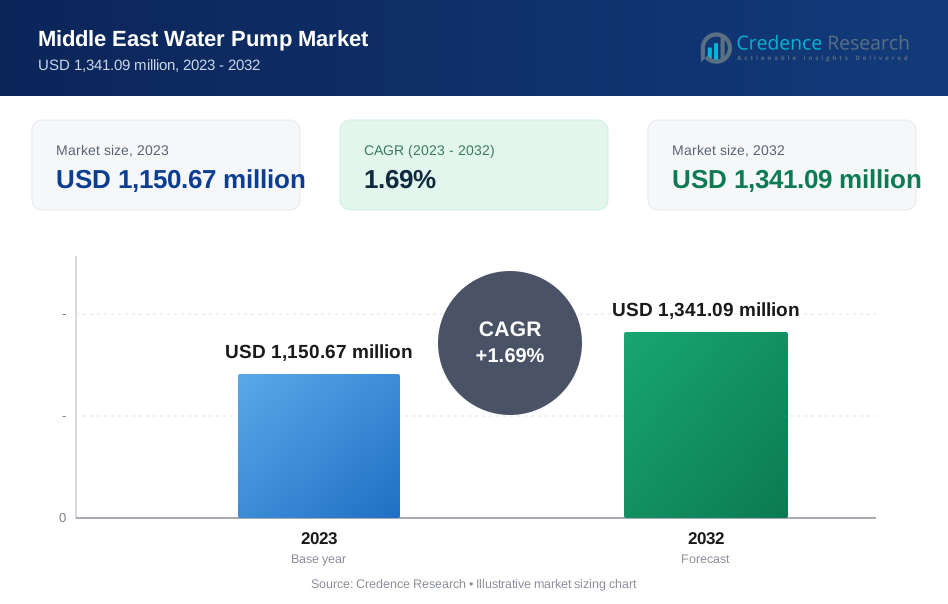
Middle East Water Pump Market size was valued at USD 1,150.67 million in 2023 and is anticipated to reach USD 1,341.09 million by 2032, at a CAGR of 1.69% during the forecast period (2023-2032).
Several key factors are propelling the Middle East water pump market forward. Foremost is the region's acute water scarcity, exacerbated by rising temperatures and limited freshwater resources, which has intensified the need for effective water extraction and distribution systems. Consequently, there has been a surge in the installation of wastewater treatment plants and desalination facilities, particularly in countries like Saudi Arabia and Oman, to recycle water for agricultural and industrial use. Additionally, the expansion of the oil and gas sector necessitates reliable pumping solutions for various applications, including pipeline transport and refinery operations. Urbanization and population growth further drive demand for water pumps in municipal water supply and sewage treatment systems. Moreover, advancements in pump technology, such as the integration of IoT and energy-efficient designs, are enhancing operational efficiency and reducing maintenance costs, making modern pumps more attractive to end-users.
Within the Middle East, Saudi Arabia stands out as the largest market for water pumps, driven by its substantial investments in infrastructure and water management projects. The country's focus on wastewater treatment to meet the growing water demand has significantly boosted the pump industry. The United Arab Emirates (UAE) is also witnessing notable growth, with expectations of registering the highest CAGR from 2024 to 2030, attributed to rapid urban development and industrialization. Other nations, such as Oman and Egypt, are investing heavily in wastewater treatment facilities to combat water scarcity, thereby increasing the demand for various types of pumps, including centrifugal and positive displacement pumps. Overall, the regional market is characterized by a concerted effort to enhance water infrastructure, driven by both necessity and strategic development goals
Market Insights:
- The Middle East Water Pump Market was valued at USD 1,150.67 million in 2023 and is expected to reach USD 1,341.09 million by 2032, growing at a CAGR of 1.69% during the forecast period.
- The global water pump market was valued at USD 55,454.00 million in 2023 and is projected to reach USD 80,304.96 million by 2032, growing at a CAGR of 4.2% during the forecast period.
- Water scarcity, exacerbated by rising temperatures and limited freshwater resources, is a primary driver of the demand for water pumps in the region.
- The expansion of desalination and wastewater treatment facilities in Saudi Arabia and Oman is significantly boosting the need for advanced pumping systems.
- The Middle East’s oil and gas sector remains a major contributor to the water pump market, requiring high-capacity pumps for offshore rigs, pipeline transport, and refinery operations.
- Rapid urbanization and industrialization across countries like the UAE are increasing demand for water pumps in municipal water supply, sewage treatment, and industrial applications.
- Technological advancements in pump design, such as energy-efficient solutions and IoT integration, are gaining traction, driving the market towards smarter, more sustainable water management systems.
- Despite market growth, challenges such as high initial investment costs, a lack of skilled workforce, and environmental regulatory compliance remain obstacles to widespread adoption of modern water pumping technologies.
Market Drivers:
Water Scarcity and Infrastructure Development
One of the primary drivers fueling the Middle East water pump market is the acute water scarcity faced across the region. Countries in the Middle East, such as Saudi Arabia, the United Arab Emirates, and Oman, are characterized by arid climates and limited access to renewable freshwater resources. To mitigate this challenge, governments have been investing heavily in infrastructure projects aimed at enhancing water security, including desalination plants, water recycling systems, and wastewater treatment facilities. For instance, the Hassyan desalination plant in Dubai, with an $875 million investment, is set to produce 818,000 cubic meters of potable water per day, making it the world’s largest solar-powered desalination plant upon completion. These initiatives significantly boost the demand for high-performance water pumps, which are critical for efficient water intake, distribution, and treatment across both urban and rural areas. As water remains a strategic resource, the deployment of advanced pumping systems continues to be a top priority for regional authorities and private operators alike.
Expansion of the Oil and Gas Industry
The water pump market in the Middle East also benefits from the sustained expansion of the oil and gas industry, which remains a cornerstone of the region’s economy. Water pumps play an integral role in various stages of hydrocarbon production, including drilling, pipeline transportation, and refining processes. The sector’s demand for reliable, durable, and high-capacity pumps is considerable, especially in offshore rigs and desert installations where conditions are often extreme. Furthermore, the rising focus on oilfield reinjection and enhanced oil recovery (EOR) techniques has led to a higher adoption of specialized pump systems. As the energy sector continues to invest in modernization and efficiency, the need for technologically advanced water pumps that offer improved energy savings and operational resilience grows steadily.
Urbanization and Industrialization
Rapid urbanization and ongoing industrial development across Middle Eastern countries have significantly contributed to the rising demand for water pumps. Expanding cities require robust municipal water supply and wastewater management systems, both of which depend on pump technologies for fluid transport and pressure regulation. For example, the Dubai Electricity and Water Authority (DEWA) announced the installation of 250,000 smart water meters by 2020, and the Abu Dhabi Distribution Company (ADDC) has been rolling out smart water meters since 2018, reflecting the integration of smart technologies in municipal water systems. Concurrently, the growth of non-oil sectors such as manufacturing, construction, and food processing has increased the requirement for industrial water pumps to support a variety of applications, from cooling systems to chemical processing. The construction of smart cities, industrial parks, and residential complexes further accelerates the integration of efficient water pumping systems, often equipped with smart monitoring and automation features.
Technological Advancements and Sustainability Initiatives
Technological innovation in pump design and functionality is another key factor propelling market growth in the Middle East. The adoption of energy-efficient pumps, driven by both economic and environmental considerations, aligns with the region’s broader commitment to sustainability. Smart pumps featuring Internet of Things (IoT) capabilities, remote monitoring, and automated control systems are gaining traction, particularly among municipal and industrial users looking to reduce operational costs and enhance system reliability. In parallel, regional policies promoting green infrastructure and energy conservation are encouraging the transition from conventional to high-efficiency pump solutions. As end-users increasingly seek sustainable and cost-effective alternatives, manufacturers are responding with products that meet evolving performance standards and regulatory requirements.
Market Trends:
Integration of Renewable Energy in Pumping Solutions
The Middle East is increasingly integrating renewable energy sources, particularly solar power, into water pumping systems. For instance, ABB introduced automated solar-powered pumping solutions for Sudan’s irrigation project, which reduced reliance on fossil fuels and improved irrigation efficiency by integrating solar-powered drives for pump motors. This shift is driven by the region's abundant solar resources and the need to reduce reliance on fossil fuels. Solar-powered pumps are gaining traction, especially in remote agricultural areas where grid connectivity is limited. The decreasing cost of solar panels and advancements in energy storage technologies have made solar-powered pumping solutions more economically viable, promoting sustainable water management practices across the region.
Advancements in Smart Pump Technologies
Technological innovations are transforming the water pump industry in the Middle East. The adoption of smart pump technologies, equipped with sensors and IoT capabilities, is enhancing operational efficiency and enabling predictive maintenance. These intelligent systems allow for real-time monitoring and control, reducing downtime and operational costs. Industries such as oil and gas, water treatment, and agriculture are increasingly investing in smart pumping solutions to optimize performance and ensure reliability in their operations.
Emphasis on Water Conservation and Efficiency
Water scarcity remains a critical issue in the Middle East, prompting a strong emphasis on water conservation and efficient usage. Governments and industries are implementing stringent regulations and standards to promote the use of energy-efficient pumps. Manufacturers are responding by developing pumps with higher efficiency ratings and lower energy consumption. These efforts align with broader sustainability goals and contribute to the region's commitment to reducing environmental impact while ensuring water security.
Growth in Infrastructure and Urban Development Projects
The Middle East is witnessing significant growth in infrastructure and urban development projects, including the construction of new cities, industrial zones, and residential areas. For example, Saudi Arabia’s Vision 2030 allocates over USD 1.2 trillion to infrastructure projects, including the USD 500 billion NEOM city, which is designed to be powered entirely by clean energy and features advanced water management systems. These developments necessitate robust water supply and wastewater management systems, driving the demand for various types of water pumps. The expansion of infrastructure projects, particularly in countries like Saudi Arabia and the United Arab Emirates, is expected to sustain the growth of the water pump market in the coming years.
Market Challenges Analysis:
High Initial Investment Costs
One of the significant challenges in the Middle East water pump market is the high initial investment required for advanced pumping systems. While modern water pumps offer long-term operational savings and efficiency improvements, their upfront costs can be a barrier for small and medium-sized enterprises (SMEs), as well as municipal bodies with limited budgets. The high capital expenditure for sophisticated pump systems, including energy-efficient and IoT-integrated solutions, can deter stakeholders from upgrading or investing in new technologies. This financial restraint is particularly pronounced in industries and regions where cost control is paramount.
Lack of Skilled Workforce Another challenge facing the Middle East water pump market is the shortage of a skilled workforce to manage the installation, operation, and maintenance of advanced water pumping systems. Many of the newer technologies, including those involving automation and IoT capabilities, require specialized knowledge and technical expertise. In certain areas, particularly remote regions, the lack of trained professionals to oversee these systems can lead to inefficiencies and increased downtime. The need for continual maintenance and troubleshooting further exacerbates the issue, especially as the complexity of water pump systems increases.
Environmental and Regulatory Compliance
The Middle East faces challenges related to stringent environmental regulations and the need to adhere to sustainability standards. While these regulations are essential for protecting natural resources, they can impose additional costs on companies operating in the region. For instance, the demand for pumps that meet high efficiency and low environmental impact standards can drive up production costs. Compliance with local regulations on water use, energy consumption, and waste management also adds complexity to the procurement and operation of water pump systems. Meeting these environmental standards can be particularly challenging for older infrastructure and systems in need of modernization.
Extreme Operating Conditions
The harsh climatic conditions prevalent in the Middle East, particularly extreme heat and sandstorms, present operational challenges for water pump systems. These conditions can cause wear and tear on equipment, reducing the lifespan and efficiency of pumps. Additionally, the harsh environment can lead to clogging and damage to pump components, requiring frequent repairs and replacements. As a result, industries and municipalities in the region must invest in high-quality, durable pumps, further increasing costs and complicating maintenance efforts.
Market Opportunities:
The Middle East water pump market presents significant opportunities, driven by the region's growing emphasis on sustainable water management and infrastructure development. With water scarcity being a major concern, the demand for advanced water pumping solutions, particularly those integrated with renewable energy sources, is increasing. Solar-powered pumps are gaining traction, particularly in rural and agricultural areas where grid access is limited. The declining costs of solar panels and energy storage systems, combined with regional initiatives aimed at enhancing sustainability, position the water pump market for robust growth in the coming years. Additionally, the adoption of smart pumps, equipped with IoT and remote monitoring technologies, presents a considerable opportunity as industries and municipalities seek to optimize operational efficiency and reduce maintenance costs.
The expansion of industrial and urban infrastructure in the Middle East further enhances the growth prospects for the water pump market. As cities expand and new industrial zones emerge, there is a rising demand for reliable water supply and wastewater management systems. Governments are making substantial investments in water treatment, desalination plants, and wastewater recycling systems, providing a fertile environment for the water pump market. Moreover, as the region's oil and gas sector continues to evolve, the demand for specialized pumps capable of withstanding extreme conditions and improving operational efficiency will remain high. This ongoing transformation offers an attractive opportunity for manufacturers to introduce innovative and energy-efficient pumping solutions, addressing both environmental and operational challenges across various industries.
Market Segmentation Analysis:
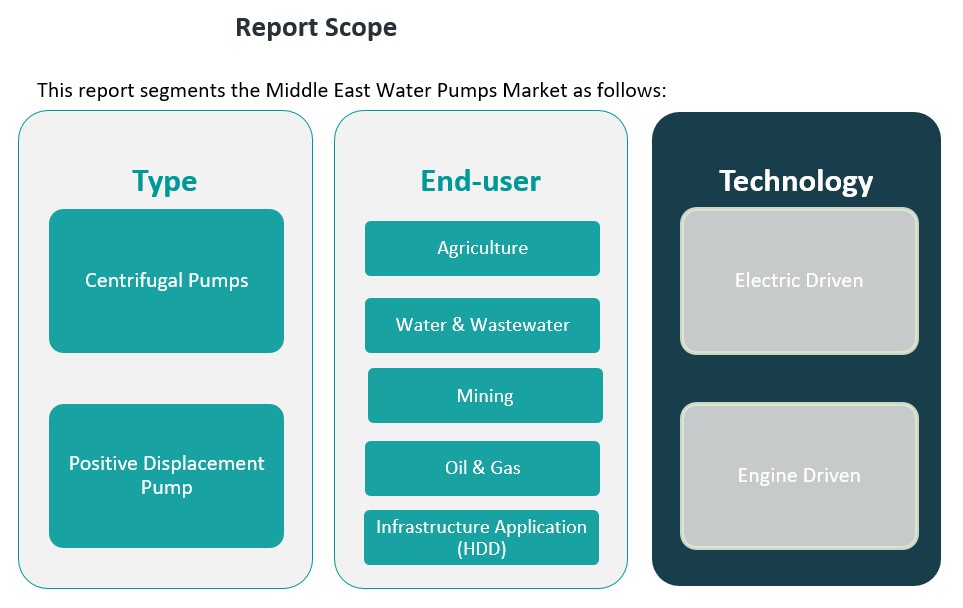
The Middle East water pump market can be categorized into various segments based on type, end-user, and technology.
By Type Segment
The market is primarily divided into two types of pumps: centrifugal pumps and positive displacement pumps. Centrifugal pumps dominate the market due to their versatility and efficiency in handling large volumes of water in applications such as water treatment, desalination, and municipal water supply. These pumps are favored for their cost-effectiveness and simple design. On the other hand, positive displacement pumps are gaining traction, especially in applications requiring the handling of highly viscous fluids, such as in the oil and gas industry. Their ability to maintain consistent flow rates despite changes in pressure makes them ideal for sectors that require precision.
By End-User Segment
In terms of end-users, the agriculture sector is a significant consumer of water pumps, particularly in irrigation systems that require efficient water distribution in arid regions. The water and wastewater segment also holds a large market share, driven by the increasing demand for efficient water treatment and sewage systems. The oil and gas industry continues to be a major driver of the market, with pumps required for drilling, extraction, and refinery processes. Additionally, the mining industry demands high-capacity pumps for fluid handling in mineral extraction, while infrastructure applications, such as Horizontal Directional Drilling (HDD) for utilities, also contribute to market growth.
By Technology Segment
The technology segment is dominated by electric-driven pumps, which offer greater energy efficiency and are ideal for urban and industrial applications. Engine-driven pumps, often used in remote areas or for temporary setups, are also in demand due to their portability and ability to operate in locations with limited electrical infrastructure.
Segmentation:
By Type Segment:
- Centrifugal Pumps
- Positive Displacement Pumps
By End-User Segment:
- Agriculture
- Water & Wastewater
- Mining
- Oil & Gas
- Infrastructure Application (HDD)
By Technology Segment:
- Electric Driven
- Engine Driven
Regional Analysis:
The Middle East water pump market is characterized by significant regional diversity, with each country presenting unique growth opportunities based on local infrastructure development, industrial expansion, and environmental needs. Key markets within the region include Saudi Arabia, the United Arab Emirates (UAE), Qatar, Kuwait, and Oman, each contributing differently to the market dynamics.
Saudi Arabia
Saudi Arabia holds the largest market share in the Middle East water pump market, accounting for approximately 40% of the region’s total revenue. The kingdom’s dominance is driven by its significant investments in water desalination, wastewater treatment, and irrigation systems, due to its vast arid regions and water scarcity issues. The government’s Vision 2030 initiative, which includes a focus on sustainable development and water resource management, further propels the demand for advanced water pump technologies. In particular, Saudi Arabia's large-scale infrastructure projects and agricultural investments continue to create demand for both centrifugal and positive displacement pumps.
United Arab Emirates (UAE)
The UAE, particularly Dubai and Abu Dhabi, is another major player in the Middle East water pump market, holding approximately 25% of the regional market share. The country’s rapid urbanization, coupled with its push toward smart city initiatives, has led to increased demand for advanced water management systems. The UAE is also heavily investing in renewable energy, especially solar-powered pumps, which align with its sustainability goals. Furthermore, the growing desalination capacity in the UAE contributes significantly to the demand for high-efficiency pumping systems in municipal and industrial sectors.
Qatar and Kuwait
Qatar and Kuwait, accounting for about 15% of the regional market share, also exhibit strong growth in the water pump market, driven by ongoing infrastructure development and water scarcity issues. Qatar's preparations for hosting the FIFA World Cup 2022 have accelerated investments in water infrastructure, boosting demand for water pumps in construction and irrigation applications. Similarly, Kuwait's expanding wastewater treatment initiatives continue to drive demand for reliable and energy-efficient pumps.
Oman
Oman, with a market share of approximately 10%, is experiencing steady growth in the water pump sector due to its focus on improving water infrastructure and expanding irrigation systems. Oman’s government has been focusing on enhancing agricultural productivity and improving water supply systems, which contributes to the demand for water pumps, particularly in remote and rural areas.
Other Middle Eastern Markets
The remaining 10% of the market share is distributed across other Middle Eastern countries such as Bahrain, Jordan, and Egypt, where investments in water treatment, desalination, and industrial applications are increasing, further contributing to the regional demand for water pumps.
Key Player Analysis:
- SLB
- Ingersoll Rand
- The Weir Group PLC
- Vaughan Company
- KSB SE & Co. KGaA
- Pentair
- Grundfos Holding A/S
- Xylem
- Flowserve Corporation
- ITT Inc.
- EBARA Corporation
Competitive Analysis:
The Middle East water pump market is highly competitive, with numerous global and regional players vying for market share. Key players include multinational corporations such as Xylem, Flowserve Corporation, KSB SE & Co. KGaA, and Grundfos, which dominate the market with their wide range of centrifugal and positive displacement pumps. These companies benefit from their established brand presence, technological expertise, and extensive distribution networks. Additionally, regional players like Saudi-based National Pump & Equipment and UAE’s Arabian Pumps are also gaining traction by offering tailored solutions that meet local needs, especially in desalination and wastewater management sectors. The market is marked by continuous innovation, particularly in energy-efficient and smart pump technologies. Companies are focusing on product differentiation through the integration of IoT, remote monitoring, and sustainable energy solutions. As infrastructure investments grow, competition is expected to intensify, with an increasing emphasis on cost-effective, reliable, and high-performance pumping systems.
Recent Developments:
- Servotech Power Systems Ltd.launched solar pump controllers on October 28, 2024, designed for 2HP to 10HP water pumps. This aligns with initiatives like PM-KUSUM to promote sustainable farming practices through water-efficient solutions.
- Roto Pumps Ltd.announced the launch of its subsidiary, Roto Energy Systems Ltd., in Feb 2024. This new division focuses on solar-powered water pumping solutions, including submersible and surface pumps, catering to eco-friendly water management needs.
- Grundfos' commitment to the Water Resilience Coalition in March 2025 aligns with the water pump market's focus on sustainability and efficient water management. The coalition’s goals include measurable improvements in global water sustainability by 2030.
- On February 28, 2025, KSB launched the MultiTec Plus pump series, specifically optimized for drinking water transport. This product integrates energy-saving technologies and real-time monitoring capabilities, emphasizing advancements in smart and sustainable water pumping solutions.
Market Concentration & Characteristics:
The Middle East water pump market exhibits moderate concentration, with a blend of global and regional players holding significant market shares. Major international players, such as Xylem, Flowserve, and Grundfos, dominate the landscape due to their technological innovations, extensive product portfolios, and well-established distribution channels. However, regional players like National Pump & Equipment and Arabian Pumps are gaining ground by offering tailored solutions and focusing on local market needs, particularly in sectors like water desalination, agriculture, and wastewater treatment. The market is characterized by a high degree of competition, driven by the demand for energy-efficient and sustainable water pump solutions. Companies in the region are increasingly adopting smart pump technologies integrated with IoT and automation features. Furthermore, with large infrastructure projects underway, including water management and desalination plants, the market is witnessing increasing collaborations between global pump manufacturers and regional engineering firms to cater to specific local demands.
Report Coverage:
The research report offers an in-depth analysis based on Type Segment, End-User Segment and Technology Segment. It details leading market players, providing an overview of their business, product offerings, investments, revenue streams, and key applications. Additionally, the report includes insights into the competitive environment, SWOT analysis, current market trends, as well as the primary drivers and constraints. Furthermore, it discusses various factors that have driven market expansion in recent years. The report also explores market dynamics, regulatory scenarios, and technological advancements that are shaping the industry. It assesses the impact of external factors and global economic changes on market growth. Lastly, it provides strategic recommendations for new entrants and established companies to navigate the complexities of the market.
Future Outlook:
- The Middle East water pump market is expected to experience steady growth driven by rising demand for water management solutions.
- There will be an increasing adoption of solar-powered and renewable energy-driven pumps as the region focuses on sustainability.
- The need for desalination and wastewater treatment plants will continue to drive demand for advanced pumping systems, especially in key markets like Saudi Arabia and the UAE.
- Urbanization and large-scale infrastructure projects will maintain the demand for efficient and reliable water supply systems.
- The integration of smart pumps with IoT capabilities will become more prevalent, enabling real-time monitoring and predictive maintenance.
- Agricultural irrigation will remain a key focus area, particularly in water-scarce countries such as Saudi Arabia and Oman.
- The oil and gas industry will continue to be a major driver, with rising demand for specialized pumps in both offshore and onshore applications.
- Ongoing investment in industrial and commercial sectors will foster steady demand for water pumps across various applications.
- Governments will likely introduce more water conservation regulations, further boosting the need for high-efficiency pumps.
- Market competition will intensify, with both global and regional players focusing on product innovation and cost-effective solutions.
Request a Free Sample
Fill in your details and we'll send you a free sample report.
- Sample data tables & charts
- Research methodology
Need a Custom Version of This Report?
Tailor the scope, geography, or segments to your exact requirements.
- Custom geography or segment scope
- Direct access to our analyst team
Frequently Asked Questions
What is the current size of the Middle East Water Pump Market?
What factors are driving the growth of the Middle East Water Pump Market?
What are the key segments within the Middle East Water Pump Market?
What are some challenges faced by the Middle East Water Pump Market?
Who are the major players in the Middle East Water Pump Market?
Table of Content
Chapter 1. Report Introduction
- 1.1 Report Description & Purpose
- 1.1.1 Report Title & Market Definition
- 1.1.2 Unique Selling Propositions (USP) & Key Differentiators
- 1.1.3 Value Proposition for Stakeholders
- 1.2 Research Objectives
- 1.2.1 Market Sizing Objectives (Volume & Revenue) (Volume Where Applicable)
- 1.2.2 Segmentation Objectives
- 1.2.3 Competitive Intelligence Objectives
- 1.2.4 Forecast & Scenario Objectives
- 1.3 Report Scope
- 1.3.1 Middle East Water Pump Scope – Segments & Subsegments Covered
- 1.3.2 Geographic Scope – Selected Region & Countries Covered
- 1.3.3 Historical Period, Base Year & Forecast Period (2023; forecast to 2032)
- 1.3.4 Inclusions & Exclusions
- 1.4 Industry Classification & Applicable Codes
- 1.5 Currency, Measurement Units & Valuation Basis
- 1.6 Target Stakeholders
- 1.7 Limitations & Assumptions
Chapter 2. Executive Summary
- 2.1 Middle East Water Pump Snapshot
- 2.1.1 Market Size – Historical (2023) & Forecast (2023-2032) (2023: USD 1,150.67 million → 2032: USD 1,341.09 million)
- 2.1.2 Volume & Revenue – Regional Totals (Volume Where Applicable)
- 2.1.3 Key Market Highlights – Top Five Facts
- 2.2 Middle East Water Pump Segmentation Snapshot
- 2.2.1 Market Split by Country – 2023 vs. 2032
- 2.3 Competitive Snapshot
- 2.3.1 Top 10 Players by Revenue Share – 2023
- 2.3.2 Top 10 Players by Volume Share – 2023 (Volume Where Applicable)
- 2.3.3 Recent Strategic Developments (18-Month Summary)
- 2.4 Key Investment Highlights & Strategic Conclusions
Chapter 3. Middle East Water Pump Dynamics & Industry Analysis
- 3.1 Market Overview & Context
- 3.1.1 Middle East Water Pump Position in the Broader Industry Value Chain
- 3.1.2 Demand Structure & Purchasing Dynamics
- 3.1.3 Market Maturity & Development Stage by Country
- 3.2 Middle East Water Pump Drivers
- 3.3 Middle East Water Pump Restraints & Challenges
- 3.4 Middle East Water Pump Opportunities
- 3.5 Porter's Five Forces Analysis
- 3.5.1 Threat of New Entrants
- 3.5.2 Bargaining Power of Suppliers
- 3.5.3 Bargaining Power of Buyers
- 3.5.4 Threat of Substitutes
- 3.5.5 Competitive Rivalry – Intensity Assessment
- 3.6 Middle East Water Pump Value Chain Analysis
- 3.6.1 Upstream – Key Inputs, Resources & Suppliers
- 3.6.1.1 Key Input/Resource 1
- 3.6.1.2 Key Input/Resource 2
- 3.6.1.3 Key Input/Resource 3
- 3.6.2 Midstream – Core Operations & Value Creation
- 3.6.2.1 Operating Model & Process Overview
- 3.6.2.2 Key Operating Locations & Capabilities by Company
- 3.6.3 Downstream – Market Channels & End Users
- 3.6.3.1 Direct Sales & Customer Engagement Channels
- 3.6.3.2 Indirect Sales, Intermediaries & Partner Channels
- 3.6.4 Value Chain Profitability Analysis
- 3.6.1 Upstream – Key Inputs, Resources & Suppliers
- 3.7 PESTEL Analysis
- 3.7.1 Political Factors
- 3.7.2 Economic Factors
- 3.7.3 Social Factors
- 3.7.4 Technological Factors
- 3.7.5 Environmental Factors
- 3.7.6 Legal Factors
- 3.8 Middle East Water Pump Supply Chain Analysis
- 3.8.1 Critical Input & Resource Availability Risk Assessment
- 3.8.2 Supplier & Operational Concentration Risk (Geographic Exposure)
- 3.8.3 Supply & Service Disruption Impact Analysis
- 3.9 Regional & Country Regulatory Landscape
Note: The regulatory and policy landscape section covers regulations based on their applicability to the market, Middle East Water Pump category, geography, and scope of the study. Only regulatory frameworks with a material impact on operations, compliance, trade, sustainability, or market access are analyzed in detail.
Chapter 4. Key Investment Pockets & Opportunity Analysis
- 4.1 Middle East Water Pump Attractiveness Analysis
- 4.1.1 By Country – Investment Attractiveness Matrix (Market Size × CAGR)
- 4.2 Absolute Revenue Growth Opportunity
- 4.2.1 By Country – Absolute Revenue Growth Through 2032
- 4.3 Incremental Demand Opportunity
- 4.3.1 By Country – Incremental Demand Through 2032
- 4.3.2 Segment – Incremental Demand
- 4.4 Emerging Submarket Opportunity Deep Dive (Subject to Applicability)
- 4.5 Priority Country Opportunity Scorecards
- 4.5.1 Priority Country 1
- 4.5.2 Priority Country 2
- 4.5.3 Priority Country 3
- 4.5.4 Priority Country 4
Note: Priority countries are selected from within the region covered by the study. Numbered entries are indicative and are populated with relevant country names based on market size, growth potential, and strategic relevance.
Chapter 5. Middle East Water Pump Cross-Border Trade & Market Access Analysis
- 5.1 Intra-Regional & Extra-Regional Trade Overview
- 5.1.1 Regional Export Value by Country (2023)
- 5.1.2 Regional Export Volume by Country (2023) (Volume Where Applicable)
- 5.1.3 Regional Import Value by Country (2023)
- 5.1.4 Regional Import Volume by Country (2023) (Volume Where Applicable)
- 5.1.5 Net Trade Balance by Country (2023)
- 5.2 Export Analysis – Segment
- 5.2.1 Category 1 (Applicable Classification Code)
- 5.2.2 Category 2 (Applicable Classification Code)
- 5.2.3 Category 3 (Applicable Classification Code)
- 5.2.4 Category 4 (Applicable Classification Code)
- 5.2.5 Category 5 (Applicable Classification Code)
- 5.3 Import Analysis – Segment
- 5.3.1 Category 1 (Applicable Classification Code)
- 5.3.2 Category 2 (Applicable Classification Code)
- 5.3.3 Category 3 (Applicable Classification Code)
- 5.3.4 Category 4 (Applicable Classification Code)
- 5.3.5 Category 5 (Applicable Classification Code)
- 5.4 Cross-Border Pricing & Transaction Benchmarks
- 5.4.1 Export Pricing – Segment & Country
- 5.4.2 Import Pricing – Segment & Source Country
- 5.4.3 Price Trends (2023)
- 5.5 Key Cross-Border Trade & Delivery Routes
- 5.5.1 Cross-Border Trade/Delivery Route 1
- 5.5.2 Cross-Border Trade/Delivery Route 2
- 5.5.3 Cross-Border Trade/Delivery Route 3
- 5.5.4 Cross-Border Trade/Delivery Route 4
- 5.5.5 Cross-Border Trade/Delivery Route 5
- 5.6 Trade Policy & Market Access Impact Assessment
- 5.6.1 Tariff & Non-Tariff Barriers
- 5.6.2 Regional Trade & Economic Integration Frameworks
- 5.6.3 Bilateral & Multilateral Trade Agreements
- 5.6.4 Cross-Border Operating, Licensing & Localization Requirements
Note: Cross-border analysis applies where relevant to Middle East Water Pump. Country trade flows distinguish intra-regional activity from trade with markets outside the region. Regional external trade totals exclude intra-regional flows to avoid double counting. Classifications and transaction measures follow the market scope; volume and route analyses apply only where meaningful.
Chapter 6. Competitive Landscape & Company Benchmarking
- 6.1 Middle East Water Pump Concentration & Structure
- 6.1.1 Herfindahl-Hirschman Index (HHI) – vs. 2023
- 6.1.2 Leading, Mid-Sized & Emerging Player Structure
- 6.1.3 Global, Regional & Local Player Dynamics
- 6.2 Middle East Water Pump Share Analysis – 2023
- 6.2.1 Regional Revenue Share by Company
- 6.2.2 Regional Volume Share by Company (Volume Where Applicable)
- 6.2.3 Company Revenue Share by Country
- 6.2.4 Market Share Evolution ( vs. 2023)
- 6.2.5 Company Market Share by Key Segment
- 6.2.6 Company Market Share by Customer Group
- 6.3 Operating Scale, Capacity & Infrastructure Analysis
- 6.3.1 Regional Operating Scale & Supply Capacity
- 6.3.2 Resource Utilization & Operating Efficiency
- 6.3.3 Output, Service Delivery & Activity Metrics
- 6.3.4 Operating Footprint & Infrastructure Map
- 6.3.5 Planned Operational & Capacity Expansion
- 6.4 Middle East Water Pump Competitive Benchmarking Matrix
- 6.4.1 Revenue, Growth, Profitability & Operating Metric Comparison
- 6.4.2 Channel Revenue Mix
- 6.4.3 Revenue Exposure by Country Within the Region
- 6.4.4 R&D Intensity
- 6.4.5 Sustainability Maturity
- 6.5 Strategic Developments in Middle East Water Pump (Last 24 Months)
- 6.5.1 Mergers, Acquisitions & Divestments
- 6.5.2 New Products, Services & Solutions in Middle East Water Pump
- 6.5.3 Operational & Infrastructure Expansions
- 6.5.4 Strategic Alliances, Joint Ventures & Partnerships
- 6.5.5 Distribution Expansion & Market Entry
- 6.5.6 Sustainability & ESG Initiatives
- 6.6 Competitive Strategy Mapping
- 6.6.1 Leader, Challenger, Follower & Niche Classification
- 6.6.2 Pricing Strategy Comparison
- 6.6.3 Channel Strategy Matrix
Note: Strategic developments are included based on their materiality and the availability of reliable information.
Chapter 7. Middle East Water Pump – By Sales & Delivery Channel
- 7.1 Segment Overview
- 7.1.1 Volume & Revenue Split by Channel (2023 & 2032) (Volume Where Applicable)
- 7.1.2 Channel Mix Evolution (2023-2032)
Chapter 8. Country Market Analysis – Regional Overview
- 8.1 Country Market Overview Within the Region
- 8.1.1 Country Volume Share Within the Region (Where Applicable)
- 8.1.2 Country Revenue Share Within the Region
- 8.1.3 Market Volume by Country (Where Applicable)
- 8.1.4 Market Revenue by Country
- 8.1.5 Country Forecasts Through 2032
- 8.2 Cross-Country Segment Analysis
- 8.2.1 By Sales & Delivery Channel
- 8.2.2 By Competitive Positioning & Price Tier
Chapter 9. Middle East Water Pump – Priority Country 1
Chapter 10. Middle East Water Pump – Priority Country 2
Chapter 11. Middle East Water Pump – Priority Country 3
Chapter 12. Middle East Water Pump – Priority Country 4
Chapter 13. Middle East Water Pump Company Profiles
- 13.1 [Company 01]
- 13.1.1 Company Overview
- 13.1.2 Key Management Personnel
- 13.1.3 Products & Services Portfolio
- 13.1.4 Financial Performance
- 13.1.5 Regional Market Focus & Country Presence
- 13.1.6 Recent Developments & Strategic Initiatives
Note: The company profile list is preliminary and may change based on research findings, market developments, data availability, and client requirements.
Chapter 14. Appendices
- Appendix A – List of Abbreviations & Acronyms
- Appendix B – Industry Classification Code Reference – Full Series
- Appendix C – Supply, Output & Operating Capacity Data Tables
- Appendix D – End-Use & Demand Base Tables
- Appendix E – Demand, Adoption & Usage Assumptions
- Appendix F – Pricing & Revenue Metric Reference Tables
- Appendix G – Company Operations & Infrastructure Database
- Appendix H – Cross-Border Trade & Activity Data Tables (Where Applicable)
- Appendix I – Regulatory Summary Tables
- Appendix J – Primary Research Participant List (Anonymized)
- Appendix K – Primary Research Questionnaire Framework
- Appendix L – Data Sources & Bibliography
- Appendix M – Market Size Divergence & Source Comparison
Chapter 15. Research Methodology
- 15.1 Research Framework & Philosophy
- 15.2 Secondary Research – Sources, Hierarchy & Data Extraction
- 15.3 Data Modeling – Country-Level Estimates & Regional Aggregation
- 15.4 Primary Research – Stakeholder Framework, LOI & Sample Sizes
- 15.5 Forecast Methodology – Regression, Scenario & Sensitivity Analysis
- 15.6 Quality Control – Four-Layer Validation Framework
- 15.7 Limitations & Standard Assumptions
- 15.8 Disclaimer
