
Mining Metal Market Overview:
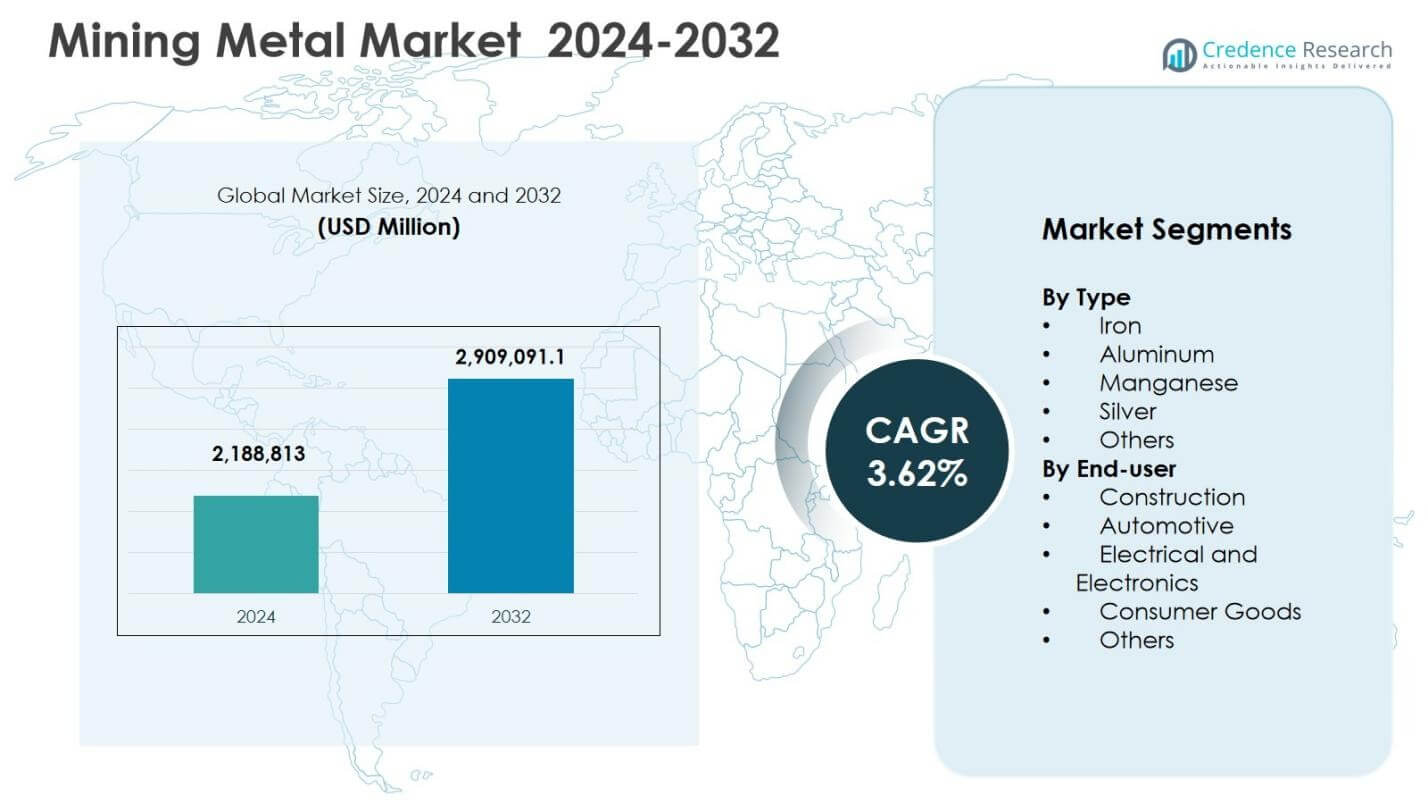
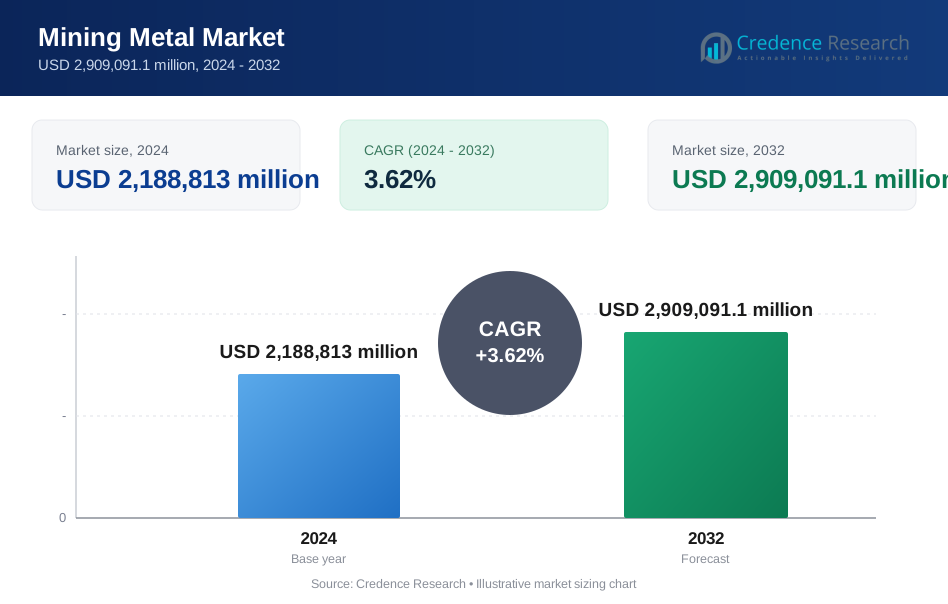
The Mining Metal Market size was valued at USD 2,188,813 million in 2024 and is anticipated to reach USD 2,909,091.1 million by 2032, registering a CAGR of 3.62% during the forecast period.
| REPORT ATTRIBUTE | DETAILS |
|---|---|
| Historical Period | 2020-2023 |
| Base Year | 2024 |
| Forecast Period | 2025-2032 |
| Mining Metal Market Size 2024 | USD 2,188,813 million |
| Mining Metal Market, CAGR | 3.62% |
| Mining Metal Market Size 2032 | USD 2,909,091.1 million |
Mining Metal Market Insights
- Infrastructure development and urban expansion remain the key growth drivers, with iron leading the market by holding a 41.6% segment share in 2024, followed by aluminum at 23.8%, supported by high consumption in steelmaking, transportation, and industrial manufacturing.
- Market trends highlight increasing adoption of sustainable mining practices, automation, and digital technologies, while aluminum and manganese demand is rising due to electric vehicles and renewable energy systems, with manganese accounting for a 14.2% segment share in 2024.
- Market dynamics show moderate intensity among major players, while restraints include price volatility, environmental regulations, and supply chain disruptions that influence investment planning and operational efficiency across mining operations.
- Regionally, Asia-Pacific dominated with a 46.8% share in 2024, followed by North America at 21.4% and Europe at 16.2%, driven by industrial demand, infrastructure projects, and advanced metal processing capabilities.
Mining Metal Market Segmentation Analysis:
By Type:
The Mining Metal Market by type is led by iron, which accounted for 41.6% market share in 2024, driven by its extensive use in steel production for infrastructure, construction, and heavy industrial applications. Iron’s dominance is supported by sustained demand from urbanization projects, transportation networks, and energy infrastructure worldwide. Aluminum followed with a 23.8% share, benefiting from lightweight, corrosion-resistant properties that support automotive and packaging applications. Manganese held 14.2%, primarily for alloying and battery applications, while silver contributed 9.4%, supported by electronics and renewable energy demand. Other metals collectively represented 11.0% of the market.
- For instance, Vale produced about 328 million metric tons of iron ore in 2024, exceeding its target range of 310–320 million tons and reinforcing its role as a major supplier to global steel producers for construction and infrastructure projects.
By End-user:
By end-user, the construction sector dominated with a 38.9% market share in 2024, supported by rising investments in residential, commercial, and infrastructure development across emerging and developed economies. Mining metals are essential for structural frameworks, reinforcement materials, and large-scale civil projects, sustaining strong volume consumption. The automotive sector followed with a 22.6% share, driven by demand for aluminum and specialty metals to improve fuel efficiency and vehicle performance. Electrical and electronics accounted for 18.1%, supported by grid expansion and consumer electronics manufacturing, while consumer goods held 12.7%, with other end-users contributing 7.7% of total demand.
- For instance, Alcoa launched the C611 EZCast aluminum alloy in 2022, certified by NIO for mega-casting vehicle underbody components like rear floor frames, reducing weight by 20% compared to prior designs.
Key Growth Drivers
Expanding Infrastructure and Urban Development
Large-scale infrastructure development remains a primary growth driver for the Mining Metal Market, supported by sustained investments in transportation networks, energy facilities, industrial parks, and urban housing. Governments across emerging and developed economies continue to prioritize roads, railways, ports, power plants, and smart cities, driving high demand for iron, aluminum, and other structural metals. Rapid urban population growth further accelerates construction activity, increasing consumption of steel-intensive materials. Public–private partnerships and long-term infrastructure funding programs are also improving project execution timelines, ensuring consistent metal offtake and stable demand growth across mining value chains.
- For instance, Adani Group received approval for a 30 MMTPA iron ore value-addition project in Odisha, featuring a beneficiation plant, slurry pipeline, and pellet plant for producing iron ore concentrate and pellets.
Rising Demand from Automotive and Manufacturing Industries
The automotive and industrial manufacturing sectors are significantly contributing to market expansion through increased adoption of lightweight and high-performance metals. Aluminum and specialty alloys are increasingly used to enhance fuel efficiency, reduce emissions, and improve durability in vehicles and machinery. Growth in electric vehicle production is further intensifying demand for aluminum, manganese, and conductive metals. Additionally, the expansion of industrial automation, heavy equipment manufacturing, and machinery replacement cycles continues to support steady metal consumption, reinforcing long-term growth prospects for mining operators.
- For instance, Audi partners with Constellium to supply advanced aluminum Auto Body Sheet and extruded components for the e-tron GT's crash management systems and battery enclosure, optimizing range, safety, and energy absorption.
Energy Transition and Power Infrastructure Expansion
The global shift toward renewable energy and electrification is strengthening demand for mining metals across power generation, transmission, and storage applications. Large-scale solar and wind projects require substantial volumes of steel, aluminum, and specialty metals, while grid expansion and modernization are increasing the need for conductive and corrosion-resistant materials. Battery manufacturing for energy storage systems is also boosting demand for manganese and other strategic metals. This energy transition-driven consumption is creating structurally higher baseline demand for mined metals worldwide.
Key Trends & Opportunities
Increasing Focus on Sustainable and Responsible Mining
Sustainability has emerged as a critical trend shaping investment and operational strategies in the Mining Metal Market. Mining companies are increasingly adopting low-emission technologies, water recycling systems, and energy-efficient extraction methods to meet regulatory requirements and investor expectations. Responsible sourcing, traceability, and environmental compliance are becoming competitive differentiators, particularly for metals used in renewable energy and electric mobility. These developments are creating opportunities for companies that invest in green mining practices, digital monitoring, and ESG-aligned operations to secure long-term contracts and premium market positioning.
- For instance, Barrick Gold commissioned a 200 MW solar plant at Nevada Gold Mines in the US, contributing to 687 MW of renewable and cleaner energy sources installed since 2019, which supports reduced reliance on carbon-intensive power.
Technological Advancements in Mining and Processing
Advancements in automation, digitalization, and data analytics are transforming mining efficiency and productivity. The integration of autonomous drilling, AI-driven exploration, and real-time monitoring systems is improving resource recovery rates and reducing operational downtime. Enhanced ore processing technologies are also enabling the economic extraction of lower-grade deposits, expanding available reserves. These innovations present significant opportunities for mining companies to optimize costs, extend mine life, and improve safety, while supporting consistent metal supply amid rising global demand.
- For instance, BHP has implemented machine learning algorithms and sensor-based data analytics at its Newman iron ore mine to predict equipment failures, cutting maintenance costs and unplanned downtime
Key Challenges
Environmental Regulations and Compliance Pressures
Stringent environmental regulations pose a significant challenge for the Mining Metal Market, increasing compliance costs and operational complexity. Governments are enforcing stricter standards related to emissions, land rehabilitation, waste management, and water usage, particularly for large-scale open-pit and underground mines. Delays in environmental approvals and community opposition can disrupt project timelines and restrict capacity expansion. Companies must invest heavily in sustainable practices and regulatory adherence, which can pressure margins, especially for smaller and mid-sized mining operators.
Price Volatility and Supply Chain Uncertainty
Fluctuating metal prices remain a persistent challenge, driven by macroeconomic conditions, geopolitical tensions, and demand–supply imbalances. Volatility in iron, aluminum, and specialty metal prices affects revenue predictability and investment planning for mining companies. Additionally, supply chain disruptions, logistics constraints, and energy cost fluctuations can impact production efficiency and delivery schedules. Managing these risks requires robust hedging strategies, diversified operations, and long-term customer contracts, adding operational and financial complexity across the mining value chain.
Regional Analysis
Asia-Pacific
Asia-Pacific dominated the Mining Metal Market with a 46.8% market share in 2024, supported by large-scale mining operations, rapid industrialization, and strong downstream demand from construction, automotive, and manufacturing sectors. China, India, and Australia remain key contributors due to extensive iron ore, aluminum, and manganese reserves combined with high domestic consumption. Government-led infrastructure expansion, urban housing projects, and power grid development continue to drive metal demand. The region also benefits from cost-efficient mining operations and expanding refining capacity, positioning Asia-Pacific as the primary global supply and consumption hub.
North America
North America accounted for 21.4% market share in 2024, driven by steady demand from construction, automotive manufacturing, and energy infrastructure projects. The United States and Canada maintain strong positions due to advanced mining technologies, well-established regulatory frameworks, and significant investments in sustainable mining practices. Rising demand for aluminum and specialty metals from electric vehicles and renewable energy installations is strengthening regional consumption. Additionally, ongoing modernization of aging infrastructure and increased domestic sourcing of critical metals are supporting long-term market stability across the region.
Europe
Europe captured 16.2% market share in 2024, supported by consistent demand from industrial manufacturing, automotive production, and electrical applications. Countries such as Germany, France, and Sweden play key roles through advanced processing capabilities and high-value metal usage rather than large-scale extraction. The region’s strong focus on sustainability, recycling, and circular economy practices is shaping metal consumption patterns. Infrastructure upgrades, renewable energy expansion, and electric mobility initiatives are sustaining demand for aluminum and specialty metals, while regulatory compliance continues to influence mining and sourcing strategies.
Latin America
Latin America represented 9.8% market share in 2024, driven by abundant reserves of iron, copper-related metals, silver, and other strategic minerals. Countries including Chile, Peru, Brazil, and Mexico serve as major mining exporters, supplying global markets. Mining investments are supported by rising demand from Asia-Pacific and North America, particularly for construction and energy applications. Government initiatives to attract foreign investment and expand mining infrastructure are strengthening regional output, although operational performance remains closely linked to commodity price movements and regulatory stability.
Middle East & Africa
The Middle East & Africa held 5.8% market share in 2024, supported by expanding mining activity and infrastructure development across select economies. Africa benefits from rich mineral reserves, including iron, manganese, and precious metals, while Middle Eastern countries are investing in metal processing to support industrial diversification. Rising construction activity, energy projects, and export-oriented mining operations are driving regional demand. Improved logistics infrastructure and increasing foreign direct investment are gradually enhancing production capacity, positioning the region for steady growth within the global mining metal landscape.
Mining Metal Market Segmentations:
By Type
- Iron
- Aluminum
- Manganese
- Silver
- Others
By End-user
- Construction
- Automotive
- Electrical and Electronics
- Consumer Goods
- Others
By Geography
- North America
- U.S.
- Canada
- Mexico
- Europe
- Germany
- France
- U.K.
- Italy
- Spain
- Rest of Europe
- Asia Pacific
- China
- Japan
- India
- South Korea
- South-east Asia
- Rest of Asia Pacific
- Latin America
- Brazil
- Argentina
- Rest of Latin America
- Middle East & Africa
- GCC Countries
- South Africa
- Rest of the Middle East and Africa
Competitive Landscape
Competitive landscape analysis of the Mining Metal Market features key players including BHP, Rio Tinto, Anglo American, Barrick Gold Corporation, Freeport-McMoRan, Alcoa Corporation, Teck Resources Limited, Antofagasta plc, Hudbay Minerals Inc, and Capstone Copper. The market remains moderately consolidated, with leading players leveraging diversified metal portfolios, large-scale reserves, and integrated mining-to-processing operations to maintain competitive strength. These companies focus on operational efficiency, cost optimization, and long-life asset development to sustain margins amid price volatility. Strategic investments in sustainable mining, automation, and low-carbon technologies are increasingly shaping competitive differentiation. Expansion through brownfield projects, capacity upgrades, and selective acquisitions remains a key growth strategy, while strong geographic presence across Asia-Pacific, the Americas, and Africa enables players to effectively serve global demand from construction, automotive, and energy sectors.
Key Player Analysis
- Freeport-McMoRan
- Antofagasta plc
- Teck Resources Limited
- BHP
- Capstone Copper
- Barrick Gold Corporation
- Rio Tinto
- Hudbay Minerals Inc
- Alcoa Corporation
- Anglo American
Recent Developments
- In December 2025, Lundin Mining announced the sale of its Eagle Mine and Humboldt Mill subsidiary to Talon Metals, creating a pure-play American nickel-copper company, with the deal valued at approximately US$83.7 million in Talon shares.
- In December 2025, IAMGOLD Corporation completed the acquisition of Mines D’Or Orbec Inc., finalizing the previously announced transaction to expand its gold mining footprint.
- In December 2025, Champion Iron Ltd entered into an agreement to acquire Norwegian iron ore company Rana Gruber, expanding its iron ore asset base in Europe.
Report Coverage
The research report offers an in-depth analysis based on Type, End User and Geography. It details leading market players, providing an overview of their business, product offerings, investments, revenue streams, and key applications. Additionally, the report includes insights into the competitive environment, SWOT analysis, current market trends, as well as the primary drivers and constraints. Furthermore, it discusses various factors that have driven market expansion in recent years. The report also explores market dynamics, regulatory scenarios, and technological advancements that are shaping the industry. It assesses the impact of external factors and global economic changes on market growth. Lastly, it provides strategic recommendations for new entrants and established companies to navigate the complexities of the market.
Future Outlook
- Mining metal demand will remain stable, supported by long-term infrastructure development and urban expansion across emerging and developed economies.
- Continued growth in construction and transportation projects will sustain high consumption of iron and aluminum globally.
- Expansion of electric vehicles and renewable energy systems will increase demand for aluminum, manganese, and conductive metals.
- Technological advancements will improve mining efficiency, safety, and recovery rates across large-scale operations.
- Automation and digital monitoring will reduce operational costs and enhance productivity in mining sites.
- Sustainability initiatives will drive wider adoption of low-emission and energy-efficient mining practices.
- Strategic investments in exploration will expand reserves and support long-term supply security.
- Regional diversification will help mining companies mitigate geopolitical and supply chain risks.
- Recycling and circular economy practices will increasingly complement primary metal production.
- Competitive intensity will remain moderate, with leading players focusing on scale, efficiency, and responsible mining practices.
Request a Free Sample
Fill in your details and we'll send you a free sample report.
- Sample data tables & charts
- Research methodology
Need a Custom Version of This Report?
Tailor the scope, geography, or segments to your exact requirements.
- Custom geography or segment scope
- Direct access to our analyst team
Frequently Asked Questions
What is the current market size for the Mining Metal Market, and what is its projected size in 2032?
At what Compound Annual Growth Rate is the Mining Metal Market projected to grow between 2024 and 2032?
Which Mining Metal Market segment held the largest share in 2024?
What are the primary factors fueling the growth of the Mining Metal Market?
Who are the leading companies in the Mining Metal Market?
Which region commanded the largest share of the Mining Metal Market in 2024?
Table of Content
Chapter 1. Report Introduction
- 1.1 Report Description & Purpose
- 1.1.1 Report Title & Market Definition
- 1.1.2 Unique Selling Propositions (USP) & Key Differentiators
- 1.1.3 Value Proposition for Stakeholders
- 1.2 Research Objectives
- 1.2.1 Market Sizing Objectives (Volume & Revenue)
- 1.2.2 Segmentation Objectives
- 1.2.3 Competitive Intelligence Objectives
- 1.2.4 Forecast & Scenario Objectives
- 1.3 Report Scope
- 1.3.1 Mining Metal Scope – Types & Subtypes Covered
- 1.3.2 Geographic Scope – Regions & Countries Covered
- 1.3.3 Historical Period, Base Year & Forecast Period (2024; forecast to 2032)
- 1.3.4 Inclusions & Exclusions
- 1.4 HS Code & Classification Framework
- 1.5 Currency, Units & Pricing Basis
- 1.6 Target Stakeholders
- 1.7 Limitations & Assumptions
Chapter 2. Executive Summary
- 2.1 Global Mining Metal Market Snapshot
- 2.1.1 Market Size – Historical (2024) & Forecast (2024-2032) (2024: USD 2,188,813 million → 2032: USD 2,909,091.1 million)
- 2.1.2 Volume & Revenue – Global Totals
- 2.1.3 Key Market Highlights – Top Five Facts
- 2.2 Mining Metal Market Segmentation Snapshot
- 2.2.1 Market Split by Region – 2024 vs. 2032
- 2.3 Competitive Snapshot
- 2.3.1 Top 10 Players by Revenue Share – 2024
- 2.3.2 Top 10 Players by Volume Share – 2024
- 2.3.3 Recent Strategic Developments (18-Month Summary)
- 2.4 Key Investment Highlights & Strategic Conclusions
Chapter 3. Mining Metal Market Dynamics & Industry Analysis
- 3.1 Market Overview & Context
- 3.1.1 Mining Metal Market Position in the Broader Automotive Value Chain
- 3.1.2 OEM vs. Replacement Market Dynamics
- 3.1.3 Market Maturity & Development Stage by Region
- 3.2 Mining Metal Market Drivers
- 3.3 Mining Metal Market Restraints & Challenges
- 3.4 Mining Metal Market Opportunities
- 3.5 Porter's Five Forces Analysis
- 3.5.1 Threat of New Entrants
- 3.5.2 Bargaining Power of Suppliers
- 3.5.3 Bargaining Power of Buyers
- 3.5.4 Threat of Substitutes
- 3.5.5 Competitive Rivalry – Intensity Assessment
- 3.6 Mining Metal Value Chain Analysis
- 3.6.1 Upstream – Raw Material/Input Suppliers
- 3.6.1.1 Raw Material/Input 1
- 3.6.1.2 Raw Material/Input 2
- 3.6.1.3 Raw Material/Input 3
- 3.6.2 Midstream – Production/Manufacturing/Service Delivery
- 3.6.2.1 Production/Process Overview
- 3.6.2.2 Key Facility Locations & Capacity by Manufacturer
- 3.6.3 Downstream – Distribution & End Consumer
- 3.6.3.1 Primary Channel – B2B/OEM
- 3.6.3.2 Secondary Channels – Dealer, Retail, Online, Direct
- 3.6.4 Value Chain Profitability Analysis
- 3.6.1 Upstream – Raw Material/Input Suppliers
- 3.7 PESTEL Analysis
- 3.7.1 Political Factors
- 3.7.2 Economic Factors
- 3.7.3 Social Factors
- 3.7.4 Technological Factors
- 3.7.5 Environmental Factors
- 3.7.6 Legal Factors
- 3.8 Mining Metal Supply Chain Analysis
- 3.8.1 Raw Material/Input Supply Risk Assessment
- 3.8.2 Manufacturing Concentration Risk (Geographic Exposure)
- 3.8.3 Trade Disruption Impact Analysis
- 3.9 Regulatory & Policy Landscape
Note: The regulatory and policy landscape section covers regulations based on their applicability to the market, Mining Metal category, geography, and scope of the study. Only regulatory frameworks with a material impact on operations, compliance, trade, sustainability, or market access are analyzed in detail.
Chapter 4. Key Investment Pockets & Opportunity Analysis
- 4.1 Mining Metal Market Attractiveness Analysis
- 4.1.1 By Region – Investment Attractiveness Matrix (Volume × CAGR)
- 4.2 Absolute Revenue Growth Opportunity
- 4.2.1 By Region – Absolute USD Growth Through 2032
- 4.3 Incremental Volume Opportunity
- 4.3.1 By Region – Incremental Volume Through 2032
- 4.3.2 Segment – Incremental Volume
- 4.4 Emerging Submarket Opportunity Deep Dive (Subject to Applicability)
- 4.5 Emerging Market Opportunity Scorecards
- 4.5.1 United States
- 4.5.2 Europe
- 4.5.3 Asia
- 4.5.4 Middle East & Africa
Note: Emerging Market Opportunity Scorecards will be included based on relevance and strategic importance. Regions listed are indicative and may vary depending on data availability and market dynamics.
Chapter 5. Mining Metal Import-Export Analysis & Trade Flows
- 5.1 Global Trade Overview
- 5.1.1 Global Export Value by Country (2024)
- 5.1.2 Global Export Volume by Country (2024)
- 5.1.3 Global Import Value by Country (2024)
- 5.1.4 Global Import Volume by Country (2024)
- 5.1.5 Net Trade Balance by Country (2024)
- 5.2 Export Analysis – Segment
- 5.2.1 Type 1 (HS Code)
- 5.2.2 Type 2 (HS Code)
- 5.2.3 Type 3 (HS Code)
- 5.2.4 Type 4 (HS Code)
- 5.2.5 Type 5 (HS Code)
- 5.3 Import Analysis – Segment
- 5.3.1 Type 1 (HS Code)
- 5.3.2 Type 2 (HS Code)
- 5.3.3 Type 3 (HS Code)
- 5.3.4 Type 4 (HS Code)
- 5.3.5 Type 5 (HS Code)
- 5.4 Average Unit Trade Prices
- 5.4.1 Average Export Price – Segment & Country
- 5.4.2 Average Import Price – Segment & Source Country
- 5.4.3 Price Trends (2024)
- 5.5 Key Trade Route Analysis
- 5.5.1 Trade Route 1
- 5.5.2 Trade Route 2
- 5.5.3 Trade Route 3
- 5.5.4 Trade Route 4
- 5.5.5 Trade Route 5
- 5.6 Trade Policy Impact Assessment
- 5.6.1 US Anti-Dumping & Section 301 Tariffs
- 5.6.2 EU Customs Union Impact
- 5.6.3 Major Free Trade Agreements
- 5.6.4 USMCA Rules of Origin
Note: Trade policy analysis will be included only where relevant to the Mining Metal market.
Chapter 6. Competitive Landscape & Company Benchmarking
- 6.1 Mining Metal Market Concentration & Structure
- 6.1.1 Herfindahl-Hirschman Index (HHI) – vs. 2024
- 6.1.2 Tier 1, Tier 2 & Tier 3 Market Structure
- 6.1.3 Global, Regional & Local Player Dynamics
- 6.2 Mining Metal Market Share Analysis – 2024
- 6.2.1 Global Revenue Share by Company
- 6.2.2 Global Volume Share by Company
- 6.2.3 Regional Revenue Share
- 6.2.4 Market Share Evolution ( vs. 2024)
- 6.2.5 OEM Segment Share by Company
- 6.2.6 Replacement Segment Share by Company
- 6.3 Production/Delivery Capacity & Facility Analysis
- 6.3.1 Global Installed Capacity
- 6.3.2 Capacity Utilization Rates
- 6.3.3 Production/Output Volume
- 6.3.4 Facility Locations & Capacity Map
- 6.3.5 Planned Capacity Additions
- 6.4 Mining Metal Competitive Benchmarking Matrix
- 6.4.1 Revenue, Volume, CAGR & Profitability Comparison
- 6.4.2 Channel Revenue Mix
- 6.4.3 Geographic Revenue Exposure
- 6.4.4 R&D Intensity
- 6.4.5 Sustainability Maturity
- 6.5 Strategic Developments in Mining Metal (Last 24 Months)
- 6.5.1 Mergers, Acquisitions & Divestments
- 6.5.2 New Mining Metal Launches
- 6.5.3 Facility Expansions
- 6.5.4 Strategic Alliances, Joint Ventures & Partnerships
- 6.5.5 Distribution Expansion & Market Entry
- 6.5.6 Sustainability & ESG Initiatives
- 6.6 Competitive Strategy Mapping
- 6.6.1 Leader, Challenger, Follower & Niche Classification
- 6.6.2 Pricing Strategy Comparison
- 6.6.3 Channel Strategy Matrix
Note: Strategic developments are included based on their materiality and the availability of reliable information.
Chapter 7. Global Mining Metal Market – By Distribution Channel
- 7.1 Segment Overview
- 7.1.1 Volume & Revenue Split by Channel (2024 & 2032)
- 7.1.2 Channel Mix Evolution (2024-2032)
Chapter 8. Regional Market Analysis – Global Overview
- 8.1 Global Regional Overview
- 8.1.1 Regional Volume Share
- 8.1.2 Regional Revenue Share
- 8.1.3 Regional Volume by Region
- 8.1.4 Regional Revenue by Region
- 8.1.5 Regional Forecast Through 2032
- 8.2 Cross-Regional Segment Analysis
- 8.2.1 By Distribution Channel
- 8.2.2 By Brand/Price Tier
Chapter 9. North America Mining Metal Market
- 9.1 United States
- 9.2 Canada
- 9.3 Mexico
Chapter 10. Europe Mining Metal Market
- 10.1 Germany
- 10.2 France
- 10.3 Italy
- 10.4 United Kingdom
- 10.5 Spain
- 10.6 Poland
- 10.7 Russia
- 10.8 Netherlands
- 10.9 Belgium
- 10.10 Sweden
- 10.11 Denmark
- 10.12 Norway
- 10.13 Rest of Europe
Chapter 11. Asia Pacific Mining Metal Market
- 11.1 China
- 11.2 India
- 11.3 Japan
- 11.4 South Korea
- 11.5 Thailand
- 11.6 Indonesia
- 11.7 Vietnam
- 11.8 Malaysia
- 11.9 Australia
- 11.10 Rest of Asia Pacific
Chapter 12. Latin America Mining Metal Market
- 12.1 Brazil
- 12.2 Argentina
- 12.3 Colombia
- 12.4 Chile
- 12.5 Rest of Latin America
Chapter 13. Middle East Mining Metal Market
- 13.1 Saudi Arabia
- 13.2 United Arab Emirates
- 13.3 Turkey
- 13.4 Israel
- 13.5 Iran
- 13.6 Rest of the Middle East
Chapter 14. Africa Mining Metal Market
- 14.1 South Africa
- 14.2 Egypt
- 14.3 Nigeria
- 14.4 Morocco
- 14.5 Rest of Africa
Chapter 15. Mining Metal Company Profiles
- 15.1 [Company 01]
- 15.1.1 Company Overview
- 15.1.2 Key Management Personnel
- 15.1.3 Products & Services Portfolio
- 15.1.4 Financial Performance
- 15.1.5 Key Market Focus & Geographic Presence
- 15.1.6 Recent Developments & Strategic Initiatives
Note: The company profile list is preliminary and may change based on research findings, market developments, data availability, and client requirements.
Chapter 16. Appendices
- Appendix A – List of Abbreviations & Acronyms
- Appendix B – Industry Classification Code Reference – Full Series
- Appendix C – Production & Capacity Data Tables
- Appendix D – End-Use & Demand Base Tables
- Appendix E – Consumption & Replacement Rate Assumptions
- Appendix F – ASP Reference Tables
- Appendix G – Manufacturing & Facility Database
- Appendix H – Import-Export Data Tables
- Appendix I – Regulatory Summary Tables
- Appendix J – Primary Research Participant List (Anonymized)
- Appendix K – Primary Research Questionnaire Framework
- Appendix L – Data Sources & Bibliography
- Appendix M – Market Size Divergence & Source Comparison
Chapter 17. Research Methodology
- 17.1 Research Framework & Philosophy
- 17.2 Secondary Research – Sources, Hierarchy & Data Extraction
- 17.3 Data Modeling – Bottom-Up & Top-Down Market Sizing
- 17.4 Primary Research – Stakeholder Framework, LOI & Sample Sizes
- 17.5 Forecast Methodology – Regression, Scenario & Sensitivity Analysis
- 17.6 Quality Control – Four-Layer Validation Framework
- 17.7 Limitations & Standard Assumptions
- 17.8 Disclaimer
