
Nickel Mining Market Overview:
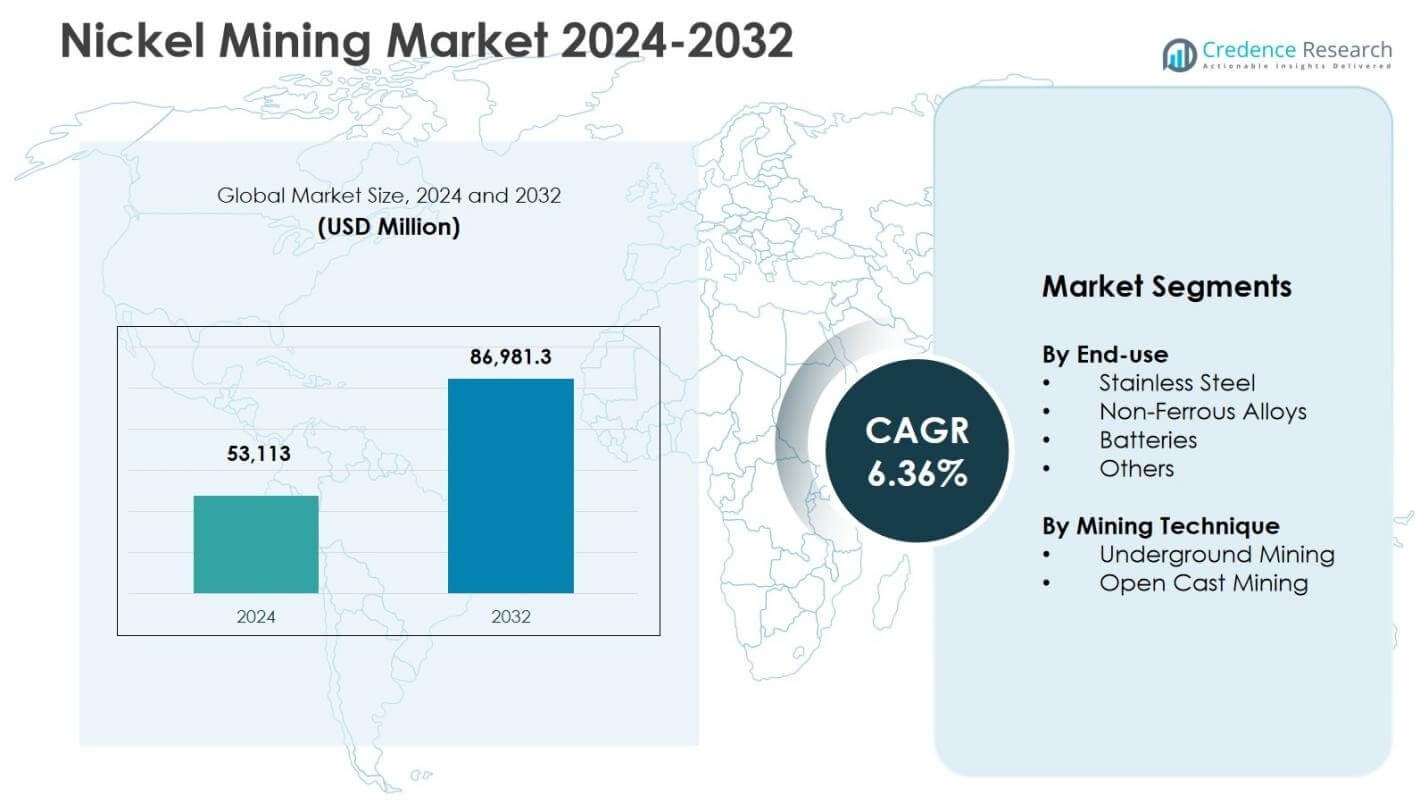
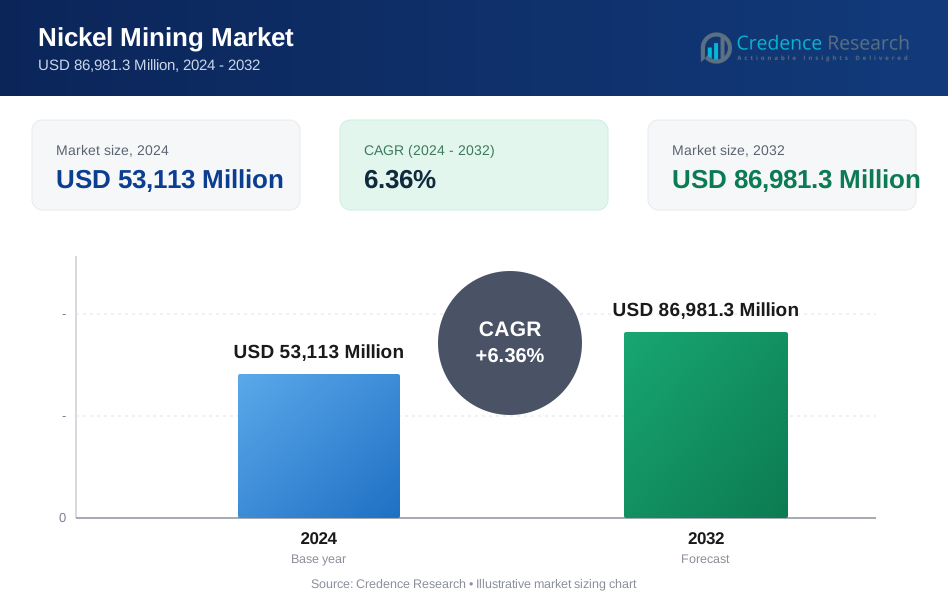
Nickel Mining Market size was valued USD 53,113 Million in 2024 and is anticipated to reach USD 86,981.3 Million by 2032, at a CAGR of 6.36% during the forecast period.
| REPORT ATTRIBUTE | DETAILS |
|---|---|
| Historical Period | 2020-2023 |
| Base Year | 2024 |
| Forecast Period | 2025-2032 |
| Nickel Mining Market Size 2024 | USD 53,113 million |
| Nickel Mining Market, CAGR | 6.36% |
| Nickel Mining Market Size 2032 | USD 86,981.3 million |
Nickel Mining Market Insights
- Market growth is driven by rising stainless-steel production and accelerating demand from EV battery supply chains, with Stainless Steel emerging as the dominant end-use segment holding a 64.8% share in 2024.
- Key trends include expansion of refining and processing capacity, technological modernization in mining operations, and increasing focus on sustainable and responsibly sourced nickel to support global energy-transition industries.
- Leading players such as Vale S.A., BHP, Glencore, Norilsk Nickel, Jinchuan Group, and Anglo American strengthen their positions through resource development, production optimization, and strategic partnerships across sulfide and laterite deposits.
- Regional Analysis shows Asia-Pacific leading with a 52.6% share in 2024, followed by Europe at 17.4% and North America at 15.8%, while Latin America and Middle East & Africa collectively expand their roles through new mining and processing projects.
Nickel Mining Market Segmentation Analysis:
By End-use:
The Nickel Mining Market by end-use segment remains dominated by Stainless Steel, which accounted for 64.8% share in 2024, driven by strong demand from construction, automotive, chemical processing, and industrial manufacturing. The segment benefits from nickel’s role in enhancing corrosion resistance, strength, and durability of stainless-steel grades used in infrastructure upgrades and urban development projects worldwide. The Batteries segment continues to gain momentum, supported by electric-vehicle and energy-storage deployments, while Non-Ferrous Alloys and Others contribute to specialized applications in aerospace and electronics; however, stainless steel retains leadership due to consistent large-scale industrial consumption.
- For instance, Terrafame supplies low-carbon nickel sulphate to Stellantis starting 2025 for EV batteries, produced via an integrated mine-to-chemical process with one of the industry's smallest carbon footprints.
By Mining Technique:
Within the Nickel Mining Market by mining technique, Open Cast Mining emerged as the leading sub-segment with a 57.3% share in 2024, supported by lower operational costs, higher ore recovery rates, and easier access to near-surface laterite deposits across Asia-Pacific and Africa. The method enables large-scale production to meet rising demand from stainless-steel and battery-grade nickel supply chains. Underground Mining holds the remaining market share, primarily serving high-grade sulfide deposits in mature mining regions, but open cast operations retain dominance due to process efficiency, scalability, and favorable project economics.
- For instance, Tsingshan Holding Group's Weda Bay open-pit mine in Maluku, Indonesia, produced an estimated 516.7 thousand tonnes of nickel in 2023 from shallow laterite deposits, enabling efficient large-scale output for stainless steel supply chains.
Key Growth Drivers
Rising Stainless-Steel Production
The Nickel Mining Market experiences strong growth due to the expanding stainless-steel industry, which accounted for a significant share of global nickel consumption in 2024. Stainless steel production continues to rise across construction, automotive, industrial machinery, and chemical processing sectors, where nickel enhances durability, corrosion resistance, and mechanical strength. Rapid urbanization, infrastructure investments, and manufacturing expansion in Asia-Pacific further strengthen demand. Additionally, the shift toward high-performance steel grades in transportation and energy systems reinforces nickel usage, encouraging mining companies to expand production capacity, optimize ore extraction, and secure long-term supply chains to support industrial growth worldwide.
- For instance, Vale S.A. announced in late 2024 its plans to enhance production at the Onça Puma mine in Brazil to meet growing demand from the stainless-steel and energy industries.
Accelerating Demand from Battery and EV Supply Chains
Nickel mining benefits significantly from the rapid expansion of electric vehicles and energy-storage technologies, where nickel-rich cathode chemistries improve energy density, driving range, and battery performance. Governments promote EV adoption through incentives and emission-reduction policies, increasing demand for battery-grade nickel sourced from both laterite and sulfide deposits. Major battery manufacturers and automotive OEMs are forming strategic partnerships with mining firms to secure long-term offtake contracts. This dynamic stimulates investment in new mining projects, processing technologies, and refinery expansions, strengthening the supply pipeline for high-purity Class-I nickel used in advanced lithium-ion batteries.
- For instance, Tesla signed a supply agreement with Vale S.A. in 2022 for sustainably produced Class I nickel from Canada to support its North American Gigafactories.
Technological Advancements in Mining and Processing
Technological innovation acts as a key growth driver in the Nickel Mining Market, improving operational efficiency, ore recovery, and sustainability performance. Automation, digital mine planning, remote monitoring, and data-driven decision systems enhance productivity and reduce downtime in both underground and open-cast operations. Advancements in hydrometallurgical and HPAL processing technologies expand the economic viability of low-grade laterite resources while supporting production of battery-grade nickel intermediates. These improvements lower production costs, minimize waste, and enhance environmental compliance, enabling miners to strengthen margins and maintain competitiveness across global supply chains while meeting industry sustainability expectations.
Key Trends & Opportunities
Shift Toward Sustainable and Responsible Mining Practices
A major trend reshaping the Nickel Mining Market is the industry-wide transition toward more sustainable and responsibly sourced nickel. Mining companies increasingly invest in decarbonization initiatives, renewable-energy integration, water-recycling systems, and tailings-management improvements to meet tightening environmental regulations and ESG expectations from investors and downstream industries. Certification programs and traceability frameworks are gaining importance, particularly for nickel used in EV batteries, where automakers demand ethically sourced materials. This trend creates opportunities for miners adopting low-carbon production technologies, circular-economy strategies, and carbon-footprint reporting, strengthening market positioning and enhancing access to premium supply contracts.
- For instance, PT Vale Indonesia powers its Sorowako nickel smelter with three hydropower plants totaling 365 MW capacity, achieving among the lowest carbon intensity nickel production in Indonesia since 1978.
Expansion of Nickel Refining and Value-Added Processing
Another key trend in the Nickel Mining Market is the growing focus on domestic refining, intermediates production, and value-added processing to support regional supply security and reduce reliance on imported materials. Countries with large ore reserves are investing in smelters, HPAL plants, and integrated processing hubs to capture greater economic value within the battery and stainless-steel supply chains. Strategic partnerships between governments, mining companies, and technology providers are enabling downstream expansion, encouraging local manufacturing ecosystems. This trend creates new revenue opportunities in high-purity nickel sulfate, matte, and precursors used in advanced battery-materials production.
- For instance, Taganito HPAL Nickel Corporation, a Sumitomo Metal Mining joint venture, operates an HPAL plant in Mindanao producing 30,000 metric tons of nickel and 2,640 metric tons of cobalt annually as mixed nickel-cobalt sulfide, refined further in Japan.
Key Challenges
Environmental Regulations and Social License to Operate
The Nickel Mining Market faces significant challenges related to environmental compliance, land-use regulations, and community expectations in mining regions. Increasing scrutiny over deforestation, tailings disposal, water contamination, and carbon emissions places pressure on operators to improve environmental-management standards and rehabilitation practices. Delays in project approvals, stricter permitting frameworks, and community opposition can extend development timelines and increase operating costs. Maintaining a strong social license to operate requires sustained investment in environmental stewardship, stakeholder engagement, local development programs, and transparent ESG reporting to ensure long-term operational continuity and regulatory alignment.
Price Volatility and Supply-Chain Uncertainty
Nickel mining companies operate in an environment characterized by commodity-price volatility, fluctuating demand patterns, and evolving supply-chain dynamics. Market uncertainty arises from shifts in stainless-steel production, battery-chemistry transitions, geopolitical risks, and changes in export policies across key producing nations. Sudden price declines can affect project viability, capital-investment decisions, and profitability, especially for high-cost operations. Additionally, logistics disruptions, energy-cost fluctuations, and refinery bottlenecks create operational risks across global value chains. Mining firms must adopt hedging strategies, flexible production planning, and strategic partnerships to manage financial exposure and stabilize long-term performance.
Regional Analysis
Asia-Pacific
Asia-Pacific dominated the Nickel Mining Market in 2024 with a 52.6% share, driven by large reserves, high production capacity, and strong downstream demand from stainless-steel, battery, and EV industries in China, Indonesia, and the Philippines. Indonesia’s laterite deposits and expanding refining infrastructure continue to strengthen the region’s supply position, while Australia contributes significantly through sulfide ore mining. Government-backed investments, export policies favoring local value addition, and partnerships with global battery manufacturers further support market expansion. Rising industrialization and regional processing integration reinforce Asia-Pacific’s leadership and ensure sustained demand for mined nickel across industrial and energy-transition applications.
Europe
Europe accounted for a 17.4% share of the Nickel Mining Market in 2024, supported by growing demand from stainless-steel, aerospace, and electric-vehicle battery manufacturing ecosystems. The region prioritizes sustainable and responsibly sourced nickel, encouraging investments in environmentally compliant mining operations and refining technologies. Countries such as Finland and Russia remain key contributors to sulfide-based nickel output, while EU decarbonization policies accelerate demand for battery-grade nickel. Strategic supply partnerships, recycling initiatives, and development of regional processing hubs strengthen Europe’s position in the global value chain, even as the region remains partially dependent on imports for long-term supply security.
North America
North America held a 15.8% share of the Nickel Mining Market in 2024, driven by renewed mining activity in Canada and the United States to support domestic battery manufacturing and clean-energy initiatives. The region benefits from high-grade sulfide deposits, strong regulatory frameworks, and increasing investments in exploration and downstream processing for Class-I nickel. Government support for energy-transition minerals and EV supply chains encourages project development and strategic offtake agreements with automakers. Although production volumes remain lower than Asia-Pacific, the region strengthens its position through technology adoption, sustainability-led mining practices, and integration with advanced materials industries.
Latin America
Latin America captured an 8.6% share of the Nickel Mining Market in 2024, supported by nickel resources in Brazil, Cuba, Colombia, and emerging exploration hotspots. The region’s growth is influenced by rising investment in laterite mining projects, expanding trade partnerships, and increasing interest from global battery and stainless-steel producers seeking diversified supply sources. Favorable geology, improving infrastructure, and policy reforms to attract foreign participation strengthen production potential. However, operational challenges related to logistics, environmental compliance, and capital intensity persist, prompting companies to enhance project efficiency and sustainability standards to unlock long-term growth opportunities across regional mining corridors.
Middle East & Africa
The Middle East & Africa region accounted for a 5.6% share of the Nickel Mining Market in 2024, driven by resource development initiatives in Madagascar, South Africa, and select East African countries. The region benefits from untapped reserves, improving investment frameworks, and participation from multinational mining companies supporting capacity expansion. Growing demand from global stainless-steel and battery supply chains encourages new exploration activities and infrastructure-led project development. Despite challenges related to geopolitical risks, regulatory consistency, and operational constraints, ongoing modernization efforts and partnerships strengthen the region’s contribution to global nickel supply and long-term sector diversification.
Nickel Mining Market Segmentations:
By End-use
- Stainless Steel
- Non-Ferrous Alloys
- Batteries
- Others
By Mining Technique
- Underground Mining
- Open Cast Mining
By Geography
- North America
- U.S.
- Canada
- Mexico
- Europe
- Germany
- France
- U.K.
- Italy
- Spain
- Rest of Europe
- Asia Pacific
- China
- Japan
- India
- South Korea
- South-east Asia
- Rest of Asia Pacific
- Latin America
- Brazil
- Argentina
- Rest of Latin America
- Middle East & Africa
- GCC Countries
- South Africa
- Rest of the Middle East and Africa
Competitive Landscape
Vale S.A., BHP, Glencore, Norilsk Nickel, Jinchuan Group International Resources Co. Ltd., Anglo American, Sumitomo Metal Mining Co., Ltd., MMC Norilsk Nickel, Sherritt International Corporation, and Eramet are the leading companies shaping the Nickel Mining Market. The market reflects a highly consolidated structure, where large multinational miners control significant reserves, integrated processing capacities, and long-term supply agreements with stainless-steel, battery, and EV manufacturers. These companies focus on expanding production efficiency, developing high-purity Class-I nickel, and investing in laterite and sulfide resource portfolios to strengthen supply security. Strategic priorities include technological modernization, cost optimization, and ESG-aligned operations to meet tightening environmental standards and stakeholder expectations. Several players are pursuing partnerships, refinery expansions, and downstream integration to enhance value capture within global supply chains. Meanwhile, emerging regional producers and government-backed projects are intensifying competition, reinforcing the need for established miners to innovate, secure offtake contracts, and diversify geographically to maintain market leadership.
Key Player Analysis
- Anglo American
- MMC Norilsk Nickel
- Sherritt International Corporation
- Vale S.A.
- Jinchuan Group International Resources Co. Ltd.
- Sumitomo Metal Mining Co., Ltd.
- Glencore
- Eramet
- BHP
- Norilsk Nickel
Recent Developments
- In December 2025, Talon Metals Corp. signed a definitive agreement to acquire Lundin Mining’s Eagle Mine and Humboldt Mill, consolidating primary U.S. nickel-copper assets under Talon and expanding its exploration and production potential.
- In October 2025, Canada Nickel and NetCarb advanced a strategic partnership to apply carbon sequestration technology to nickel tailings at the Crawford Nickel Project, supporting low-carbon industrial development in Ontario.
- In December 2025, Lundin Mining announced the sale of its Eagle Mine and Humboldt Mill to Talon Metals, creating a pure-play American nickel-copper company.
Report Coverage
The research report offers an in-depth analysis based on End Use, Mining Technique and Geography. It details leading market players, providing an overview of their business, product offerings, investments, revenue streams, and key applications. Additionally, the report includes insights into the competitive environment, SWOT analysis, current market trends, as well as the primary drivers and constraints. Furthermore, it discusses various factors that have driven market expansion in recent years. The report also explores market dynamics, regulatory scenarios, and technological advancements that are shaping the industry. It assesses the impact of external factors and global economic changes on market growth. Lastly, it provides strategic recommendations for new entrants and established companies to navigate the complexities of the market.
Future Outlook
- The market will continue to expand as demand from stainless-steel and electric-vehicle battery applications strengthens across global industries.
- Mining companies will increase investments in high-grade sulfide and laterite deposits to secure long-term nickel supply for energy-transition value chains.
- Battery-grade Class-I nickel production will gain strategic priority as OEMs and cell manufacturers emphasize higher energy-density chemistries.
- Countries with large resource bases will accelerate refinery and processing capacity expansion to promote domestic value addition.
- Sustainability, decarbonization, and ESG compliance will play a central role in future project development and investor decisions.
- Technology-driven mining operations, automation, and digital monitoring systems will enhance productivity and operational reliability.
- Strategic alliances between miners, refiners, and battery manufacturers will strengthen supply-chain integration and offtake security.
- Recycling and secondary nickel initiatives will gain traction as industries seek circular-economy sourcing models.
- Price fluctuations and policy-driven market shifts will continue to influence investment cycles and production planning.
- Geographical diversification of mining assets will increase as companies mitigate geopolitical and regulatory risks across regions.
Request a Free Sample
Fill in your details and we'll send you a free sample report.
- Sample data tables & charts
- Research methodology
Need a Custom Version of This Report?
Tailor the scope, geography, or segments to your exact requirements.
- Custom geography or segment scope
- Direct access to our analyst team
Frequently Asked Questions
What is the current market size for the Nickel Mining Market, and what is its projected size in 2032?
At what Compound Annual Growth Rate is the Nickel Mining Market projected to grow between 2024 and 2032?
Which Nickel Mining Market segment held the largest share in 2024?
What are the primary factors fueling the growth of the Nickel Mining Market?
Who are the leading companies in the Nickel Mining Market?
Which region commanded the largest share of the Nickel Mining Market in 2024?
Table of Content
Chapter 1. Report Introduction
- 1.1 Report Description & Purpose
- 1.1.1 Report Title & Market Definition
- 1.1.2 Unique Selling Propositions (USP) & Key Differentiators
- 1.1.3 Value Proposition for Stakeholders
- 1.2 Research Objectives
- 1.2.1 Market Sizing Objectives (Volume & Revenue)
- 1.2.2 Segmentation Objectives
- 1.2.3 Competitive Intelligence Objectives
- 1.2.4 Forecast & Scenario Objectives
- 1.3 Report Scope
- 1.3.1 Nickel Mining Scope – Types & Subtypes Covered
- 1.3.2 Geographic Scope – Regions & Countries Covered
- 1.3.3 Historical Period, Base Year & Forecast Period (2024; forecast to 2032)
- 1.3.4 Inclusions & Exclusions
- 1.4 HS Code & Classification Framework
- 1.5 Currency, Units & Pricing Basis
- 1.6 Target Stakeholders
- 1.7 Limitations & Assumptions
Chapter 2. Executive Summary
- 2.1 Global Nickel Mining Market Snapshot
- 2.1.1 Market Size – Historical (2024) & Forecast (2024-2032) (2024: USD 53,113 Million → 2032: USD 86,981.3 Million)
- 2.1.2 Volume & Revenue – Global Totals
- 2.1.3 Key Market Highlights – Top Five Facts
- 2.2 Nickel Mining Market Segmentation Snapshot
- 2.2.1 Market Split by Region – 2024 vs. 2032
- 2.3 Competitive Snapshot
- 2.3.1 Top 10 Players by Revenue Share – 2024
- 2.3.2 Top 10 Players by Volume Share – 2024
- 2.3.3 Recent Strategic Developments (18-Month Summary)
- 2.4 Key Investment Highlights & Strategic Conclusions
Chapter 3. Nickel Mining Market Dynamics & Industry Analysis
- 3.1 Market Overview & Context
- 3.1.1 Nickel Mining Market Position in the Broader Automotive Value Chain
- 3.1.2 OEM vs. Replacement Market Dynamics
- 3.1.3 Market Maturity & Development Stage by Region
- 3.2 Nickel Mining Market Drivers
- 3.3 Nickel Mining Market Restraints & Challenges
- 3.4 Nickel Mining Market Opportunities
- 3.5 Porter's Five Forces Analysis
- 3.5.1 Threat of New Entrants
- 3.5.2 Bargaining Power of Suppliers
- 3.5.3 Bargaining Power of Buyers
- 3.5.4 Threat of Substitutes
- 3.5.5 Competitive Rivalry – Intensity Assessment
- 3.6 Nickel Mining Value Chain Analysis
- 3.6.1 Upstream – Raw Material/Input Suppliers
- 3.6.1.1 Raw Material/Input 1
- 3.6.1.2 Raw Material/Input 2
- 3.6.1.3 Raw Material/Input 3
- 3.6.2 Midstream – Production/Manufacturing/Service Delivery
- 3.6.2.1 Production/Process Overview
- 3.6.2.2 Key Facility Locations & Capacity by Manufacturer
- 3.6.3 Downstream – Distribution & End Consumer
- 3.6.3.1 Primary Channel – B2B/OEM
- 3.6.3.2 Secondary Channels – Dealer, Retail, Online, Direct
- 3.6.4 Value Chain Profitability Analysis
- 3.6.1 Upstream – Raw Material/Input Suppliers
- 3.7 PESTEL Analysis
- 3.7.1 Political Factors
- 3.7.2 Economic Factors
- 3.7.3 Social Factors
- 3.7.4 Technological Factors
- 3.7.5 Environmental Factors
- 3.7.6 Legal Factors
- 3.8 Nickel Mining Supply Chain Analysis
- 3.8.1 Raw Material/Input Supply Risk Assessment
- 3.8.2 Manufacturing Concentration Risk (Geographic Exposure)
- 3.8.3 Trade Disruption Impact Analysis
- 3.9 Regulatory & Policy Landscape
Note: The regulatory and policy landscape section covers regulations based on their applicability to the market, Nickel Mining category, geography, and scope of the study. Only regulatory frameworks with a material impact on operations, compliance, trade, sustainability, or market access are analyzed in detail.
Chapter 4. Key Investment Pockets & Opportunity Analysis
- 4.1 Nickel Mining Market Attractiveness Analysis
- 4.1.1 By Region – Investment Attractiveness Matrix (Volume × CAGR)
- 4.2 Absolute Revenue Growth Opportunity
- 4.2.1 By Region – Absolute USD Growth Through 2032
- 4.3 Incremental Volume Opportunity
- 4.3.1 By Region – Incremental Volume Through 2032
- 4.3.2 Segment – Incremental Volume
- 4.4 Emerging Submarket Opportunity Deep Dive (Subject to Applicability)
- 4.5 Emerging Market Opportunity Scorecards
- 4.5.1 United States
- 4.5.2 Europe
- 4.5.3 Asia
- 4.5.4 Middle East & Africa
Note: Emerging Market Opportunity Scorecards will be included based on relevance and strategic importance. Regions listed are indicative and may vary depending on data availability and market dynamics.
Chapter 5. Nickel Mining Import-Export Analysis & Trade Flows
- 5.1 Global Trade Overview
- 5.1.1 Global Export Value by Country (2024)
- 5.1.2 Global Export Volume by Country (2024)
- 5.1.3 Global Import Value by Country (2024)
- 5.1.4 Global Import Volume by Country (2024)
- 5.1.5 Net Trade Balance by Country (2024)
- 5.2 Export Analysis – Segment
- 5.2.1 Type 1 (HS Code)
- 5.2.2 Type 2 (HS Code)
- 5.2.3 Type 3 (HS Code)
- 5.2.4 Type 4 (HS Code)
- 5.2.5 Type 5 (HS Code)
- 5.3 Import Analysis – Segment
- 5.3.1 Type 1 (HS Code)
- 5.3.2 Type 2 (HS Code)
- 5.3.3 Type 3 (HS Code)
- 5.3.4 Type 4 (HS Code)
- 5.3.5 Type 5 (HS Code)
- 5.4 Average Unit Trade Prices
- 5.4.1 Average Export Price – Segment & Country
- 5.4.2 Average Import Price – Segment & Source Country
- 5.4.3 Price Trends (2024)
- 5.5 Key Trade Route Analysis
- 5.5.1 Trade Route 1
- 5.5.2 Trade Route 2
- 5.5.3 Trade Route 3
- 5.5.4 Trade Route 4
- 5.5.5 Trade Route 5
- 5.6 Trade Policy Impact Assessment
- 5.6.1 US Anti-Dumping & Section 301 Tariffs
- 5.6.2 EU Customs Union Impact
- 5.6.3 Major Free Trade Agreements
- 5.6.4 USMCA Rules of Origin
Note: Trade policy analysis will be included only where relevant to the Nickel Mining market.
Chapter 6. Competitive Landscape & Company Benchmarking
- 6.1 Nickel Mining Market Concentration & Structure
- 6.1.1 Herfindahl-Hirschman Index (HHI) – vs. 2024
- 6.1.2 Tier 1, Tier 2 & Tier 3 Market Structure
- 6.1.3 Global, Regional & Local Player Dynamics
- 6.2 Nickel Mining Market Share Analysis – 2024
- 6.2.1 Global Revenue Share by Company
- 6.2.2 Global Volume Share by Company
- 6.2.3 Regional Revenue Share
- 6.2.4 Market Share Evolution ( vs. 2024)
- 6.2.5 OEM Segment Share by Company
- 6.2.6 Replacement Segment Share by Company
- 6.3 Production/Delivery Capacity & Facility Analysis
- 6.3.1 Global Installed Capacity
- 6.3.2 Capacity Utilization Rates
- 6.3.3 Production/Output Volume
- 6.3.4 Facility Locations & Capacity Map
- 6.3.5 Planned Capacity Additions
- 6.4 Nickel Mining Competitive Benchmarking Matrix
- 6.4.1 Revenue, Volume, CAGR & Profitability Comparison
- 6.4.2 Channel Revenue Mix
- 6.4.3 Geographic Revenue Exposure
- 6.4.4 R&D Intensity
- 6.4.5 Sustainability Maturity
- 6.5 Strategic Developments in Nickel Mining (Last 24 Months)
- 6.5.1 Mergers, Acquisitions & Divestments
- 6.5.2 New Nickel Mining Launches
- 6.5.3 Facility Expansions
- 6.5.4 Strategic Alliances, Joint Ventures & Partnerships
- 6.5.5 Distribution Expansion & Market Entry
- 6.5.6 Sustainability & ESG Initiatives
- 6.6 Competitive Strategy Mapping
- 6.6.1 Leader, Challenger, Follower & Niche Classification
- 6.6.2 Pricing Strategy Comparison
- 6.6.3 Channel Strategy Matrix
Note: Strategic developments are included based on their materiality and the availability of reliable information.
Chapter 7. Global Nickel Mining Market – By Distribution Channel
- 7.1 Segment Overview
- 7.1.1 Volume & Revenue Split by Channel (2024 & 2032)
- 7.1.2 Channel Mix Evolution (2024-2032)
Chapter 8. Regional Market Analysis – Global Overview
- 8.1 Global Regional Overview
- 8.1.1 Regional Volume Share
- 8.1.2 Regional Revenue Share
- 8.1.3 Regional Volume by Region
- 8.1.4 Regional Revenue by Region
- 8.1.5 Regional Forecast Through 2032
- 8.2 Cross-Regional Segment Analysis
- 8.2.1 By Distribution Channel
- 8.2.2 By Brand/Price Tier
Chapter 9. North America Nickel Mining Market
- 9.1 United States
- 9.2 Canada
- 9.3 Mexico
Chapter 10. Europe Nickel Mining Market
- 10.1 Germany
- 10.2 France
- 10.3 Italy
- 10.4 United Kingdom
- 10.5 Spain
- 10.6 Poland
- 10.7 Russia
- 10.8 Netherlands
- 10.9 Belgium
- 10.10 Sweden
- 10.11 Denmark
- 10.12 Norway
- 10.13 Rest of Europe
Chapter 11. Asia Pacific Nickel Mining Market
- 11.1 China
- 11.2 India
- 11.3 Japan
- 11.4 South Korea
- 11.5 Thailand
- 11.6 Indonesia
- 11.7 Vietnam
- 11.8 Malaysia
- 11.9 Australia
- 11.10 Rest of Asia Pacific
Chapter 12. Latin America Nickel Mining Market
- 12.1 Brazil
- 12.2 Argentina
- 12.3 Colombia
- 12.4 Chile
- 12.5 Rest of Latin America
Chapter 13. Middle East Nickel Mining Market
- 13.1 Saudi Arabia
- 13.2 United Arab Emirates
- 13.3 Turkey
- 13.4 Israel
- 13.5 Iran
- 13.6 Rest of the Middle East
Chapter 14. Africa Nickel Mining Market
- 14.1 South Africa
- 14.2 Egypt
- 14.3 Nigeria
- 14.4 Morocco
- 14.5 Rest of Africa
Chapter 15. Nickel Mining Company Profiles
- 15.1 [Company 01]
- 15.1.1 Company Overview
- 15.1.2 Key Management Personnel
- 15.1.3 Products & Services Portfolio
- 15.1.4 Financial Performance
- 15.1.5 Key Market Focus & Geographic Presence
- 15.1.6 Recent Developments & Strategic Initiatives
Note: The company profile list is preliminary and may change based on research findings, market developments, data availability, and client requirements.
Chapter 16. Appendices
- Appendix A – List of Abbreviations & Acronyms
- Appendix B – Industry Classification Code Reference – Full Series
- Appendix C – Production & Capacity Data Tables
- Appendix D – End-Use & Demand Base Tables
- Appendix E – Consumption & Replacement Rate Assumptions
- Appendix F – ASP Reference Tables
- Appendix G – Manufacturing & Facility Database
- Appendix H – Import-Export Data Tables
- Appendix I – Regulatory Summary Tables
- Appendix J – Primary Research Participant List (Anonymized)
- Appendix K – Primary Research Questionnaire Framework
- Appendix L – Data Sources & Bibliography
- Appendix M – Market Size Divergence & Source Comparison
Chapter 17. Research Methodology
- 17.1 Research Framework & Philosophy
- 17.2 Secondary Research – Sources, Hierarchy & Data Extraction
- 17.3 Data Modeling – Bottom-Up & Top-Down Market Sizing
- 17.4 Primary Research – Stakeholder Framework, LOI & Sample Sizes
- 17.5 Forecast Methodology – Regression, Scenario & Sensitivity Analysis
- 17.6 Quality Control – Four-Layer Validation Framework
- 17.7 Limitations & Standard Assumptions
- 17.8 Disclaimer
