
Nickel Market Overview:
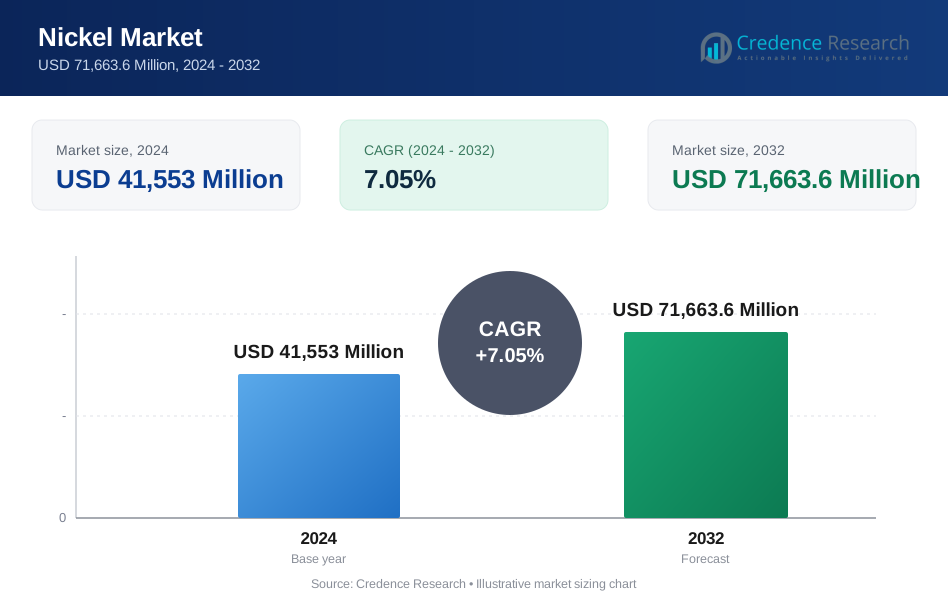
Nickel Market size was valued USD 41,553 Million in 2024 and is anticipated to reach USD 71,663.6 Million by 2032, at a CAGR of 7.05% during the forecast period.
| REPORT ATTRIBUTE | DETAILS |
|---|---|
| Historical Period | 2020-2023 |
| Base Year | 2024 |
| Forecast Period | 2025-2032 |
| Nickel Market Size 2024 | USD 41,553 million |
| Nickel Market, CAGR | 7.05% |
| Nickel Market Size 2032 | USD 71,663.6 million |
Nickel Market Insights
- Market overview highlights strong demand from stainless steel, batteries, and alloy manufacturing, with the Stainless Steel segment holding 56.2% share in 2024 and Class 1 (99.8%) nickel accounting for 71.6% share due to its critical role in battery and high-purity applications.
- Market drivers include rapid growth in electric-vehicle battery production, rising infrastructure and industrial development, and increased adoption of high-performance nickel alloys across aerospace and energy sectors.
- Market trends show rising investments in refining technologies, sustainability initiatives, and value-chain integration by major producers, while market restraints include price volatility, environmental regulations, and high operational and project-development costs.
- Regional analysis indicates Asia-Pacific leads the Nickel Market with 64.3% share in 2024, followed by Europe at 14.8% and North America at 11.2%, supported by mining expansion, EV battery manufacturing, and stainless-steel production growth.

Nickel Market Segmentation Analysis:
By Class Type
The Nickel Market by class type remains strongly led by Class 1 (99.8%), which accounted for 71.6% share in 2024, driven by its critical use in battery-grade chemicals, high-purity alloys, and advanced stainless-steel formulations. Producers increasingly invest in hydrometallurgical refining and HPAL technologies to support EV and energy-storage supply chains, reinforcing demand for premium-grade nickel. Class 2 (<99.8%) captured 28.4% share, supported by its cost-effective suitability for bulk stainless-steel production; however, its growth remains comparatively moderate due to limited compatibility with high-performance battery applications.
- For instance, BHP's Kwinana Nickel Refinery refines nickel matte into 99.8% pure powder and briquettes, with a 2021 nickel sulphate plant addition supporting lithium-ion batteries for EVs.
By Application
By application, Stainless Steel emerged as the dominant sub-segment with 56.2% share in 2024, supported by rising consumption in construction, appliances, transportation components, and industrial equipment, where nickel enhances corrosion resistance and structural durability. Batteries accounted for 21.4% share, expanding rapidly due to strong penetration of nickel-rich cathode chemistries in electric vehicles. Alloys held 9.6% share, followed by Electroplating at 6.8%, Special Steels at 4.1%, and Others at 1.9%, with growth across these segments driven by aerospace, electronics miniaturization, and precision engineering applications.
- For instance, Indian metro coaches incorporate about 8 tonnes of Type 301LN nickel-containing stainless steel per shell for lightweight, high-strength construction in corrosion-prone environments.
Key Growth Drivers
Surge in Stainless Steel Production and Industrial Applications
The Nickel Market experiences strong growth due to the rising demand for stainless steel across construction, infrastructure, automotive, food processing, and industrial equipment manufacturing. Nickel enhances corrosion resistance, durability, and structural strength, making it essential for high-performance stainless-steel grades used in pipes, tanks, rail systems, and consumer appliances. Rapid urbanization, expanding industrialization in Asia-Pacific, and refurbishment of infrastructure in developed economies continue to drive large-scale consumption. Additionally, strategic investments in manufacturing capacity, energy-processing facilities, and chemical plants reinforce sustained nickel usage, strengthening its role as a critical alloying element across heavy engineering and industrial value chains.
- For instance, JSW Steel Ltd. manufactures SS304 stainless steel pipes with 8-10% nickel content, used in automotive fuel and hydraulic systems for superior pressure resistance and corrosion protection in high-stress environments.
Rapid Expansion of Electric Vehicles and Battery Manufacturing
The accelerating adoption of electric vehicles significantly boosts nickel demand, particularly for nickel-rich lithium-ion battery chemistries such as NMC and NCA. Battery manufacturers increasingly favor high-nickel cathodes due to their superior energy density, longer driving range, and performance efficiency. Government incentives for EV production, advancing battery-gigafactory investments, and strong commitments from automakers toward electrification amplify nickel consumption in the global battery supply chain. Furthermore, the emergence of energy-storage systems, renewable-integration projects, and grid-level storage applications strengthens long-term market prospects as nickel becomes a strategic raw material for clean-energy technologies.
- For instance, POSCO Future M developed ultra-high-nickel cathode materials with over 95% nickel content for premium EVs, maximizing energy density and suitability for urban air mobility. These single-crystal cathodes enhance driving range while improving safety and lifespan compared to lower-nickel variants.
Increasing Use of High-Performance Alloys and Aerospace Components
The Nickel Market benefits from rising adoption of high-performance nickel-based alloys in aerospace, power generation, marine systems, and high-temperature industrial environments. These alloys offer superior heat resistance, strength, and oxidation tolerance, making them ideal for turbine blades, aircraft engines, reactor components, and critical engineering structures. Growth in air travel, upgrading of gas-turbine fleets, and capacity expansion in energy infrastructure continue to stimulate demand. In addition, advancements in superalloy manufacturing, precision casting technologies, and defense-grade applications further enhance nickel consumption, reinforcing its value in advanced materials and high-reliability engineering segments.
Key Trends & Opportunities
Transition Toward Sustainable Mining and Recycling-Driven Nickel Supply
A major trend shaping the Nickel Market is the growing emphasis on sustainable extraction, low-carbon refining, and circular-economy sourcing models. Mining companies are increasingly investing in responsible operations, waste-minimization technologies, and renewable-powered smelting facilities to reduce environmental footprints. Parallelly, recycling of stainless steel and spent batteries opens significant opportunities for secondary nickel supply, supporting resource efficiency and supply-chain resilience. The development of advanced scrap-recovery systems, hydrometallurgical recycling processes, and government-led sustainability mandates further strengthens this shift, enabling long-term supply security while aligning the industry with global decarbonization objectives.
- For instance, Vale's Long Harbour refinery in Newfoundland and Labrador uses hydrometallurgy to produce nickel with a carbon footprint of 4.4 tonnes of CO2 equivalent per tonne, significantly below the industry average of 13 tonnes.
Technological Advancements in HPAL Processing and Battery-Grade Refining
Technological progress in High-Pressure Acid Leach (HPAL) processing and hydrometallurgical refining presents strong opportunities for producing battery-grade Class 1 nickel from laterite ores. These innovations support the supply of high-purity nickel sulfate required for EV cathode manufacturing, reducing dependence on traditional sulfide resources. Investments in integrated refining hubs, automation technologies, and digital process-optimization enhance production efficiency and operational reliability. Collaboration among miners, battery manufacturers, and chemical processors accelerates resource conversion into value-added downstream materials, strengthening vertical integration across the battery-materials ecosystem and improving long-term market competitiveness.
- For instance, GEM partnered with PT Vale Indonesia on a $1.4 billion HPAL facility in central Sulawesi, Indonesia, designed to yield at least 60,000 tonnes annually of contained nickel in mixed hydroxide precipitate for EV batteries.
Key Challenges
Price Volatility and Supply-Demand Imbalances Across Global Markets
The Nickel Market faces challenges associated with price fluctuations driven by shifts in mining output, geopolitical uncertainties, speculative trading, and cyclical industrial demand. Over-dependence on limited mining regions, production disruptions, and varying export-control policies contribute to supply instability, affecting downstream manufacturers and battery producers. Sudden capacity expansions or oversupply phases can also pressure profitability across the value chain. These volatility-induced risks compel manufacturers to adopt hedging strategies, diversify sourcing networks, and optimize inventory management, although sustained uncertainty continues to pose strategic challenges for producers and end-use industries.
Environmental Regulations and High Operational Costs in Mining and Refining
Stringent environmental compliance requirements, emission-control norms, and land-rehabilitation obligations increase operational complexity for nickel mining and refining companies. High capital intensity, waste-management costs, and regulatory approval delays often constrain project development timelines, particularly in ecologically sensitive regions. Communities and stakeholders increasingly demand responsible mining practices, further elevating sustainability expectations and compliance pressures. In addition, energy-intensive processing methods, rising labor expenses, and infrastructure-related constraints impact cost competitiveness, compelling operators to invest in cleaner technologies, process-efficiency improvements, and environmentally responsible production frameworks to maintain long-term viability.
Regional Analysis
Asia-Pacific
Asia-Pacific dominated the Nickel Market in 2024 with a 64.3% market share, supported by strong stainless-steel production, expanding electric-vehicle battery manufacturing, and large-scale industrial development across China, Indonesia, Japan, and South Korea. Indonesia’s rapidly increasing laterite mining and refining capacity, coupled with investments in Class 1 battery-grade nickel, continues to strengthen regional supply leadership. Rising infrastructure spending, urban construction, and manufacturing expansion further stimulate consumption across alloys and industrial applications. Government-backed mining policies, EV localization programs, and downstream value-chain integration reinforce Asia-Pacific as the primary growth engine for global nickel demand during the forecast period.
Europe
Europe accounted for 14.8% market share in 2024, driven by growing demand from electric-vehicle manufacturing, aerospace alloys, and advanced engineering industries. The region focuses strongly on sustainable sourcing, recycling initiatives, and low-carbon nickel production, supported by regulatory frameworks promoting circular-economy practices and responsible mining partnerships. Expansion of giga-factories in Germany, France, and the Nordic region strengthens consumption of high-purity Class 1 nickel for cathode materials. Additionally, the presence of specialty steel producers and turbine-component manufacturers sustains industrial demand, while supply-chain diversification strategies and technology-driven refining capabilities continue to enhance Europe’s strategic position in the global market.
North America
North America held 11.2% market share in 2024, supported by increasing investments in domestic battery supply chains, aerospace manufacturing, and high-performance alloy production. The United States and Canada advance regional mining exploration, refining projects, and battery-materials integration to reduce import dependence and strengthen strategic mineral security. Growth in electric-vehicle manufacturing, energy-storage deployment, and defense-grade engineering components drives sustained nickel consumption. Supportive policy frameworks, including clean-energy incentives and critical-minerals development programs, encourage capacity expansion. Additionally, ongoing advancements in recycling infrastructure and nickel recovery from stainless-steel scrap enhance supply resilience across industrial applications and technology-driven manufacturing sectors.
Latin America
Latin America represented 5.6% market share in 2024, driven by expanding nickel mining activities, resource development projects, and growing participation in global stainless-steel and battery-materials supply chains. Brazil and Cuba remain key contributors, supported by investment inflows, exploration programs, and infrastructure modernization in the mining sector. The region benefits from rising export opportunities to Asia and Europe, particularly for Class 2 nickel used in steel production. Increasing collaboration with international refining and battery-industry stakeholders enhances downstream integration potential, while government initiatives supporting resource-based industrial growth strengthen Latin America’s emerging role in the global nickel market landscape.
Middle East & Africa
Middle East & Africa accounted for 4.1% market share in 2024, supported by ongoing mining exploration, strengthening metallurgical investments, and rising industrial development across Southern and Sub-Saharan Africa. Countries such as South Africa and Madagascar contribute to regional output, particularly through nickel-cobalt mining linked to global battery-materials supply chains. Infrastructure expansion, stainless-steel consumption in construction and energy sectors, and export-oriented production support steady demand. Strategic partnerships with international investors and technology providers encourage capacity upgrades and operational efficiency improvements, while resource-driven economic programs position the region as a gradually strengthening contributor to long-term global nickel supply.
Nickel Market Segmentations:
By Class Type
- Class 1 (99.8%)
- Class 2 (<99.8%)
By Application
- Stainless Steel
- Special Steels
- Batteries
- Electroplating
- Alloys
- Others
By Geography
- North America
- U.S.
- Canada
- Mexico
- Europe
- Germany
- France
- U.K.
- Italy
- Spain
- Rest of Europe
- Asia Pacific
- China
- Japan
- India
- South Korea
- South-east Asia
- Rest of Asia Pacific
- Latin America
- Brazil
- Argentina
- Rest of Latin America
- Middle East & Africa
- GCC Countries
- South Africa
- Rest of the Middle East and Africa
Competitive Landscape
Competitive landscape in the Nickel Market is shaped by the presence of leading players such as Vale SA, BHP, Glencore, Norilsk Nickel, Jinchuan Group International Resources Co. Ltd., Sumitomo Metal Mining Co., Ltd., Eramet SA, Sherritt International Corporation, Western Areas Ltd., and Independence Group NL. These companies focus on strengthening mining capacities, advancing refining technologies, and expanding integrated value-chain capabilities across stainless steel, battery materials, and high-performance alloys. Strategic priorities include investment in Class 1 battery-grade nickel production, long-term supply agreements with EV and cathode manufacturers, and sustainability-driven operations to meet tightening environmental standards. Market participants increasingly emphasize cost optimization, reserve expansion, and downstream collaboration to enhance competitiveness. In addition, mergers, exploration programs, and partnerships in Indonesia, Australia, Canada, and Africa support resource security and production diversification, while technology-enabled processing, recycling initiatives, and vertical integration reinforce the evolving competitive dynamics of the global nickel industry.
Key Player Analysis
- Independence Group NL
- Glencore
- Sumitomo Metal Mining Co., Ltd.
- Western Areas Ltd.
- Eramet SA
- Sherritt International Corporation
- Norilsk Nickel
- Vale SA
- Jinchuan Group International Resources Co. Ltd.
- BHP
Recent Developments
- In December 2025, Lundin Mining signed a definitive agreement to sell its Eagle Mine and Humboldt Mill to Talon Metals, creating a pure-play American nickel-copper company in a strategic acquisition deal.
- In December 2024, Abaxx announced the launch of Nickel Sulphate futures contracts on January 10, 2025, targeting better price discovery for battery metals in the nickel market.
Report Coverage
The research report offers an in-depth analysis based on Class Type, Application and Geography. It details leading market players, providing an overview of their business, product offerings, investments, revenue streams, and key applications. Additionally, the report includes insights into the competitive environment, SWOT analysis, current market trends, as well as the primary drivers and constraints. Furthermore, it discusses various factors that have driven market expansion in recent years. The report also explores market dynamics, regulatory scenarios, and technological advancements that are shaping the industry. It assesses the impact of external factors and global economic changes on market growth. Lastly, it provides strategic recommendations for new entrants and established companies to navigate the complexities of the market.
Future Outlook
- The Nickel Market will experience sustained growth as demand rises from stainless steel, electric vehicles, and advanced alloy manufacturing.
- Battery-grade Class 1 nickel will gain stronger prominence as automakers shift toward high-nickel chemistries for longer-range electric vehicles.
- Mining and refining companies will increasingly invest in sustainable production, low-carbon technologies, and responsible sourcing practices.
- Recycling of stainless steel and spent batteries will expand, strengthening secondary nickel supply and improving supply-chain resilience.
- Vertical integration across mining, refining, and battery-materials processing will intensify as companies secure long-term resource access.
- Indonesia and Asia-Pacific will continue to strengthen their leadership in global nickel production and downstream processing ecosystems.
- Technological innovations in HPAL and hydrometallurgical refining will enhance production efficiency and support high-purity output.
- Strategic partnerships between miners, EV manufacturers, and chemical processors will reshape value-chain collaboration models.
- Market participants will focus on cost optimization and capacity expansion to manage price volatility and global demand fluctuations.
- Regulatory frameworks and environmental compliance standards will increasingly influence investment decisions and project development.
Request a Free Sample
Fill in your details and we'll send you a free sample report.
- Sample data tables & charts
- Research methodology
Need a Custom Version of This Report?
Tailor the scope, geography, or segments to your exact requirements.
- Custom geography or segment scope
- Direct access to our analyst team
Frequently Asked Questions
What is the current market size for the Nickel Market, and what is its projected size in 2032?
At what Compound Annual Growth Rate is the Nickel Market projected to grow between 2024 and 2032?
Which Nickel Market segment held the largest share in 2024?
What are the primary factors fueling the growth of the Nickel Market?
Who are the leading companies in the Nickel Market?
Which region commanded the largest share of the Nickel Market in 2024?
Table of Content
Chapter 1 Market Segmentation
- 1.1 Segmentation Framework
- 1.1.1 Product and Service Classification
- 1.1.2 Application and End-Use Classification
- 1.1.3 Technology and Solution Classification
- 1.1.4 Customer and Distribution Channel Classification
- 1.1.5 Geographic Segmentation
- 1.1.6 Market Segment Definitions and Boundaries
Chapter 2 Introduction
- 2.1 Report Objectives and Scope
- 2.2 Product Definition and Industry Terminology
- 2.3 Market Inclusions and Exclusions
- 2.4 Research Process
- 2.4.1 Primary Research and Expert Interviews
- 2.4.2 Secondary Research and Source Review
- 2.4.3 Top-Down and Bottom-Up Estimation
- 2.4.4 Data Triangulation and Verification
- 2.5 Market Size Measurement Basis
- 2.5.1 2024: USD 41,553 Million → 2032: USD 71,663.6 Million
- 2.6 Historical and Forecast Reference Periods
- 2.6.1 Base Year: 2024
- 2.6.2 Forecast Period: 2024-2032
- 2.7 Research Assumptions and Limitations
Chapter 3 Executive Summary
- 3.1 Market Snapshot and Key Findings
- 3.2 Base-Year Market Size, 2024
- 3.3 Forecast Market Size, 2032
- 3.4 Revenue and Volume Growth Outlook
- 3.5 Key Demand and Supply Indicators
- 3.6 Leading Market Segments
- 3.7 Fastest-Growing Market Opportunities
- 3.8 Regional Performance Highlights
- 3.9 Technology and Industry Transformation
- 3.10 Competitive Landscape Summary
- 3.11 Analyst View and Strategic Implications
Chapter 4 Global Nickel Market Trends and Developments
- 4.1 Historical Industry Development
- 4.2 Recent Market Trends and Developments
- 4.3 Demand and Customer Behavior Trends
- 4.4 Technology and Product Innovation
- 4.5 Artificial Intelligence, Automation and Digitalization
- 4.6 Local Manufacturing and Supply Chain Realignment
- 4.7 Industry Partnerships, Mergers and Acquisitions
- 4.8 Sustainability and Circular Economy Developments
- 4.9 Government and Private Sector Investment Trends
- 4.10 Emerging Business Models and Commercialization
- 4.11 Industry Developments and Announcements
Chapter 5 Global Nickel Market Production, Supply and Demand Analysis
- 5.1 Demand Trend and Consumption Analysis
- 5.2 Demand Forecast, 2024-2032
- 5.3 Production and Output Trend
- 5.4 Production and Output Forecast, 2024-2032
- 5.5 Installed Capacity and Capacity Utilization
- 5.6 Company-Wise Production Plants and Statistics
- 5.6.1 Installed Production Capacity
- 5.6.2 Actual Production
- 5.6.3 Planned Capacity and Expansion Targets
- 5.7 Supply Chain Structure and Procurement Trends
- 5.8 Supply-Demand Gap and Bottlenecks
- 5.9 Import Dependence and Sourcing Structure
- 5.10 Contract Manufacturing and Outsourcing
- 5.11 Regional Supply and Demand Concentration
Chapter 6 Global Nickel Market Pricing Analysis
- 6.1 Pricing Structure and Measurement
- 6.2 Historical Pricing Trends
- 6.3 Pricing Outlook, 2024-2032
- 6.4 Average Selling Price and Unit Economics
- 6.5 Pricing by Product and Market Segment
- 6.6 Geographic Pricing Differences
- 6.7 Key Input, Energy, Labor and Logistics Costs
- 6.8 Contract Pricing and Purchasing Models
- 6.9 Pricing Sensitivity and Competitive Positioning
- 6.10 Price, Margin and Profitability Implications
Chapter 7 Global Nickel Market Dynamics
- 7.1 Market Growth Drivers
- 7.1.1 Demand-Side Drivers
- 7.1.2 Technology and Innovation Drivers
- 7.1.3 Infrastructure and Investment Drivers
- 7.1.4 Regulatory and Policy Drivers
- 7.2 Market Restraints
- 7.2.1 Cost and Affordability Constraints
- 7.2.2 Technology and Adoption Barriers
- 7.2.3 Supply Chain and Operational Constraints
- 7.3 Market Challenges
- 7.3.1 Competitive Pressure and Margin Erosion
- 7.3.2 Skills, Infrastructure and Implementation Gaps
- 7.4 Emerging Market Opportunities
- 7.5 Market Dynamics Impact and Time-Horizon Assessment
Chapter 8 Global Nickel Value Chain Analysis
- 8.1 Industry Value Chain Overview
- 8.2 Upstream Suppliers and Critical Inputs
- 8.3 Technology and Component Providers
- 8.4 Manufacturing or Service Delivery
- 8.5 Distribution, Channel Partners and Integrators
- 8.6 Downstream Applications and End Users
- 8.7 Value Addition and Profit Pools
- 8.8 Vertical Integration and Outsourcing
- 8.9 Supplier Concentration and Risk
- 8.10 Supply Chain Localization and Resilience
Chapter 9 Global Nickel Market Regulations and Policies
- 9.1 Relevant Laws, Standards and Compliance Frameworks
- 9.2 Product, Service, Safety and Quality Requirements
- 9.3 Government Policies, Incentives and Subsidies
- 9.4 Imports, Exports and Trade Barriers
- 9.5 Public Procurement and Local Content Requirements
- 9.6 Environmental and Sustainability Compliance
- 9.7 Upcoming Policy Changes and Market Implications
Chapter 10 Global Nickel Market Hotspots and Opportunities
- 10.1 Market Opportunity Mapping and Growth Hotspots
- 10.2 High-Growth Applications and Customer Groups
- 10.3 Underserved Markets and White-Space Opportunities
- 10.4 Emerging Technology and Product Opportunities
- 10.5 New Capacity and Investment Hotspots
- 10.6 Market Entry and Expansion Opportunities
- 10.7 Distribution and Partnership Opportunities
- 10.8 Near-Term and Long-Term Commercial Potential
- 10.9 Opportunity Attractiveness and Execution Risks
Chapter 11 Global Nickel Market Outlook, 2024-2032
- 11.1 Market Size and Analysis
- 11.1.1 Revenue (Market Measurement: 2024: USD 41,553 Million → 2032: USD 71,663.6 Million)
- 11.1.2 Market Volume and Quantity Sold
- 11.1.3 Historical Market Size
- 11.1.4 Base-Year Market Size, 2024
- 11.2 Market Forecast, 2024-2032
- 11.2.1 Revenue Forecast to 2032
- 11.2.2 Volume Forecast to 2032
- 11.2.3 CAGR and Year-on-Year Growth
- 11.2.4 Incremental Revenue Opportunity
- 11.3 Forecast Assumptions and Scenario Analysis
- 11.3.1 Base-Case Forecast
- 11.3.2 Optimistic and Conservative Scenarios
- 11.3.3 Technology, Pricing and Policy Sensitivities
- 11.4 Market Attractiveness and Growth Outlook
Chapter 12 Global Nickel Market Segmentation and Outlook
- 12.1 Segmentation Summary and Market Shares, 2024
- 12.2 Largest and Fastest-Growing Segments
- 12.3 Segment Growth Comparison
- 12.4 Segment Attractiveness and Priority Matrix
Chapter 13 Global Nickel Geographic Market Outlook, 2024-2032
- 13.1 Regional Market Size and Share, 2024
- 13.2 Regional Market Forecast, 2024-2032
- 13.3 Regional Pricing, Production and Demand Differences
- 13.4 North America
- 13.4.1 United States
- 13.4.2 Canada
- 13.4.3 Mexico
- 13.5 Europe
- 13.5.1 Germany
- 13.5.2 France
- 13.5.3 Italy
- 13.5.4 United Kingdom
- 13.5.5 Spain
- 13.5.6 Poland
- 13.5.7 Russia
- 13.5.8 Netherlands
- 13.5.9 Belgium
- 13.5.10 Sweden
- 13.5.11 Denmark
- 13.5.12 Norway
- 13.5.13 Rest of Europe
- 13.6 Asia Pacific
- 13.6.1 China
- 13.6.2 India
- 13.6.3 Japan
- 13.6.4 South Korea
- 13.6.5 Thailand
- 13.6.6 Indonesia
- 13.6.7 Vietnam
- 13.6.8 Malaysia
- 13.6.9 Australia
- 13.6.10 Rest of Asia Pacific
- 13.7 Latin America
- 13.7.1 Brazil
- 13.7.2 Argentina
- 13.7.3 Colombia
- 13.7.4 Chile
- 13.7.5 Rest of Latin America
- 13.8 Middle East
- 13.8.1 Saudi Arabia
- 13.8.2 United Arab Emirates
- 13.8.3 Turkey
- 13.8.4 Israel
- 13.8.5 Iran
- 13.8.6 Rest of the Middle East
- 13.9 Africa
- 13.9.1 South Africa
- 13.9.2 Egypt
- 13.9.3 Nigeria
- 13.9.4 Morocco
- 13.9.5 Rest of Africa
- 13.10 Regional Investment, Policy and Supply Chain Differences
- 13.11 Regional Competitive Landscape
- 13.12 Geographic Growth Hotspots
Chapter 14 Global Nickel Technology, Innovation and Sustainability Outlook
- 14.1 Technology Landscape and Maturity
- 14.2 Product, Process and Service Innovation
- 14.3 AI, Automation and Digital Tools in the Industry
- 14.4 Technology Adoption and Performance Benchmarking
- 14.5 Innovation Pipeline and R&D Investment
- 14.6 Patent and Intellectual Property Trends
- 14.7 Energy Efficiency and Resource Management
- 14.8 Sustainability, Recycling and Circularity
- 14.9 Technology Roadmap, 2024-2032
- 14.10 Risks of Obsolescence and Technology Substitution
Chapter 15 Global Nickel Market Key Strategic Imperatives
- 15.1 Growth and Market Entry Priorities
- 15.2 High-Return Products and Segments
- 15.3 Pricing, Profitability and Cost Optimization
- 15.4 Technology Investment and Product Differentiation
- 15.5 Supply Chain Localization and Resilience
- 15.6 Distribution and Customer Acquisition
- 15.7 Partnership, Acquisition and Capacity Strategy
- 15.8 Regional Expansion Priorities
- 15.9 Short-, Medium- and Long-Term Actions
Chapter 16 Competition Outlook
- 16.1 Industry Competition Characteristics
- 16.2 Market Structure and Concentration
- 16.3 Market Share and Competitive Positioning, 2024
- 16.4 Company-Wise Revenue and Product Benchmarking
- 16.5 Production and Service Capacity Benchmarking
- 16.6 Technology, Pricing and Differentiation
- 16.7 Regional Footprint and Distribution Strength
- 16.8 Mergers, Acquisitions and Strategic Alliances
- 16.9 New Entrants and Competitive Threats
- 16.10 Porter's Five Forces and Industry Attractiveness
- 16.11 Competitive Outlook, 2024-2032
Chapter 17 Company Profiles
- 17.1 Company Coverage and Selection Criteria
- 17.2 Leading Market Participants – Standard Profile Structure
- 17.2.1 Business Description
- 17.2.2 Company Ownership and Geographic Presence
- 17.2.3 Product and Service Portfolio
- 17.2.4 Manufacturing and Operating Footprint
- 17.2.5 Production Capacity and Expansion Plans
- 17.2.6 Financial Performance and Investment
- 17.2.7 Market Share and Competitive Position
- 17.2.8 Technology and Innovation Capabilities
- 17.2.9 Strategic Alliances or Partnerships
- 17.2.10 Recent Developments
- 17.2.11 Growth Strategy and Outlook
- 17.3 Other Relevant Market Participants
Note: Every listed company is profiled on the structure shown under the first company. The company list is preliminary and may change based on research findings, market developments, data availability and client requirements.
Chapter 18 Disclaimer
- 18.1 Research and Forecast Disclaimer
- 18.2 Data Source and Estimation Limitations
Note: The depth of individual sections depends on data availability for this market. Volume, capacity, trade and other unit-based metrics are included where applicable.

