
Metal Forging Market Overview:
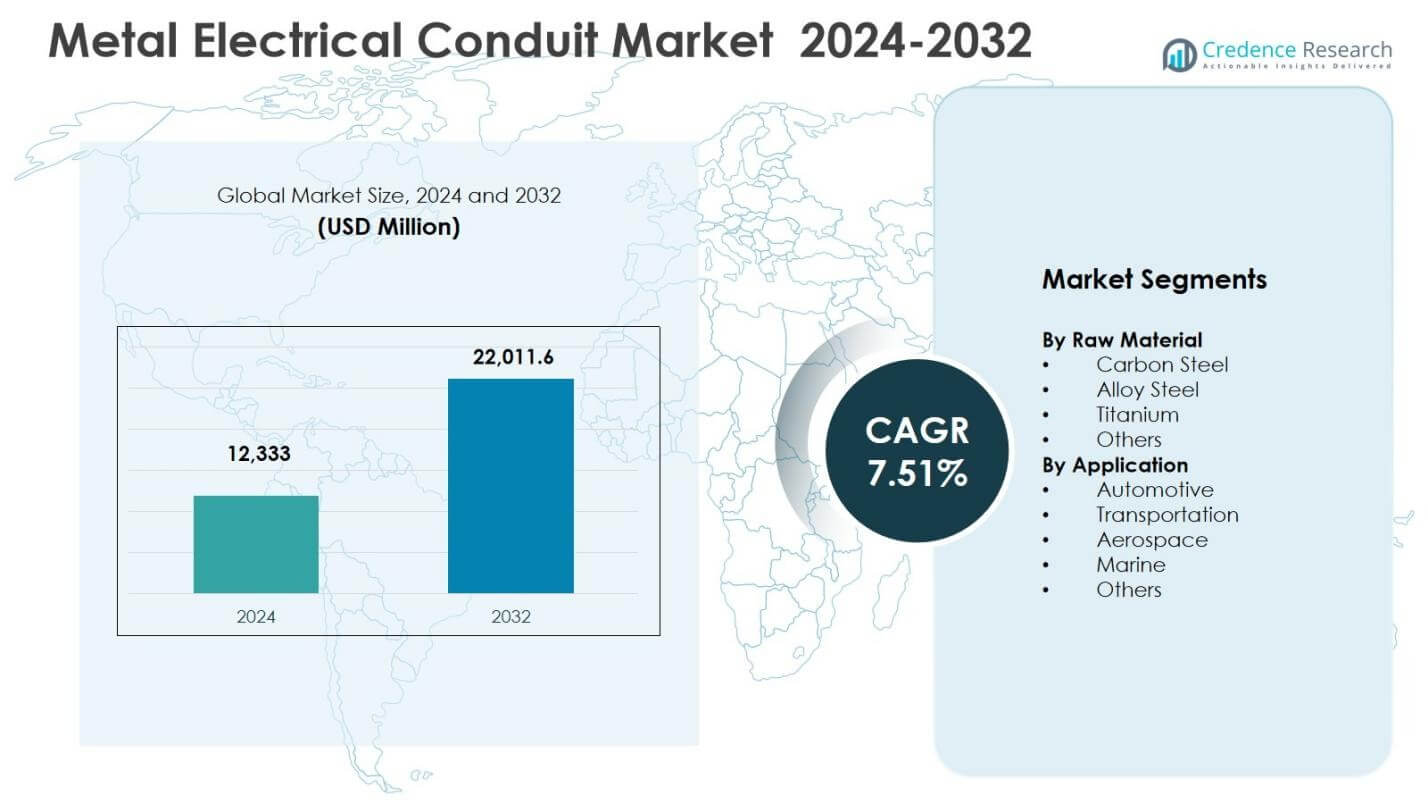
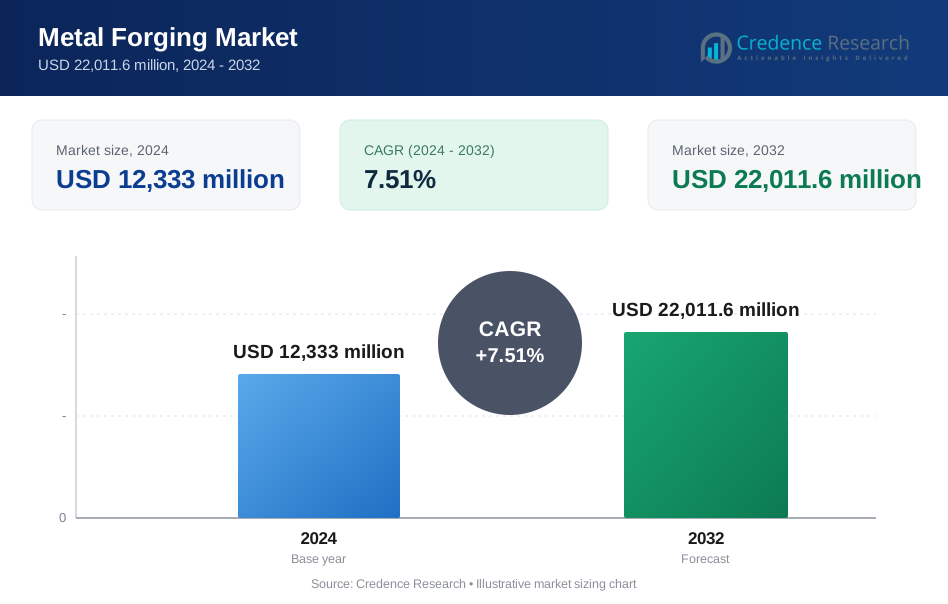
The Metal Forging Market size was valued at USD 12,333 million in 2024 and is anticipated to reach USD 22,011.6 million by 2032, growing at a CAGR of 7.51% during the forecast period.
| REPORT ATTRIBUTE | DETAILS |
|---|---|
| Historical Period | 2020-2023 |
| Base Year | 2024 |
| Forecast Period | 2025-2032 |
| Metal Forging Market Size 2024 | USD 12,333 million |
| Metal Forging Market, CAGR | 7.51% |
| Metal Forging Market Size 2032 | USD 22,011.6 million |
Metal Forging Market Insights
- Market growth is supported by rising automotive and transportation production, where forged components ensure high strength and safety, with the automotive segment holding a 41.8% share in 2024, reinforcing large-volume consumption.
- Key market trends include increasing adoption of lightweight materials such as aluminum and titanium and the integration of automation and advanced forging technologies to improve efficiency, precision, and cost optimization across applications.
- The market structure reflects strong participation of global and regional manufacturers focusing on capacity expansion, advanced material processing, and long-term OEM partnerships, while high capital intensity and raw material price volatility act as restraints.
- Regionally, Asia Pacific dominated with a 38.6% share in 2024, followed by North America at 26.4% and Europe at 22.8%, supported by industrialization, automotive output, aerospace manufacturing, and infrastructure investments.
Metal Forging Market Segmentation Analysis:
By Raw Material:
The Metal Forging Market by raw material is led by carbon steel, which accounted for 46.2% market share in 2024, driven by its high strength, cost efficiency, and wide applicability across automotive, construction, and industrial machinery. Carbon steel forgings benefit from excellent fatigue resistance and ease of heat treatment, supporting large-scale production. Alloy steel follows with strong adoption due to superior mechanical properties and wear resistance in high-stress applications. Titanium forging remains niche but strategically important for aerospace due to its high strength-to-weight ratio and corrosion resistance, while other materials support specialized industrial uses.
- For instance, ArcelorMittal supplies carbon steel grades for forging automotive components like crankshafts and connecting rods, which provide a balance of ductility and strength through heat treatment.
By Application:
By application, the automotive segment dominated the Metal Forging Market with a 41.8% share in 2024, supported by rising vehicle production, lightweighting initiatives, and demand for high-strength forged components such as crankshafts, gears, and axles. Forged parts offer superior durability and safety compared to cast alternatives, making them essential for powertrain and chassis systems. Transportation and aerospace applications continue to expand, driven by rail infrastructure upgrades and aircraft manufacturing growth. Marine and other industrial applications contribute steadily, supported by offshore energy and heavy equipment demand.
- For instance, ThyssenKrupp Forged Technologies produces high-performance crankshafts and gear components for automotive applications using innovative forging methods and recyclable materials.
Key Growth Drivers
Rising Automotive and Transportation Production
The Metal Forging Market is strongly driven by increasing automotive and transportation production, supported by global vehicle manufacturing recovery and long-term mobility demand. Forged components such as crankshafts, connecting rods, gears, and axles offer superior strength, fatigue resistance, and dimensional accuracy, making them essential for safety-critical applications. Automakers continue to prefer forging over casting to meet stricter performance and durability requirements. In addition, expansion of rail networks, commercial vehicles, and heavy trucks further boosts demand for large and precision-forged parts, reinforcing sustained growth across both developed and emerging economies.
- For instance, Viking Forge manufactures flashless closed-die forgings for light, heavy-duty, Class 7 & 8 trucks, and heavy-duty locomotive engine components for rail and mass transit worldwide. Their near-net shaped parts reduce machining needs for truck and trailer hardware.
Growth in Aerospace and Defense Manufacturing
Expansion of aerospace and defense manufacturing significantly accelerates the Metal Forging Market, as aircraft structures and engines require high-strength, lightweight, and defect-free components. Forged titanium, aluminum, and alloy steel parts are widely used in landing gears, turbine discs, and structural components due to their superior mechanical integrity. Rising air passenger traffic, increasing aircraft fleet sizes, and growing defense budgets are driving consistent procurement of forged parts. Moreover, defense modernization programs and increased demand for military aircraft and naval vessels further strengthen the long-term requirement for advanced metal forging solutions.
- For instance, Precision Castparts Corp. supplies closed-die forgings of titanium and nickel alloys for aircraft engines, including turbine disks, shafts, and fan hubs that handle critical rotating applications in commercial programs like the Boeing 787 and A350.
Industrialization and Infrastructure Development
Rapid industrialization and large-scale infrastructure development projects continue to propel demand in the Metal Forging Market. Forged components are extensively used in construction equipment, power generation systems, oil and gas machinery, and mining applications where high load-bearing capacity is essential. Government-led investments in energy infrastructure, renewable power projects, and industrial manufacturing hubs increase consumption of heavy and open-die forgings. Additionally, replacement demand for aging industrial equipment supports steady aftermarket growth, ensuring consistent utilization of forging capacities across global manufacturing regions.
Key Trends & Opportunities
Shift Toward Lightweight and High-Performance Materials
A major trend in the Metal Forging Market is the shift toward lightweight and high-performance materials such as aluminum alloys and titanium. Automotive and aerospace manufacturers increasingly adopt these materials to improve fuel efficiency, reduce emissions, and enhance overall performance. Advanced forging techniques enable precise shaping of complex components while maintaining strength-to-weight advantages. This trend creates strong opportunities for forging companies to invest in specialized material capabilities, expand value-added services, and collaborate with OEMs on next-generation vehicle and aircraft platforms.
- For instance, Chalco Aluminum produces 6A10 T6 forged components widely used in passenger vehicle control arms, leveraging the alloy's high strength and lightweight properties for chassis applications.
Adoption of Advanced Forging Technologies
The growing adoption of advanced forging technologies presents significant opportunities in the Metal Forging Market. Automation, digital simulation, and precision-controlled forging processes improve product consistency, reduce material waste, and enhance productivity. Technologies such as isothermal forging and near-net-shape forging support complex geometries and high-performance applications. These advancements enable manufacturers to meet stringent quality standards while optimizing production costs. As end users demand tighter tolerances and faster turnaround times, technology-driven forging facilities gain a competitive advantage and unlock new revenue streams.
- For instance, Bharat Forge employs fully automated forging press lines ranging from 1600T to 16000T, powered by renewable energy, which deliver turnkey services including open-die pressing and ring rolling for high-strength components in aerospace and oil & gas sectors.
Key Challenges
Volatility in Raw Material Prices
Fluctuating prices of raw materials such as steel, aluminum, and titanium pose a major challenge for the Metal Forging Market. Sudden cost variations directly impact production expenses and profit margins, particularly for long-term supply contracts with fixed pricing structures. Dependence on global commodity markets and supply chain disruptions further intensify pricing uncertainty. Manufacturers often face difficulty in passing increased costs to end users, leading to margin pressure. Managing raw material sourcing and inventory efficiently remains critical for sustaining operational stability.
High Capital and Energy Intensity
The Metal Forging Market faces challenges due to high capital investment and energy-intensive operations. Forging presses, heat treatment facilities, and precision tooling require substantial upfront expenditure and continuous maintenance. Rising energy costs increase operational expenses, particularly for large-scale and high-temperature forging processes. Small and mid-sized players often struggle to adopt advanced technologies due to financial constraints. Additionally, increasing environmental regulations related to emissions and energy consumption add compliance costs, further impacting overall profitability.
Regional Analysis
North America
North America held a 26.4% share of the Metal Forging Market in 2024, driven by strong demand from automotive, aerospace, defense, and industrial machinery sectors. The United States dominates regional consumption due to high production of forged engine components, aircraft structural parts, and energy equipment. Continuous investments in defense modernization, rising adoption of lightweight forged materials, and reshoring of manufacturing activities support market expansion. Advanced forging technologies and strict quality standards further enhance regional competitiveness. Canada and Mexico contribute through automotive supply chains and cross-border manufacturing integration, strengthening overall regional demand.
Europe
Europe accounted for 22.8% of the Metal Forging Market share in 2024, supported by a well-established automotive and industrial manufacturing base. Germany, France, and Italy lead demand due to high production of forged components for vehicles, aerospace systems, and industrial equipment. Strong emphasis on precision engineering, sustainability, and energy-efficient manufacturing boosts adoption of advanced forging solutions. Growth in electric vehicles and renewable energy infrastructure further increases demand for specialized forged parts. Eastern European countries also contribute through cost-competitive manufacturing and increasing investments in heavy engineering industries.
Asia Pacific
Asia Pacific dominated the Metal Forging Market with a 38.6% share in 2024, driven by rapid industrialization, large-scale automotive production, and expanding infrastructure development. China and India represent major growth engines due to high demand for forged automotive components, construction machinery parts, and power equipment. Rising investments in railways, defense manufacturing, and renewable energy projects further accelerate market growth. Japan and South Korea support regional demand through advanced automotive and aerospace forging capabilities. Cost-effective labor, expanding manufacturing capacity, and strong domestic consumption sustain Asia Pacific’s market leadership.
Latin America
Latin America captured 6.1% of the Metal Forging Market share in 2024, supported by automotive manufacturing expansion and infrastructure development initiatives. Brazil and Mexico are key contributors due to strong automotive assembly operations and increasing demand for forged engine and transmission components. Growth in mining, oil and gas, and agricultural machinery further supports forging demand. Regional governments continue to invest in transportation infrastructure, driving consumption of heavy forgings. Although technological adoption remains moderate, increasing foreign investments and integration into global supply chains strengthen long-term market prospects.
Middle East & Africa
The Middle East & Africa held a 6.1% share of the Metal Forging Market in 2024, driven by demand from energy, construction, and heavy industrial applications. Oil and gas projects, power generation facilities, and large-scale infrastructure developments generate steady demand for forged components. Countries such as Saudi Arabia and the UAE focus on industrial diversification, supporting local manufacturing and forging capacity expansion. In Africa, mining and infrastructure projects contribute to market growth. Gradual industrialization and government-backed manufacturing initiatives support sustained regional demand.
Metal Forging Market Segmentations:
By Raw Material
- Carbon Steel
- Alloy Steel
- Titanium
- Others
By Application
- Automotive
- Transportation
- Aerospace
- Marine
- Others
By Geography
- North America
- U.S.
- Canada
- Mexico
- Europe
- Germany
- France
- U.K.
- Italy
- Spain
- Rest of Europe
- Asia Pacific
- China
- Japan
- India
- South Korea
- South-east Asia
- Rest of Asia Pacific
- Latin America
- Brazil
- Argentina
- Rest of Latin America
- Middle East & Africa
- GCC Countries
- South Africa
- Rest of the Middle East and Africa
Competitive Landscape
Competitive landscape analysis of the Metal Forging Market highlights the presence of major players such as Bharat Forge Ltd., Precision Castparts Corp., Nippon Steel Corp., Larsen & Toubro Ltd., ATI, ELLWOOD Group, Inc., China First Heavy Machinery Co., Ltd., Bruck GmbH, and Jiangyin Hengrun Heavy Industries Co., Ltd. The market is characterized by a mix of global conglomerates and regionally strong manufacturers competing on forging capacity, material expertise, and application-specific solutions. Leading companies focus on expanding advanced forging capabilities, particularly for automotive, aerospace, defense, and energy applications. Investments in automation, precision forging, and lightweight material processing strengthen competitive positioning. Strategic partnerships with OEMs, long-term supply contracts, and geographic expansion remain key strategies. Additionally, players emphasize quality certifications and vertical integration to ensure cost control and supply reliability. Competition remains intense, with technological differentiation, scale advantages, and customer-specific engineering solutions acting as critical success factors.
Key Player Analysis
- Precision Castparts Corp.
- Bharat Forge Ltd.
- Nippon Steel Corp.
- ELLWOOD Group, Inc.
- Larsen & Toubro Ltd.
- China First Heavy Machinery Co., Ltd.
- Bruck GmbH
- ATI
- Jiangyin Hengrun Heavy Industries Co., Ltd.
- Ironic
Recent Developments
- In February 2025, Trive Capital (Dallas-based private equity firm) partnered with and acquired a majority stake in Independent Forgings & Alloys (IFA), a UK-based integrated manufacturer of complex forgings for aerospace, defense, and industrial applications, marking a significant investment in forging industry capabilities and expansion potential.
- In July 2025, Bharat Forge Limited successfully completed the acquisition of AAM India Manufacturing Private Limited's commercial vehicle business for an equity value of ₹7,464.6 million, enhancing its automotive forging capabilities for OEMs in traditional and new mobility sectors.
- In November 2025, GMH Gruppe completed the acquisition of Buderus Edelstahl GmbH business units, expanding its rolling and forging capabilities within steel and associated forged product segments (part of broader metals manufacturing consolidation).
Report Coverage
The research report offers an in-depth analysis based on Raw Material, Application and Geography. It details leading market players, providing an overview of their business, product offerings, investments, revenue streams, and key applications. Additionally, the report includes insights into the competitive environment, SWOT analysis, current market trends, as well as the primary drivers and constraints. Furthermore, it discusses various factors that have driven market expansion in recent years. The report also explores market dynamics, regulatory scenarios, and technological advancements that are shaping the industry. It assesses the impact of external factors and global economic changes on market growth. Lastly, it provides strategic recommendations for new entrants and established companies to navigate the complexities of the market.
Future Outlook
- The Metal Forging Market will continue to expand due to sustained demand from automotive, aerospace, and transportation industries.
- Increasing adoption of lightweight and high-strength forged components will support long-term market growth.
- Advanced forging technologies and automation will improve productivity and product consistency across manufacturers.
- Growing investments in infrastructure and industrial development will increase demand for heavy and open-die forgings.
- Expansion of aerospace and defense manufacturing will drive demand for precision-forged alloy and titanium components.
- Electric vehicle production will create new opportunities for specialized forged drivetrain and chassis parts.
- Manufacturers will focus on energy-efficient and environmentally compliant forging processes to meet regulations.
- Strategic partnerships with OEMs will strengthen long-term supply relationships and market positioning.
- Capacity expansions in emerging economies will enhance global production capabilities and competitiveness.
- Innovation in material processing and near-net-shape forging will improve cost efficiency and design flexibility.
Request a Free Sample
Fill in your details and we'll send you a free sample report.
- Sample data tables & charts
- Research methodology
Need a Custom Version of This Report?
Tailor the scope, geography, or segments to your exact requirements.
- Custom geography or segment scope
- Direct access to our analyst team
Frequently Asked Questions
What is the current market size for the Metal Forging Market, and what is its projected size in 2032?
At what Compound Annual Growth Rate is the Metal Forging Market projected to grow between 2024 and 2032?
Which Metal Forging Market segment held the largest share in 2024?
What are the primary factors fueling the growth of the Metal Forging Market?
Who are the leading companies in the Metal Forging Market?
Which region commanded the largest share of the Metal Forging Market in 2024?
Table of Content
Chapter 1. Report Introduction
- 1.1 Report Description & Purpose
- 1.1.1 Report Title & Market Definition
- 1.1.2 Unique Selling Propositions (USP) & Key Differentiators
- 1.1.3 Value Proposition for Stakeholders
- 1.2 Research Objectives
- 1.2.1 Market Sizing Objectives (Volume & Revenue)
- 1.2.2 Segmentation Objectives
- 1.2.3 Competitive Intelligence Objectives
- 1.2.4 Forecast & Scenario Objectives
- 1.3 Report Scope
- 1.3.1 Metal Forging Scope – Types & Subtypes Covered
- 1.3.2 Geographic Scope – Regions & Countries Covered
- 1.3.3 Historical Period, Base Year & Forecast Period (2024; forecast to 2032)
- 1.3.4 Inclusions & Exclusions
- 1.4 HS Code & Classification Framework
- 1.5 Currency, Units & Pricing Basis
- 1.6 Target Stakeholders
- 1.7 Limitations & Assumptions
Chapter 2. Executive Summary
- 2.1 Global Metal Forging Market Snapshot
- 2.1.1 Market Size – Historical (2024) & Forecast (2024-2032) (2024: USD 12,333 million → 2032: USD 22,011.6 million)
- 2.1.2 Volume & Revenue – Global Totals
- 2.1.3 Key Market Highlights – Top Five Facts
- 2.2 Metal Forging Market Segmentation Snapshot
- 2.2.1 Market Split by Region – 2024 vs. 2032
- 2.3 Competitive Snapshot
- 2.3.1 Top 10 Players by Revenue Share – 2024
- 2.3.2 Top 10 Players by Volume Share – 2024
- 2.3.3 Recent Strategic Developments (18-Month Summary)
- 2.4 Key Investment Highlights & Strategic Conclusions
Chapter 3. Metal Forging Market Dynamics & Industry Analysis
- 3.1 Market Overview & Context
- 3.1.1 Metal Forging Market Position in the Broader Automotive Value Chain
- 3.1.2 OEM vs. Replacement Market Dynamics
- 3.1.3 Market Maturity & Development Stage by Region
- 3.2 Metal Forging Market Drivers
- 3.3 Metal Forging Market Restraints & Challenges
- 3.4 Metal Forging Market Opportunities
- 3.5 Porter's Five Forces Analysis
- 3.5.1 Threat of New Entrants
- 3.5.2 Bargaining Power of Suppliers
- 3.5.3 Bargaining Power of Buyers
- 3.5.4 Threat of Substitutes
- 3.5.5 Competitive Rivalry – Intensity Assessment
- 3.6 Metal Forging Value Chain Analysis
- 3.6.1 Upstream – Raw Material/Input Suppliers
- 3.6.1.1 Raw Material/Input 1
- 3.6.1.2 Raw Material/Input 2
- 3.6.1.3 Raw Material/Input 3
- 3.6.2 Midstream – Production/Manufacturing/Service Delivery
- 3.6.2.1 Production/Process Overview
- 3.6.2.2 Key Facility Locations & Capacity by Manufacturer
- 3.6.3 Downstream – Distribution & End Consumer
- 3.6.3.1 Primary Channel – B2B/OEM
- 3.6.3.2 Secondary Channels – Dealer, Retail, Online, Direct
- 3.6.4 Value Chain Profitability Analysis
- 3.6.1 Upstream – Raw Material/Input Suppliers
- 3.7 PESTEL Analysis
- 3.7.1 Political Factors
- 3.7.2 Economic Factors
- 3.7.3 Social Factors
- 3.7.4 Technological Factors
- 3.7.5 Environmental Factors
- 3.7.6 Legal Factors
- 3.8 Metal Forging Supply Chain Analysis
- 3.8.1 Raw Material/Input Supply Risk Assessment
- 3.8.2 Manufacturing Concentration Risk (Geographic Exposure)
- 3.8.3 Trade Disruption Impact Analysis
- 3.9 Regulatory & Policy Landscape
Note: The regulatory and policy landscape section covers regulations based on their applicability to the market, Metal Forging category, geography, and scope of the study. Only regulatory frameworks with a material impact on operations, compliance, trade, sustainability, or market access are analyzed in detail.
Chapter 4. Key Investment Pockets & Opportunity Analysis
- 4.1 Metal Forging Market Attractiveness Analysis
- 4.1.1 By Region – Investment Attractiveness Matrix (Volume × CAGR)
- 4.2 Absolute Revenue Growth Opportunity
- 4.2.1 By Region – Absolute USD Growth Through 2032
- 4.3 Incremental Volume Opportunity
- 4.3.1 By Region – Incremental Volume Through 2032
- 4.3.2 Segment – Incremental Volume
- 4.4 Emerging Submarket Opportunity Deep Dive (Subject to Applicability)
- 4.5 Emerging Market Opportunity Scorecards
- 4.5.1 United States
- 4.5.2 Europe
- 4.5.3 Asia
- 4.5.4 Middle East & Africa
Note: Emerging Market Opportunity Scorecards will be included based on relevance and strategic importance. Regions listed are indicative and may vary depending on data availability and market dynamics.
Chapter 5. Metal Forging Import-Export Analysis & Trade Flows
- 5.1 Global Trade Overview
- 5.1.1 Global Export Value by Country (2024)
- 5.1.2 Global Export Volume by Country (2024)
- 5.1.3 Global Import Value by Country (2024)
- 5.1.4 Global Import Volume by Country (2024)
- 5.1.5 Net Trade Balance by Country (2024)
- 5.2 Export Analysis – Segment
- 5.2.1 Type 1 (HS Code)
- 5.2.2 Type 2 (HS Code)
- 5.2.3 Type 3 (HS Code)
- 5.2.4 Type 4 (HS Code)
- 5.2.5 Type 5 (HS Code)
- 5.3 Import Analysis – Segment
- 5.3.1 Type 1 (HS Code)
- 5.3.2 Type 2 (HS Code)
- 5.3.3 Type 3 (HS Code)
- 5.3.4 Type 4 (HS Code)
- 5.3.5 Type 5 (HS Code)
- 5.4 Average Unit Trade Prices
- 5.4.1 Average Export Price – Segment & Country
- 5.4.2 Average Import Price – Segment & Source Country
- 5.4.3 Price Trends (2024)
- 5.5 Key Trade Route Analysis
- 5.5.1 Trade Route 1
- 5.5.2 Trade Route 2
- 5.5.3 Trade Route 3
- 5.5.4 Trade Route 4
- 5.5.5 Trade Route 5
- 5.6 Trade Policy Impact Assessment
- 5.6.1 US Anti-Dumping & Section 301 Tariffs
- 5.6.2 EU Customs Union Impact
- 5.6.3 Major Free Trade Agreements
- 5.6.4 USMCA Rules of Origin
Note: Trade policy analysis will be included only where relevant to the Metal Forging market.
Chapter 6. Competitive Landscape & Company Benchmarking
- 6.1 Metal Forging Market Concentration & Structure
- 6.1.1 Herfindahl-Hirschman Index (HHI) – vs. 2024
- 6.1.2 Tier 1, Tier 2 & Tier 3 Market Structure
- 6.1.3 Global, Regional & Local Player Dynamics
- 6.2 Metal Forging Market Share Analysis – 2024
- 6.2.1 Global Revenue Share by Company
- 6.2.2 Global Volume Share by Company
- 6.2.3 Regional Revenue Share
- 6.2.4 Market Share Evolution ( vs. 2024)
- 6.2.5 OEM Segment Share by Company
- 6.2.6 Replacement Segment Share by Company
- 6.3 Production/Delivery Capacity & Facility Analysis
- 6.3.1 Global Installed Capacity
- 6.3.2 Capacity Utilization Rates
- 6.3.3 Production/Output Volume
- 6.3.4 Facility Locations & Capacity Map
- 6.3.5 Planned Capacity Additions
- 6.4 Metal Forging Competitive Benchmarking Matrix
- 6.4.1 Revenue, Volume, CAGR & Profitability Comparison
- 6.4.2 Channel Revenue Mix
- 6.4.3 Geographic Revenue Exposure
- 6.4.4 R&D Intensity
- 6.4.5 Sustainability Maturity
- 6.5 Strategic Developments in Metal Forging (Last 24 Months)
- 6.5.1 Mergers, Acquisitions & Divestments
- 6.5.2 New Metal Forging Launches
- 6.5.3 Facility Expansions
- 6.5.4 Strategic Alliances, Joint Ventures & Partnerships
- 6.5.5 Distribution Expansion & Market Entry
- 6.5.6 Sustainability & ESG Initiatives
- 6.6 Competitive Strategy Mapping
- 6.6.1 Leader, Challenger, Follower & Niche Classification
- 6.6.2 Pricing Strategy Comparison
- 6.6.3 Channel Strategy Matrix
Note: Strategic developments are included based on their materiality and the availability of reliable information.
Chapter 7. Global Metal Forging Market – By Distribution Channel
- 7.1 Segment Overview
- 7.1.1 Volume & Revenue Split by Channel (2024 & 2032)
- 7.1.2 Channel Mix Evolution (2024-2032)
Chapter 8. Regional Market Analysis – Global Overview
- 8.1 Global Regional Overview
- 8.1.1 Regional Volume Share
- 8.1.2 Regional Revenue Share
- 8.1.3 Regional Volume by Region
- 8.1.4 Regional Revenue by Region
- 8.1.5 Regional Forecast Through 2032
- 8.2 Cross-Regional Segment Analysis
- 8.2.1 By Distribution Channel
- 8.2.2 By Brand/Price Tier
Chapter 9. North America Metal Forging Market
- 9.1 United States
- 9.2 Canada
- 9.3 Mexico
Chapter 10. Europe Metal Forging Market
- 10.1 Germany
- 10.2 France
- 10.3 Italy
- 10.4 United Kingdom
- 10.5 Spain
- 10.6 Poland
- 10.7 Russia
- 10.8 Netherlands
- 10.9 Belgium
- 10.10 Sweden
- 10.11 Denmark
- 10.12 Norway
- 10.13 Rest of Europe
Chapter 11. Asia Pacific Metal Forging Market
- 11.1 China
- 11.2 India
- 11.3 Japan
- 11.4 South Korea
- 11.5 Thailand
- 11.6 Indonesia
- 11.7 Vietnam
- 11.8 Malaysia
- 11.9 Australia
- 11.10 Rest of Asia Pacific
Chapter 12. Latin America Metal Forging Market
- 12.1 Brazil
- 12.2 Argentina
- 12.3 Colombia
- 12.4 Chile
- 12.5 Rest of Latin America
Chapter 13. Middle East Metal Forging Market
- 13.1 Saudi Arabia
- 13.2 United Arab Emirates
- 13.3 Turkey
- 13.4 Israel
- 13.5 Iran
- 13.6 Rest of the Middle East
Chapter 14. Africa Metal Forging Market
- 14.1 South Africa
- 14.2 Egypt
- 14.3 Nigeria
- 14.4 Morocco
- 14.5 Rest of Africa
Chapter 15. Metal Forging Company Profiles
- 15.1 [Company 01]
- 15.1.1 Company Overview
- 15.1.2 Key Management Personnel
- 15.1.3 Products & Services Portfolio
- 15.1.4 Financial Performance
- 15.1.5 Key Market Focus & Geographic Presence
- 15.1.6 Recent Developments & Strategic Initiatives
Note: The company profile list is preliminary and may change based on research findings, market developments, data availability, and client requirements.
Chapter 16. Appendices
- Appendix A – List of Abbreviations & Acronyms
- Appendix B – Industry Classification Code Reference – Full Series
- Appendix C – Production & Capacity Data Tables
- Appendix D – End-Use & Demand Base Tables
- Appendix E – Consumption & Replacement Rate Assumptions
- Appendix F – ASP Reference Tables
- Appendix G – Manufacturing & Facility Database
- Appendix H – Import-Export Data Tables
- Appendix I – Regulatory Summary Tables
- Appendix J – Primary Research Participant List (Anonymized)
- Appendix K – Primary Research Questionnaire Framework
- Appendix L – Data Sources & Bibliography
- Appendix M – Market Size Divergence & Source Comparison
Chapter 17. Research Methodology
- 17.1 Research Framework & Philosophy
- 17.2 Secondary Research – Sources, Hierarchy & Data Extraction
- 17.3 Data Modeling – Bottom-Up & Top-Down Market Sizing
- 17.4 Primary Research – Stakeholder Framework, LOI & Sample Sizes
- 17.5 Forecast Methodology – Regression, Scenario & Sensitivity Analysis
- 17.6 Quality Control – Four-Layer Validation Framework
- 17.7 Limitations & Standard Assumptions
- 17.8 Disclaimer
