Market Overview:
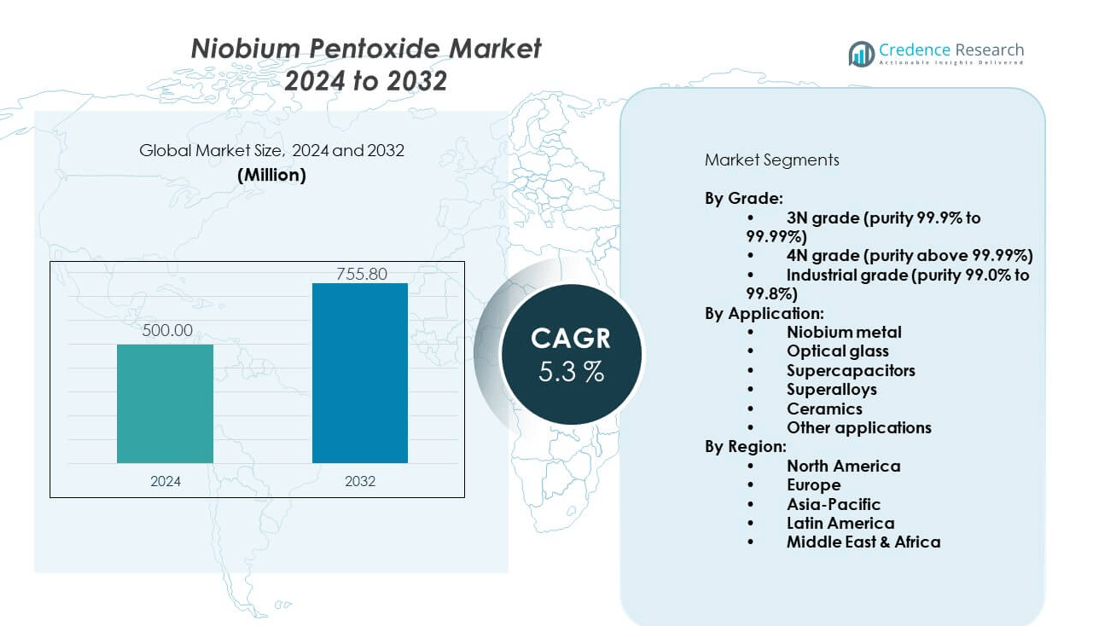
The niobium pentoxide market is projected to grow from USD 500 million in 2024 to an estimated USD 755.8 million by 2032, registering a CAGR of 5.3% during the forecast period (2024–2032).
| REPORT ATTRIBUTE | DETAILS |
|---|---|
| Historical Period | 2020-2023 |
| Base Year | 2024 |
| Forecast Period | 2025-2032 |
| Niobium Pentoxide Market Size 2024 | USD 500 million |
| Niobium Pentoxide Market, CAGR | 5.3% |
| Niobium Pentoxide Market Size 2032 | USD 755.8 million |
The market is primarily driven by the rising demand for energy storage technologies and high-performance electronics. Niobium pentoxide plays a vital role in enhancing the efficiency and durability of capacitors and rechargeable batteries. Its application in optical glass and catalysts further supports adoption in electronics and chemical industries. Growing demand for sustainable and high-energy-density storage in electric vehicles, along with innovation in consumer electronics, strengthens its growth. Expanding R&D initiatives into next-generation materials is further unlocking new opportunities for niobium pentoxide.
The Asia-Pacific region leads the market, supported by strong electronics manufacturing in China, Japan, and South Korea, along with rising electric vehicle production in the region. North America follows, driven by advanced research initiatives and adoption in clean energy technologies. Europe maintains steady demand due to its robust automotive and specialty glass industries. Emerging regions such as Latin America are gaining traction due to growing industrialization and mineral resources, while the Middle East & Africa show gradual adoption supported by rising investment in energy and industrial sectors.
Market Insights:
- The niobium pentoxide market is projected to grow from USD 500 million in 2024 to USD 755.8 million by 2032, at a CAGR of 5.3%.
- Rising demand for lithium-ion batteries and capacitors is fueling market expansion across automotive and electronics sectors.
- Its role in optical glass, catalysts, and specialty coatings supports industrial and technological adoption.
- Limited supply concentration in Brazil poses risks to availability and creates global supply chain challenges.
- High production costs and technical complexities in refining restrict broader commercial adoption in price-sensitive industries.
- Asia-Pacific dominates the market due to strong electronics manufacturing and rising electric vehicle demand.
- North America and Europe show steady growth, while Latin America and the Middle East & Africa are emerging due to resource availability and industrialization.
Market Drivers:
Rising Demand from Energy Storage and Advanced Battery Applications Strengthening Global Adoption:
The niobium pentoxide market is witnessing strong growth due to its critical use in advanced energy storage systems. It plays an essential role in improving lithium-ion battery performance through better thermal stability, safety, and cycle life. Manufacturers are adopting niobium-based additives to produce fast-charging batteries with enhanced durability. The growing demand for electric vehicles and renewable energy storage solutions is accelerating its adoption. Energy companies are investing heavily in R&D to integrate niobium pentoxide into next-generation battery technologies. Governments supporting electric mobility are further boosting its usage in battery chemistry. It is increasingly viewed as a strategic material for sustainable transportation and energy systems. This trend continues to shape both automotive and energy sectors globally.
- For instance, CBMM operates a state-of-the-art R&D pilot plant and collaborates with multiple partners to develop niobium-enhanced battery materials, such as niobium-doped cathodes for LMO and LCO batteries with Technology Readiness Levels (TRL) of 9 and 8 respectively.
Expanding Role in High-Performance Capacitors Supporting Electronics and Telecommunications Industry:
The niobium pentoxide market benefits from its vital role in the production of capacitors used in consumer electronics and telecommunications. Capacitors with niobium pentoxide deliver high dielectric strength, reliability, and miniaturization, meeting the requirements of advanced devices. The global demand for smartphones, tablets, and 5G equipment creates consistent growth for niobium-based capacitors. Electronics firms rely on niobium pentoxide to meet rising performance standards. The material allows devices to become smaller while maintaining efficiency and safety. It is widely recognized as a preferred choice for manufacturers of high-grade capacitors in Asia-Pacific. The rise of smart devices and connected technologies strengthens this demand further. This trend ensures continued adoption in consumer and industrial electronics.
- For instance, CBMM has officially opened the world's largest niobium-based anode production facility in Araxá, Brazil, with a capacity of 2,000 tonnes per year of Echion Technologies' active anode material. This plant enables ultra-fast charging lithium-ion batteries that maintain high energy density and durability across more than 10,000 charging cycles, benefiting heavy-duty vehicles and mass transit.
Increasing Application in Optical Glass and Specialty Coatings Driving Industrial Utilization:
The niobium pentoxide market is expanding due to its strong adoption in optical glass and coatings. Its ability to enhance refractive index and durability makes it critical for advanced optics. Specialty glass producers use it to manufacture camera lenses, fiber optics, and precision instruments. The rise of augmented reality, virtual reality, and medical imaging increases the demand for high-quality optics. Niobium pentoxide is also employed in anti-reflective coatings and specialized industrial surfaces. It provides improved strength and performance to products requiring advanced optical properties. Industries in defense, healthcare, and communication sectors are investing heavily in this material. Its industrial versatility ensures continued momentum across diverse application areas.
Strategic Role in Catalysis and High-Value Industrial Processes Supporting Global Adoption:
The niobium pentoxide market is driven by its expanding role in catalysts used in petrochemical and polymer industries. It supports cleaner chemical reactions, higher yields, and improved efficiency. Catalysts based on niobium pentoxide are increasingly used for producing plastics, polymers, and fine chemicals. The push for sustainable chemical processes is enhancing its adoption worldwide. Industrial companies adopt niobium pentoxide to align with regulations on cleaner manufacturing practices. It is being integrated into processes requiring high-performance catalysts in multiple industries. Strong emphasis on reducing emissions and increasing productivity supports wider application. Its adaptability across different industrial sectors ensures steady demand growth.
Market Trends:
Emerging Integration into Next-Generation Semiconductor and Microelectronics Manufacturing:
The niobium pentoxide market is experiencing a rise in applications within semiconductors and microelectronics. Niobium-based compounds are being tested for use in thin-film transistors, memory devices, and integrated circuits. It offers high dielectric constant and stable electrical performance, supporting miniaturized electronics. Researchers are exploring its potential as a substitute in high-value semiconductor materials. The push for advanced computing technologies is creating opportunities for broader adoption. Growing interest in quantum computing and high-performance chips enhances this demand. It is becoming a candidate for next-generation materials in electronics manufacturing. This trend is expected to influence high-tech industries globally.
- For instance, CBMM also announced strategic partnerships and development agreements with companies like NOVONIX for niobium-enhanced nickel cathode materials and Nano One for high-nickel cathodes with enhanced durability, confirming their leadership in niobium battery materials innovation.
Expanding Role in Sustainable Energy Projects Across Solar and Hydrogen Applications:
The niobium pentoxide market is witnessing a trend of adoption in solar technologies and hydrogen energy systems. Researchers are exploring its role in improving solar cell efficiency by enhancing light absorption. It is also studied for use in photocatalysts to support hydrogen production. These applications align with the global push toward renewable energy adoption. Energy firms are evaluating niobium pentoxide for long-term use in green projects. The growth of hydrogen as an alternative energy source strengthens its demand further. It is positioned as a potential material for sustainable energy infrastructure. This emerging use broadens its market beyond conventional applications.
- For instance, Toshiba, Sojitz, and CBMM unveiled a prototype ultra-fast charging electric bus powered by next-generation lithium-ion batteries using niobium titanium oxide (NTO) anodes. The batteries recharge fully in about 10 minutes and are tested in operational trials, which validates niobium's safety and efficiency in advanced battery applications.
Rising Investment in Advanced Coating Materials Supporting Aerospace and Defense Applications:
The niobium pentoxide market is observing a strong trend of adoption in aerospace and defense coatings. Niobium-based coatings are valued for their high hardness, corrosion resistance, and optical properties. Aerospace industries use it for protective layers in extreme environments. Defense applications benefit from its integration into specialized optics and protective systems. The rising global defense expenditure enhances demand for such advanced materials. Coatings with niobium pentoxide improve operational efficiency and longevity of critical components. It is increasingly incorporated into research projects focused on durable aerospace materials. This trend supports long-term demand in high-value sectors.
Development of High-Purity Grades for Medical and Biomedical Applications:
The niobium pentoxide market is evolving with the development of high-purity grades for medical use. High-purity niobium oxides are being adopted in medical imaging, surgical instruments, and implants. Biomedical research highlights its potential biocompatibility and safe integration into devices. It is considered for use in glass for diagnostic equipment requiring clarity and durability. Medical manufacturers are investing in niobium pentoxide for next-generation devices. Healthcare infrastructure expansion strengthens this trend globally. It supports precision and safety in medical technology development. The focus on innovation in healthcare materials ensures its growing role in medical fields.
Market Challenges Analysis:
Limited Supply Chain and Resource Dependence Creating Vulnerability for Global Producers:
The niobium pentoxide market faces challenges due to the concentration of niobium ore production in a few regions. Brazil accounts for the majority of global niobium supply, creating heavy reliance on one geography. Supply disruptions or geopolitical instability in producing nations can significantly impact global availability. Manufacturers relying on consistent niobium feedstock face uncertainty in sourcing. Limited mining expansion restricts supply growth to match rising demand. It creates pricing volatility and market instability for downstream industries. Dependence on few mining firms limits competitive balance. This vulnerability continues to be a major concern for producers and consumers worldwide.
Technical Barriers and Cost Pressures Restricting Broader Commercial Adoption:
The niobium pentoxide market encounters obstacles due to technical complexities in processing and high production costs. Advanced refining technologies are required to produce high-purity grades suitable for specialized industries. Manufacturers face challenges in scaling production economically while meeting quality standards. High costs limit adoption in industries sensitive to pricing pressures. Smaller companies struggle to integrate niobium pentoxide due to cost barriers. It is also facing competition from substitute materials in some applications. Limited awareness of its full potential restricts faster commercialization. These factors combine to slow down broader adoption despite strong market potential.
Market Opportunities:
Growing Role in Electric Vehicle Batteries and Energy Storage Infrastructure:
The niobium pentoxide market is positioned to gain from increasing adoption in electric vehicle batteries and large-scale energy storage systems. Its ability to enhance safety, fast-charging, and cycle life makes it highly attractive for manufacturers. Automotive firms are exploring partnerships with material suppliers to secure niobium resources. Expanding charging infrastructure for EVs supports demand growth. Energy storage projects linked to renewable energy create parallel opportunities. It is increasingly viewed as a strategic enabler of sustainable energy. This positioning aligns with global carbon reduction goals and electric mobility adoption.
Rising Innovation in Specialty Optics, Electronics, and Advanced Coatings Applications:
The niobium pentoxide market holds opportunities in advanced optics, microelectronics, and protective coatings. Its role in enabling AR/VR devices, semiconductors, and aerospace systems supports diversified growth. Rising investments in specialty glass production and defense optics strengthen long-term prospects. Electronics producers are testing its integration in high-density circuits and advanced sensors. Demand for lightweight yet durable coatings in aerospace enhances market opportunities. It is becoming a key component for industries demanding precision and resilience. These opportunities expand its relevance across multiple sectors.
Market Segmentation Analysis:
By Grade
The niobium pentoxide market is segmented into 3N, 4N, and industrial grades. The 3N grade, with 99.9% to 99.99% purity, holds significant share due to balanced cost and wide use in capacitors, ceramics, and electronics. The 4N grade, with purity above 99.99%, is increasingly adopted in high-precision fields such as semiconductors, optical glass, and biomedical devices, where reliability and stability are critical. Industrial grade, with 99.0% to 99.8% purity, supports catalysts and large-scale industrial applications that demand consistent quality but not ultra-high purity.
- For instance, CBMM produces high-purity 4N grade niobium oxide used in high-precision applications including semiconductors and biomedical devices, where stability is crucial. This production is supported by pilot and industrial plants achieving daily material outputs ranging from sample grams to kilograms, with industrial-scale production planned to reach kiloton levels by 2030.
By Application
Niobium metal is the dominant application segment, widely used in superalloys, specialty steels, and structural materials. Optical glass is experiencing rapid growth, supported by demand from fiber optics, lenses, and imaging technologies. Supercapacitors are emerging as a promising use, where niobium pentoxide improves efficiency, cycle life, and performance in advanced energy storage solutions. Superalloys represent a strong segment, especially in aerospace and defense industries, where high strength and resistance to extreme conditions are essential. Ceramics utilize niobium pentoxide to enhance mechanical strength and electrical performance across advanced material applications. Other applications, including catalysts and specialized chemical processes, diversify its market scope and ensure steady demand across multiple industrial sectors.
- For example, Skeleton Technologies, a leading European supercapacitor manufacturer, signed a strategic cooperation agreement with Marubeni Corporation, one of Japan’s largest conglomerates, to commercialize their niobium-containing SuperBattery product line in the Asian automotive and hydrogen transportation markets.
Segmentation:
By Grade:
- 3N grade (purity 99.9% to 99.99%)
- 4N grade (purity above 99.99%)
- Industrial grade (purity 99.0% to 99.8%)
By Application:
- Niobium metal
- Optical glass
- Supercapacitors
- Superalloys
- Ceramics
- Other applications (catalysts and specialized chemical processes)
By Region:
- North America
- U.S.
- Canada
- Mexico
- Europe
- UK
- France
- Germany
- Italy
- Spain
- Russia
- Belgium
- Netherlands
- Austria
- Sweden
- Poland
- Denmark
- Switzerland
- Rest of Europe
- Asia Pacific
- China
- Japan
- South Korea
- India
- Australia
- Thailand
- Indonesia
- Vietnam
- Malaysia
- Philippines
- Taiwan
- Rest of Asia Pacific
- Latin America
- Brazil
- Argentina
- Peru
- Chile
- Colombia
- Rest of Latin America
- Middle East
- UAE
- KSA
- Israel
- Turkey
- Iran
- Rest of Middle East
- Africa
- Egypt
- Nigeria
- Algeria
- Morocco
- Rest of Africa
Regional Analysis:
Asia-Pacific
The Asia-Pacific region dominates the niobium pentoxide market, accounting for over 40% of the global share. Strong demand arises from electronics manufacturing hubs in China, Japan, and South Korea, where niobium pentoxide is critical for capacitors, semiconductors, and optical glass. Growing adoption in electric vehicle batteries strengthens its use in China and emerging Southeast Asian markets. Japan’s advanced optical glass and precision instrument industries further increase regional consumption. It continues to attract investments from global players due to its strong supply chain ecosystem. Rapid industrialization and rising renewable energy projects also support long-term demand in this region.
North America
North America holds around 25% share of the niobium pentoxide market, driven by its use in aerospace, defense, and advanced electronics. The United States leads with extensive applications in superalloys and catalysts, while Canada supports production through resource availability and mining initiatives. Adoption in supercapacitors and energy storage solutions is expanding due to growth in electric vehicle infrastructure. It benefits from strong R&D spending, particularly in next-generation battery technologies and semiconductor materials. Industries in this region value high-purity niobium pentoxide for specialty applications. The demand outlook remains steady due to technological innovation and government support for sustainable energy projects.
Europe, Latin America, and Middle East & Africa
Europe captures nearly 20% of the niobium pentoxide market, supported by its robust automotive sector and optical glass industries in Germany, France, and the UK. Latin America accounts for close to 10%, with Brazil playing a central role as the world’s primary supplier of niobium ore. It secures global influence by hosting major mining operations and processing facilities. The Middle East & Africa represent around 5% share, with demand gradually rising due to industrialization and energy investments. Regional growth is also linked to increasing focus on defense and infrastructure development. Each of these regions plays a unique role in balancing global supply and demand for niobium pentoxide.
Key Player Analysis:
- CBMM
- AMG
- Solikamsk Magnesium Plant OJSC
- XIMEI Resources Holding Limited
- Materion
- Mitsui Kinzoku
- NioCorp Developments
Competitive Analysis:
The niobium pentoxide market is moderately consolidated, with a few global companies controlling significant supply and production capacities. CBMM remains the dominant supplier, supported by vertically integrated operations and a large resource base in Brazil. AMG, Materion, and Mitsui Kinzoku compete through advanced material offerings and strong customer bases across electronics, aerospace, and energy storage. XIMEI Resources and Solikamsk Magnesium Plant OJSC strengthen their positions through regional presence and partnerships. NioCorp Developments focuses on expanding mining projects to diversify supply chains. It is shaped by strategies emphasizing high-purity products, technological integration, and sustainability goals. Competitive dynamics are influenced by resource access, R&D investment, and alignment with high-growth end-user sectors.
Recent Developments:
- In July 2025, Materion expanded its semiconductor footprint by acquiring manufacturing assets for tantalum solutions in Dangjin City, South Korea. This acquisition includes a newly constructed state-of-the-art facility aimed at enhancing Materion’s capacity to supply critical deposition materials for advanced semiconductor chips focused on high-performance computing and AI applications.
- By August 2025, XIMEI Resources Holding Limited reported strong interim financial results for the first half of the year, with revenues increasing to RMB 954.2 million and net income rising 71.4%, driven significantly by expanded tantalum and niobium pyrometallurgical product sales. The company is focused on developing new products and markets to strengthen its competitive position.
- In May 2025, Mitsui Kinzoku ACT Corporation was set for acquisition by Hi-Lex Corporation, with a transaction valued at about ¥11.3 billion. This deal, pending regulatory approval and expected to close by late 2025, will expand Mitsui Kinzoku’s strategic presence through integration with Hi-Lex’s portfolio.
Report Coverage:
The research report offers an in-depth analysis based on By Grade and By Application segmentation. It details leading market players, providing an overview of their business, product offerings, investments, revenue streams, and key applications. Additionally, the report includes insights into the competitive environment, SWOT analysis, current market trends, as well as the primary drivers and constraints. Furthermore, it discusses various factors that have driven market expansion in recent years. The report also explores market dynamics, regulatory scenarios, and technological advancements that are shaping the industry. It assesses the impact of external factors and global economic changes on market growth. Lastly, it provides strategic recommendations for new entrants and established companies to navigate the complexities of the market.
Future Outlook:
- Demand will expand with rising adoption in energy storage systems.
- Growth in electric vehicles will increase consumption of high-purity grades.
- Optical glass demand will drive innovation in imaging and communication devices.
- Supercapacitors will gain attention as industries seek fast-charging technologies.
- Aerospace and defense sectors will continue to rely on superalloys.
- Ceramics and specialty chemicals will strengthen niche demand streams.
- Asia-Pacific will remain the largest market, led by China and Japan.
- North America will expand through EV infrastructure and advanced R&D.
- Europe will focus on automotive and semiconductor applications.
- Supply chain diversification will become critical to reduce dependence on Brazil.

Request a Free Sample
Fill in your details and we'll send you a free sample report.
- Sample data tables & charts
- Research methodology
Market Dynamics
Advanced Battery and Energy Storage Demand
Niobium pentoxide is increasingly used in lithium-ion batteries and energy storage systems to improve thermal stability, safety, and cycle life, supporting the rapid growth of electric vehicles and renewable energy projects worldwide.
Expansion in High-Performance Electronics and Capacitors
Its critical role in capacitors and miniaturized electronics, especially for smartphones, 5G equipment, and advanced computing, is fueling demand as manufacturers seek materials that enable higher performance and reliability.
Growth in Optical Glass and Specialty Coatings
The material's ability to enhance refractive index and durability is driving adoption in optical glass for imaging, fiber optics, and AR/VR devices, as well as in specialty coatings for industrial and defense applications.
Strategic Use in Catalysts and Industrial Processes
Niobium pentoxide is increasingly used in catalysts for petrochemical and polymer industries, supporting cleaner chemical reactions and higher yields, which aligns with global trends toward sustainable manufacturing.
Rising R&D and Innovation in Next-Generation Materials
Expanding research into high-purity niobium pentoxide for semiconductors, biomedical devices, and advanced coatings is unlocking new applications and supporting long-term market growth across high-tech sectors.
Need a Custom Version of This Report?
Tailor the scope, geography, or segments to your exact requirements.
- Custom geography or segment scope
- Direct access to our analyst team
Frequently Asked Questions
What is the current market size for Niobium pentoxide market, and what is its projected size in 2032?
Which Niobium pentoxide market segment held the largest share in 2024?
What are the primary factors fueling the growth of the Niobium pentoxide market?
Who are the leading companies in the Niobium pentoxide market?
Table of Content
Chapter 1 Market Segmentation
- 1.1 Segmentation Framework
- 1.1.1 Product and Service Classification
- 1.1.2 Application and End-Use Classification
- 1.1.3 Technology and Solution Classification
- 1.1.4 Customer and Distribution Channel Classification
- 1.1.5 Geographic Segmentation
- 1.1.6 Market Segment Definitions and Boundaries
- 1.2 By Grade
- 1.2.1 3N grade (purity 99.9% to 99.99%)
- 1.2.2 4N grade (purity above 99.99%)
- 1.2.3 Industrial grade (purity 99.0% to 99.8%)
- 1.3 By Application
- 1.3.1 Niobium metal
- 1.3.2 Optical glass
- 1.3.3 Supercapacitors
- 1.3.4 Superalloys
- 1.3.5 Ceramics
- 1.3.6 Other applications (catalysts and specialized chemical processes)
Chapter 2 Introduction
- 2.1 Report Objectives and Scope
- 2.2 Product Definition and Industry Terminology
- 2.3 Market Inclusions and Exclusions
- 2.4 Research Process
- 2.4.1 Primary Research and Expert Interviews
- 2.4.2 Secondary Research and Source Review
- 2.4.3 Top-Down and Bottom-Up Estimation
- 2.4.4 Data Triangulation and Verification
- 2.5 Market Size Measurement Basis
- 2.5.1 2024: USD 500 million → 2032: USD 755.8 million
- 2.6 Historical and Forecast Reference Periods
- 2.6.1 Base Year: 2024
- 2.6.2 Forecast Period: 2024-2032
- 2.7 Research Assumptions and Limitations
Chapter 3 Executive Summary
- 3.1 Market Snapshot and Key Findings
- 3.2 Base-Year Market Size, 2024
- 3.3 Forecast Market Size, 2032
- 3.4 Revenue and Volume Growth Outlook
- 3.5 Key Demand and Supply Indicators
- 3.6 Leading Market Segments
- 3.7 Fastest-Growing Market Opportunities
- 3.8 Regional Performance Highlights
- 3.9 Technology and Industry Transformation
- 3.10 Competitive Landscape Summary
- 3.11 Analyst View and Strategic Implications
Chapter 4 Global Niobium Pentoxide Market Trends and Developments
- 4.1 Historical Industry Development
- 4.2 Recent Market Trends and Developments
- 4.3 Demand and Customer Behavior Trends
- 4.4 Technology and Product Innovation
- 4.5 Artificial Intelligence, Automation and Digitalization
- 4.6 Local Manufacturing and Supply Chain Realignment
- 4.7 Industry Partnerships, Mergers and Acquisitions
- 4.8 Sustainability and Circular Economy Developments
- 4.9 Government and Private Sector Investment Trends
- 4.10 Emerging Business Models and Commercialization
- 4.11 Industry Developments and Announcements
Chapter 5 Global Niobium Pentoxide Market Production, Supply and Demand Analysis
- 5.1 Demand Trend and Consumption Analysis
- 5.2 Demand Forecast, 2024-2032
- 5.3 Production and Output Trend
- 5.4 Production and Output Forecast, 2024-2032
- 5.5 Installed Capacity and Capacity Utilization
- 5.6 Company-Wise Production Plants and Statistics
- 5.6.1 Installed Production Capacity
- 5.6.2 Actual Production
- 5.6.3 Planned Capacity and Expansion Targets
- 5.7 Supply Chain Structure and Procurement Trends
- 5.8 Supply-Demand Gap and Bottlenecks
- 5.9 Import Dependence and Sourcing Structure
- 5.10 Contract Manufacturing and Outsourcing
- 5.11 Regional Supply and Demand Concentration
Chapter 6 Global Niobium Pentoxide Market Pricing Analysis
- 6.1 Pricing Structure and Measurement
- 6.2 Historical Pricing Trends
- 6.3 Pricing Outlook, 2024-2032
- 6.4 Average Selling Price and Unit Economics
- 6.5 Pricing by Product and Market Segment
- 6.6 Geographic Pricing Differences
- 6.7 Key Input, Energy, Labor and Logistics Costs
- 6.8 Contract Pricing and Purchasing Models
- 6.9 Pricing Sensitivity and Competitive Positioning
- 6.10 Price, Margin and Profitability Implications
Chapter 7 Global Niobium Pentoxide Market Dynamics
- 7.1 Market Growth Drivers
- 7.1.1 Demand-Side Drivers
- 7.1.2 Technology and Innovation Drivers
- 7.1.3 Infrastructure and Investment Drivers
- 7.1.4 Regulatory and Policy Drivers
- 7.2 Market Restraints
- 7.2.1 Cost and Affordability Constraints
- 7.2.2 Technology and Adoption Barriers
- 7.2.3 Supply Chain and Operational Constraints
- 7.3 Market Challenges
- 7.3.1 Competitive Pressure and Margin Erosion
- 7.3.2 Skills, Infrastructure and Implementation Gaps
- 7.4 Emerging Market Opportunities
- 7.5 Market Dynamics Impact and Time-Horizon Assessment
Chapter 8 Global Niobium Pentoxide Value Chain Analysis
- 8.1 Industry Value Chain Overview
- 8.2 Upstream Suppliers and Critical Inputs
- 8.3 Technology and Component Providers
- 8.4 Manufacturing or Service Delivery
- 8.5 Distribution, Channel Partners and Integrators
- 8.6 Downstream Applications and End Users
- 8.7 Value Addition and Profit Pools
- 8.8 Vertical Integration and Outsourcing
- 8.9 Supplier Concentration and Risk
- 8.10 Supply Chain Localization and Resilience
Chapter 9 Global Niobium Pentoxide Market Regulations and Policies
- 9.1 Relevant Laws, Standards and Compliance Frameworks
- 9.2 Product, Service, Safety and Quality Requirements
- 9.3 Government Policies, Incentives and Subsidies
- 9.4 Imports, Exports and Trade Barriers
- 9.5 Public Procurement and Local Content Requirements
- 9.6 Environmental and Sustainability Compliance
- 9.7 Upcoming Policy Changes and Market Implications
Chapter 10 Global Niobium Pentoxide Market Hotspots and Opportunities
- 10.1 Market Opportunity Mapping and Growth Hotspots
- 10.2 High-Growth Applications and Customer Groups
- 10.3 Underserved Markets and White-Space Opportunities
- 10.4 Emerging Technology and Product Opportunities
- 10.5 New Capacity and Investment Hotspots
- 10.6 Market Entry and Expansion Opportunities
- 10.7 Distribution and Partnership Opportunities
- 10.8 Near-Term and Long-Term Commercial Potential
- 10.9 Opportunity Attractiveness and Execution Risks
Chapter 11 Global Niobium Pentoxide Market Outlook, 2024-2032
- 11.1 Market Size and Analysis
- 11.1.1 Revenue (Market Measurement: 2024: USD 500 million → 2032: USD 755.8 million)
- 11.1.2 Market Volume and Quantity Sold
- 11.1.3 Historical Market Size
- 11.1.4 Base-Year Market Size, 2024
- 11.2 Market Forecast, 2024-2032
- 11.2.1 Revenue Forecast to 2032
- 11.2.2 Volume Forecast to 2032
- 11.2.3 CAGR and Year-on-Year Growth
- 11.2.4 Incremental Revenue Opportunity
- 11.3 Forecast Assumptions and Scenario Analysis
- 11.3.1 Base-Case Forecast
- 11.3.2 Optimistic and Conservative Scenarios
- 11.3.3 Technology, Pricing and Policy Sensitivities
- 11.4 Market Attractiveness and Growth Outlook
Chapter 12 Global Niobium Pentoxide Market Segmentation and Outlook
- 12.1 Segmentation Summary and Market Shares, 2024
- 12.2 Largest and Fastest-Growing Segments
- 12.3 By Grade - Market Size and Forecast, 2024-2032
- 12.3.1 Segment Definition and Scope
- 12.3.2 Historical Market Size
- 12.3.3 Revenue Forecast, 2024-2032
- 12.3.4 Volume Forecast, 2024-2032
- 12.3.5 Base-Year Market Share, 2024
- 12.3.6 Segment CAGR and Growth Drivers
- 12.3.7 Subsegment Market Size and Forecast
- 12.3.7.1 3N grade (purity 99.9% to 99.99%)
- 12.3.7.2 4N grade (purity above 99.99%)
- 12.3.7.3 Industrial grade (purity 99.0% to 99.8%)
- 12.3.8 Subsegment Pricing and Adoption Trends
- 12.3.9 Leading Suppliers and Competition
- 12.3.10 Regional Demand and Opportunities
- 12.4 By Application - Market Size and Forecast, 2024-2032
- 12.4.1 Segment Definition and Scope
- 12.4.2 Historical Market Size
- 12.4.3 Revenue Forecast, 2024-2032
- 12.4.4 Volume Forecast, 2024-2032
- 12.4.5 Base-Year Market Share, 2024
- 12.4.6 Segment CAGR and Growth Drivers
- 12.4.7 Subsegment Market Size and Forecast
- 12.4.7.1 Niobium metal
- 12.4.7.2 Optical glass
- 12.4.7.3 Supercapacitors
- 12.4.7.4 Superalloys
- 12.4.7.5 Ceramics
- 12.4.7.6 Other applications (catalysts and specialized chemical processes)
- 12.4.8 Subsegment Pricing and Adoption Trends
- 12.4.9 Leading Suppliers and Competition
- 12.4.10 Regional Demand and Opportunities
- 12.5 Segment Growth Comparison
- 12.6 Segment Attractiveness and Priority Matrix
Chapter 13 Global Niobium Pentoxide End-Use and Application Market Outlook
- 13.1 End-Use Industry and Customer Demand Structure
- 13.2 Leading Applications and Customer Groups
- 13.3 End-Use Market Size, Share and Forecast
- 13.4 Major End-Use Industry Deep Dives
- 13.4.1 Customer Requirements and Use Cases
- 13.4.2 Demand and Replacement Cycles
- 13.4.3 Technical and Regulatory Considerations
- 13.4.4 Purchasing and Procurement Models
- 13.4.5 Leading Vendors and Distribution Channels
- 13.4.6 Forecast and Commercial Opportunities
- 13.5 Emerging Applications and Cross-Segment Demand
- 13.6 End-Use Industry Investment Priorities
Chapter 14 Global Niobium Pentoxide Geographic Market Outlook, 2024-2032
- 14.1 Regional Market Size and Share, 2024
- 14.2 Regional Market Forecast, 2024-2032
- 14.3 Regional Pricing, Production and Demand Differences
- 14.4 North America
- 14.4.1 United States
- 14.4.2 Canada
- 14.4.3 Mexico
- 14.5 Europe
- 14.5.1 Germany
- 14.5.2 France
- 14.5.3 Italy
- 14.5.4 United Kingdom
- 14.5.5 Spain
- 14.5.6 Poland
- 14.5.7 Russia
- 14.5.8 Netherlands
- 14.5.9 Belgium
- 14.5.10 Sweden
- 14.5.11 Denmark
- 14.5.12 Norway
- 14.5.13 Rest of Europe
- 14.6 Asia Pacific
- 14.6.1 China
- 14.6.2 India
- 14.6.3 Japan
- 14.6.4 South Korea
- 14.6.5 Thailand
- 14.6.6 Indonesia
- 14.6.7 Vietnam
- 14.6.8 Malaysia
- 14.6.9 Australia
- 14.6.10 Rest of Asia Pacific
- 14.7 Latin America
- 14.7.1 Brazil
- 14.7.2 Argentina
- 14.7.3 Colombia
- 14.7.4 Chile
- 14.7.5 Rest of Latin America
- 14.8 Middle East
- 14.8.1 Saudi Arabia
- 14.8.2 United Arab Emirates
- 14.8.3 Turkey
- 14.8.4 Israel
- 14.8.5 Iran
- 14.8.6 Rest of the Middle East
- 14.9 Africa
- 14.9.1 South Africa
- 14.9.2 Egypt
- 14.9.3 Nigeria
- 14.9.4 Morocco
- 14.9.5 Rest of Africa
- 14.10 Regional Investment, Policy and Supply Chain Differences
- 14.11 Regional Competitive Landscape
- 14.12 Geographic Growth Hotspots
Chapter 15 Global Niobium Pentoxide Technology, Innovation and Sustainability Outlook
- 15.1 Technology Landscape and Maturity
- 15.2 Product, Process and Service Innovation
- 15.3 AI, Automation and Digital Tools in the Industry
- 15.4 Technology Adoption and Performance Benchmarking
- 15.5 Innovation Pipeline and R&D Investment
- 15.6 Patent and Intellectual Property Trends
- 15.7 Energy Efficiency and Resource Management
- 15.8 Sustainability, Recycling and Circularity
- 15.9 Technology Roadmap, 2024-2032
- 15.10 Risks of Obsolescence and Technology Substitution
Chapter 16 Global Niobium Pentoxide Market Key Strategic Imperatives
- 16.1 Growth and Market Entry Priorities
- 16.2 High-Return Products and Segments
- 16.3 Pricing, Profitability and Cost Optimization
- 16.4 Technology Investment and Product Differentiation
- 16.5 Supply Chain Localization and Resilience
- 16.6 Distribution and Customer Acquisition
- 16.7 Partnership, Acquisition and Capacity Strategy
- 16.8 Regional Expansion Priorities
- 16.9 Short-, Medium- and Long-Term Actions
Chapter 17 Competition Outlook
- 17.1 Industry Competition Characteristics
- 17.2 Market Structure and Concentration
- 17.3 Market Share and Competitive Positioning, 2024
- 17.4 Company-Wise Revenue and Product Benchmarking
- 17.5 Production and Service Capacity Benchmarking
- 17.6 Technology, Pricing and Differentiation
- 17.7 Regional Footprint and Distribution Strength
- 17.8 Mergers, Acquisitions and Strategic Alliances
- 17.9 New Entrants and Competitive Threats
- 17.10 Porter's Five Forces and Industry Attractiveness
- 17.11 Competitive Outlook, 2024-2032
Chapter 18 Company Profiles
- 18.1 Company Coverage and Selection Criteria
- 18.2 CBMM
- 18.2.1 Business Description
- 18.2.2 Company Ownership and Geographic Presence
- 18.2.3 Product and Service Portfolio
- 18.2.4 Manufacturing and Operating Footprint
- 18.2.5 Production Capacity and Expansion Plans
- 18.2.6 Financial Performance and Investment
- 18.2.7 Market Share and Competitive Position
- 18.2.8 Technology and Innovation Capabilities
- 18.2.9 Strategic Alliances or Partnerships
- 18.2.10 Recent Developments
- 18.2.11 Growth Strategy and Outlook
- 18.3 AMG
- 18.4 Solikamsk Magnesium Plant OJSC
- 18.5 XIMEI Resources Holding Limited
- 18.6 Materion
- 18.7 Mitsui Kinzoku
- 18.8 NioCorp Developments
- 18.9 Hi-Lex Corporation
- 18.10 Toshiba
- 18.11 Skeleton Technologies
- 18.12 Other Relevant Market Participants
Note: Every listed company is profiled on the structure shown under the first company. The company list is preliminary and may change based on research findings, market developments, data availability and client requirements.
Chapter 19 Disclaimer
- 19.1 Research and Forecast Disclaimer
- 19.2 Data Source and Estimation Limitations
Note: The depth of individual sections depends on data availability for this market. Volume, capacity, trade and other unit-based metrics are included where applicable.