
| REPORT ATTRIBUTE | DETAILS |
|---|---|
| Historical Period | 2020-2023 |
| Base Year | 2024 |
| Forecast Period | 2025-2032 |
| North America Feminine Hygiene Products market Size 2023 | USD 8,244.99 million |
| North America Feminine Hygiene Products market, CAGR | 7.12% |
| North America Feminine Hygiene Products market Size 2032 | USD 15,316.17 million |
Market Overview:
North America Feminine Hygiene Products size was valued at USD 8,244.99 million in 2023 and is anticipated to reach USD 15,316.17 million by 2032, at a CAGR of 7.12% during the forecast period (2023-2032).
The growth of the North American feminine hygiene products market is driven by multiple factors. Increasing awareness and education about menstrual hygiene have played a significant role in reducing the stigma around menstruation, leading to greater product adoption. Consumers are becoming more conscious of their health and hygiene needs, prompting a surge in demand for high-quality, effective products. Moreover, product innovation is another major driver, as manufacturers continually introduce new products with enhanced features, including organic and eco-friendly alternatives. The rising disposable income of consumers, coupled with a shift toward premium products offering higher comfort and performance, is further propelling the market. The expansion of e-commerce has also made it easier for consumers to access a wide range of feminine hygiene products, contributing to market growth by offering convenience, privacy, and subscription services.
In terms of regional dynamics, North America remains a key market, with both the United States and Canada leading in terms of market share and growth. In the U.S., the government has supported access to menstrual products by enacting laws to provide free products in schools, correctional facilities, and shelters, thereby addressing both affordability and accessibility. Canada's commitment to menstrual equity is also noteworthy, with government programs aimed at making feminine hygiene products available to low-income populations. These initiatives have further bolstered market demand, as they reduce barriers to access and foster an inclusive approach to menstrual health. These efforts, along with high consumer awareness and accessibility to premium products, position North America as a significant and growing market for feminine hygiene products.
Market Insights:
- The North American feminine hygiene products market was valued at USD 8,244.99 million in 2023 and is projected to reach USD 15,316.17 million by 2032, with a CAGR of 7.12% from 2023 to 2032.
- The global feminine hygiene products market, valued at USD 23,490.00 million in 2023, is projected to reach USD 43,917.35 million by 2032, growing at a CAGR of 7.2% from 2023 to 2032.
- The market is driven by rising awareness and education about menstrual hygiene, reducing the stigma surrounding menstruation and increasing product adoption.
- Product innovation is a major factor, with a growing demand for organic, eco-friendly, and highly effective products catering to health-conscious consumers.
- Rising disposable income and changing lifestyles are leading to increased spending on premium hygiene products, further driving market growth.
- The expansion of e-commerce has enhanced product accessibility, offering convenience, privacy, and subscription services to a broader consumer base.
- Challenges such as high product costs, particularly for eco-friendly and organic products, can limit the adoption of premium options among price-sensitive consumers.
- The market faces cultural and societal stigma in certain communities, impacting open discussions on menstrual health and limiting product usage, particularly in underserved populations.
Report scope
This report segments the North American feminine hygiene products market as follow: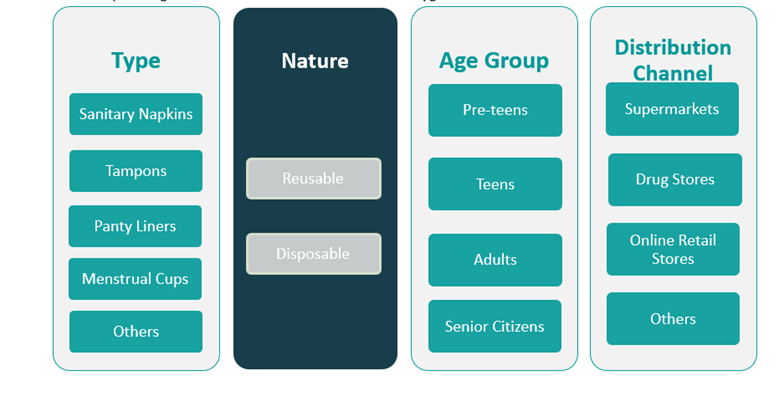
Market Drivers:
Increased Awareness and Education on Menstrual Hygiene
The growing awareness about menstrual hygiene and health is one of the primary drivers fueling the North American feminine hygiene products market. For example, Procter & Gamble’s Always brand has run the #EndPeriodPoverty campaign, partnering with organizations to donate millions of pads to schools and communities in need, directly addressing period poverty and raising public awareness. As the stigma surrounding menstruation continues to decrease, more women are embracing the use of feminine hygiene products to ensure better hygiene and comfort during their menstrual cycles. Educational campaigns from both governmental and non-governmental organizations have played a significant role in increasing awareness, leading to a shift in consumer attitudes towards menstrual health. Furthermore, there is a rising focus on educating younger generations in schools, encouraging the adoption of healthier and more sustainable hygiene practices. This heightened awareness is directly influencing the demand for feminine hygiene products, driving the market's growth across North America.
Product Innovation and Technological Advancements
Innovation in product design and technology is another crucial driver in the North American feminine hygiene products market. As consumer preferences evolve, manufacturers are responding by developing advanced, more effective products that cater to specific needs such as comfort, absorbency, and ease of use. For instance, in May 2023, KNH launched biodegradable sanitary pads made from bamboo fibers, offering rapid absorption, breathability, and bacteriostatic properties to meet the rising demand for eco-friendly options. Innovations like organic cotton pads, tampons with better absorption rates, and menstrual cups have gained significant traction, especially among eco-conscious consumers. Additionally, the development of sustainable and biodegradable products is addressing growing environmental concerns, as more women opt for products that minimize their ecological footprint. With continued technological advancements and product diversification, the market is witnessing an expanding range of options that cater to the diverse needs of women, further boosting consumer demand.
Rising Disposable Income and Changing Lifestyles
The increase in disposable income among women in North America is another vital factor contributing to the growth of the feminine hygiene products market. As women’s purchasing power continues to rise, they are more willing to invest in premium, high-quality feminine hygiene products that offer superior comfort, effectiveness, and convenience. This is particularly true for products like organic cotton pads, which often come at a higher price point. Changing lifestyles, including the growing trend of dual-income households and the rise of urban living, have also contributed to the willingness to spend more on personal care products. The ability to prioritize health and well-being in everyday life further fuels the demand for high-quality, reliable hygiene products, thereby fostering market growth in the region.
Expansion of E-commerce and Online Retail Channels
The rise of e-commerce and online retail platforms has significantly influenced the North American feminine hygiene products market. With the increasing preference for online shopping, consumers can now access a wide variety of feminine hygiene products from the comfort of their homes. E-commerce provides an enhanced shopping experience with easy comparisons of products, customer reviews, and convenient home delivery services. Subscription models, where customers receive regular shipments of hygiene products, have further bolstered the growth of the market by providing a more personalized and convenient option for busy consumers. As the online shopping trend continues to grow, it has become an essential channel for manufacturers to reach a broader audience and increase their market penetration, making feminine hygiene products more accessible than ever before.
Market Trends:
Sustainability and Eco-Friendly Products
Sustainability is a prominent trend within the North American feminine hygiene products market, as an increasing number of consumers are prioritizing environmentally friendly and sustainable alternatives. This trend is largely driven by growing awareness of environmental issues, such as plastic waste and the carbon footprint of traditional hygiene products. As a result, manufacturers are investing in eco-conscious innovations like organic cotton pads, biodegradable tampons, and menstrual cups. For example, in December 2022, Trace Femcare introduced tampons made from Climate Beneficial Cotton and regenerative hemp fiber, specifically targeting the reduction of plastic waste associated with traditional hygiene products. These products not only appeal to environmentally aware consumers but also align with broader societal shifts towards sustainability. With many brands now offering recyclable or compostable packaging, this trend reflects a wider commitment within the industry to reduce environmental impact while meeting consumer demand for sustainable options.
Personalized and Premium Products
The North American market is experiencing a shift towards more personalized and premium feminine hygiene products. As women become more discerning about their hygiene needs, they are increasingly opting for products tailored to their specific preferences. This trend includes a growing demand for organic, hypoallergenic, and chemical-free options that cater to sensitive skin or those with allergies. For instance, Knix, a Canadian apparel and intimate brand, launched a new range of period underwear in November 2023, available in sizes XS to XXXXL, capable of absorbing 0.8 to three teaspoons of liquid-equivalent to about one to three tampons or one to two panty liners-addressing the need for both inclusivity and superior absorbency. Additionally, premium products that provide added comfort, superior absorbency, and long-lasting freshness are seeing a rise in popularity. Brands that offer unique features, such as fragrance-free options or products with added wellness benefits like anti-inflammatory properties, are gaining significant market share. This trend is further influenced by a broader consumer focus on health and wellness, making premium products increasingly common in the feminine hygiene space.
Technological Integration in Product Development
Technological advancements are reshaping the development of feminine hygiene products, particularly in terms of comfort, convenience, and performance. The use of advanced materials, such as super-absorbent polymers and organic fabrics, is becoming more prevalent, allowing products to offer enhanced absorbency and leak protection. Additionally, there is a growing trend of incorporating technology into products, such as smart menstrual cups and connected devices that track menstruation cycles. These innovations enable consumers to better understand and manage their menstrual health. The integration of technology into product development is expected to accelerate as brands seek to differentiate themselves in a competitive market and meet the increasing demand for personalized, efficient solutions.
Rise of Subscription Services and Online Retail
The convenience of subscription-based services and online retail has become a significant trend within the North American feminine hygiene products market. As consumers increasingly seek convenience and a more streamlined shopping experience, subscription services that deliver products directly to consumers' doorsteps are gaining popularity. These services allow customers to personalize their delivery schedules and select products suited to their preferences. Alongside this, the growth of online retail platforms has made it easier for consumers to access a wider range of feminine hygiene products, compare brands, and make informed purchasing decisions. This trend is particularly appealing to younger consumers who prioritize convenience and flexibility in their purchasing habits. As e-commerce continues to grow, it is expected to remain a dominant force in shaping the market’s future trajectory.
Market Challenges Analysis:
High Product Costs
One of the primary challenges faced by the North American feminine hygiene products market is the high cost of premium products. Organic, eco-friendly, and hypoallergenic products often come with a significantly higher price tag compared to conventional options. While these premium products appeal to a growing segment of environmentally conscious and health-focused consumers, the cost can limit their widespread adoption. For instance, as of 2024, the average person in the U.S. spends between $120 and $180 annually on menstrual products, amounting to $4,500–$9,000 over a lifetime depending on product choice and cycle length. This price barrier poses a challenge, particularly in price-sensitive demographics, and can restrict market growth in lower-income households. Brands must balance product quality with affordability to appeal to a broader consumer base without alienating budget-conscious shoppers.
Cultural and Societal Stigma
Despite growing awareness and education efforts, menstrual stigma remains a significant challenge in some parts of North America. While the stigma surrounding menstruation has decreased over time, certain communities may still face cultural taboos that prevent open discussions about menstrual health and hygiene. This cultural barrier can result in underreporting of menstrual-related issues and hesitation to purchase feminine hygiene products. Additionally, menstrual products are still often regarded as "luxury" items, leading to affordability challenges for low-income women. These societal factors can hinder the market's ability to reach its full potential, particularly in underserved communities.
Regulatory and Safety Concerns
Regulatory and safety concerns surrounding the materials used in feminine hygiene products are another challenge for the industry. Increased consumer awareness about chemical ingredients, including concerns about the potential risks of synthetic materials, has raised the demand for more transparent labeling and safer alternatives. However, navigating the complex regulatory environment and ensuring compliance with health and safety standards can be time-consuming and costly for manufacturers. Stricter regulations or changes in safety guidelines can result in product recalls or delays in product launches, creating uncertainty for companies operating in the market.
Intense Competition and Market Saturation
The North American feminine hygiene products market is highly competitive, with numerous established brands and new entrants vying for market share. As the market matures, the level of competition has intensified, making it challenging for companies to differentiate their products. While innovation plays a key role, maintaining a competitive edge in an increasingly saturated market requires constant investment in research and development, marketing, and customer engagement. Smaller companies may struggle to compete with larger, more established brands that dominate the market, leading to consolidation and increased competition for retail space and consumer attention.
Market Opportunities:
The North American feminine hygiene products market presents significant growth opportunities, particularly in the demand for sustainable and eco-friendly products. As environmental awareness continues to rise, consumers are increasingly shifting towards organic, biodegradable, and reusable products such as menstrual cups, organic cotton pads, and tampons. This growing demand for environmentally conscious alternatives offers an opportunity for companies to capitalize on a more sustainable product line, catering to a consumer base that prioritizes eco-friendliness. Brands that invest in developing green technologies and offer products with minimal environmental impact are well-positioned to capture a larger market share in the coming years.
Furthermore, the rising focus on personalized health and wellness presents a lucrative opportunity for brands to innovate within the market. With consumers becoming more discerning about their hygiene needs, there is an increasing demand for products tailored to specific requirements, such as hypoallergenic, chemical-free, and fragrance-free options. The integration of technology into products, such as smart menstrual cups or cycle-tracking apps, also offers an opportunity for manufacturers to expand their product offerings and meet the growing demand for personalization. By capitalizing on these emerging trends, companies can not only cater to the evolving needs of consumers but also establish strong brand loyalty in an increasingly competitive market.
Market Segmentation Analysis:
The North American feminine hygiene products market is segmented by type, nature, age group, and distribution channel, each influencing consumer preferences and market dynamics.
By type, sanitary napkins dominate the market, driven by their widespread use and convenience. Tampons are also a popular choice, particularly among active consumers, while panty liners cater to daily hygiene needs. Menstrual cups have gained traction in recent years, driven by the growing trend towards sustainable and reusable products. Other products in this segment include feminine wipes and organic alternatives, appealing to eco-conscious consumers.
By nature, the market is split between reusable and disposable products. Disposable products such as sanitary napkins, tampons, and panty liners continue to be the most commonly used, due to their convenience and widespread availability. However, reusable products, particularly menstrual cups and washable cloth pads, are gaining popularity as consumers become more environmentally conscious and seek long-term cost-effective solutions.
By age group reveals distinct preferences, with pre-teens and teens opting for sanitary napkins and panty liners due to ease of use. Adults make up the largest consumer base, with a growing preference for tampons and menstrual cups. Senior citizens, on the other hand, often prefer products with added comfort and absorbency, such as sanitary napkins designed for sensitive skin.
By distribution channels, supermarkets and drug stores continue to be dominant, offering convenient access to products. However, online retail stores are gaining traction, providing consumers with the convenience of home delivery and a wider product selection.
Segmentation:
By Type
- Sanitary Napkins
- Tampons
- Panty Liners
- Menstrual Cups
- Others
By Nature
- Reusable
- Disposable
By Age-Group
- Pre-teens
- Teens
- Adults
- Senior Citizens
By Distribution Channel
- Supermarkets
- Drug Stores
- Online Retail Stores
- Others
Regional Analysis:
The North American feminine hygiene products market is primarily dominated by the United States, which holds the largest market share within the region, followed by Canada. The overall market is witnessing steady growth, driven by increasing consumer awareness, higher disposable income, and the rising demand for sustainable products. The U.S. market, accounting for approximately 80% of the total North American market share, plays a crucial role in driving product innovations and market trends, including the rise of organic and eco-friendly products.
In the United States, the demand for feminine hygiene products is fueled by various factors, including the growing focus on health and wellness, as well as the increasing shift towards sustainable alternatives. The country has witnessed a significant rise in the popularity of menstrual cups, organic cotton pads, and eco-friendly tampons. Additionally, legislative actions promoting menstrual health have had a positive impact, including initiatives to provide free menstrual products in schools and public spaces. These measures, combined with heightened consumer awareness, are expected to continue driving market growth in the U.S.
Canada, while accounting for a smaller share of the market compared to the U.S., has seen a steady rise in the demand for feminine hygiene products, especially those that are sustainable and health-conscious. Canada’s market growth is influenced by increasing disposable incomes and an active government push towards menstrual equity. The Canadian government’s support for initiatives that make feminine hygiene products more accessible, particularly for low-income women, further contributes to the market's expansion. As a result, Canada is expected to experience a steady growth rate, with increasing adoption of reusable and organic hygiene products.
Regional disparities in product demand also exist between urban and rural areas. Urban areas in both the U.S. and Canada show a higher inclination towards premium, eco-friendly products, while rural regions tend to favor more traditional, disposable products due to lower availability of specialized items. The ongoing expansion of e-commerce platforms also bridges this gap, providing consumers in rural areas with access to a wide range of feminine hygiene products.
Key Player Analysis:
- Johnson & Johnson
- Procter & Gamble
- Kimberly-Clark
- Essity Aktiebolag
- Kao Corporation
- Daio Paper Corporation
- Unicharm Corporation
- Premier FMCG
- Ontex
- Hengan International Group Company Ltd
- Drylock Technologies
- Natracare LLC
- First Quality Enterprises, Inc
- Bingbing Paper Co., Ltd
Competitive Analysis:
The North American feminine hygiene products market is highly competitive, with several key players dominating the landscape. Major brands such as Procter & Gamble (with its Always brand), Kimberly-Clark (Huggies and Kotex), and Johnson & Johnson (with its Stayfree brand) lead the market, owing to their strong brand recognition, wide distribution networks, and extensive product portfolios. These companies continually innovate, focusing on enhanced comfort, absorbency, and sustainability to meet the evolving needs of consumers. Smaller, eco-conscious brands like DivaCup and Organic Initiative are gaining ground by catering to the growing demand for organic, biodegradable, and reusable products. They differentiate themselves through their focus on sustainability and environmental responsibility. The competitive pressure in this market is intensified by the rise of e-commerce, allowing both established and new players to reach a wider audience. As sustainability becomes a central consumer concern, brands that prioritize eco-friendly solutions are positioned to gain a competitive advantage.
Recent Developments:
- In May 2024, Carefree expanded its feminine care portfolio in North America by introducing new pads alongside its existing liners, reflecting the brand’s commitment to meeting evolving consumer needs for comfort and innovation in feminine hygiene products.
- In 2024, Compass Diversified (CODI) made a significant move by investing USD 380 million to acquire The Honey Pot Company, a well-known feminine care brand available in over 33,000 U.S. retail stores. This acquisition is designed to accelerate The Honey Pot Company’s nationwide expansion by leveraging CODI’s resources and distribution network.
- In Feb 2022, Kimberly-Clark Corporation completed its acquisition of a controlling interest in Thinx, Inc., a leader in reusable period and incontinence underwear. This strategic acquisition allows Kimberly-Clark to broaden its product portfolio and capitalize on the increasing demand for sustainable feminine hygiene solutions in North America
Market Concentration & Characteristics:
The North American feminine hygiene products market is characterized by a high level of concentration, with a few dominant players commanding significant market share. Procter & Gamble (P&G), Kimberly-Clark, and Edgewell Personal Care are among the leading companies in this sector. P&G's brands, such as Always and Tampax, hold substantial market shares, benefiting from strong brand recognition and extensive distribution networks. Kimberly-Clark's Kotex and Huggies brands also maintain a significant presence, while Edgewell's Playtex competes in the tampon and feminine care segments. These companies leverage economies of scale, extensive marketing campaigns, and established retail partnerships to maintain their market positions. Despite the dominance of these major players, the market exhibits characteristics of increasing fragmentation. This is driven by a growing consumer preference for sustainable and organic products, leading to the emergence of niche brands that cater to eco-conscious consumers. Companies like Thinx and DivaCup have capitalized on this trend, offering reusable and environmentally friendly alternatives to traditional disposable products. Additionally, the rise of e-commerce has facilitated the entry of smaller brands into the market, allowing them to reach a broader audience without the need for extensive physical retail infrastructure. This shift towards sustainability and online retail is reshaping the competitive landscape, providing consumers with more diverse options and encouraging innovation within the industry
Report Coverage:
The research report offers an in-depth analysis based on Type, Nature, Age-Group and Distribution Channel. It details leading market players, providing an overview of their business, product offerings, investments, revenue streams, and key applications. Additionally, the report includes insights into the competitive environment, SWOT analysis, current market trends, as well as the primary drivers and constraints. Furthermore, it discusses various factors that have driven market expansion in recent years. The report also explores market dynamics, regulatory scenarios, and technological advancements that are shaping the industry. It assesses the impact of external factors and global economic changes on market growth. Lastly, it provides strategic recommendations for new entrants and established companies to navigate the complexities of the market.
Future Outlook:
- The North American feminine hygiene products market is expected to grow at a steady pace, driven by increasing awareness of menstrual health and hygiene.
- Demand for sustainable and eco-friendly products, including organic cotton pads and menstrual cups, will continue to rise as consumers prioritize environmental responsibility.
- Innovation in product features, such as enhanced absorbency, comfort, and hypoallergenic properties, will shape consumer choices.
- Reusable products are forecasted to see higher adoption due to growing environmental concerns and cost-efficiency.
- E-commerce and online retail platforms will become increasingly dominant, offering convenient access and personalized shopping experiences.
- Expansion in subscription-based services for regular product delivery will cater to consumer demand for convenience.
- Government and nonprofit initiatives to provide free menstrual products in public spaces will drive accessibility and demand.
- Consumer preference for premium products will increase as disposable income and health-conscious behavior rise.
- The competitive landscape will become more fragmented with the emergence of niche, eco-friendly brands targeting environmentally conscious consumers.
- The market will see greater regulatory focus on product safety and transparency, especially regarding ingredient labeling and environmental impact.

Request a Free Sample
Fill in your details and we'll send you a free sample report.
- Sample data tables & charts
- Research methodology
Market Dynamics
Increased Awareness and Education on Menstrual Hygiene
Educational campaigns and reduced stigma around menstruation have led to higher adoption of feminine hygiene products, especially as schools and organizations promote menstrual health and provide free products to underserved populations.
Product Innovation and Technological Advancements
Manufacturers are introducing organic, biodegradable, and highly absorbent products, catering to health-conscious and eco-friendly consumers, which expands the market by meeting evolving consumer preferences.
Rising Disposable Income and Changing Lifestyles
Higher disposable incomes and urbanization have led consumers to prioritize premium, high-quality feminine hygiene products, increasing overall market value and shifting demand toward comfort and performance.
Expansion of E-commerce and Online Retail Channels
The growth of online retail and subscription services has made feminine hygiene products more accessible, offering convenience, privacy, and a broader product selection, thus driving market penetration across diverse consumer segments.
Government and Nonprofit Initiatives for Menstrual Equity
Policies and programs providing free menstrual products in schools and public spaces in the U.S. and Canada have improved accessibility and affordability, directly boosting market demand and supporting underserved communities.
Need a Custom Version of This Report?
Tailor the scope, geography, or segments to your exact requirements.
- Custom geography or segment scope
- Direct access to our analyst team
Frequently Asked Questions
What is the current market size of the North America Feminine Hygiene Products market?
What factors are driving the growth of the North America Feminine Hygiene Products market?
What are some challenges faced by the North America Feminine Hygiene Products market?
Who are the major players in the North America Feminine Hygiene Products Market?
Table of Content
Chapter 1 Market Segmentation
- 1.1 Segmentation Framework
- 1.1.1 Product and Service Classification
- 1.1.2 Application and End-Use Classification
- 1.1.3 Technology and Solution Classification
- 1.1.4 Customer and Distribution Channel Classification
- 1.1.5 Geographic Segmentation
- 1.1.6 Market Segment Definitions and Boundaries
- 1.2 By Type
- 1.2.1 Sanitary Napkins
- 1.2.2 Tampons
- 1.2.3 Panty Liners
- 1.2.4 Menstrual Cups
- 1.2.5 Others
- 1.3 By Nature
- 1.3.1 Reusable
- 1.3.2 Disposable
- 1.4 By Age-Group
- 1.4.1 Pre-teens
- 1.4.2 Teens
- 1.4.3 Adults
- 1.4.4 Senior Citizens
Chapter 2 Introduction
- 2.1 Report Objectives and Scope
- 2.2 Product Definition and Industry Terminology
- 2.3 Market Inclusions and Exclusions
- 2.4 Research Process
- 2.4.1 Primary Research and Expert Interviews
- 2.4.2 Secondary Research and Source Review
- 2.4.3 Top-Down and Bottom-Up Estimation
- 2.4.4 Data Triangulation and Verification
- 2.5 Market Size Measurement Basis
- 2.5.1 2023: USD 8,244.99 million → 2032: USD 15,316.17 million
- 2.6 Historical and Forecast Reference Periods
- 2.6.1 Base Year: 2023
- 2.6.2 Forecast Period: 2023-2032
- 2.7 Research Assumptions and Limitations
Chapter 3 Executive Summary
- 3.1 Market Snapshot and Key Findings
- 3.2 Base-Year Market Size, 2023
- 3.3 Forecast Market Size, 2032
- 3.4 Revenue and Volume Growth Outlook
- 3.5 Key Demand and Supply Indicators
- 3.6 Leading Market Segments
- 3.7 Fastest-Growing Market Opportunities
- 3.8 Regional Performance Highlights
- 3.9 Technology and Industry Transformation
- 3.10 Competitive Landscape Summary
- 3.11 Analyst View and Strategic Implications
Chapter 4 North America Feminine Hygiene Products Market Trends and Developments
- 4.1 Historical Industry Development
- 4.2 Recent Market Trends and Developments
- 4.3 Demand and Customer Behavior Trends
- 4.4 Technology and Product Innovation
- 4.5 Artificial Intelligence, Automation and Digitalization
- 4.6 Local Manufacturing and Supply Chain Realignment
- 4.7 Industry Partnerships, Mergers and Acquisitions
- 4.8 Sustainability and Circular Economy Developments
- 4.9 Government and Private Sector Investment Trends
- 4.10 Emerging Business Models and Commercialization
- 4.11 Industry Developments and Announcements
Chapter 5 North America Feminine Hygiene Products Market Production, Supply and Demand Analysis
- 5.1 Demand Trend and Consumption Analysis
- 5.2 Demand Forecast, 2023-2032
- 5.3 Production and Output Trend
- 5.4 Production and Output Forecast, 2023-2032
- 5.5 Installed Capacity and Capacity Utilization
- 5.6 Company-Wise Production Plants and Statistics
- 5.6.1 Installed Production Capacity
- 5.6.2 Actual Production
- 5.6.3 Planned Capacity and Expansion Targets
- 5.7 Supply Chain Structure and Procurement Trends
- 5.8 Supply-Demand Gap and Bottlenecks
- 5.9 Import Dependence and Sourcing Structure
- 5.10 Contract Manufacturing and Outsourcing
- 5.11 Regional Supply and Demand Concentration
Chapter 6 North America Feminine Hygiene Products Market Pricing Analysis
- 6.1 Pricing Structure and Measurement
- 6.2 Historical Pricing Trends
- 6.3 Pricing Outlook, 2023-2032
- 6.4 Average Selling Price and Unit Economics
- 6.5 Pricing by Product and Market Segment
- 6.6 Geographic Pricing Differences
- 6.7 Key Input, Energy, Labor and Logistics Costs
- 6.8 Contract Pricing and Purchasing Models
- 6.9 Pricing Sensitivity and Competitive Positioning
- 6.10 Price, Margin and Profitability Implications
Chapter 7 North America Feminine Hygiene Products Market Dynamics
- 7.1 Market Growth Drivers
- 7.1.1 Demand-Side Drivers
- 7.1.2 Technology and Innovation Drivers
- 7.1.3 Infrastructure and Investment Drivers
- 7.1.4 Regulatory and Policy Drivers
- 7.2 Market Restraints
- 7.2.1 Cost and Affordability Constraints
- 7.2.2 Technology and Adoption Barriers
- 7.2.3 Supply Chain and Operational Constraints
- 7.3 Market Challenges
- 7.3.1 Competitive Pressure and Margin Erosion
- 7.3.2 Skills, Infrastructure and Implementation Gaps
- 7.4 Emerging Market Opportunities
- 7.5 Market Dynamics Impact and Time-Horizon Assessment
Chapter 8 North America Feminine Hygiene Products Value Chain Analysis
- 8.1 Industry Value Chain Overview
- 8.2 Upstream Suppliers and Critical Inputs
- 8.3 Technology and Component Providers
- 8.4 Manufacturing or Service Delivery
- 8.5 Distribution, Channel Partners and Integrators
- 8.6 Downstream Applications and End Users
- 8.7 Value Addition and Profit Pools
- 8.8 Vertical Integration and Outsourcing
- 8.9 Supplier Concentration and Risk
- 8.10 Supply Chain Localization and Resilience
Chapter 9 North America Feminine Hygiene Products Market Regulations and Policies
- 9.1 Relevant Laws, Standards and Compliance Frameworks
- 9.2 Product, Service, Safety and Quality Requirements
- 9.3 Government Policies, Incentives and Subsidies
- 9.4 Imports, Exports and Trade Barriers
- 9.5 Public Procurement and Local Content Requirements
- 9.6 Environmental and Sustainability Compliance
- 9.7 Upcoming Policy Changes and Market Implications
Chapter 10 North America Feminine Hygiene Products Market Hotspots and Opportunities
- 10.1 Market Opportunity Mapping and Growth Hotspots
- 10.2 High-Growth Applications and Customer Groups
- 10.3 Underserved Markets and White-Space Opportunities
- 10.4 Emerging Technology and Product Opportunities
- 10.5 New Capacity and Investment Hotspots
- 10.6 Market Entry and Expansion Opportunities
- 10.7 Distribution and Partnership Opportunities
- 10.8 Near-Term and Long-Term Commercial Potential
- 10.9 Opportunity Attractiveness and Execution Risks
Chapter 11 North America Feminine Hygiene Products Market Outlook, 2023-2032
- 11.1 Market Size and Analysis
- 11.1.1 Revenue (Market Measurement: 2023: USD 8,244.99 million → 2032: USD 15,316.17 million)
- 11.1.2 Market Volume and Quantity Sold
- 11.1.3 Historical Market Size
- 11.1.4 Base-Year Market Size, 2023
- 11.2 Market Forecast, 2023-2032
- 11.2.1 Revenue Forecast to 2032
- 11.2.2 Volume Forecast to 2032
- 11.2.3 CAGR and Year-on-Year Growth
- 11.2.4 Incremental Revenue Opportunity
- 11.3 Forecast Assumptions and Scenario Analysis
- 11.3.1 Base-Case Forecast
- 11.3.2 Optimistic and Conservative Scenarios
- 11.3.3 Technology, Pricing and Policy Sensitivities
- 11.4 Market Attractiveness and Growth Outlook
Chapter 12 North America Feminine Hygiene Products Market Segmentation and Outlook
- 12.1 Segmentation Summary and Market Shares, 2023
- 12.2 Largest and Fastest-Growing Segments
- 12.3 By Type - Market Size and Forecast, 2023-2032
- 12.3.1 Segment Definition and Scope
- 12.3.2 Historical Market Size
- 12.3.3 Revenue Forecast, 2023-2032
- 12.3.4 Volume Forecast, 2023-2032
- 12.3.5 Base-Year Market Share, 2023
- 12.3.6 Segment CAGR and Growth Drivers
- 12.3.7 Subsegment Market Size and Forecast
- 12.3.7.1 Sanitary Napkins
- 12.3.7.2 Tampons
- 12.3.7.3 Panty Liners
- 12.3.7.4 Menstrual Cups
- 12.3.7.5 Others
- 12.3.8 Subsegment Pricing and Adoption Trends
- 12.3.9 Leading Suppliers and Competition
- 12.3.10 Regional Demand and Opportunities
- 12.4 By Nature - Market Size and Forecast, 2023-2032
- 12.4.1 Segment Definition and Scope
- 12.4.2 Historical Market Size
- 12.4.3 Revenue Forecast, 2023-2032
- 12.4.4 Volume Forecast, 2023-2032
- 12.4.5 Base-Year Market Share, 2023
- 12.4.6 Segment CAGR and Growth Drivers
- 12.4.7 Subsegment Market Size and Forecast
- 12.4.7.1 Reusable
- 12.4.7.2 Disposable
- 12.4.8 Subsegment Pricing and Adoption Trends
- 12.4.9 Leading Suppliers and Competition
- 12.4.10 Regional Demand and Opportunities
- 12.5 By Age-Group - Market Size and Forecast, 2023-2032
- 12.5.1 Segment Definition and Scope
- 12.5.2 Historical Market Size
- 12.5.3 Revenue Forecast, 2023-2032
- 12.5.4 Volume Forecast, 2023-2032
- 12.5.5 Base-Year Market Share, 2023
- 12.5.6 Segment CAGR and Growth Drivers
- 12.5.7 Subsegment Market Size and Forecast
- 12.5.7.1 Pre-teens
- 12.5.7.2 Teens
- 12.5.7.3 Adults
- 12.5.7.4 Senior Citizens
- 12.5.8 Subsegment Pricing and Adoption Trends
- 12.5.9 Leading Suppliers and Competition
- 12.5.10 Regional Demand and Opportunities
- 12.6 Segment Growth Comparison
- 12.7 Segment Attractiveness and Priority Matrix
Chapter 13 North America Feminine Hygiene Products Geographic Market Outlook, 2023-2032
- 13.1 Regional Market Size and Country-Level Shares, 2023
- 13.2 Country Market Size Comparison, 2023
- 13.3 Country Market Forecasts, 2023-2032
- 13.4 Subregional Industrial and Demand Clusters
- 13.5 Intra-Regional Pricing and Cost Differences
- 13.6 Cross-Border Trade and Supply Networks
- 13.7 Regional Supply and Demand Balances
- 13.8 Country Opportunity Comparison and Prioritization
Note: Every listed country is covered on the structure shown under the first country.
Chapter 14 North America Feminine Hygiene Products Technology, Innovation and Sustainability Outlook
- 14.1 Technology Landscape and Maturity
- 14.2 Product, Process and Service Innovation
- 14.3 AI, Automation and Digital Tools in the Industry
- 14.4 Technology Adoption and Performance Benchmarking
- 14.5 Innovation Pipeline and R&D Investment
- 14.6 Patent and Intellectual Property Trends
- 14.7 Energy Efficiency and Resource Management
- 14.8 Sustainability, Recycling and Circularity
- 14.9 Technology Roadmap, 2023-2032
- 14.10 Risks of Obsolescence and Technology Substitution
Chapter 15 North America Feminine Hygiene Products Market Key Strategic Imperatives
- 15.1 Growth and Market Entry Priorities
- 15.2 High-Return Products and Segments
- 15.3 Pricing, Profitability and Cost Optimization
- 15.4 Technology Investment and Product Differentiation
- 15.5 Supply Chain Localization and Resilience
- 15.6 Distribution and Customer Acquisition
- 15.7 Partnership, Acquisition and Capacity Strategy
- 15.8 Regional Expansion Priorities
- 15.9 Short-, Medium- and Long-Term Actions
Chapter 16 Competition Outlook
- 16.1 Industry Competition Characteristics
- 16.2 Market Structure and Concentration
- 16.3 Market Share and Competitive Positioning, 2023
- 16.4 Company-Wise Revenue and Product Benchmarking
- 16.5 Production and Service Capacity Benchmarking
- 16.6 Technology, Pricing and Differentiation
- 16.7 Regional Footprint and Distribution Strength
- 16.8 Mergers, Acquisitions and Strategic Alliances
- 16.9 New Entrants and Competitive Threats
- 16.10 Porter's Five Forces and Industry Attractiveness
- 16.11 Competitive Outlook, 2023-2032
Chapter 17 Company Profiles
- 17.1 Company Coverage and Selection Criteria
- 17.2 Procter & Gamble
- 17.2.1 Business Description
- 17.2.2 Company Ownership and Geographic Presence
- 17.2.3 Product and Service Portfolio
- 17.2.4 Manufacturing and Operating Footprint
- 17.2.5 Production Capacity and Expansion Plans
- 17.2.6 Financial Performance and Investment
- 17.2.7 Market Share and Competitive Position
- 17.2.8 Technology and Innovation Capabilities
- 17.2.9 Strategic Alliances or Partnerships
- 17.2.10 Recent Developments
- 17.2.11 Growth Strategy and Outlook
- 17.3 Kimberly-Clark
- 17.4 Johnson & Johnson
- 17.5 Essity Aktiebolag
- 17.6 Kao Corporation
- 17.7 Unicharm Corporation
- 17.8 Daio Paper Corporation
- 17.9 Ontex
- 17.10 First Quality Enterprises, Inc
- 17.11 Natracare LLC
- 17.12 Other Relevant Market Participants
Note: Every listed company is profiled on the structure shown under the first company. The company list is preliminary and may change based on research findings, market developments, data availability and client requirements.
Chapter 18 Disclaimer
- 18.1 Research and Forecast Disclaimer
- 18.2 Data Source and Estimation Limitations
Note: The depth of individual sections depends on data availability for this market. Volume, capacity, trade and other unit-based metrics are included where applicable.

