
| REPORT ATTRIBUTE | DETAILS |
|---|---|
| Historical Period | 2020-2023 |
| Base Year | 2024 |
| Forecast Period | 2025-2032 |
| North America Mining Simulation Software Market Size 2023 | USD 877.50 Million |
| North America Mining Simulation Software Market, CAGR | 8.52% |
| North America Mining Simulation Software Market Size 2032 | USD 1,831.99 Million |
Market Overview:
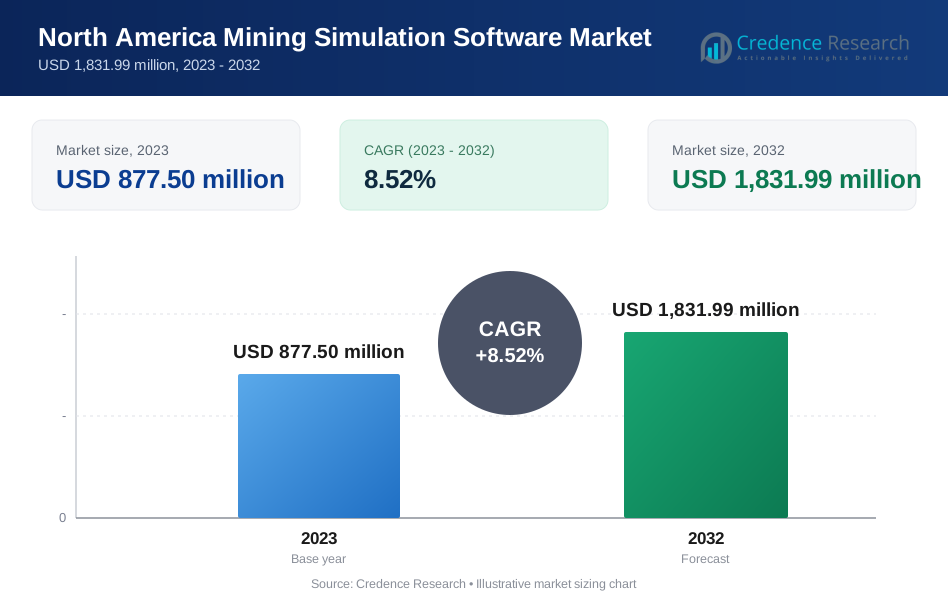
North America Mining Simulation Software Market size was valued at USD 877.50 million in 2023 and is anticipated to reach USD 1,831.99 million by 2032, at a CAGR of 8.52% during the forecast period (2023-2032).
The growth of the North American mining simulation software market is primarily driven by several key factors. Technological advancements, such as the integration of artificial intelligence (AI), machine learning, and virtual reality (VR), enable more accurate modeling and immersive training experiences, which significantly improve decision-making and operational efficiency. Additionally, mining companies are increasingly adopting simulation software to enhance safety and risk management. These tools allow operators to simulate hazardous scenarios and assess risks in a controlled environment, thus reducing workplace accidents and improving regulatory compliance. Furthermore, the need for operational efficiency drives the adoption of simulation software, as it optimizes resource allocation, equipment utilization, and production schedules, leading to cost reductions and increased productivity. The growing emphasis on environmental sustainability also plays a pivotal role in the market's expansion.
North America is the dominant region in the mining simulation software market, driven by a well-established mining industry and significant investments in digital transformation. The United States leads this growth, with its strong focus on automation, process optimization, and advanced technology adoption. In Canada, the growing emphasis on sustainable mining practices and technological innovation is further fueling the demand for simulation software. Meanwhile, Mexico is also showing an upward trend in adopting these tools, spurred by the expansion of mining activities and the need for improved operational efficiency. The region benefits from a robust ecosystem of leading technology providers such as Hexagon AB, Dassault Systèmes, and Maptek, which offer specialized solutions to address the unique challenges faced by the mining industry. This combination of technological adoption, investment in automation, and a commitment to sustainability positions North America as a key player in the global mining simulation software market.
Market Insights:
- The North American mining simulation software market is projected to grow significantly, with the market size anticipated to reach USD 1,831.99 million by 2032, driven by key factors such as technological advancements and operational needs.
- The global mining simulation software market was valued at approximately USD 2.5 billion in 2023 and is projected to reach over USD 5.25 billion by 2032, reflecting a compound annual growth rate (CAGR) of 8.6% during the forecast period.
- AI, machine learning, and virtual reality (VR) are transforming the mining simulation landscape, enabling better decision-making, predictive maintenance, and immersive training experiences, which are increasing the adoption of these technologies.
- Mining companies are increasingly using simulation software to improve safety by modeling hazardous scenarios and testing safety measures, thus reducing workplace accidents and enhancing regulatory compliance.
- Operational efficiency and cost reduction remain a priority, with simulation tools optimizing resource allocation, equipment usage, and production schedules, which helps minimize downtime and maximize productivity.
- As environmental sustainability becomes a central focus, mining simulation software allows companies to model and mitigate environmental impacts, such as water contamination and habitat destruction, aligning with stringent regulatory standards.
- The United States is the largest contributor to the market, with significant investments in automation and process optimization, followed by Canada, which focuses on sustainable mining practices.
- The growing adoption of simulation software is also observed in Mexico, where mining activities are expanding, and the need for operational efficiency and technological innovation is on the rise.
Market Drivers:
Technological Advancements
One of the primary drivers of the North American mining simulation software market is the rapid advancement of technology. The integration of artificial intelligence (AI), machine learning, and virtual reality (VR) into mining simulation software is transforming how operations are modeled, planned, and executed. For example, companies such as MOSIMTEC provide simulation tools that allow users to simulate years of mine operations within minutes, enabling scenario management, 2D/3D mine layout editing, and rapid data analysis for both open-pit and underground mines. These technologies allow mining companies to simulate complex environments and scenarios with high accuracy, enabling better decision-making and operational planning. AI and machine learning algorithms enhance predictive capabilities, enabling operators to foresee equipment failures, optimize resource allocation, and improve maintenance schedules. Additionally, VR facilitates immersive training environments, helping workers understand equipment operation and safety protocols in a controlled, risk-free setting. The continuous evolution of these technologies will further drive the adoption of mining simulation software in North America.
Enhanced Safety and Risk Management
Safety remains a top priority in the mining industry, and mining simulation software plays a crucial role in enhancing safety protocols. For example, mining simulation platforms allow workers to practice standard operating procedures (SOPs) for emergencies, such as evacuations, under realistic underground conditions using augmented and virtual reality systems. By allowing operators to simulate hazardous scenarios, these tools help identify potential risks and prepare appropriate mitigation strategies without exposing workers to actual danger. This capability is especially important in underground and high-risk mining operations, where safety concerns are paramount. Furthermore, the ability to model emergency situations enables operators to test responses and refine safety measures, ensuring quicker and more effective reactions during real-world crises. As safety regulations become more stringent across North America, the need for advanced simulation tools to support compliance and risk management is expected to grow, further driving the demand for mining simulation software.
Operational Efficiency and Cost Reduction
Mining companies are under constant pressure to improve efficiency and reduce operational costs. Simulation software helps achieve both objectives by optimizing mining processes, equipment utilization, and production schedules. By creating accurate digital twins of mining environments, companies can simulate and test different operational scenarios to determine the most efficient workflows, resource allocation, and equipment deployment strategies. This reduces the need for trial and error in real-world conditions, which can be costly and time-consuming. Additionally, simulation software allows for better management of mining cycles, which helps minimize downtime and maximize productivity. With increasing pressure on the mining industry to reduce costs while improving output, mining simulation software provides a valuable solution to streamline operations and enhance profitability.
Environmental Sustainability and Compliance
As environmental concerns continue to rise, mining companies are under increasing pressure to adopt sustainable practices and comply with regulatory standards. Mining simulation software assists in meeting these challenges by enabling companies to model the environmental impacts of their operations before implementing them. By simulating the potential effects of various mining practices, companies can identify and mitigate negative environmental impacts, such as water contamination, soil erosion, and habitat destruction. This capability is especially critical in North America, where environmental regulations are stringent and continuously evolving. The growing emphasis on sustainability in the mining sector, coupled with the need to meet regulatory requirements, makes mining simulation software an essential tool for companies seeking to improve their environmental performance and reduce their ecological footprint.
Market Trends:
Integration of Cloud-Based Solutions
A significant trend in the North American mining simulation software market is the increasing integration of cloud-based solutions. For example, Symboticware, based in Ontario, has developed the SymBot® platform, which enables real-time data collection and remote access to mining equipment information, allowing teams to collaborate across multiple sites and improve decision-making. Cloud computing offers several advantages over traditional on-premise systems, including reduced infrastructure costs, easier scalability, and enhanced collaboration. Mining companies can now access simulation software remotely, making it easier to deploy across multiple sites, especially for multinational operations. This flexibility allows teams to collaborate in real-time, regardless of location, ensuring that the latest data is accessible to all stakeholders. Additionally, cloud-based solutions support better data storage and analysis, helping mining companies leverage large datasets to improve operational efficiency and make more informed decisions. As more companies migrate to cloud environments, this trend is expected to drive further adoption of mining simulation software in the region.
Increased Focus on Real-Time Data Integration
Another key trend in the North American mining simulation software market is the growing emphasis on integrating real-time data into simulation models. Traditionally, simulation software relied on static data sets for creating models and predicting outcomes. For instance, Rio Tinto’s Kennecott mine in Utah uses NB-IoT technology to monitor equipment health and environmental conditions, providing actionable real-time data on air quality and structural integrity, which supports predictive maintenance and improves safety. However, with advancements in Internet of Things (IoT) technologies and sensors, real-time data can now be incorporated into simulations, providing more dynamic and accurate insights. For instance, real-time data on equipment performance, environmental conditions, and operational metrics can be used to adjust simulation models and predict potential failures or bottlenecks. This integration of live data allows for proactive decision-making and helps mining companies respond more quickly to changes on the ground, improving both efficiency and safety.
Adoption of Digital Twins
The concept of digital twins is rapidly gaining traction in the mining simulation software market. A digital twin is a virtual replica of a physical mining asset, such as a machine, equipment, or entire mining operation. By using digital twins, mining companies can simulate the performance of physical assets in real-time, predict maintenance needs, and optimize operations. This trend is driven by the need for more precise, data-driven management of mining operations, especially in high-risk environments where downtime can be costly. Digital twins allow for continuous monitoring and analysis, providing mining companies with actionable insights to improve efficiency and extend the lifecycle of critical assets. As the technology becomes more refined, the adoption of digital twins in North American mining operations is expected to grow, further enhancing the role of simulation software in the industry.
Shift Toward Autonomous Mining Operations
The North American mining industry is increasingly shifting toward autonomous mining operations, and simulation software plays a pivotal role in this transition. Autonomous mining vehicles, drills, and equipment are becoming more common, offering increased efficiency, reduced labor costs, and improved safety. Simulation software is essential for designing, testing, and optimizing autonomous systems before they are deployed in real-world environments. It enables mining companies to simulate the behavior of autonomous machines in various scenarios, ensuring they can operate safely and efficiently without human intervention. As the adoption of autonomous technologies expands, mining simulation software will be integral in supporting this evolution, helping companies achieve greater automation while minimizing risks associated with the integration of new technologies.
Market Challenges Analysis:
High Initial Investment Costs
One of the key restraints in the North American mining simulation software market is the high initial investment required for advanced simulation technologies. While these tools offer significant long-term benefits in terms of operational efficiency and safety, the upfront costs associated with purchasing, implementing, and maintaining the software can be substantial. For instance, HAULSIM, a specialized mine haulage simulation platform, offers enterprise licenses tailored for large-scale operations, but pricing is custom and often requires direct consultation, making it challenging for smaller companies to budget for adoption. For many mining companies, particularly small to mid-sized operations, the high costs of acquiring cutting-edge simulation software may limit adoption. Additionally, the need for specialized hardware and infrastructure to support these systems can further increase the financial burden, slowing down the widespread deployment of such technologies across the industry.
Complexity of Software Integration
The complexity of integrating mining simulation software with existing mining operations and legacy systems presents another challenge. Many mining companies rely on older technologies that may not be compatible with modern simulation tools, leading to integration difficulties. The process of transitioning to advanced simulation systems often requires significant modifications to current workflows, retraining of personnel, and ensuring data compatibility across multiple platforms. These integration challenges can cause delays in implementation and add additional costs, which may deter some companies from fully adopting simulation software. Furthermore, the ongoing support required for smooth integration may strain internal resources.
Data Security and Privacy Concerns
As mining simulation software increasingly relies on cloud-based solutions, data security and privacy concerns have become a significant challenge. With sensitive operational data being stored and accessed remotely, mining companies face potential risks related to data breaches, cyber-attacks, or unauthorized access. Protecting critical operational and environmental data is essential for ensuring compliance with industry regulations and safeguarding proprietary business information. As the adoption of cloud-based solutions grows, companies must invest in robust cybersecurity measures to mitigate these risks and maintain trust with stakeholders.
Lack of Skilled Workforce
A shortage of skilled personnel capable of using and maintaining advanced mining simulation software is another barrier to widespread adoption. Simulation software requires specialized knowledge in both mining operations and software systems, and there is a limited pool of professionals with the required expertise. The need for continuous training and the difficulty of attracting qualified personnel can slow the implementation and utilization of these tools, limiting their effectiveness in improving mining operations.
Market Opportunities:
The North American mining simulation software market presents several growth opportunities driven by the increasing adoption of advanced technologies within the mining sector. One key opportunity lies in the growing demand for digital transformation and automation across mining operations. As companies seek to improve efficiency, safety, and cost-effectiveness, the integration of simulation software into daily operations offers the potential to streamline processes, reduce downtime, and enhance resource management. The increasing use of technologies such as artificial intelligence (AI), machine learning, and real-time data analytics within simulation models further enhances these benefits, creating an opportunity for software providers to expand their market presence. By offering solutions that cater to the evolving needs of modern mining operations, companies can tap into the demand for smarter, more automated mining environments.
Additionally, the growing focus on sustainability and environmental compliance presents a significant market opportunity. Mining companies in North America are under increasing pressure to minimize their environmental impact and comply with stringent regulatory standards. Mining simulation software can play a crucial role in this by helping companies model and optimize their operations to reduce environmental risks, improve energy efficiency, and enhance resource utilization. As environmental regulations become more stringent, mining simulation software will be an essential tool for companies striving to meet compliance requirements while maintaining productivity. This shift towards greener practices offers a promising opportunity for software developers to innovate and provide solutions that support sustainable mining practices across the region.
Market Segmentation Analysis:
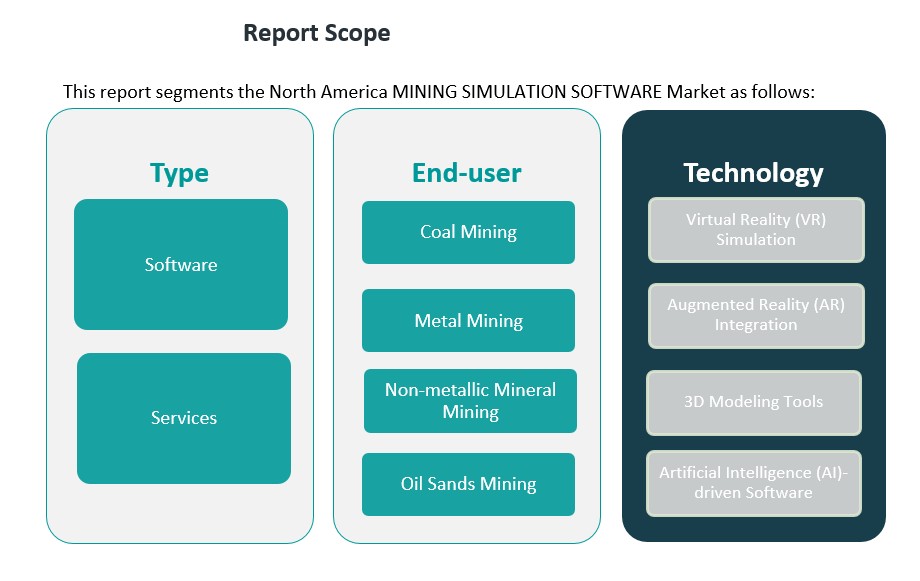
The North American mining simulation software market is segmented based on type, end-user, and technology, each catering to specific needs and driving growth within the industry.
By Type Segment
The market is primarily divided into two main categories: software and services. The software segment holds the largest share, driven by the growing demand for advanced simulation tools to enhance operational efficiency, safety, and productivity in mining operations. As mining companies continue to integrate simulation technologies into their workflows, the software segment remains essential for creating digital models and predictive simulations. The services segment, while smaller, is also growing, particularly in areas such as consulting, training, and support, which are crucial for ensuring the effective implementation and maintenance of simulation systems.
By End-User Segment
The end-user segment of the North American mining simulation software market is diverse, including coal mining, metal mining, non-metallic mineral mining, and oil sands mining. Metal mining holds the largest share, driven by the extensive use of simulation tools in optimizing processes and improving safety in this high-value sector. Non-metallic mineral mining and oil sands mining are also key contributors, with simulation software playing a significant role in streamlining operations and reducing environmental impact in these sectors. Coal mining, although facing some challenges, continues to adopt simulation technologies for operational efficiency and cost reduction.
By Technology Segment
In terms of technology, the market is witnessing significant growth in virtual reality (VR) simulation, augmented reality (AR) integration, and 3D modeling tools. These technologies offer immersive, interactive experiences that enhance training and operational planning. Additionally, artificial intelligence (AI)-driven software is increasingly being adopted for predictive maintenance and real-time decision-making, further enhancing the accuracy and efficiency of mining operations. These technologies are transforming how mining companies plan, execute, and optimize their operations.
Segmentation:
By Type Segment:
- Software
- Services
By End-User Segment:
- Coal Mining
- Metal Mining
- Non-metallic Mineral Mining
- Oil Sands Mining
By Technology Segment:
- Virtual Reality (VR) Simulation
- Augmented Reality (AR) Integration
- 3D Modeling Tools
- Artificial Intelligence (AI)-driven Software
Regional Analysis:
The North American mining simulation software market is predominantly driven by the United States, with significant contributions from Canada and, to a lesser extent, Mexico. The market dynamics in these countries are shaped by technological advancements, regulatory standards, and the growing need for operational efficiency and safety within the mining industry.
United States
The United States holds the largest market share in North America, accounting for approximately 70% of the region’s total revenue. This dominance is attributed to the country's extensive mining operations, including coal, metal, and non-metallic mineral mining. The U.S. mining sector is undergoing a digital transformation, with mining companies investing in advanced technologies such as artificial intelligence (AI), virtual reality (VR), and 3D modeling tools to enhance their operations. The growing emphasis on sustainability and environmental regulations also plays a significant role in the adoption of mining simulation software in the U.S. The country’s strong technological infrastructure and high levels of investment in innovation and research further support the rapid growth of the market.
Canada
Canada is the second-largest market in North America, contributing about 25% of the market share. The country’s mining sector is diverse, with significant operations in metal, non-metallic minerals, and oil sands mining. Canada’s commitment to sustainability and environmental stewardship is a key driver for the adoption of mining simulation software, particularly in oil sands mining, where simulation tools are used to model and reduce environmental impacts. Additionally, Canada’s mining industry is increasingly adopting automation and AI-driven technologies to improve efficiency and safety, creating a favorable environment for the growth of mining simulation software.
Mexico
Mexico holds a smaller share of the market, approximately 5%, but is expected to experience significant growth over the coming years. Mexico's mining industry, particularly in metal mining, is expanding rapidly. The increasing demand for minerals such as gold, silver, and copper is driving the need for more advanced technologies, including simulation software. As mining operations in Mexico scale up, there is a growing interest in utilizing simulation tools to optimize processes, reduce downtime, and enhance productivity. Additionally, Mexico’s mining industry is becoming more integrated with North American supply chains, increasing the demand for simulation software that supports operational efficiency and safety.
Key Player Analysis:
- Dassault Systèmes
- Bentley Systems
- RPM North America
- Hexagon Mining
- Maptek
- Siemens AG
- VIST Group
- Autodesk
- Caterpillar
- BMT Group
- Eclipse Mining Technologies
- Glencore Technology
Competitive Analysis:
The North American mining simulation software market is highly competitive, with key players focusing on technological innovation and strategic partnerships to expand their market presence. Prominent companies in the market include Hexagon AB, Dassault Systèmes, Maptek, and Vulcan. Hexagon AB is a leading player, known for its integrated simulation software that enhances operational efficiency and safety in mining operations. Dassault Systèmes offers advanced 3D modeling and simulation tools, widely adopted for their ability to optimize mine planning and reduce operational costs. Maptek, a notable competitor, provides comprehensive mining solutions, including advanced simulation tools designed for both exploration and production stages. Vulcan, with its specialized software for geospatial modeling and mine design, also contributes significantly to the market. These companies are focusing on continuous product development, technological integration, and providing customized solutions to meet the evolving demands of mining operations, driving competition in the market.
Recent Developments:
- On April 2, 2025, Hexagon completed the acquisition of the Geomagic software business from 3D Systems Corporation. This acquisition brings advanced 3D measurement, modeling, and reverse engineering capabilities to Hexagon’s portfolio, strengthening its offering across manufacturing, mining, and construction sectors. The Geomagic suite will now be integrated into Hexagon’s Manufacturing Intelligence division and supported for all existing hardware and software partners.
- In February 2025, Dassault Systèmes announced that its subsidiary, Centric Software, acquired Contentserv, an AI-powered Product Experience Management (PXM) solution provider, for €220 million. This acquisition strengthens Dassault Systèmes' digital transformation capabilities, especially in cloud-based product lifecycle management.
- In November 2024, Maptek announced early access for its new Maptek Vestrex ecosystem, a platform for automation and orchestration in mining operations. This suite includes the Maptek Data System, Compute Framework, and Orchestration Environment, providing integrated solutions for mine planning and scheduling—key for Asian mines seeking operational efficiency.
Market Concentration & Characteristics:
The North American mining simulation software market exhibits a moderate to high concentration, with several key players dominating the landscape. Companies such as Hexagon AB, Dassault Systèmes, Maptek, and Rockwell Automation lead the market, offering comprehensive simulation solutions that cater to various mining operations. These firms leverage advanced technologies like artificial intelligence (AI), virtual reality (VR), and 3D modeling to enhance the accuracy and efficiency of mining simulations. The presence of these established players fosters a competitive environment, driving continuous innovation and the development of tailored solutions to meet the evolving needs of the mining industry. The market is characterized by a high degree of innovation, with companies focusing on integrating emerging technologies to improve simulation capabilities. For instance, the incorporation of AI and machine learning algorithms enables predictive analytics, enhancing decision-making processes. Additionally, the adoption of cloud-based platforms facilitates real-time data access and collaboration across geographically dispersed teams. These technological advancements contribute to the market's growth, as mining companies increasingly recognize the value of simulation software in optimizing operations, ensuring safety, and achieving sustainability goals. However, the market also faces challenges, including the high cost of implementation and the need for specialized training, which may limit adoption among smaller enterprises.
Report Coverage:
The research report offers an in-depth analysis based on Type Segment, End-User Segment and Technology Segment. It details leading market players, providing an overview of their business, product offerings, investments, revenue streams, and key applications. Additionally, the report includes insights into the competitive environment, SWOT analysis, current market trends, as well as the primary drivers and constraints. Furthermore, it discusses various factors that have driven market expansion in recent years. The report also explores market dynamics, regulatory scenarios, and technological advancements that are shaping the industry. It assesses the impact of external factors and global economic changes on market growth. Lastly, it provides strategic recommendations for new entrants and established companies to navigate the complexities of the market.
Future Outlook:
- The North American mining simulation software market is expected to experience sustained growth, driven by the increasing digitalization of mining operations.
- Advancements in AI and machine learning will enhance predictive analytics, improving decision-making processes across the industry.
- The integration of virtual reality (VR) and augmented reality (AR) will revolutionize training and operational planning within mining environments.
- The shift towards cloud-based solutions will offer greater flexibility and scalability, fostering enhanced collaboration across mining operations.
- As sustainability becomes a greater priority, mining companies will increasingly rely on simulation software to minimize environmental impact and ensure compliance.
- Technological progress in 3D modeling tools will continue to optimize resource management and mine design capabilities.
- The ongoing adoption of automation and autonomous systems in mining will create demand for simulation tools to optimize these new technologies.
- The rise of digital twins will play a significant role in real-time monitoring and predictive maintenance of mining assets.
- As mining operations expand in complexity, the need for advanced simulation software to manage multi-site projects will grow.
- Focus on safety will remain a key driver, with simulation software enhancing risk assessment and emergency preparedness within mining operations.
Request a Free Sample
Fill in your details and we'll send you a free sample report.
- Sample data tables & charts
- Research methodology
Need a Custom Version of This Report?
Tailor the scope, geography, or segments to your exact requirements.
- Custom geography or segment scope
- Direct access to our analyst team
Frequently Asked Questions
Q: What is the current size of the North America Mining Simulation Software Market?
Q: What factors are driving the growth of the North America Mining Simulation Software Market?
What are the key segments within the North America Mining Simulation Software Market?
What are some challenges faced by the North America Mining Simulation Software Market?
Who are the major players in the North America Mining Simulation Software Market?
Table of Content
Chapter 1. Report Introduction
- 1.1 Report Description & Purpose
- 1.1.1 Report Title & Market Definition
- 1.1.2 Unique Selling Propositions (USP) & Key Differentiators
- 1.1.3 Value Proposition for Stakeholders
- 1.2 Research Objectives
- 1.2.1 Market Sizing Objectives (Volume & Revenue)
- 1.2.2 Segmentation Objectives
- 1.2.3 Competitive Intelligence Objectives
- 1.2.4 Forecast & Scenario Objectives
- 1.3 Report Scope
- 1.3.1 North America Mining Simulation Software Scope – Types & Subtypes Covered
- 1.3.2 Geographic Scope – Regions & Countries Covered
- 1.3.3 Historical Period, Base Year & Forecast Period (2023; forecast to 2032)
- 1.3.4 Inclusions & Exclusions
- 1.4 HS Code & Classification Framework
- 1.5 Currency, Units & Pricing Basis
- 1.6 Target Stakeholders
- 1.7 Limitations & Assumptions
Chapter 2. Executive Summary
- 2.1 Global North America Mining Simulation Software Market Snapshot
- 2.1.1 Market Size – Historical (2023) & Forecast (2023-2032) (2023: USD 877.50 million → 2032: USD 1,831.99 million)
- 2.1.2 Volume & Revenue – Global Totals
- 2.1.3 Key Market Highlights – Top Five Facts
- 2.2 North America Mining Simulation Software Market Segmentation Snapshot
- 2.2.1 Market Split by Region – 2023 vs. 2032
- 2.3 Competitive Snapshot
- 2.3.1 Top 10 Players by Revenue Share – 2023
- 2.3.2 Top 10 Players by Volume Share – 2023
- 2.3.3 Recent Strategic Developments (18-Month Summary)
- 2.4 Key Investment Highlights & Strategic Conclusions
Chapter 3. North America Mining Simulation Software Market Dynamics & Industry Analysis
- 3.1 Market Overview & Context
- 3.1.1 North America Mining Simulation Software Market Position in the Broader Automotive Value Chain
- 3.1.2 OEM vs. Replacement Market Dynamics
- 3.1.3 Market Maturity & Development Stage by Region
- 3.2 North America Mining Simulation Software Market Drivers
- 3.3 North America Mining Simulation Software Market Restraints & Challenges
- 3.4 North America Mining Simulation Software Market Opportunities
- 3.5 Porter's Five Forces Analysis
- 3.5.1 Threat of New Entrants
- 3.5.2 Bargaining Power of Suppliers
- 3.5.3 Bargaining Power of Buyers
- 3.5.4 Threat of Substitutes
- 3.5.5 Competitive Rivalry – Intensity Assessment
- 3.6 North America Mining Simulation Software Value Chain Analysis
- 3.6.1 Upstream – Raw Material/Input Suppliers
- 3.6.1.1 Raw Material/Input 1
- 3.6.1.2 Raw Material/Input 2
- 3.6.1.3 Raw Material/Input 3
- 3.6.2 Midstream – Production/Manufacturing/Service Delivery
- 3.6.2.1 Production/Process Overview
- 3.6.2.2 Key Facility Locations & Capacity by Manufacturer
- 3.6.3 Downstream – Distribution & End Consumer
- 3.6.3.1 Primary Channel – B2B/OEM
- 3.6.3.2 Secondary Channels – Dealer, Retail, Online, Direct
- 3.6.4 Value Chain Profitability Analysis
- 3.6.1 Upstream – Raw Material/Input Suppliers
- 3.7 PESTEL Analysis
- 3.7.1 Political Factors
- 3.7.2 Economic Factors
- 3.7.3 Social Factors
- 3.7.4 Technological Factors
- 3.7.5 Environmental Factors
- 3.7.6 Legal Factors
- 3.8 North America Mining Simulation Software Supply Chain Analysis
- 3.8.1 Raw Material/Input Supply Risk Assessment
- 3.8.2 Manufacturing Concentration Risk (Geographic Exposure)
- 3.8.3 Trade Disruption Impact Analysis
- 3.9 Regulatory & Policy Landscape
Note: The regulatory and policy landscape section covers regulations based on their applicability to the market, North America Mining Simulation Software category, geography, and scope of the study. Only regulatory frameworks with a material impact on operations, compliance, trade, sustainability, or market access are analyzed in detail.
Chapter 4. Key Investment Pockets & Opportunity Analysis
- 4.1 North America Mining Simulation Software Market Attractiveness Analysis
- 4.1.1 By Region – Investment Attractiveness Matrix (Volume × CAGR)
- 4.2 Absolute Revenue Growth Opportunity
- 4.2.1 By Region – Absolute USD Growth Through 2032
- 4.3 Incremental Volume Opportunity
- 4.3.1 By Region – Incremental Volume Through 2032
- 4.3.2 Segment – Incremental Volume
- 4.4 Emerging Submarket Opportunity Deep Dive (Subject to Applicability)
- 4.5 Emerging Market Opportunity Scorecards
- 4.5.1 United States
- 4.5.2 Europe
- 4.5.3 Asia
- 4.5.4 Middle East & Africa
Note: Emerging Market Opportunity Scorecards will be included based on relevance and strategic importance. Regions listed are indicative and may vary depending on data availability and market dynamics.
Chapter 5. North America Mining Simulation Software Import-Export Analysis & Trade Flows
- 5.1 Global Trade Overview
- 5.1.1 Global Export Value by Country (2023)
- 5.1.2 Global Export Volume by Country (2023)
- 5.1.3 Global Import Value by Country (2023)
- 5.1.4 Global Import Volume by Country (2023)
- 5.1.5 Net Trade Balance by Country (2023)
- 5.2 Export Analysis – Segment
- 5.2.1 Type 1 (HS Code)
- 5.2.2 Type 2 (HS Code)
- 5.2.3 Type 3 (HS Code)
- 5.2.4 Type 4 (HS Code)
- 5.2.5 Type 5 (HS Code)
- 5.3 Import Analysis – Segment
- 5.3.1 Type 1 (HS Code)
- 5.3.2 Type 2 (HS Code)
- 5.3.3 Type 3 (HS Code)
- 5.3.4 Type 4 (HS Code)
- 5.3.5 Type 5 (HS Code)
- 5.4 Average Unit Trade Prices
- 5.4.1 Average Export Price – Segment & Country
- 5.4.2 Average Import Price – Segment & Source Country
- 5.4.3 Price Trends (2023)
- 5.5 Key Trade Route Analysis
- 5.5.1 Trade Route 1
- 5.5.2 Trade Route 2
- 5.5.3 Trade Route 3
- 5.5.4 Trade Route 4
- 5.5.5 Trade Route 5
- 5.6 Trade Policy Impact Assessment
- 5.6.1 US Anti-Dumping & Section 301 Tariffs
- 5.6.2 EU Customs Union Impact
- 5.6.3 Major Free Trade Agreements
- 5.6.4 USMCA Rules of Origin
Note: Trade policy analysis will be included only where relevant to the North America Mining Simulation Software market.
Chapter 6. Competitive Landscape & Company Benchmarking
- 6.1 North America Mining Simulation Software Market Concentration & Structure
- 6.1.1 Herfindahl-Hirschman Index (HHI) – vs. 2023
- 6.1.2 Tier 1, Tier 2 & Tier 3 Market Structure
- 6.1.3 Global, Regional & Local Player Dynamics
- 6.2 North America Mining Simulation Software Market Share Analysis – 2023
- 6.2.1 Global Revenue Share by Company
- 6.2.2 Global Volume Share by Company
- 6.2.3 Regional Revenue Share
- 6.2.4 Market Share Evolution ( vs. 2023)
- 6.2.5 OEM Segment Share by Company
- 6.2.6 Replacement Segment Share by Company
- 6.3 Production/Delivery Capacity & Facility Analysis
- 6.3.1 Global Installed Capacity
- 6.3.2 Capacity Utilization Rates
- 6.3.3 Production/Output Volume
- 6.3.4 Facility Locations & Capacity Map
- 6.3.5 Planned Capacity Additions
- 6.4 North America Mining Simulation Software Competitive Benchmarking Matrix
- 6.4.1 Revenue, Volume, CAGR & Profitability Comparison
- 6.4.2 Channel Revenue Mix
- 6.4.3 Geographic Revenue Exposure
- 6.4.4 R&D Intensity
- 6.4.5 Sustainability Maturity
- 6.5 Strategic Developments in North America Mining Simulation Software (Last 24 Months)
- 6.5.1 Mergers, Acquisitions & Divestments
- 6.5.2 New North America Mining Simulation Software Launches
- 6.5.3 Facility Expansions
- 6.5.4 Strategic Alliances, Joint Ventures & Partnerships
- 6.5.5 Distribution Expansion & Market Entry
- 6.5.6 Sustainability & ESG Initiatives
- 6.6 Competitive Strategy Mapping
- 6.6.1 Leader, Challenger, Follower & Niche Classification
- 6.6.2 Pricing Strategy Comparison
- 6.6.3 Channel Strategy Matrix
Note: Strategic developments are included based on their materiality and the availability of reliable information.
Chapter 7. Global North America Mining Simulation Software Market – By Distribution Channel
- 7.1 Segment Overview
- 7.1.1 Volume & Revenue Split by Channel (2023 & 2032)
- 7.1.2 Channel Mix Evolution (2023-2032)
Chapter 8. Regional Market Analysis – Global Overview
- 8.1 Global Regional Overview
- 8.1.1 Regional Volume Share
- 8.1.2 Regional Revenue Share
- 8.1.3 Regional Volume by Region
- 8.1.4 Regional Revenue by Region
- 8.1.5 Regional Forecast Through 2032
- 8.2 Cross-Regional Segment Analysis
- 8.2.1 By Distribution Channel
- 8.2.2 By Brand/Price Tier
Chapter 9. North America North America Mining Simulation Software Market
- 9.1 United States
- 9.2 Canada
- 9.3 Mexico
Chapter 10. Europe North America Mining Simulation Software Market
- 10.1 Germany
- 10.2 France
- 10.3 Italy
- 10.4 United Kingdom
- 10.5 Spain
- 10.6 Poland
- 10.7 Russia
- 10.8 Netherlands
- 10.9 Belgium
- 10.10 Sweden
- 10.11 Denmark
- 10.12 Norway
- 10.13 Rest of Europe
Chapter 11. Asia Pacific North America Mining Simulation Software Market
- 11.1 China
- 11.2 India
- 11.3 Japan
- 11.4 South Korea
- 11.5 Thailand
- 11.6 Indonesia
- 11.7 Vietnam
- 11.8 Malaysia
- 11.9 Australia
- 11.10 Rest of Asia Pacific
Chapter 12. Latin America North America Mining Simulation Software Market
- 12.1 Brazil
- 12.2 Argentina
- 12.3 Colombia
- 12.4 Chile
- 12.5 Rest of Latin America
Chapter 13. Middle East North America Mining Simulation Software Market
- 13.1 Saudi Arabia
- 13.2 United Arab Emirates
- 13.3 Turkey
- 13.4 Israel
- 13.5 Iran
- 13.6 Rest of the Middle East
Chapter 14. Africa North America Mining Simulation Software Market
- 14.1 South Africa
- 14.2 Egypt
- 14.3 Nigeria
- 14.4 Morocco
- 14.5 Rest of Africa
Chapter 15. North America Mining Simulation Software Company Profiles
- 15.1 [Company 01]
- 15.1.1 Company Overview
- 15.1.2 Key Management Personnel
- 15.1.3 Products & Services Portfolio
- 15.1.4 Financial Performance
- 15.1.5 Key Market Focus & Geographic Presence
- 15.1.6 Recent Developments & Strategic Initiatives
Note: The company profile list is preliminary and may change based on research findings, market developments, data availability, and client requirements.
Chapter 16. Appendices
- Appendix A – List of Abbreviations & Acronyms
- Appendix B – Industry Classification Code Reference – Full Series
- Appendix C – Production & Capacity Data Tables
- Appendix D – End-Use & Demand Base Tables
- Appendix E – Consumption & Replacement Rate Assumptions
- Appendix F – ASP Reference Tables
- Appendix G – Manufacturing & Facility Database
- Appendix H – Import-Export Data Tables
- Appendix I – Regulatory Summary Tables
- Appendix J – Primary Research Participant List (Anonymized)
- Appendix K – Primary Research Questionnaire Framework
- Appendix L – Data Sources & Bibliography
- Appendix M – Market Size Divergence & Source Comparison
Chapter 17. Research Methodology
- 17.1 Research Framework & Philosophy
- 17.2 Secondary Research – Sources, Hierarchy & Data Extraction
- 17.3 Data Modeling – Bottom-Up & Top-Down Market Sizing
- 17.4 Primary Research – Stakeholder Framework, LOI & Sample Sizes
- 17.5 Forecast Methodology – Regression, Scenario & Sensitivity Analysis
- 17.6 Quality Control – Four-Layer Validation Framework
- 17.7 Limitations & Standard Assumptions
- 17.8 Disclaimer
