
Market Overview
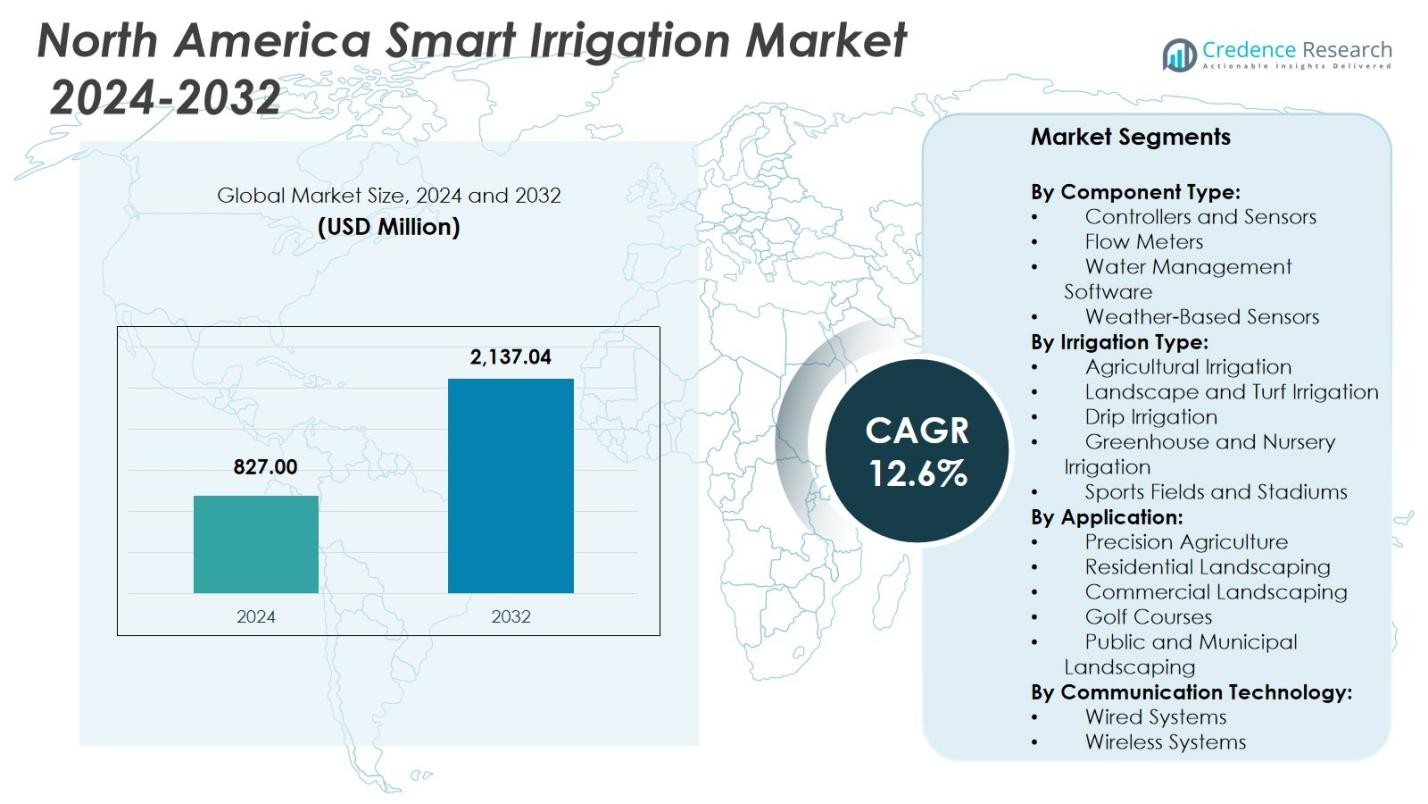
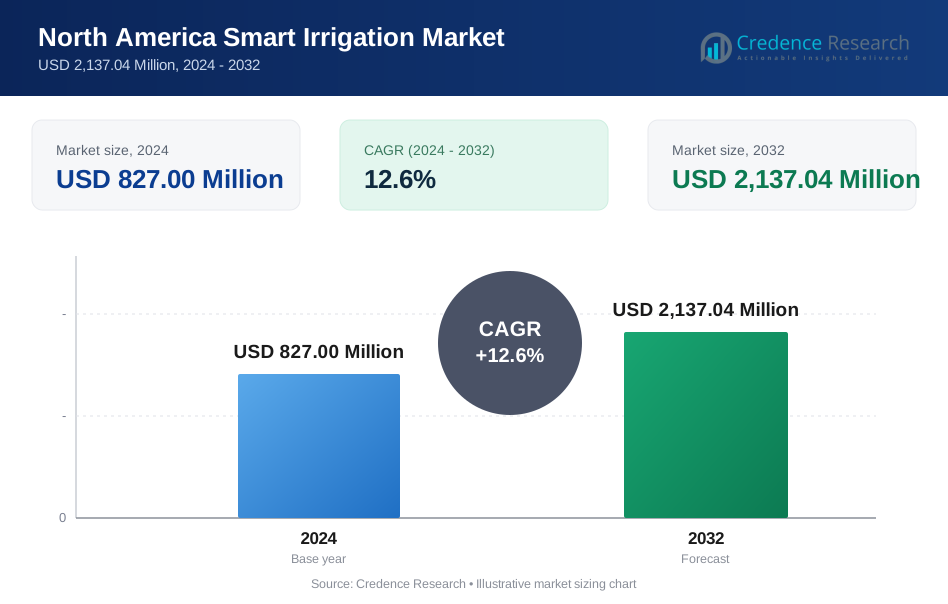
North America Smart Irrigation Market size was valued at USD 827.00 Million in 2024 and is anticipated to reach USD 2,137.04 Million by 2032, at a CAGR of 12.6% during the forecast period.
| REPORT ATTRIBUTE | DETAILS |
|---|---|
| Historical Period | 2020-2023 |
| Base Year | 2024 |
| Forecast Period | 2025-2032 |
| North America Smart Irrigation Market Size 2024 | USD 827.00 Million |
| North America Smart Irrigation Market, CAGR | 12.6% |
| North America Smart Irrigation Market Size 2032 | USD 2,137.04 Million |
North America Smart Irrigation Market features leading players such as Galcon, The Toro Company, Banyan Water, Inc., Rain Bird Corporation, NETAFIM, Weathermatic, Orbit Irrigation Products LLC, Rachio Inc., HUNTER INDUSTRIES, and HydroPoint, all driving innovation through advanced controllers, cloud-based platforms, and sensor-integrated irrigation systems. These companies focus on enhancing water efficiency, automation, and real-time monitoring across agriculture, residential landscapes, and commercial green spaces. The United States led the market with a 71.4% share in 2024, driven by strong adoption of precision agriculture technologies, drought-management initiatives, and expanding smart city landscaping programs, followed by Canada and Mexico with growing implementation across farms and urban landscapes.
Market Insights
- North America Smart Irrigation Market was valued at USD 827.00 Million in 2024 and is projected to grow at a CAGR of 12.6% through 2032.
- Strong market drivers include rising adoption of precision agriculture, expansion of automated irrigation controllers and sensors, and increasing municipal focus on water-conservation programs.
- Key market trends highlight rapid integration of IoT, AI-driven analytics, weather-based automation, and growing adoption of drip irrigation and soil-moisture monitoring technologies across farms and landscapes.
- Leading players such as Galcon, The Toro Company, Rain Bird Corporation, NETAFIM, and HydroPoint strengthen industry growth through product innovation, digital irrigation platforms, and strategic partnerships across agriculture and commercial landscaping.
- The United States dominated the market with a 4% share, supported by high deployment of smart controllers and precision agriculture tools, while Controllers and Sensors led segment performance with a 41.2% share, followed by Canada and Mexico showing rising adoption in greenhouse farming and urban green-space management.
 Market Segmentation Analysis:
By Component Type
Controllers and Sensors dominated the North America Smart Irrigation Market with a 41.2% share in 2024, driven by widespread adoption of automated scheduling, soil-moisture sensing, and real-time system adjustments across agriculture and landscaping. Their integration with weather-based inputs, IoT platforms, and wireless communication improves irrigation accuracy and reduces manual intervention, making them the preferred choice among farms, golf courses, and municipal landscapes. Water Management Software and Weather-Based Sensors are also growing steadily as data-driven irrigation gains traction, while Flow Meters support system-level efficiency monitoring and leak detection across high-use irrigation networks.
- For instance, Rain Bird’s ET Manager integrates weather data with sensor inputs to optimize irrigation timing, reducing water waste on golf courses.
By Irrigation Type
Agricultural Irrigation held the leading position with a 38.5% share in 2024, supported by the rapid shift toward precision water management across large farmlands in the U.S. and Canada. Farmers increasingly adopt sensor-driven and weather-responsive irrigation systems to reduce water wastage, improve crop yields, and address sustainability mandates. Landscape and Turf Irrigation continues expanding with strong adoption across urban green spaces, while Drip Irrigation and Greenhouse Irrigation gain momentum due to efficiency benefits. Sports Fields and Stadiums also demonstrate rising uptake for maintaining turf quality under fluctuating climatic conditions.
- For instance, CropX deploys AI-driven sensors that analyze soil moisture, weather forecasts, and crop cycles to automate irrigation scheduling.
By Application
Precision Agriculture emerged as the dominant application with a 36.7% share in 2024, driven by the growing need for real-time crop monitoring, optimized resource utilization, and automated irrigation control across high-value farming zones. Producers increasingly rely on IoT sensors, satellite imagery, soil-moisture probes, and weather analytics to execute targeted watering strategies that enhance productivity and reduce operational costs. Residential and Commercial Landscaping segments grow steadily due to water-conservation regulations, while Golf Courses and Public Landscaping increasingly adopt smart irrigation systems to maintain landscape quality under tightening municipal water-use policies.
Key Growth Drivers
Expansion of Precision Agriculture Practices
Precision agriculture significantly drives the North America Smart Irrigation Market as farmers increasingly adopt IoT-enabled sensors, weather-based controllers, and soil-moisture monitoring tools. These systems help optimize water usage, enhance crop yields, and lower operational costs across large agricultural zones. Government programs promoting water conservation further accelerate adoption, while advanced analytics support targeted irrigation decisions. The integration of automation and remote monitoring strengthens farm productivity, making precision irrigation an essential investment for modern agricultural operations.
- For instance, John Deere's Field Connect utilizes soil moisture sensors to provide real-time irrigation data, helping farmers conserve water while increasing efficiency.
Urban Landscaping Modernization and Water Conservation Mandates
Urban regions across the U.S. and Canada are experiencing rising pressure to reduce water consumption in residential, municipal, and commercial landscapes. Smart irrigation systems support automated scheduling and real-time water adjustments, helping cities comply with conservation regulations. Adoption grows quickly across public parks, smart city projects, golf courses, and commercial complexes seeking sustainability certifications. The demand for efficient irrigation technologies intensifies due to rising water tariffs and expanding ESG-driven landscaping initiatives.
- For instance, Calsense smart irrigation systems deployed in U.S. cities for parks and public spaces optimize watering to cut water use while maintaining green areas efficiently. These systems integrate real-time data for precise control, supporting municipal sustainability goals in urban environments.
Technological Advancements in Connected Irrigation Systems
Rapid advancements in wireless communication, cloud platforms, AI-based prediction models, and mobile-enabled irrigation controls strongly support market growth. Integrated systems offer remote monitoring, leak detection, and predictive watering based on weather analytics, improving decision-making accuracy. Manufacturers increasingly embed machine learning features to anticipate plant needs and prevent over-irrigation. The shift toward fully connected ecosystems enhances system reliability, reduces water wastage, and strengthens adoption across agriculture and urban landscaping environments.
Key Trends & Opportunities
Growing Integration of IoT, AI, and Predictive Analytics
IoT devices, soil sensors, and AI-driven forecasting tools are becoming central to irrigation decision-making. Predictive analytics assists users in adjusting irrigation patterns based on real-time weather conditions, soil characteristics, and plant requirements. This trend creates strong opportunities for software-as-a-service irrigation platforms that provide remote control and automated scheduling. As climate variability increases, demand for intelligent, self-learning irrigation systems continues to expand across farms, golf courses, and municipal landscapes.
- For instance, AI models in Vassar Labs' irrigation planning tools forecast water needs by analyzing weather forecasts and crop health data. The system proactively schedules irrigation to avoid over- or under-watering amid climatic variations.
Rising Adoption of Sustainable and Water-Efficient Irrigation Solutions
Sustainability goals across agriculture and landscaping are accelerating the shift toward efficient irrigation technologies. Water-efficient systems such as drip irrigation, weather-based controllers, and flow-monitoring devices are gaining momentum as organizations aim to reduce environmental impact. Federal and state incentives for water conservation create favorable market opportunities. Businesses and municipalities increasingly adopt smart irrigation to meet regulatory compliance, achieve green certifications, and optimize long-term irrigation costs through reduced water consumption.
- For instance, CropX employs soil sensors and data analytics for real-time irrigation optimization across various crops. This approach delivers over 40% water conservation while boosting yields by around 10%.
Key Challenges
High Initial Installation and Integration Costs
Despite strong benefits, the upfront cost of deploying smart irrigation systems remains a key barrier, particularly for small farms and residential users. Controllers, sensors, and cloud-based platforms require substantial investment, while integrating these systems with existing irrigation infrastructure adds technical complexity. Limited awareness of long-term cost savings further slows adoption. Budget constraints within municipal landscaping programs also hinder broader implementation, especially in regions with limited funding for infrastructure modernization.
Limited Connectivity and Technical Skill Gaps in Rural Areas
Many rural agricultural regions face connectivity issues that restrict the use of cloud-based and IoT-enabled irrigation tools. Weak cellular networks and limited broadband availability reduce the performance of real-time monitoring systems. Additionally, users often lack the technical expertise needed to operate advanced platforms, analyze sensor data, or troubleshoot system malfunctions. This skill gap increases dependence on service providers and slows widespread adoption in remote farming communities.
Regional Analysis
United States
The United States dominated the North America Smart Irrigation Market with a 71.4% share in 2024, driven by strong adoption across precision agriculture, commercial landscaping, golf courses, and municipal green spaces. The country benefits from advanced IoT infrastructure, supportive water-conservation regulations, and widespread use of automated controllers and soil-moisture sensors. States such as California, Texas, and Arizona lead deployment due to severe drought conditions and stringent water-use policies. Increasing integration of AI-enabled irrigation platforms and smart city landscaping programs continues to strengthen U.S. leadership, supported by significant investments from agriculture technology providers and urban sustainability initiatives.
Canada
Canada accounted for a 21.8% share in 2024, supported by rising adoption of smart irrigation systems across high-value agriculture, greenhouse production, and public landscaping. The country experiences growing demand for water-efficient solutions as climate variability intensifies, particularly in provinces like Alberta, Ontario, and British Columbia. Canadian farms increasingly adopt weather-based controllers, advanced drip irrigation, and sensor-driven monitoring to enhance crop resilience and optimize water usage. Government incentives promoting sustainable agriculture and municipal green-space management further stimulate market expansion. Continued integration of connected irrigation platforms and winter-resilient technologies strengthens Canada’s role in the regional market.
Mexico
Mexico held a 6.8% share in 2024, supported by expanding demand for modern irrigation solutions in agriculture-dominant regions facing chronic water scarcity. Adoption grows rapidly across fruit, vegetable, and export-oriented crop farms that rely on precise water management to maintain yield quality and reduce operational losses. Drip irrigation and sensor-enabled systems gain traction as growers prioritize efficiency under rising water-cost pressures. Government programs promoting irrigation modernization, particularly in arid northern states, support the shift toward smart irrigation. Increasing interest from commercial landscaping, hotels, and resorts further contributes to Mexico’s emerging presence in the regional market.
Market Segmentations:
By Component Type:
- Controllers and Sensors
- Flow Meters
- Water Management Software
- Weather-Based Sensors
By Irrigation Type:
- Agricultural Irrigation
- Landscape and Turf Irrigation
- Drip Irrigation
- Greenhouse and Nursery Irrigation
- Sports Fields and Stadiums
By Application:
- Precision Agriculture
- Residential Landscaping
- Commercial Landscaping
- Golf Courses
- Public and Municipal Landscaping
By Communication Technology:
- Wired Systems
- Wireless Systems
By Geography
- United States
- Canada
- Mexico
Competitive Landscape
Competitive landscape in the North America Smart Irrigation Market features key players such as Galcon, The Toro Company, Banyan Water, Inc., Rain Bird Corporation, NETAFIM, Weathermatic, Orbit Irrigation Products LLC, Rachio Inc., HUNTER INDUSTRIES, and HydroPoint. These companies actively expand their portfolios through advanced controllers, AI-enabled scheduling platforms, cloud-based water-management software, and sensor-integrated irrigation solutions designed for agricultural, residential, and commercial use. Vendors prioritize innovation in weather-based automation, flow monitoring, and predictive analytics to enhance water efficiency and system reliability. Strategic partnerships with municipalities, landscaping firms, and agritech integrators strengthen market penetration, while investments in mobile apps and connected IoT ecosystems improve user accessibility. Manufacturers also focus on regulatory compliance, sustainability-driven product design, and drought-resilient irrigation technologies to align with evolving water-use policies across the U.S., Canada, and Mexico. Overall, intensifying R&D initiatives and digital integration continue to shape a highly dynamic competitive environment.
Key Player Analysis
- Galcon
- The Toro Company
- Banyan Water, Inc.
- Rain Bird Corporation
- NETAFIM
- Weathermatic
- Orbit Irrigation Products LLC
- Rachio Inc.
- HUNTER INDUSTRIES
- HydroPoint
Recent Developments
- In October 2025 Rain Bird Corporation acquired Rachio, Inc., expanding its footprint in smart, sustainable irrigation solutions.
- In 2023, NETAFIM introduced a new line of smart drip irrigation systems equipped with IoT sensors and cloud-based analytics to support real-time soil-moisture monitoring and precision water management.
- In 2022 the company HydroPoint partnered with Aliaxis to offer integrated smart irrigation and leak/flow monitoring solutions for building irrigation and landscape water management.
Report Coverage
The research report offers an in-depth analysis based on Component Type, Irrigation Type, Application, Communication Technology and Geography. It details leading market players, providing an overview of their business, product offerings, investments, revenue streams, and key applications. Additionally, the report includes insights into the competitive environment, SWOT analysis, current market trends, as well as the primary drivers and constraints. Furthermore, it discusses various factors that have driven market expansion in recent years. The report also explores market dynamics, regulatory scenarios, and technological advancements that are shaping the industry. It assesses the impact of external factors and global economic changes on market growth. Lastly, it provides strategic recommendations for new entrants and established companies to navigate the complexities of the market.
Future Outlook
- Adoption of AI-enabled irrigation scheduling will increase as farms and landscapes prioritize data-driven water management.
- Integration of IoT sensors, cloud platforms, and mobile controls will expand across residential, commercial, and municipal applications.
- Water-scarcity challenges and stricter conservation regulations will accelerate demand for automated and efficient irrigation systems.
- Growth in precision agriculture will boost usage of soil-moisture sensors, weather-based controllers, and predictive analytics.
- Smart city development will create strong opportunities for connected irrigation networks in public parks and urban landscapes.
- The landscaping sector will adopt more advanced automation to reduce labor needs and enhance irrigation accuracy.
- Rising environmental sustainability requirements will support wider deployment of water-efficient irrigation technologies.
- Manufacturers will invest heavily in AI, ML, and remote-monitoring capabilities to improve system performance.
- Expansion of commercial green spaces, golf courses, and sports facilities will drive long-term adoption.
- Government incentives and supportive agricultural modernization programs will strengthen market penetration across the region.
Request a Free Sample
Fill in your details and we'll send you a free sample report.
- Sample data tables & charts
- Research methodology
Need a Custom Version of This Report?
Tailor the scope, geography, or segments to your exact requirements.
- Custom geography or segment scope
- Direct access to our analyst team
Frequently Asked Questions
What is the current market size for North America Smart Irrigation Market, and what is its projected size in 2032?
At what Compound Annual Growth Rate is the North America Smart Irrigation Market projected to grow between 2025 and 2032?
Which North America Smart Irrigation Market segment held the largest share in 2024?
What are the primary factors fueling the growth of the North America Smart Irrigation Market?
Who are the leading companies in the North America Smart Irrigation Market?
Which region commanded the largest share of the North America Smart Irrigation Market in 2024?
Table of Content
Chapter 1. Report Introduction
- 1.1 Report Description & Purpose
- 1.1.1 Report Title & Market Definition
- 1.1.2 Unique Selling Propositions (USP) & Key Differentiators
- 1.1.3 Value Proposition for Stakeholders
- 1.2 Research Objectives
- 1.2.1 Market Sizing Objectives (Volume & Revenue) (Volume Where Applicable)
- 1.2.2 Segmentation Objectives
- 1.2.3 Competitive Intelligence Objectives
- 1.2.4 Forecast & Scenario Objectives
- 1.3 Report Scope
- 1.3.1 North America Smart Irrigation Scope – Segments & Subsegments Covered
- 1.3.2 Geographic Scope – Selected Region & Countries Covered
- 1.3.3 Historical Period, Base Year & Forecast Period (2024; forecast to 2032)
- 1.3.4 Inclusions & Exclusions
- 1.4 Industry Classification & Applicable Codes
- 1.5 Currency, Measurement Units & Valuation Basis
- 1.6 Target Stakeholders
- 1.7 Limitations & Assumptions
Chapter 2. Executive Summary
- 2.1 North America Smart Irrigation Snapshot
- 2.1.1 Market Size – Historical (2024) & Forecast (2024-2032) (2024: USD 827.00 Million → 2032: USD 2,137.04 Million)
- 2.1.2 Volume & Revenue – Regional Totals (Volume Where Applicable)
- 2.1.3 Key Market Highlights – Top Five Facts
- 2.2 North America Smart Irrigation Segmentation Snapshot
- 2.2.1 Market Split by Country – 2024 vs. 2032
- 2.3 Competitive Snapshot
- 2.3.1 Top 10 Players by Revenue Share – 2024
- 2.3.2 Top 10 Players by Volume Share – 2024 (Volume Where Applicable)
- 2.3.3 Recent Strategic Developments (18-Month Summary)
- 2.4 Key Investment Highlights & Strategic Conclusions
Chapter 3. North America Smart Irrigation Dynamics & Industry Analysis
- 3.1 Market Overview & Context
- 3.1.1 North America Smart Irrigation Position in the Broader Industry Value Chain
- 3.1.2 Demand Structure & Purchasing Dynamics
- 3.1.3 Market Maturity & Development Stage by Country
- 3.2 North America Smart Irrigation Drivers
- 3.3 North America Smart Irrigation Restraints & Challenges
- 3.4 North America Smart Irrigation Opportunities
- 3.5 Porter's Five Forces Analysis
- 3.5.1 Threat of New Entrants
- 3.5.2 Bargaining Power of Suppliers
- 3.5.3 Bargaining Power of Buyers
- 3.5.4 Threat of Substitutes
- 3.5.5 Competitive Rivalry – Intensity Assessment
- 3.6 North America Smart Irrigation Value Chain Analysis
- 3.6.1 Upstream – Key Inputs, Resources & Suppliers
- 3.6.1.1 Key Input/Resource 1
- 3.6.1.2 Key Input/Resource 2
- 3.6.1.3 Key Input/Resource 3
- 3.6.2 Midstream – Core Operations & Value Creation
- 3.6.2.1 Operating Model & Process Overview
- 3.6.2.2 Key Operating Locations & Capabilities by Company
- 3.6.3 Downstream – Market Channels & End Users
- 3.6.3.1 Direct Sales & Customer Engagement Channels
- 3.6.3.2 Indirect Sales, Intermediaries & Partner Channels
- 3.6.4 Value Chain Profitability Analysis
- 3.6.1 Upstream – Key Inputs, Resources & Suppliers
- 3.7 PESTEL Analysis
- 3.7.1 Political Factors
- 3.7.2 Economic Factors
- 3.7.3 Social Factors
- 3.7.4 Technological Factors
- 3.7.5 Environmental Factors
- 3.7.6 Legal Factors
- 3.8 North America Smart Irrigation Supply Chain Analysis
- 3.8.1 Critical Input & Resource Availability Risk Assessment
- 3.8.2 Supplier & Operational Concentration Risk (Geographic Exposure)
- 3.8.3 Supply & Service Disruption Impact Analysis
- 3.9 Regional & Country Regulatory Landscape
Note: The regulatory and policy landscape section covers regulations based on their applicability to the market, North America Smart Irrigation category, geography, and scope of the study. Only regulatory frameworks with a material impact on operations, compliance, trade, sustainability, or market access are analyzed in detail.
Chapter 4. Key Investment Pockets & Opportunity Analysis
- 4.1 North America Smart Irrigation Attractiveness Analysis
- 4.1.1 By Country – Investment Attractiveness Matrix (Market Size × CAGR)
- 4.2 Absolute Revenue Growth Opportunity
- 4.2.1 By Country – Absolute Revenue Growth Through 2032
- 4.3 Incremental Demand Opportunity
- 4.3.1 By Country – Incremental Demand Through 2032
- 4.3.2 Segment – Incremental Demand
- 4.4 Emerging Submarket Opportunity Deep Dive (Subject to Applicability)
- 4.5 Priority Country Opportunity Scorecards
- 4.5.1 Priority Country 1
- 4.5.2 Priority Country 2
- 4.5.3 Priority Country 3
- 4.5.4 Priority Country 4
Note: Priority countries are selected from within the region covered by the study. Numbered entries are indicative and are populated with relevant country names based on market size, growth potential, and strategic relevance.
Chapter 5. North America Smart Irrigation Cross-Border Trade & Market Access Analysis
- 5.1 Intra-Regional & Extra-Regional Trade Overview
- 5.1.1 Regional Export Value by Country (2024)
- 5.1.2 Regional Export Volume by Country (2024) (Volume Where Applicable)
- 5.1.3 Regional Import Value by Country (2024)
- 5.1.4 Regional Import Volume by Country (2024) (Volume Where Applicable)
- 5.1.5 Net Trade Balance by Country (2024)
- 5.2 Export Analysis – Segment
- 5.2.1 Category 1 (Applicable Classification Code)
- 5.2.2 Category 2 (Applicable Classification Code)
- 5.2.3 Category 3 (Applicable Classification Code)
- 5.2.4 Category 4 (Applicable Classification Code)
- 5.2.5 Category 5 (Applicable Classification Code)
- 5.3 Import Analysis – Segment
- 5.3.1 Category 1 (Applicable Classification Code)
- 5.3.2 Category 2 (Applicable Classification Code)
- 5.3.3 Category 3 (Applicable Classification Code)
- 5.3.4 Category 4 (Applicable Classification Code)
- 5.3.5 Category 5 (Applicable Classification Code)
- 5.4 Cross-Border Pricing & Transaction Benchmarks
- 5.4.1 Export Pricing – Segment & Country
- 5.4.2 Import Pricing – Segment & Source Country
- 5.4.3 Price Trends (2024)
- 5.5 Key Cross-Border Trade & Delivery Routes
- 5.5.1 Cross-Border Trade/Delivery Route 1
- 5.5.2 Cross-Border Trade/Delivery Route 2
- 5.5.3 Cross-Border Trade/Delivery Route 3
- 5.5.4 Cross-Border Trade/Delivery Route 4
- 5.5.5 Cross-Border Trade/Delivery Route 5
- 5.6 Trade Policy & Market Access Impact Assessment
- 5.6.1 Tariff & Non-Tariff Barriers
- 5.6.2 Regional Trade & Economic Integration Frameworks
- 5.6.3 Bilateral & Multilateral Trade Agreements
- 5.6.4 Cross-Border Operating, Licensing & Localization Requirements
Note: Cross-border analysis applies where relevant to North America Smart Irrigation. Country trade flows distinguish intra-regional activity from trade with markets outside the region. Regional external trade totals exclude intra-regional flows to avoid double counting. Classifications and transaction measures follow the market scope; volume and route analyses apply only where meaningful.
Chapter 6. Competitive Landscape & Company Benchmarking
- 6.1 North America Smart Irrigation Concentration & Structure
- 6.1.1 Herfindahl-Hirschman Index (HHI) – the historical period vs. 2024
- 6.1.2 Leading, Mid-Sized & Emerging Player Structure
- 6.1.3 Global, Regional & Local Player Dynamics
- 6.2 North America Smart Irrigation Share Analysis – 2024
- 6.2.1 Regional Revenue Share by Company
- 6.2.2 Regional Volume Share by Company (Volume Where Applicable)
- 6.2.3 Company Revenue Share by Country
- 6.2.4 Market Share Evolution (the historical period vs. 2024)
- 6.2.5 Company Market Share by Key Segment
- 6.2.6 Company Market Share by Customer Group
- 6.3 Operating Scale, Capacity & Infrastructure Analysis
- 6.3.1 Regional Operating Scale & Supply Capacity
- 6.3.2 Resource Utilization & Operating Efficiency
- 6.3.3 Output, Service Delivery & Activity Metrics
- 6.3.4 Operating Footprint & Infrastructure Map
- 6.3.5 Planned Operational & Capacity Expansion
- 6.4 North America Smart Irrigation Competitive Benchmarking Matrix
- 6.4.1 Revenue, Growth, Profitability & Operating Metric Comparison
- 6.4.2 Channel Revenue Mix
- 6.4.3 Revenue Exposure by Country Within the Region
- 6.4.4 R&D Intensity
- 6.4.5 Sustainability Maturity
- 6.5 Strategic Developments in North America Smart Irrigation (Last 24 Months)
- 6.5.1 Mergers, Acquisitions & Divestments
- 6.5.2 New Products, Services & Solutions in North America Smart Irrigation
- 6.5.3 Operational & Infrastructure Expansions
- 6.5.4 Strategic Alliances, Joint Ventures & Partnerships
- 6.5.5 Distribution Expansion & Market Entry
- 6.5.6 Sustainability & ESG Initiatives
- 6.6 Competitive Strategy Mapping
- 6.6.1 Leader, Challenger, Follower & Niche Classification
- 6.6.2 Pricing Strategy Comparison
- 6.6.3 Channel Strategy Matrix
Note: Strategic developments are included based on their materiality and the availability of reliable information.
Chapter 7. North America Smart Irrigation – By Sales & Delivery Channel
- 7.1 Segment Overview
- 7.1.1 Volume & Revenue Split by Channel (2024 & 2032) (Volume Where Applicable)
- 7.1.2 Channel Mix Evolution (2024-2032)
Chapter 8. Country Market Analysis – Regional Overview
- 8.1 Country Market Overview Within the Region
- 8.1.1 Country Volume Share Within the Region (Where Applicable)
- 8.1.2 Country Revenue Share Within the Region
- 8.1.3 Market Volume by Country (Where Applicable)
- 8.1.4 Market Revenue by Country
- 8.1.5 Country Forecasts Through 2032
- 8.2 Cross-Country Segment Analysis
- 8.2.1 By Sales & Delivery Channel
- 8.2.2 By Competitive Positioning & Price Tier
Chapter 9. North America Smart Irrigation – Priority Country 1
Chapter 10. North America Smart Irrigation – Priority Country 2
Chapter 11. North America Smart Irrigation – Priority Country 3
Chapter 12. North America Smart Irrigation – Priority Country 4
Chapter 13. North America Smart Irrigation Company Profiles
- 13.1 [Company 01]
- 13.1.1 Company Overview
- 13.1.2 Key Management Personnel
- 13.1.3 Products & Services Portfolio
- 13.1.4 Financial Performance
- 13.1.5 Regional Market Focus & Country Presence
- 13.1.6 Recent Developments & Strategic Initiatives
Note: The company profile list is preliminary and may change based on research findings, market developments, data availability, and client requirements.
Chapter 14. Appendices
- Appendix A – List of Abbreviations & Acronyms
- Appendix B – Industry Classification Code Reference – Full Series
- Appendix C – Supply, Output & Operating Capacity Data Tables
- Appendix D – End-Use & Demand Base Tables
- Appendix E – Demand, Adoption & Usage Assumptions
- Appendix F – Pricing & Revenue Metric Reference Tables
- Appendix G – Company Operations & Infrastructure Database
- Appendix H – Cross-Border Trade & Activity Data Tables (Where Applicable)
- Appendix I – Regulatory Summary Tables
- Appendix J – Primary Research Participant List (Anonymized)
- Appendix K – Primary Research Questionnaire Framework
- Appendix L – Data Sources & Bibliography
- Appendix M – Market Size Divergence & Source Comparison
Chapter 15. Research Methodology
- 15.1 Research Framework & Philosophy
- 15.2 Secondary Research – Sources, Hierarchy & Data Extraction
- 15.3 Data Modeling – Country-Level Estimates & Regional Aggregation
- 15.4 Primary Research – Stakeholder Framework, LOI & Sample Sizes
- 15.5 Forecast Methodology – Regression, Scenario & Sensitivity Analysis
- 15.6 Quality Control – Four-Layer Validation Framework
- 15.7 Limitations & Standard Assumptions
- 15.8 Disclaimer
