
Paper Wrap Market Overview:
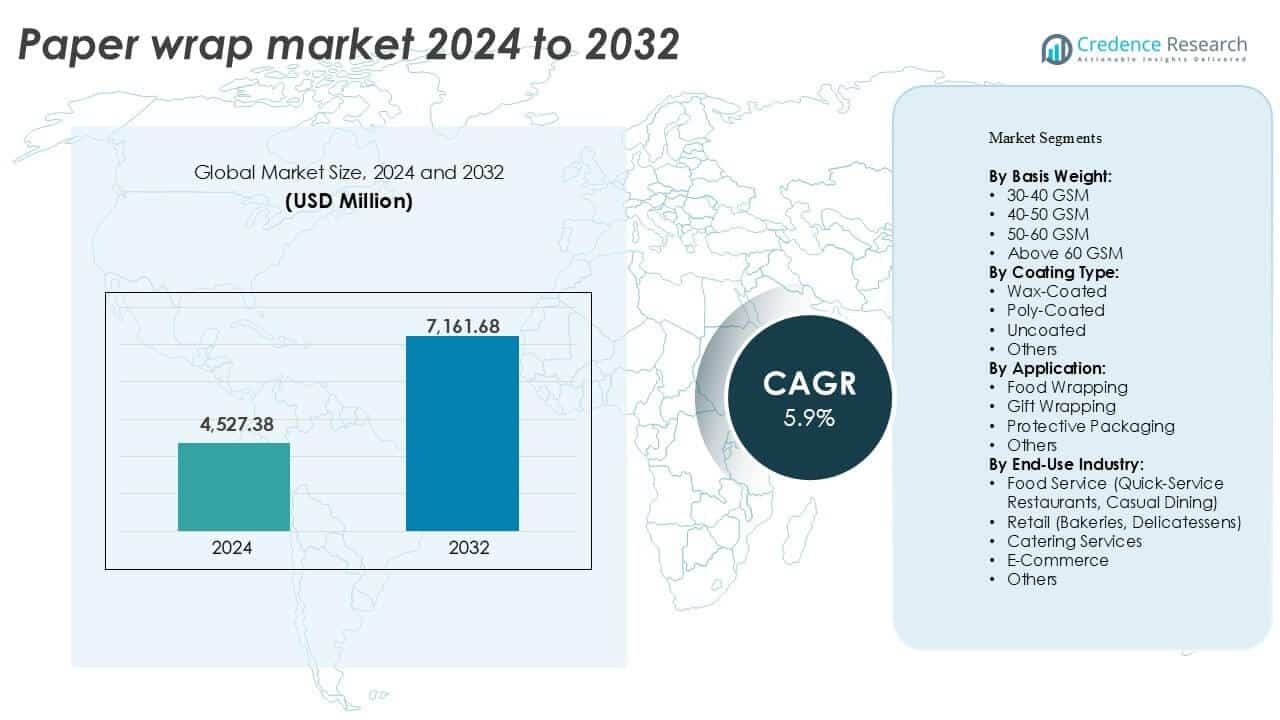
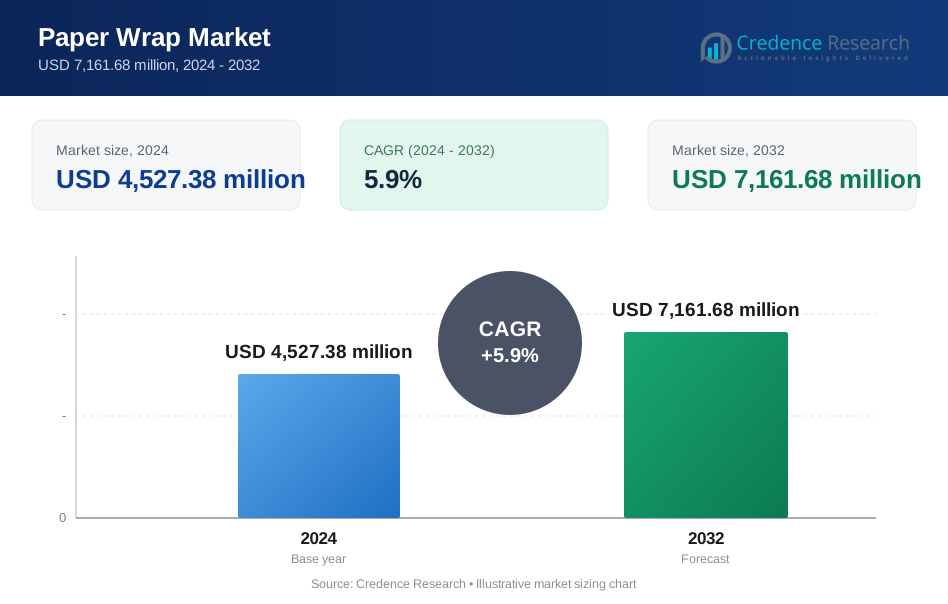
The Paper Wrap Market size was valued at USD 4,527.38 million in 2024 and is anticipated to reach USD 7,161.68 million by 2032, at a CAGR of 5.9% during the forecast period.
| REPORT ATTRIBUTE | DETAILS |
|---|---|
| Historical Period | 2020-2023 |
| Base Year | 2024 |
| Forecast Period | 2025-2032 |
| Paper Wrap Market Size 2024 | USD 4,527.38 million |
| Paper Wrap Market, CAGR | 5.9% |
| Paper Wrap Market Size 2032 | USD 7,161.68 million |
Top players in the paper wrap market include International Paper Company, WestRock Company, Mondi Group, Smurfit Kappa Group, and Georgia-Pacific LLC. These companies lead through extensive production capabilities, global distribution, and investments in sustainable packaging technologies. Mondi and Smurfit Kappa focus heavily on recyclable coatings and value-added printing, while International Paper and WestRock maintain strong supply chain integration across North America. Europe and North America dominate the market, together accounting for over 58% of global revenue in 2024. Europe leads with a 28% market share, driven by stringent environmental regulations and high adoption of eco-friendly packaging.
Paper Wrap Market Insights
- The Paper Wrap Market was valued at USD 4,527.38 million in 2024 and is projected to reach USD 7,161.68 million by 2032, growing at a CAGR of 5.9% during the forecast period.
- Strong demand for sustainable, compostable packaging drives market growth, especially across the foodservice and retail sectors.
- Key trends include adoption of wax-coated wraps for food safety and increasing use of printed, specialty wraps in premium packaging.
- Major players such as Mondi Group, International Paper, and Smurfit Kappa focus on eco-innovation, while regional suppliers address cost-sensitive and niche segments.
- Europe leads the market with a 28% share, followed by North America at 30%, while the 40–50 GSM segment holds the largest share by basis weight due to its balance of strength and flexibility.
Paper Wrap Market Segmentation Analysis:
By Basis Weight
The 40–50 GSM segment dominates the paper wrap market, accounting for the largest market share in 2024. This range offers an ideal balance of strength and flexibility, making it well-suited for food and retail packaging applications. It withstands handling stress during wrapping without compromising product protection or presentation. Rising adoption in quick-service restaurants and retail counters further boosts demand for this weight class. Its compatibility with both manual and automated wrapping systems also enhances its preference across industries seeking cost-efficient and sustainable packaging materials.
- For instance, Mondi produces kraft paper wraps at 40 GSM with high tensile strength typically ranging around 4.2 kN/m to 5.1 kN/m in the machine direction (MD) for specific grades, enabling secure food wrapping on high-speed counters.
By Coating Type
Wax-coated paper wrap holds the leading market share within this segment. Its superior moisture resistance makes it ideal for perishable food items and greasy goods. Quick absorption prevention and ease of folding drive its adoption across bakery, deli, and confectionery packaging. The wax-coated type also offers better printability, supporting branding and product identification. Growth in food delivery and takeout services continues to drive demand for high-performance, grease-resistant wraps, positioning this sub-segment ahead of poly-coated and uncoated options in terms of volume and usage frequency.
- For instance, Georgia‑Pacific’s Dixie Rite wax‑finished deli paper is designed with enhanced wet strength and grease absorption to maintain product integrity in high‑use foodservice applications.
By Application
Food wrapping emerges as the dominant application, holding the highest share of the global paper wrap market. Regulatory pressure to reduce plastic food packaging accelerates the shift toward paper-based alternatives. Restaurants, cafes, and food stalls widely use paper wraps for sandwiches, baked goods, and snacks. The segment benefits from high consumption rates in daily food service and retail chains. Growing demand for compostable, biodegradable wrapping materials further supports this application’s expansion, especially in regions enforcing sustainable packaging laws across the food industry.
Paper Wrap Market Key Growth Drivers
Rising Demand for Sustainable Packaging Solutions
Environmental regulations and consumer awareness continue to accelerate the transition toward eco-friendly packaging. Paper wrap, being biodegradable and recyclable, addresses growing concerns over plastic waste and pollution. Governments worldwide are banning or taxing single-use plastics, pushing businesses to adopt paper-based alternatives. Major foodservice and retail chains are switching to paper wraps to meet sustainability goals and brand positioning. For instance, fast-food brands are now replacing polyethylene wrappers with compostable paper wraps to reduce environmental impact. These changes support large-scale demand from both developed and emerging economies. Additionally, packaging manufacturers are investing in green technologies and coatings to improve paper wrap durability without compromising sustainability. This shift aligns with circular economy goals and strengthens the long-term viability of paper wrap as a mainstream packaging solution.
- For instance, Tetra Pak’s paper‑based barrier innovation replaced one aluminum foil layer with paper in its 200 ml aseptic cartons, supporting easier recycling and higher fiber yield in mills.
Expansion of the Global Foodservice and Delivery Industry
The growing foodservice and food delivery sectors significantly boost the demand for paper wrap products. As consumption of ready-to-eat, fast food, and packaged snacks grows, restaurants, cloud kitchens, and delivery platforms require safe and eco-friendly wrapping materials. Paper wrap offers an ideal blend of functionality, hygiene, and brand visibility. Its grease-resistant and customizable properties make it suitable for wrapping burgers, sandwiches, and bakery items. With online food delivery witnessing double-digit annual growth in key markets like India, China, and the U.S., volume demand for paper wrap continues to climb. Moreover, increasing consumer preference for aesthetically pleasing and sustainable food packaging supports paper wrap usage across premium outlets. This trend is expected to accelerate as urbanization, convenience-based lifestyles, and disposable income levels rise globally.
- For instance, noissue’s Custom Food Wrapping Paper is FSC‑certified and engineered for compostability while maintaining strength for fast‑food applications.
Technological Advancements in Coating and Printing
Innovation in paper coating and printing technologies drives performance improvements in paper wrap. Modern wax and biodegradable coatings now offer enhanced grease and moisture resistance while maintaining compostability. Poly-free barrier coatings are also gaining popularity for their recyclability and reduced carbon footprint. Furthermore, advancements in digital printing allow brands to create high-quality, customized wraps for product differentiation. These innovations support branding, traceability, and anti-counterfeit measures in food and retail packaging. Companies are also developing coatings that meet food contact regulations without requiring lamination or plastic film layers. As technical capabilities improve, paper wraps become more competitive with plastic wraps in terms of both functionality and cost-effectiveness. The ability to deliver sustainable, high-performance wraps expands the addressable market across industries seeking compliant, brand-enhancing packaging.
Paper Wrap Market Key Trends & Opportunities
Shift Toward Premium and Specialty Paper Wraps
Premiumization is emerging as a strong trend, especially in the foodservice and gift packaging segments. Businesses are using soft-touch, textured, and custom-printed wraps to enhance brand value and customer experience. Specialty wraps with decorative prints, natural fibers, or artisanal finishes are gaining popularity in boutique bakeries and premium cafes. The trend extends to gift wrapping where consumers seek eco-luxury alternatives to plastic films and foils. This opens opportunities for high-margin products that combine aesthetics, sustainability, and performance. Paper wrap producers can benefit by offering tailored designs, seasonal themes, or co-branding options. As businesses shift focus toward experiential packaging, the demand for value-added wraps is set to increase. This niche, though smaller in volume, presents a high-growth opportunity for innovation-driven suppliers targeting retail branding and direct-to-consumer channels.
- For instance, companies printing branded wrapping paper achieve custom prints on papers ranging from 80 GSM to over 300 GSM, making the paper feel thicker and more premium compared to standard wraps.
Growth Potential in Emerging Markets
Emerging economies present a strong opportunity for paper wrap manufacturers due to rapid urbanization, rising disposable incomes, and expanding modern retail networks. As organized foodservice and quick-commerce platforms grow in Asia-Pacific, Latin America, and Africa, demand for clean and safe wrapping solutions accelerates. Local regulations banning plastic bags and single-use packaging further support adoption. Small food vendors, supermarkets, and bakeries increasingly opt for paper wraps for cost-effective and eco-friendly packaging. Additionally, government-backed sustainability initiatives and waste-reduction goals in these regions create favorable market conditions. Local manufacturing hubs and supply chain expansion efforts also help reduce lead times and improve access. These markets remain price-sensitive, but offer long-term scalability for low-GSM or uncoated paper wrap products tailored to regional preferences and affordability.
Paper Wrap Market Key Challenges
Price Volatility and Supply Uncertainty of Raw Materials
Paper wrap production heavily depends on pulp and paperboard, which are prone to supply disruptions and price fluctuations. Factors such as wood pulp shortages, high energy costs, and logistics delays impact production margins and delivery timelines. Global supply chain disruptions and increased competition for sustainable fiber sources also affect pricing stability. Smaller converters often face procurement challenges due to limited access to high-quality pulp or coated substrates. These fluctuations reduce predictability for manufacturers and buyers, impacting profitability. Moreover, sudden changes in raw material pricing make it difficult to maintain consistent product pricing in contract-based supply agreements. As sustainability demand rises, pressure on certified fiber sources increases further, aggravating this supply challenge.
Performance Limitations Compared to Plastic Wraps
Despite sustainability advantages, paper wraps still face performance-related limitations, especially in moisture barrier and tear resistance. For high-grease or high-moisture content foods, traditional paper wraps may fail to offer sufficient protection compared to polyethylene or aluminum alternatives. This limits their application in certain food segments unless enhanced with costly coatings or lamination. While innovations are improving barrier properties, coated paper wraps often involve additional cost and may affect recyclability. These technical trade-offs pose a challenge in markets where cost, durability, and storage life are key decision factors. Manufacturers must balance functionality and sustainability without significantly increasing production costs or compromising food safety standards.
Paper Wrap Market Regional Analysis
North America
North America holds a significant share of the global paper wrap market, accounting for over 30% in 2024. The region benefits from strong regulatory support for sustainable packaging and high consumer awareness. Major food chains and retail brands in the U.S. and Canada are rapidly transitioning to eco-friendly alternatives, driving demand for paper wraps. The U.S. leads the region in both consumption and innovation, with local players investing in coated and printable wrap technologies. E-commerce packaging and food delivery applications further support volume growth. Ongoing bans on single-use plastics reinforce long-term market expansion across key states.
Europe
Europe captures approximately 28% of the global paper wrap market, supported by strict environmental regulations and widespread plastic bans. Countries like Germany, France, and the UK lead in adopting recyclable and compostable packaging materials. Strong presence of established players like Mondi Group and Smurfit Kappa accelerates market penetration. Government-backed green initiatives and EU-wide sustainability goals further boost paper wrap adoption across retail and foodservice sectors. Premium paper wrap demand also rises in gift and specialty packaging segments. The region continues to innovate in coating and printing techniques, positioning Europe as a leader in high-performance sustainable packaging.
Asia-Pacific
Asia-Pacific accounts for around 24% of the global market, driven by rapid urbanization, rising disposable incomes, and expanding foodservice industries. China, India, and Japan represent key contributors to volume growth, especially in food wrapping applications. Regional governments are implementing policies to reduce plastic usage, creating opportunities for paper-based alternatives. Local manufacturers focus on affordable, low-GSM paper wraps to meet the region’s price-sensitive demands. Growing quick-service restaurants, bakery chains, and online food delivery platforms support sustained demand. While the market is fragmented, increasing investment in local production and innovation is expected to improve competitiveness and regional supply resilience.
Latin America
Latin America holds nearly 10% of the paper wrap market, with Brazil and Mexico leading regional consumption. The food and beverage sector drives most of the demand, supported by growing middle-class populations and increased packaging needs. As countries begin enforcing plastic restrictions, adoption of paper wraps gains momentum across supermarkets, restaurants, and local vendors. Import reliance and limited domestic paper processing capacity remain challenges. However, partnerships between local converters and global suppliers improve market access. Eco-conscious branding strategies among Latin American food chains further boost paper wrap usage in food wrapping and protective packaging applications.
Middle East & Africa (MEA)
MEA represents a smaller but growing share, contributing about 8% to the global paper wrap market. Urban expansion, rising retail activity, and growth in food delivery services support demand across the UAE, Saudi Arabia, and South Africa. Governments are slowly introducing policies to curb plastic usage, opening doors for sustainable alternatives like paper wraps. High temperatures and moisture levels in some areas limit paper wrap suitability, especially without advanced coatings. Nonetheless, demand for uncoated and cost-effective wraps grows in bakery and takeaway segments. Market players are beginning to explore local production and distribution partnerships to improve affordability and supply reach.
Paper Wrap Market Segmentations:
By Basis Weight:
- 30-40 GSM
- 40-50 GSM
- 50-60 GSM
- Above 60 GSM
By Basis Weight:
- Wax-Coated
- Poly-Coated
- Uncoated
- Others
By Application:
- Food Wrapping
- Gift Wrapping
- Protective Packaging
- Others
By End-Use Industry:
- Food Service (Quick-Service Restaurants, Casual Dining)
- Retail (Bakeries, Delicatessens)
- Catering Services
- E-Commerce
- Others
By Geography
- North America
- U.S.
- Canada
- Mexico
- Europe
- Germany
- France
- U.K.
- Italy
- Spain
- Rest of Europe
- Asia Pacific
- China
- Japan
- India
- South Korea
- South-east Asia
- Rest of Asia Pacific
- Latin America
- Brazil
- Argentina
- Rest of Latin America
- Middle East & Africa
- GCC Countries
- South Africa
- Rest of the Middle East and Africa
Competitive Landscape
The paper wrap market features a moderately consolidated competitive landscape, with key players focusing on sustainability, innovation, and regional expansion. Companies like International Paper Company, Mondi Group, and Smurfit Kappa Group maintain strong global presence through integrated manufacturing, diversified product portfolios, and robust distribution networks. These players invest in recyclable coatings, food-grade paper technologies, and digital printing capabilities to meet growing regulatory and customer demands. Strategic mergers, acquisitions, and capacity expansions are common, aimed at improving market access and production efficiency. Meanwhile, regional players such as Nordic Paper AB and Mitsubishi HiTec Paper Europe GmbH focus on niche applications and customized solutions. Rising demand for specialty and eco-premium wraps has also encouraged new entrants and startups to explore sustainable material innovations. Collaborations with foodservice brands and e-commerce platforms further enhance brand positioning and volume growth. Overall, product differentiation, supply chain resilience, and sustainable sourcing remain key factors shaping competition in this market.
Key Player Analysis
- Nordic Paper AB
- Georgia-Pacific LLC
- Delfortgroup AG
- Smurfit Kappa Group
- Sealed Air Corporation
- Ahlstrom-Munksjö
- WestRock Company
- Mondi Group
- Mitsubishi HiTec Paper Europe GmbH
- International Paper Company
Recent Developments
- In January 2025, International Paper completed its acquisition of DS Smith, forming a global leader in sustainable packaging. According to CEO Andrew K. Silvernail, the combined company will enhance growth, profitability, and customer service with its broad geographic reach and innovative eco-friendly packaging International Paper is a leading producer of renewable fiber-based packaging, pulp, and paper products. The company specializes in corrugated packaging solutions, containerboard, and cellulose fibers, serving customers across North America, Latin America, Europe, and Asia. DS Smith is a leading provider of sustainable corrugated packaging solutions, paper products, and recycling services. The company operates in over 30 countries, focusing on innovative, fiber-based packaging that supports the circular economy.
- In January 2025, Smurfit Westrock introduced an innovative 100% paper-based pallet wrap designed to enhance supply chain sustainability by replacing traditional polyethylene stretch wrap. This eco-friendly solution helps businesses significantly reduce emissions associated with pallet load stabilization during transportation.
- In 2024, Mondi, a global leader in sustainable packaging and paper, developed a new secondary paper packaging solution for bundling food and beverage products, offering an alternative to the plastic shrink film that has long been the industry standard. This innovative solution, called TrayWrap, is made using Mondi’s Advantage StretchWrap and is currently being used by a coffee brand to secure sets of 12 coffee packages for transport across Sweden. The paper wrap keeps the coffee packs firmly in place with the help of four to six adhesive dots applied to the bottom of the existing corrugated tray. Pre-punched folding points on each open side provide added stability, allowing the products to remain visible, stackable, easy to transport, and convenient to unpack for retail display.
Report Coverage
The research report offers an in-depth analysis based on Basis Weight, Basis Weight, Application, End-Use Industry and Geography. It details leading market players, providing an overview of their business, product offerings, investments, revenue streams, and key applications. Additionally, the report includes insights into the competitive environment, SWOT analysis, current market trends, as well as the primary drivers and constraints. Furthermore, it discusses various factors that have driven market expansion in recent years. The report also explores market dynamics, regulatory scenarios, and technological advancements that are shaping the industry. It assesses the impact of external factors and global economic changes on market growth. Lastly, it provides strategic recommendations for new entrants and established companies to navigate the complexities of the market.
Future Outlook
- Demand for recyclable and compostable wraps will grow due to bans on single-use plastics.
- Foodservice and delivery sectors will continue driving volume growth across urban and semi-urban areas.
- Coating innovations will enhance grease and moisture resistance without compromising recyclability.
- Premium wraps with decorative prints and textures will gain traction in bakery and gift packaging.
- Companies will expand regional production to reduce lead times and meet local compliance needs.
- North America and Europe will retain over 55% market share due to strong sustainability regulations.
- Asia-Pacific will show fastest growth driven by rising food delivery and plastic restrictions.
- Performance gaps with plastic wraps will push R&D in barrier technology and hybrid materials.
- Raw material price fluctuations may challenge smaller players and affect overall cost competitiveness.
- Strategic partnerships with food chains and e-commerce platforms will help brands scale rapidly.
Request a Free Sample
Fill in your details and we'll send you a free sample report.
- Sample data tables & charts
- Research methodology
Need a Custom Version of This Report?
Tailor the scope, geography, or segments to your exact requirements.
- Custom geography or segment scope
- Direct access to our analyst team
Frequently Asked Questions
What is the current market size for Paper Wrap Market, and what is its projected size in 2032?
At what Compound Annual Growth Rate is the Paper Wrap Market projected to grow between 2024 and 2032?
Which Paper Wrap Market segment held the largest share in 2024?
What are the primary factors fueling the growth of the Paper Wrap Market?
Who are the leading companies in the Paper Wrap Market?
Which region commanded the largest share of the Paper Wrap Market in 2024?
Table of Content
Chapter 1. Report Introduction
- 1.1 Report Description & Purpose
- 1.1.1 Report Title & Market Definition
- 1.1.2 Unique Selling Propositions (USP) & Key Differentiators
- 1.1.3 Value Proposition for Stakeholders
- 1.2 Research Objectives
- 1.2.1 Market Sizing Objectives (Volume & Revenue)
- 1.2.2 Segmentation Objectives
- 1.2.3 Competitive Intelligence Objectives
- 1.2.4 Forecast & Scenario Objectives
- 1.3 Report Scope
- 1.3.1 Paper Wrap Scope – Types & Subtypes Covered
- 1.3.2 Geographic Scope – Regions & Countries Covered
- 1.3.3 Historical Period, Base Year & Forecast Period (2024; forecast to 2032)
- 1.3.4 Inclusions & Exclusions
- 1.4 HS Code & Classification Framework
- 1.5 Currency, Units & Pricing Basis
- 1.6 Target Stakeholders
- 1.7 Limitations & Assumptions
Chapter 2. Executive Summary
- 2.1 Global Paper Wrap Market Snapshot
- 2.1.1 Market Size – Historical (2024) & Forecast (2024-2032) (2024: USD 4,527.38 million → 2032: USD 7,161.68 million)
- 2.1.2 Volume & Revenue – Global Totals
- 2.1.3 Key Market Highlights – Top Five Facts
- 2.2 Paper Wrap Market Segmentation Snapshot
- 2.2.1 Market Split by Region – 2024 vs. 2032
- 2.3 Competitive Snapshot
- 2.3.1 Top 10 Players by Revenue Share – 2024
- 2.3.2 Top 10 Players by Volume Share – 2024
- 2.3.3 Recent Strategic Developments (18-Month Summary)
- 2.4 Key Investment Highlights & Strategic Conclusions
Chapter 3. Paper Wrap Market Dynamics & Industry Analysis
- 3.1 Market Overview & Context
- 3.1.1 Paper Wrap Market Position in the Broader Automotive Value Chain
- 3.1.2 OEM vs. Replacement Market Dynamics
- 3.1.3 Market Maturity & Development Stage by Region
- 3.2 Paper Wrap Market Drivers
- 3.3 Paper Wrap Market Restraints & Challenges
- 3.4 Paper Wrap Market Opportunities
- 3.5 Porter's Five Forces Analysis
- 3.5.1 Threat of New Entrants
- 3.5.2 Bargaining Power of Suppliers
- 3.5.3 Bargaining Power of Buyers
- 3.5.4 Threat of Substitutes
- 3.5.5 Competitive Rivalry – Intensity Assessment
- 3.6 Paper Wrap Value Chain Analysis
- 3.6.1 Upstream – Raw Material/Input Suppliers
- 3.6.1.1 Raw Material/Input 1
- 3.6.1.2 Raw Material/Input 2
- 3.6.1.3 Raw Material/Input 3
- 3.6.2 Midstream – Production/Manufacturing/Service Delivery
- 3.6.2.1 Production/Process Overview
- 3.6.2.2 Key Facility Locations & Capacity by Manufacturer
- 3.6.3 Downstream – Distribution & End Consumer
- 3.6.3.1 Primary Channel – B2B/OEM
- 3.6.3.2 Secondary Channels – Dealer, Retail, Online, Direct
- 3.6.4 Value Chain Profitability Analysis
- 3.6.1 Upstream – Raw Material/Input Suppliers
- 3.7 PESTEL Analysis
- 3.7.1 Political Factors
- 3.7.2 Economic Factors
- 3.7.3 Social Factors
- 3.7.4 Technological Factors
- 3.7.5 Environmental Factors
- 3.7.6 Legal Factors
- 3.8 Paper Wrap Supply Chain Analysis
- 3.8.1 Raw Material/Input Supply Risk Assessment
- 3.8.2 Manufacturing Concentration Risk (Geographic Exposure)
- 3.8.3 Trade Disruption Impact Analysis
- 3.9 Regulatory & Policy Landscape
Note: The regulatory and policy landscape section covers regulations based on their applicability to the market, Paper Wrap category, geography, and scope of the study. Only regulatory frameworks with a material impact on operations, compliance, trade, sustainability, or market access are analyzed in detail.
Chapter 4. Key Investment Pockets & Opportunity Analysis
- 4.1 Paper Wrap Market Attractiveness Analysis
- 4.1.1 By Region – Investment Attractiveness Matrix (Volume × CAGR)
- 4.2 Absolute Revenue Growth Opportunity
- 4.2.1 By Region – Absolute USD Growth Through 2032
- 4.3 Incremental Volume Opportunity
- 4.3.1 By Region – Incremental Volume Through 2032
- 4.3.2 Segment – Incremental Volume
- 4.4 Emerging Submarket Opportunity Deep Dive (Subject to Applicability)
- 4.5 Emerging Market Opportunity Scorecards
- 4.5.1 United States
- 4.5.2 Europe
- 4.5.3 Asia
- 4.5.4 Middle East & Africa
Note: Emerging Market Opportunity Scorecards will be included based on relevance and strategic importance. Regions listed are indicative and may vary depending on data availability and market dynamics.
Chapter 5. Paper Wrap Import-Export Analysis & Trade Flows
- 5.1 Global Trade Overview
- 5.1.1 Global Export Value by Country (2024)
- 5.1.2 Global Export Volume by Country (2024)
- 5.1.3 Global Import Value by Country (2024)
- 5.1.4 Global Import Volume by Country (2024)
- 5.1.5 Net Trade Balance by Country (2024)
- 5.2 Export Analysis – Segment
- 5.2.1 Type 1 (HS Code)
- 5.2.2 Type 2 (HS Code)
- 5.2.3 Type 3 (HS Code)
- 5.2.4 Type 4 (HS Code)
- 5.2.5 Type 5 (HS Code)
- 5.3 Import Analysis – Segment
- 5.3.1 Type 1 (HS Code)
- 5.3.2 Type 2 (HS Code)
- 5.3.3 Type 3 (HS Code)
- 5.3.4 Type 4 (HS Code)
- 5.3.5 Type 5 (HS Code)
- 5.4 Average Unit Trade Prices
- 5.4.1 Average Export Price – Segment & Country
- 5.4.2 Average Import Price – Segment & Source Country
- 5.4.3 Price Trends (2024)
- 5.5 Key Trade Route Analysis
- 5.5.1 Trade Route 1
- 5.5.2 Trade Route 2
- 5.5.3 Trade Route 3
- 5.5.4 Trade Route 4
- 5.5.5 Trade Route 5
- 5.6 Trade Policy Impact Assessment
- 5.6.1 US Anti-Dumping & Section 301 Tariffs
- 5.6.2 EU Customs Union Impact
- 5.6.3 Major Free Trade Agreements
- 5.6.4 USMCA Rules of Origin
Note: Trade policy analysis will be included only where relevant to the Paper Wrap market.
Chapter 6. Competitive Landscape & Company Benchmarking
- 6.1 Paper Wrap Market Concentration & Structure
- 6.1.1 Herfindahl-Hirschman Index (HHI) – vs. 2024
- 6.1.2 Tier 1, Tier 2 & Tier 3 Market Structure
- 6.1.3 Global, Regional & Local Player Dynamics
- 6.2 Paper Wrap Market Share Analysis – 2024
- 6.2.1 Global Revenue Share by Company
- 6.2.2 Global Volume Share by Company
- 6.2.3 Regional Revenue Share
- 6.2.4 Market Share Evolution ( vs. 2024)
- 6.2.5 OEM Segment Share by Company
- 6.2.6 Replacement Segment Share by Company
- 6.3 Production/Delivery Capacity & Facility Analysis
- 6.3.1 Global Installed Capacity
- 6.3.2 Capacity Utilization Rates
- 6.3.3 Production/Output Volume
- 6.3.4 Facility Locations & Capacity Map
- 6.3.5 Planned Capacity Additions
- 6.4 Paper Wrap Competitive Benchmarking Matrix
- 6.4.1 Revenue, Volume, CAGR & Profitability Comparison
- 6.4.2 Channel Revenue Mix
- 6.4.3 Geographic Revenue Exposure
- 6.4.4 R&D Intensity
- 6.4.5 Sustainability Maturity
- 6.5 Strategic Developments in Paper Wrap (Last 24 Months)
- 6.5.1 Mergers, Acquisitions & Divestments
- 6.5.2 New Paper Wrap Launches
- 6.5.3 Facility Expansions
- 6.5.4 Strategic Alliances, Joint Ventures & Partnerships
- 6.5.5 Distribution Expansion & Market Entry
- 6.5.6 Sustainability & ESG Initiatives
- 6.6 Competitive Strategy Mapping
- 6.6.1 Leader, Challenger, Follower & Niche Classification
- 6.6.2 Pricing Strategy Comparison
- 6.6.3 Channel Strategy Matrix
Note: Strategic developments are included based on their materiality and the availability of reliable information.
Chapter 7. Global Paper Wrap Market – By Distribution Channel
- 7.1 Segment Overview
- 7.1.1 Volume & Revenue Split by Channel (2024 & 2032)
- 7.1.2 Channel Mix Evolution (2024-2032)
Chapter 8. Regional Market Analysis – Global Overview
- 8.1 Global Regional Overview
- 8.1.1 Regional Volume Share
- 8.1.2 Regional Revenue Share
- 8.1.3 Regional Volume by Region
- 8.1.4 Regional Revenue by Region
- 8.1.5 Regional Forecast Through 2032
- 8.2 Cross-Regional Segment Analysis
- 8.2.1 By Distribution Channel
- 8.2.2 By Brand/Price Tier
Chapter 9. North America Paper Wrap Market
- 9.1 United States
- 9.2 Canada
- 9.3 Mexico
Chapter 10. Europe Paper Wrap Market
- 10.1 Germany
- 10.2 France
- 10.3 Italy
- 10.4 United Kingdom
- 10.5 Spain
- 10.6 Poland
- 10.7 Russia
- 10.8 Netherlands
- 10.9 Belgium
- 10.10 Sweden
- 10.11 Denmark
- 10.12 Norway
- 10.13 Rest of Europe
Chapter 11. Asia Pacific Paper Wrap Market
- 11.1 China
- 11.2 India
- 11.3 Japan
- 11.4 South Korea
- 11.5 Thailand
- 11.6 Indonesia
- 11.7 Vietnam
- 11.8 Malaysia
- 11.9 Australia
- 11.10 Rest of Asia Pacific
Chapter 12. Latin America Paper Wrap Market
- 12.1 Brazil
- 12.2 Argentina
- 12.3 Colombia
- 12.4 Chile
- 12.5 Rest of Latin America
Chapter 13. Middle East Paper Wrap Market
- 13.1 Saudi Arabia
- 13.2 United Arab Emirates
- 13.3 Turkey
- 13.4 Israel
- 13.5 Iran
- 13.6 Rest of the Middle East
Chapter 14. Africa Paper Wrap Market
- 14.1 South Africa
- 14.2 Egypt
- 14.3 Nigeria
- 14.4 Morocco
- 14.5 Rest of Africa
Chapter 15. Paper Wrap Company Profiles
- 15.1 [Company 01]
- 15.1.1 Company Overview
- 15.1.2 Key Management Personnel
- 15.1.3 Products & Services Portfolio
- 15.1.4 Financial Performance
- 15.1.5 Key Market Focus & Geographic Presence
- 15.1.6 Recent Developments & Strategic Initiatives
Note: The company profile list is preliminary and may change based on research findings, market developments, data availability, and client requirements.
Chapter 16. Appendices
- Appendix A – List of Abbreviations & Acronyms
- Appendix B – Industry Classification Code Reference – Full Series
- Appendix C – Production & Capacity Data Tables
- Appendix D – End-Use & Demand Base Tables
- Appendix E – Consumption & Replacement Rate Assumptions
- Appendix F – ASP Reference Tables
- Appendix G – Manufacturing & Facility Database
- Appendix H – Import-Export Data Tables
- Appendix I – Regulatory Summary Tables
- Appendix J – Primary Research Participant List (Anonymized)
- Appendix K – Primary Research Questionnaire Framework
- Appendix L – Data Sources & Bibliography
- Appendix M – Market Size Divergence & Source Comparison
Chapter 17. Research Methodology
- 17.1 Research Framework & Philosophy
- 17.2 Secondary Research – Sources, Hierarchy & Data Extraction
- 17.3 Data Modeling – Bottom-Up & Top-Down Market Sizing
- 17.4 Primary Research – Stakeholder Framework, LOI & Sample Sizes
- 17.5 Forecast Methodology – Regression, Scenario & Sensitivity Analysis
- 17.6 Quality Control – Four-Layer Validation Framework
- 17.7 Limitations & Standard Assumptions
- 17.8 Disclaimer
