
| REPORT ATTRIBUTE | DETAILS |
|---|---|
| Historical Period | 2019-2022 |
| Base Year | 2023 |
| Forecast Period | 2024-2032 |
| Patient Infotainment Terminals Market Size 2023 | USD 815.2 Million |
| Patient Infotainment Terminals Market, CAGR | 6.30% |
| Patient Infotainment Terminals Market Size 2032 | USD 1412.7 Million |
Market Insights
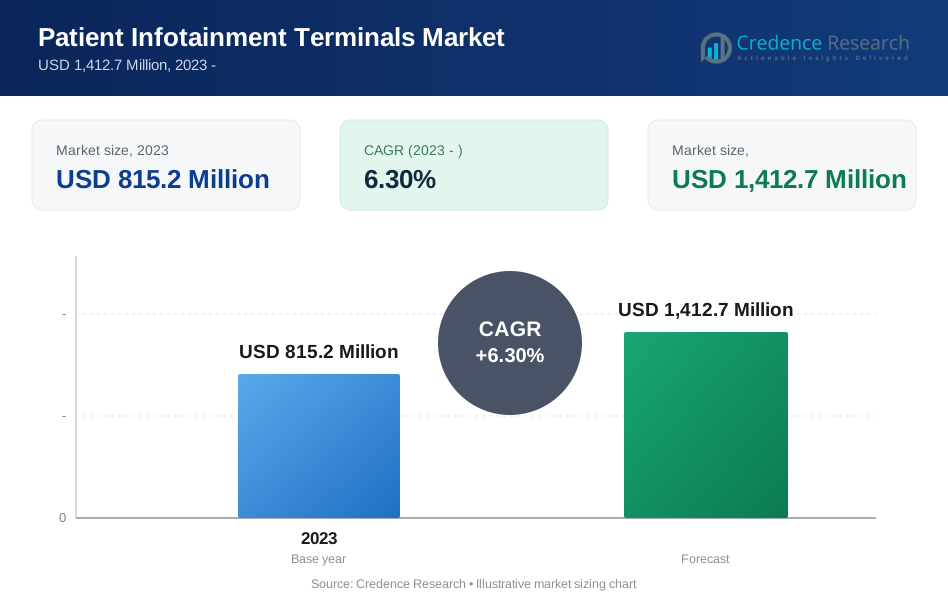
- The Patient Infotainment Terminals Market attained a valuation of USD 815.2 Million in 2023 and is anticipated to escalate to USD 1412.7 Million by 2032, exhibiting a robust CAGR of 6.30% during the forecast period from 2024 to 2032.
- Among the key segments, Integrated bedside terminals hold the largest market share by product type, approximately 40-45% in 2023, owing to their convenience and functionality at the point of care. Mobile Terminals are projected to witness the highest CAGR during the forecast period due to their flexibility in providing access to important services while allowing patient mobility.
- Hospitals currently dominate the market by end-user, holding approximately 40-42% market share in 2023, driven by their robust healthcare IT structures and investments in patient infotainment solutions. Long-Term Care Facilities are projected to witness the highest CAGR during the forecast period due to the aging population's need for extended support and quality of life.
- Entertainment functionality holds the largest market share by functionality, approximately 30-32% in 2023, owing to its ability to provide patients with stress-relief and connectivity with loved ones. Education is projected to witness the highest CAGR during the forecast period due to its interactive learning capabilities.
- Standalone terminals hold the largest market share by integration, approximately 60-65% in 2023, owing to their ease of installation and compatibility with existing hospital IT infrastructure. Integrated Systems are projected to witness the highest CAGR during the forecast period.
- Standardized terminals hold the largest market share by customization, approximately 50-55% in 2023, due to their ease of setup and broad applicability across multiple settings. Customized terminals are projected to witness the highest CAGR during the forecast period due to personalized features catering to specific needs.
- North America held the largest market share, around 38-42% in 2023, driven by developed healthcare infrastructure, government initiatives, and collaborations between technology companies and hospitals. Asia Pacific and Europe collectively accounted for just under 55% share in 2023, with Asia Pacific holding over 20% share in the same year.
- Technological advancements, emphasis on preventive medicine, regulatory mandates, and economic considerations are primary drivers of the market growth. Additionally, collaborations between technology companies and healthcare facilities contribute to market expansion.

Executive Summary
Market Definition
The global patient infotainment terminals market identifies manufacturers and sellers of devices. The market is growing due to the demand for enhanced patient experience, increased focus on patient engagement and education, and technological advancements variety of wall-mounted, portable, and bedside products in this market. A patient infotainment terminal is a device installed in patient rooms in hospitals and healthcare facilities. It provides patients with entertainment channels such as movies, TV shows, music, internet surveys, and educational materials about their health conditions and treatment plans these terminals allow patients to order food, communicate with hospital staff, and room environment around, like a lamp, heat which he can control it.
Market Overview
The Patient Infotainment Terminals Market has exhibited steady growth and is anticipated to maintain a robust Compound Annual Growth Rate (CAGR) of 6.30% from 2024 to 2032. Valued at USD 815.2 million in 2023, this market is forecasted to reach USD 1412.7 million by 2032.
The key driver boosting the growth rate of the Patient Infotainment Terminals market is the increasing focus on patient-centered care solutions and advancements in technology that enable enhanced patient experiences and engagement. The demand for improved patient satisfaction and education, coupled with technological advancements in wall-mounted, portable, and bedside products, drives market expansion.
Furthermore, the expansion of the Patient Infotainment Terminals market is actively driven by regulatory mandates and economic considerations, alongside the emphasis on preventive medicine. The market is expected to grow significantly during the forecast period due to increasing investments in healthcare IT infrastructure and the aging population's demand for long-term care solutions.
In addition, the Patient Infotainment Terminals market is poised for growth due to the adoption of various strategies among market players, including mergers & acquisitions, collaborations, and new product launches, to meet evolving patient needs and stay competitive in the market. These factors create several new opportunities for the Patient Infotainment Terminals market to expand during the forecast period.
Segmentation by Product Type:
- Integrated bedside terminals currently hold the largest market share approx. 40-45% in 2023 owing to they offer convenience and functionality at the point of care.
- Mobile Terminals are projected to witness the highest CAGR during the forecast period. Mobile terminals permit patients to move freely inside and outside the health center while still having access to important offerings such as meal ordering, verbal exchange with clinical experts, and net connectivity.
Segmentation by End User
- Hospitals currently hold the largest market share approx. 40-42% in 2023 owing to hospitals having greater healthcare IT structures. Hospitals tend to make investments greater comfortably in patient infotainment solutions which drive the market growth.
- Long-Term Care Facilities are projected to witness the highest CAGR during the forecast period owing to the aging population requiring long-term support and quality of life during extended stays.
Segmentation by Functionality
- Entertainment functionality currently holds the largest market share approx. 30-32% in 2023 owing to easy access to movies, TV shows, music, games, and video conferencing allows patients to reduce stress, and maintain connections with loved ones during their stay.
- Education is projected to witness the highest CAGR during the forecast period. Education offering interactive learning enhanced patient satisfaction.
Segmentation by Integration
- Standalone terminals currently hold the largest market share approx. 60-65% in 2023 owing to ease of installation, low initial cost, and compatibility with existing hospital IT infrastructure.
- Integrated Systems is projected to witness the highest CAGR during the forecast period.
Segmentation by Customization:
- Standardized terminals currently hold the largest market share approx. 50-55% in 2023. Many healthcare vendors opt for standardized terminals bringing up minimal setup complexity, easier renovation, and extensive applicability across a couple of settings.
- Customized terminals is projected to witness the highest CAGR during the forecast period. Personalized features encompass hardware aesthetics, software packages, and language localizations that drive market growth.
Segmentation by Region
- North America Asia Pacific held the largest share around 38-42% of the market in 2023. Cutting-edge technology, high healthcare spending, favorable government policies, and the presence of key market players are key factors driving the growth of the patient infotainment terminals market in North America.
- Asia Pacific and Europe collectively account for just under 55% share in 2023, with Asia Pacific holding over 20% share in the same year.
- The rest of the world, including Latin America, the Middle East, and Africa, supplies the remaining demand for Patient Infotainment terminals.
Technological advancements, emphasis on preventive medicine, regulatory mandates, and economic considerations are also contributing to the market growth.
The North American region holds the largest market share in the Patient Infotainment Terminals market. The market is growing due to various factors such as developed healthcare infrastructure, government initiatives, robust healthcare IT systems, and investment in developed integrated healthcare IT systems. For instance, in October 2023, officials at the Texas Health and Human Services Commission (HHSC) announced a $120 million investment to renovate the Rio Grande State Center in Harlingen, Texas, transforming it into a state-of-the-art inpatient psychiatric facility with a 50-bed maximum security unit and modern therapeutic spaces for patients experiencing mental illness. Moreover, the presence of advanced technology-based companies collaborated with various hospitals to cater to the demand of this market. For instance, in September 2023, Microsoft and Mercy collaborated to empower clinicians to transform patient care through the use of generative AI and other digital technologies.
The Asia Pacific region witnesses significant growth in the patient infotainment terminals market. This growth can be attributed to several key factors such as rapid advancements in healthcare infrastructure and technology adoption in countries like China, India, Japan, and South Korea have increases which have driven the market growth. For instance, in October 2023, Mitsui & Co., Ltd. invested $8 million in Lokavant Holdings Inc., a U.S. clinical trial intelligence technology company, to expand Lokavant's AI-optimized platform across the Asia-Pacific (APAC) region. Mitsui is indeed focused on transforming the healthcare system into a more patient-centric one by promoting the prevention of illnesses and creating environments that support both physical and mental well-being. Moreover, the presence of various market players such as Advantech Co., Ltd, ARBOR Technology Corp, PDi Communication Systems Inc., and others continue to innovate new solutions to cater to the demand of this region. For instance, in December 2023, Advantech, a leading provider of digital healthcare solutions, introduced the USM-100H, a medical-grade, slim, mini-computer designed for clinical applications in the healthcare industry.
Key Highlights of the Report
The global Patient Infotainment Terminals market is segmented by product type, end-user, functionality, integration, customization, and region. Integrated bedside terminals hold the largest market share by product type, particularly in hospitals, while entertainment functionality dominates in terms of functionality. Standalone terminals are the most widely used integration type, and standardized terminals are predominant in terms of customization. North America leads the market growth.
One of the main factors driving the global market for Patient Infotainment Terminals is the increasing focus on patient-centered care solutions and technological advancements that enhance the patient experience. The demand for improved patient satisfaction and engagement, coupled with investments in healthcare IT infrastructure, also contributes significantly to market expansion. Additionally, regulatory mandates and economic considerations propel market growth.
Nonetheless, North America is expected to hold the largest share of the global Patient Infotainment Terminals market due to its developed healthcare infrastructure and government initiatives supporting patient-centric care solutions. Furthermore, the market is projected to grow at the highest rate in the Asia-Pacific (APAC) region, driven by rapid advancements in healthcare technology and the increasing demand for personalized patient experiences.
Key players such as Advantech Co., Ltd, ARBOR Technology Corp, PDi Communication Systems Inc., Onyx Healthcare Inc., CliniLinc, ClinicAll International Corporation, and others focus on product innovation and strategic collaborations to maintain their market position and competitiveness in the Patient Infotainment Terminals industry.
What Are The Main Drivers Of The Global Patient Infotainment Terminals Market?
The global Patient Infotainment Terminals market is driven by various factors such as advancements in healthcare technology, rising demand for digital healthcare solutions, and increasing focus on patient-centered care solutions with various functionalities such as education, entertainment, and hospital services. Moreover, the growing aging population led to an increasing need for patient infotainment terminals and rising healthcare expenditures further drive the market growth.
What Are The Major Challenges Faced By The Global Patient Infotainment Terminals Market?
The global Patient Infotainment Terminals market is mainly challenged by fierce competition among key players, rapid technological advancements high cost of implementation and maintenance, concerns regarding data security and patient privacy, and cyber security issues related to patient data and hospitals. Moreover, the complexity of integrating infotainment terminals poses challenges to existing workflows creating significant challenges for the market.
What Are The Growth Opportunities In The Global Patient Infotainment Terminals Market?
The global Patient Infotainment Terminals market presents numerous growth opportunities such as increasing adoption of digital healthcare solutions, expansion of healthcare infrastructure in emerging markets, and increasing remote monitoring create opportunities for the market. With advanced technology such as AI and ML various hospitals take advantage of this technology to provide seamless patient infotainment terminals solutions in various customization solutions such as standardized terminals, and customized terminals. In addition, the adoption of various strategies among market players creates significant opportunities for the market.
Market Drivers
The global Patient Infotainment Terminals market is driven by several factors. The following are the key drivers of the global Patient Infotainment Terminals market:
Increasing Focus On Patient-Centered Care Solutions
Increasing focus on patient-centered care solutions with various functionalities such as education, entertainment, and hospital services drives the global Patient Infotainment Terminals market. As healthcare vendors prioritize improving patient experience, the demand for such solutions is growing. Patients benefit from access to information and entertainment during their hospital stay, improving satisfaction levels. Moreover, healthcare centers can streamline communique and deliver crucial messages correctly through these terminals. This awareness of patient-targeted care drives the adoption of Patient Infotainment Terminals, contributing to market increase globally. For instance, in May 2022, Advantech launched the POC-4 Series, The Advantech POC-4 Series is a medical-grade point-of-care (POC) terminal designed for diverse healthcare applications, featuring a full HD display ranging from 21” to 24” and powered by an 8th gen Intel Core i5 8365UE/Celeron 4305UE processor for high-performance computing.
Market Restraints
The global Patient Infotainment Terminals market faces some challenges that may hinder its growth. These include the following:
Rapid Technological Advancements
The Patient Infotainment Terminals market is primarily constrained by rapid technological advancements, which require significant investment in R&D to be competitive. This need for constant product innovation may restrain the growth of the patient infotainment terminals market. High R&D costs and short product life of breaking systems can make it difficult for companies to recoup their investments, potentially hampering market expansion. Moreover, rapid technological change means companies must continuously innovate their products, which can increase production costs and short product life cycles can be affected.
Opportunities
The global Patient Infotainment Terminals market offers significant growth opportunities. These include the following:
Adoption Of Various Strategies Among Market Players
The adoption of various strategies among market players creates significant opportunities for the market. The major companies serving the global Patient Infotainment Terminals Market are Advantech Co., Ltd, ARBOR Technology Corp, and PDi Communication Systems Inc.,, among others. The market players are considerably contributing to the market growth by the adoption of various strategies including mergers & acquisitions, collaborations, funding, and new product launches, approvals to stay competitive in the market. For instance, in May 2021, The TMM-Advantech solution was implemented in CHAL Hospital and two additional French hospitals-Sainte Marie and Institut De Readaptation D'acheres-providing patients with entertaining and informative content. This collaboration aims to enhance patient satisfaction, increase engagement, and facilitate smooth communication between hospital staff and patients. Featuring customizable user interfaces, multi-language support, and flexible device integration, this system caters to diverse patient needs and preferences while strengthening hospitals' capacity to handle large volumes of requests efficiently.
Competitive Landscape
Key Players
The global Patient Infotainment Terminals market is highly competitive, with several key players. Some of the major players in the market and their market share are as follows:
- Advantech Co., Ltd
- ARBOR Technology Corp
- PDi Communication Systems Inc.
- Onyx Healthcare Inc.
- CliniLinc
- ClinicAll International Corporation
- Others
These organizations prioritize product innovation, distribution channel expansion, and mergers and acquisitions to stay competitive.
The global Patient Infotainment Terminals market's key players continually seek to stay ahead by offering new products and developments.
In April 2024, Dräger, a renowned medical and safety technology leader, introduced the Vista 300 patient monitoring system in India to revolutionize hospital-wide information flow. This innovative system is designed to enhance patient monitoring, ensuring seamless data transfer and advanced features for optimal care delivery.
In May 2022, Advantech launched the POC-4 Series. The Advantech POC-4 Series is a medical-grade point-of-care (POC) terminal designed for diverse healthcare applications, featuring a full HD display ranging from 21” to 24” and powered by an 8th gen Intel Core i5 8365UE/Celeron 4305UE processor for high-performance computing.
Summary of Key Findings
- The Patient Infotainment Terminals Market is experiencing significant growth, propelled by the increasing focus on patient-centered care solutions and technological advancements enhancing patient experiences. This growth is further fueled by investments in healthcare IT infrastructure and regulatory mandates promoting patient engagement.
- Market segmentation within the Patient Infotainment Terminals Market encompasses product type, end user, functionality, integration, customization, and region, reflecting the diverse applications of patient infotainment solutions across various healthcare settings.
- Integrated bedside terminals emerge as the dominant segment, offering convenience and functionality at the point of care. Entertainment functionality leads the segment, providing patients with stress-relief and connectivity options.
- Hospitals hold the largest market share by end user, driven by their robust healthcare IT structures and investments in patient infotainment solutions. Standardized terminals dominate the customization segment, offering minimal setup complexity and extensive applicability.
- North America leads the market in terms of region, supported by developed healthcare infrastructure and government initiatives promoting patient-centric care solutions. Asia Pacific and Europe collectively account for a significant share, driven by advancements in healthcare technology.
Future Outlook
- The future outlook for the Patient Infotainment Terminals Market indicates promising growth opportunities, particularly within hospitals, long-term care facilities, and specialty clinics segments, driven by increasing healthcare expenditures and the aging population's demand for personalized patient experiences.
- Anticipated challenges include intense competition among key players, rapid technological advancements, and concerns regarding data security and patient privacy. To maintain market competitiveness, industry players should focus on continuous innovation, strategic collaborations, and market expansion.
- Companies need to prioritize research and development efforts to meet evolving patient needs and regulatory standards. Additionally, exploring opportunities in emerging markets and leveraging advanced technologies will be crucial for sustained growth in the Patient Infotainment Terminals Market.
How CXOs Can Benefit from the Credence Research Patient Infotainment Terminals Market Report
The Credence Research Patient Infotainment Terminals Market Report provides CXOs with a comprehensive overview of the market, including:
- Market size and growth forecast: The report provides detailed estimates of the global Patient Infotainment Terminals market size, segmented by product type, end-user, functionality, integration, customization, and region. It also includes forecasts for the market through 2032, based on key trends and drivers.
- Market segmentation: The report segments the Patient Infotainment Terminals market by product type, end-user, functionality, integration, customization, and region. The increasing demand for advanced solutions is driven. This segmentation provides CXOs with a granular understanding of the market and the opportunities in each segment.
- Competitive landscape: The report profiles the key players in the Patient Infotainment Terminals market and provides insights into their strategies, product offerings, and financial performance. This information can help CXOs to identify and assess their competition.
- Key trends and drivers: The report identifies and analyzes the key trends and drivers that are shaping the Patient Infotainment Terminals market. This information can help CXOs to make informed decisions about their investments and strategies.
CXOs can use the insights from the Credence Research Patient Infotainment Terminals Market Report to:
- Identify growth opportunities: The report can help CXOs identify new growth opportunities in the Patient Infotainment Terminals market. For example, the report identifies the growing demand for Patient Infotainment terminal networks from cloud computing providers and telecom companies as a key opportunity.
- Make informed investment decisions: The report can help CXOs make informed investment decisions about Patient Infotainment terminal networks. For example, the report provides insights into the key factors to consider when evaluating Patient Infotainment Terminals providers and selecting Patient Infotainment Terminals solutions.
- Develop competitive strategies: The report can help CXOs to develop competitive strategies for their Patient Infotainment Terminals businesses. For example, the report identifies the key strategies that Patient Infotainment terminal providers are using to differentiate themselves from their competitors.
- Track market developments: The report can help CXOs track market developments and stay ahead of the curve. For example, the report provides insights into the latest trends and innovations in the Patient Infotainment Terminals market.
Overall, the Credence Research Patient Infotainment Terminals Market Report is a valuable resource for CXOs who are looking to gain a deeper understanding of the market and identify growth opportunities.
Segmentation
- Product Type:
- Integrated Bedside Terminals
- Mobile Terminals
- Wall-Mounted Terminals
- Desktop Terminals
- End User:
- Hospitals
- Long-Term Care Facilities
- Specialty Clinics
- Functionality:
- Entertainment
- Communication
- Education
- Hospital Services
- Integration:
- Standalone Terminals
- Integrated Systems
- Customization:
- Standardized Terminals
- Customized Terminal
- By Region
- North America
- The U.S.
- Canada
- Mexico
- Europe
- Germany
- France
- The U.K.
- Italy
- Spain
- Rest of Europe
- Asia Pacific
- China
- Japan
- India
- South Korea
- South-east Asia
- Rest of Asia Pacific
- Latin America
- Brazil
- Argentina
- Rest of Latin America
- Middle East & Africa
- GCC Countries
- South Africa
- Rest of Middle East and Africa
- North America
Adjacent Markets
In the Patient Infotainment Terminals market, several adjacent markets have high revenue growth opportunities. The key adjacent markets for the Patient Infotainment Terminals market -
Adjacent Markets |
||
| Healthcare IT Solutions | Digital Health Technologies | Healthcare Communication Systems |
| Telemedicine Services | Remote Patient Monitoring Systems | Medical Device Connectivity Solutions |
| Patient Engagement Platforms | Hospital Entertainment Systems | Patient Education Platforms |
Request a Free Sample
Fill in your details and we'll send you a free sample report.
- Sample data tables & charts
- Research methodology
Market Dynamics
Emphasis on Patient-Centered Care
Healthcare providers are increasingly prioritizing patient experience and engagement, driving adoption of infotainment terminals that offer entertainment, education, and communication functionalities to improve satisfaction and outcomes.
Technological Advancements in Healthcare IT
Continuous innovation in digital health technologies, such as integration with hospital information systems and support for interactive applications, is making patient infotainment terminals more versatile and attractive to healthcare facilities.
Regulatory Mandates and Quality Initiatives
Government policies and accreditation standards are encouraging hospitals to invest in solutions that enhance patient engagement and communication, directly supporting the deployment of infotainment terminals.
Expansion of Long-Term and Elderly Care
The growing aging population and increased demand for long-term care facilities are boosting the need for infotainment terminals that support quality of life and patient education during extended stays.
Collaborations and Strategic Partnerships
Partnerships between technology providers and healthcare institutions are accelerating the rollout of advanced infotainment solutions, enabling broader market penetration and tailored offerings.
Need a Custom Version of This Report?
Tailor the scope, geography, or segments to your exact requirements.
- Custom geography or segment scope
- Direct access to our analyst team
Frequently Asked Questions
What is the current size of the global Patient Infotainment Terminals market?
What is the expected growth rate of the Patient Infotainment Terminals market between 2024 and 2032?
Which segment is leading the market share in terms of Product Type?
Which End User segments govern the demand for Patient Infotainment terminals in the world?
Which Functionality segment is expected to post the highest CAGR during the forecast period?
Which region is fueling the growth of the Patient Infotainment Terminals industry?
Who are the major players in the global Patient Infotainment Terminals market?
What are the major market drivers of the Patient Infotainment Terminals industry?
What are the major market restraints of the Patient Infotainment Terminals industry?
What are the major market opportunities of the Patient Infotainment Terminals industry?
Table of Content
Chapter 1 Market Segmentation
- 1.1 Segmentation Framework
- 1.1.1 Product and Service Classification
- 1.1.2 Application and End-Use Classification
- 1.1.3 Technology and Solution Classification
- 1.1.4 Customer and Distribution Channel Classification
- 1.1.5 Geographic Segmentation
- 1.1.6 Market Segment Definitions and Boundaries
- 1.2 By End User
- 1.2.1 Hospitals
- 1.2.2 Long-Term Care Facilities
- 1.2.3 Specialty Clinics
- 1.3 By Integration
- 1.3.1 Standalone Terminals
- 1.3.2 Integrated Systems
- 1.4 By Product Type
- 1.4.1 Integrated Bedside Terminals
- 1.4.2 Mobile Terminals
- 1.4.3 Wall-Mounted Terminals
- 1.4.4 Desktop Terminals
- 1.5 By Functionality
- 1.5.1 Entertainment
- 1.5.2 Communication
- 1.5.3 Education
- 1.5.4 Hospital Services
Chapter 2 Introduction
- 2.1 Report Objectives and Scope
- 2.2 Product Definition and Industry Terminology
- 2.3 Market Inclusions and Exclusions
- 2.4 Research Process
- 2.4.1 Primary Research and Expert Interviews
- 2.4.2 Secondary Research and Source Review
- 2.4.3 Top-Down and Bottom-Up Estimation
- 2.4.4 Data Triangulation and Verification
- 2.5 Market Size Measurement Basis
- 2.5.1 2023: USD 815.2 Million → 2032: USD 1,412.7 Million
- 2.6 Historical and Forecast Reference Periods
- 2.6.1 Base Year: 2023
- 2.6.2 Forecast Period: 2023-2032
- 2.7 Research Assumptions and Limitations
Chapter 3 Executive Summary
- 3.1 Market Snapshot and Key Findings
- 3.2 Base-Year Market Size, 2023
- 3.3 Forecast Market Size, 2032
- 3.4 Revenue and Volume Growth Outlook
- 3.5 Key Demand and Supply Indicators
- 3.6 Leading Market Segments
- 3.7 Fastest-Growing Market Opportunities
- 3.8 Regional Performance Highlights
- 3.9 Technology and Industry Transformation
- 3.10 Competitive Landscape Summary
- 3.11 Analyst View and Strategic Implications
Chapter 4 Global Patient Infotainment Terminals Market Trends and Developments
- 4.1 Historical Industry Development
- 4.2 Recent Market Trends and Developments
- 4.3 Demand and Customer Behavior Trends
- 4.4 Technology and Product Innovation
- 4.5 Artificial Intelligence, Automation and Digitalization
- 4.6 Local Manufacturing and Supply Chain Realignment
- 4.7 Industry Partnerships, Mergers and Acquisitions
- 4.8 Sustainability and Circular Economy Developments
- 4.9 Government and Private Sector Investment Trends
- 4.10 Emerging Business Models and Commercialization
- 4.11 Industry Developments and Announcements
Chapter 5 Global Patient Infotainment Terminals Market Production, Supply and Demand Analysis
- 5.1 Demand Trend and Consumption Analysis
- 5.2 Demand Forecast, 2023-2032
- 5.3 Production and Output Trend
- 5.4 Production and Output Forecast, 2023-2032
- 5.5 Installed Capacity and Capacity Utilization
- 5.6 Company-Wise Production Plants and Statistics
- 5.6.1 Installed Production Capacity
- 5.6.2 Actual Production
- 5.6.3 Planned Capacity and Expansion Targets
- 5.7 Supply Chain Structure and Procurement Trends
- 5.8 Supply-Demand Gap and Bottlenecks
- 5.9 Import Dependence and Sourcing Structure
- 5.10 Contract Manufacturing and Outsourcing
- 5.11 Regional Supply and Demand Concentration
Chapter 6 Global Patient Infotainment Terminals Market Pricing Analysis
- 6.1 Pricing Structure and Measurement
- 6.2 Historical Pricing Trends
- 6.3 Pricing Outlook, 2023-2032
- 6.4 Average Selling Price and Unit Economics
- 6.5 Pricing by Product and Market Segment
- 6.6 Geographic Pricing Differences
- 6.7 Key Input, Energy, Labor and Logistics Costs
- 6.8 Contract Pricing and Purchasing Models
- 6.9 Pricing Sensitivity and Competitive Positioning
- 6.10 Price, Margin and Profitability Implications
Chapter 7 Global Patient Infotainment Terminals Market Dynamics
- 7.1 Market Growth Drivers
- 7.1.1 Demand-Side Drivers
- 7.1.2 Technology and Innovation Drivers
- 7.1.3 Infrastructure and Investment Drivers
- 7.1.4 Regulatory and Policy Drivers
- 7.2 Market Restraints
- 7.2.1 Cost and Affordability Constraints
- 7.2.2 Technology and Adoption Barriers
- 7.2.3 Supply Chain and Operational Constraints
- 7.3 Market Challenges
- 7.3.1 Competitive Pressure and Margin Erosion
- 7.3.2 Skills, Infrastructure and Implementation Gaps
- 7.4 Emerging Market Opportunities
- 7.5 Market Dynamics Impact and Time-Horizon Assessment
Chapter 8 Global Patient Infotainment Terminals Value Chain Analysis
- 8.1 Industry Value Chain Overview
- 8.2 Upstream Suppliers and Critical Inputs
- 8.3 Technology and Component Providers
- 8.4 Manufacturing or Service Delivery
- 8.5 Distribution, Channel Partners and Integrators
- 8.6 Downstream Applications and End Users
- 8.7 Value Addition and Profit Pools
- 8.8 Vertical Integration and Outsourcing
- 8.9 Supplier Concentration and Risk
- 8.10 Supply Chain Localization and Resilience
Chapter 9 Global Patient Infotainment Terminals Market Regulations and Policies
- 9.1 Relevant Laws, Standards and Compliance Frameworks
- 9.2 Product, Service, Safety and Quality Requirements
- 9.3 Government Policies, Incentives and Subsidies
- 9.4 Imports, Exports and Trade Barriers
- 9.5 Public Procurement and Local Content Requirements
- 9.6 Environmental and Sustainability Compliance
- 9.7 Upcoming Policy Changes and Market Implications
Chapter 10 Global Patient Infotainment Terminals Market Hotspots and Opportunities
- 10.1 Market Opportunity Mapping and Growth Hotspots
- 10.2 High-Growth Applications and Customer Groups
- 10.3 Underserved Markets and White-Space Opportunities
- 10.4 Emerging Technology and Product Opportunities
- 10.5 New Capacity and Investment Hotspots
- 10.6 Market Entry and Expansion Opportunities
- 10.7 Distribution and Partnership Opportunities
- 10.8 Near-Term and Long-Term Commercial Potential
- 10.9 Opportunity Attractiveness and Execution Risks
Chapter 11 Global Patient Infotainment Terminals Market Outlook, 2023-2032
- 11.1 Market Size and Analysis
- 11.1.1 Revenue (Market Measurement: 2023: USD 815.2 Million → 2032: USD 1,412.7 Million)
- 11.1.2 Market Volume and Quantity Sold
- 11.1.3 Historical Market Size
- 11.1.4 Base-Year Market Size, 2023
- 11.2 Market Forecast, 2023-2032
- 11.2.1 Revenue Forecast to 2032
- 11.2.2 Volume Forecast to 2032
- 11.2.3 CAGR and Year-on-Year Growth
- 11.2.4 Incremental Revenue Opportunity
- 11.3 Forecast Assumptions and Scenario Analysis
- 11.3.1 Base-Case Forecast
- 11.3.2 Optimistic and Conservative Scenarios
- 11.3.3 Technology, Pricing and Policy Sensitivities
- 11.4 Market Attractiveness and Growth Outlook
Chapter 12 Global Patient Infotainment Terminals Market Segmentation and Outlook
- 12.1 Segmentation Summary and Market Shares, 2023
- 12.2 Largest and Fastest-Growing Segments
- 12.3 By End User - Market Size and Forecast, 2023-2032
- 12.3.1 Segment Definition and Scope
- 12.3.2 Historical Market Size
- 12.3.3 Revenue Forecast, 2023-2032
- 12.3.4 Volume Forecast, 2023-2032
- 12.3.5 Base-Year Market Share, 2023
- 12.3.6 Segment CAGR and Growth Drivers
- 12.3.7 Subsegment Market Size and Forecast
- 12.3.7.1 Hospitals
- 12.3.7.2 Long-Term Care Facilities
- 12.3.7.3 Specialty Clinics
- 12.3.8 Subsegment Pricing and Adoption Trends
- 12.3.9 Leading Suppliers and Competition
- 12.3.10 Regional Demand and Opportunities
- 12.4 By Integration - Market Size and Forecast, 2023-2032
- 12.4.1 Segment Definition and Scope
- 12.4.2 Historical Market Size
- 12.4.3 Revenue Forecast, 2023-2032
- 12.4.4 Volume Forecast, 2023-2032
- 12.4.5 Base-Year Market Share, 2023
- 12.4.6 Segment CAGR and Growth Drivers
- 12.4.7 Subsegment Market Size and Forecast
- 12.4.7.1 Standalone Terminals
- 12.4.7.2 Integrated Systems
- 12.4.8 Subsegment Pricing and Adoption Trends
- 12.4.9 Leading Suppliers and Competition
- 12.4.10 Regional Demand and Opportunities
- 12.5 By Product Type - Market Size and Forecast, 2023-2032
- 12.5.1 Segment Definition and Scope
- 12.5.2 Historical Market Size
- 12.5.3 Revenue Forecast, 2023-2032
- 12.5.4 Volume Forecast, 2023-2032
- 12.5.5 Base-Year Market Share, 2023
- 12.5.6 Segment CAGR and Growth Drivers
- 12.5.7 Subsegment Market Size and Forecast
- 12.5.7.1 Integrated Bedside Terminals
- 12.5.7.2 Mobile Terminals
- 12.5.7.3 Wall-Mounted Terminals
- 12.5.7.4 Desktop Terminals
- 12.5.8 Subsegment Pricing and Adoption Trends
- 12.5.9 Leading Suppliers and Competition
- 12.5.10 Regional Demand and Opportunities
- 12.6 By Functionality - Market Size and Forecast, 2023-2032
- 12.6.1 Segment Definition and Scope
- 12.6.2 Historical Market Size
- 12.6.3 Revenue Forecast, 2023-2032
- 12.6.4 Volume Forecast, 2023-2032
- 12.6.5 Base-Year Market Share, 2023
- 12.6.6 Segment CAGR and Growth Drivers
- 12.6.7 Subsegment Market Size and Forecast
- 12.6.7.1 Entertainment
- 12.6.7.2 Communication
- 12.6.7.3 Education
- 12.6.7.4 Hospital Services
- 12.6.8 Subsegment Pricing and Adoption Trends
- 12.6.9 Leading Suppliers and Competition
- 12.6.10 Regional Demand and Opportunities
- 12.7 Segment Growth Comparison
- 12.8 Segment Attractiveness and Priority Matrix
Chapter 13 Global Patient Infotainment Terminals End-Use and Application Market Outlook
- 13.1 End-Use Industry and Customer Demand Structure
- 13.2 Leading Applications and Customer Groups
- 13.3 End-Use Market Size, Share and Forecast
- 13.4 Major End-Use Industry Deep Dives
- 13.4.1 Customer Requirements and Use Cases
- 13.4.2 Demand and Replacement Cycles
- 13.4.3 Technical and Regulatory Considerations
- 13.4.4 Purchasing and Procurement Models
- 13.4.5 Leading Vendors and Distribution Channels
- 13.4.6 Forecast and Commercial Opportunities
- 13.5 Emerging Applications and Cross-Segment Demand
- 13.6 End-Use Industry Investment Priorities
Chapter 14 Global Patient Infotainment Terminals Geographic Market Outlook, 2023-2032
- 14.1 Regional Market Size and Share, 2023
- 14.2 Regional Market Forecast, 2023-2032
- 14.3 Regional Pricing, Production and Demand Differences
- 14.4 North America
- 14.4.1 United States
- 14.4.2 Canada
- 14.4.3 Mexico
- 14.5 Europe
- 14.5.1 Germany
- 14.5.2 France
- 14.5.3 Italy
- 14.5.4 United Kingdom
- 14.5.5 Spain
- 14.5.6 Poland
- 14.5.7 Russia
- 14.5.8 Netherlands
- 14.5.9 Belgium
- 14.5.10 Sweden
- 14.5.11 Denmark
- 14.5.12 Norway
- 14.5.13 Rest of Europe
- 14.6 Asia Pacific
- 14.6.1 China
- 14.6.2 India
- 14.6.3 Japan
- 14.6.4 South Korea
- 14.6.5 Thailand
- 14.6.6 Indonesia
- 14.6.7 Vietnam
- 14.6.8 Malaysia
- 14.6.9 Australia
- 14.6.10 Rest of Asia Pacific
- 14.7 Latin America
- 14.7.1 Brazil
- 14.7.2 Argentina
- 14.7.3 Colombia
- 14.7.4 Chile
- 14.7.5 Rest of Latin America
- 14.8 Middle East
- 14.8.1 Saudi Arabia
- 14.8.2 United Arab Emirates
- 14.8.3 Turkey
- 14.8.4 Israel
- 14.8.5 Iran
- 14.8.6 Rest of the Middle East
- 14.9 Africa
- 14.9.1 South Africa
- 14.9.2 Egypt
- 14.9.3 Nigeria
- 14.9.4 Morocco
- 14.9.5 Rest of Africa
- 14.10 Regional Investment, Policy and Supply Chain Differences
- 14.11 Regional Competitive Landscape
- 14.12 Geographic Growth Hotspots
Chapter 15 Global Patient Infotainment Terminals Technology, Innovation and Sustainability Outlook
- 15.1 Technology Landscape and Maturity
- 15.2 Product, Process and Service Innovation
- 15.3 AI, Automation and Digital Tools in the Industry
- 15.4 Technology Adoption and Performance Benchmarking
- 15.5 Innovation Pipeline and R&D Investment
- 15.6 Patent and Intellectual Property Trends
- 15.7 Energy Efficiency and Resource Management
- 15.8 Sustainability, Recycling and Circularity
- 15.9 Technology Roadmap, 2023-2032
- 15.10 Risks of Obsolescence and Technology Substitution
Chapter 16 Global Patient Infotainment Terminals Market Key Strategic Imperatives
- 16.1 Growth and Market Entry Priorities
- 16.2 High-Return Products and Segments
- 16.3 Pricing, Profitability and Cost Optimization
- 16.4 Technology Investment and Product Differentiation
- 16.5 Supply Chain Localization and Resilience
- 16.6 Distribution and Customer Acquisition
- 16.7 Partnership, Acquisition and Capacity Strategy
- 16.8 Regional Expansion Priorities
- 16.9 Short-, Medium- and Long-Term Actions
Chapter 17 Competition Outlook
- 17.1 Industry Competition Characteristics
- 17.2 Market Structure and Concentration
- 17.3 Market Share and Competitive Positioning, 2023
- 17.4 Company-Wise Revenue and Product Benchmarking
- 17.5 Production and Service Capacity Benchmarking
- 17.6 Technology, Pricing and Differentiation
- 17.7 Regional Footprint and Distribution Strength
- 17.8 Mergers, Acquisitions and Strategic Alliances
- 17.9 New Entrants and Competitive Threats
- 17.10 Porter's Five Forces and Industry Attractiveness
- 17.11 Competitive Outlook, 2023-2032
Chapter 18 Company Profiles
- 18.1 Company Coverage and Selection Criteria
- 18.2 Advantech Co., Ltd
- 18.2.1 Business Description
- 18.2.2 Company Ownership and Geographic Presence
- 18.2.3 Product and Service Portfolio
- 18.2.4 Manufacturing and Operating Footprint
- 18.2.5 Production Capacity and Expansion Plans
- 18.2.6 Financial Performance and Investment
- 18.2.7 Market Share and Competitive Position
- 18.2.8 Technology and Innovation Capabilities
- 18.2.9 Strategic Alliances or Partnerships
- 18.2.10 Recent Developments
- 18.2.11 Growth Strategy and Outlook
- 18.3 ARBOR Technology Corp
- 18.4 PDi Communication Systems Inc.
- 18.5 Onyx Healthcare Inc.
- 18.6 CliniLinc
- 18.7 ClinicAll International Corporation
- 18.8 BEWATEC Kommunikationstechnik GmbH
- 18.9 Barco NV
- 18.10 Lincor Solutions
- 18.11 ITD GmbH
- 18.12 Other Relevant Market Participants
Note: Every listed company is profiled on the structure shown under the first company. The company list is preliminary and may change based on research findings, market developments, data availability and client requirements.
Chapter 19 Disclaimer
- 19.1 Research and Forecast Disclaimer
- 19.2 Data Source and Estimation Limitations
Note: The depth of individual sections depends on data availability for this market. Volume, capacity, trade and other unit-based metrics are included where applicable.
