
Market Overview
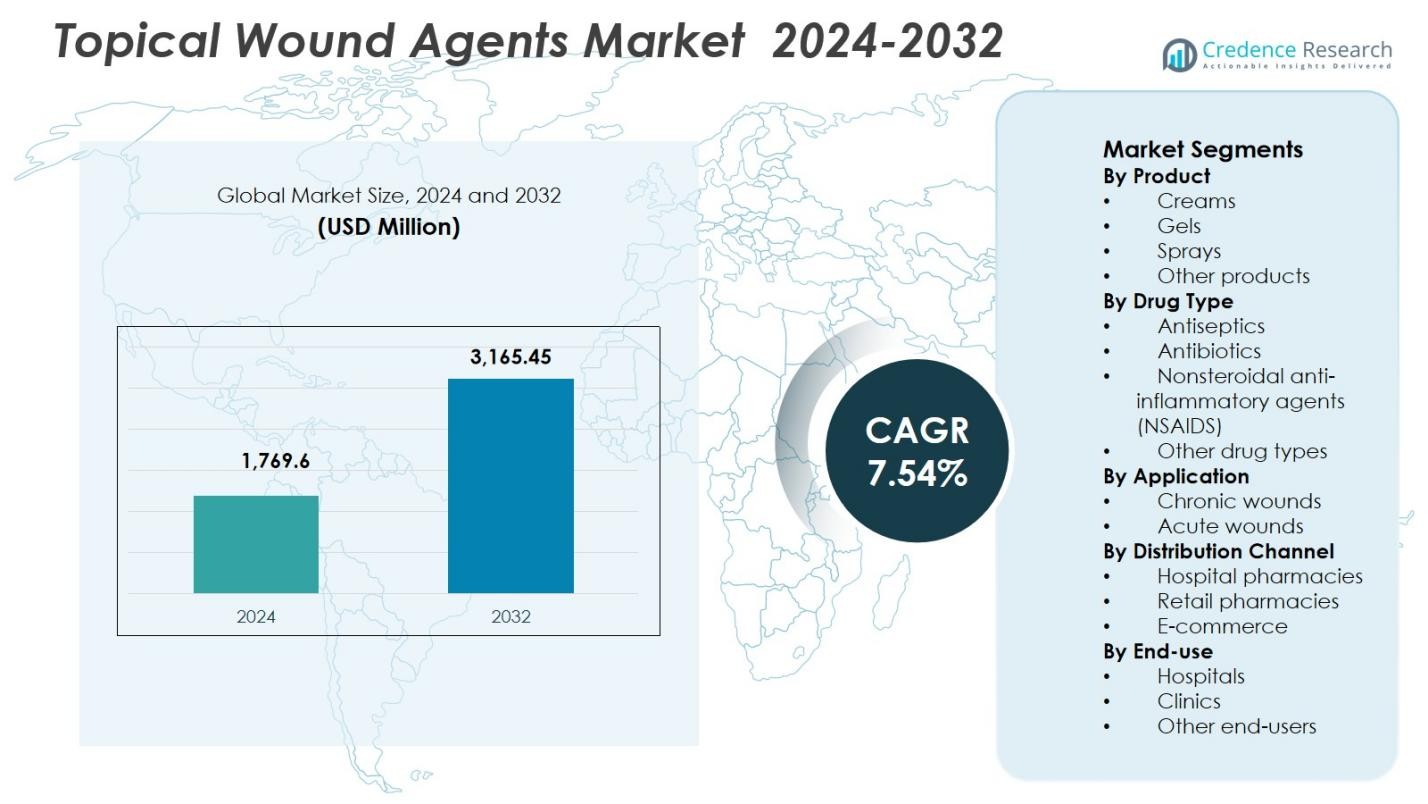
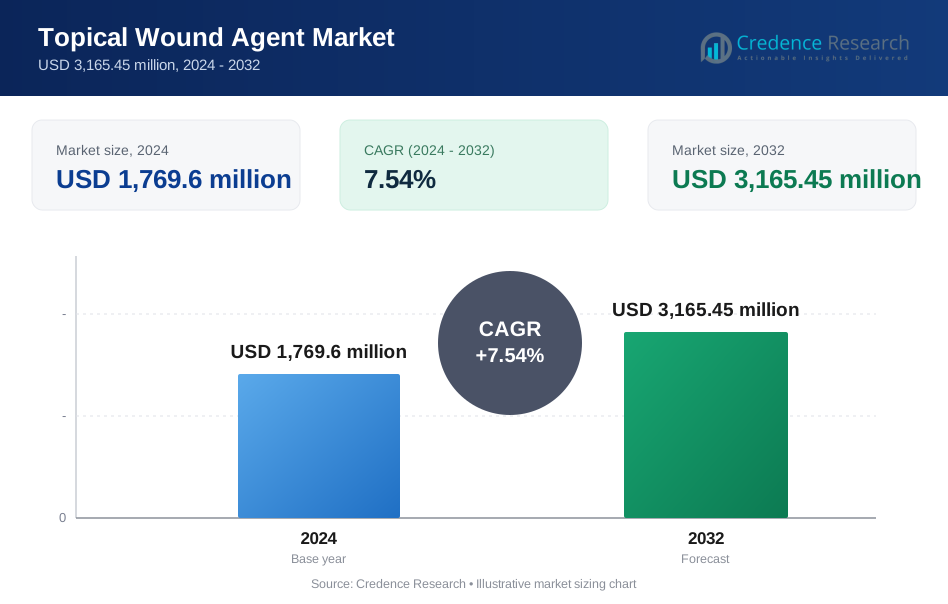
Topical Wound Agents Market size was valued at USD 1,769.6 million in 2024 and is anticipated to reach USD 3,165.45 million by 2032, at a CAGR of 7.54% during the forecast period.
| REPORT ATTRIBUTE | DETAILS |
|---|---|
| Historical Period | 2020-2023 |
| Base Year | 2024 |
| Forecast Period | 2025-2032 |
| Topical Wound Agents Market Size 2024 | USD 1,769.6 Million |
| Topical Wound Agents Market, CAGR | 7.54% |
| Topical Wound Agents Market Size 2032 | USD 3,165.45 Million |
Topical Wound Agents Market is shaped by the strong presence of established healthcare and pharmaceutical companies such as Smith & Nephew plc, 3M Company, Mölnlycke Health Care AB, Coloplast A/S, Medline Industries, Inc., Teva Pharmaceutical Industries Ltd., AstraZeneca, Arch Therapeutics, Inc., and Osiris Therapeutics, Inc. These players focus on expanding topical portfolios across creams, gels, and sprays to address infection control, pain management, and accelerated healing outcomes. Continuous investment in formulation advancements and broader distribution across hospitals and homecare settings supports sustained adoption. Regionally, North America leads the market with a 38.6% share, driven by advanced healthcare infrastructure, high chronic wound prevalence, and strong uptake of evidence-based wound care practices across clinical and outpatient settings.
Market Insights
- The Topical Wound Agents Market was valued at USD 1,769.6 million in 2024 and is projected to grow at a CAGR of 7.54% through the forecast period, driven by rising demand for effective wound management solutions across acute and chronic care settings.
- Market growth is primarily driven by increasing prevalence of chronic wounds, higher surgical volumes, and growing reliance on topical therapies for infection control, pain relief, and faster healing outcomes in hospitals and homecare environments.
- Product innovation remains a key trend, with creams holding a 42.6% segment share due to ease of application, while antiseptics lead by drug type with a 46.8% share supported by broad-spectrum antimicrobial effectiveness.
- Intense participation by established players encourages portfolio expansion, formulation enhancements, and wider distribution, while pricing pressure and regulatory scrutiny act as notable restraints affecting product positioning.
- Regionally, North America leads with a 38.6% share, followed by Europe at 27.4% and Asia Pacific at 22.1%, reflecting differences in healthcare infrastructure, chronic wound burden, and adoption of advanced wound care practices.
Market Segmentation Analysis:
By Product:
The Topical Wound Agents Market by product shows creams as the dominant sub-segment, accounting for 42.6% market share in 2024. Creams lead due to their ease of application, balanced moisture retention, and suitability across a wide range of wound types, including minor cuts and post-surgical wounds. Their ability to deliver consistent drug concentration enhances patient compliance in both hospital and homecare settings. Gels hold a 28.4% share, supported by cooling effects and rapid absorption, while sprays account for 19.1%, driven by demand for touch-free application. Other products collectively represent 9.9%, serving niche clinical needs.
- For instance, Hansaplast Wound Spray provides alcohol-free antiseptic cleansing for cuts, abrasions, and minor burns via mechanical irrigation, working at any angle without stinging or staining
By Drug Type:
By drug type, antiseptics dominate the Topical Wound Agents Market with a 46.8% market share, driven by their broad-spectrum antimicrobial action and widespread use in infection prevention. Antiseptics are preferred in first-line wound management across hospitals and outpatient clinics due to low resistance risk. Antibiotics follow with a 31.5% share, supported by their effectiveness in infected and high-risk wounds. NSAIDs account for 14.2%, benefiting from demand for pain and inflammation control during wound healing. Other drug types hold 7.5%, primarily used in specialized wound care protocols and adjunct therapies.
- For instance, Voltaren Gel (diclofenac sodium 1%) provides targeted relief for acute soft tissue injuries like sprains, offering pain reduction comparable to oral NSAIDs with localized action and minimal systemic absorption.
By Application:
Based on application, chronic wounds represent the dominant sub-segment with a 58.9% market share, driven by the rising prevalence of diabetic foot ulcers, pressure ulcers, and venous leg ulcers. The need for long-term wound management and frequent topical intervention sustains strong demand in this segment. Advanced topical formulations that support infection control and tissue regeneration further reinforce growth. Acute wounds account for 41.1%, supported by increasing surgical procedures, trauma cases, and outpatient wound treatments. Faster healing timelines and standardized treatment protocols characterize acute wound management across healthcare settings.
Key Growth Drivers
Rising Prevalence of Chronic and Lifestyle-Related Wounds
The Topical Wound Agents Market is strongly driven by the growing burden of chronic wounds associated with diabetes, obesity, and vascular disorders. Diabetic foot ulcers, pressure ulcers, and venous leg ulcers require continuous topical intervention for infection control and tissue regeneration. The expanding geriatric population further increases demand, as aging skin demonstrates delayed healing and higher vulnerability to injury. Healthcare providers increasingly rely on topical wound agents to manage long-term wound care efficiently, supporting sustained market growth across hospital, outpatient, and homecare settings.
- For instance, Collagenase SANTYL Ointment from Smith & Nephew treated pressure ulcers in a study of 787 patients. Patients achieved 38% higher 100% granulation rates and 47% higher epithelialization at one year versus medicinal honey.
Increasing Volume of Surgical Procedures and Trauma Cases
The steady rise in surgical procedures and trauma-related injuries significantly supports demand for topical wound agents. Post-operative wound management relies heavily on topical formulations to prevent infections, reduce inflammation, and accelerate healing. Growing adoption of minimally invasive surgeries and higher emergency care volumes reinforce consistent product utilization. Hospitals and ambulatory surgical centers integrate topical wound agents into standardized care pathways to enhance recovery outcomes and reduce complications, positioning these products as essential components of modern wound management protocols.
- For instance, Mölnlycke Health Care's Mepitel Ag, a silicone-based antimicrobial wound contact layer, inactivates wound pathogens within four hours and sustains activity for up to eight days in vitro, minimizing pain during dressing changes for sutured surgical wounds.
Advancements in Topical Drug Formulations and Delivery Technologies
Ongoing advancements in topical drug delivery and formulation technologies act as a key growth catalyst. Manufacturers are introducing enhanced creams, gels, and sprays with improved antimicrobial efficacy, optimized moisture balance, and controlled drug release. These innovations improve wound healing efficiency while enhancing patient compliance. Advanced formulations tailored for specific wound types support broader clinical adoption. Improved stability, ease of application, and compatibility with homecare use further strengthen market penetration across diverse healthcare environments.
Key Trends and Opportunities
Rising Adoption of Homecare and Self-Administered Wound Treatments
The growing shift toward home-based wound care represents a major trend and opportunity in the market. Patients increasingly prefer topical wound agents that allow safe and effective self-application, reducing dependency on frequent clinical visits. Easy-to-use creams and sprays align with shorter hospital stays and outpatient recovery models. Expanding retail and digital distribution channels further enhance accessibility, enabling manufacturers to directly engage patients and strengthen their presence in consumer-driven wound care segments.
- For instance, Neosporin First Aid Antibiotic Ointment enables home users to apply a thin layer directly to minor cuts, scrapes, or burns after cleaning, helping prevent infection without clinical intervention. Users cover it with a bandage and change daily as needed, supporting outpatient recovery.
Development of Multifunctional and Combination Topical Therapies
The market is witnessing increased development of multifunctional topical agents that combine antimicrobial, anti-inflammatory, and healing-promoting properties. These combination therapies simplify treatment protocols and improve clinical efficiency by addressing multiple wound care needs simultaneously. Healthcare professionals favor such integrated solutions to reduce product complexity and improve patient outcomes. This trend creates opportunities for premium product positioning and wider adoption in advanced and chronic wound management applications.
- For instance, ConvaTec's AQUACEL Ag Advantage dressing incorporates ionic silver and a hydrofiber layer that gels on contact with exudate to manage bioburden, sequester debris, and create a moist healing environment that reduces inflammation in infected chronic and acute wounds.
Key Challenges
Concerns Over Antimicrobial Resistance and Regulatory Compliance
Rising concerns regarding antimicrobial resistance present a significant challenge for the Topical Wound Agents Market. Excessive or inappropriate use of antibiotic-based topical agents increases resistance risks, prompting stricter clinical guidelines and regulatory scrutiny. Regulatory authorities demand robust evidence supporting safety, efficacy, and appropriate usage claims. These requirements increase development timelines and compliance costs, compelling manufacturers to invest heavily in research, clinical validation, and regulatory alignment to maintain market credibility.
Pricing Pressure and Inconsistent Reimbursement Policies
Pricing constraints and limited reimbursement coverage pose ongoing challenges to market expansion. In several regions, topical wound agents receive partial or no insurance reimbursement, particularly for long-term chronic wound care. Healthcare providers often prioritize cost containment, placing downward pressure on pricing and margins. This challenge is more acute in cost-sensitive and emerging markets, requiring manufacturers to balance innovation, affordability, and value-based differentiation to sustain adoption.
Regional Analysis
North America
North America leads the Topical Wound Agents Market with a 38.6% market share, driven by a high prevalence of chronic wounds, advanced healthcare infrastructure, and strong adoption of evidence-based wound care practices. The region benefits from widespread use of topical antiseptics and antibiotics across hospitals, ambulatory surgical centers, and homecare settings. Rising surgical volumes and trauma cases further support demand. Strong reimbursement frameworks and early adoption of advanced topical formulations enhance product penetration. The presence of established pharmaceutical and medical device companies also supports continuous innovation and consistent market growth across the United States and Canada.
Europe
Europe accounts for a 27.4% market share in the Topical Wound Agents Market, supported by an aging population and rising incidence of chronic wounds such as pressure ulcers and venous leg ulcers. Well-structured public healthcare systems promote standardized wound management protocols, driving steady demand for topical agents. Increased focus on infection prevention and post-surgical care further strengthens adoption. Countries including Germany, the United Kingdom, and France contribute significantly due to high healthcare spending and strong clinical awareness. Regulatory emphasis on safety and efficacy supports sustained use of clinically validated topical wound therapies.
Asia Pacific
Asia Pacific holds a 22.1% market share, reflecting rapid growth driven by increasing diabetes prevalence, rising surgical procedures, and expanding healthcare access. Growing awareness of wound care management and improving hospital infrastructure support higher adoption of topical wound agents. Countries such as China, India, and Japan contribute significantly due to large patient populations and expanding outpatient care services. Increasing investments in healthcare modernization and wider availability of affordable topical formulations further enhance market expansion. The region also benefits from growing acceptance of homecare-based wound management solutions.
Latin America
Latin America represents a 7.1% market share, supported by improving healthcare infrastructure and rising awareness of wound infection management. Increasing incidence of trauma injuries and surgical procedures drives demand for topical wound agents across hospitals and clinics. Countries such as Brazil and Mexico play a key role due to expanding public healthcare programs and urbanization. Growing access to basic wound care products and gradual adoption of advanced topical therapies support market growth. However, pricing sensitivity continues to influence product selection, encouraging demand for cost-effective formulations.
Middle East & Africa
The Middle East & Africa region accounts for a 4.8% market share, driven by gradual improvements in healthcare access and increasing focus on infection control in wound management. Rising cases of diabetes-related wounds and trauma injuries contribute to steady demand. Gulf Cooperation Council countries lead regional adoption due to higher healthcare spending and modern hospital facilities. In Africa, expanding primary healthcare initiatives support increased use of essential topical wound agents. While market penetration remains moderate, ongoing healthcare investments and awareness programs support long-term growth potential.
Market Segmentations:
By Product
- Creams
- Gels
- Sprays
- Other products
By Drug Type
- Antiseptics
- Antibiotics
- Nonsteroidal anti-inflammatory agents (NSAIDS)
- Other drug types
By Application
- Chronic wounds
- Acute wounds
By Distribution Channel
- Hospital pharmacies
- Retail pharmacies
- E-commerce
By End-use
- Hospitals
- Clinics
- Other end-users
By Geography
- North America
- U.S.
- Canada
- Mexico
- Europe
- Germany
- France
- U.K.
- Italy
- Spain
- Rest of Europe
- Asia Pacific
- China
- Japan
- India
- South Korea
- South-east Asia
- Rest of Asia Pacific
- Latin America
- Brazil
- Argentina
- Rest of Latin America
- Middle East & Africa
- GCC Countries
- South Africa
- Rest of the Middle East and Africa
Competitive Landscape
Competitive Landscape in the Topical Wound Agents Market features leading players such as Smith & Nephew plc, 3M Company, Mölnlycke Health Care AB, Coloplast A/S, Medline Industries, Inc., Teva Pharmaceutical Industries Ltd., AstraZeneca, Arch Therapeutics, Inc., and Osiris Therapeutics, Inc. These companies focus on portfolio expansion through advanced topical formulations, combination therapies, and differentiated delivery formats including creams, gels, and sprays. Market participants emphasize infection control, faster healing outcomes, and improved patient compliance to strengthen clinical adoption. Strategic priorities include product innovation, regulatory approvals, and expansion into homecare and outpatient settings. Partnerships with hospitals, wound care clinics, and distributors support broader market reach. Companies also invest in clinical validation and brand positioning to differentiate products in a highly regulated environment. Pricing strategies and value-based offerings play a critical role in maintaining competitiveness, particularly in cost-sensitive regions and long-term chronic wound management applications.
Key Player Analysis
- Medline Industries, Inc.
- Arch Therapeutics, Inc.
- Smith & Nephew plc
- Coloplast A/S
- AstraZeneca
- 3M Company
- Mölnlycke Health Care AB
- Osiris Therapeutics, Inc.
- Mylan N.V.
- Teva Pharmaceutical Industries Ltd.
Recent Developments
- In August 2025, Nuance Medical launched Hurri-Freeze, a new topical anesthetic spray designed for rapid, safe pain relief at the point of care.
- In March 2025, BioLab Holdings, Inc. entered a partnership with Real Collagen GmbH to develop advanced wound care products using fish collagen technology.
- In April 2024, Mölnlycke Health Care AB agreed to acquire P.G.F. Industry Solutions GmbH, adding the Granudacyn wound cleansing range to its portfolio.
- In November 2024, BioStem Technologies signed a letter of intent to acquire ProgenaCare Global's wound care products, including the topical revyve Antimicrobial Wound Gel, to expand its portfolio in hospital-based segments.
Report Coverage
The research report offers an in-depth analysis based on Product, Drug Type, Application, Distribution Channel, End Use and Geography. It details leading market players, providing an overview of their business, product offerings, investments, revenue streams, and key applications. Additionally, the report includes insights into the competitive environment, SWOT analysis, current market trends, as well as the primary drivers and constraints. Furthermore, it discusses various factors that have driven market expansion in recent years. The report also explores market dynamics, regulatory scenarios, and technological advancements that are shaping the industry. It assesses the impact of external factors and global economic changes on market growth. Lastly, it provides strategic recommendations for new entrants and established companies to navigate the complexities of the market.
Future Outlook
- The market will continue to expand steadily due to rising demand for effective management of chronic and lifestyle-related wounds.
- Advanced topical formulations with enhanced antimicrobial and healing properties will gain wider clinical acceptance.
- Homecare and self-administered wound treatment solutions will increasingly influence product design and distribution strategies.
- Combination therapies integrating infection control and tissue regeneration will shape future product development.
- Growing surgical volumes and outpatient procedures will sustain demand for acute wound care applications.
- Manufacturers will focus on improving patient compliance through easy-to-apply and fast-acting topical formats.
- Regulatory emphasis on safety and efficacy will encourage higher investment in clinical validation and innovation.
- Emerging markets will witness faster adoption supported by expanding healthcare infrastructure and awareness.
- Digital and retail pharmacy channels will play a larger role in improving product accessibility.
- Competitive intensity will increase as companies pursue differentiation through innovation, pricing strategies, and portfolio expansion.
Request a Free Sample
Fill in your details and we'll send you a free sample report.
- Sample data tables & charts
- Research methodology
Need a Custom Version of This Report?
Tailor the scope, geography, or segments to your exact requirements.
- Custom geography or segment scope
- Direct access to our analyst team
Frequently Asked Questions
What is the current market size for the Topical Wound Agents Market, and what is its projected size in 2032?
At what Compound Annual Growth Rate is the Topical Wound Agents Market projected to grow between 2024 and 2032?
Which Topical Wound Agents Market segment held the largest share in 2024?
What are the primary factors fueling the growth of the Topical Wound Agents Market?
Who are the leading companies in the Topical Wound Agents Market?
Which region commanded the largest share of the Topical Wound Agents Market in 2024?
Table of Content
Chapter 1. Report Introduction
- 1.1 Report Description & Purpose
- 1.1.1 Report Title & Market Definition
- 1.1.2 Unique Selling Propositions (USP) & Key Differentiators
- 1.1.3 Value Proposition for Stakeholders
- 1.2 Research Objectives
- 1.2.1 Market Sizing Objectives (Volume & Revenue)
- 1.2.2 Segmentation Objectives
- 1.2.3 Competitive Intelligence Objectives
- 1.2.4 Forecast & Scenario Objectives
- 1.3 Report Scope
- 1.3.1 Topical Wound Agent Scope – Types & Subtypes Covered
- 1.3.2 Geographic Scope – Regions & Countries Covered
- 1.3.3 Historical Period, Base Year & Forecast Period (2024; forecast to 2032)
- 1.3.4 Inclusions & Exclusions
- 1.4 HS Code & Classification Framework
- 1.5 Currency, Units & Pricing Basis
- 1.6 Target Stakeholders
- 1.7 Limitations & Assumptions
Chapter 2. Executive Summary
- 2.1 Global Topical Wound Agent Market Snapshot
- 2.1.1 Market Size – Historical (2024) & Forecast (2024-2032) (2024: USD 1,769.6 million → 2032: USD 3,165.45 million)
- 2.1.2 Volume & Revenue – Global Totals
- 2.1.3 Key Market Highlights – Top Five Facts
- 2.2 Topical Wound Agent Market Segmentation Snapshot
- 2.2.1 Market Split by Region – 2024 vs. 2032
- 2.3 Competitive Snapshot
- 2.3.1 Top 10 Players by Revenue Share – 2024
- 2.3.2 Top 10 Players by Volume Share – 2024
- 2.3.3 Recent Strategic Developments (18-Month Summary)
- 2.4 Key Investment Highlights & Strategic Conclusions
Chapter 3. Topical Wound Agent Market Dynamics & Industry Analysis
- 3.1 Market Overview & Context
- 3.1.1 Topical Wound Agent Market Position in the Broader Automotive Value Chain
- 3.1.2 OEM vs. Replacement Market Dynamics
- 3.1.3 Market Maturity & Development Stage by Region
- 3.2 Topical Wound Agent Market Drivers
- 3.3 Topical Wound Agent Market Restraints & Challenges
- 3.4 Topical Wound Agent Market Opportunities
- 3.5 Porter's Five Forces Analysis
- 3.5.1 Threat of New Entrants
- 3.5.2 Bargaining Power of Suppliers
- 3.5.3 Bargaining Power of Buyers
- 3.5.4 Threat of Substitutes
- 3.5.5 Competitive Rivalry – Intensity Assessment
- 3.6 Topical Wound Agent Value Chain Analysis
- 3.6.1 Upstream – Raw Material/Input Suppliers
- 3.6.1.1 Raw Material/Input 1
- 3.6.1.2 Raw Material/Input 2
- 3.6.1.3 Raw Material/Input 3
- 3.6.2 Midstream – Production/Manufacturing/Service Delivery
- 3.6.2.1 Production/Process Overview
- 3.6.2.2 Key Facility Locations & Capacity by Manufacturer
- 3.6.3 Downstream – Distribution & End Consumer
- 3.6.3.1 Primary Channel – B2B/OEM
- 3.6.3.2 Secondary Channels – Dealer, Retail, Online, Direct
- 3.6.4 Value Chain Profitability Analysis
- 3.6.1 Upstream – Raw Material/Input Suppliers
- 3.7 PESTEL Analysis
- 3.7.1 Political Factors
- 3.7.2 Economic Factors
- 3.7.3 Social Factors
- 3.7.4 Technological Factors
- 3.7.5 Environmental Factors
- 3.7.6 Legal Factors
- 3.8 Topical Wound Agent Supply Chain Analysis
- 3.8.1 Raw Material/Input Supply Risk Assessment
- 3.8.2 Manufacturing Concentration Risk (Geographic Exposure)
- 3.8.3 Trade Disruption Impact Analysis
- 3.9 Regulatory & Policy Landscape
Note: The regulatory and policy landscape section covers regulations based on their applicability to the market, Topical Wound Agent category, geography, and scope of the study. Only regulatory frameworks with a material impact on operations, compliance, trade, sustainability, or market access are analyzed in detail.
Chapter 4. Key Investment Pockets & Opportunity Analysis
- 4.1 Topical Wound Agent Market Attractiveness Analysis
- 4.1.1 By Region – Investment Attractiveness Matrix (Volume × CAGR)
- 4.2 Absolute Revenue Growth Opportunity
- 4.2.1 By Region – Absolute USD Growth Through 2032
- 4.3 Incremental Volume Opportunity
- 4.3.1 By Region – Incremental Volume Through 2032
- 4.3.2 Segment – Incremental Volume
- 4.4 Emerging Submarket Opportunity Deep Dive (Subject to Applicability)
- 4.5 Emerging Market Opportunity Scorecards
- 4.5.1 United States
- 4.5.2 Europe
- 4.5.3 Asia
- 4.5.4 Middle East & Africa
Note: Emerging Market Opportunity Scorecards will be included based on relevance and strategic importance. Regions listed are indicative and may vary depending on data availability and market dynamics.
Chapter 5. Topical Wound Agent Import-Export Analysis & Trade Flows
- 5.1 Global Trade Overview
- 5.1.1 Global Export Value by Country (2024)
- 5.1.2 Global Export Volume by Country (2024)
- 5.1.3 Global Import Value by Country (2024)
- 5.1.4 Global Import Volume by Country (2024)
- 5.1.5 Net Trade Balance by Country (2024)
- 5.2 Export Analysis – Segment
- 5.2.1 Type 1 (HS Code)
- 5.2.2 Type 2 (HS Code)
- 5.2.3 Type 3 (HS Code)
- 5.2.4 Type 4 (HS Code)
- 5.2.5 Type 5 (HS Code)
- 5.3 Import Analysis – Segment
- 5.3.1 Type 1 (HS Code)
- 5.3.2 Type 2 (HS Code)
- 5.3.3 Type 3 (HS Code)
- 5.3.4 Type 4 (HS Code)
- 5.3.5 Type 5 (HS Code)
- 5.4 Average Unit Trade Prices
- 5.4.1 Average Export Price – Segment & Country
- 5.4.2 Average Import Price – Segment & Source Country
- 5.4.3 Price Trends (2024)
- 5.5 Key Trade Route Analysis
- 5.5.1 Trade Route 1
- 5.5.2 Trade Route 2
- 5.5.3 Trade Route 3
- 5.5.4 Trade Route 4
- 5.5.5 Trade Route 5
- 5.6 Trade Policy Impact Assessment
- 5.6.1 US Anti-Dumping & Section 301 Tariffs
- 5.6.2 EU Customs Union Impact
- 5.6.3 Major Free Trade Agreements
- 5.6.4 USMCA Rules of Origin
Note: Trade policy analysis will be included only where relevant to the Topical Wound Agent market.
Chapter 6. Competitive Landscape & Company Benchmarking
- 6.1 Topical Wound Agent Market Concentration & Structure
- 6.1.1 Herfindahl-Hirschman Index (HHI) – vs. 2024
- 6.1.2 Tier 1, Tier 2 & Tier 3 Market Structure
- 6.1.3 Global, Regional & Local Player Dynamics
- 6.2 Topical Wound Agent Market Share Analysis – 2024
- 6.2.1 Global Revenue Share by Company
- 6.2.2 Global Volume Share by Company
- 6.2.3 Regional Revenue Share
- 6.2.4 Market Share Evolution ( vs. 2024)
- 6.2.5 OEM Segment Share by Company
- 6.2.6 Replacement Segment Share by Company
- 6.3 Production/Delivery Capacity & Facility Analysis
- 6.3.1 Global Installed Capacity
- 6.3.2 Capacity Utilization Rates
- 6.3.3 Production/Output Volume
- 6.3.4 Facility Locations & Capacity Map
- 6.3.5 Planned Capacity Additions
- 6.4 Topical Wound Agent Competitive Benchmarking Matrix
- 6.4.1 Revenue, Volume, CAGR & Profitability Comparison
- 6.4.2 Channel Revenue Mix
- 6.4.3 Geographic Revenue Exposure
- 6.4.4 R&D Intensity
- 6.4.5 Sustainability Maturity
- 6.5 Strategic Developments in Topical Wound Agent (Last 24 Months)
- 6.5.1 Mergers, Acquisitions & Divestments
- 6.5.2 New Topical Wound Agent Launches
- 6.5.3 Facility Expansions
- 6.5.4 Strategic Alliances, Joint Ventures & Partnerships
- 6.5.5 Distribution Expansion & Market Entry
- 6.5.6 Sustainability & ESG Initiatives
- 6.6 Competitive Strategy Mapping
- 6.6.1 Leader, Challenger, Follower & Niche Classification
- 6.6.2 Pricing Strategy Comparison
- 6.6.3 Channel Strategy Matrix
Note: Strategic developments are included based on their materiality and the availability of reliable information.
Chapter 7. Global Topical Wound Agent Market – By Distribution Channel
- 7.1 Segment Overview
- 7.1.1 Volume & Revenue Split by Channel (2024 & 2032)
- 7.1.2 Channel Mix Evolution (2024-2032)
Chapter 8. Regional Market Analysis – Global Overview
- 8.1 Global Regional Overview
- 8.1.1 Regional Volume Share
- 8.1.2 Regional Revenue Share
- 8.1.3 Regional Volume by Region
- 8.1.4 Regional Revenue by Region
- 8.1.5 Regional Forecast Through 2032
- 8.2 Cross-Regional Segment Analysis
- 8.2.1 By Distribution Channel
- 8.2.2 By Brand/Price Tier
Chapter 9. North America Topical Wound Agent Market
- 9.1 United States
- 9.2 Canada
- 9.3 Mexico
Chapter 10. Europe Topical Wound Agent Market
- 10.1 Germany
- 10.2 France
- 10.3 Italy
- 10.4 United Kingdom
- 10.5 Spain
- 10.6 Poland
- 10.7 Russia
- 10.8 Netherlands
- 10.9 Belgium
- 10.10 Sweden
- 10.11 Denmark
- 10.12 Norway
- 10.13 Rest of Europe
Chapter 11. Asia Pacific Topical Wound Agent Market
- 11.1 China
- 11.2 India
- 11.3 Japan
- 11.4 South Korea
- 11.5 Thailand
- 11.6 Indonesia
- 11.7 Vietnam
- 11.8 Malaysia
- 11.9 Australia
- 11.10 Rest of Asia Pacific
Chapter 12. Latin America Topical Wound Agent Market
- 12.1 Brazil
- 12.2 Argentina
- 12.3 Colombia
- 12.4 Chile
- 12.5 Rest of Latin America
Chapter 13. Middle East Topical Wound Agent Market
- 13.1 Saudi Arabia
- 13.2 United Arab Emirates
- 13.3 Turkey
- 13.4 Israel
- 13.5 Iran
- 13.6 Rest of the Middle East
Chapter 14. Africa Topical Wound Agent Market
- 14.1 South Africa
- 14.2 Egypt
- 14.3 Nigeria
- 14.4 Morocco
- 14.5 Rest of Africa
Chapter 15. Topical Wound Agent Company Profiles
- 15.1 [Company 01]
- 15.1.1 Company Overview
- 15.1.2 Key Management Personnel
- 15.1.3 Products & Services Portfolio
- 15.1.4 Financial Performance
- 15.1.5 Key Market Focus & Geographic Presence
- 15.1.6 Recent Developments & Strategic Initiatives
Note: The company profile list is preliminary and may change based on research findings, market developments, data availability, and client requirements.
Chapter 16. Appendices
- Appendix A – List of Abbreviations & Acronyms
- Appendix B – Industry Classification Code Reference – Full Series
- Appendix C – Production & Capacity Data Tables
- Appendix D – End-Use & Demand Base Tables
- Appendix E – Consumption & Replacement Rate Assumptions
- Appendix F – ASP Reference Tables
- Appendix G – Manufacturing & Facility Database
- Appendix H – Import-Export Data Tables
- Appendix I – Regulatory Summary Tables
- Appendix J – Primary Research Participant List (Anonymized)
- Appendix K – Primary Research Questionnaire Framework
- Appendix L – Data Sources & Bibliography
- Appendix M – Market Size Divergence & Source Comparison
Chapter 17. Research Methodology
- 17.1 Research Framework & Philosophy
- 17.2 Secondary Research – Sources, Hierarchy & Data Extraction
- 17.3 Data Modeling – Bottom-Up & Top-Down Market Sizing
- 17.4 Primary Research – Stakeholder Framework, LOI & Sample Sizes
- 17.5 Forecast Methodology – Regression, Scenario & Sensitivity Analysis
- 17.6 Quality Control – Four-Layer Validation Framework
- 17.7 Limitations & Standard Assumptions
- 17.8 Disclaimer
