
| REPORT ATTRIBUTE | DETAILS |
|---|---|
| Historical Period | 2019-2022 |
| Base Year | 2023 |
| Forecast Period | 2024-2032 |
| Physical Security Equipment Market Size 2023 | USD 61581.20 Million |
| Physical Security Equipment Market CAGR | 7.00% |
| Physical Security Equipment Market Size 2032 | USD 113214.52 Million |
Market Insights
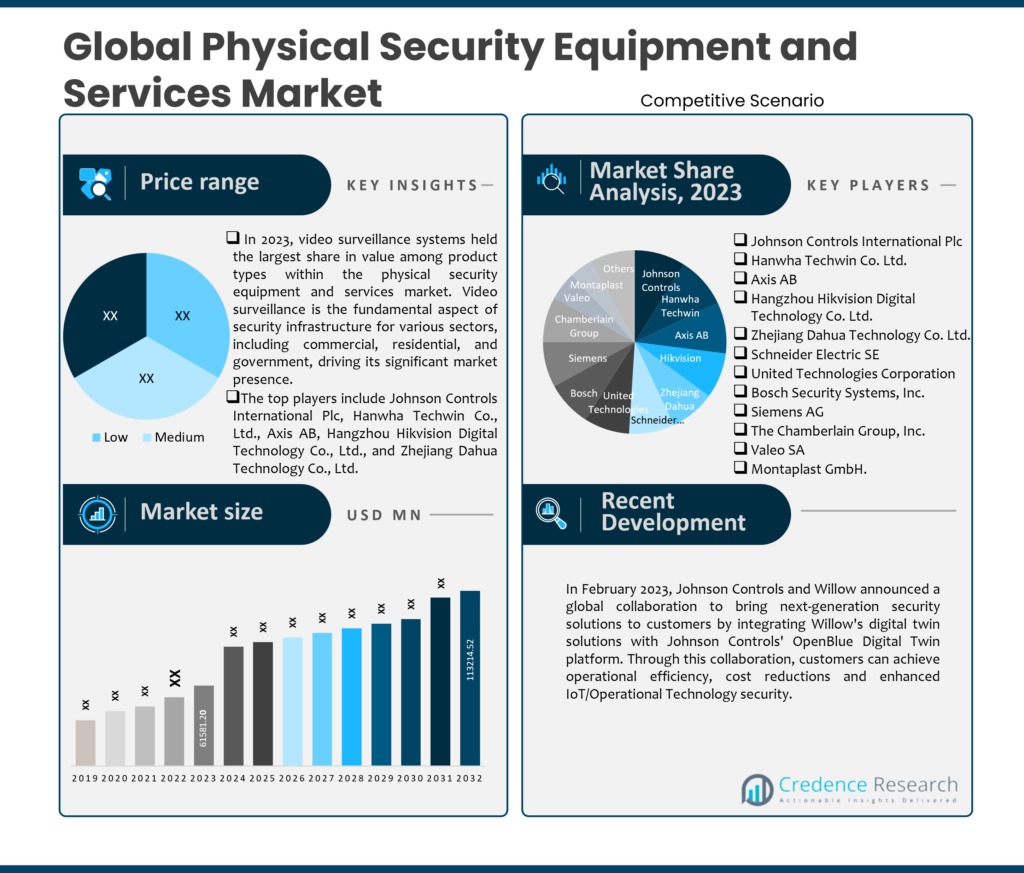
- The global demand for Physical Security Equipment and Services was valued at USD 61581.20 Million in 2023 and is expected to reach USD 113214.52 Million in 2032, growing at a CAGR of 7.00% between 2024 and 2032.
- The Video Surveillance Systems is the market leader by product type, accounting for a significant portion of total value in 2023, while the Intrusion Detection and Prevention Systems (IDPS) segment is expected to grow rapidly throughout the forecast period.
- The Installation and Integration Services segment dominates the global need by functionality, accounting for a significant portion in 2023, and the Monitoring and Surveillance Services segment is expected to grow at the fastest rate throughout the forecast period.
- Over the projection period, the Residential sector is expected to expand at the highest rate, while the Government and Defense sector will dominate the market in 2023 with a substantial share.
- North America is dominating the Physical Security Equipment and Services industry with a substantial share in 2023, while Asia Pacific is expected to grow at the highest rate during the forecast period.
- The market's primary possibilities include increasing innovations in surveillance cameras, access control systems, biometric authentication, and artificial intelligence to enhance threat detection and response capabilities.
Executive Summary
Market Definition
Physical security equipment and services are designed to protect physical assets, individuals, and properties from various threats, such as theft, vandalism, unauthorized access, and other criminal activities, through a broad range of tools, technologies, and professional services. This domain includes tangible security devices including locks, safes, barriers, and surveillance systems, as well as advanced electronic security systems such as alarms, access control systems, and biometric scanners. These components work together to create multiple layers of defense, making it difficult for unauthorized individuals to breach security parameters. These services include security consulting, system installation, maintenance, and monitoring, as well as the provision of trained security personnel. Security consultants assess vulnerabilities and design comprehensive security plans tailored to specific needs, while installation and maintenance teams ensure that security systems are correctly set up and functioning optimally.
Market Overview
The global Physical Security Equipment and Services Market has witnessed steady growth in recent years and is expected to grow at a CAGR of 7.00% between 2024 and 2032. The market was valued at USD 61581.20 million in 2023 and is expected to reach USD 113214.52 million in 2032.
The rise in instances of malicious activities and security breaches to physical systems has become a significant factor driving the growth of the physical security equipment and services market. As these threats become more frequent and sophisticated, organizations and government agencies are increasingly shifting their focus from traditional legacy solutions, such as badge readers, alarm systems, and door locks, to advanced logical security measures. These modern solutions encompass breach detection, threat management, and intrusion prevention, providing a higher success rate in deterring crime and preventing security breaches.
In addition to technological advancements, there is a growing awareness of the importance of ensuring the safety of resources, people, and vital assets against physical threats and unique vulnerabilities. This awareness is anticipated to drive the demand for robust security environments further. The heightened concerns over security have led to a surge in the efforts to maintain highly secure physical infrastructures, not only at business premises but also in residential areas.
Moreover, governments across major regions are continuously involved in enhancing their physical security infrastructure to mitigate growing threats. For instance, in December 2021, Axis Communications AB, a Sweden-based company that provides services to both the private sector and government agencies worldwide, launched body-worn cameras for the private security of government officials. These body-worn cameras offer multiple benefits, including liability protection, personal safety, and operational efficiency, underscoring the growing emphasis on advanced security solutions.
Segmentation by Product Type
- Video Surveillance Systems are the leading segment by product type and hold a substantial share in 2023 due to their effectiveness in monitoring, deterring crime, and providing valuable evidence.
- The Intrusion Detection and Prevention Systems (IDPS) segment is expected to exhibit a significant CAGR during the forecast period owing to the increasing concerns about unauthorized access and security breaches, coupled with advancements in sensor technology and integration with IoT and AI.
- The Perimeter Security Systems, Security Screening Equipment, and Fire and Life Safety Systems segments are also significantly contributing to the market's growth.
Segmentation by Service Type
- The Installation and Integration Services segment boasts the dominating position in the Physical Security Equipment and Services industry, holding a massive share in 2023. This is because the initial deployment of physical security systems, including access control, video surveillance, and intrusion detection systems, requires professional installation and integration with existing infrastructure.
- The Monitoring and Surveillance Services segment is expected to grow with the highest CAGR during the projected period. The increasing need for real-time monitoring and rapid response to security incidents drives the demand for these services.
- Maintenance and Support Services, Consulting and Advisory Services, and Managed Security Services further contribute significantly to the market's growth.
Segmentation by End-Use Vertical
- The Government and Defense is leading the market share with a significant share in 2023. This is attributed to the critical importance of security in government facilities and defense installations, coupled with significant investments made by government agencies and defense organizations to safeguard assets and personnel.
- The Residential is expected to post the highest CAGR during the forecast period due to the advancements in home automation and the availability of affordable security systems
- Other end-user industries such as Commercial & Corporate, Transportation & Logistics, Critical Infrastructure (Energy, Utilities, and Telecom), Healthcare, Retail, Banking & Finance, and Education also significantly contribute to the growth of the market
Segmentation by Region
- North America is fueling the growth of the Physical Security Equipment and Services industry, with a massive share in 2023 due to the region’s robust economic growth, regulatory reforms, increasing investments by small and medium-sized enterprises (SMEs), and the prevalence of advanced IT infrastructure.
- The Asia Pacific market is expected to grow at the highest rate during the forecasted period.
- The rest of the world, including Latin America, the Middle East, and Africa, supplies the remaining demand for the Physical Security Equipment and Services industry.
North America is dominating the physical security equipment and services market, primarily due to the established economies of the U.S. and Canada. The region benefits from robust economic growth, regulatory reforms, and increasing investments by small and medium-sized enterprises (SMEs). For instance, in February 2022, the U.S. Small Business Administration (SBA) provided USD 3 million in funding to help SMEs across the U.S. develop physical security infrastructure. This financial support highlights the region's commitment to enhancing security measures, further fueling market growth.
The prevalence of advanced IT infrastructure in North America also plays a crucial role in the adoption and integration of sophisticated physical security solutions. The region's well-developed technological landscape provides a fertile ground for implementing cutting-edge security systems. Additionally, North America's security infrastructure and technological development are highly advanced and flexible, supported by numerous regulatory compliances. The National Institute of Standards and Technology (NIST), along with other regulations such as PCI-DSS, HIPAA, GLBA, and SOX, offers standards that help safeguard critical infrastructures and sensitive data.
The U.S. is currently the largest market for physical security equipment in the residential sector, driven by the development of smart homes and the increased use of advanced video surveillance and access control systems. For example, in April 2022, Knightscope, Inc. launched the Knightscope K5 Autonomous Security Robot (ASR), which companies have started implementing in their outdoor residential and business premises to enhance security. North America's strong economic foundation, regulatory support, technological advancements, and significant investments in security infrastructure contribute to its dominance and drive the growth of the physical security equipment and services market in the region.
On the other hand, the Asia Pacific region is expected to register the highest growth rate during the forecast period, driven by increasing demand for smart security solutions in countries including India and China. Significant investments by the Chinese government in safe city projects, which focus on city surveillance and traffic monitoring, are anticipated to drive market growth. Since the establishment of the China Smart City Industry Alliance in 2010, China has developed 500 smart cities, leveraging technologies such as artificial intelligence and IoT to enhance urban planning and development. By the end of 2020, the Chinese government planned to develop 100 more smart cities, underscoring its commitment to advancing security infrastructure.
Businesses in the region are also seeking to enhance their security measures amidst evolving threats, leading to increased adoption of advanced security technologies. For example, in February 2022, Hangzhou Hikvision Digital Technology Co., Ltd., a leading video surveillance equipment provider, launched the Hikvision AX PRO wireless external Tri-tech detector and a dedicated camera. This new product offers precise detection, clear imaging, and a modular design, thereby increasing alarm safety for small businesses and homeowners. The deployment of such advanced security solutions in smart city projects across China exemplifies the region's proactive approach to security.
These developments highlight the growing focus on smart security solutions in the Asia Pacific, contributing to market expansion. The region's commitment to integrating cutting-edge technologies in urban development and the increasing adoption of sophisticated security measures by businesses are key factors driving the growth of the physical security equipment and services market in the Asia Pacific.
Key Highlights of the Report
The global physical security equipment and services market is segmented by product type, service type, end-user vertical, and region. Video Surveillance Systems are the most popular segment by product type, while Installation and Integration Services are the primary segment by service type. In addition, the Government and Defense industry is the most demanding end-user, with the North American region leading the market growth.
The rise in malicious activities and security breaches propels the growth of the physical security equipment and services market. Organizations and government agencies are shifting from traditional solutions, including badge readers and door locks, to advanced security measures such as breach detection, threat management, and intrusion prevention. Moreover, increasing concerns over the safety of resources, people, and vital assets further amplify the demand for robust security environments in both residential and business premises.
Nonetheless, North America is anticipated to have the greatest share of the worldwide Physical Security Equipment and Services Market due to the region’s robust economic growth, regulatory reforms, and increasing investments by small and medium-sized enterprises (SMEs). Furthermore, the market is anticipated to expand at the highest rate in the Asia-Pacific region due to the region's commitment to integrating cutting-edge technologies in urban development and the increasing adoption of sophisticated security measures by businesses.
What Are the Main Drivers of the Global Physical Security Equipment and Services Market?
The rise in malicious activities and security breaches is a significant factor driving the growth of the physical security equipment and services market. Organizations and government agencies are shifting from traditional solutions to advanced security measures such as breach detection, threat management, and intrusion prevention. Moreover, increasing concerns over the safety of resources, people, and vital assets further amplify the demand for robust security environments in both residential and business premises.
What Are the Major Challenges Faced by the Global Physical Security Equipment and Services Market?
A significant factor restraining the growth of the physical security equipment and services market is the lack of technical expertise within organizations. This deficiency hinders the optimization of advanced security solutions, leading to challenges in configuring and maintaining these systems effectively. The rapid evolution of security technology adds pressure to adapt, but without specialized skills, adoption becomes difficult, impeding market growth. Additionally, poor management of sophisticated systems exposes assets and personnel to threats, underscoring the need for skilled personnel and training.
What Are the Growth Opportunities in the Global Physical Security Equipment and Services Market?
Increasing technological advancements are creating significant opportunities for the growth of the physical security equipment and services market. Innovations in surveillance cameras, access control systems, biometric authentication, and artificial intelligence enhance threat detection and response capabilities. Integration with IoT technologies improves situational awareness and operational efficiency, while advancements in cloud and edge computing offer scalable and flexible security solutions.
Market Drivers
Rise in Instances of Physical Security Breaches
Rising threats related to terrorism and espionage are driving the growth of the physical security equipment and services market. The surge in physical attacks and damage has made security equipment imperative for various institutions globally. Organizations across sectors such as BFSI, healthcare, education, manufacturing, government, residential, retail, utilities, energy, commercial, and transportation are increasingly adopting physical security equipment to ensure the safety of their personnel and property.
The rise in terrorism has led governments and organizations to invest in advanced security solutions to protect their physical sites and employees. Additionally, the increase in espionage and thefts, particularly in commercial buildings and the banking sector, has further fueled the demand for physical security equipment. For example, in September 2022, Axis Communications launched two multidirectional, dual-sensor cameras designed for 24/7 operation in difficult lighting conditions, providing wide-angle overviews and detailed zoomed-in coverage. These cameras, equipped with a deep learning processing unit, enhance data collection and analysis, improving emergency response by communicating precise information about the nature and location of dangers before rescuers arrive.
Governments worldwide are also strengthening their physical security infrastructure to combat growing threats, often as part of smart city initiatives. For instance, in December 2021, Axis Communications launched body-worn cameras for the private security of government officials, offering benefits such as liability protection, personal safety, and operational efficiency. This focus on enhancing security infrastructure is significantly contributing to the expansion of the physical security equipment and services market.
Market Restraints
Lack of Technical Expertise Hinders the Optimization of Advanced Physical Security Solutions
The lack of technical expertise within organizations, which hinders the optimization of advanced security solutions, is restraining the growth of the physical security equipment and services market. Implementing and managing complex physical security systems often necessitates specialized knowledge and skills that are frequently lacking. This deficiency can result in challenges in properly configuring and maintaining these systems, ultimately reducing their effectiveness and leaving security vulnerabilities unaddressed. Furthermore, the inability to effectively manage sophisticated security systems can leave critical assets and personnel exposed to potential threats. This vulnerability underscores the importance of specialized training and skilled personnel in ensuring the efficacy of physical security measures. Organizations that fail to bridge this expertise gap may struggle to leverage advanced security technologies fully, compromising their overall security posture.
Opportunities
Increasing Technological Advancements Enhance the Capabilities of Security Solutions
Increasing technological advancements are creating significant opportunities for the growth of the physical security equipment and services market. Innovations in surveillance cameras, access control systems, biometric authentication, and artificial intelligence are enhancing the capabilities of security solutions, enabling more sophisticated threat detection and response mechanisms. For instance, modern surveillance cameras equipped with advanced AI analytics can identify suspicious activities in real time, providing organizations with actionable insights to prevent security breaches. Also, the integration of these advanced systems with IoT technologies facilitates seamless connectivity and data-driven insights, thereby improving situational awareness and operational efficiency.
Furthermore, advancements in cloud computing and edge computing are revolutionizing the deployment of security solutions. These technologies offer scalable and flexible options that can be tailored to meet the diverse needs of various industries, from retail and healthcare to transportation and government sectors. Cloud-based security platforms provide centralized management and storage capabilities, while edge computing enables local data processing, reducing latency and enhancing real-time decision-making.
Competitive Landscape
Key Players
The global Physical Security Equipment and Services market is highly competitive, with several key players. Some of the major players in the market and their market share are as follows:
- Johnson Controls International Plc
- Hanwha Techwin Co., Ltd.
- Axis AB
- Hangzhou Hikvision Digital Technology Co., Ltd.
- Zhejiang Dahua Technology Co., Ltd.
- Schneider Electric SE
- United Technologies Corporation
- Bosch Security Systems, Inc.
- Siemens AG
- The Chamberlain Group, Inc.
- Valeo SA
- Montaplast GmbH.
- Others
These organizations prioritize product innovation to stay competitive.
The global Physical Security Equipment and Services market's key players continually seek to stay ahead by offering new products and developments.
In February 2023, Johnson Controls and Willow announced a global collaboration to bring next-generation solutions to customers by integrating Willow's digital twin solutions with Johnson Controls' OpenBlue Digital Twin platform. Through this collaboration, customers can achieve operational efficiency, cost reductions, and enhanced IoT/Operational Technology security.
In March 2023, Axis Communications unveiled new devices at the ISC West security conference in Las Vegas, USA. These new products include security cameras built on ARTPEC-8 chip technology with deep learning processing units (DLPU) for advanced video analytics at the network edge. These cameras are designed for tough environments, featuring IK10-rated, vandal-resistant casings with electronic image stabilization for smooth video in vibrating conditions.
How are Companies Performing in the Physical Security Equipment and Services Market?
The global Physical Security Equipment and Services Market is highly competitive, with several key players.
Startups are playing a pivotal role in propelling the growth of the Physical Security Equipment and Services Market by injecting innovation and agility into the industry. These emerging companies are leveraging cutting-edge technologies such as artificial intelligence (AI), machine learning, and the Internet of Things (IoT) to develop groundbreaking security solutions that address evolving threats and challenges. Startups, including Verkada and Openpath, are reshaping access control systems by introducing mobile credentials and cloud-based management platforms. This modernization streamlines access management processes and enhances security measures, catering to the needs of businesses across various industries. Additionally, Rhombus Systems stands out for its cloud-managed video security cameras equipped with AI-powered analytics for smart threat detection. This proactive approach to security helps organizations identify and address security incidents in real time, improving overall safety and security. Meanwhile, Deep Sentinel is making strides in home security with its AI-powered cameras and live guard services. Their proactive approach to threat detection deters potential intruders and provides homeowners with peace of mind.
Moreover, Cobalt Robotics is pioneering the development of autonomous security robots equipped with sophisticated sensors and AI capabilities. These robots patrol indoor spaces, providing real-time alerts and insights to security teams, thereby improving situational awareness and response times. Also, Kisi is another startup making waves with its cloud-based access control systems tailored for modern workplaces. Their platform offers seamless integration with existing infrastructure and enables remote access management, making it a popular choice for businesses seeking flexibility and convenience. Rhombus Systems stands out for its cloud-managed video security cameras equipped with AI-powered analytics for smart threat detection. This proactive approach to security helps organizations identify and address security incidents in real time, improving overall safety and security.
Furthermore, Vigilant Solutions is transforming law enforcement and public safety with its license plate recognition and facial recognition technologies. These advanced solutions enhance investigative capabilities and improve community safety, contributing to overall security efforts. As these startups continue to disrupt the industry, the physical security landscape is expected to evolve rapidly, creating new opportunities for growth and advancement.
Summary of Key Findings
- The rise in malicious activities and security breaches drives the surge in demand for physical security equipment and services. Several entities are shifting from traditional solutions to advanced security measures such as breach detection, threat management, and intrusion prevention. Moreover, increasing concerns over the safety of resources, people, and vital assets further amplify the demand for robust security environments in both residential and business premises.
- Market segmented by product type, service type, end-user vertical, and region.
- Video Surveillance Systems are the leading segment by product type due to their effectiveness in monitoring, deterring crime, and providing valuable evidence
- The Government and Defense are leading the market share due to the critical importance of security in government facilities and defense installations, coupled with significant investments made by government agencies and defense organizations to safeguard assets and personnel.
- North America is leading market growth; the market is highly competitive with key players including Johnson Controls International Plc, Hanwha Techwin Co., Ltd., Axis AB, Hangzhou Hikvision Digital Technology Co., Ltd., Zhejiang Dahua Technology Co., Ltd., Schneider Electric SE, United Technologies Corporation, Bosch Security Systems, Inc., Siemens AG, The Chamberlain Group, Inc., Valeo SA, and Montaplast GmbH.
Future Outlook
- Positive outlook for the global Physical Security Equipment and Services market with significant growth potential in the Asia Pacific region.
- The rise in malicious activities and security breaches is one of the main factors promoting the market's growth.
- During the forecast period, lack of technical expertise within organizations, which hinders the optimization of advanced security solutions, is expected to act as a significant factor restraining the growth of the Physical Security Equipment and Services market
- To stay competitive, key firms in the Physical Security Equipment and Services Market should prioritize increasing innovations in surveillance cameras, access control systems, biometric authentication, and artificial intelligence to enhance threat detection and response capabilities.
How CXOs Can Benefit from the Credence Research Physical Security Equipment and Services Market Report
The Credence Research Physical Security Equipment and Services Market Report provides CXOs with a comprehensive overview of the market, including:
- Market size and growth forecast:The report provides detailed estimates of the global Physical Security Equipment and Services Market size, segmented by product type, service type, end-user vertical, and region. It also includes forecasts for the market through 2032 based on key trends and drivers.
- Market segmentation: The report segments the Physical Security Equipment and Services Market by product type, service type, end-user vertical, and region. This segmentation provides CXOs with a granular understanding of the market and the opportunities in each segment.
- Competitive Landscape:The report profiles the key players in the Physical Security Equipment and Services Market and provides insights into their strategies, product offerings, and financial performance. This information can help CXOs to identify and assess their competition.
- Key trends and drivers:The report identifies and analyses the key trends and drivers shaping the Physical Security Equipment and Services Market. This information can help CXOs make informed decisions about their investments and strategies.
CXOs can use the insights from the Credence Research Physical Security Equipment and Services Market Report to:
- Identify growth opportunities:The report can help CXOs to identify new growth opportunities in the Physical Security Equipment and Services market. For example, the report identifies a rise in malicious activities and security breaches posing significant demand for physical security equipment and services.
- Make informed investment decisions:The report can help CXOs make informed investment decisions about the Physical Security Equipment and Services industry. For example, it provides insights into the key factors to consider when evaluating and selecting providers.
- Develop competitive strategies:The report can help CXOs develop competitive strategies for their Physical Security Equipment and Services businesses. For example, the report identifies the key strategies that Physical Security Equipment and Services providers are using to differentiate themselves from their competitors.
- Track market developments:The report can help CXOs monitor market developments and stay ahead of the curve. For example, it provides insights into the latest trends and innovations in the Physical Security Equipment and Services Market.
Overall, the Credence Research Physical Security Equipment and Services Market Report is a valuable resource for CXOs who are looking to gain a deeper understanding of the market and identify opportunities for growth.
Segmentation
-
By Product Type
- Access Control Systems
- Video Surveillance Systems
- Intrusion Detection and Prevention Systems (IDPS)
- Perimeter Security Systems
- Security Screening Equipment
- Fire and Life Safety Systems
-
By Service Type
- Installation and Integration Services
- Maintenance and Support Services
- Monitoring and Surveillance Services
- Consulting and Advisory Services
- Managed Security Services
-
By End-User Vertical
- Commercial and Corporate
- Government and Defense
- Transportation and Logistics
- Critical Infrastructure (Energy, Utilities, and Telecom)
- Healthcare
- Retail
- Banking and Finance
- Education
- Residential
-
By Region
- North America
- US
- Canada
- Mexico
- Europe
- Germany
- France
- UK.
- Italy
- Spain
- Rest of Europe
- Asia Pacific
- China
- Japan
- India
- South Korea
- South-east Asia
- Rest of Asia Pacific
- Latin America
- Brazil
- Argentina
- Rest of Latin America
- Middle East & Africa
- GCC Countries
- South Africa
- Rest of the Middle East and Africa
- North America
Adjacent Markets
In the Physical Security Equipment and Services Market, several adjacent markets have high revenue growth opportunities. The key adjacent markets for Physical Security Equipment and Services Market -
|
Adjacent Markets |
||
| Video Surveillance Systems Market | AI CCTV Market | Perimeter Security Systems Market |
| Access Control Systems Market | Alarm and Notification Systems Market | Smart Home Security Market |
| Biometric Authentication Market | Physical Security Information Management (PSIM) Market | Intrusion Detection and Prevention Systems Market |

Request a Free Sample
Fill in your details and we'll send you a free sample report.
- Sample data tables & charts
- Research methodology
Market Dynamics
Increase in Malicious Activities and Security Breaches
The growing frequency and sophistication of physical security breaches, including theft, vandalism, and unauthorized access, are compelling organizations and governments to invest in advanced security equipment and services to protect assets, people, and infrastructure.
Technological Advancements in Security Solutions
Innovations in surveillance cameras, access control systems, biometric authentication, and artificial intelligence are enhancing threat detection and response capabilities, making security systems more effective and appealing to a broader range of end-users.
Government Initiatives and Regulatory Compliance
Governments worldwide are investing in upgrading physical security infrastructure and enforcing stricter regulations, especially in critical sectors like defense, transportation, and utilities, which drives demand for comprehensive security solutions.
Growth of Smart Cities and Urbanization
The expansion of smart city projects, particularly in Asia Pacific, is increasing the deployment of integrated security systems for urban safety, traffic monitoring, and public infrastructure protection, fueling market growth.
Rising Adoption in Residential and SME Sectors
Advancements in affordable home security and the availability of scalable solutions are driving adoption among residential users and small to medium-sized enterprises, expanding the market beyond traditional large-scale commercial and government applications.
Need a Custom Version of This Report?
Tailor the scope, geography, or segments to your exact requirements.
- Custom geography or segment scope
- Direct access to our analyst team
Frequently Asked Questions
What is the current size of the global Physical Security Equipment and Services market?
What is the expected growth rate of the Physical Security Equipment and Services Market between 2024 and 2032?
Which segment is leading the market share in terms of product type?
Which segment is leading the market share in terms of end-user vertical?
Which segment is expected to post the highest CAGR during the forecast period in terms of Service Type?
Which region is fueling the growth of the Physical Security Equipment and Services Market?
Who are the major players in the global Physical Security Equipment and Services Market?
What are the major market drivers of the global Physical Security Equipment and Services market?
What is the major market restraint of the Physical Security Equipment and Services market?
What are the major market opportunities of the global Physical Security Equipment and Services market?
Table of Content
Chapter 1 Market Segmentation
- 1.1 Segmentation Framework
- 1.1.1 Product and Service Classification
- 1.1.2 Application and End-Use Classification
- 1.1.3 Technology and Solution Classification
- 1.1.4 Customer and Distribution Channel Classification
- 1.1.5 Geographic Segmentation
- 1.1.6 Market Segment Definitions and Boundaries
- 1.2 By Product Type
- 1.2.1 Access Control Systems
- 1.2.2 Video Surveillance Systems
- 1.2.3 Intrusion Detection and Prevention Systems (IDPS)
- 1.2.4 Perimeter Security Systems
- 1.2.5 Security Screening Equipment
- 1.2.6 Fire and Life Safety Systems
- 1.3 By Service Type
- 1.3.1 Installation and Integration Services
- 1.3.2 Maintenance and Support Services
- 1.3.3 Monitoring and Surveillance Services
- 1.3.4 Consulting and Advisory Services
- 1.3.5 Managed Security Services
- 1.4 By End-User Vertical
- 1.4.1 Commercial and Corporate
- 1.4.2 Government and Defense
- 1.4.3 Transportation and Logistics
- 1.4.4 Critical Infrastructure (Energy, Utilities, and Telecom)
- 1.4.5 Healthcare
- 1.4.6 Retail
- 1.4.7 Banking and Finance
- 1.4.8 Education
- 1.4.9 Residential
Chapter 2 Introduction
- 2.1 Report Objectives and Scope
- 2.2 Product Definition and Industry Terminology
- 2.3 Market Inclusions and Exclusions
- 2.4 Research Process
- 2.4.1 Primary Research and Expert Interviews
- 2.4.2 Secondary Research and Source Review
- 2.4.3 Top-Down and Bottom-Up Estimation
- 2.4.4 Data Triangulation and Verification
- 2.5 Market Size Measurement Basis
- 2.5.1 2023: USD 61581.20 Million → 2032: USD 113,214.52 Million
- 2.6 Historical and Forecast Reference Periods
- 2.6.1 Base Year: 2023
- 2.6.2 Forecast Period: 2023-2032
- 2.7 Research Assumptions and Limitations
Chapter 3 Executive Summary
- 3.1 Market Snapshot and Key Findings
- 3.2 Base-Year Market Size, 2023
- 3.3 Forecast Market Size, 2032
- 3.4 Revenue and Volume Growth Outlook
- 3.5 Key Demand and Supply Indicators
- 3.6 Leading Market Segments
- 3.7 Fastest-Growing Market Opportunities
- 3.8 Regional Performance Highlights
- 3.9 Technology and Industry Transformation
- 3.10 Competitive Landscape Summary
- 3.11 Analyst View and Strategic Implications
Chapter 4 Global Physical Security Equipment And Services Market Trends and Developments
- 4.1 Historical Industry Development
- 4.2 Recent Market Trends and Developments
- 4.3 Demand and Customer Behavior Trends
- 4.4 Technology and Product Innovation
- 4.5 Artificial Intelligence, Automation and Digitalization
- 4.6 Local Manufacturing and Supply Chain Realignment
- 4.7 Industry Partnerships, Mergers and Acquisitions
- 4.8 Sustainability and Circular Economy Developments
- 4.9 Government and Private Sector Investment Trends
- 4.10 Emerging Business Models and Commercialization
- 4.11 Industry Developments and Announcements
Chapter 5 Global Physical Security Equipment And Services Market Supply and Demand Analysis
- 5.1 Demand Trend and Consumption Analysis
- 5.2 Demand Forecast, 2023-2032
- 5.3 Supply Chain Structure and Procurement Trends
- 5.4 Supply-Demand Gap and Bottlenecks
- 5.5 Import Dependence and Sourcing Structure
- 5.6 Regional Supply and Demand Concentration
Chapter 6 Global Physical Security Equipment And Services Market Pricing Analysis
- 6.1 Pricing Structure and Measurement
- 6.2 Historical Pricing Trends
- 6.3 Pricing Outlook, 2023-2032
- 6.4 Pricing by Product and Market Segment
- 6.5 Geographic Pricing Differences
- 6.6 Key Input, Energy, Labor and Logistics Costs
- 6.7 Contract Pricing and Purchasing Models
- 6.8 Pricing Sensitivity and Competitive Positioning
- 6.9 Price, Margin and Profitability Implications
Chapter 7 Global Physical Security Equipment And Services Market Dynamics
- 7.1 Market Growth Drivers
- 7.1.1 Demand-Side Drivers
- 7.1.2 Technology and Innovation Drivers
- 7.1.3 Infrastructure and Investment Drivers
- 7.1.4 Regulatory and Policy Drivers
- 7.2 Market Restraints
- 7.2.1 Cost and Affordability Constraints
- 7.2.2 Technology and Adoption Barriers
- 7.2.3 Supply Chain and Operational Constraints
- 7.3 Market Challenges
- 7.3.1 Competitive Pressure and Margin Erosion
- 7.3.2 Skills, Infrastructure and Implementation Gaps
- 7.4 Emerging Market Opportunities
- 7.5 Market Dynamics Impact and Time-Horizon Assessment
Chapter 8 Global Physical Security Equipment And Services Value Chain Analysis
- 8.1 Industry Value Chain Overview
- 8.2 Upstream Suppliers and Critical Inputs
- 8.3 Technology and Component Providers
- 8.4 Manufacturing or Service Delivery
- 8.5 Distribution, Channel Partners and Integrators
- 8.6 Downstream Applications and End Users
- 8.7 Value Addition and Profit Pools
- 8.8 Vertical Integration and Outsourcing
- 8.9 Supplier Concentration and Risk
- 8.10 Supply Chain Localization and Resilience
Chapter 9 Global Physical Security Equipment And Services Market Regulations and Policies
- 9.1 Relevant Laws, Standards and Compliance Frameworks
- 9.2 Product, Service, Safety and Quality Requirements
- 9.3 Government Policies, Incentives and Subsidies
- 9.4 Imports, Exports and Trade Barriers
- 9.5 Public Procurement and Local Content Requirements
- 9.6 Data Protection, AI and Cybersecurity Compliance
- 9.7 Upcoming Policy Changes and Market Implications
Chapter 10 Global Physical Security Equipment And Services Market Hotspots and Opportunities
- 10.1 Market Opportunity Mapping and Growth Hotspots
- 10.2 High-Growth Applications and Customer Groups
- 10.3 Underserved Markets and White-Space Opportunities
- 10.4 Emerging Technology and Product Opportunities
- 10.5 New Capacity and Investment Hotspots
- 10.6 Market Entry and Expansion Opportunities
- 10.7 Distribution and Partnership Opportunities
- 10.8 Near-Term and Long-Term Commercial Potential
- 10.9 Opportunity Attractiveness and Execution Risks
Chapter 11 Global Physical Security Equipment And Services Market Outlook, 2023-2032
- 11.1 Market Size and Analysis
- 11.1.1 Revenue (Market Measurement: 2023: USD 61581.20 Million → 2032: USD 113,214.52 Million)
- 11.1.2 Historical Market Size
- 11.1.3 Base-Year Market Size, 2023
- 11.2 Market Forecast, 2023-2032
- 11.2.1 Revenue Forecast to 2032
- 11.2.2 CAGR and Year-on-Year Growth
- 11.2.3 Incremental Revenue Opportunity
- 11.3 Forecast Assumptions and Scenario Analysis
- 11.3.1 Base-Case Forecast
- 11.3.2 Optimistic and Conservative Scenarios
- 11.3.3 Technology, Pricing and Policy Sensitivities
- 11.4 Market Attractiveness and Growth Outlook
Chapter 12 Global Physical Security Equipment And Services Market Segmentation and Outlook
- 12.1 Segmentation Summary and Market Shares, 2023
- 12.2 Largest and Fastest-Growing Segments
- 12.3 By Product Type - Market Size and Forecast, 2023-2032
- 12.3.1 Segment Definition and Scope
- 12.3.2 Historical Market Size
- 12.3.3 Revenue Forecast, 2023-2032
- 12.3.4 Base-Year Market Share, 2023
- 12.3.5 Segment CAGR and Growth Drivers
- 12.3.6 Subsegment Market Size and Forecast
- 12.3.6.1 Access Control Systems
- 12.3.6.2 Video Surveillance Systems
- 12.3.6.3 Intrusion Detection and Prevention Systems (IDPS)
- 12.3.6.4 Perimeter Security Systems
- 12.3.6.5 Security Screening Equipment
- 12.3.6.6 Fire and Life Safety Systems
- 12.3.7 Subsegment Pricing and Adoption Trends
- 12.3.8 Leading Suppliers and Competition
- 12.3.9 Regional Demand and Opportunities
- 12.4 By Service Type - Market Size and Forecast, 2023-2032
- 12.4.1 Segment Definition and Scope
- 12.4.2 Historical Market Size
- 12.4.3 Revenue Forecast, 2023-2032
- 12.4.4 Base-Year Market Share, 2023
- 12.4.5 Segment CAGR and Growth Drivers
- 12.4.6 Subsegment Market Size and Forecast
- 12.4.6.1 Installation and Integration Services
- 12.4.6.2 Maintenance and Support Services
- 12.4.6.3 Monitoring and Surveillance Services
- 12.4.6.4 Consulting and Advisory Services
- 12.4.6.5 Managed Security Services
- 12.4.7 Subsegment Pricing and Adoption Trends
- 12.4.8 Leading Suppliers and Competition
- 12.4.9 Regional Demand and Opportunities
- 12.5 By End-User Vertical - Market Size and Forecast, 2023-2032
- 12.5.1 Segment Definition and Scope
- 12.5.2 Historical Market Size
- 12.5.3 Revenue Forecast, 2023-2032
- 12.5.4 Base-Year Market Share, 2023
- 12.5.5 Segment CAGR and Growth Drivers
- 12.5.6 Subsegment Market Size and Forecast
- 12.5.6.1 Commercial and Corporate
- 12.5.6.2 Government and Defense
- 12.5.6.3 Transportation and Logistics
- 12.5.6.4 Critical Infrastructure (Energy, Utilities, and Telecom)
- 12.5.6.5 Healthcare
- 12.5.6.6 Retail
- 12.5.6.7 Banking and Finance
- 12.5.6.8 Education
- 12.5.6.9 Residential
- 12.5.7 Subsegment Pricing and Adoption Trends
- 12.5.8 Leading Suppliers and Competition
- 12.5.9 Regional Demand and Opportunities
- 12.6 Segment Growth Comparison
- 12.7 Segment Attractiveness and Priority Matrix
Chapter 13 Global Physical Security Equipment And Services End-Use and Application Market Outlook
- 13.1 End-Use Industry and Customer Demand Structure
- 13.2 Leading Applications and Customer Groups
- 13.3 End-Use Market Size, Share and Forecast
- 13.4 Major End-Use Industry Deep Dives
- 13.4.1 Customer Requirements and Use Cases
- 13.4.2 Demand and Replacement Cycles
- 13.4.3 Technical and Regulatory Considerations
- 13.4.4 Purchasing and Procurement Models
- 13.4.5 Leading Vendors and Distribution Channels
- 13.4.6 Forecast and Commercial Opportunities
- 13.5 Emerging Applications and Cross-Segment Demand
- 13.6 End-Use Industry Investment Priorities
Chapter 14 Global Physical Security Equipment And Services Geographic Market Outlook, 2023-2032
- 14.1 Regional Market Size and Share, 2023
- 14.2 Regional Market Forecast, 2023-2032
- 14.3 Regional Pricing, Production and Demand Differences
- 14.4 North America
- 14.4.1 United States
- 14.4.2 Canada
- 14.4.3 Mexico
- 14.5 Europe
- 14.5.1 Germany
- 14.5.2 France
- 14.5.3 Italy
- 14.5.4 United Kingdom
- 14.5.5 Spain
- 14.5.6 Poland
- 14.5.7 Russia
- 14.5.8 Netherlands
- 14.5.9 Belgium
- 14.5.10 Sweden
- 14.5.11 Denmark
- 14.5.12 Norway
- 14.5.13 Rest of Europe
- 14.6 Asia Pacific
- 14.6.1 China
- 14.6.2 India
- 14.6.3 Japan
- 14.6.4 South Korea
- 14.6.5 Thailand
- 14.6.6 Indonesia
- 14.6.7 Vietnam
- 14.6.8 Malaysia
- 14.6.9 Australia
- 14.6.10 Rest of Asia Pacific
- 14.7 Latin America
- 14.7.1 Brazil
- 14.7.2 Argentina
- 14.7.3 Colombia
- 14.7.4 Chile
- 14.7.5 Rest of Latin America
- 14.8 Middle East
- 14.8.1 Saudi Arabia
- 14.8.2 United Arab Emirates
- 14.8.3 Turkey
- 14.8.4 Israel
- 14.8.5 Iran
- 14.8.6 Rest of the Middle East
- 14.9 Africa
- 14.9.1 South Africa
- 14.9.2 Egypt
- 14.9.3 Nigeria
- 14.9.4 Morocco
- 14.9.5 Rest of Africa
- 14.10 Regional Investment, Policy and Supply Chain Differences
- 14.11 Regional Competitive Landscape
- 14.12 Geographic Growth Hotspots
Chapter 15 Global Physical Security Equipment And Services Technology, Innovation and Sustainability Outlook
- 15.1 Technology Landscape and Maturity
- 15.2 Product, Process and Service Innovation
- 15.3 AI, Automation and Digital Tools in the Industry
- 15.4 Technology Adoption and Performance Benchmarking
- 15.5 Innovation Pipeline and R&D Investment
- 15.6 Energy Efficiency and Resource Management
- 15.7 Sustainability, Recycling and Circularity
- 15.8 Technology Roadmap, 2023-2032
- 15.9 Risks of Obsolescence and Technology Substitution
Chapter 16 Global Physical Security Equipment And Services Market Key Strategic Imperatives
- 16.1 Growth and Market Entry Priorities
- 16.2 High-Return Products and Segments
- 16.3 Pricing, Profitability and Cost Optimization
- 16.4 Technology Investment and Product Differentiation
- 16.5 Supply Chain Localization and Resilience
- 16.6 Distribution and Customer Acquisition
- 16.7 Partnership, Acquisition and Capacity Strategy
- 16.8 Regional Expansion Priorities
- 16.9 Short-, Medium- and Long-Term Actions
Chapter 17 Competition Outlook
- 17.1 Industry Competition Characteristics
- 17.2 Market Structure and Concentration
- 17.3 Market Share and Competitive Positioning, 2023
- 17.4 Company-Wise Revenue and Product Benchmarking
- 17.5 Production and Service Capacity Benchmarking
- 17.6 Technology, Pricing and Differentiation
- 17.7 Regional Footprint and Distribution Strength
- 17.8 Mergers, Acquisitions and Strategic Alliances
- 17.9 New Entrants and Competitive Threats
- 17.10 Porter's Five Forces and Industry Attractiveness
- 17.11 Competitive Outlook, 2023-2032
Chapter 18 Company Profiles
- 18.1 Company Coverage and Selection Criteria
- 18.2 Johnson Controls International Plc
- 18.2.1 Business Description
- 18.2.2 Company Ownership and Geographic Presence
- 18.2.3 Product and Service Portfolio
- 18.2.4 Manufacturing and Operating Footprint
- 18.2.5 Financial Performance and Investment
- 18.2.6 Market Share and Competitive Position
- 18.2.7 Technology and Innovation Capabilities
- 18.2.8 Strategic Alliances or Partnerships
- 18.2.9 Recent Developments
- 18.2.10 Growth Strategy and Outlook
- 18.3 Hanwha Techwin Co., Ltd.
- 18.4 Axis AB
- 18.5 Hangzhou Hikvision Digital Technology Co., Ltd.
- 18.6 Zhejiang Dahua Technology Co., Ltd.
- 18.7 Schneider Electric SE
- 18.8 Bosch Security Systems, Inc.
- 18.9 Siemens AG
- 18.10 United Technologies Corporation
- 18.11 The Chamberlain Group, Inc.
- 18.12 Other Relevant Market Participants
Note: Every listed company is profiled on the structure shown under the first company. The company list is preliminary and may change based on research findings, market developments, data availability and client requirements.
Chapter 19 Disclaimer
- 19.1 Research and Forecast Disclaimer
- 19.2 Data Source and Estimation Limitations
Note: The depth of individual sections depends on data availability for this market. Volume, capacity, trade and other unit-based metrics are included where applicable.

