
Market Overview:
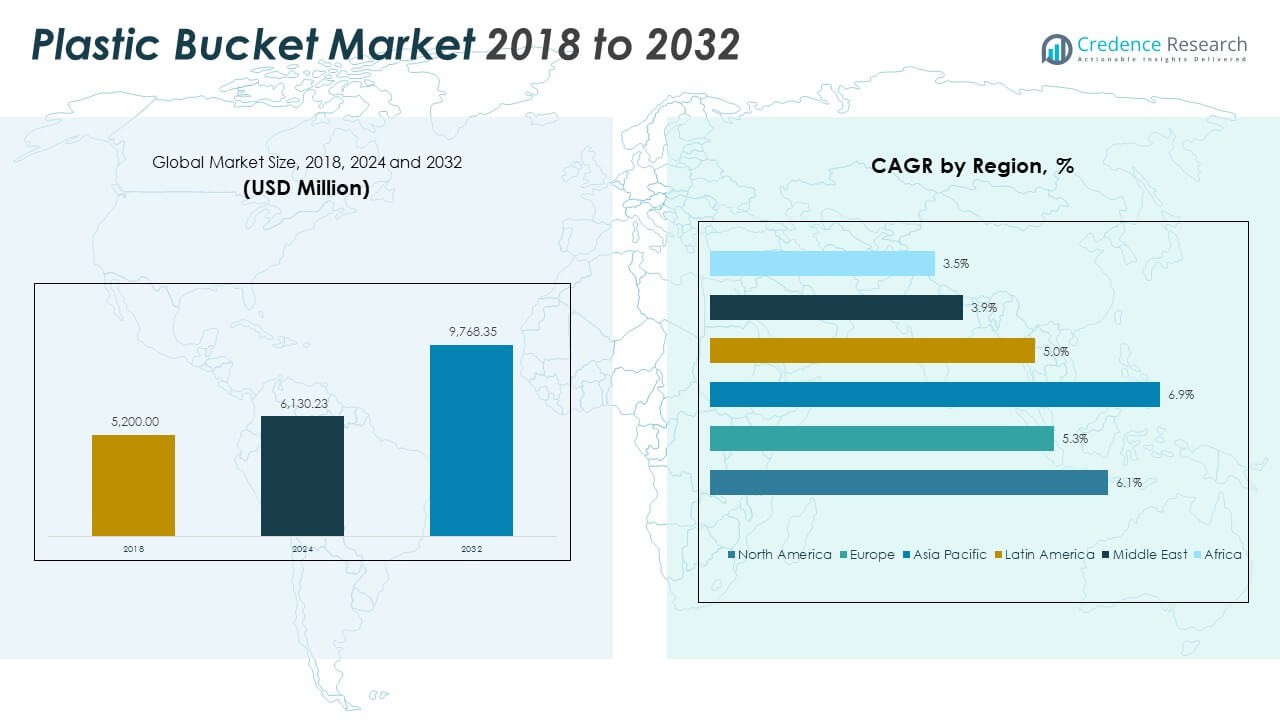
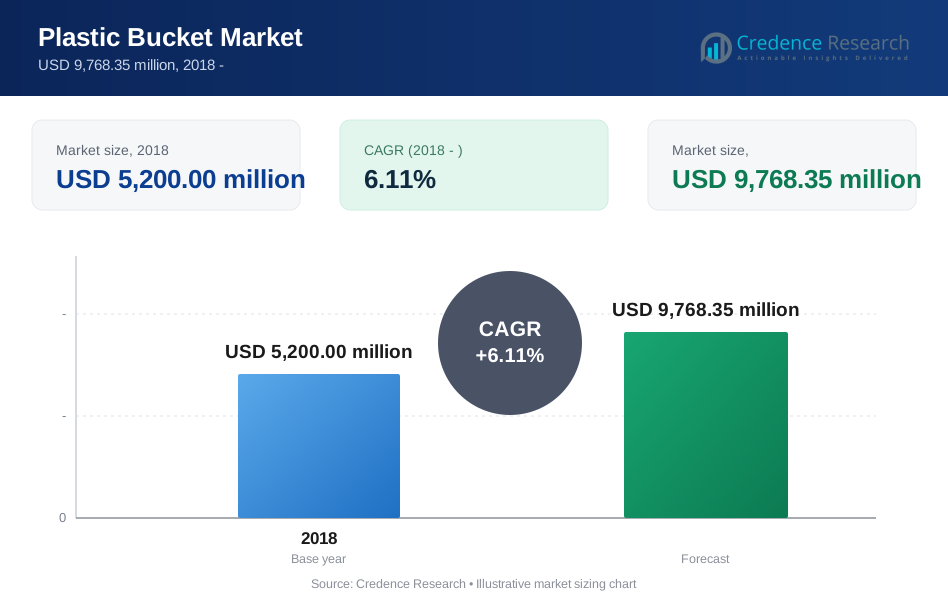
The Global Plastic Bucket Market size was valued at USD 5,200.00 million in 2018 to USD 6,130.23 million in 2024 and is anticipated to reach USD 9,768.35 million by 2032, at a CAGR of 6.11% during the forecast period.
| REPORT ATTRIBUTE | DETAILS |
|---|---|
| Historical Period | 2020-2023 |
| Base Year | 2024 |
| Forecast Period | 2025-2032 |
| Plastic Bucket Market Size 2024 | USD 6,130.23 Million |
| Plastic Bucket Market, CAGR | 6.11% |
| Plastic Bucket Market Size 2032 | USD 9,768.35 Million |
The market grows through rising industrial production and steady demand for safe storage. Producers use advanced molding systems to deliver uniform strength and impact resistance. Food-grade variants gain traction due to hygiene rules across many regions. Paint and coating firms depend on strong buckets for secure shipments. Chemical companies push for high-density options that protect material stability. Eco-designed buckets gain interest as firms cut waste. Strong packaging needs across trade and logistics support broader use.
North America leads due to strong industrial activity and wide adoption across paints, chemicals, and home improvement. Europe follows with strict quality rules and strong demand for food-grade and recyclable polymers. Asia Pacific emerges as the fastest-growing region due to rising construction, expanding manufacturing, and wider consumer use. China and India lift consumption through rapid infrastructure work and higher retail demand. Latin America and the Middle East show steady growth as local industries invest in durable and low-cost packaging solutions.
Market Insights:
- The Global Plastic Bucket Market was valued at USD 5,200.00 million in 2018, reached USD 6,130.23 million in 2024, and is set to hit USD 9,768.35 million by 2032, growing at a CAGR of 6.11% driven by strong use across chemicals, paints, food, and construction.
- Asia Pacific (41.86%), North America (25.36%), and Europe (22.58%) hold the largest shares due to strong industrial bases, rising construction output, and strict quality standards supporting wider bucket adoption.
- Asia Pacific is the fastest-growing region, supported by expanding manufacturing, rapid infrastructure development in China and India, and broad retail penetration that lifts packaging demand.
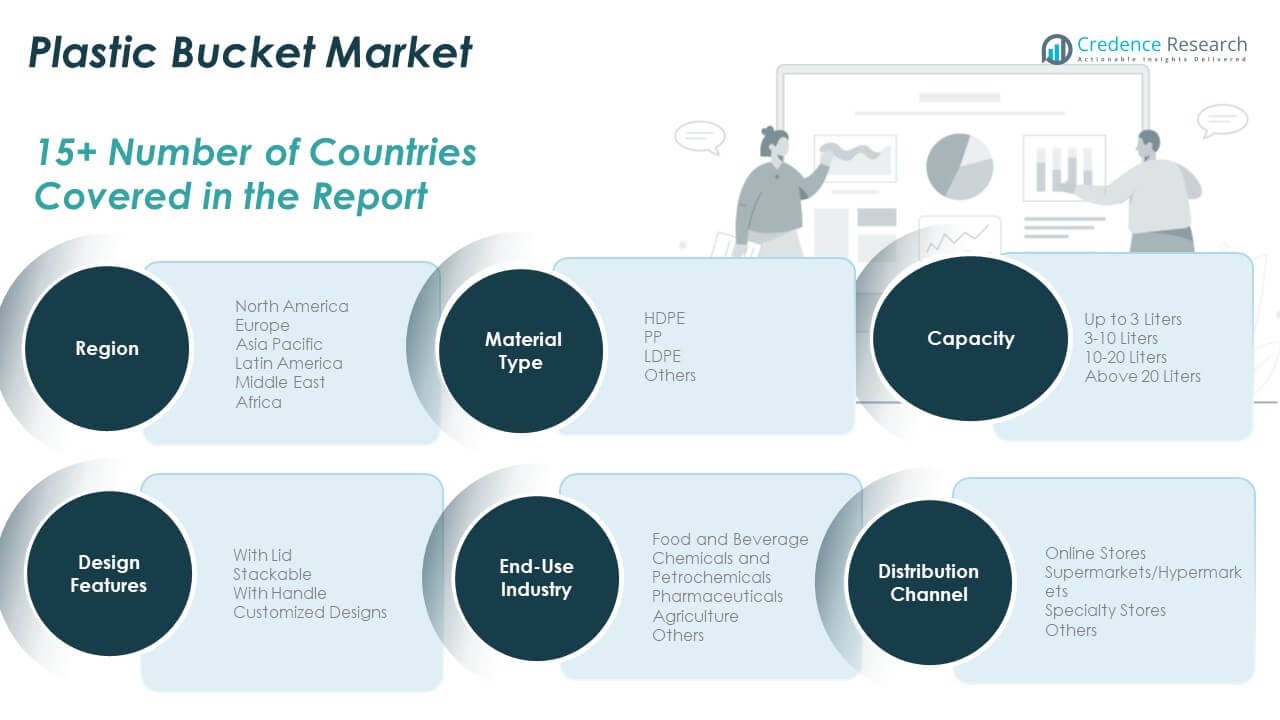
- From the material distribution shown in the chart, HDPE accounts for the largest share at roughly 32–35%, supported by its durability and strong chemical resistance across industrial sectors.
- PP contributes an estimated 25–28% share, benefiting from higher heat tolerance and rising demand in food, coatings, and logistics applications highlighted in the segment growth pattern.
Market Drivers:
Rising Use Across Packaging, Construction, Chemical, and Food Industries
The Global Plastic Bucket Market expands through high consumption across diverse industries. Paint makers depend on strong buckets for secure transport. Chemical firms rely on leak-proof formats that support safe storage. Food processors adopt food-grade variants that meet hygiene rules. Construction sites use durable buckets for cement, coatings, and mixtures. Retail buyers pick lightweight designs that support easy handling. Brands improve resin quality to lift strength. Industrial demand pushes producers to enhance product life cycles.
- For instance, Berry Global upgraded its industrial pails with high-density resin technology that improves drop-impact performance and meets UN-rated packaging standards for hazardous materials.
Growing Shift Toward Lightweight, Cost-Efficient, and Durable Storage Solutions
Many sectors prefer lightweight buckets that reduce handling strain and shipping effort. Producers optimize resin blends to maintain strength under heavy loads. Bucket designs focus on impact resistance for tougher industrial use. Sealed lids prevent moisture entry and protect sensitive goods. Stackable formats save storage space across warehouses. Transport firms benefit from reduced freight weight. The Global Plastic Bucket Market gains traction through stable packaging adoption. Many industries invest in reliable packaging for long-term use.
- For instance, Greif introduced its lighter-weight rigid plastic containers under the GCUBE series, which reduce material use while maintaining UN performance certification for industrial transport.
Rising Adoption of Hygienic, Food-Grade, and Tamper-Proof Packaging Formats
Food processors demand buckets that meet strict safety requirements. Tamper-proof seals support product integrity during movement. Many brands design smooth inner walls for easy cleaning. Producers add odor-resistant features to protect product quality. Buckets with nesting designs reduce clutter in food plants. High-density materials support storage of sauces, powders, and bulk items. The Global Plastic Bucket Market grows due to expanding food supply chains. Companies strengthen compliance to meet global standards.
Innovation in Manufacturing and Customizable Features Enhancing User Value
Producers adopt advanced molding for uniform walls and better durability. Custom prints help brands communicate instructions or warnings. Ergonomic handles support easy lifting for workers. Buckets with UV-resistant materials protect outdoor-use products. Firms develop easy-pour rims for controlled flow. Smooth surfaces reduce residue buildup. The Global Plastic Bucket Market benefits from rising interest in tailored formats. Better designs lift user comfort and operational safety.
Market Trends:
Growing Adoption of Recyclable Resins and Eco-Certified Packaging Designs
Sustainability drives higher interest in recyclable buckets. Producers shift toward resins that support circular use. Many firms test bio-based blends to cut carbon output. Recycled-grade buckets enter supply chains for non-food applications. Brands highlight eco-labels to lift buyer trust. Regulations push firms toward cleaner materials. The Global Plastic Bucket Market shifts toward greener choices. More companies set long-term targets for reduced plastic waste.
- For instance, Mauser Packaging Solutions expanded its “Infinity Series” using PCR plastics, enabling pails and containers made with up to 100% recycled resin for industrial applications.
Rising Demand for Smart Labeling, Color-Coding, and Digital Traceability Features
Industries use color-coded buckets to simplify material sorting. Printed QR codes support better traceability. Digital labels guide users on safe handling steps. Chemical firms prefer coded containers to reduce mix-up risks. RFID tags gain use in large warehouses. Visual cues help workers identify content quickly. The Global Plastic Bucket Market evolves with data-enabled formats. Smart identification improves workflow safety and tracking.
- For instance, IPL Plastics offers advanced in-mold labeling (IML) systems that generate high-resolution, scannable graphics integrated into buckets, supporting full digital traceability in supply chains.
Increasing Interest in Specialized Buckets for Chemicals, Agriculture, and Hazardous Goods
Chemical producers need high-strength buckets with thick walls. Agriculture depends on UV-safe formats for fertilizers and feed. Hazardous material rules push firms to adopt certified designs. Strong handles support lifting in rural environments. Buckets with reinforced bases handle heavy products. Transport firms prefer sealed lids for better containment. The Global Plastic Bucket Market gains value from industry-specific solutions. Advanced materials support tough field conditions.
Steady Expansion of Decorated, Printed, and Brand-Focused Bucket Designs
Consumer goods companies use printed buckets for marketing. Colorful formats attract retail buyers. Smooth exteriors support high-quality prints. Custom art helps brands stand out in stores. Many firms use decorated buckets for promotional events. Tough prints resist water and wear. The Global Plastic Bucket Market adapts to retail trends that favor visual appeal. Design flexibility supports strong buyer engagement.
Market Challenges Analysis:
Rising Environmental Rules, Waste Reduction Pressure, and Resin Price Volatility
The Global Plastic Bucket Market faces challenges from strict waste rules. Government bodies push for reduced plastic usage. Compliance lifts production cost for makers. Resin prices shift due to supply changes. Firms struggle to maintain stable margins. Buyers push for greener options that need investment. Companies redesign formats to meet recycling rules. Competition pressures them to control cost while meeting standards.
Quality Issues, Counterfeit Products, and Lack of Standardization in Low-Cost Regions
Low-grade buckets enter markets with weak durability. Counterfeit items disrupt supply chains. Many regions lack strong product standards. Workers face safety risks from unstable containers. Brands lose trust due to fake products. Producers invest in testing to protect quality. The Global Plastic Bucket Market must raise standards across small manufacturers. Industry groups support training to lift production quality.
Market Opportunities:
Growth in Recycled Resin Use, Bio-Based Polymer Development, and Circular Packaging Systems
Recycled resin demand creates openings for new manufacturing lines. Many firms test bio-based blends that lower environmental impact. Governments support circular packaging policy work. Brands promote sustainable buckets for industrial and retail buyers. The Global Plastic Bucket Market gains new growth paths from green programs. Producers explore reprocessing units to improve material flow. Large distributors prefer eco-certified suppliers. More companies plan long-term sustainability targets.
Rising Demand in Construction, Agriculture, Home Improvement, and Retail Storage Applications
Construction sites need strong buckets for heavy materials. Agricultural operations use UV-safe containers for feed and fertilizer. Retail buyers pick compact designs for daily use. Home improvement stores stock multi-use formats for paint and tools. Firms design ergonomic options for workers. The Global Plastic Bucket Market benefits from rising household and industrial adoption. Product innovation lifts long-term use potential. New materials expand design choices for makers.
Market Segmentation Analysis:
By Material Type
The Global Plastic Bucket Market expands through strong use of HDPE, PP, LDPE, and other polymers. HDPE leads due to high strength and chemical resistance. PP gains traction where heat tolerance matters. LDPE supports flexible storage needs across lighter applications. Specialty resins fall under others and serve niche segments. Industries pick materials based on durability, safety, and handling demands. Many producers refine resin blends to improve product life. Material choice shapes performance across industrial and retail use.
- For instance, Greif’s HDPE manufacturing lines are engineered to deliver UN-rated pails capable of meeting stringent hazardous-goods requirements across global regulatory frameworks.
By Capacity
Buckets in the up to 3 liters range target household, food service, and retail needs. The 3–10 liters category supports paint, coatings, and general storage. Buckets from 10–20 liters meet requirements across construction and chemicals. Above 20 liters formats handle bulk loads with stronger walls and reinforced bases. Capacity choice depends on application complexity and load weight. Buyers prefer formats that match usage cycles. Many industries rely on multiple sizes for distribution efficiency. It supports wide adoption across value chains.
- For instance, Mauser Packaging Solutions produces industrial pails up to 30 liters under its UN-certified product line, supporting heavy-load chemical and lubricant applications.
By End-user Industry
Food and beverage uses buckets for sauces, powders, and safe handling tasks. Chemicals and petrochemicals need stronger formats that resist corrosion. Pharmaceuticals depend on hygienic, tamper-proof variants. Agriculture adopts UV-safe buckets for feed and fertilizer. Others include household goods, paints, and cleaning supplies. Each sector demands features linked to safety and durability. Industry diversity lifts overall product demand. It supports steady growth across global supply networks.
By Design Features
With lid buckets secure sensitive materials. Stackable designs save warehouse space and ease transport. With handle formats improve manual handling. Customized designs support branding and special uses. Design choice reflects user workflow and safety needs. Many companies request ergonomic improvements. Strong features lift product utility in industrial settings. It strengthens use across complex applications.
By Distribution Channel
Online stores support wide reach and flexible order volumes. Supermarkets and hypermarkets handle household and light commercial demand. Specialty stores cater to professional users. Others include direct supply chains and industrial distributors. Channel diversity improves market access for producers. Buyers pick channels based on convenience and pricing. Retail and industrial flows shape product movement worldwide.
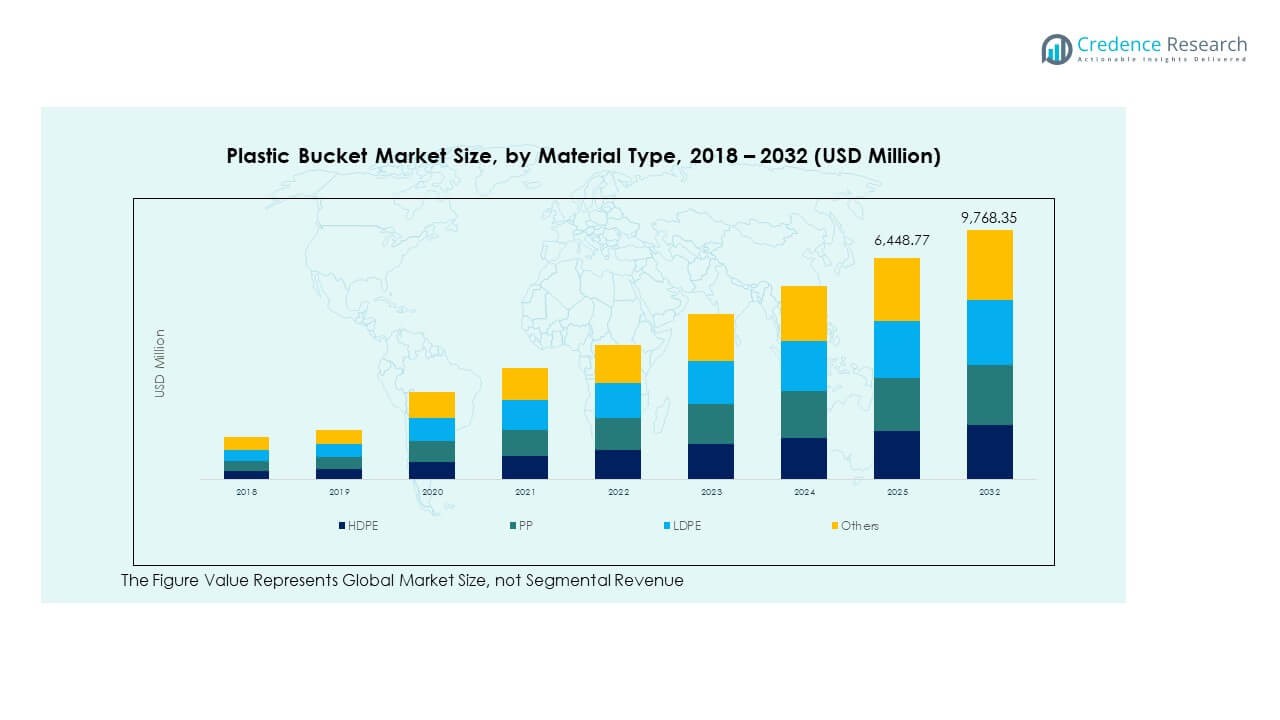
Segmentation:
By Material Type
- HDPE
- PP
- LDPE
- Others
By Capacity
- Up to 3 Liters
- 3–10 Liters
- 10–20 Liters
- Above 20 Liters
By End-user Industry
- Food and Beverage
- Chemicals and Petrochemicals
- Pharmaceuticals
- Agriculture
- Others
By Design Features
- With Lid
- Stackable
- With Handle
- Customized Designs
By Distribution Channel
- Online Stores
- Supermarkets/Hypermarkets
- Specialty Stores
- Others
By Region
- North America
- Europe
- Asia Pacific
- Latin America
- Middle East
- Africa
Regional Analysis:
North America
The North America Global Plastic Bucket Market size was valued at USD 1,341.60 million in 2018 to USD 1,554.59 million in 2024 and is anticipated to reach USD 2,472.39 million by 2032, at a CAGR of 6.1% during the forecast period. North America holds a 25.36% share of the global market. Strong industrial activity drives wide adoption across paints, coatings, and chemicals. Food processors rely on FDA-grade buckets for safe handling. Construction growth across the U.S. supports stable purchasing across bulk formats. Many distributors request durable HDPE variants for logistics. It benefits from strong supply networks and high product standards. Sustainability rules lift interest in recyclable buckets. Market growth stays firm due to rising demand from industrial and retail channels.
Europe
The Europe Global Plastic Bucket Market size was valued at USD 1,227.20 million in 2018 to USD 1,384.04 million in 2024 and is anticipated to reach USD 2,068.47 million by 2032, at a CAGR of 5.3% during the forecast period. Europe holds a 22.58% share of the global market. Strict quality and safety rules shape material selection across industries. Food and beverage plants rely on high-grade buckets for hygiene compliance. Chemical producers demand formats that meet EU safety norms. Growth in home improvement trends lifts household use. It benefits from advanced manufacturing hubs across Germany, France, and the UK. Recycling targets support adoption of eco-conscious products. Demand grows where traceability and product integrity matter.
Asia Pacific
The Asia Pacific Global Plastic Bucket Market size was valued at USD 2,120.56 million in 2018 to USD 2,566.39 million in 2024 and is anticipated to reach USD 4,347.90 million by 2032, at a CAGR of 6.9% during the forecast period. Asia Pacific holds a 41.86% share, making it the largest regional market. Strong manufacturing bases in China, India, and Southeast Asia lift steady demand. Construction and agriculture rely on bulk buckets for daily operations. Food companies expand packaging use due to higher output volumes. It benefits from rising retail penetration and low-cost production. Many producers scale operations to meet export orders. Regional growth stays robust due to strong industrial diversification.
Latin America
The Latin America Global Plastic Bucket Market size was valued at USD 284.96 million in 2018 to USD 332.20 million in 2024 and is anticipated to reach USD 485.19 million by 2032, at a CAGR of 5.0% during the forecast period. Latin America holds a 5.42% share of the global market. Expanding construction work increases demand for medium and large capacity buckets. Food processors rely on durable formats for sauces, powders, and bulk goods. Chemical plants in Brazil and Mexico use reinforced buckets for handling tasks. Retail channels strengthen distribution across small businesses. It grows through rising local production in key countries. Manufacturers invest in cost-efficient materials to raise margins. Market expansion remains steady but sensitive to economic shifts.
Middle East
The Middle East Global Plastic Bucket Market size was valued at USD 127.40 million in 2018 to USD 135.44 million in 2024 and is anticipated to reach USD 181.75 million by 2032, at a CAGR of 3.9% during the forecast period. The Middle East holds a 2.21% share of the global market. Oil and chemical segments rely on high-strength buckets for industrial use. Construction growth across the GCC supports rising consumption. Food service operators pick hygienic, sealed designs for handling. It sees demand from cleaning chemicals and building material suppliers. Import reliance shapes procurement strategies across distributors. Sustainability programs gain traction across urban centers. Market growth remains moderate due to economic diversification cycles.
Africa
The Africa Global Plastic Bucket Market size was valued at USD 98.28 million in 2018 to USD 157.57 million in 2024 and is anticipated to reach USD 212.65 million by 2032, at a CAGR of 3.5% during the forecast period. Africa holds a 2.57% share of the global market. Rising urban development lifts demand for construction-grade buckets. Agriculture depends on UV-resistant designs for rural applications. Food distribution networks adopt buckets for bulk handling. It grows through expanding retail penetration in developing cities. Local producers supply low-cost formats to meet rising demand. Import flows continue for specialized designs. Market expansion stays gradual but consistent across growing economies.
Key Player Analysis:
- Greif Inc.
- Mauser Packaging Solutions
- Berry Global Inc.
- RPC Group Plc
- BWAY Corporation
- M&M Industries Inc.
- Encore Plastics Corporation
- Letica Corporation
- Plastipak Holdings Inc.
- Ropak Packaging
- NCI Packaging
- Pro-Western Plastics Ltd.
- IPL Plastics Inc.
- Involvement Packaging Ltd.
- Viscount Plastics Pty Ltd.
- Industrial Container Services
- Paragon Manufacturing Inc.
- Affordable Plastics LLC
- Allied Plastics Co. Inc.
Competitive Analysis:
The Global Plastic Bucket Market features strong competition driven by material innovation, wider capacity ranges, and improved distribution reach. Large manufacturers focus on durable HDPE and PP buckets that meet industrial safety needs. Regional producers compete through cost efficiency and rapid delivery cycles. Many firms invest in customizable designs that support brand visibility. Global players expand portfolios to serve chemicals, food, and construction applications. It gains strength from rising demand for recyclable and lightweight formats. New entrants compete with low-cost offerings across emerging economies. The market demonstrates steady consolidation as companies secure stronger supply capabilities.
Recent Developments:
- In April 2025, Amcor plc successfully completed its all-stock combination with Berry Global, creating a global leader in consumer and healthcare packaging solutions. The merger, announced in November 2024, created a combined entity with approximately 400 packaging plants and 75,000 employees located in 140 countries. The transaction was expected to deliver approximately $260 million of pre-tax synergies in fiscal 2026, driving adjusted earnings per share accretion of approximately 12%, with total pre-tax synergy benefits expected to build to approximately $650 million by the end of fiscal 2028.
- In April 2025, IPL, a manufacturer of rigid plastic products, and Schoeller Allibert, a manufacturer of reusable transport packaging, announced a strategic merger to create a global company focused on reusable plastic packaging. The combined company was expected to have pro-forma annual revenues exceeding $1.4 billion, with operations across 27 manufacturing facilities spanning North America, the United Kingdom, and mainland Europe. IPL's existing shareholders would own a 55% stake in the newly formed company, while Schoeller Allibert shareholders would hold the remaining 45% stake. The combined entity, headquartered in Dublin and led by IPL CEO Alan Walsh, targeted completion in the third quarter of 2025.
- In March 2024, Greif Inc., a global leader in industrial packaging products and services, completed its acquisition of Ipackchem Group SAS, a global leader in premium barrier and non-barrier jerrycans and small plastic containers. The cash transaction was valued at $538 million, plus an additional $38 million as a ticking fee compensating the seller for earnings that inured to Greif, bringing the total funded amount to $576 million. The acquisition added approximately 1,400 Ipackchem employees across 13 operating facilities in 8 countries to Greif's portfolio. According to Greif's President and Chief Executive Officer Ole Rosgaard, the integration aimed to capture targeted synergies of $7 million and unlock significant new capabilities and market opportunities to further establish Greif as a world leader in high-performance small plastic containers and jerrycans.
- In February 2024, Mauser Packaging Solutions completed the acquisition of substantially all the assets of Consolidated Container Company, LLC for $56 million in cash. Consolidated Container, a manufacturer, reconditioner, and distributor of industrial containers with facilities in Minneapolis, Minnesota and Kansas City, Kansas, was integrated into Mauser's North America Industrial Packaging segment. According to David Vergo, President of Mauser's North America Industrial Packaging segment, the acquisition was expected to be highly complementary to Mauser's existing business, creating tremendous opportunities for customers, employees, and suppliers.
Report Coverage:
The research report offers an in-depth analysis based on material type, capacity, end-user industry, design features, and distribution channel. It details leading market players, providing an overview of their business, product offerings, investments, revenue streams, and key applications. Additionally, the report includes insights into the competitive environment, SWOT analysis, current market trends, as well as the primary drivers and constraints. Furthermore, it discusses various factors that have driven market expansion in recent years. The report also explores market dynamics, regulatory scenarios, and technological advancements that are shaping the industry. It assesses the impact of external factors and global economic changes on market growth. Lastly, it provides strategic recommendations for new entrants and established companies to navigate the complexities of the market.
Future Outlook:
- Demand will rise across construction, chemicals, and food industries driven by safe handling needs.
- Recyclable HDPE and PP buckets will gain strong traction with sustainability programs.
- Custom printing and brand-focused designs will shape adoption in retail applications.
- Industrial users will shift to stronger, leak-proof formats for hazardous materials.
- Growth in e-commerce will lift demand for lightweight and compact packaging units.
- Automation in molding will improve product uniformity and reduce production waste.
- New resin technologies will support higher durability and improved heat resistance.
- Asia Pacific will remain the most dynamic region due to manufacturing expansion.
- Companies will focus on supply chain resilience to manage resin price swings.
- Adoption of tamper-proof and hygienic designs will increase in food processing.
Request a Free Sample
Fill in your details and we'll send you a free sample report.
- Sample data tables & charts
- Research methodology
Need a Custom Version of This Report?
Tailor the scope, geography, or segments to your exact requirements.
- Custom geography or segment scope
- Direct access to our analyst team
Frequently Asked Questions
What is the current market size for the Global Plastic Bucket Market, and what is its projected size in 2032?
At what Compound Annual Growth Rate is the Global Plastic Bucket Market projected to grow between 2025 and 2032?
Which Global Plastic Bucket Market segment held the largest share in 2024?
What are the primary factors fueling the growth of the Global Plastic Bucket Market?
Who are the leading companies in the Global Plastic Bucket Market?
Which region commanded the largest share of the Global Plastic Bucket Market in 2024?
Table of Content
Chapter 1. Report Introduction
- 1.1 Report Description & Purpose
- 1.1.1 Report Title & Market Definition
- 1.1.2 Unique Selling Propositions (USP) & Key Differentiators
- 1.1.3 Value Proposition for Stakeholders
- 1.2 Research Objectives
- 1.2.1 Market Sizing Objectives (Volume & Revenue)
- 1.2.2 Segmentation Objectives
- 1.2.3 Competitive Intelligence Objectives
- 1.2.4 Forecast & Scenario Objectives
- 1.3 Report Scope
- 1.3.1 Plastic Bucket Scope – Types & Subtypes Covered
- 1.3.2 Geographic Scope – Regions & Countries Covered
- 1.3.3 Historical Period, Base Year & Forecast Period (2018; forecast to the forecast period)
- 1.3.4 Inclusions & Exclusions
- 1.4 HS Code & Classification Framework
- 1.5 Currency, Units & Pricing Basis
- 1.6 Target Stakeholders
- 1.7 Limitations & Assumptions
Chapter 2. Executive Summary
- 2.1 Global Plastic Bucket Market Snapshot
- 2.1.1 Market Size – Historical (2018) & Forecast (the forecast period) (2018: USD 5,200.00 million → forecast year: USD 9,768.35 million)
- 2.1.2 Volume & Revenue – Global Totals
- 2.1.3 Key Market Highlights – Top Five Facts
- 2.2 Plastic Bucket Market Segmentation Snapshot
- 2.2.1 Market Split by Region – 2018 vs.
- 2.3 Competitive Snapshot
- 2.3.1 Top 10 Players by Revenue Share – 2018
- 2.3.2 Top 10 Players by Volume Share – 2018
- 2.3.3 Recent Strategic Developments (18-Month Summary)
- 2.4 Key Investment Highlights & Strategic Conclusions
Chapter 3. Plastic Bucket Market Dynamics & Industry Analysis
- 3.1 Market Overview & Context
- 3.1.1 Plastic Bucket Market Position in the Broader Automotive Value Chain
- 3.1.2 OEM vs. Replacement Market Dynamics
- 3.1.3 Market Maturity & Development Stage by Region
- 3.2 Plastic Bucket Market Drivers
- 3.3 Plastic Bucket Market Restraints & Challenges
- 3.4 Plastic Bucket Market Opportunities
- 3.5 Porter's Five Forces Analysis
- 3.5.1 Threat of New Entrants
- 3.5.2 Bargaining Power of Suppliers
- 3.5.3 Bargaining Power of Buyers
- 3.5.4 Threat of Substitutes
- 3.5.5 Competitive Rivalry – Intensity Assessment
- 3.6 Plastic Bucket Value Chain Analysis
- 3.6.1 Upstream – Raw Material/Input Suppliers
- 3.6.1.1 Raw Material/Input 1
- 3.6.1.2 Raw Material/Input 2
- 3.6.1.3 Raw Material/Input 3
- 3.6.2 Midstream – Production/Manufacturing/Service Delivery
- 3.6.2.1 Production/Process Overview
- 3.6.2.2 Key Facility Locations & Capacity by Manufacturer
- 3.6.3 Downstream – Distribution & End Consumer
- 3.6.3.1 Primary Channel – B2B/OEM
- 3.6.3.2 Secondary Channels – Dealer, Retail, Online, Direct
- 3.6.4 Value Chain Profitability Analysis
- 3.6.1 Upstream – Raw Material/Input Suppliers
- 3.7 PESTEL Analysis
- 3.7.1 Political Factors
- 3.7.2 Economic Factors
- 3.7.3 Social Factors
- 3.7.4 Technological Factors
- 3.7.5 Environmental Factors
- 3.7.6 Legal Factors
- 3.8 Plastic Bucket Supply Chain Analysis
- 3.8.1 Raw Material/Input Supply Risk Assessment
- 3.8.2 Manufacturing Concentration Risk (Geographic Exposure)
- 3.8.3 Trade Disruption Impact Analysis
- 3.9 Regulatory & Policy Landscape
Note: The regulatory and policy landscape section covers regulations based on their applicability to the market, Plastic Bucket category, geography, and scope of the study. Only regulatory frameworks with a material impact on operations, compliance, trade, sustainability, or market access are analyzed in detail.
Chapter 4. Key Investment Pockets & Opportunity Analysis
- 4.1 Plastic Bucket Market Attractiveness Analysis
- 4.1.1 By Region – Investment Attractiveness Matrix (Volume × CAGR)
- 4.2 Absolute Revenue Growth Opportunity
- 4.2.1 By Region – Absolute USD Growth Through the forecast period
- 4.3 Incremental Volume Opportunity
- 4.3.1 By Region – Incremental Volume Through the forecast period
- 4.3.2 Segment – Incremental Volume
- 4.4 Emerging Submarket Opportunity Deep Dive (Subject to Applicability)
- 4.5 Emerging Market Opportunity Scorecards
- 4.5.1 United States
- 4.5.2 Europe
- 4.5.3 Asia
- 4.5.4 Middle East & Africa
Note: Emerging Market Opportunity Scorecards will be included based on relevance and strategic importance. Regions listed are indicative and may vary depending on data availability and market dynamics.
Chapter 5. Plastic Bucket Import-Export Analysis & Trade Flows
- 5.1 Global Trade Overview
- 5.1.1 Global Export Value by Country (2018)
- 5.1.2 Global Export Volume by Country (2018)
- 5.1.3 Global Import Value by Country (2018)
- 5.1.4 Global Import Volume by Country (2018)
- 5.1.5 Net Trade Balance by Country (2018)
- 5.2 Export Analysis – Segment
- 5.2.1 Type 1 (HS Code)
- 5.2.2 Type 2 (HS Code)
- 5.2.3 Type 3 (HS Code)
- 5.2.4 Type 4 (HS Code)
- 5.2.5 Type 5 (HS Code)
- 5.3 Import Analysis – Segment
- 5.3.1 Type 1 (HS Code)
- 5.3.2 Type 2 (HS Code)
- 5.3.3 Type 3 (HS Code)
- 5.3.4 Type 4 (HS Code)
- 5.3.5 Type 5 (HS Code)
- 5.4 Average Unit Trade Prices
- 5.4.1 Average Export Price – Segment & Country
- 5.4.2 Average Import Price – Segment & Source Country
- 5.4.3 Price Trends (2018)
- 5.5 Key Trade Route Analysis
- 5.5.1 Trade Route 1
- 5.5.2 Trade Route 2
- 5.5.3 Trade Route 3
- 5.5.4 Trade Route 4
- 5.5.5 Trade Route 5
- 5.6 Trade Policy Impact Assessment
- 5.6.1 US Anti-Dumping & Section 301 Tariffs
- 5.6.2 EU Customs Union Impact
- 5.6.3 Major Free Trade Agreements
- 5.6.4 USMCA Rules of Origin
Note: Trade policy analysis will be included only where relevant to the Plastic Bucket market.
Chapter 6. Competitive Landscape & Company Benchmarking
- 6.1 Plastic Bucket Market Concentration & Structure
- 6.1.1 Herfindahl-Hirschman Index (HHI) – vs. 2018
- 6.1.2 Tier 1, Tier 2 & Tier 3 Market Structure
- 6.1.3 Global, Regional & Local Player Dynamics
- 6.2 Plastic Bucket Market Share Analysis – 2018
- 6.2.1 Global Revenue Share by Company
- 6.2.2 Global Volume Share by Company
- 6.2.3 Regional Revenue Share
- 6.2.4 Market Share Evolution ( vs. 2018)
- 6.2.5 OEM Segment Share by Company
- 6.2.6 Replacement Segment Share by Company
- 6.3 Production/Delivery Capacity & Facility Analysis
- 6.3.1 Global Installed Capacity
- 6.3.2 Capacity Utilization Rates
- 6.3.3 Production/Output Volume
- 6.3.4 Facility Locations & Capacity Map
- 6.3.5 Planned Capacity Additions
- 6.4 Plastic Bucket Competitive Benchmarking Matrix
- 6.4.1 Revenue, Volume, CAGR & Profitability Comparison
- 6.4.2 Channel Revenue Mix
- 6.4.3 Geographic Revenue Exposure
- 6.4.4 R&D Intensity
- 6.4.5 Sustainability Maturity
- 6.5 Strategic Developments in Plastic Bucket (Last 24 Months)
- 6.5.1 Mergers, Acquisitions & Divestments
- 6.5.2 New Plastic Bucket Launches
- 6.5.3 Facility Expansions
- 6.5.4 Strategic Alliances, Joint Ventures & Partnerships
- 6.5.5 Distribution Expansion & Market Entry
- 6.5.6 Sustainability & ESG Initiatives
- 6.6 Competitive Strategy Mapping
- 6.6.1 Leader, Challenger, Follower & Niche Classification
- 6.6.2 Pricing Strategy Comparison
- 6.6.3 Channel Strategy Matrix
Note: Strategic developments are included based on their materiality and the availability of reliable information.
Chapter 7. Global Plastic Bucket Market – By Distribution Channel
- 7.1 Segment Overview
- 7.1.1 Volume & Revenue Split by Channel (2018 & )
- 7.1.2 Channel Mix Evolution (the forecast period)
Chapter 8. Regional Market Analysis – Global Overview
- 8.1 Global Regional Overview
- 8.1.1 Regional Volume Share
- 8.1.2 Regional Revenue Share
- 8.1.3 Regional Volume by Region
- 8.1.4 Regional Revenue by Region
- 8.1.5 Regional Forecast Through the forecast period
- 8.2 Cross-Regional Segment Analysis
- 8.2.1 By Distribution Channel
- 8.2.2 By Brand/Price Tier
Chapter 9. North America Plastic Bucket Market
- 9.1 United States
- 9.2 Canada
- 9.3 Mexico
Chapter 10. Europe Plastic Bucket Market
- 10.1 Germany
- 10.2 France
- 10.3 Italy
- 10.4 United Kingdom
- 10.5 Spain
- 10.6 Poland
- 10.7 Russia
- 10.8 Netherlands
- 10.9 Belgium
- 10.10 Sweden
- 10.11 Denmark
- 10.12 Norway
- 10.13 Rest of Europe
Chapter 11. Asia Pacific Plastic Bucket Market
- 11.1 China
- 11.2 India
- 11.3 Japan
- 11.4 South Korea
- 11.5 Thailand
- 11.6 Indonesia
- 11.7 Vietnam
- 11.8 Malaysia
- 11.9 Australia
- 11.10 Rest of Asia Pacific
Chapter 12. Latin America Plastic Bucket Market
- 12.1 Brazil
- 12.2 Argentina
- 12.3 Colombia
- 12.4 Chile
- 12.5 Rest of Latin America
Chapter 13. Middle East Plastic Bucket Market
- 13.1 Saudi Arabia
- 13.2 United Arab Emirates
- 13.3 Turkey
- 13.4 Israel
- 13.5 Iran
- 13.6 Rest of the Middle East
Chapter 14. Africa Plastic Bucket Market
- 14.1 South Africa
- 14.2 Egypt
- 14.3 Nigeria
- 14.4 Morocco
- 14.5 Rest of Africa
Chapter 15. Plastic Bucket Company Profiles
- 15.1 [Company 01]
- 15.1.1 Company Overview
- 15.1.2 Key Management Personnel
- 15.1.3 Products & Services Portfolio
- 15.1.4 Financial Performance
- 15.1.5 Key Market Focus & Geographic Presence
- 15.1.6 Recent Developments & Strategic Initiatives
Note: The company profile list is preliminary and may change based on research findings, market developments, data availability, and client requirements.
Chapter 16. Appendices
- Appendix A – List of Abbreviations & Acronyms
- Appendix B – Industry Classification Code Reference – Full Series
- Appendix C – Production & Capacity Data Tables
- Appendix D – End-Use & Demand Base Tables
- Appendix E – Consumption & Replacement Rate Assumptions
- Appendix F – ASP Reference Tables
- Appendix G – Manufacturing & Facility Database
- Appendix H – Import-Export Data Tables
- Appendix I – Regulatory Summary Tables
- Appendix J – Primary Research Participant List (Anonymized)
- Appendix K – Primary Research Questionnaire Framework
- Appendix L – Data Sources & Bibliography
- Appendix M – Market Size Divergence & Source Comparison
Chapter 17. Research Methodology
- 17.1 Research Framework & Philosophy
- 17.2 Secondary Research – Sources, Hierarchy & Data Extraction
- 17.3 Data Modeling – Bottom-Up & Top-Down Market Sizing
- 17.4 Primary Research – Stakeholder Framework, LOI & Sample Sizes
- 17.5 Forecast Methodology – Regression, Scenario & Sensitivity Analysis
- 17.6 Quality Control – Four-Layer Validation Framework
- 17.7 Limitations & Standard Assumptions
- 17.8 Disclaimer
