Market Overview
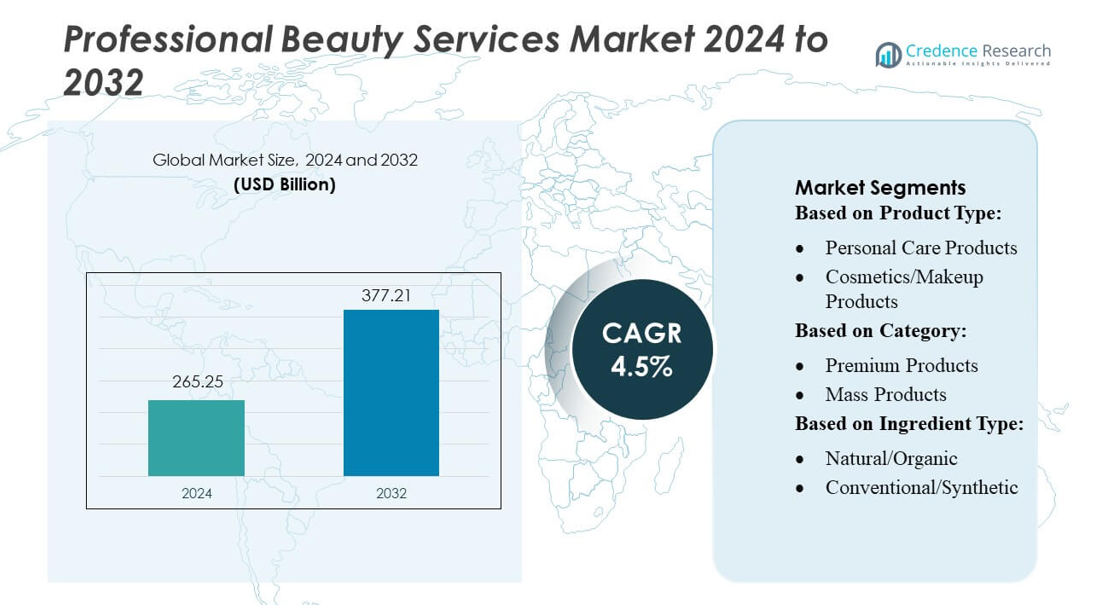
Professional Beauty Services Market size was valued USD 265.25 billion in 2024 and is anticipated to reach USD 377.21 billion by 2032, at a CAGR of 4.5% during the forecast period.
| REPORT ATTRIBUTE | DETAILS |
|---|---|
| Historical Period | 2020-2023 |
| Base Year | 2024 |
| Forecast Period | 2025-2032 |
| Professional Beauty Services Market Size 2024 | USD 265.25 billion |
| Professional Beauty Services Market, CAGR | 4.5% |
| Professional Beauty Services Market Size 2032 | USD 377.21 billion |
The professional beauty services market is dominated by established global players such as L’Oréal S.A., Coty Inc., Wella, Estée Lauder, Procter & Gamble, Shiseido, Henkel, Kao, Revlon, and Toni & Guy, which together drive innovation in hair, skin, and spa services. These companies are expanding through premium salons, franchise networks, and advanced service offerings. Regionally, North America leads the global professional beauty services market, commanding approximately 38.2 % of the total market, fueled by high disposable incomes, sophisticated salon infrastructure, and robust consumer demand.
Market Insights
- The Professional Beauty Services Market reached USD 265.25 billion in 2024 and is projected to hit USD 377.21 billion by 2032 at a 5% CAGR, supported by rising consumer spending on premium beauty treatments.
- Growing demand for personalized hair, skin, and spa solutions drives market expansion, with consumers increasingly opting for specialized services and technologically enhanced treatments.
- Key trends include rapid adoption of digital booking systems, rising male grooming participation, and strong growth in franchised salon networks across urban centers.
- Competition intensifies as leading players such as L’Oréal, Coty, Wella, Estée Lauder, P&G, Shiseido, Henkel, Kao, Revlon, and Toni & Guy expand service portfolios, while high service costs and skilled labor shortages restrain overall market scalability.
- North America holds 38.2% of the global market, while premium salon services lead the segment share globally, driven by well-developed infrastructure and strong brand penetration.
Market Segmentation Analysis:
By Product Type
The professional beauty services market remains dominated by personal care products, which account for an estimated 58–62% market share, driven by consistent demand for skincare, haircare, and hygiene-focused formulations used across salons and clinics. Their dominance stems from high-frequency consumption, recurring service-based application, and rapid innovation in targeted solutions such as barrier-repair skincare, salon-grade hair treatments, and anti-pollution formats. Cosmetics and makeup products show steady growth but remain secondary due to lower usage frequency and rising consumer prioritization of skin health over heavy cosmetic application in professional settings.
- For instance, Unilever has integrated AI-driven manufacturing into its personal care factories - at its Hefei, China plant, AI has delivered an 8% increase in overall equipment effectiveness and a 20% reduction in waste.
By Category
Premium products lead the market with an estimated 55–60% share, supported by strong consumer willingness to invest in high-performance, salon-grade formulations that deliver visible results. Growth in dermatological services, ingredient-focused beauty, and luxury salon chains further accelerates preference for premium lines. These products leverage advanced actives, high efficacy claims, and personalized service integration, enabling professionals to charge higher service premiums. Mass products continue to serve price-sensitive segments but face competitive pressure as consumers increasingly associate premium formulations with safety, effectiveness, and long-term skin or hair improvement.
- For instance, Avon launched its Beyond Glow collection with 15+ SKUs featuring glow-boosting actives like snail mucin, niacinamide, vitamin C, ceramides, and peptides, bringing lab-grade Korean skin science to its direct sales network.
By Ingredient Type
Natural and organic ingredient-based products hold the dominant position with an estimated 52–55% share, driven by expanding demand for clean beauty, chemical-free treatments, and eco-conscious salon offerings. Professional consumers increasingly prefer botanical extracts, plant-based actives, and allergen-free formulations to minimize irritation and align with sustainability expectations. Their adoption is further boosted by regulatory tightening on synthetic ingredients and rising awareness of ingredient transparency. Conventional and synthetic formulations remain relevant due to affordability and performance stability but are gradually losing share as salons rebrand around wellness-aligned natural solutions.
Key Growth Drivers
Rising Consumer Demand for Personalized and Premium Treatments
Growing consumer preference for tailored beauty experiences significantly accelerates market expansion. Clients increasingly seek advanced skin, hair, and wellness treatments designed around their lifestyle, skin type, and aesthetic goals. Premium offerings-such as dermal therapies, laser treatments, and customized hair services-strengthen service differentiation and boost repeat business. This demand is especially strong among urban, high-income consumers who value quality, safety, and expertise. As personalization becomes a core decision factor, service providers invest in skilled professionals and advanced tools to enhance outcomes and customer retention.
- For instance, Shiseido’s VOYAGER digital platform uses AI trained on over 500,000 data points - combining raw-material chemistry, ingredient interactions, and cutaneous science - to rapidly generate new personalized formulations.
Proliferation of Technology-Enabled Service Models
Digital integration is reshaping how beauty services are delivered and experienced. Online appointment systems, virtual consultations, AI-driven skin analysis tools, and CRM-based loyalty programs streamline operations and improve service accuracy. Technology also enables better capacity management, faster onboarding of clients, and stronger data-driven decision-making. Salons and clinics adopting automation, digital payment systems, and app-based engagement platforms achieve higher customer satisfaction and operational efficiency. Additionally, social media marketing and influencer partnerships magnify brand visibility, supporting faster expansion for both organized chains and independent professionals.
- For instance, Beauty Genius virtual beauty assistant uses generative AI and has been trained on more than 750 L’Oréal Paris products, combining data from over 16,000 skin images and 150,000 dermatologist-annotated images to provide personalized routines.
Growing Popularity of Wellness and Holistic Beauty Solutions
Consumers increasingly blend beauty with wellness, fueling demand for integrative services such as therapeutic massages, organic skincare treatments, aromatherapy, and non-invasive rejuvenation procedures. This shift aligns with a broader lifestyle trend toward preventive care, stress reduction, and long-term skin health. Service providers offering holistic packages gain a competitive edge by addressing both physical appearance and emotional well-being. The surge in clean-beauty awareness further encourages salons and clinics to use natural ingredients and eco-friendly products, helping strengthen brand trust and attract sustainability-conscious clients.
Key Trends & Opportunities
Expansion of Male Grooming and Unisex Service Segments
The male grooming segment has evolved rapidly from basic haircuts to advanced skincare, beard styling, and wellness services. Growing awareness of personal appearance and professional presentation among men presents new revenue opportunities for salons and grooming studios. Unisex service formats allow operators to diversify their client base and optimize capacity. Many brands are launching male-specific product lines and premium grooming lounges, indicating substantial opportunity for operators who tailor their offerings to this expanding demographic with specialized expertise and curated service experiences.
- For instance, RNA-monitoring technology that extracts sebum on a single oil-blotting film and reads RNA information for over 10,000 genes, enabling non-invasive insights into skin and scalp health.
Rapid Growth of Organized Salon Chains and Franchise Models
The market is witnessing strong consolidation as organized chains expand through franchising to meet rising demand for standardized, hygienic, and professionally managed beauty services. Consumers increasingly prefer brands that offer consistent service quality, certified technicians, transparent pricing, and high safety protocols. Franchise models help leading players tap into Tier II and Tier III cities with minimal capital investment, enabling faster geographical penetration. This trend creates opportunities for investors and entrepreneurs seeking predictable returns, streamlined training systems, and brand-led operational support.
- For instance, Oriflame has introduced a digital AI Skin Advisor, developed in partnership with Revieve, which analyzes over 120 skin metrics via selfie and questionnaire inputs and has logged more than 100,000 completed consultations with an 80% completion rate.
Increasing Adoption of Eco-Friendly and Sustainable Practices
Sustainability is becoming a defining trend as clients prioritize environmentally responsible beauty choices. Salons integrating biodegradable products, water-efficient equipment, vegan formulations, and reduced-waste protocols attract eco-conscious consumers and strengthen brand reputation. Additionally, green certifications and sustainable product partnerships enable service providers to differentiate themselves in a competitive landscape. This shift opens opportunities to introduce organic treatment lines, refillable product stations, and energy-efficient technologies, creating value while meeting regulatory expectations and environmental standards.
Key Challenges
Shortage of Skilled Professionals and High Training Costs
The market faces persistent talent gaps due to the limited availability of certified beauty therapists, stylists, and dermatology-trained technicians. Continuous upskilling is essential to keep pace with evolving trends, advanced equipment, and safety requirements, but training costs remain high for both individuals and service providers. This challenge affects service consistency, brand standardization, and expansion plans-especially for smaller operators. As customer expectations rise for premium experiences and specialized procedures, the industry must invest heavily in structured training and professional development frameworks.
High Competition and Price Sensitivity in Local Markets
Despite growing demand, the market remains highly fragmented with intense competition from independent salons, home-service professionals, and emerging online platforms. Many consumers remain price-sensitive, especially in developing regions, limiting operators’ ability to increase service rates or introduce premium packages. Discount-driven marketing and low switching costs further pressure margins. Organized players struggle to balance competitive pricing with rising overheads for skilled labor, rent, and technology adoption. This dynamic makes it essential for service providers to differentiate through quality, hygiene, and customer engagement strategies.
Regional Analysis
North America
North America holds approximately 32% of the Professional Beauty Services Market, driven by strong consumer spending on premium skincare, aesthetic treatments, and advanced salon services. High adoption of technology-enabled platforms and demand for medical-grade beauty solutions reinforce market growth. The region benefits from well-established salon chains, dermatology clinics, and wellness centers offering specialized treatments. Urban centers such as New York, Los Angeles, and Toronto contribute significantly due to high service penetration and disposable incomes. Strict hygiene standards, skilled professionals, and rising interest in holistic wellness further support sustained market expansion.
Europe
Europe accounts for nearly 27% of the global market, supported by a mature beauty ecosystem, strong regulatory standards, and high consumer awareness of professional skincare and haircare services. Demand remains strong for anti-aging treatments, organic beauty solutions, and wellness-integrated service packages. Countries such as Germany, France, Italy, and the UK lead market adoption with established salon chains and dermatology-driven beauty clinics. The region’s preference for sustainability, clean beauty practices, and premium formulations encourages providers to innovate. Growth is further driven by rising tourism-based beauty services and expanding male grooming trends.
Asia-Pacific
Asia-Pacific dominates the market with approximately 34% share, fueled by rapid urbanization, rising disposable income, and strong cultural affinity for beauty and grooming. The region experiences robust growth in professional skincare, haircare, and technologically advanced aesthetic services, particularly in China, India, South Korea, and Japan. Expanding middle-class populations and increasing adoption of global beauty standards accelerate demand. Organized salon chains and franchise models are scaling rapidly across tiered cities. Additionally, the influence of K-beauty, social media-driven trends, and younger demographic participation significantly strengthens long-term market potential.
Latin America
Latin America represents around 4% of the market, with growth centered on Brazil, Mexico, and Argentina. Rising interest in hair treatments, skincare services, and wellness-focused beauty offerings supports gradual expansion. Urban consumers increasingly prioritize professional grooming, while local beauty cultures drive demand for specialized haircare and body treatments. Economic fluctuations and price sensitivity limit market acceleration, yet increasing adoption of franchise salon models and digital booking platforms enhances accessibility. Growing tourism and demand for premium services in major cities further contribute to steady development in the region’s professional beauty services landscape.
Middle East & Africa
The Middle East & Africa region holds approximately 3% share, driven by rising demand for luxury beauty services, aesthetic treatments, and high-end salon experiences across the UAE, Saudi Arabia, and South Africa. Growth is supported by expanding expat populations, strong retail beauty culture, and increasing acceptance of non-invasive cosmetic procedures. Premium malls and beauty hubs fuel service adoption. However, market fragmentation and limited availability of advanced training restrict wider penetration. Despite these challenges, increasing wellness tourism, salon franchising, and investment in modern beauty clinics position the region for progressive long-term growth.
Market Segmentations:
By Product Type:
- Personal Care Products
- Cosmetics/Makeup Products
By Category:
- Premium Products
- Mass Products
By Ingredient Type:
- Natural/Organic
- Conventional/Synthetic
By Geography
- North America
- U.S.
- Canada
- Mexico
- Europe
- Germany
- France
- U.K.
- Italy
- Spain
- Rest of Europe
- Asia Pacific
- China
- Japan
- India
- South Korea
- South-east Asia
- Rest of Asia Pacific
- Latin America
- Brazil
- Argentina
- Rest of Latin America
- Middle East & Africa
- GCC Countries
- South Africa
- Rest of the Middle East and Africa
Competitive Landscape
The Professional Beauty Services Market players such as Coty Inc., Unilever, AVON PRODUCTS, INC, Shiseido, L'Oréal S.A., Kao Corporation, Estée Lauder, ORIFLAME COSMETICS S.A., Revlon, and Procter & Gamble. The Professional Beauty Services Market features a dynamic and highly fragmented competitive environment with strong participation from global brands, regional chains, and independent service providers. Competition intensifies as companies prioritize service innovation, premium treatment development, and digital integration to enhance the customer experience. Advanced skincare technologies, personalized treatment programs, and wellness-oriented offerings help businesses differentiate in a crowded market. Many providers invest in technician training, hygiene standards, and loyalty programs to strengthen client retention. Franchise models continue to expand, enabling faster penetration into emerging cities while maintaining standardized service quality. Additionally, digital booking platforms, social media marketing, and influencer collaborations reshape competitive strategies by increasing brand visibility and client engagement. Sustainability practices, such as eco-friendly products and energy-efficient equipment, further influence competitive positioning as consumers increasingly seek ethical and safe beauty solutions. Overall, the market remains competitive, with innovation, experience quality, and brand trust defining long-term success.
Key Player Analysis
- Coty Inc.
- Unilever
- AVON PRODUCTS, INC
- Shiseido
- L'Oréal S.A.
- Kao Corporation
- Estée Lauder
- ORIFLAME COSMETICS S.A.
- Revlon
- Procter & Gamble
Recent Developments
- In January 2025, Albéa Matamoros and Drunk Elephant formed a partnership to introduce three sustainable skincare products in the United States market: D-Bronzi, O-Bloos, and B-Goldi.
- In January 2025, L'Oréal partnered with IBM to develop sustainable cosmetic formulations using generative artificial intelligence (AI). The company utilized IBM's GenAI technology to analyze cosmetic formulation data, enabling the incorporation of sustainable raw materials while reducing energy consumption and material waste.
- In April 2024, Italian salon chain Luca Piattelli is now in India with its first flagship store at South Delhi's Safdarjung Enclave. Located in the Sardarjung neighborhood of New Delhi, the salon provides an extensive range of services for both men and women.
- In June 2023, Estee Lauder launched the Responsible Store Design Program, which will augment the environmental targets and engage with consumers in retail sustainability. It was created in collaboration with a sustainability consulting firm that specializes in green building design and is subject to third-party review to ensure credibility & precision
Report Coverage
The research report offers an in-depth analysis based on Product Type, Category, Ingredient Type and Geography. It details leading market players, providing an overview of their business, product offerings, investments, revenue streams, and key applications. Additionally, the report includes insights into the competitive environment, SWOT analysis, current market trends, as well as the primary drivers and constraints. Furthermore, it discusses various factors that have driven market expansion in recent years. The report also explores market dynamics, regulatory scenarios, and technological advancements that are shaping the industry. It assesses the impact of external factors and global economic changes on market growth. Lastly, it provides strategic recommendations for new entrants and established companies to navigate the complexities of the market.
Future Outlook
- The market will continue to expand as consumers increasingly prioritize personalized, premium, and wellness-oriented beauty services.
- Digital platforms and AI-based skin and hair diagnostics will play a larger role in service delivery and client engagement.
- Demand for non-invasive aesthetic treatments will rise as clients seek effective solutions with minimal downtime.
- Organized salon chains and franchise models will gain stronger market share through standardized quality and scalable operations.
- Sustainability and clean-beauty practices will become essential differentiators for service providers.
- Male grooming services will grow steadily as awareness and willingness to invest in appearance increase.
- Hybrid beauty models combining in-salon experiences with at-home service extensions will gain popularity.
- Training and certification programs for beauty professionals will expand to meet rising expectations for expertise and safety.
- Technology-enabled appointment systems, loyalty platforms, and CRM tools will strengthen customer retention.
- Market competition will intensify as regional players introduce niche, affordable, and culturally tailored service offerings.

Request a Free Sample
Fill in your details and we'll send you a free sample report.
- Sample data tables & charts
- Research methodology
Market Dynamics
Personalization and Premiumization
Consumers are increasingly seeking tailored beauty experiences and are willing to pay a premium for advanced, personalized treatments that address specific skin, hair, and wellness needs. This trend is especially strong among urban and high-income demographics, driving growth in premium service offerings and repeat business.
Technology-Enabled Service Delivery
The adoption of digital booking systems, AI-driven diagnostics, and virtual consultations is transforming the client experience and operational efficiency for salons and clinics. These technologies streamline appointment management, enhance service accuracy, and enable data-driven personalization, making professional beauty services more accessible and appealing.
Wellness and Holistic Beauty Integration
There is a growing consumer preference for beauty services that incorporate wellness elements such as therapeutic massages, organic skincare, and non-invasive rejuvenation treatments. This convergence of beauty and wellness aligns with broader lifestyle trends toward preventive care and stress reduction, expanding the scope and appeal of professional beauty services.
Sustainability and Clean Beauty Demand
Rising awareness of environmental and health impacts is fueling demand for natural, organic, and eco-friendly beauty products and services. Salons and clinics that adopt sustainable practices and offer clean beauty solutions are attracting a growing segment of eco-conscious consumers, differentiating themselves in a competitive market.
Expansion of Male Grooming and Unisex Services
The rapid evolution of male grooming from basic haircuts to advanced skincare and wellness services is opening new revenue streams. Unisex service formats and male-specific product lines are enabling providers to diversify their client base and capitalize on increasing male participation in professional beauty care.
Need a Custom Version of This Report?
Tailor the scope, geography, or segments to your exact requirements.
- Custom geography or segment scope
- Direct access to our analyst team
Frequently Asked Questions
What is the current market size for the Professional Beauty Services Market, and what is its projected size in 2032?
At what Compound Annual Growth Rate is the Professional Beauty Services Market projected to grow between 2025 and 2032?
Who are the major players in the global professional beauty services market?
What are the major market drivers of the professional beauty services industry?
What are the major market restraints of the Professional Beauty Services industry?
What are the major market opportunities in the Professional Beauty Services industry?
Who are the leading companies in the Professional Beauty Services Market?
Table of Content
Chapter 1 Market Segmentation
- 1.1 Segmentation Framework
- 1.1.1 Product and Service Classification
- 1.1.2 Application and End-Use Classification
- 1.1.3 Technology and Solution Classification
- 1.1.4 Customer and Distribution Channel Classification
- 1.1.5 Geographic Segmentation
- 1.1.6 Market Segment Definitions and Boundaries
- 1.2 By Category
- 1.2.1 Premium Products
- 1.2.2 Mass Products
- 1.3 By Product Type
- 1.3.1 Personal Care Products
- 1.3.2 Cosmetics/Makeup Products
- 1.4 By Ingredient Type
- 1.4.1 Natural/Organic
- 1.4.2 Conventional/Synthetic
Chapter 2 Introduction
- 2.1 Report Objectives and Scope
- 2.2 Product Definition and Industry Terminology
- 2.3 Market Inclusions and Exclusions
- 2.4 Research Process
- 2.4.1 Primary Research and Expert Interviews
- 2.4.2 Secondary Research and Source Review
- 2.4.3 Top-Down and Bottom-Up Estimation
- 2.4.4 Data Triangulation and Verification
- 2.5 Market Size Measurement Basis
- 2.5.1 2024: USD 265.25 billion → 2032: USD 377.21 billion
- 2.6 Historical and Forecast Reference Periods
- 2.6.1 Base Year: 2024
- 2.6.2 Forecast Period: 2024-2032
- 2.7 Research Assumptions and Limitations
Chapter 3 Executive Summary
- 3.1 Market Snapshot and Key Findings
- 3.2 Base-Year Market Size, 2024
- 3.3 Forecast Market Size, 2032
- 3.4 Revenue and Volume Growth Outlook
- 3.5 Key Demand and Supply Indicators
- 3.6 Leading Market Segments
- 3.7 Fastest-Growing Market Opportunities
- 3.8 Regional Performance Highlights
- 3.9 Technology and Industry Transformation
- 3.10 Competitive Landscape Summary
- 3.11 Analyst View and Strategic Implications
Chapter 4 Global Professional Beauty Services Market Trends and Developments
- 4.1 Historical Industry Development
- 4.2 Recent Market Trends and Developments
- 4.3 Demand and Customer Behavior Trends
- 4.4 Technology and Product Innovation
- 4.5 Artificial Intelligence, Automation and Digitalization
- 4.6 Local Manufacturing and Supply Chain Realignment
- 4.7 Industry Partnerships, Mergers and Acquisitions
- 4.8 Sustainability and Circular Economy Developments
- 4.9 Government and Private Sector Investment Trends
- 4.10 Emerging Business Models and Commercialization
- 4.11 Industry Developments and Announcements
Chapter 5 Global Professional Beauty Services Market Supply and Demand Analysis
- 5.1 Demand Trend and Consumption Analysis
- 5.2 Demand Forecast, 2024-2032
- 5.3 Supply Chain Structure and Procurement Trends
- 5.4 Supply-Demand Gap and Bottlenecks
- 5.5 Import Dependence and Sourcing Structure
- 5.6 Regional Supply and Demand Concentration
Chapter 6 Global Professional Beauty Services Market Pricing Analysis
- 6.1 Pricing Structure and Measurement
- 6.2 Historical Pricing Trends
- 6.3 Pricing Outlook, 2024-2032
- 6.4 Pricing by Product and Market Segment
- 6.5 Geographic Pricing Differences
- 6.6 Key Input, Energy, Labor and Logistics Costs
- 6.7 Contract Pricing and Purchasing Models
- 6.8 Pricing Sensitivity and Competitive Positioning
- 6.9 Price, Margin and Profitability Implications
Chapter 7 Global Professional Beauty Services Market Dynamics
- 7.1 Market Growth Drivers
- 7.1.1 Demand-Side Drivers
- 7.1.2 Technology and Innovation Drivers
- 7.1.3 Infrastructure and Investment Drivers
- 7.1.4 Regulatory and Policy Drivers
- 7.2 Market Restraints
- 7.2.1 Cost and Affordability Constraints
- 7.2.2 Technology and Adoption Barriers
- 7.2.3 Supply Chain and Operational Constraints
- 7.3 Market Challenges
- 7.3.1 Competitive Pressure and Margin Erosion
- 7.3.2 Skills, Infrastructure and Implementation Gaps
- 7.4 Emerging Market Opportunities
- 7.5 Market Dynamics Impact and Time-Horizon Assessment
Chapter 8 Global Professional Beauty Services Value Chain Analysis
- 8.1 Industry Value Chain Overview
- 8.2 Upstream Suppliers and Critical Inputs
- 8.3 Technology and Component Providers
- 8.4 Manufacturing or Service Delivery
- 8.5 Distribution, Channel Partners and Integrators
- 8.6 Downstream Applications and End Users
- 8.7 Value Addition and Profit Pools
- 8.8 Vertical Integration and Outsourcing
- 8.9 Supplier Concentration and Risk
- 8.10 Supply Chain Localization and Resilience
Chapter 9 Global Professional Beauty Services Market Regulations and Policies
- 9.1 Relevant Laws, Standards and Compliance Frameworks
- 9.2 Product, Service, Safety and Quality Requirements
- 9.3 Government Policies, Incentives and Subsidies
- 9.4 Imports, Exports and Trade Barriers
- 9.5 Public Procurement and Local Content Requirements
- 9.6 Data Protection, AI and Cybersecurity Compliance
- 9.7 Upcoming Policy Changes and Market Implications
Chapter 10 Global Professional Beauty Services Market Hotspots and Opportunities
- 10.1 Market Opportunity Mapping and Growth Hotspots
- 10.2 High-Growth Applications and Customer Groups
- 10.3 Underserved Markets and White-Space Opportunities
- 10.4 Emerging Technology and Product Opportunities
- 10.5 New Capacity and Investment Hotspots
- 10.6 Market Entry and Expansion Opportunities
- 10.7 Distribution and Partnership Opportunities
- 10.8 Near-Term and Long-Term Commercial Potential
- 10.9 Opportunity Attractiveness and Execution Risks
Chapter 11 Global Professional Beauty Services Market Outlook, 2024-2032
- 11.1 Market Size and Analysis
- 11.1.1 Revenue (Market Measurement: 2024: USD 265.25 billion → 2032: USD 377.21 billion)
- 11.1.2 Historical Market Size
- 11.1.3 Base-Year Market Size, 2024
- 11.2 Market Forecast, 2024-2032
- 11.2.1 Revenue Forecast to 2032
- 11.2.2 CAGR and Year-on-Year Growth
- 11.2.3 Incremental Revenue Opportunity
- 11.3 Forecast Assumptions and Scenario Analysis
- 11.3.1 Base-Case Forecast
- 11.3.2 Optimistic and Conservative Scenarios
- 11.3.3 Technology, Pricing and Policy Sensitivities
- 11.4 Market Attractiveness and Growth Outlook
Chapter 12 Global Professional Beauty Services Market Segmentation and Outlook
- 12.1 Segmentation Summary and Market Shares, 2024
- 12.2 Largest and Fastest-Growing Segments
- 12.3 By Category - Market Size and Forecast, 2024-2032
- 12.3.1 Segment Definition and Scope
- 12.3.2 Historical Market Size
- 12.3.3 Revenue Forecast, 2024-2032
- 12.3.4 Base-Year Market Share, 2024
- 12.3.5 Segment CAGR and Growth Drivers
- 12.3.6 Subsegment Market Size and Forecast
- 12.3.6.1 Premium Products
- 12.3.6.2 Mass Products
- 12.3.7 Subsegment Pricing and Adoption Trends
- 12.3.8 Leading Suppliers and Competition
- 12.3.9 Regional Demand and Opportunities
- 12.4 By Product Type - Market Size and Forecast, 2024-2032
- 12.4.1 Segment Definition and Scope
- 12.4.2 Historical Market Size
- 12.4.3 Revenue Forecast, 2024-2032
- 12.4.4 Base-Year Market Share, 2024
- 12.4.5 Segment CAGR and Growth Drivers
- 12.4.6 Subsegment Market Size and Forecast
- 12.4.6.1 Personal Care Products
- 12.4.6.2 Cosmetics/Makeup Products
- 12.4.7 Subsegment Pricing and Adoption Trends
- 12.4.8 Leading Suppliers and Competition
- 12.4.9 Regional Demand and Opportunities
- 12.5 By Ingredient Type - Market Size and Forecast, 2024-2032
- 12.5.1 Segment Definition and Scope
- 12.5.2 Historical Market Size
- 12.5.3 Revenue Forecast, 2024-2032
- 12.5.4 Base-Year Market Share, 2024
- 12.5.5 Segment CAGR and Growth Drivers
- 12.5.6 Subsegment Market Size and Forecast
- 12.5.6.1 Natural/Organic
- 12.5.6.2 Conventional/Synthetic
- 12.5.7 Subsegment Pricing and Adoption Trends
- 12.5.8 Leading Suppliers and Competition
- 12.5.9 Regional Demand and Opportunities
- 12.6 Segment Growth Comparison
- 12.7 Segment Attractiveness and Priority Matrix
Chapter 13 Global Professional Beauty Services Geographic Market Outlook, 2024-2032
- 13.1 Regional Market Size and Share, 2024
- 13.2 Regional Market Forecast, 2024-2032
- 13.3 Regional Pricing, Production and Demand Differences
- 13.4 North America
- 13.4.1 United States
- 13.4.2 Canada
- 13.4.3 Mexico
- 13.5 Europe
- 13.5.1 Germany
- 13.5.2 France
- 13.5.3 Italy
- 13.5.4 United Kingdom
- 13.5.5 Spain
- 13.5.6 Poland
- 13.5.7 Russia
- 13.5.8 Netherlands
- 13.5.9 Belgium
- 13.5.10 Sweden
- 13.5.11 Denmark
- 13.5.12 Norway
- 13.5.13 Rest of Europe
- 13.6 Asia Pacific
- 13.6.1 China
- 13.6.2 India
- 13.6.3 Japan
- 13.6.4 South Korea
- 13.6.5 Thailand
- 13.6.6 Indonesia
- 13.6.7 Vietnam
- 13.6.8 Malaysia
- 13.6.9 Australia
- 13.6.10 Rest of Asia Pacific
- 13.7 Latin America
- 13.7.1 Brazil
- 13.7.2 Argentina
- 13.7.3 Colombia
- 13.7.4 Chile
- 13.7.5 Rest of Latin America
- 13.8 Middle East
- 13.8.1 Saudi Arabia
- 13.8.2 United Arab Emirates
- 13.8.3 Turkey
- 13.8.4 Israel
- 13.8.5 Iran
- 13.8.6 Rest of the Middle East
- 13.9 Africa
- 13.9.1 South Africa
- 13.9.2 Egypt
- 13.9.3 Nigeria
- 13.9.4 Morocco
- 13.9.5 Rest of Africa
- 13.10 Regional Investment, Policy and Supply Chain Differences
- 13.11 Regional Competitive Landscape
- 13.12 Geographic Growth Hotspots
Chapter 14 Global Professional Beauty Services Technology, Innovation and Sustainability Outlook
- 14.1 Technology Landscape and Maturity
- 14.2 Product, Process and Service Innovation
- 14.3 AI, Automation and Digital Tools in the Industry
- 14.4 Technology Adoption and Performance Benchmarking
- 14.5 Innovation Pipeline and R&D Investment
- 14.6 Energy Efficiency and Resource Management
- 14.7 Sustainability, Recycling and Circularity
- 14.8 Technology Roadmap, 2024-2032
- 14.9 Risks of Obsolescence and Technology Substitution
Chapter 15 Global Professional Beauty Services Market Key Strategic Imperatives
- 15.1 Growth and Market Entry Priorities
- 15.2 High-Return Products and Segments
- 15.3 Pricing, Profitability and Cost Optimization
- 15.4 Technology Investment and Product Differentiation
- 15.5 Supply Chain Localization and Resilience
- 15.6 Distribution and Customer Acquisition
- 15.7 Partnership, Acquisition and Capacity Strategy
- 15.8 Regional Expansion Priorities
- 15.9 Short-, Medium- and Long-Term Actions
Chapter 16 Competition Outlook
- 16.1 Industry Competition Characteristics
- 16.2 Market Structure and Concentration
- 16.3 Market Share and Competitive Positioning, 2024
- 16.4 Company-Wise Revenue and Product Benchmarking
- 16.5 Production and Service Capacity Benchmarking
- 16.6 Technology, Pricing and Differentiation
- 16.7 Regional Footprint and Distribution Strength
- 16.8 Mergers, Acquisitions and Strategic Alliances
- 16.9 New Entrants and Competitive Threats
- 16.10 Porter's Five Forces and Industry Attractiveness
- 16.11 Competitive Outlook, 2024-2032
Chapter 17 Company Profiles
- 17.1 Company Coverage and Selection Criteria
- 17.2 L'Oréal S.A.
- 17.2.1 Business Description
- 17.2.2 Company Ownership and Geographic Presence
- 17.2.3 Product and Service Portfolio
- 17.2.4 Manufacturing and Operating Footprint
- 17.2.5 Financial Performance and Investment
- 17.2.6 Market Share and Competitive Position
- 17.2.7 Technology and Innovation Capabilities
- 17.2.8 Strategic Alliances or Partnerships
- 17.2.9 Recent Developments
- 17.2.10 Growth Strategy and Outlook
- 17.3 Coty Inc.
- 17.4 Wella
- 17.5 Estée Lauder
- 17.6 Procter & Gamble
- 17.7 Shiseido
- 17.8 Henkel
- 17.9 Kao Corporation
- 17.10 Revlon
- 17.11 Toni & Guy
- 17.12 Other Relevant Market Participants
Note: Every listed company is profiled on the structure shown under the first company. The company list is preliminary and may change based on research findings, market developments, data availability and client requirements.
Chapter 18 Disclaimer
- 18.1 Research and Forecast Disclaimer
- 18.2 Data Source and Estimation Limitations
Note: The depth of individual sections depends on data availability for this market. Volume, capacity, trade and other unit-based metrics are included where applicable.