
| REPORT ATTRIBUTE | DETAILS |
|---|---|
| Historical Period | 2019-2022 |
| Base Year | 2023 |
| Forecast Period | 2024-2032 |
| Brazil Cloud Professional Services Market Size 2024 | USD 753.65 million |
| Brazil Cloud Professional Services Market, CAGR | 16.27% |
| Brazil Cloud Professional Services Market Size 2032 | USD 2517.98 million |
Market Overview:
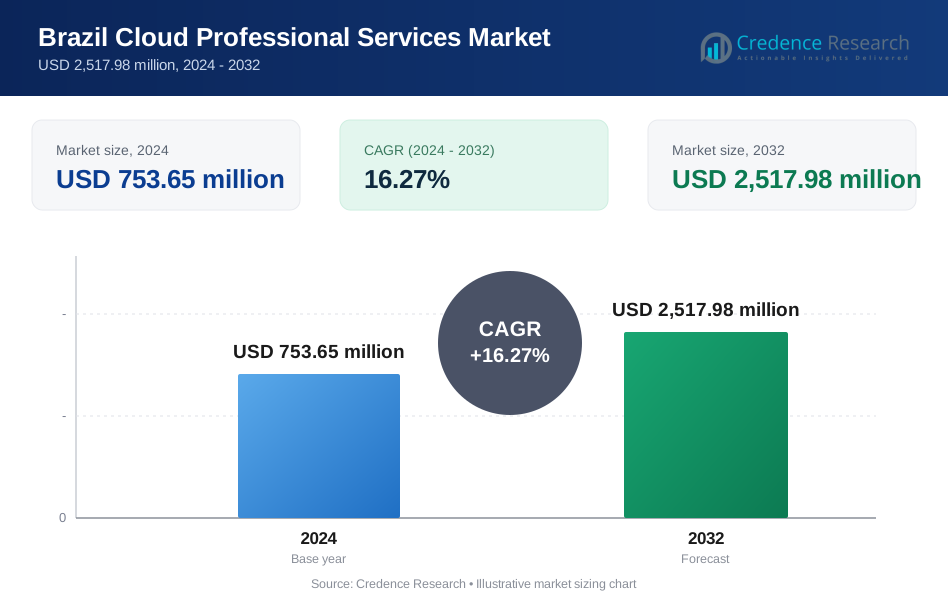
The Brazil Cloud Professional Services Market is projected to grow from USD 753.65 million in 2024 to an estimated USD 2517.98 million by 2032, with a compound annual growth rate (CAGR) of 16.27% from 2024 to 2032.
The market's growth is propelled by several key drivers, including the widespread digital transformation across industries and increasing investments in cloud infrastructure from both public and private sectors. Brazilian enterprises are transitioning to hybrid and multi-cloud environments to enhance operational flexibility, minimize risks, and optimize resource allocation. The demand for consulting, implementation, and managed services has surged as businesses strive to navigate the complexities of cloud adoption. Government initiatives, such as tax incentives for IT investments and policies promoting the digital economy, are playing a pivotal role in accelerating cloud deployment. Additionally, the growing emphasis on cybersecurity and regulatory compliance in Brazil has heightened the demand for specialized cloud professional services that address critical aspects of data privacy, security, and governance, ensuring organizations align with stringent local and international regulations.
Geographically, the market exhibits significant regional variations, with São Paulo and Rio de Janeiro emerging as dominant hubs. These regions, accounting for over 65% of the market share, benefit from their robust industrial ecosystems, extensive technology infrastructure, and a highly skilled workforce. São Paulo, being the financial and technological heart of Brazil, leads in cloud adoption, while Rio de Janeiro is also a significant contributor due to its vibrant business environment. Beyond these hubs, the northeastern and southern regions of Brazil are experiencing accelerated cloud adoption fueled by growing investments in technology parks, innovation hubs, and favorable regional government policies. Key players in the market, including global giants such as AWS, Microsoft, and Google Cloud, alongside local IT service firms, are intensifying their presence and expanding offerings to cater to the diverse and evolving needs of enterprises across these regions. Their efforts to provide localized solutions, enhanced support, and advanced technology integration are shaping the competitive landscape and driving regional growth.
Market Insights:
- The Brazil Cloud Professional Services Market is projected to grow from USD 753.65 million in 2024 to an estimated USD 2,517.98 million by 2032, reflecting a robust CAGR of 16.27%. This growth is fueled by rapid digital transformation across industries, as businesses increasingly adopt cloud solutions to improve efficiency, scalability, and competitiveness.
- Hybrid and multi-cloud adoption is gaining momentum as enterprises seek flexible, secure, and optimized cloud deployment models, driving demand for consulting and managed services.
- Government initiatives, including tax incentives and investments in technology infrastructure, play a pivotal role in accelerating cloud adoption across businesses and regions.
- The growing emphasis on cybersecurity and compliance, especially with regulations like LGPD, is pushing enterprises to adopt professional cloud services that address data privacy and governance.
- São Paulo and Rio de Janeiro dominate the market with over 65% share, thanks to their robust industrial bases and advanced technology ecosystems, while other regions like the northeast and south are emerging as growth hubs.
- Challenges such as regulatory complexities, workforce skill gaps, and high initial investments pose barriers to market expansion, particularly for small and medium-sized enterprises (SMEs).
- Cloud providers are increasingly focusing on localized solutions and partnerships with regional IT firms to address connectivity issues and enhance market penetration in underserved areas.
Market Drivers:
Accelerated Digital Transformation Across Industries
The rapid pace of digital transformation across various industries in Brazil is a significant driver of the cloud professional services market. For instance, Itaú Unibanco has collaborated with SAP to deploy cloud-based financial and analytics solutions, streamlining operations and enhancing scalability. Businesses are adopting cloud-based solutions to streamline operations, enhance scalability, and reduce costs. With increasing reliance on data-driven decision-making and digital tools, enterprises are seeking cloud consulting, implementation, and managed services to support their transformation journeys. This shift is evident in sectors like BFSI, healthcare, retail, and manufacturing, where companies leverage cloud technologies to innovate and remain competitive.
Growing Adoption of Hybrid and Multi-Cloud Environments
Hybrid and multi-cloud environments are becoming the preferred cloud deployment models for Brazilian businesses. These setups allow organizations to optimize workloads by utilizing the strengths of multiple cloud platforms while maintaining robust data security. The flexibility offered by hybrid cloud solutions has attracted enterprises looking to enhance their IT infrastructure without compromising on control. Multi-cloud strategies, on the other hand, are helping companies avoid vendor lock-in, improve disaster recovery capabilities, and achieve greater operational agility. This trend is boosting demand for cloud professional services, particularly in consulting and management. For instance, report by Information Services Group (ISG) noted that Brazilian companies are increasingly adopting hybrid architectures to enhance connectivity and security.
Supportive Government Initiatives and Policies
The Brazilian government’s focus on fostering a digital economy has been instrumental in driving the cloud professional services market. Tax incentives for IT investments, along with initiatives aimed at improving connectivity and infrastructure, have encouraged businesses to embrace cloud technologies. Policies supporting data sovereignty and cybersecurity compliance further compel organizations to seek professional cloud services to navigate regulatory complexities. Additionally, the government’s investments in technology hubs and innovation parks have created a conducive environment for cloud adoption across regions. For instance, The Brazilian Digital Transformation Strategy (E-Digital), launched in 2018, aims to promote digital inclusion, strengthen cybersecurity, and expand internet access.
Increasing Focus on Cybersecurity and Data Compliance
The rising awareness of cybersecurity risks and stringent data protection regulations, such as the General Data Protection Law (LGPD), have heightened the demand for secure and compliant cloud solutions. Businesses are turning to cloud professional service providers to ensure their cloud deployments align with local and international compliance standards. These services are particularly crucial for industries like BFSI and healthcare, where data privacy and security are paramount. For instance, IBM Cloud provides tailored cybersecurity solutions for financial institutions in Brazil, helping them meet LGPD requirements and protect sensitive customer data. The ability to address cybersecurity challenges effectively has positioned cloud professional services as a vital component of digital strategies in Brazil.
Market Trends:
Rising Adoption of Hybrid and Multi-Cloud Solutions
An increasing number of Brazilian enterprises are adopting hybrid and multi-cloud strategies to achieve operational flexibility and improve risk management. For instance, V8 Consulting is collaborating with Google Cloud to provide hybrid solutions that cater to the diverse needs of clients, balancing scalability with security. Hybrid cloud solutions, which combine private and public cloud infrastructures, are gaining traction among organizations seeking to balance scalability with security. Multi-cloud setups, leveraging multiple service providers, enable businesses to optimize performance and avoid vendor lock-in. This trend reflects the growing complexity of IT environments as companies strive to align cloud strategies with specific operational and regulatory requirements.
Advancements in AI-Driven Cloud Services
Artificial intelligence (AI) is transforming the cloud professional services landscape in Brazil. Cloud providers are increasingly integrating AI and machine learning capabilities into their offerings to enhance automation, analytics, and operational efficiency. For example, Brasilprev has deployed an AI tool, Brasilprev GPT, which has led to a 28% conversion rate and surpassed $9.86 billion in business by leveraging Azure OpenAI Service and ChatGPT. AI-driven services, such as predictive analytics and automated IT management, enable organizations to make data-driven decisions and optimize resource allocation. Brazilian companies are leveraging these advancements to improve customer experiences, streamline operations, and gain a competitive edge in their respective industries.
Focus on Industry-Specific Cloud Solutions
Another emerging trend in the Brazil Cloud Professional Services Market is the development of industry-specific solutions tailored to the unique needs of various sectors. The healthcare industry, for example, is adopting cloud services for secure patient data management and telemedicine applications, while the retail sector uses cloud-based tools to improve inventory management and customer analytics. For instance, ContaAzul is a cloud-based accounting platform designed to meet the needs of small and medium-sized enterprises (SMEs) in Brazil. The software offers tools for automating tasks such as invoicing, expense management, and inventory tracking. By simplifying financial workflows, ContaAzul helps businesses stay organized while ensuring compliance with Brazil's tax laws and regulatory requirements. These customized solutions are driving adoption across industries and opening new revenue streams for cloud service providers.
Regional Expansion and Localization Efforts
Cloud providers are focusing on regional expansion and localization to tap into Brazil’s diverse market. For instance, Oracle has opened its second Brazilian Cloud region in Vinhedo, following the launch of its São Paulo Cloud region, making Brazil Oracle’s latest country offering dual cloud regions. Investments in localized data centers and tailored service offerings are helping companies address region-specific challenges, such as connectivity and compliance. Providers are also partnering with local IT firms to enhance their market presence and offer culturally relevant solutions. This trend is particularly pronounced in the northeastern and southern regions, where growing technology hubs and government initiatives are fueling cloud adoption.
Market Challenges Analysis:
Regulatory and Compliance Complexities
One of the primary challenges in the Brazil Cloud Professional Services Market is navigating the complex regulatory landscape. Data privacy laws, such as the General Data Protection Law (LGPD), impose stringent compliance requirements on businesses. Ensuring data sovereignty while integrating global cloud platforms adds further complexity. Organizations often face difficulties aligning their cloud strategies with local and international regulations, which can delay cloud adoption and increase operational costs.
Skill Gaps and Workforce Limitations
The market faces a shortage of skilled professionals proficient in advanced cloud technologies, including hybrid cloud management, AI, and cybersecurity. This skills gap limits the ability of businesses to maximize the potential of cloud solutions and creates dependencies on external service providers. For small and medium-sized enterprises (SMEs), the lack of in-house expertise poses an additional barrier to adoption.
High Initial Investment Costs
While cloud services are cost-effective in the long term, the initial investment in cloud migration, infrastructure upgrades, and professional services can be prohibitively high for many businesses, especially SMEs. These costs often deter smaller enterprises from fully transitioning to cloud environments, limiting the market’s growth potential.
Infrastructure and Connectivity Challenges
Despite advancements, regions in Brazil still face inadequate connectivity and digital infrastructure, particularly in rural and remote areas. These limitations hinder the adoption of cloud services and create regional disparities in market penetration. Businesses in these regions struggle to access reliable cloud solutions, further exacerbating the divide.
Market Opportunities:
The Brazil Cloud Professional Services Market presents significant growth opportunities driven by the increasing adoption of digital transformation strategies across industries. As businesses transition to cloud-based infrastructures, there is a growing demand for consulting, implementation, and managed services to ensure seamless migration and optimization. The rise of hybrid and multi-cloud environments has created a need for specialized services that enable organizations to balance flexibility, scalability, and security. Moreover, government initiatives promoting IT investments and digital economy growth further enhance market potential by encouraging enterprises to adopt cloud solutions. Small and medium-sized enterprises (SMEs) also present an untapped segment, with many seeking cost-effective and scalable cloud solutions to modernize operations and remain competitive.
Industry-specific opportunities abound as sectors such as BFSI, healthcare, and retail increasingly rely on cloud services to enhance operational efficiency and customer experiences. In the BFSI sector, opportunities lie in providing secure, compliant cloud solutions for data management and digital banking. Similarly, the healthcare sector requires robust cloud services for managing electronic medical records and supporting telemedicine platforms. Retail and e-commerce industries seek cloud-enabled solutions for customer analytics and inventory management. Regional diversity further expands the market’s opportunities, with northeastern and southern Brazil emerging as growth areas due to rising technology investments and innovation hubs. These factors, combined with advancements in AI, IoT, and automation, position the Brazil Cloud Professional Services Market as a thriving ecosystem with immense potential for future growth and innovation.
Market Segmentation Analysis:
The Brazil Cloud Professional Services Market is segmented into multiple categories based on service type, deployment model, enterprise size, and industry vertical, each reflecting the diverse needs of businesses.
By Type, the market encompasses consulting, application development and modernization, implementation and migration, and managed services. Consulting leads as enterprises seek expert guidance to design cloud strategies, while managed services are in high demand for ongoing operational support.
By Deployment Model, the market is categorized into public cloud, private cloud, and hybrid cloud. Public cloud solutions dominate due to their scalability and cost-efficiency, while hybrid cloud adoption is growing as businesses aim to combine flexibility with enhanced security.
By Enterprise Size, the market is divided into small and medium-sized enterprises (SMEs) and large enterprises. SMEs are increasingly embracing cloud services for cost-effectiveness and scalability, while large enterprises prioritize advanced solutions for complex IT needs.
By Industry Vertical, the market includes BFSI, healthcare, retail, IT and telecommunications, and others. BFSI and IT and telecommunications are the largest consumers of cloud professional services, driven by the need for data security, operational efficiency, and digital transformation. The healthcare sector is rapidly growing, leveraging cloud solutions for secure patient data management and telemedicine advancements.
Segmentation:
By Type
- Consulting
- Application Development and Modernization
- Implementation and Migration
- Managed Services
By Deployment Model
- Public Cloud
- Private Cloud
- Hybrid Cloud
By Enterprise Size
- Small and Medium-Sized Enterprises (SMEs)
- Large Enterprises
By Industry Vertical
- BFSI
- Healthcare
- Retail
- IT and Telecommunications
- Others
By Region
- São Paulo
- Rio de Janeiro
- Northeastern Brazil
- Southern Brazil
- Other
Regional Analysis:
The Brazil Cloud Professional Services Market exhibits notable regional variations, with São Paulo and Rio de Janeiro dominating the landscape and collectively accounting for over 65% of the market share.
São Paulo stands out as the primary hub due to its role as Brazil’s financial and technological epicenter. The region hosts a high concentration of large enterprises and multinational corporations, driving the demand for advanced cloud solutions. Companies in São Paulo are increasingly leveraging hybrid and multi-cloud environments for operational efficiency, scalability, and regulatory compliance. The region's robust infrastructure and skilled workforce further solidify its leadership position in the market.
Rio de Janeiro follows closely, benefiting from its diverse industrial base, which includes sectors like energy, media, and manufacturing. The city’s thriving business environment fuels demand for cloud professional services tailored to enhance operational performance and data security. Organizations in Rio de Janeiro are also prioritizing the adoption of cloud technologies for advanced analytics and digital transformation initiatives, contributing significantly to the region’s market share.
The northeastern region, including states such as Bahia, Pernambuco, and Ceará, accounts for approximately 15% of the market. This area is experiencing increasing investments in technology parks, innovation hubs, and government-led digital inclusion programs. Businesses in the northeast are gradually embracing cloud services to enhance their digital capabilities and remain competitive in the evolving market.
The southern region, encompassing Paraná, Santa Catarina, and Rio Grande do Sul, holds around 10% of the market share. This area benefits from a well-developed industrial sector and growing adoption of digital tools among small and medium-sized enterprises (SMEs). The region’s technology-driven initiatives and collaborations with global cloud providers are fostering growth in cloud professional services.
Other regions, such as the central and northern parts of Brazil, collectively represent the remaining 10% of the market. Although these regions are currently smaller contributors, they are gradually gaining traction due to government efforts to promote cloud adoption and the expansion of localized service offerings.
Key Player Analysis:
- Accenture
- IBM Corporation
- Deloitte
- Cognizant
- Microsoft
- Amazon Web Services (AWS)
- Salesforce
- Google Cloud
- Oracle Corporation
- HPE (Hewlett Packard Enterprise)
Competitive Analysis:
The Brazil Cloud Professional Services Market is highly competitive, with global technology leaders such as AWS, Microsoft, and Google Cloud holding significant market share alongside prominent local IT service providers. These global players leverage their extensive expertise, robust cloud infrastructure, and advanced technological offerings to address the evolving demands of enterprises. Local providers enhance competitiveness by offering tailored solutions, regional support, and in-depth understanding of local market dynamics. Competition in the market is fueled by increasing demand for hybrid and multi-cloud strategies, which require seamless integration and optimization services. Providers are focusing on innovation, leveraging emerging technologies like AI, machine learning, and automation to offer differentiated services. Strategic partnerships, acquisitions, and investments in localized data centers further intensify the competitive landscape. For instance, Microsoft and IT service provider Locaweb, collaborated to offer integrated cloud solutions tailored to the unique needs of Brazilian businesses. The market's diversity, driven by regional variations in adoption rates and industry-specific needs, creates opportunities for both established players and emerging entrants.
Recent Developments:
- In May 2024, Accenture announced its intent to acquire SOKO, an independent Brazilian creative agency known for blending creativity, data, and cultural understanding to develop impactful brand stories. SOKO will join Droga5 São Paulo, enhancing Accenture Song's creative and brand experience capabilities in Brazil.
- In September 2024, IBM announced its intent to acquire Accelalpha, a global Oracle services provider with deep expertise in supply chain, logistics, finance, EPM, and CX-CPQ. This acquisition aims to accelerate clients' Oracle Cloud Application adoption and expand IBM's consulting expertise in these areas103747.
- In January 2023, Deloitte was awarded the "Digital Transformation of the Year" by Alibaba Cloud for its outstanding cloud service capabilities. This recognition came during the Alibaba Cloud Summit 2022 in Hong Kong, where Deloitte shared insights on industry trends and best practices in digital transformation11.
- In November 2024, Cognizant partnered with Nvidia to enhance its data modernization offering, aiming to help clients process large datasets quicker, control cloud computing costs, and lead to faster adoption of AI use cases32.
- In September 2024, Microsoft pledged to invest $2.7 billion in Brazil over three years to enhance its cloud infrastructure and artificial intelligence capabilities. This investment is part of the broader "Microsoft Mais Brasil" program, aiming to boost Brazil's economic growth through AI adoption5.
- In August 2024, AWS named Ingram Micro as its Global Distributor Partner of the Year for the second consecutive year, highlighting Ingram Micro's significant contributions to the AWS ecosystem
Market Concentration & Characteristics:
The Brazil Cloud Professional Services Market is characterized by a moderate to high level of concentration, with major global players such as AWS, Microsoft, and Google Cloud dominating alongside strong local IT service providers. These leaders leverage their extensive portfolios, global infrastructure, and advanced technologies to meet the diverse needs of Brazilian enterprises. Local players add value by offering culturally and regionally tailored solutions, fostering a competitive landscape. The market exhibits dynamic characteristics driven by rapid digital transformation, hybrid and multi-cloud adoption, and growing demand for managed services. Providers focus on integrating emerging technologies like AI, IoT, and automation to enhance operational efficiency. Government support through tax incentives and digital economy policies further accelerates market growth. Regional diversity adds complexity, with São Paulo and Rio de Janeiro leading adoption due to superior infrastructure, while other regions present emerging opportunities fueled by technology investments and innovation hubs.
Report Coverage:
The research report offers an in-depth analysis based on By Type, By Deployment Model, By Enterprise Size and By Industry Vertical. It details leading market players, providing an overview of their business, product offerings, investments, revenue streams, and key applications. Additionally, the report includes insights into the competitive environment, SWOT analysis, current market trends, as well as the primary drivers and constraints. Furthermore, it discusses various factors that have driven market expansion in recent years. The report also explores market dynamics, regulatory scenarios, and technological advancements that are shaping the industry. It assesses the impact of external factors and global economic changes on market growth. Lastly, it provides strategic recommendations for new entrants and established companies to navigate the complexities of the market.
Future Outlook:
- The market is poised for substantial growth, driven by increasing adoption of cloud professional services across diverse industries.
- Accelerated digital transformation across sectors will drive demand for consulting, implementation, and managed cloud services.
- Hybrid and multi-cloud adoption will expand as enterprises seek flexibility and cost optimization.
- Increasing investments in cybersecurity solutions will elevate the need for specialized cloud services addressing data privacy and compliance.
- Government incentives for IT investments and digital economy policies will foster widespread cloud adoption.
- Technological advancements, including AI and automation, will redefine service delivery and enhance operational efficiency.
- Small and medium-sized enterprises (SMEs) will emerge as a key market segment due to growing affordability and accessibility of cloud services.
- São Paulo and Rio de Janeiro will remain dominant regional hubs, while northeastern and southern regions will witness accelerated growth.
- Collaborations between global cloud giants and local IT firms will enhance service localization and drive competition.
- The growing demand for industry-specific solutions, such as healthcare and financial services, will create new revenue streams for providers.
Request a Free Sample
Fill in your details and we'll send you a free sample report.
- Sample data tables & charts
- Research methodology
Need a Custom Version of This Report?
Tailor the scope, geography, or segments to your exact requirements.
- Custom geography or segment scope
- Direct access to our analyst team
Frequently Asked Questions
What is the current market size and future projection for the Brazil Cloud Professional Services Market?
What factors are driving the growth of the Brazil Cloud Professional Services Market?
Which regions in Brazil dominate the cloud professional services market?
What challenges does the Brazil Cloud Professional Services Market face?
Table of Content
Chapter 1. Report Introduction
- 1.1 Report Description & Purpose
- 1.1.1 Report Title & Market Definition
- 1.1.2 Unique Selling Propositions (USP) & Key Differentiators
- 1.1.3 Value Proposition for Stakeholders
- 1.2 Research Objectives
- 1.2.1 Market Sizing Objectives (Volume & Revenue)
- 1.2.2 Segmentation Objectives
- 1.2.3 Competitive Intelligence Objectives
- 1.2.4 Forecast & Scenario Objectives
- 1.3 Report Scope
- 1.3.1 Brazil Cloud Professional Services Scope – Types & Subtypes Covered
- 1.3.2 Geographic Scope – Regions & Countries Covered
- 1.3.3 Historical Period, Base Year & Forecast Period (2024; forecast to 2032)
- 1.3.4 Inclusions & Exclusions
- 1.4 HS Code & Classification Framework
- 1.5 Currency, Units & Pricing Basis
- 1.6 Target Stakeholders
- 1.7 Limitations & Assumptions
Chapter 2. Executive Summary
- 2.1 Global Brazil Cloud Professional Services Market Snapshot
- 2.1.1 Market Size – Historical (2024) & Forecast (2024-2032) (2024: USD 753.65 million → 2032: USD 2,517.98 million)
- 2.1.2 Volume & Revenue – Global Totals
- 2.1.3 Key Market Highlights – Top Five Facts
- 2.2 Brazil Cloud Professional Services Market Segmentation Snapshot
- 2.2.1 Market Split by Region – 2024 vs. 2032
- 2.3 Competitive Snapshot
- 2.3.1 Top 10 Players by Revenue Share – 2024
- 2.3.2 Top 10 Players by Volume Share – 2024
- 2.3.3 Recent Strategic Developments (18-Month Summary)
- 2.4 Key Investment Highlights & Strategic Conclusions
Chapter 3. Brazil Cloud Professional Services Market Dynamics & Industry Analysis
- 3.1 Market Overview & Context
- 3.1.1 Brazil Cloud Professional Services Market Position in the Broader Automotive Value Chain
- 3.1.2 OEM vs. Replacement Market Dynamics
- 3.1.3 Market Maturity & Development Stage by Region
- 3.2 Brazil Cloud Professional Services Market Drivers
- 3.3 Brazil Cloud Professional Services Market Restraints & Challenges
- 3.4 Brazil Cloud Professional Services Market Opportunities
- 3.5 Porter's Five Forces Analysis
- 3.5.1 Threat of New Entrants
- 3.5.2 Bargaining Power of Suppliers
- 3.5.3 Bargaining Power of Buyers
- 3.5.4 Threat of Substitutes
- 3.5.5 Competitive Rivalry – Intensity Assessment
- 3.6 Brazil Cloud Professional Services Value Chain Analysis
- 3.6.1 Upstream – Raw Material/Input Suppliers
- 3.6.1.1 Raw Material/Input 1
- 3.6.1.2 Raw Material/Input 2
- 3.6.1.3 Raw Material/Input 3
- 3.6.2 Midstream – Production/Manufacturing/Service Delivery
- 3.6.2.1 Production/Process Overview
- 3.6.2.2 Key Facility Locations & Capacity by Manufacturer
- 3.6.3 Downstream – Distribution & End Consumer
- 3.6.3.1 Primary Channel – B2B/OEM
- 3.6.3.2 Secondary Channels – Dealer, Retail, Online, Direct
- 3.6.4 Value Chain Profitability Analysis
- 3.6.1 Upstream – Raw Material/Input Suppliers
- 3.7 PESTEL Analysis
- 3.7.1 Political Factors
- 3.7.2 Economic Factors
- 3.7.3 Social Factors
- 3.7.4 Technological Factors
- 3.7.5 Environmental Factors
- 3.7.6 Legal Factors
- 3.8 Brazil Cloud Professional Services Supply Chain Analysis
- 3.8.1 Raw Material/Input Supply Risk Assessment
- 3.8.2 Manufacturing Concentration Risk (Geographic Exposure)
- 3.8.3 Trade Disruption Impact Analysis
- 3.9 Regulatory & Policy Landscape
Note: The regulatory and policy landscape section covers regulations based on their applicability to the market, Brazil Cloud Professional Services category, geography, and scope of the study. Only regulatory frameworks with a material impact on operations, compliance, trade, sustainability, or market access are analyzed in detail.
Chapter 4. Key Investment Pockets & Opportunity Analysis
- 4.1 Brazil Cloud Professional Services Market Attractiveness Analysis
- 4.1.1 By Region – Investment Attractiveness Matrix (Volume × CAGR)
- 4.2 Absolute Revenue Growth Opportunity
- 4.2.1 By Region – Absolute USD Growth Through 2032
- 4.3 Incremental Volume Opportunity
- 4.3.1 By Region – Incremental Volume Through 2032
- 4.3.2 Segment – Incremental Volume
- 4.4 Emerging Submarket Opportunity Deep Dive (Subject to Applicability)
- 4.5 Emerging Market Opportunity Scorecards
- 4.5.1 United States
- 4.5.2 Europe
- 4.5.3 Asia
- 4.5.4 Middle East & Africa
Note: Emerging Market Opportunity Scorecards will be included based on relevance and strategic importance. Regions listed are indicative and may vary depending on data availability and market dynamics.
Chapter 5. Brazil Cloud Professional Services Import-Export Analysis & Trade Flows
- 5.1 Global Trade Overview
- 5.1.1 Global Export Value by Country (2024)
- 5.1.2 Global Export Volume by Country (2024)
- 5.1.3 Global Import Value by Country (2024)
- 5.1.4 Global Import Volume by Country (2024)
- 5.1.5 Net Trade Balance by Country (2024)
- 5.2 Export Analysis – Segment
- 5.2.1 Type 1 (HS Code)
- 5.2.2 Type 2 (HS Code)
- 5.2.3 Type 3 (HS Code)
- 5.2.4 Type 4 (HS Code)
- 5.2.5 Type 5 (HS Code)
- 5.3 Import Analysis – Segment
- 5.3.1 Type 1 (HS Code)
- 5.3.2 Type 2 (HS Code)
- 5.3.3 Type 3 (HS Code)
- 5.3.4 Type 4 (HS Code)
- 5.3.5 Type 5 (HS Code)
- 5.4 Average Unit Trade Prices
- 5.4.1 Average Export Price – Segment & Country
- 5.4.2 Average Import Price – Segment & Source Country
- 5.4.3 Price Trends (2024)
- 5.5 Key Trade Route Analysis
- 5.5.1 Trade Route 1
- 5.5.2 Trade Route 2
- 5.5.3 Trade Route 3
- 5.5.4 Trade Route 4
- 5.5.5 Trade Route 5
- 5.6 Trade Policy Impact Assessment
- 5.6.1 US Anti-Dumping & Section 301 Tariffs
- 5.6.2 EU Customs Union Impact
- 5.6.3 Major Free Trade Agreements
- 5.6.4 USMCA Rules of Origin
Note: Trade policy analysis will be included only where relevant to the Brazil Cloud Professional Services market.
Chapter 6. Competitive Landscape & Company Benchmarking
- 6.1 Brazil Cloud Professional Services Market Concentration & Structure
- 6.1.1 Herfindahl-Hirschman Index (HHI) – vs. 2024
- 6.1.2 Tier 1, Tier 2 & Tier 3 Market Structure
- 6.1.3 Global, Regional & Local Player Dynamics
- 6.2 Brazil Cloud Professional Services Market Share Analysis – 2024
- 6.2.1 Global Revenue Share by Company
- 6.2.2 Global Volume Share by Company
- 6.2.3 Regional Revenue Share
- 6.2.4 Market Share Evolution ( vs. 2024)
- 6.2.5 OEM Segment Share by Company
- 6.2.6 Replacement Segment Share by Company
- 6.3 Production/Delivery Capacity & Facility Analysis
- 6.3.1 Global Installed Capacity
- 6.3.2 Capacity Utilization Rates
- 6.3.3 Production/Output Volume
- 6.3.4 Facility Locations & Capacity Map
- 6.3.5 Planned Capacity Additions
- 6.4 Brazil Cloud Professional Services Competitive Benchmarking Matrix
- 6.4.1 Revenue, Volume, CAGR & Profitability Comparison
- 6.4.2 Channel Revenue Mix
- 6.4.3 Geographic Revenue Exposure
- 6.4.4 R&D Intensity
- 6.4.5 Sustainability Maturity
- 6.5 Strategic Developments in Brazil Cloud Professional Services (Last 24 Months)
- 6.5.1 Mergers, Acquisitions & Divestments
- 6.5.2 New Brazil Cloud Professional Services Launches
- 6.5.3 Facility Expansions
- 6.5.4 Strategic Alliances, Joint Ventures & Partnerships
- 6.5.5 Distribution Expansion & Market Entry
- 6.5.6 Sustainability & ESG Initiatives
- 6.6 Competitive Strategy Mapping
- 6.6.1 Leader, Challenger, Follower & Niche Classification
- 6.6.2 Pricing Strategy Comparison
- 6.6.3 Channel Strategy Matrix
Note: Strategic developments are included based on their materiality and the availability of reliable information.
Chapter 7. Global Brazil Cloud Professional Services Market – By Distribution Channel
- 7.1 Segment Overview
- 7.1.1 Volume & Revenue Split by Channel (2024 & 2032)
- 7.1.2 Channel Mix Evolution (2024-2032)
Chapter 8. Regional Market Analysis – Global Overview
- 8.1 Global Regional Overview
- 8.1.1 Regional Volume Share
- 8.1.2 Regional Revenue Share
- 8.1.3 Regional Volume by Region
- 8.1.4 Regional Revenue by Region
- 8.1.5 Regional Forecast Through 2032
- 8.2 Cross-Regional Segment Analysis
- 8.2.1 By Distribution Channel
- 8.2.2 By Brand/Price Tier
Chapter 9. North America Brazil Cloud Professional Services Market
- 9.1 United States
- 9.2 Canada
- 9.3 Mexico
Chapter 10. Europe Brazil Cloud Professional Services Market
- 10.1 Germany
- 10.2 France
- 10.3 Italy
- 10.4 United Kingdom
- 10.5 Spain
- 10.6 Poland
- 10.7 Russia
- 10.8 Netherlands
- 10.9 Belgium
- 10.10 Sweden
- 10.11 Denmark
- 10.12 Norway
- 10.13 Rest of Europe
Chapter 11. Asia Pacific Brazil Cloud Professional Services Market
- 11.1 China
- 11.2 India
- 11.3 Japan
- 11.4 South Korea
- 11.5 Thailand
- 11.6 Indonesia
- 11.7 Vietnam
- 11.8 Malaysia
- 11.9 Australia
- 11.10 Rest of Asia Pacific
Chapter 12. Latin America Brazil Cloud Professional Services Market
- 12.1 Brazil
- 12.2 Argentina
- 12.3 Colombia
- 12.4 Chile
- 12.5 Rest of Latin America
Chapter 13. Middle East Brazil Cloud Professional Services Market
- 13.1 Saudi Arabia
- 13.2 United Arab Emirates
- 13.3 Turkey
- 13.4 Israel
- 13.5 Iran
- 13.6 Rest of the Middle East
Chapter 14. Africa Brazil Cloud Professional Services Market
- 14.1 South Africa
- 14.2 Egypt
- 14.3 Nigeria
- 14.4 Morocco
- 14.5 Rest of Africa
Chapter 15. Brazil Cloud Professional Services Company Profiles
- 15.1 [Company 01]
- 15.1.1 Company Overview
- 15.1.2 Key Management Personnel
- 15.1.3 Products & Services Portfolio
- 15.1.4 Financial Performance
- 15.1.5 Key Market Focus & Geographic Presence
- 15.1.6 Recent Developments & Strategic Initiatives
Note: The company profile list is preliminary and may change based on research findings, market developments, data availability, and client requirements.
Chapter 16. Appendices
- Appendix A – List of Abbreviations & Acronyms
- Appendix B – Industry Classification Code Reference – Full Series
- Appendix C – Production & Capacity Data Tables
- Appendix D – End-Use & Demand Base Tables
- Appendix E – Consumption & Replacement Rate Assumptions
- Appendix F – ASP Reference Tables
- Appendix G – Manufacturing & Facility Database
- Appendix H – Import-Export Data Tables
- Appendix I – Regulatory Summary Tables
- Appendix J – Primary Research Participant List (Anonymized)
- Appendix K – Primary Research Questionnaire Framework
- Appendix L – Data Sources & Bibliography
- Appendix M – Market Size Divergence & Source Comparison
Chapter 17. Research Methodology
- 17.1 Research Framework & Philosophy
- 17.2 Secondary Research – Sources, Hierarchy & Data Extraction
- 17.3 Data Modeling – Bottom-Up & Top-Down Market Sizing
- 17.4 Primary Research – Stakeholder Framework, LOI & Sample Sizes
- 17.5 Forecast Methodology – Regression, Scenario & Sensitivity Analysis
- 17.6 Quality Control – Four-Layer Validation Framework
- 17.7 Limitations & Standard Assumptions
- 17.8 Disclaimer
