| REPORT ATTRIBUTE | DETAILS |
|---|---|
| Historical Period | 2019-2022 |
| Base Year | 2023 |
| Forecast Period | 2024-2032 |
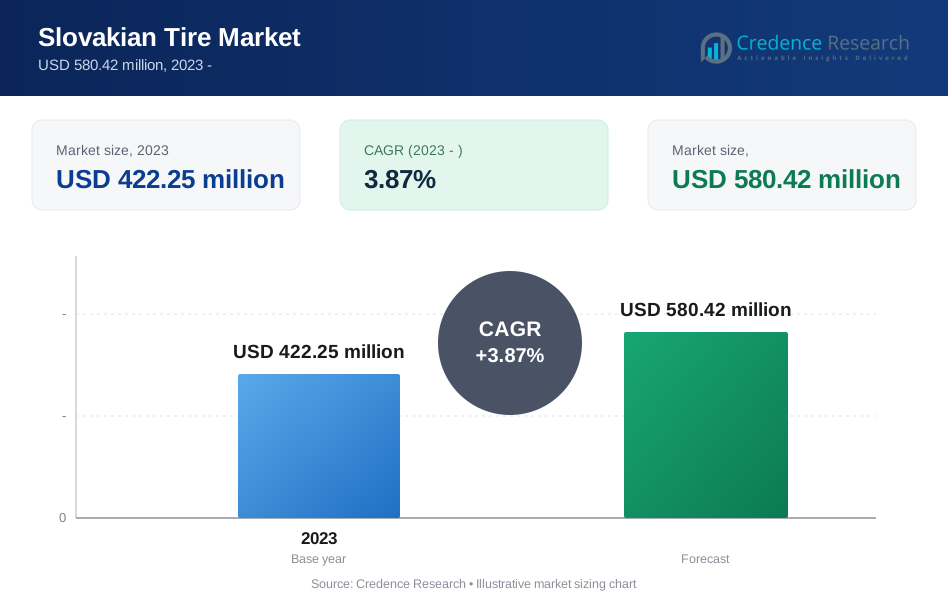
| Slovakian Tire Market Size 2023 | USD 422.25 Million |
| Slovakian Tire Market, CAGR | 3.87% |
| Slovakian Tire Market Size 2032 | USD 580.42 Million |
Market Overview:
The Slovakian tire market, valued at USD 422.25 million in 2023, is forecasted to grow steadily with a projected CAGR of 3.87%, reaching USD 580.42 million by 2032.
This growth trajectory is attributed to several factors, notably the robust expansion of the Slovakian automotive industry. With prominent car manufacturers such as Volkswagen, Kia Motors, and Peugeot Citroën Slovakia establishing production facilities in the country, the demand for replacement tires remains consistently high. Moreover, the increasing ownership of vehicles among the Slovakian populace further drives tire sales, reinforcing the market's upward trajectory.
The market is also influenced by the growing emphasis on safety regulations and fuel efficiency standards, particularly within the framework of stringent European Union (EU) guidelines. These regulations mandate clear labeling regarding a tire's fuel efficiency, wet grip, and external rolling noise, prompting consumers to prioritize premium tires that offer superior traction, lower rolling resistance for enhanced fuel economy, and reduced noise generation. Consequently, there exists an opportunity for tire manufacturers to innovate and introduce products that align with evolving consumer preferences for safety and environmental performance.
However, alongside these opportunities, the Slovakian tire market encounters challenges, including the prevalence of a significant budget segment. Price-sensitive consumers often opt for cheaper, imported tires from neighboring countries, posing pressure on profit margins for established brands. Additionally, the persistent threat of counterfeit tires infiltrating the market remains a concern. These counterfeit products, lacking the safety and performance characteristics of genuine tires, pose risks to drivers and undermine the market's integrity. Addressing these challenges will be crucial for sustaining growth and ensuring the continued advancement of the Slovakian tire industry.
Market Drivers:
Expanding Automotive Industry and Safety Focus:
Slovakia’s automotive industry is a significant player in the region, hosting production facilities for major car manufacturers like Volkswagen, which has been operating in Slovakia since 1991. This thriving sector employs directly around 176,000 people and indirectly around 261,000 people. In 2019, Slovakia produced 1.15 million cars, making it the world leader in per capita auto production. This robust sector drives the demand for replacement tires, as vehicles require regular maintenance for safety and performance. For example, a car typically needs tire replacement every 25,000 to 50,000 miles. Moreover, with potential expansions in vehicle production, fueled by factors such as production line expansions or new manufacturing plants, the demand for tires is expected to escalate. Concurrently, there’s a growing emphasis among Slovakian drivers on safety and performance, leading to an increasing preference for tires with features like shorter braking distances and better handling, thus driving market growth.
Seasonal Tire Trends and E-commerce Integration:
The practice of switching between summer and winter tires is gaining traction in Slovakia, driven by awareness of the benefits of seasonal tires and rising disposable incomes. According to tire service providers, the peak demand for tire changes occurs from October 15 to November 30, with many drivers advised to switch when temperatures drop to 7°C or below. This trend fuels demand for both summer and winter tire segments. Additionally, the burgeoning e-commerce landscape in Slovakia offers consumers a convenient platform to access a wider range of tire brands and retailers. With the ease of comparison shopping and competitive pricing online, more consumers are likely to opt for e-commerce channels, bolstering overall market growth. For instance, tire services report that drivers are currently facing wait times of up to three weeks for tire changes, highlighting the urgency and growing consumer engagement in seasonal tire practices. This shift is further supported by public awareness campaigns emphasizing the safety advantages of using appropriate tires for seasonal conditions, as evidenced by tire regulations in various countries, including Slovakia, where winter tires are recommended under specific weather conditions.
Electric Vehicle Market Opportunity:
The Slovakian government's efforts to promote electric vehicle adoption create a significant growth opportunity for the tire market. As the EV market expands, there will be a growing demand for tires specifically designed to meet the unique requirements of electric vehicles, such as handling weight distribution and torque characteristics. This emerging segment presents a lucrative avenue for tire manufacturers in Slovakia to tap into.
Adaptation to Environmental Regulations:
Stringent environmental regulations, including tire labeling and production standards, are pushing tire manufacturers to develop sustainable and eco-friendly tire options. With a focus on lower rolling resistance and improved fuel efficiency, tire companies are aligning their offerings with consumer preferences for environmentally friendly products. These regulations not only drive the demand for sustainable tire solutions but also shape the future trajectory of the Slovakian tire market towards greater eco-consciousness.
Market Trends:
Rising Demand for Replacement Tires:
A significant factor influencing the market is the increasing stock of vehicles on Slovakia’s roads. For instance, as of 2020, Slovakia had a total of 3,225,941 registered vehicles. As the average vehicle age rises, currently at 12 years in the European Union, and the overall number of vehicles owned continues to climb, the demand for replacement tires is projected to grow steadily.
Growing Consumer Preference for Sustainable Materials:
Environmental consciousness is on the rise among Slovakian consumers. This translates to a growing preference for tires manufactured with eco-friendly materials and featuring improved fuel efficiency. For instance, a survey by the Slovak Environmental Agency found that 78% of Slovak consumers prefer natural materials over substitutes, indicating a strong demand for sustainable tire options. With the trend shifting towards radial tires, which have lower rolling resistance and align with eco-friendly and cost-effective consumer choices, manufacturers are responding by developing more eco-friendly tires. Matador, a major tire manufacturer in Slovakia, has invested in producing radial tires with innovative compounds and tread patterns to meet the evolving needs of environmentally conscious consumers.
Shifting Consumer Behavior Towards Online Tire Sales:
The convenience and price comparison opportunities offered by online retail channels are influencing consumer behavior in Slovakia. Several online platforms for tire sales are available in Slovakia, indicating a growing market segment. Although exact numbers for online tire sales in Slovakia are not readily available, the online tire market segment is expected to experience continued growth in the coming years. However, brick-and-mortar retailers are likely to adapt and offer competitive online options as well. For example, Pneuservis.sk, a leading online tire retailer in Slovakia, has seen a significant increase in sales, with online orders now accounting for 30% of their total sales, up from just 10% five years ago.
Focus on Safety and Performance:
Slovakian drivers are increasingly prioritizing safety and performance when choosing tires. This trend is fueled by growing awareness of the impact that tires have on vehicle handling, braking distances, and overall driving experience. Manufacturers are responding by investing in research and development to create tires that deliver superior performance in all weather conditions.
Potential for Growth in Specialty Tire Segments:
The rise in popularity of electric vehicles (EVs) in Slovakia presents an opportunity for the specialty tire market. As EVs have unique requirements when it comes to weight distribution, noise reduction, and rolling resistance, there is a growing demand for tires specifically designed for these vehicles. This trend is expected to create new market opportunities in the coming years.
Market Restraints and Challenges:
Price Sensitivity and Budget Constraints:
Slovak consumers are known to be price-sensitive, particularly during economic downturns. This can lead to them delaying tire replacements or opting for cheaper, less durable options. Economic fluctuations and rising disposable income can significantly impact consumer buying decisions, potentially hindering market growth, especially for premium tire segments. Tire manufacturers and retailers need to strategize by offering competitive pricing models and value-added services to cater to budget-conscious consumers.
Shifting Consumer Preferences and Rising Demand for Sustainable Solutions:
Growing environmental awareness among Slovak consumers is driving a demand for sustainable products. This includes a preference for tires with lower rolling resistance, which improves fuel efficiency and reduces environmental impact. However, these eco-friendly tires often come at a premium price point, potentially creating a conflict with price sensitivity. Manufacturers need to focus on developing cost-effective and environmentally friendly tire options to meet evolving consumer preferences and remain competitive.
Intense Competition and Market Saturation:
The Slovak tire market is witnessing intensifying competition from both domestic and international players. Major global tire manufacturers are vying for market share, offering a wide range of products across various price points. This competitive landscape can lead to price wars and pressure on profit margins for smaller players. To stand out, manufacturers need to focus on innovation, product differentiation based on performance and sustainability, and strong brand building to attract and retain customers.
Fluctuations in Raw Material Prices and Supply Chain Disruptions:
The tire industry relies heavily on raw materials like rubber and synthetic polymers. Price fluctuations of these materials can significantly impact production costs and ultimately, consumer prices. Additionally, global supply chain disruptions can affect the availability of raw materials and finished products, leading to potential stock shortages and price hikes. Mitigating these challenges requires robust supplier relationships, diversification of sourcing strategies, and exploring alternative materials to minimize dependence on volatile commodities.
Limited Scope for Domestic Production and Dependence on Imports: Slovakia has a limited domestic tire manufacturing industry, relying heavily on imports to meet market demand. This dependence on external sources can be susceptible to global market fluctuations and import duties. Additionally, the lack of a strong domestic manufacturing base restricts opportunities for job creation and economic growth within the Slovak tire sector. The potential for growth in domestic production, with a focus on innovation and niche markets, could help reduce reliance on imports and contribute to the overall development of the Slovak tire industry.
Recent Developments:
- December 2022: Toyo Tire Corporation officially opened a new passenger vehicle tire factory in the Municipality of Indjija, the Republic of Serbia.
- November 2022: Nokian Tyres announced plans to invest in a new zero-carbon emission passenger car tire production factory in Oradea in the North-West of Romania, near the Hungarian border, with an annual capacity of 6 million tires and an expansion potential in the future.
- May 2022: Goodyear Tire & Rubber Company officially opened its new manufacturing facility in Dudelange, Luxembourg, following a $77 million investment in its Industry 4.0 digital manufacturing process.
Segmentation Analysis:
By Vehicle Type:
- Passenger Cars: This segment holds the largest market share due to the high number of passenger cars in Slovakia. Rising disposable income and increasing car ownership are expected to continue driving this segment's growth.
- Light Commercial Vehicles (LCVs): The growing demand for LCVs for commercial deliveries and transportation activities is expected to positively impact this segment.
- Medium & Heavy Commercial Vehicles (M&HCVs): Stringent regulations on emissions and safety are driving the demand for high-performance tires in this segment. Increasing investments in infrastructure projects are also expected to contribute to growth.
- Two-Wheelers: This segment caters to motorcycles and scooters, and its growth is influenced by factors like fuel efficiency and safety considerations.
- Three-Wheelers: This segment is relatively smaller but could witness growth due to its increasing use for commercial purposes.
- Off-the-Road (OTR) Vehicles: This segment includes tires for construction and agricultural machinery. Growth in these sectors will likely drive demand for OTR tires.
By Tire Construction Type:
- The market is bifurcated into Radial and Bias segments. The radial segment dominates due to its durability, fuel efficiency, and resistance to heat build-up.
By End User:
- The market is segmented into OEM and Replacement categories. The replacement segment holds a higher share, attributed to the country’s seasonal variations, especially harsh winters, leading to frequent tire replacements as consumers switch between summer and winter tires.
The Slovakian Tire Market has witnessed robust growth in recent years, driven by the expansion of the automotive industry and an increasing number of vehicles on the road. The presence of major tire manufacturers in Slovakia further enriches the market’s growth potential, providing consumers with a widening array of tire options. These factors are expected to boost the expansion of the Slovakia tire market in the future.
Segments:
By Vehicle Type:
- Passenger Car
- Light Commercial Vehicle (LCV)
- Medium & Heavy Commercial Vehicles (M&HCV)
- Off-the-Road Vehicles (OTR)
- Two-Wheeler
By Tire Construction Type:
- Radial
- Bias
By Demand Category:
- OEM
- Replacement
By Region:
- Bratislava
- Western
- Central
- Eastern
Key player:
- Bridgestone Corporation
- Continental AG
- Goodyear Tire & Rubber Company
- Sumitomo Rubber Industries Ltd
- Michelin Group
- Pirelli & C. S.p.A.
- Yokohama Rubber Company Limited
- Kumho Tire Co. Inc.
Regional Analysis:
Moreover, while the demand for tires remains consistent across various regions of Slovakia, certain areas exhibit higher market shares due to factors such as population density and economic activity. Urban regions, including the capital city of Bratislava and other major metropolitan areas, command significant market shares owing to higher vehicle ownership rates and increased demand for replacement tires. Additionally, regions with a strong industrial presence, such as automotive manufacturing clusters, witness heightened demand for both original equipment manufacturer (OEM) and aftermarket tires, further influencing market dynamics.
Furthermore, the implementation of stringent safety regulations and the growing emphasis on fuel efficiency across all regions of Slovakia play a pivotal role in shaping tire preferences and market trends. Consumers across different regions increasingly prioritize premium tires that offer superior traction, fuel efficiency, and safety features in compliance with European Union (EU) standards. As a result, tire manufacturers strategically focus on innovation and product differentiation to capture market share across diverse regional landscapes, ensuring sustained growth and market competitiveness in the Slovakian tire industry.
Future Outlook:
- Continued expansion of the automotive industry in Slovakia, particularly passenger car production, will drive demand for replacement tires.
- Increasing consumer preference for safety, fuel efficiency, and performance will fuel the demand for premium tire segments.
- Increasing awareness of seasonal tire safety regulations and benefits will lead to higher adoption rates of summer and winter tires.
- The growing popularity of online tire sales is expected to provide greater convenience and competitive pricing for consumers.
- Development and adoption of eco-friendly tire materials and retreading technologies will gain traction as sustainability concerns become more prominent.
- Compliance with stricter regulations on tire labeling and fuel efficiency will influence tire design and production processes.
- As the existing vehicle fleet in Slovakia ages, the demand for replacement tires in the aftermarket is expected to rise.
- Depending on global trade dynamics, Slovakia might witness an increase in tire imports to meet domestic demand.
- Rising tire prices and environmental considerations might lead to a growing focus on retreading and tire repair services.
- Advancements in tire materials, manufacturing processes, and connected tire technologies are expected to shape the future of the market.
Request a Free Sample
Fill in your details and we'll send you a free sample report.
- Sample data tables & charts
- Research methodology
Market Dynamics
Expanding Automotive Industry
Slovakia's robust automotive sector, with major manufacturers like Volkswagen, Kia, and Peugeot Citroën operating local plants, drives consistent demand for both OEM and replacement tires as vehicle production and ownership rise.
Seasonal Tire Trends and Safety Regulations
Growing awareness of the benefits of switching between summer and winter tires, combined with stringent EU safety and labeling regulations, is increasing the frequency of tire replacements and boosting demand for premium, compliant products.
Growth of E-commerce Tire Sales
The rise of online retail platforms in Slovakia is making tire shopping more convenient and price-competitive, encouraging consumers to purchase tires online and expanding market reach for both domestic and international brands.
Environmental and Fuel Efficiency Focus
Increasing consumer preference for eco-friendly and fuel-efficient tires, driven by EU regulations and sustainability trends, is pushing manufacturers to innovate and offer products with lower rolling resistance and sustainable materials.
Electric Vehicle Market Opportunity
Government incentives and growing adoption of electric vehicles in Slovakia are creating new demand for specialized tires designed for EVs, presenting a lucrative growth segment for tire manufacturers.
Need a Custom Version of This Report?
Tailor the scope, geography, or segments to your exact requirements.
- Custom geography or segment scope
- Direct access to our analyst team
Frequently Asked Questions
What is the projected growth of the Slovakian tire market?
What factors are driving the growth of the Slovakian tire market?
How do safety regulations and fuel efficiency standards influence the market?
What challenges does the Slovakian tire market face?
Table of Content
Chapter 1 Market Segmentation
- 1.1 Segmentation Framework
- 1.1.1 Product and Service Classification
- 1.1.2 Application and End-Use Classification
- 1.1.3 Technology and Solution Classification
- 1.1.4 Customer and Distribution Channel Classification
- 1.1.5 Geographic Segmentation
- 1.1.6 Market Segment Definitions and Boundaries
- 1.2 By Vehicle Type
- 1.2.1 Passenger Car
- 1.2.2 Light Commercial Vehicle (LCV)
- 1.2.3 Medium & Heavy Commercial Vehicles (M&HCV)
- 1.2.4 Off-the-Road Vehicles (OTR)
- 1.2.5 Two-Wheeler
- 1.3 By Demand Category
- 1.3.1 OEM
- 1.3.2 Replacement
- 1.4 By Tire Construction Type
- 1.4.1 Radial
- 1.4.2 Bias
Chapter 2 Introduction
- 2.1 Report Objectives and Scope
- 2.2 Product Definition and Industry Terminology
- 2.3 Market Inclusions and Exclusions
- 2.4 Research Process
- 2.4.1 Primary Research and Expert Interviews
- 2.4.2 Secondary Research and Source Review
- 2.4.3 Top-Down and Bottom-Up Estimation
- 2.4.4 Data Triangulation and Verification
- 2.5 Market Size Measurement Basis
- 2.5.1 2023: USD 422.25 million → 2032: USD 580.42 million
- 2.6 Historical and Forecast Reference Periods
- 2.6.1 Base Year: 2023
- 2.6.2 Forecast Period: 2023-2032
- 2.7 Research Assumptions and Limitations
Chapter 3 Executive Summary
- 3.1 Market Snapshot and Key Findings
- 3.2 Base-Year Market Size, 2023
- 3.3 Forecast Market Size, 2032
- 3.4 Revenue and Volume Growth Outlook
- 3.5 Key Demand and Supply Indicators
- 3.6 Leading Market Segments
- 3.7 Fastest-Growing Market Opportunities
- 3.8 Regional Performance Highlights
- 3.9 Technology and Industry Transformation
- 3.10 Competitive Landscape Summary
- 3.11 Analyst View and Strategic Implications
Chapter 4 Global Slovakian Tire Market Trends and Developments
- 4.1 Historical Industry Development
- 4.2 Recent Market Trends and Developments
- 4.3 Demand and Customer Behavior Trends
- 4.4 Technology and Product Innovation
- 4.5 Artificial Intelligence, Automation and Digitalization
- 4.6 Local Manufacturing and Supply Chain Realignment
- 4.7 Industry Partnerships, Mergers and Acquisitions
- 4.8 Sustainability and Circular Economy Developments
- 4.9 Government and Private Sector Investment Trends
- 4.10 Emerging Business Models and Commercialization
- 4.11 Industry Developments and Announcements
Chapter 5 Global Slovakian Tire Market Production, Supply and Demand Analysis
- 5.1 Demand Trend and Consumption Analysis
- 5.2 Demand Forecast, 2023-2032
- 5.3 Production and Output Trend
- 5.4 Production and Output Forecast, 2023-2032
- 5.5 Installed Capacity and Capacity Utilization
- 5.6 Company-Wise Production Plants and Statistics
- 5.6.1 Installed Production Capacity
- 5.6.2 Actual Production
- 5.6.3 Planned Capacity and Expansion Targets
- 5.7 Supply Chain Structure and Procurement Trends
- 5.8 Supply-Demand Gap and Bottlenecks
- 5.9 Import Dependence and Sourcing Structure
- 5.10 Contract Manufacturing and Outsourcing
- 5.11 Regional Supply and Demand Concentration
Chapter 6 Global Slovakian Tire Market Pricing Analysis
- 6.1 Pricing Structure and Measurement
- 6.2 Historical Pricing Trends
- 6.3 Pricing Outlook, 2023-2032
- 6.4 Average Selling Price and Unit Economics
- 6.5 Pricing by Product and Market Segment
- 6.6 Geographic Pricing Differences
- 6.7 Key Input, Energy, Labor and Logistics Costs
- 6.8 Contract Pricing and Purchasing Models
- 6.9 Pricing Sensitivity and Competitive Positioning
- 6.10 Price, Margin and Profitability Implications
Chapter 7 Global Slovakian Tire Market Dynamics
- 7.1 Market Growth Drivers
- 7.1.1 Demand-Side Drivers
- 7.1.2 Technology and Innovation Drivers
- 7.1.3 Infrastructure and Investment Drivers
- 7.1.4 Regulatory and Policy Drivers
- 7.2 Market Restraints
- 7.2.1 Cost and Affordability Constraints
- 7.2.2 Technology and Adoption Barriers
- 7.2.3 Supply Chain and Operational Constraints
- 7.3 Market Challenges
- 7.3.1 Competitive Pressure and Margin Erosion
- 7.3.2 Skills, Infrastructure and Implementation Gaps
- 7.4 Emerging Market Opportunities
- 7.5 Market Dynamics Impact and Time-Horizon Assessment
Chapter 8 Global Slovakian Tire Value Chain Analysis
- 8.1 Industry Value Chain Overview
- 8.2 Upstream Suppliers and Critical Inputs
- 8.3 Technology and Component Providers
- 8.4 Manufacturing or Service Delivery
- 8.5 Distribution, Channel Partners and Integrators
- 8.6 Downstream Applications and End Users
- 8.7 Value Addition and Profit Pools
- 8.8 Vertical Integration and Outsourcing
- 8.9 Supplier Concentration and Risk
- 8.10 Supply Chain Localization and Resilience
Chapter 9 Global Slovakian Tire Market Regulations and Policies
- 9.1 Relevant Laws, Standards and Compliance Frameworks
- 9.2 Product, Service, Safety and Quality Requirements
- 9.3 Government Policies, Incentives and Subsidies
- 9.4 Imports, Exports and Trade Barriers
- 9.5 Public Procurement and Local Content Requirements
- 9.6 Environmental and Sustainability Compliance
- 9.7 Upcoming Policy Changes and Market Implications
Chapter 10 Global Slovakian Tire Market Hotspots and Opportunities
- 10.1 Market Opportunity Mapping and Growth Hotspots
- 10.2 High-Growth Applications and Customer Groups
- 10.3 Underserved Markets and White-Space Opportunities
- 10.4 Emerging Technology and Product Opportunities
- 10.5 New Capacity and Investment Hotspots
- 10.6 Market Entry and Expansion Opportunities
- 10.7 Distribution and Partnership Opportunities
- 10.8 Near-Term and Long-Term Commercial Potential
- 10.9 Opportunity Attractiveness and Execution Risks
Chapter 11 Global Slovakian Tire Market Outlook, 2023-2032
- 11.1 Market Size and Analysis
- 11.1.1 Revenue (Market Measurement: 2023: USD 422.25 million → 2032: USD 580.42 million)
- 11.1.2 Market Volume and Quantity Sold
- 11.1.3 Historical Market Size
- 11.1.4 Base-Year Market Size, 2023
- 11.2 Market Forecast, 2023-2032
- 11.2.1 Revenue Forecast to 2032
- 11.2.2 Volume Forecast to 2032
- 11.2.3 CAGR and Year-on-Year Growth
- 11.2.4 Incremental Revenue Opportunity
- 11.3 Forecast Assumptions and Scenario Analysis
- 11.3.1 Base-Case Forecast
- 11.3.2 Optimistic and Conservative Scenarios
- 11.3.3 Technology, Pricing and Policy Sensitivities
- 11.4 Market Attractiveness and Growth Outlook
Chapter 12 Global Slovakian Tire Market Segmentation and Outlook
- 12.1 Segmentation Summary and Market Shares, 2023
- 12.2 Largest and Fastest-Growing Segments
- 12.3 By Vehicle Type - Market Size and Forecast, 2023-2032
- 12.3.1 Segment Definition and Scope
- 12.3.2 Historical Market Size
- 12.3.3 Revenue Forecast, 2023-2032
- 12.3.4 Volume Forecast, 2023-2032
- 12.3.5 Base-Year Market Share, 2023
- 12.3.6 Segment CAGR and Growth Drivers
- 12.3.7 Subsegment Market Size and Forecast
- 12.3.7.1 Passenger Car
- 12.3.7.2 Light Commercial Vehicle (LCV)
- 12.3.7.3 Medium & Heavy Commercial Vehicles (M&HCV)
- 12.3.7.4 Off-the-Road Vehicles (OTR)
- 12.3.7.5 Two-Wheeler
- 12.3.8 Subsegment Pricing and Adoption Trends
- 12.3.9 Leading Suppliers and Competition
- 12.3.10 Regional Demand and Opportunities
- 12.4 By Demand Category - Market Size and Forecast, 2023-2032
- 12.4.1 Segment Definition and Scope
- 12.4.2 Historical Market Size
- 12.4.3 Revenue Forecast, 2023-2032
- 12.4.4 Volume Forecast, 2023-2032
- 12.4.5 Base-Year Market Share, 2023
- 12.4.6 Segment CAGR and Growth Drivers
- 12.4.7 Subsegment Market Size and Forecast
- 12.4.7.1 OEM
- 12.4.7.2 Replacement
- 12.4.8 Subsegment Pricing and Adoption Trends
- 12.4.9 Leading Suppliers and Competition
- 12.4.10 Regional Demand and Opportunities
- 12.5 By Tire Construction Type - Market Size and Forecast, 2023-2032
- 12.5.1 Segment Definition and Scope
- 12.5.2 Historical Market Size
- 12.5.3 Revenue Forecast, 2023-2032
- 12.5.4 Volume Forecast, 2023-2032
- 12.5.5 Base-Year Market Share, 2023
- 12.5.6 Segment CAGR and Growth Drivers
- 12.5.7 Subsegment Market Size and Forecast
- 12.5.7.1 Radial
- 12.5.7.2 Bias
- 12.5.8 Subsegment Pricing and Adoption Trends
- 12.5.9 Leading Suppliers and Competition
- 12.5.10 Regional Demand and Opportunities
- 12.6 Segment Growth Comparison
- 12.7 Segment Attractiveness and Priority Matrix
Chapter 13 Global Slovakian Tire Geographic Market Outlook, 2023-2032
- 13.1 Regional Market Size and Share, 2023
- 13.2 Regional Market Forecast, 2023-2032
- 13.3 Regional Pricing, Production and Demand Differences
- 13.4 North America
- 13.4.1 United States
- 13.4.2 Canada
- 13.4.3 Mexico
- 13.5 Europe
- 13.5.1 Germany
- 13.5.2 France
- 13.5.3 Italy
- 13.5.4 United Kingdom
- 13.5.5 Spain
- 13.5.6 Poland
- 13.5.7 Russia
- 13.5.8 Netherlands
- 13.5.9 Belgium
- 13.5.10 Sweden
- 13.5.11 Denmark
- 13.5.12 Norway
- 13.5.13 Rest of Europe
- 13.6 Asia Pacific
- 13.6.1 China
- 13.6.2 India
- 13.6.3 Japan
- 13.6.4 South Korea
- 13.6.5 Thailand
- 13.6.6 Indonesia
- 13.6.7 Vietnam
- 13.6.8 Malaysia
- 13.6.9 Australia
- 13.6.10 Rest of Asia Pacific
- 13.7 Latin America
- 13.7.1 Brazil
- 13.7.2 Argentina
- 13.7.3 Colombia
- 13.7.4 Chile
- 13.7.5 Rest of Latin America
- 13.8 Middle East
- 13.8.1 Saudi Arabia
- 13.8.2 United Arab Emirates
- 13.8.3 Turkey
- 13.8.4 Israel
- 13.8.5 Iran
- 13.8.6 Rest of the Middle East
- 13.9 Africa
- 13.9.1 South Africa
- 13.9.2 Egypt
- 13.9.3 Nigeria
- 13.9.4 Morocco
- 13.9.5 Rest of Africa
- 13.10 Regional Investment, Policy and Supply Chain Differences
- 13.11 Regional Competitive Landscape
- 13.12 Geographic Growth Hotspots
Chapter 14 Global Slovakian Tire Technology, Innovation and Sustainability Outlook
- 14.1 Technology Landscape and Maturity
- 14.2 Product, Process and Service Innovation
- 14.3 AI, Automation and Digital Tools in the Industry
- 14.4 Technology Adoption and Performance Benchmarking
- 14.5 Innovation Pipeline and R&D Investment
- 14.6 Patent and Intellectual Property Trends
- 14.7 Energy Efficiency and Resource Management
- 14.8 Sustainability, Recycling and Circularity
- 14.9 Technology Roadmap, 2023-2032
- 14.10 Risks of Obsolescence and Technology Substitution
Chapter 15 Global Slovakian Tire Market Key Strategic Imperatives
- 15.1 Growth and Market Entry Priorities
- 15.2 High-Return Products and Segments
- 15.3 Pricing, Profitability and Cost Optimization
- 15.4 Technology Investment and Product Differentiation
- 15.5 Supply Chain Localization and Resilience
- 15.6 Distribution and Customer Acquisition
- 15.7 Partnership, Acquisition and Capacity Strategy
- 15.8 Regional Expansion Priorities
- 15.9 Short-, Medium- and Long-Term Actions
Chapter 16 Competition Outlook
- 16.1 Industry Competition Characteristics
- 16.2 Market Structure and Concentration
- 16.3 Market Share and Competitive Positioning, 2023
- 16.4 Company-Wise Revenue and Product Benchmarking
- 16.5 Production and Service Capacity Benchmarking
- 16.6 Technology, Pricing and Differentiation
- 16.7 Regional Footprint and Distribution Strength
- 16.8 Mergers, Acquisitions and Strategic Alliances
- 16.9 New Entrants and Competitive Threats
- 16.10 Porter's Five Forces and Industry Attractiveness
- 16.11 Competitive Outlook, 2023-2032
Chapter 17 Company Profiles
- 17.1 Company Coverage and Selection Criteria
- 17.2 Bridgestone Corporation
- 17.2.1 Business Description
- 17.2.2 Company Ownership and Geographic Presence
- 17.2.3 Product and Service Portfolio
- 17.2.4 Manufacturing and Operating Footprint
- 17.2.5 Production Capacity and Expansion Plans
- 17.2.6 Financial Performance and Investment
- 17.2.7 Market Share and Competitive Position
- 17.2.8 Technology and Innovation Capabilities
- 17.2.9 Strategic Alliances or Partnerships
- 17.2.10 Recent Developments
- 17.2.11 Growth Strategy and Outlook
- 17.3 Continental AG
- 17.4 Goodyear Tire & Rubber Company
- 17.5 Sumitomo Rubber Industries Ltd
- 17.6 Michelin Group
- 17.7 Pirelli & C. S.p.A.
- 17.8 Yokohama Rubber Company Limited
- 17.9 Kumho Tire Co. Inc.
- 17.10 Other Relevant Market Participants
Note: Every listed company is profiled on the structure shown under the first company. The company list is preliminary and may change based on research findings, market developments, data availability and client requirements.
Chapter 18 Disclaimer
- 18.1 Research and Forecast Disclaimer
- 18.2 Data Source and Estimation Limitations
Note: The depth of individual sections depends on data availability for this market. Volume, capacity, trade and other unit-based metrics are included where applicable.