
Market Overview:
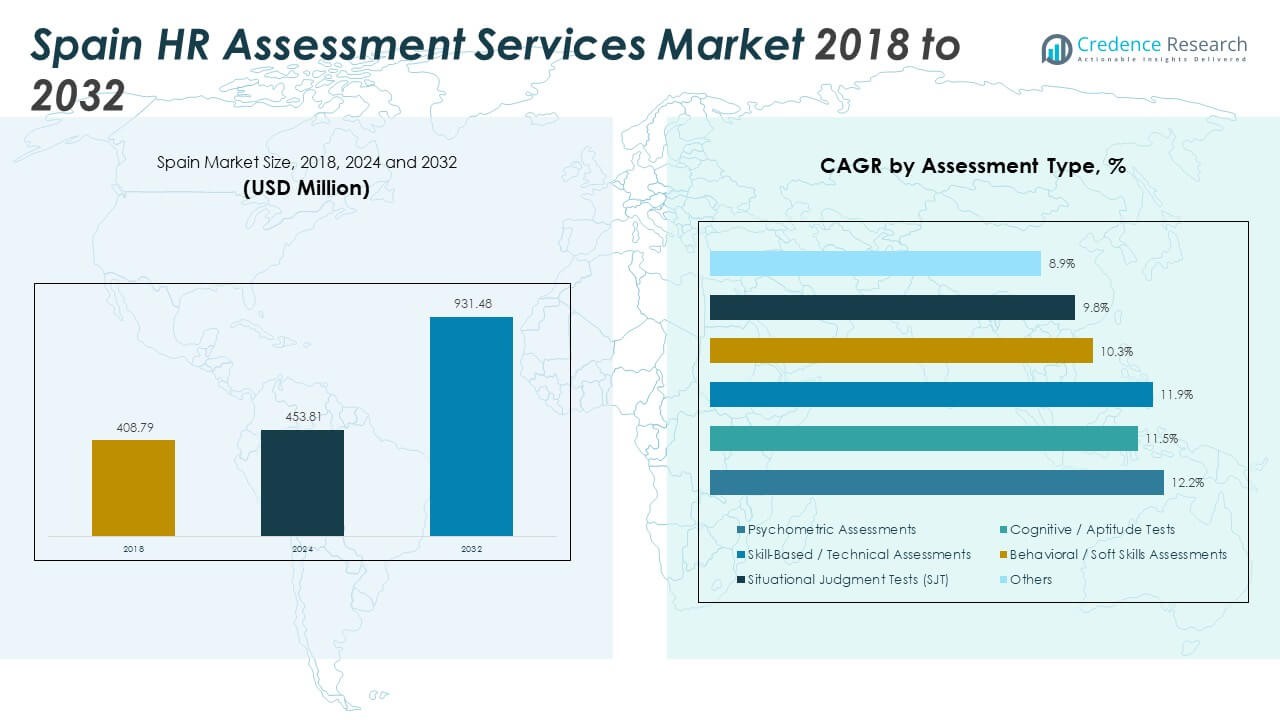
The Spain HR Assessment Services Market size was valued at USD 408.79 million in 2018 to USD 453.81 million in 2024 and is anticipated to reach USD 931.48 million by 2032, at a CAGR of 9.41% during the forecast period.
| REPORT ATTRIBUTE | DETAILS |
|---|---|
| Historical Period | 2020-2023 |
| Base Year | 2024 |
| Forecast Period | 2025-2032 |
| Spain HR Assessment Services Market Size 2024 | USD 453.81 Million |
| Spain HR Assessment Services Market, CAGR | 9.41% |
| Spain HR Assessment Services Market Size 2032 | USD 931.48 Million |
Strong digital transformation across industries is driving the adoption of HR assessment tools in Spain. Organizations are increasingly using AI-driven psychometric and skill-based tests to improve recruitment accuracy and employee development. The growing focus on data-driven workforce management, remote hiring, and internal mobility programs is further boosting the market demand. In addition, expanding adoption by SMEs to streamline HR operations supports steady market expansion.
Regionally, major urban and industrial centers such as Madrid, Catalonia, and Andalusia are leading the Spain HR Assessment Services Market due to high enterprise concentration and HR modernization initiatives. Northern Spain is showing growing adoption supported by regional tech hubs and education-driven employment systems. Meanwhile, smaller regions are emerging with rising awareness of digital HR practices and the growing presence of local HR service providers.
Market Insights:
- The Spain HR Assessment Services Market was valued at USD 408.79 million in 2018, expected to reach USD 453.81 million in 2024, and projected to hit USD 931.48 million by 2032, expanding at a CAGR of 9.41%.
- Central Spain (Madrid) leads with 35% share, driven by corporate headquarters, government agencies, and digital HR transformation. Catalonia (27%) follows, supported by its tech and startup ecosystem, while Andalusia (18%) benefits from industrial expansion and workforce digitization.
- Northern Spain, holding 12% share, is the fastest-growing region, propelled by industrial development, university partnerships, and government initiatives supporting skill-based employment programs.
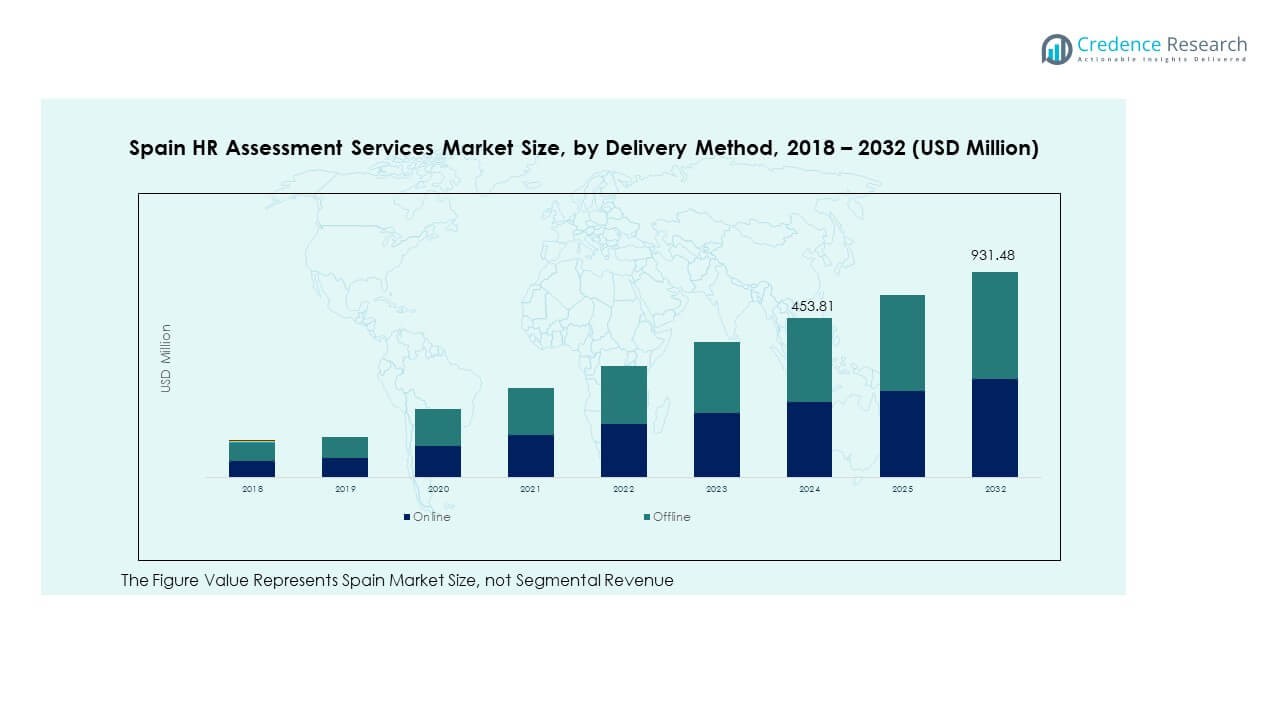
- The online delivery segment accounts for about 60% share, supported by the shift to virtual recruitment and cloud-based testing platforms.
- The offline segment holds nearly 40% share, maintaining relevance among traditional sectors and public organizations favoring in-person evaluations.
Market Drivers:
Growing Shift Toward Data-Driven Hiring and Employee Development
The Spain HR Assessment Services Market is witnessing strong growth due to a widespread shift toward data-driven recruitment. Companies are investing in AI-enabled tools that assess cognitive skills, emotional intelligence, and job-specific competencies with measurable accuracy. This approach reduces hiring bias and improves cultural alignment between candidates and organizations. It is helping HR teams make better predictions on employee performance and retention. The focus on digital assessment platforms is rising across both large enterprises and SMEs. Organizations prefer standardized testing frameworks to improve the quality of hires. The emphasis on evidence-based HR decision-making continues to strengthen demand. Growing awareness of structured assessment solutions is expanding adoption across diverse sectors.
- For instance, Personio, a provider operating in Spain, reports enabling approximately 50% faster recruiting cycles and saving 15 minutes per routine HR task through its integrated AI-driven assessment platform in 2025, as confirmed by recent technology adoption studies.
Expansion of Remote Work and Virtual Talent Evaluation Platforms
The rise of hybrid and remote work models has driven the demand for online assessment platforms in Spain. Companies are prioritizing digital tools that facilitate virtual interviews, psychometric evaluations, and role-based skill testing. It has become vital for organizations to assess candidates remotely with precision and fairness. The Spain HR Assessment Services Market benefits from this transition by offering technology-enabled evaluation ecosystems. HR teams now depend on digital analytics to measure candidate performance beyond traditional resumes. Remote tools also improve the accessibility of national and international talent pools. This evolution supports faster recruitment cycles and reduces costs. The continued shift toward virtual workforce management ensures long-term demand for assessment technologies.
- For instance, Talentoo, a video interviewing platform cited in Spanish recruitment industry studies, enables remote interviews resulting in significant time and cost savings for client companies in 2025, with published figures indicating over 40% faster candidate screening via online evaluations.
Increased Emphasis on Learning and Development Programs
Spanish organizations are increasingly aligning HR assessments with employee development strategies. Employers are using performance assessments to identify training needs and career progression opportunities. The Spain HR Assessment Services Market supports this evolution through competency-based evaluation systems. It enables HR departments to link performance data with personalized learning paths. Many companies invest in continuous skill testing to measure employee improvement post-training. This integration fosters a culture of learning and performance accountability. Companies view such assessments as key to retaining talent in competitive labor markets. Enhanced use of analytics-driven learning assessments is driving continuous adoption across industries.
Government and Institutional Support for Workforce Digitalization
Government-backed initiatives promoting workforce digitalization are stimulating market growth. Policies encouraging digital skill development and HR innovation are improving awareness across the public and private sectors. The Spain HR Assessment Services Market benefits from training grants and educational collaborations aimed at employment readiness. Universities and corporate partnerships are integrating assessment tools into education-to-employment programs. It is enabling smoother transitions for graduates into professional environments. Public-sector organizations are also embracing digital HR testing to modernize recruitment. These efforts align with Spain’s broader strategy to enhance productivity and labor market efficiency. Such institutional backing significantly strengthens industry momentum across the nation.
Market Trends:
Integration of Artificial Intelligence and Predictive Analytics in Assessments
AI-driven analytics are becoming central to the evolution of the Spain HR Assessment Services Market. Predictive algorithms now assist in identifying potential top performers based on data from previous hires. It enables recruiters to improve accuracy and reduce human error during evaluations. Automated scoring systems help standardize candidate comparisons across diverse profiles. Companies are using AI tools to detect patterns in behavior, cognitive ability, and skill fit. This trend has improved the quality of hiring decisions in competitive industries. AI-driven personalization also helps tailor assessments to specific job roles. Widespread adoption of intelligent analytics is transforming traditional HR processes into agile, evidence-based frameworks.
Rising Popularity of Gamified and Interactive Assessment Tools
Gamification has emerged as a strong trend in Spain’s HR assessment landscape. Companies are using interactive tools to engage candidates through realistic job simulations and problem-solving tasks. It enhances user experience while delivering reliable behavioral insights. The Spain HR Assessment Services Market has embraced this shift to attract younger, tech-savvy candidates. Gamified platforms encourage participation and provide real-time feedback. Organizations use these tools to measure creativity, leadership, and teamwork more effectively. This trend also improves employer branding by offering modern candidate experiences. The continued innovation in game-based testing strengthens its adoption across industries seeking engagement-driven evaluation formats.
- For instance, based on HireVue's "2025 Global Guide to AI in Hiring," AI adoption among HR professionals surged to 72% globally this year, with 41% of surveyed professionals stating that their companies are now using skills assessments in the hiring process to combat a rise in AI-generated applications.
Growing Role of Cloud-Based and SaaS Platforms for Scalability
Cloud-enabled solutions are rapidly replacing legacy HR systems in Spain. Enterprises prefer SaaS-based assessment platforms that offer scalability, security, and remote accessibility. The Spain HR Assessment Services Market benefits from this movement toward flexible, subscription-based models. It allows HR teams to deploy multiple assessment modules with minimal infrastructure. Data centralization through the cloud ensures seamless analytics and integration with HR management systems. Organizations can now manage end-to-end testing processes remotely. This trend has made HR operations more adaptive and cost-efficient. Cloud-based infrastructure continues to attract adoption from both startups and established corporations.
Increased Use of Behavioral and Soft Skill Assessments in Hiring Decisions
Spanish employers are increasingly valuing emotional intelligence, adaptability, and collaboration in their workforce. Behavioral assessments are being integrated into hiring processes to evaluate interpersonal and cultural compatibility. The Spain HR Assessment Services Market supports this shift with advanced psychometric and situational judgment tools. It helps companies identify candidates capable of thriving in dynamic and cross-functional environments. Employers also use soft-skill data for leadership development and succession planning. The trend reflects a growing recognition that technical expertise alone is insufficient. The market’s evolution toward holistic evaluation strengthens workforce resilience and engagement. It represents a major transformation in Spain’s HR evaluation landscape.
Market Challenges Analysis:
High Cost of Implementation and Limited Awareness Among SMEs
The high upfront cost of deploying digital HR assessment tools poses a major barrier for small and medium enterprises. Many SMEs still rely on traditional recruitment methods due to limited budgets and awareness. The Spain HR Assessment Services Market faces challenges in penetrating this price-sensitive segment. It requires sustained education about long-term cost savings and performance benefits. Lack of trained HR professionals to interpret assessment data adds further complexity. Limited digital infrastructure in smaller firms slows adoption rates. Some organizations also fear data privacy risks linked to cloud-based systems. Expanding awareness campaigns and affordable pricing models remain essential to overcome these obstacles.
Regulatory Constraints and Data Protection Concerns Affecting Adoption
Strict data protection laws in Spain create compliance burdens for HR technology providers. The Spain HR Assessment Services Market must continuously adapt to evolving data privacy frameworks. Companies handling sensitive assessment data face increased pressure to ensure transparency and ethical use. It demands regular audits, encryption measures, and GDPR-compliant operations. Any data breach can harm brand trust and client relationships. Furthermore, organizations are cautious about using AI-based evaluations due to potential bias concerns. Complex regulatory environments increase operational costs and limit innovation speed. Balancing compliance with technological advancement remains a core challenge for market participants.
Market Opportunities:
Emerging Demand for Customized Assessments Across Industries
Rising need for role-specific evaluations is creating significant opportunities in the Spain HR Assessment Services Market. Industries such as IT, healthcare, and manufacturing seek tailored solutions for technical and behavioral testing. It opens prospects for service providers to design flexible assessment modules. Growing acceptance of modular testing frameworks supports long-term scalability. Customization helps companies align HR assessments with corporate culture and business goals. Providers offering multi-language support and sector-specific analytics gain strong traction. This trend positions Spain as a key regional hub for specialized HR testing solutions.
Integration of HR Assessment Tools With Learning and HRM Systems
Growing demand for integrated HR ecosystems offers a major opportunity for vendors. The Spain HR Assessment Services Market is seeing collaboration between assessment firms and HR management software developers. Integration enables end-to-end visibility across recruitment, training, and performance tracking. It ensures that insights from assessments feed directly into workforce development programs. Organizations benefit from unified data-driven decision-making across HR functions. It also enhances operational efficiency by reducing redundancy. Continuous innovation in integration capabilities promises long-term growth for market participants. This synergy between HR analytics and learning systems will shape the market’s future expansion.
Market Segmentation Analysis:
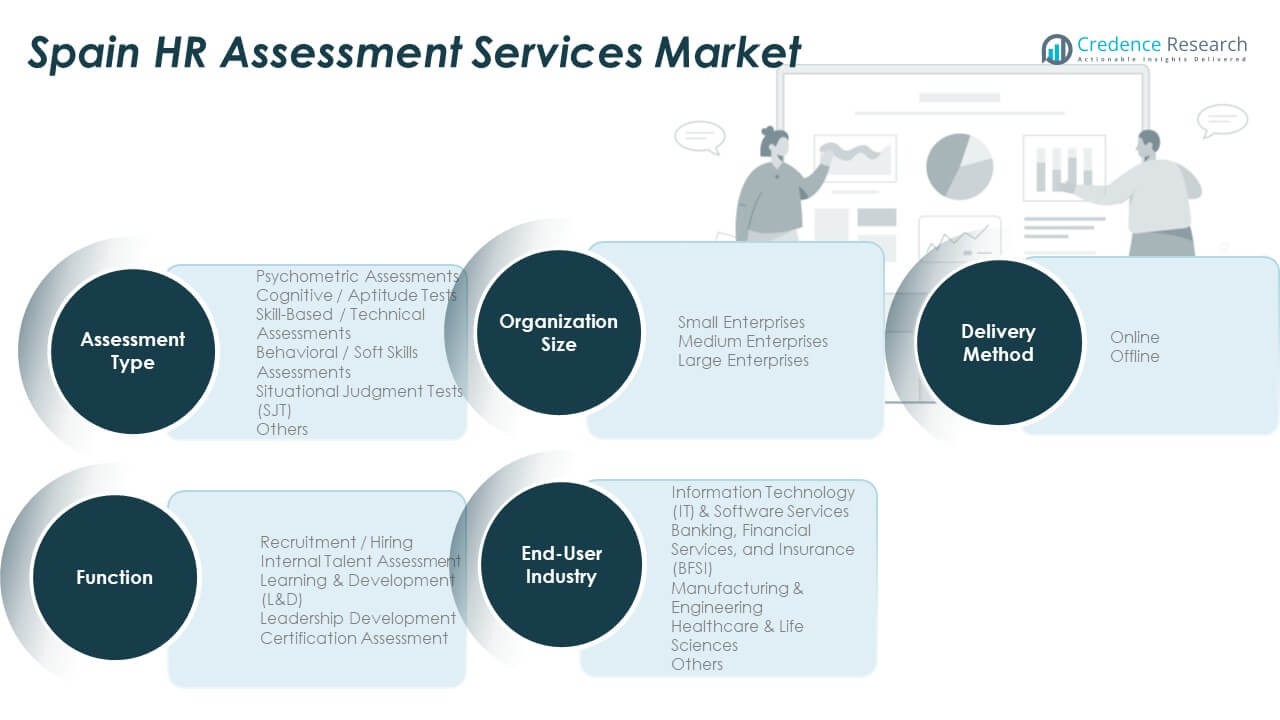
By Assessment Type
The Spain HR Assessment Services Market is segmented into psychometric assessments, cognitive or aptitude tests, skill-based or technical assessments, behavioral or soft skills assessments, situational judgment tests (SJT), and others. Psychometric assessments hold strong demand due to their ability to measure personality, motivation, and emotional intelligence. Cognitive tests are used widely in high-skill industries such as IT and finance to identify analytical capability. Skill-based and behavioral assessments are gaining attention in manufacturing and healthcare for productivity improvement. SJTs are increasingly used in leadership hiring for decision-making and problem-solving evaluation.
By Delivery Method
The market is categorized into online and offline delivery modes. Online assessments dominate due to their convenience, scalability, and integration with HR software systems. It supports remote recruitment processes and data-driven analysis, making it a preferred option for large enterprises. Offline assessments remain relevant in traditional organizations requiring physical evaluation centers. Increased adoption of cloud platforms and AI-backed testing is transforming delivery models toward virtual modes.
- For instance, Paradox, which delivers conversational AI solutions to global clients including some with operations in Spain through a partnership with SAP SuccessFactors, has published verified case study results. One report detailed how the AI-powered process saved store leaders at the US-based company 7-Eleven more than 40,000 hours per week. Another case study highlighted how the franchisor Neighborly used Paradox's conversational AI to achieve a 54% decrease in cost-per-hire.
By End-User Industry, Function, and Organization Size
The end-user segmentation includes IT and software services, BFSI, manufacturing and engineering, healthcare and life sciences, and others. IT and BFSI sectors lead adoption due to high employee turnover and digital HR readiness. By function, recruitment and internal talent assessment hold the largest share, while learning and leadership development are expanding steadily. In terms of organization size, large enterprises dominate due to higher resource availability, while SMEs are emerging adopters driven by cost-effective digital tools.
Segmentation:
By Assessment Type
- Psychometric Assessments
- Cognitive / Aptitude Tests
- Skill-Based / Technical Assessments
- Behavioural / Soft Skills Assessments
- Situational Judgment Tests (SJT)
- Others
By Delivery Method
- Online
- Offline
By End-User Industry
- Information Technology (IT) & Software Services
- Banking, Financial Services, and Insurance (BFSI)
- Manufacturing & Engineering
- Healthcare & Life Sciences
- Others
By Function
- Recruitment / Hiring
- Internal Talent Assessment
- Learning & Development (L&D)
- Leadership Development
- Certification Assessment
By Organization Size
- Small Enterprises
- Medium Enterprises
- Large Enterprises
Regional Analysis:
Dominance of Central Spain – Madrid and Surrounding Areas
Central Spain, led by Madrid, holds the largest share of the Spain HR Assessment Services Market at 35%. The region’s dominance is driven by a high concentration of corporate headquarters, multinational firms, and government institutions. It has a mature HR ecosystem supported by digital transformation initiatives and widespread adoption of AI-based recruitment tools. Madrid’s strong economy and skilled workforce attract both domestic and international assessment providers. The presence of major service firms and technology startups accelerates the use of online testing and analytics solutions. Its growing focus on workforce reskilling further enhances market expansion in the capital region.
Strong Growth in Catalonia and Andalusia – Expanding Business Ecosystems
Catalonia accounts for 27% of the market share, supported by its thriving business environment and advanced technological infrastructure. Barcelona, as a hub for innovation and startups, has led to rising demand for digital HR tools and assessment software. Andalusia follows closely with 18% market share, backed by expanding industrial sectors and a growing number of mid-sized enterprises adopting assessment systems. The Spain HR Assessment Services Market benefits from increasing investment in skill development and education partnerships across these regions. Both regions have seen strong participation from universities and HR tech incubators that promote digital employment practices. Their competitive labor environments sustain continuous adoption of sophisticated candidate evaluation platforms.
Emerging Potential in Northern and Eastern Spain – Rising Digital Adoption
Northern Spain, including regions such as Basque Country and Galicia, contributes around 12% of the total market, supported by growing industrial and educational collaborations. Eastern Spain, including Valencia and Murcia, holds approximately 8% share and is gaining attention due to increasing digital transformation among SMEs. The Spain HR Assessment Services Market is expanding into these emerging areas as businesses modernize recruitment and training systems. Government-backed digital skill initiatives and improved broadband infrastructure encourage broader adoption of assessment solutions. The rising focus on inclusive hiring and workforce analytics ensures sustained growth momentum across these evolving regions.
Key Player Analysis:
- Bizneo HR
- Factorial
- Meta4 (Cegid)
- SAP SuccessFactors
- Oracle Cloud HCM
- Personio
- Workday
- Cornerstone
- Bizneo
- Endalia
Competitive Analysis:
The Spain HR Assessment Services Market is moderately competitive, with several domestic and international players offering a wide range of assessment solutions. It is characterized by companies focusing on AI integration, digital testing platforms, and data-driven analytics. Local firms such as Bizneo HR and Factorial compete with global leaders like SAP SuccessFactors, Oracle Cloud HCM, and Workday. Vendors are strengthening partnerships with enterprises to enhance workforce analytics and remote hiring efficiency. The market’s competitiveness is driven by innovation in psychometric testing, cloud-based systems, and user experience enhancement. Companies are also expanding their product portfolios to meet diverse HR functions across recruitment, training, and leadership development. Continuous investment in automation and integration with HRM systems sustains long-term market growth.
Recent Developments:
- In October 2025, Factorial, the Barcelona-based HR and business management platform, launched its latest AI agent named "One" during Factorial Next: AI Edition 2025. This addition delivers automated HR processes and intelligent data-driven decision-making for Spanish businesses. Earlier in March 2025, Factorial secured an additional €110 million funding led by General Catalyst; these funds specifically support product innovation and geographic expansion, further boosting their presence in Spain's HR services market.
- SAP SuccessFactors announced its 2H 2025 product release in October, introducing extensive AI-driven enhancements and new features for Spanish users, particularly in Performance and Goal Management. Notably, SAP also revealed its acquisition of SmartRecruiters in August 2025, signifying a strategic focus on end-to-end talent acquisition and assessment capabilities for Spain's HR sector. The feature rollouts and acquisition are contributing to smarter, automated HR workflows across Spanish enterprises.
Report Coverage:
The research report offers an in-depth analysis based on assessment type, delivery method, end-user industry, function, and organization size. It details leading market players, providing an overview of their business, product offerings, investments, revenue streams, and key applications. Additionally, the report includes insights into the competitive environment, SWOT analysis, current market trends, as well as the primary drivers and constraints. Furthermore, it discusses various factors that have driven market expansion in recent years. The report also explores market dynamics, regulatory scenarios, and technological advancements that are shaping the industry. It assesses the impact of external factors and global economic changes on market growth. Lastly, it provides strategic recommendations for new entrants and established companies to navigate the complexities of the market.
Future Outlook:
- Rising adoption of AI and machine learning will enhance recruitment accuracy and efficiency.
- Cloud-based assessment solutions will dominate due to scalability and ease of integration.
- SMEs will emerge as a key growth segment through affordable and flexible HR platforms.
- Partnerships between universities and HR tech firms will expand workforce readiness programs.
- Data-driven insights will reshape HR decision-making and employee performance evaluation.
- Increased focus on soft skills and behavioral assessments will redefine candidate selection.
- Remote and hybrid working models will strengthen demand for online testing solutions.
- Vendors will invest in cybersecurity to ensure safe handling of assessment data.
- The market will experience consolidation through mergers and acquisitions among tech providers.
- Government digitalization initiatives will continue supporting technology-driven HR practices.

Request a Free Sample
Fill in your details and we'll send you a free sample report.
- Sample data tables & charts
- Research methodology
Need a Custom Version of This Report?
Tailor the scope, geography, or segments to your exact requirements.
- Custom geography or segment scope
- Direct access to our analyst team
Frequently Asked Questions
What is the current market size for Spain HR Assessment Services Market, and what is its projected size in 2032?
At what Compound Annual Growth Rate is the Spain HR Assessment Services Market projected to grow between 2024 and 2032?
Which Spain HR Assessment Services Market segment held the largest share in 2024?
What are the primary factors fueling the growth of the Spain HR Assessment Services Market?
Who are the leading companies in the Spain HR Assessment Services Market?
Which region commanded the largest share of the Spain HR Assessment Services Market in 2024?
Table of Content
Chapter 1 Market Segmentation
- 1.1 Segmentation Framework
- 1.1.1 Product and Service Classification
- 1.1.2 Application and End-Use Classification
- 1.1.3 Technology and Solution Classification
- 1.1.4 Customer and Distribution Channel Classification
- 1.1.5 Geographic Segmentation
- 1.1.6 Market Segment Definitions and Boundaries
Chapter 2 Introduction
- 2.1 Report Objectives and Scope
- 2.2 Product Definition and Industry Terminology
- 2.3 Market Inclusions and Exclusions
- 2.4 Research Process
- 2.4.1 Primary Research and Expert Interviews
- 2.4.2 Secondary Research and Source Review
- 2.4.3 Top-Down and Bottom-Up Estimation
- 2.4.4 Data Triangulation and Verification
- 2.5 Market Size Measurement Basis
- 2.5.1 2024: USD 453.81 million → 2032: USD 931.48 million
- 2.6 Historical and Forecast Reference Periods
- 2.6.1 Base Year: 2024
- 2.6.2 Forecast Period: 2024-2032
- 2.7 Research Assumptions and Limitations
Chapter 3 Executive Summary
- 3.1 Market Snapshot and Key Findings
- 3.2 Base-Year Market Size, 2024
- 3.3 Forecast Market Size, 2032
- 3.4 Revenue and Volume Growth Outlook
- 3.5 Key Demand and Supply Indicators
- 3.6 Leading Market Segments
- 3.7 Fastest-Growing Market Opportunities
- 3.8 Regional Performance Highlights
- 3.9 Technology and Industry Transformation
- 3.10 Competitive Landscape Summary
- 3.11 Analyst View and Strategic Implications
Chapter 4 Spain HR Assessment Services Market Trends and Developments
- 4.1 Historical Industry Development
- 4.2 Recent Market Trends and Developments
- 4.3 Demand and Customer Behavior Trends
- 4.4 Technology and Product Innovation
- 4.5 Artificial Intelligence, Automation and Digitalization
- 4.6 Local Manufacturing and Supply Chain Realignment
- 4.7 Industry Partnerships, Mergers and Acquisitions
- 4.8 Sustainability and Circular Economy Developments
- 4.9 Government and Private Sector Investment Trends
- 4.10 Emerging Business Models and Commercialization
- 4.11 Industry Developments and Announcements
Chapter 5 Spain HR Assessment Services Market Supply and Demand Analysis
- 5.1 Demand Trend and Consumption Analysis
- 5.2 Demand Forecast, 2024-2032
- 5.3 Supply Chain Structure and Procurement Trends
- 5.4 Supply-Demand Gap and Bottlenecks
- 5.5 Import Dependence and Sourcing Structure
- 5.6 Regional Supply and Demand Concentration
Chapter 6 Spain HR Assessment Services Market Pricing Analysis
- 6.1 Pricing Structure and Measurement
- 6.2 Historical Pricing Trends
- 6.3 Pricing Outlook, 2024-2032
- 6.4 Pricing by Product and Market Segment
- 6.5 Geographic Pricing Differences
- 6.6 Key Input, Energy, Labor and Logistics Costs
- 6.7 Contract Pricing and Purchasing Models
- 6.8 Pricing Sensitivity and Competitive Positioning
- 6.9 Price, Margin and Profitability Implications
Chapter 7 Spain HR Assessment Services Market Dynamics
- 7.1 Market Growth Drivers
- 7.1.1 Demand-Side Drivers
- 7.1.2 Technology and Innovation Drivers
- 7.1.3 Infrastructure and Investment Drivers
- 7.1.4 Regulatory and Policy Drivers
- 7.2 Market Restraints
- 7.2.1 Cost and Affordability Constraints
- 7.2.2 Technology and Adoption Barriers
- 7.2.3 Supply Chain and Operational Constraints
- 7.3 Market Challenges
- 7.3.1 Competitive Pressure and Margin Erosion
- 7.3.2 Skills, Infrastructure and Implementation Gaps
- 7.4 Emerging Market Opportunities
- 7.5 Market Dynamics Impact and Time-Horizon Assessment
Chapter 8 Spain HR Assessment Services Value Chain Analysis
- 8.1 Industry Value Chain Overview
- 8.2 Upstream Suppliers and Critical Inputs
- 8.3 Technology and Component Providers
- 8.4 Manufacturing or Service Delivery
- 8.5 Distribution, Channel Partners and Integrators
- 8.6 Downstream Applications and End Users
- 8.7 Value Addition and Profit Pools
- 8.8 Vertical Integration and Outsourcing
- 8.9 Supplier Concentration and Risk
- 8.10 Supply Chain Localization and Resilience
Chapter 9 Spain HR Assessment Services Market Regulations and Policies
- 9.1 Relevant Laws, Standards and Compliance Frameworks
- 9.2 Product, Service, Safety and Quality Requirements
- 9.3 Government Policies, Incentives and Subsidies
- 9.4 Imports, Exports and Trade Barriers
- 9.5 Public Procurement and Local Content Requirements
- 9.6 Data Protection, AI and Cybersecurity Compliance
- 9.7 Upcoming Policy Changes and Market Implications
Chapter 10 Spain HR Assessment Services Market Hotspots and Opportunities
- 10.1 Market Opportunity Mapping and Growth Hotspots
- 10.2 High-Growth Applications and Customer Groups
- 10.3 Underserved Markets and White-Space Opportunities
- 10.4 Emerging Technology and Product Opportunities
- 10.5 New Capacity and Investment Hotspots
- 10.6 Market Entry and Expansion Opportunities
- 10.7 Distribution and Partnership Opportunities
- 10.8 Near-Term and Long-Term Commercial Potential
- 10.9 Opportunity Attractiveness and Execution Risks
Chapter 11 Spain HR Assessment Services Market Outlook, 2024-2032
- 11.1 Market Size and Analysis
- 11.1.1 Revenue (Market Measurement: 2024: USD 453.81 million → 2032: USD 931.48 million)
- 11.1.2 Historical Market Size
- 11.1.3 Base-Year Market Size, 2024
- 11.2 Market Forecast, 2024-2032
- 11.2.1 Revenue Forecast to 2032
- 11.2.2 CAGR and Year-on-Year Growth
- 11.2.3 Incremental Revenue Opportunity
- 11.3 Forecast Assumptions and Scenario Analysis
- 11.3.1 Base-Case Forecast
- 11.3.2 Optimistic and Conservative Scenarios
- 11.3.3 Technology, Pricing and Policy Sensitivities
- 11.4 Market Attractiveness and Growth Outlook
Chapter 12 Spain HR Assessment Services Market Segmentation and Outlook
- 12.1 Segmentation Summary and Market Shares, 2024
- 12.2 Largest and Fastest-Growing Segments
- 12.3 Segment Growth Comparison
- 12.4 Segment Attractiveness and Priority Matrix
Chapter 13 Spain HR Assessment Services Geographic Market Outlook, 2024-2032
- 13.1 Domestic Market Distribution and Demand Clusters
- 13.2 State- or Province-Wise Market Size and Forecast, 2024-2032
- 13.3 City and Metropolitan Market Outlook
- 13.4 Industrial, Manufacturing and Commercial Clusters
- 13.5 Geographic Concentration of Key End Users
- 13.6 Local Pricing and Purchasing Differences
- 13.7 Domestic Production Facilities and Capacity Map
- 13.8 Local Infrastructure and Project Pipeline
- 13.9 State-Level Policy and Incentive Differences
- 13.10 Subnational Investment Hotspots and Opportunities
- 13.11 Distribution and Logistics Networks
- 13.12 Domestic Competitive Footprint
Chapter 14 Spain HR Assessment Services Technology, Innovation and Sustainability Outlook
- 14.1 Technology Landscape and Maturity
- 14.2 Product, Process and Service Innovation
- 14.3 AI, Automation and Digital Tools in the Industry
- 14.4 Technology Adoption and Performance Benchmarking
- 14.5 Innovation Pipeline and R&D Investment
- 14.6 Energy Efficiency and Resource Management
- 14.7 Sustainability, Recycling and Circularity
- 14.8 Technology Roadmap, 2024-2032
- 14.9 Risks of Obsolescence and Technology Substitution
Chapter 15 Spain HR Assessment Services Market Key Strategic Imperatives
- 15.1 Growth and Market Entry Priorities
- 15.2 High-Return Products and Segments
- 15.3 Pricing, Profitability and Cost Optimization
- 15.4 Technology Investment and Product Differentiation
- 15.5 Supply Chain Localization and Resilience
- 15.6 Distribution and Customer Acquisition
- 15.7 Partnership, Acquisition and Capacity Strategy
- 15.8 Regional Expansion Priorities
- 15.9 Short-, Medium- and Long-Term Actions
Chapter 16 Competition Outlook
- 16.1 Industry Competition Characteristics
- 16.2 Market Structure and Concentration
- 16.3 Market Share and Competitive Positioning, 2024
- 16.4 Company-Wise Revenue and Product Benchmarking
- 16.5 Production and Service Capacity Benchmarking
- 16.6 Technology, Pricing and Differentiation
- 16.7 Regional Footprint and Distribution Strength
- 16.8 Mergers, Acquisitions and Strategic Alliances
- 16.9 New Entrants and Competitive Threats
- 16.10 Porter's Five Forces and Industry Attractiveness
- 16.11 Competitive Outlook, 2024-2032
Chapter 17 Company Profiles
- 17.1 Company Coverage and Selection Criteria
- 17.2 Leading Market Participants – Standard Profile Structure
- 17.2.1 Business Description
- 17.2.2 Company Ownership and Geographic Presence
- 17.2.3 Product and Service Portfolio
- 17.2.4 Manufacturing and Operating Footprint
- 17.2.5 Financial Performance and Investment
- 17.2.6 Market Share and Competitive Position
- 17.2.7 Technology and Innovation Capabilities
- 17.2.8 Strategic Alliances or Partnerships
- 17.2.9 Recent Developments
- 17.2.10 Growth Strategy and Outlook
- 17.3 Other Relevant Market Participants
Note: Every listed company is profiled on the structure shown under the first company. The company list is preliminary and may change based on research findings, market developments, data availability and client requirements.
Chapter 18 Disclaimer
- 18.1 Research and Forecast Disclaimer
- 18.2 Data Source and Estimation Limitations
Note: The depth of individual sections depends on data availability for this market. Volume, capacity, trade and other unit-based metrics are included where applicable.

