
Specialty and High-Performance Films Market Overview:
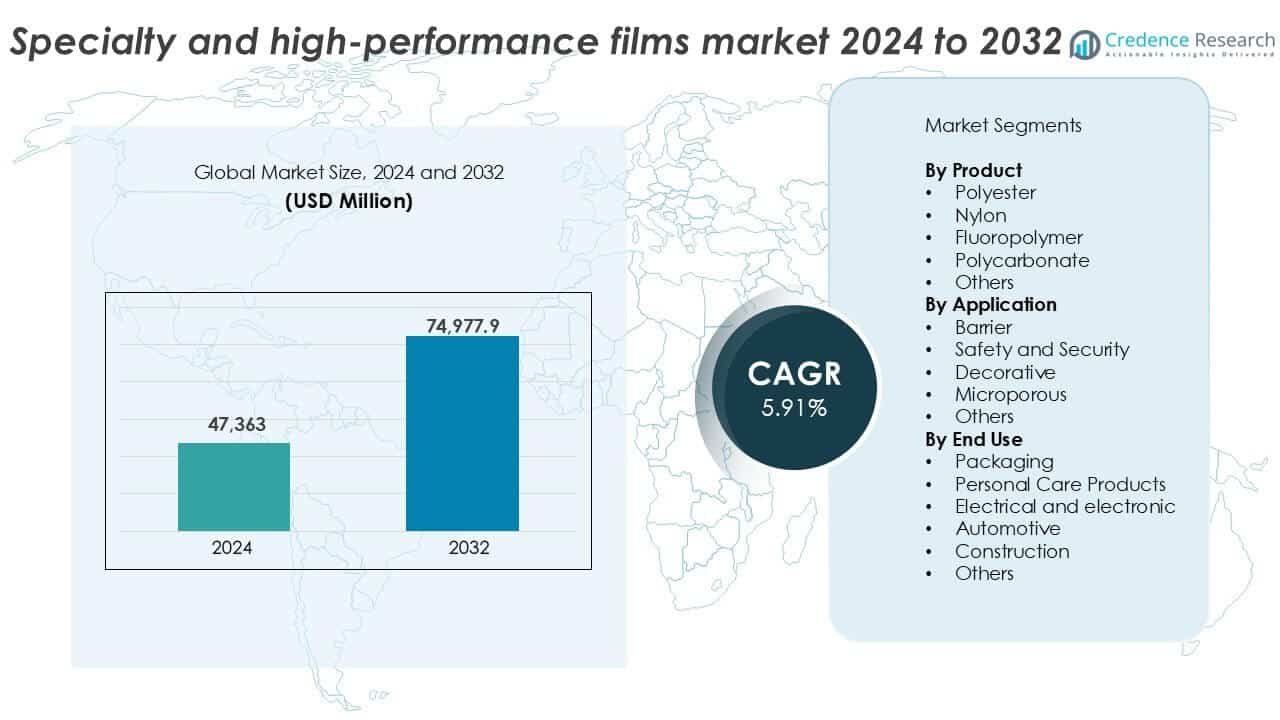
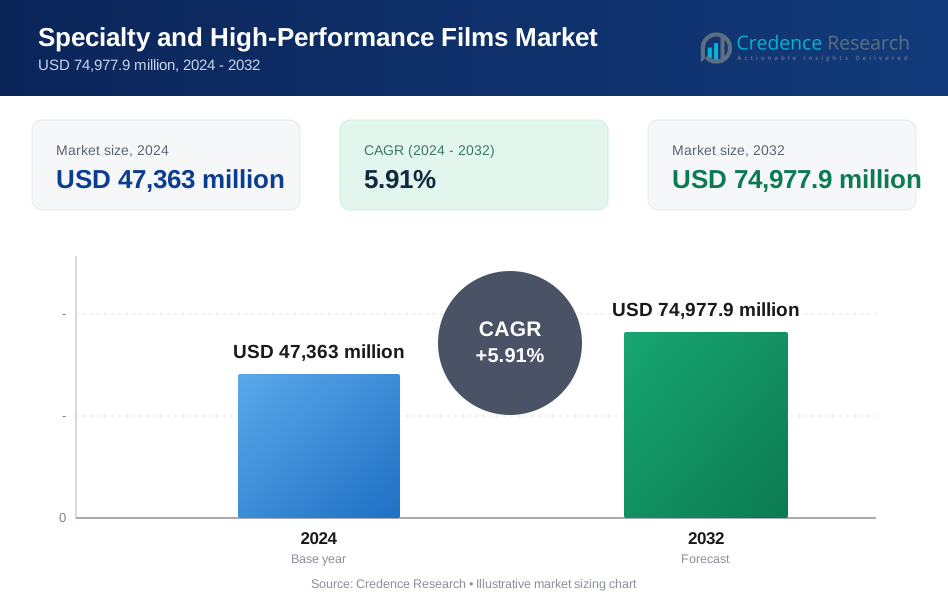
The Specialty and High-Performance Films market size was valued at USD 47,363 million in 2024 and is anticipated to reach USD 74,977.9 million by 2032, at a CAGR of 5.91% during the forecast period.
| REPORT ATTRIBUTE | DETAILS |
|---|---|
| Historical Period | 2020-2023 |
| Base Year | 2024 |
| Forecast Period | 2025-2032 |
| Specialty and High-Performance Films Market Size 2024 | USD 47,363 million |
| Specialty and High-Performance Films Market, CAGR | 5.91% |
| Specialty and High-Performance Films Market Size 2032 | USD 74,977.9 million |
Top players in the specialty and high-performance films market include BASF SE, Evonik Industries AG, The Dow Chemical Company, and ExxonMobil Corporation, each focusing on diverse applications from packaging to electronics and automotive. Other key companies such as Clariant AG, Albemarle Corporation, Kaneka Corporation, Nouryon, LANXESS AG, and Songwon Industrial Co., Ltd. strengthen their competitive edge through product innovations and strategic expansions. Asia Pacific leads the global market with a 34% share in 2024, driven by strong manufacturing growth and increasing demand across food packaging, electronics, and automotive sectors. North America and Europe follow, accounting for 28% and 24% respectively, supported by technological advancements and regulatory emphasis on sustainable films.
Specialty and High-Performance Films Market Insights
- The market stood at USD 47,363 million in 2024 and will reach USD 74,977.9 million by 2032, growing at a 5.91% CAGR, supported by packaging, electronics, and automotive demand.
- Growth rises from flexible packaging needs, product protection focus, and lightweight material use, with polyester films holding over 40% share and packaging end use leading with more than 45% share.
- Trends favor recyclable and high-barrier films, while barrier applications hold above 35% share, and companies invest in multilayer, thin-gauge, and sustainable film solutions to meet regulations.
- Competition remains moderate, led by BASF, Dow, Evonik, and ExxonMobil, as players expand capacity, improve film performance, and target electronics, medical, and automotive niches.
- Asia Pacific leads with 34% share, followed by North America at 28% and Europe at 24%, while Latin America and Middle East & Africa each contribute nearly 7% through steady industrial growth.
Specialty and High-Performance Films Market Segmentation Analysis:
By Product
The polyester segment dominates the specialty and high-performance films market, accounting for over 40% of the global share in 2024. Its widespread use stems from excellent tensile strength, chemical resistance, and low production cost. Polyester films are widely used in flexible packaging, electronics insulation, and imaging applications. Fluoropolymer films follow, driven by strong demand in electronics and automotive for their thermal and chemical stability. Nylon and polycarbonate segments see moderate growth due to expanding use in protective and optical films. Innovations in bio-based polyester further support segment leadership and sustainability trends.
- For instance, polyester films like biaxially oriented PET (BoPET) are widely used in flexible packaging and electronics as substrates for circuits and displays thanks to high tensile strength and thermal stability.
By Application
Barrier films lead the application segment, holding more than 35% share in 2024, driven by their extensive use in food and pharmaceutical packaging. These films offer strong moisture, oxygen, and UV resistance, which helps preserve product shelf life. Safety and security films show steady adoption in the construction and automotive industries for shatter resistance. Decorative and microporous films cater to niche segments such as home décor and filtration, respectively. Continued growth in the packaging sector sustains demand for high-barrier materials across geographies.
- For instance, barrier films composed of PET or other polymers block moisture and oxygen to extend product shelf life in packaged goods.
By End Use
Packaging emerges as the leading end-use segment, capturing over 45% of the market share in 2024. Rising demand for flexible, durable, and protective materials in food, pharmaceuticals, and personal care supports segment dominance. Specialty films are increasingly used for lightweight, tamper-resistant packaging formats. Electrical and electronics also contribute significantly, driven by miniaturization trends and circuit insulation needs. Automotive and construction sectors show rising usage of safety, decorative, and heat-resistant films. Personal care applications gain traction through breathable films used in hygiene products and cosmetic packaging.
Specialty and High-Performance Films Market Key Growth Drivers
Expanding Demand from Flexible Packaging Industry
The rapid growth of the flexible packaging sector significantly drives demand for specialty and high-performance films. These films offer strong barrier properties, high tensile strength, and chemical resistance essential for food, pharmaceuticals, and consumer goods packaging. Rising consumer preference for lightweight, resealable, and eco-friendly packaging formats accelerates their adoption. Multilayer film structures using polyester, nylon, and fluoropolymers ensure extended shelf life and product safety. Manufacturers also benefit from reduced logistics costs due to lightweight packaging. In emerging economies, increased disposable incomes and urbanization boost consumption of packaged food, directly expanding film consumption. Regulatory shifts favoring recyclable and BPA-free materials also push brands to upgrade from conventional films to high-performance variants. This transition from rigid to flexible packaging in industries worldwide is set to fuel steady long-term growth.
- For instance, polyester films like biaxially oriented PET (BoPET) offer high tensile and chemical resistance, which makes them suitable for flexible packaging applications where durability and product safety matter.
Advancements in Film Engineering and Performance Optimization
Technological innovations in polymer processing and film formulation drive consistent upgrades in specialty and high-performance films. Manufacturers develop tailored films with improved barrier efficiency, UV protection, thermal resistance, and optical clarity. High-performance films are increasingly designed for application-specific attributes—such as scratch resistance in electronics, flame retardance in automotive interiors, or microporous structure in breathable membranes. Co-extrusion and multilayer lamination techniques allow better material utilization and cost-efficiency. The integration of nanomaterials, biodegradable additives, and smart functionalities (such as anti-fog or antimicrobial coatings) enhances the functional versatility of films. These advances enable new uses across sectors, reduce raw material wastage, and support sustainability targets. R&D spending from leading players focuses on producing thinner, stronger, and recyclable films, unlocking broader market opportunities.
- For instance, co‑extrusion enables multilayer films that balance barrier efficiency with material use, benefiting packaging performance and cost efficiency.
Growing Applications in Electronics and Automotive Sectors
The increasing use of specialty and high-performance films in electronics and automotive components contributes significantly to market expansion. In electronics, films serve in applications such as capacitor insulation, flexible displays, circuit protection, and adhesive substrates. Their ability to withstand high voltage, temperature, and mechanical stress is critical in compact, high-performance devices. In the automotive sector, lightweight films help reduce vehicle weight while offering durability, thermal stability, and decorative aesthetics. Fluoropolymer and polycarbonate films are widely used in instrument panels, dashboards, and window protection. The global push for electric vehicles further supports demand for heat-resistant and insulating films. As OEMs focus on safety, comfort, and energy efficiency, specialty films provide reliable and multifunctional material solutions, driving continuous market uptake.
Specialty and High-Performance Films Market Key Trends & Opportunities
Shift Toward Sustainable and Recyclable Film Solutions
Sustainability is becoming a central focus across the specialty films value chain, opening new market opportunities. Consumers and regulators increasingly demand eco-friendly materials, which is pushing manufacturers to replace conventional plastic films with recyclable, biodegradable, or compostable alternatives. Bio-based polymers such as PLA and PHA, as well as post-consumer recycled content, are gaining traction in high-performance film applications. Major packaging companies commit to circular economy goals, encouraging suppliers to innovate sustainable film structures without compromising performance. Single-material barrier films that support easy recycling are in high demand across Europe and North America. The growing awareness about plastic pollution and global regulations around extended producer responsibility (EPR) further reinforce this trend. Players investing in green product lines and closed-loop systems are poised to benefit from the shift toward environmental compliance and conscious consumerism.
- For instance, European flexible film markets show strong adoption of recyclable and biodegradable formats driven by strict EU guidelines and customer preference for eco‑friendly films.
Rising Use in Medical and Hygiene Applications
Specialty films are witnessing increased demand in the healthcare and hygiene sectors, driven by infection control needs and expanding personal care markets. Films used in wound care, surgical drapes, diagnostic devices, and protective barriers require precise moisture management, breathability, and biocompatibility. Microporous and breathable film variants are key materials in hygiene products like adult diapers, sanitary napkins, and baby care products. The COVID-19 pandemic significantly accelerated awareness and investment in medical-grade films, a trend that continues with an aging global population and rising healthcare expenditures. Moreover, antimicrobial film coatings and sterilizable high-performance polymers are being increasingly used in medical packaging and equipment protection. These factors create new growth pathways for players offering specialized films tailored to hygiene and clinical standards.
Specialty and High-Performance Films Market Key Challenges
High Cost of Raw Materials and Advanced Processing Technologies
One of the major challenges in the specialty and high-performance films market is the high cost of raw materials and complex processing requirements. Premium polymers such as fluoropolymers, polyimides, and specialty nylon resins are significantly more expensive than standard polyethylene or polypropylene. The use of additives, multilayer laminates, and advanced co-extrusion technologies further increases production costs. This creates pricing pressure, especially in cost-sensitive applications and emerging markets. Additionally, volatile crude oil prices affect the availability and cost of petroleum-based inputs. Manufacturers face the dual challenge of maintaining performance standards while managing costs to stay competitive. Small and mid-sized enterprises often struggle to invest in specialized machinery and R&D required to develop high-specification films, creating entry barriers and limiting innovation diversity.
Stringent Environmental Regulations and Recycling Barriers
Regulatory pressure surrounding single-use plastics and polymer waste poses significant challenges to the specialty films industry. Although high-performance films are often used in durable applications, many multi-layer structures are difficult to recycle due to the combination of incompatible resins. Governments across regions are introducing bans, recycling mandates, and material traceability rules that impact product formulations and packaging designs. Achieving recyclability while maintaining performance standards like barrier protection, thermal resistance, or transparency remains technically difficult. Compliance with evolving global norms like the EU Green Deal or Extended Producer Responsibility laws increases operational complexity. Manufacturers must rethink supply chains, invest in recyclable technologies, or risk losing access to regulated markets. This transition period adds uncertainty and requires significant resource allocation across the industry.
Specialty and High-Performance Films Market Regional Analysis
North America
North America holds a significant share of the specialty and high-performance films market, accounting for approximately 28% in 2024. Strong demand from the packaging, electronics, and automotive industries drives market growth in the region. The U.S. leads in innovation, supported by investments in advanced polymer technologies and R&D. The region also shows increasing adoption of sustainable and recyclable film solutions due to stringent environmental regulations. Rapid growth in healthcare and personal care sectors further fuels demand for breathable and antimicrobial films. The presence of key players and a mature industrial base contributes to steady regional expansion.
Europe
Europe accounts for around 24% of the global market in 2024, driven by strong environmental regulations and advanced packaging technologies. Countries like Germany, France, and the U.K. lead in high-performance films used in food packaging, automotive, and electronics. The EU’s Green Deal and circular economy targets encourage the use of recyclable and biodegradable films. Growth in electric vehicles supports demand for thermally stable and lightweight films. Technological advancements and high-quality standards drive adoption across industrial sectors. Sustainability-focused innovation remains a key driver for European manufacturers in specialty films.
Asia Pacific
Asia Pacific dominates the specialty and high-performance films market with over 34% share in 2024. China, Japan, South Korea, and India lead the region’s strong growth due to industrial expansion and rising consumer demand. Increasing use in food packaging, electronics manufacturing, and automotive production boosts regional uptake. China is a major exporter of polyester films, while Japan and South Korea focus on high-tech applications like displays and semiconductors. Cost-effective manufacturing and favorable government support in India encourage local production. Rapid urbanization and disposable income growth continue to fuel packaging and personal care film demand.
Latin America
Latin America holds a modest share of nearly 7% in the global market in 2024. Brazil and Mexico are the primary contributors, driven by growth in food processing, agriculture, and construction. Rising demand for barrier and decorative films in flexible packaging supports the market. The region also sees increasing imports of specialty films for electronics and healthcare sectors. Economic recovery and consumer product consumption encourage the use of advanced film materials. However, limited local production capacity and dependency on imports pose a challenge to growth.
Middle East & Africa
The Middle East & Africa account for approximately 7% of the global specialty and high-performance films market in 2024. Growing infrastructure development and healthcare investments in the GCC and South Africa drive demand for protective and breathable films. The packaging sector sees rising use of barrier films due to increasing retail activity. However, limited polymer conversion capacity and high import dependence affect market penetration. Ongoing initiatives in smart city projects and clean energy offer long-term potential for films used in solar modules and construction insulation. Regional growth remains steady, supported by gradual industrial diversification.
Specialty and High-Performance Films Market Segmentations:
By Product
- Polyester
- Nylon
- Fluoropolymer
- Polycarbonate
- Others
By Application
- Barrier
- Safety and Security
- Decorative
- Microporous
- Others
By End Use
- Packaging
- Personal Care Products
- Electrical and electronic
- Automotive
- Construction
- Others
By Geography
- North America
- U.S.
- Canada
- Mexico
- Europe
- Germany
- France
- U.K.
- Italy
- Spain
- Rest of Europe
- Asia Pacific
- China
- Japan
- India
- South Korea
- South-east Asia
- Rest of Asia Pacific
- Latin America
- Brazil
- Argentina
- Rest of Latin America
- Middle East & Africa
- GCC Countries
- South Africa
- Rest of the Middle East and Africa
Competitive Landscape
The competitive landscape of the specialty and high-performance films market is characterized by the presence of both global chemical giants and specialized material manufacturers. Key players such as BASF SE, The Dow Chemical Company, and Evonik Industries AG focus on expanding their film portfolios through product innovation and strategic partnerships. Companies like Clariant AG, Albemarle Corporation, and Nouryon emphasize performance enhancement and sustainability, aligning with growing regulatory and environmental demands. Songwon Industrial Co., Ltd. and Kaneka Corporation cater to niche applications with customized solutions, especially in electronics and automotive sectors. Mergers, capacity expansions, and acquisitions remain central strategies to strengthen market position and geographical reach. Technological advancement in barrier properties, recyclability, and multi-layer constructions drives competition. Manufacturers also invest in localized production to meet demand from emerging economies and reduce supply chain dependencies. The market remains moderately consolidated, with innovation and sustainability positioning as key differentiators in long-term competitive success.
Key Player Analysis
- Nouryon
- ExxonMobil Corporation
- Evonik Industries AG
- Clariant AG
- Albemarle Corporation
- The Dow Chemical Company
- LANXESS AG
- Kaneka Corporation
- BASF SE
- Songwon Industrial Co., Ltd.
Recent Developments
- In May 2024, Clariant AG unveiled a range of innovative solutions at NPE 2024 to significantly reduce the environmental impact of plastics, particularly in specialty and high-performance films. These new offerings are designed to enhance the sustainability profile of plastic products while maintaining their performance characteristics.
- In January 2024, LANXESS launched a sustainability film highlighting its commitment to sustainable practices within the specialty and high-performance films sector. This film showcases how the company integrates sustainability into its production processes, emphasizing the development of innovative materials that meet high-performance standards and adhere to environmental regulations and sustainability goals.
- In January 2023, Covestro and LANXESS joined forces to greener raw materials, resulting in a yearly decrease of up to 120,000 tons in CO2 footprint
Report Coverage
The research report offers an in-depth analysis based on Product, Application, End Use and Geography. It details leading market players, providing an overview of their business, product offerings, investments, revenue streams, and key applications. Additionally, the report includes insights into the competitive environment, SWOT analysis, current market trends, as well as the primary drivers and constraints. Furthermore, it discusses various factors that have driven market expansion in recent years. The report also explores market dynamics, regulatory scenarios, and technological advancements that are shaping the industry. It assesses the impact of external factors and global economic changes on market growth. Lastly, it provides strategic recommendations for new entrants and established companies to navigate the complexities of the market.
Future Outlook
- Demand for high-barrier films will increase across food, pharmaceutical, and industrial packaging sectors.
- Growth in electric vehicles will drive adoption of thermally stable and lightweight film materials.
- Manufacturers will invest more in recyclable and biodegradable film innovations to meet regulations.
- Advancements in nanocomposites and multilayer films will improve strength and functional performance.
- Medical and hygiene applications will expand, boosting demand for breathable and antimicrobial films.
- Electronics sector will use more specialty films in flexible circuits, displays, and battery insulation.
- Asia Pacific will continue leading the market due to strong industrial output and lower production costs.
- Companies will focus on regional production hubs to reduce supply chain risk and meet local demand.
- Automation and AI tools will support precise film manufacturing and quality control.
- Rising costs of raw materials may lead to innovation in alternative film resins and blends.
Request a Free Sample
Fill in your details and we'll send you a free sample report.
- Sample data tables & charts
- Research methodology
Need a Custom Version of This Report?
Tailor the scope, geography, or segments to your exact requirements.
- Custom geography or segment scope
- Direct access to our analyst team
Frequently Asked Questions
What is the current market size for the Specialty and high-performance films market, and what is its projected size in 2032?
At what Compound Annual Growth Rate is the Specialty and high-performance films market projected to grow between 2024 and 2032?
Which Specialty and high-performance films market segment held the largest share in 2024?
What are the primary factors fueling the growth of the Specialty and high-performance films market?
Who are the leading companies in the Specialty and high-performance films market?
Which region commanded the largest share of the Specialty and high-performance films market in 2024?
Table of Content
Chapter 1. Report Introduction
- 1.1 Report Description & Purpose
- 1.1.1 Report Title & Market Definition
- 1.1.2 Unique Selling Propositions (USP) & Key Differentiators
- 1.1.3 Value Proposition for Stakeholders
- 1.2 Research Objectives
- 1.2.1 Market Sizing Objectives (Volume & Revenue)
- 1.2.2 Segmentation Objectives
- 1.2.3 Competitive Intelligence Objectives
- 1.2.4 Forecast & Scenario Objectives
- 1.3 Report Scope
- 1.3.1 Specialty and High-Performance Films Scope – Types & Subtypes Covered
- 1.3.2 Geographic Scope – Regions & Countries Covered
- 1.3.3 Historical Period, Base Year & Forecast Period (2024; forecast to 2032)
- 1.3.4 Inclusions & Exclusions
- 1.4 HS Code & Classification Framework
- 1.5 Currency, Units & Pricing Basis
- 1.6 Target Stakeholders
- 1.7 Limitations & Assumptions
Chapter 2. Executive Summary
- 2.1 Global Specialty and High-Performance Films Market Snapshot
- 2.1.1 Market Size – Historical (2024) & Forecast (2024-2032) (2024: USD 47,363 million → 2032: USD 74,977.9 million)
- 2.1.2 Volume & Revenue – Global Totals
- 2.1.3 Key Market Highlights – Top Five Facts
- 2.2 Specialty and High-Performance Films Market Segmentation Snapshot
- 2.2.1 Market Split by Region – 2024 vs. 2032
- 2.3 Competitive Snapshot
- 2.3.1 Top 10 Players by Revenue Share – 2024
- 2.3.2 Top 10 Players by Volume Share – 2024
- 2.3.3 Recent Strategic Developments (18-Month Summary)
- 2.4 Key Investment Highlights & Strategic Conclusions
Chapter 3. Specialty and High-Performance Films Market Dynamics & Industry Analysis
- 3.1 Market Overview & Context
- 3.1.1 Specialty and High-Performance Films Market Position in the Broader Automotive Value Chain
- 3.1.2 OEM vs. Replacement Market Dynamics
- 3.1.3 Market Maturity & Development Stage by Region
- 3.2 Specialty and High-Performance Films Market Drivers
- 3.3 Specialty and High-Performance Films Market Restraints & Challenges
- 3.4 Specialty and High-Performance Films Market Opportunities
- 3.5 Porter's Five Forces Analysis
- 3.5.1 Threat of New Entrants
- 3.5.2 Bargaining Power of Suppliers
- 3.5.3 Bargaining Power of Buyers
- 3.5.4 Threat of Substitutes
- 3.5.5 Competitive Rivalry – Intensity Assessment
- 3.6 Specialty and High-Performance Films Value Chain Analysis
- 3.6.1 Upstream – Raw Material/Input Suppliers
- 3.6.1.1 Raw Material/Input 1
- 3.6.1.2 Raw Material/Input 2
- 3.6.1.3 Raw Material/Input 3
- 3.6.2 Midstream – Production/Manufacturing/Service Delivery
- 3.6.2.1 Production/Process Overview
- 3.6.2.2 Key Facility Locations & Capacity by Manufacturer
- 3.6.3 Downstream – Distribution & End Consumer
- 3.6.3.1 Primary Channel – B2B/OEM
- 3.6.3.2 Secondary Channels – Dealer, Retail, Online, Direct
- 3.6.4 Value Chain Profitability Analysis
- 3.6.1 Upstream – Raw Material/Input Suppliers
- 3.7 PESTEL Analysis
- 3.7.1 Political Factors
- 3.7.2 Economic Factors
- 3.7.3 Social Factors
- 3.7.4 Technological Factors
- 3.7.5 Environmental Factors
- 3.7.6 Legal Factors
- 3.8 Specialty and High-Performance Films Supply Chain Analysis
- 3.8.1 Raw Material/Input Supply Risk Assessment
- 3.8.2 Manufacturing Concentration Risk (Geographic Exposure)
- 3.8.3 Trade Disruption Impact Analysis
- 3.9 Regulatory & Policy Landscape
Note: The regulatory and policy landscape section covers regulations based on their applicability to the market, Specialty and High-Performance Films category, geography, and scope of the study. Only regulatory frameworks with a material impact on operations, compliance, trade, sustainability, or market access are analyzed in detail.
Chapter 4. Key Investment Pockets & Opportunity Analysis
- 4.1 Specialty and High-Performance Films Market Attractiveness Analysis
- 4.1.1 By Region – Investment Attractiveness Matrix (Volume × CAGR)
- 4.2 Absolute Revenue Growth Opportunity
- 4.2.1 By Region – Absolute USD Growth Through 2032
- 4.3 Incremental Volume Opportunity
- 4.3.1 By Region – Incremental Volume Through 2032
- 4.3.2 Segment – Incremental Volume
- 4.4 Emerging Submarket Opportunity Deep Dive (Subject to Applicability)
- 4.5 Emerging Market Opportunity Scorecards
- 4.5.1 United States
- 4.5.2 Europe
- 4.5.3 Asia
- 4.5.4 Middle East & Africa
Note: Emerging Market Opportunity Scorecards will be included based on relevance and strategic importance. Regions listed are indicative and may vary depending on data availability and market dynamics.
Chapter 5. Specialty and High-Performance Films Import-Export Analysis & Trade Flows
- 5.1 Global Trade Overview
- 5.1.1 Global Export Value by Country (2024)
- 5.1.2 Global Export Volume by Country (2024)
- 5.1.3 Global Import Value by Country (2024)
- 5.1.4 Global Import Volume by Country (2024)
- 5.1.5 Net Trade Balance by Country (2024)
- 5.2 Export Analysis – Segment
- 5.2.1 Type 1 (HS Code)
- 5.2.2 Type 2 (HS Code)
- 5.2.3 Type 3 (HS Code)
- 5.2.4 Type 4 (HS Code)
- 5.2.5 Type 5 (HS Code)
- 5.3 Import Analysis – Segment
- 5.3.1 Type 1 (HS Code)
- 5.3.2 Type 2 (HS Code)
- 5.3.3 Type 3 (HS Code)
- 5.3.4 Type 4 (HS Code)
- 5.3.5 Type 5 (HS Code)
- 5.4 Average Unit Trade Prices
- 5.4.1 Average Export Price – Segment & Country
- 5.4.2 Average Import Price – Segment & Source Country
- 5.4.3 Price Trends (2024)
- 5.5 Key Trade Route Analysis
- 5.5.1 Trade Route 1
- 5.5.2 Trade Route 2
- 5.5.3 Trade Route 3
- 5.5.4 Trade Route 4
- 5.5.5 Trade Route 5
- 5.6 Trade Policy Impact Assessment
- 5.6.1 US Anti-Dumping & Section 301 Tariffs
- 5.6.2 EU Customs Union Impact
- 5.6.3 Major Free Trade Agreements
- 5.6.4 USMCA Rules of Origin
Note: Trade policy analysis will be included only where relevant to the Specialty and High-Performance Films market.
Chapter 6. Competitive Landscape & Company Benchmarking
- 6.1 Specialty and High-Performance Films Market Concentration & Structure
- 6.1.1 Herfindahl-Hirschman Index (HHI) – vs. 2024
- 6.1.2 Tier 1, Tier 2 & Tier 3 Market Structure
- 6.1.3 Global, Regional & Local Player Dynamics
- 6.2 Specialty and High-Performance Films Market Share Analysis – 2024
- 6.2.1 Global Revenue Share by Company
- 6.2.2 Global Volume Share by Company
- 6.2.3 Regional Revenue Share
- 6.2.4 Market Share Evolution ( vs. 2024)
- 6.2.5 OEM Segment Share by Company
- 6.2.6 Replacement Segment Share by Company
- 6.3 Production/Delivery Capacity & Facility Analysis
- 6.3.1 Global Installed Capacity
- 6.3.2 Capacity Utilization Rates
- 6.3.3 Production/Output Volume
- 6.3.4 Facility Locations & Capacity Map
- 6.3.5 Planned Capacity Additions
- 6.4 Specialty and High-Performance Films Competitive Benchmarking Matrix
- 6.4.1 Revenue, Volume, CAGR & Profitability Comparison
- 6.4.2 Channel Revenue Mix
- 6.4.3 Geographic Revenue Exposure
- 6.4.4 R&D Intensity
- 6.4.5 Sustainability Maturity
- 6.5 Strategic Developments in Specialty and High-Performance Films (Last 24 Months)
- 6.5.1 Mergers, Acquisitions & Divestments
- 6.5.2 New Specialty and High-Performance Films Launches
- 6.5.3 Facility Expansions
- 6.5.4 Strategic Alliances, Joint Ventures & Partnerships
- 6.5.5 Distribution Expansion & Market Entry
- 6.5.6 Sustainability & ESG Initiatives
- 6.6 Competitive Strategy Mapping
- 6.6.1 Leader, Challenger, Follower & Niche Classification
- 6.6.2 Pricing Strategy Comparison
- 6.6.3 Channel Strategy Matrix
Note: Strategic developments are included based on their materiality and the availability of reliable information.
Chapter 7. Global Specialty and High-Performance Films Market – By Distribution Channel
- 7.1 Segment Overview
- 7.1.1 Volume & Revenue Split by Channel (2024 & 2032)
- 7.1.2 Channel Mix Evolution (2024-2032)
Chapter 8. Regional Market Analysis – Global Overview
- 8.1 Global Regional Overview
- 8.1.1 Regional Volume Share
- 8.1.2 Regional Revenue Share
- 8.1.3 Regional Volume by Region
- 8.1.4 Regional Revenue by Region
- 8.1.5 Regional Forecast Through 2032
- 8.2 Cross-Regional Segment Analysis
- 8.2.1 By Distribution Channel
- 8.2.2 By Brand/Price Tier
Chapter 9. North America Specialty and High-Performance Films Market
- 9.1 United States
- 9.2 Canada
- 9.3 Mexico
Chapter 10. Europe Specialty and High-Performance Films Market
- 10.1 Germany
- 10.2 France
- 10.3 Italy
- 10.4 United Kingdom
- 10.5 Spain
- 10.6 Poland
- 10.7 Russia
- 10.8 Netherlands
- 10.9 Belgium
- 10.10 Sweden
- 10.11 Denmark
- 10.12 Norway
- 10.13 Rest of Europe
Chapter 11. Asia Pacific Specialty and High-Performance Films Market
- 11.1 China
- 11.2 India
- 11.3 Japan
- 11.4 South Korea
- 11.5 Thailand
- 11.6 Indonesia
- 11.7 Vietnam
- 11.8 Malaysia
- 11.9 Australia
- 11.10 Rest of Asia Pacific
Chapter 12. Latin America Specialty and High-Performance Films Market
- 12.1 Brazil
- 12.2 Argentina
- 12.3 Colombia
- 12.4 Chile
- 12.5 Rest of Latin America
Chapter 13. Middle East Specialty and High-Performance Films Market
- 13.1 Saudi Arabia
- 13.2 United Arab Emirates
- 13.3 Turkey
- 13.4 Israel
- 13.5 Iran
- 13.6 Rest of the Middle East
Chapter 14. Africa Specialty and High-Performance Films Market
- 14.1 South Africa
- 14.2 Egypt
- 14.3 Nigeria
- 14.4 Morocco
- 14.5 Rest of Africa
Chapter 15. Specialty and High-Performance Films Company Profiles
- 15.1 [Company 01]
- 15.1.1 Company Overview
- 15.1.2 Key Management Personnel
- 15.1.3 Products & Services Portfolio
- 15.1.4 Financial Performance
- 15.1.5 Key Market Focus & Geographic Presence
- 15.1.6 Recent Developments & Strategic Initiatives
Note: The company profile list is preliminary and may change based on research findings, market developments, data availability, and client requirements.
Chapter 16. Appendices
- Appendix A – List of Abbreviations & Acronyms
- Appendix B – Industry Classification Code Reference – Full Series
- Appendix C – Production & Capacity Data Tables
- Appendix D – End-Use & Demand Base Tables
- Appendix E – Consumption & Replacement Rate Assumptions
- Appendix F – ASP Reference Tables
- Appendix G – Manufacturing & Facility Database
- Appendix H – Import-Export Data Tables
- Appendix I – Regulatory Summary Tables
- Appendix J – Primary Research Participant List (Anonymized)
- Appendix K – Primary Research Questionnaire Framework
- Appendix L – Data Sources & Bibliography
- Appendix M – Market Size Divergence & Source Comparison
Chapter 17. Research Methodology
- 17.1 Research Framework & Philosophy
- 17.2 Secondary Research – Sources, Hierarchy & Data Extraction
- 17.3 Data Modeling – Bottom-Up & Top-Down Market Sizing
- 17.4 Primary Research – Stakeholder Framework, LOI & Sample Sizes
- 17.5 Forecast Methodology – Regression, Scenario & Sensitivity Analysis
- 17.6 Quality Control – Four-Layer Validation Framework
- 17.7 Limitations & Standard Assumptions
- 17.8 Disclaimer
