
| REPORT ATTRIBUTE | DETAILS |
|---|---|
| Historical Period | 2019-2022 |
| Base Year | 2023 |
| Forecast Period | 2024-2032 |
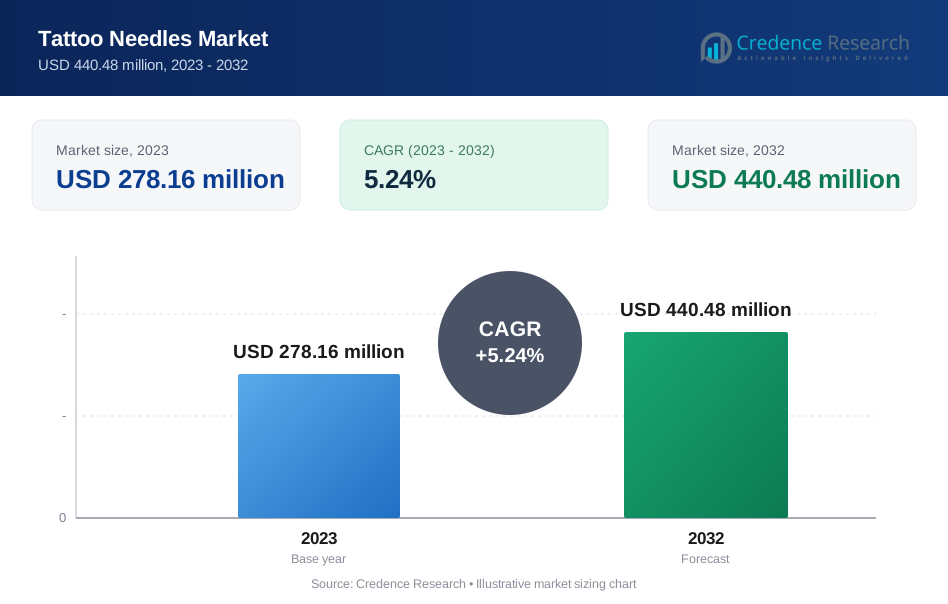
| Tattoo Needles Market Size 2023 | USD 278.16Million |
| Tattoo Needles Market, CAGR | 5.24% |
| Tattoo Needles Market Size 2032 | USD 440.48 Million |
Market Overview
The Tattoo Needles Market is projected to witness significant growth, with its value expected to surge from USD 278.16 million in 2023 to USD 440.48 million by 2032, reflecting a compound annual growth rate of 5.24%.
The Global Tattoo Needles Market is being primarily driven by the growing popularity of body art and tattoo culture, especially among younger demographics globally. Additionally, advancements in tattooing techniques and equipment, coupled with increasing disposable income levels, are fueling market expansion. Moreover, the rising acceptance of tattoos in mainstream society, coupled with the growing number of professional tattoo studios and artists, is contributing to market growth. Furthermore, the availability of a wide range of innovative tattoo needle designs and materials, aimed at enhancing precision and reducing discomfort for clients, is emerging as a prominent trend shaping the market landscape.
Geographically, the Global Tattoo Needles Market exhibits a robust presence across regions, with North America and Europe leading in market share owing to a high prevalence of tattoo culture and a large number of tattoo studios. Additionally, the Asia Pacific region is witnessing significant growth due to increasing adoption of Western tattooing trends and a rising number of tattoo parlors in countries like China and Japan. Key players dominating the market include Mithra, Cheyenne, Kwadron, Powerline and Eikon Device, among others, who continually innovate to offer high-quality, safe, and efficient tattoo needle products to meet the evolving demands of consumers worldwide.
Market Drivers
Increasing Popularity of Tattoos
The social stigma surrounding tattoos has significantly declined in recent years, leading to a growing acceptance of body art across all demographics. For instance, a recent study showed that the percentage of Americans with at least one tattoo has increased from 21% in 2012 to 30% in 2021. Technological advancements have played a pivotal role in this growth. For example, the introduction of rotary tattoo machines, which are quieter and cause less skin irritation, has made tattoos more accessible to a wider audience. Additionally, the development of new needle configurations allows for more precision and variety in tattoo designs, catering to the 47% of millennials who seek custom tattoo designs. This cultural shift has resulted in a surge in demand for tattoo services, consequently driving the market for tattoo needles. With tattoos becoming more mainstream, individuals from various age groups and backgrounds are embracing this form of self-expression, fueling the need for high-quality tattoo needles to meet the increasing demand.
Technological Advancements
Continuous advancements in technology within the tattoo industry have led to the introduction of new and improved tattoo needles. Such features are becoming increasingly popular, with a survey indicating that 73% of tattoo artists prefer using cartridge needles for their convenience and safety. The industry’s commitment to enhancing safety is also reflected in the rise of sterilized needle options, which have seen a 50% increase in demand over the past three years. This focus on hygiene and efficiency is contributing to the overall satisfaction of both artists and clients, ensuring the continuous growth of the tattoo needle market. These needles offer better precision, control, and hygiene, thereby enhancing the tattooing experience for both artists and clients. Innovations such as single-use disposable needles and needle cartridges equipped with advanced features are becoming increasingly popular, reflecting the industry's commitment to enhancing safety, efficiency, and overall satisfaction.
Rising Demand for Customization
As people seek unique and personalized tattoos, there is a growing demand for a wider variety of tattoo needles. For instance, the demand for customized tattoo needles has led to the development of over 50 different needle configurations, catering to the diverse design preferences of clients. In 2023, the most popular needle size was #12 (0.35 mm), which accounted for the highest share in the market. This trend towards personalization is not only driving innovation in needle manufacturing but also fostering creativity within the tattooing community. Tattoo artists are challenged to accommodate diverse design preferences, requiring manufacturers to develop new needle configurations and sizes. This trend towards customization not only drives the innovation of tattoo needles but also fosters creativity within the tattooing community, as artists strive to meet the individualized preferences of their clients with precision and artistry.
Expanding E-commerce Market
The rise of e-commerce platforms has revolutionized the purchasing process for tattoo needles and other supplies, making them more accessible to a wider audience of tattoo artists. This expansion of the e-commerce market has increased competition among manufacturers and suppliers, leading to price competition and greater affordability. As a result, tattoo needles have become more readily available, empowering artists with greater flexibility and convenience in sourcing their supplies to meet the demands of their clientele.
Market Trends
Shift Towards Disposable Needles
For safety reasons, disposable needles are gaining significant popularity among tattoo artists and studios. For instance, a recent study showed that the use of disposable needles in tattoo studios has increased by 25% over the past year. This surge is attributed to the fact that disposable needles reduce the risk of cross-contamination and the spread of bloodborne diseases, such as hepatitis B and C, by an estimated 70%. This trend is expected to continue due to the implementation of stricter hygiene regulations and a growing focus on infection control within the industry. With disposable needles, the risk of cross-contamination and the spread of bloodborne diseases is minimized, enhancing the safety of both artists and clients. As a result, manufacturers are increasingly focusing on producing high-quality disposable needles to meet the rising demand from the tattooing community.
Demand for Specialized Needles
As customization in tattoos becomes increasingly prevalent, the market is witnessing a rise in demand for specialized needles. Specifically, the demand for needles used in microblading has seen a significant increase, with a 20% rise in sales over the past year, as more clients opt for semi-permanent eyebrow tattoos. Moreover, a survey among professional tattoo artists revealed that 85% prefer using specialized needles for fine line work to ensure precision and detail. This has led manufacturers to expand their product lines, with some offering over 30 different needle configurations, tailored for various tattooing techniques. Tattoo artists are seeking needles tailored to specific techniques such as microblading, shading, and fine line work to achieve intricate and personalized designs for their clients. This demand for specialized needles reflects the evolving preferences of both artists and clients towards more intricate and detailed tattoo designs. Manufacturers are responding by innovating and offering a diverse range of needle configurations to cater to the varied needs of tattoo artists.
Market Challenges Analysis
Stringent Regulations
The tattoo industry operates within a complex regulatory landscape, with stringent regulations governing safety and hygiene standards. These regulations can vary significantly from one region to another, presenting a challenge for manufacturers striving to produce needles that comply with all applicable requirements. Navigating these diverse regulations requires careful attention to detail and may involve significant investment in research and development to ensure compliance with each jurisdiction's standards.
Counterfeiting and Black Market Products
The growing demand for tattoo needles has unfortunately led to an increase in counterfeiting and the circulation of black market products within the industry. These counterfeit needles are often made with inferior materials and may not undergo proper sterilization processes, posing serious health risks to both tattoo artists and their clients. The presence of counterfeit and black market products undermines consumer confidence in the safety and reliability of tattoo needles, highlighting the need for heightened vigilance and robust enforcement measures to combat this illicit trade.
Price Sensitivity
Tattoo artists and studios can be highly price-sensitive when it comes to purchasing needles, often seeking cost-effective solutions without compromising on quality. This pressure on manufacturers to keep costs low can lead to challenges in maintaining profitability while ensuring the production of high-quality, safe needles. Balancing price considerations with the need for innovation and quality control is essential for manufacturers to remain competitive in the market while meeting the evolving demands of price-conscious customers.
Market Segmentation Analysis:
By Product Type:
The Global Tattoo Needles Market is segmented by product type into Magnum, Round Liners, Round Shaders, Cartridge, and Others. Magnum needles are favored for their versatility in shading and coloring large areas, offering a smooth and consistent ink flow. Round Liners are essential for creating precise outlines and detailed work, making them indispensable for intricate designs. Round Shaders are designed for smooth shading and soft transitions, enhancing the depth and dimension of tattoos. Cartridge needles, known for their convenience and ease of use, allow quick needle changes and improved hygiene, catering to the growing demand for disposable options. The "Others" category includes specialty needles designed for specific techniques, reflecting the diverse needs of tattoo artists. The broad range of needle types underscores the industry's commitment to catering to various tattooing styles and preferences, ensuring artists have the right tools to achieve optimal results.
By Application:
The tattoo needles market is also segmented based on application into Lining and Shading or Coloring. Needles used for Lining are typically round liners, known for their ability to create sharp, clean outlines essential for defining the structure of a tattoo. These needles are critical for precision work, ensuring that the foundational lines of a tattoo are accurate and consistent. On the other hand, Shading or Coloring applications predominantly utilize Magnum and Round Shader needles. Magnum needles excel in covering large areas with solid fills and gradients, while Round Shaders provide smooth, even shading to add depth and dimension to the tattoo. This segmentation highlights the distinct roles different needles play in the tattooing process, with each type designed to meet specific artistic needs. The ability to choose the appropriate needle for lining or shading ensures that tattoo artists can achieve the desired effects, enhancing the overall quality and aesthetics of their work.
Segments:
Based on Product Type
- Magnum
- Round Liners
- Round Shaders
- Cartridge
- Others
Based on Application
- Lining
- Shading or Colouring
Based on Needle Size
- 12 (0.35 mm)
- 10 (0.30 mm)
- 8 (0.25 mm)
- 6(0.20 mm)
- Others
Based on the Geography:
- North America
- Asia-Pacific
- South America
- Europe
- Middle East and Africa
Regional Analysis
North America
The North American region, comprising the United States and Canada, holds a significant market share of approximately 28%. This region has a well-established tattoo culture, with a large number of professional tattoo artists and studios. The demand for high-quality tattoo needles is driven by the emphasis on safety, precision, and artistic expression.
Europe
The European region, including countries like Germany, Italy, and the United Kingdom, accounts for around 25% of the global market share. While tattooing has a long history in Europe, the market is influenced by varying cultural attitudes and regulatory frameworks across different nations. Nevertheless, the region's thriving tattoo industry and growing acceptance of body art contribute to the demand for tattoo needles.
Key Player Analysis
- Mithra
- Eikon Device
- DragonHawk
- Kwadron
- Barber DTS
- Powerline
- Intenze Tattoo Ink
- Electric Ink
- Tommys Tattoo Supplies
- Kuro Sumi
- Baker Street Machine
- Sabre
- FK Irons
- EZ Tattoo Supply
- Eternal Tattoo Supply
- Magic Moon
- Bullet
- Cheyenne
- Wujiang Shenling
Competitive Analysis
The Global Tattoo Needles Market is highly competitive, with several key players driving innovation and market growth. Leading companies such as Mithra, Cheyenne, Kwadron, and Eikon Device dominate the market due to their extensive product portfolios and commitment to quality. Mithra is known for its high-precision needles and strong global presence, while Cheyenne stands out for its advanced technology and ergonomic designs, catering to professional tattoo artists seeking reliable and efficient tools. Kwadron's focus on superior craftsmanship and precision has earned it a loyal customer base. Eikon Device is renowned for its research-driven approach and durable products, enhancing its competitive edge. Additionally, DragonHawk and Barber DTS contribute significantly to the market with their affordable yet high-quality offerings, appealing to a broad range of artists. These companies continually invest in R&D, product innovation, and customer service, maintaining their leadership positions in a market characterized by evolving consumer preferences and stringent safety standards.
Recent Developments
- In March 2023, Ishan Rana, a tattoo artist hailing from Vadodara, India, achieved a remarkable feat by setting a Guinness World Record. Over a period of 91 consecutive hours, Rana tattooed a total of 74 tattoos on 64 individuals. The inking marathon commenced on March 3rd and concluded on March 7th.
- In February 2023, Oleander Tattoo, a studio based in Ravenswood, Chicago, US, made an announcement regarding their expansion plans. The studio intends to hire additional artists and organize fundraisers for non-profit organizations, showcasing their commitment to growth and community engagement.
- In February 2022, Mad Rabbit, a US-based skincare brand specializing in natural and clean tattoo care, secured a fresh funding round amounting to USD 4 million. This investment will facilitate the brand's expansion in terms of retail presence and product portfolio, underscoring their ambition to cater to the evolving needs of tattoo enthusiasts.
- In January 2022, Société Bic S.A., a French manufacturer of writing instruments, acquired Inkbox Ink Inc., a Canadian brand specializing in semi-permanent and Direct-to-Consumer (DTC) body art. The acquisition, valued at USD 65 million, represents Société Bic S.A.'s strategic move to enhance its DTC capabilities in the body art category through the acquisition of Inkbox Ink Inc.
Market Concentration & Characteristics
The Global Tattoo Needles Market exhibits a moderate level of market concentration, with a mix of well-established brands and numerous smaller players. Key characteristics of the market include a strong emphasis on quality, precision, and safety due to the critical role needles play in the tattooing process. Leading companies like Mithra, Cheyenne, and Kwadron maintain their competitive edge through continuous innovation, extensive product ranges, and adherence to stringent safety standards. The market also features a high degree of specialization, with different needles tailored for specific techniques such as lining, shading, and coloring. Additionally, the market is influenced by regional regulatory variations, requiring manufacturers to ensure compliance across different markets. The presence of counterfeit products poses a challenge, driving the need for robust quality assurance and brand protection measures. Overall, the market is dynamic, driven by evolving consumer preferences, technological advancements, and a growing emphasis on health and safety.
Report Coverage
The research report offers an in-depth analysis based on Product Type, Application, Needle Size and Geography. It details leading market players, providing an overview of their business, product offerings, investments, revenue streams, and key applications. Additionally, the report includes insights into the competitive environment, SWOT analysis, current market trends, as well as the primary drivers and constraints. Furthermore, it discusses various factors that have driven market expansion in recent years. The report also explores market dynamics, regulatory scenarios, and technological advancements that are shaping the industry. It assesses the impact of external factors and global economic changes on market growth. Lastly, it provides strategic recommendations for new entrants and established companies to navigate the complexities of the market.
Future Outlook
- Continued Market Expansion: The global tattoo needles market is poised for continued growth, driven by increasing tattoo culture acceptance worldwide.
- Technological Advancements: Ongoing innovations in tattoo needle design and manufacturing processes will enhance precision, efficiency, and safety.
- Demand Diversification: Manufacturers will focus on diversifying product offerings to cater to diverse tattooing styles, preferences, and skin types.
- Emphasis on Safety and Hygiene: There will be a heightened emphasis on safety and hygiene standards to address concerns related to infection prevention and skin health.
- Regulatory Compliance: Compliance with stringent regulatory standards governing tattoo equipment and practices will remain a key focus for industry players.
- Rising Popularity of Permanent Cosmetics: The growing trend towards permanent makeup and cosmetic tattooing will drive demand for specialized needle configurations.
- Market Segmentation: The market will witness increased segmentation based on needle configuration, needle diameter, and application-specific needles for precise tattooing.
- Growing Adoption of Disposable Needles: Disposable tattoo needles will gain traction due to their convenience, sterility, and reduced risk of cross-contamination.
- Geographic Expansion: Manufacturers will explore opportunities in emerging markets and regions with evolving tattoo culture to expand their global footprint.
- Industry Collaboration: Collaboration between manufacturers, tattoo artists, and healthcare professionals will foster innovation and best practices, driving market growth and ensuring customer satisfaction.
Request a Free Sample
Fill in your details and we'll send you a free sample report.
- Sample data tables & charts
- Research methodology
Need a Custom Version of This Report?
Tailor the scope, geography, or segments to your exact requirements.
- Custom geography or segment scope
- Direct access to our analyst team
Frequently Asked Questions
What is the current size of the Global Tattoo Needles Market?
What factors are driving the growth of the Global Tattoo Needles Market?
What are the key segments within the Global Tattoo Needles Market?
What are some challenges faced by the Global Tattoo Needles Market?
Who are the major players in the Global Tattoo Needles Market?
Table of Content
Chapter 1. Report Introduction
- 1.1 Report Description & Purpose
- 1.1.1 Report Title & Market Definition
- 1.1.2 Unique Selling Propositions (USP) & Key Differentiators
- 1.1.3 Value Proposition for Stakeholders
- 1.2 Research Objectives
- 1.2.1 Market Sizing Objectives (Volume & Revenue) (Volume Where Applicable)
- 1.2.2 Segmentation Objectives
- 1.2.3 Competitive Intelligence Objectives
- 1.2.4 Forecast & Scenario Objectives
- 1.3 Report Scope
- 1.3.1 Tattoo Needles Scope – Segments & Subsegments Covered
- 1.3.2 Geographic Scope – Regions & Countries Covered
- 1.3.3 Historical Period, Base Year & Forecast Period (2023; forecast to 2032)
- 1.3.4 Inclusions & Exclusions
- 1.4 Industry Classification & Applicable Codes
- 1.5 Currency, Measurement Units & Valuation Basis
- 1.6 Target Stakeholders
- 1.7 Limitations & Assumptions
Chapter 2. Executive Summary
- 2.1 Global Tattoo Needles Market Snapshot
- 2.1.1 Market Size – Historical (2023) & Forecast (2023-2032) (2023: USD 278.16 million → 2032: USD 440.48 million)
- 2.1.2 Volume & Revenue – Global Totals (Volume Where Applicable)
- 2.1.3 Key Market Highlights – Top Five Facts
- 2.2 Tattoo Needles Market Segmentation Snapshot
- 2.2.1 Market Split by Region – 2023 vs. 2032
- 2.3 Competitive Snapshot
- 2.3.1 Top 10 Players by Revenue Share – 2023
- 2.3.2 Top 10 Players by Volume Share – 2023 (Volume Where Applicable)
- 2.3.3 Recent Strategic Developments (18-Month Summary)
- 2.4 Key Investment Highlights & Strategic Conclusions
Chapter 3. Tattoo Needles Market Dynamics & Industry Analysis
- 3.1 Market Overview & Context
- 3.1.1 Tattoo Needles Market Position in the Broader Industry Value Chain
- 3.1.2 Demand Structure & Purchasing Dynamics
- 3.1.3 Market Maturity & Development Stage by Region
- 3.2 Tattoo Needles Market Drivers
- 3.3 Tattoo Needles Market Restraints & Challenges
- 3.4 Tattoo Needles Market Opportunities
- 3.5 Porter's Five Forces Analysis
- 3.5.1 Threat of New Entrants
- 3.5.2 Bargaining Power of Suppliers
- 3.5.3 Bargaining Power of Buyers
- 3.5.4 Threat of Substitutes
- 3.5.5 Competitive Rivalry – Intensity Assessment
- 3.6 Tattoo Needles Value Chain Analysis
- 3.6.1 Upstream – Key Inputs, Resources & Suppliers
- 3.6.1.1 Key Input/Resource 1
- 3.6.1.2 Key Input/Resource 2
- 3.6.1.3 Key Input/Resource 3
- 3.6.2 Midstream – Core Operations & Value Creation
- 3.6.2.1 Operating Model & Process Overview
- 3.6.2.2 Key Operating Locations & Capabilities by Company
- 3.6.3 Downstream – Market Channels & End Users
- 3.6.3.1 Direct Sales & Customer Engagement Channels
- 3.6.3.2 Indirect Sales, Intermediaries & Partner Channels
- 3.6.4 Value Chain Profitability Analysis
- 3.6.1 Upstream – Key Inputs, Resources & Suppliers
- 3.7 PESTEL Analysis
- 3.7.1 Political Factors
- 3.7.2 Economic Factors
- 3.7.3 Social Factors
- 3.7.4 Technological Factors
- 3.7.5 Environmental Factors
- 3.7.6 Legal Factors
- 3.8 Tattoo Needles Supply Chain Analysis
- 3.8.1 Critical Input & Resource Availability Risk Assessment
- 3.8.2 Supplier & Operational Concentration Risk (Geographic Exposure)
- 3.8.3 Supply & Service Disruption Impact Analysis
- 3.9 Regulatory & Policy Landscape
Note: The regulatory and policy landscape section covers regulations based on their applicability to the market, Tattoo Needles category, geography, and scope of the study. Only regulatory frameworks with a material impact on operations, compliance, trade, sustainability, or market access are analyzed in detail.
Chapter 4. Key Investment Pockets & Opportunity Analysis
- 4.1 Tattoo Needles Market Attractiveness Analysis
- 4.1.1 By Region – Investment Attractiveness Matrix (Market Size × CAGR)
- 4.2 Absolute Revenue Growth Opportunity
- 4.2.1 By Region – Absolute Revenue Growth Through 2032
- 4.3 Incremental Demand Opportunity
- 4.3.1 By Region – Incremental Demand Through 2032
- 4.3.2 Segment – Incremental Demand
- 4.4 Emerging Submarket Opportunity Deep Dive (Subject to Applicability)
- 4.5 Priority Market Opportunity Scorecards
- 4.5.1 United States
- 4.5.2 Europe
- 4.5.3 Asia
- 4.5.4 Middle East & Africa
Note: Priority market opportunity scorecards reflect the geographic scope and strategic relevance of the study. Listed markets are indicative and may be adapted to the industry.
Chapter 5. Tattoo Needles Cross-Border Trade & Market Access Analysis
- 5.1 International Trade & Cross-Border Activity Overview
- 5.1.1 Global Export Value by Country (2023)
- 5.1.2 Global Export Volume by Country (2023) (Volume Where Applicable)
- 5.1.3 Global Import Value by Country (2023)
- 5.1.4 Global Import Volume by Country (2023) (Volume Where Applicable)
- 5.1.5 Net Trade Balance by Country (2023)
- 5.2 Export Analysis – Segment
- 5.2.1 Category 1 (Applicable Classification Code)
- 5.2.2 Category 2 (Applicable Classification Code)
- 5.2.3 Category 3 (Applicable Classification Code)
- 5.2.4 Category 4 (Applicable Classification Code)
- 5.2.5 Category 5 (Applicable Classification Code)
- 5.3 Import Analysis – Segment
- 5.3.1 Category 1 (Applicable Classification Code)
- 5.3.2 Category 2 (Applicable Classification Code)
- 5.3.3 Category 3 (Applicable Classification Code)
- 5.3.4 Category 4 (Applicable Classification Code)
- 5.3.5 Category 5 (Applicable Classification Code)
- 5.4 Cross-Border Pricing & Transaction Benchmarks
- 5.4.1 Export Pricing – Segment & Country
- 5.4.2 Import Pricing – Segment & Source Country
- 5.4.3 Price Trends (2023)
- 5.5 Key Cross-Border Trade & Delivery Routes
- 5.5.1 Cross-Border Trade/Delivery Route 1
- 5.5.2 Cross-Border Trade/Delivery Route 2
- 5.5.3 Cross-Border Trade/Delivery Route 3
- 5.5.4 Cross-Border Trade/Delivery Route 4
- 5.5.5 Cross-Border Trade/Delivery Route 5
- 5.6 Trade Policy & Market Access Impact Assessment
- 5.6.1 Tariff & Non-Tariff Barriers
- 5.6.2 Regional Trade & Economic Integration Frameworks
- 5.6.3 Bilateral & Multilateral Trade Agreements
- 5.6.4 Cross-Border Operating, Licensing & Localization Requirements
Note: This chapter applies where cross-border trade or delivery is relevant to Tattoo Needles. Goods, services, and digital offerings are assessed using applicable classifications and transaction measures. Import-export volumes, trade balances, and route analyses are included only where meaningful to the market.
Chapter 6. Competitive Landscape & Company Benchmarking
- 6.1 Tattoo Needles Market Concentration & Structure
- 6.1.1 Herfindahl-Hirschman Index (HHI) – the historical period vs. 2023
- 6.1.2 Leading, Mid-Sized & Emerging Player Structure
- 6.1.3 Global, Regional & Local Player Dynamics
- 6.2 Tattoo Needles Market Share Analysis – 2023
- 6.2.1 Global Revenue Share by Company
- 6.2.2 Global Volume Share by Company (Volume Where Applicable)
- 6.2.3 Regional Revenue Share
- 6.2.4 Market Share Evolution (the historical period vs. 2023)
- 6.2.5 Company Market Share by Key Segment
- 6.2.6 Company Market Share by Customer Group
- 6.3 Operating Scale, Capacity & Infrastructure Analysis
- 6.3.1 Global Operating Scale & Supply Capacity
- 6.3.2 Resource Utilization & Operating Efficiency
- 6.3.3 Output, Service Delivery & Activity Metrics
- 6.3.4 Operating Footprint & Infrastructure Map
- 6.3.5 Planned Operational & Capacity Expansion
- 6.4 Tattoo Needles Competitive Benchmarking Matrix
- 6.4.1 Revenue, Growth, Profitability & Operating Metric Comparison
- 6.4.2 Channel Revenue Mix
- 6.4.3 Geographic Revenue Exposure
- 6.4.4 R&D Intensity
- 6.4.5 Sustainability Maturity
- 6.5 Strategic Developments in Tattoo Needles (Last 24 Months)
- 6.5.1 Mergers, Acquisitions & Divestments
- 6.5.2 New Products, Services & Solutions in Tattoo Needles
- 6.5.3 Operational & Infrastructure Expansions
- 6.5.4 Strategic Alliances, Joint Ventures & Partnerships
- 6.5.5 Distribution Expansion & Market Entry
- 6.5.6 Sustainability & ESG Initiatives
- 6.6 Competitive Strategy Mapping
- 6.6.1 Leader, Challenger, Follower & Niche Classification
- 6.6.2 Pricing Strategy Comparison
- 6.6.3 Channel Strategy Matrix
Note: Strategic developments are included based on their materiality and the availability of reliable information.
Chapter 7. Global Tattoo Needles Market – By Sales & Delivery Channel
- 7.1 Segment Overview
- 7.1.1 Volume & Revenue Split by Channel (2023 & 2032) (Volume Where Applicable)
- 7.1.2 Channel Mix Evolution (2023-2032)
Chapter 8. Regional Market Analysis – Global Overview
- 8.1 Global Regional Overview
- 8.1.1 Regional Volume Share (Volume Where Applicable)
- 8.1.2 Regional Revenue Share
- 8.1.3 Regional Volume by Region (Volume Where Applicable)
- 8.1.4 Regional Revenue by Region
- 8.1.5 Regional Forecast Through 2032
- 8.2 Cross-Regional Segment Analysis
- 8.2.1 By Sales & Delivery Channel
- 8.2.2 By Competitive Positioning & Price Tier
Chapter 9. North America Tattoo Needles Market
- 9.1 United States
- 9.2 Canada
- 9.3 Mexico
Chapter 10. Europe Tattoo Needles Market
- 10.1 Germany
- 10.2 France
- 10.3 Italy
- 10.4 United Kingdom
- 10.5 Spain
- 10.6 Poland
- 10.7 Russia
- 10.8 Netherlands
- 10.9 Belgium
- 10.10 Sweden
- 10.11 Denmark
- 10.12 Norway
- 10.13 Rest of Europe
Chapter 11. Asia Pacific Tattoo Needles Market
- 11.1 China
- 11.2 India
- 11.3 Japan
- 11.4 South Korea
- 11.5 Thailand
- 11.6 Indonesia
- 11.7 Vietnam
- 11.8 Malaysia
- 11.9 Australia
- 11.10 Rest of Asia Pacific
Chapter 12. Latin America Tattoo Needles Market
- 12.1 Brazil
- 12.2 Argentina
- 12.3 Colombia
- 12.4 Chile
- 12.5 Rest of Latin America
Chapter 13. Middle East Tattoo Needles Market
- 13.1 Saudi Arabia
- 13.2 United Arab Emirates
- 13.3 Turkey
- 13.4 Israel
- 13.5 Iran
- 13.6 Rest of the Middle East
Chapter 14. Africa Tattoo Needles Market
- 14.1 South Africa
- 14.2 Egypt
- 14.3 Nigeria
- 14.4 Morocco
- 14.5 Rest of Africa
Chapter 15. Tattoo Needles Company Profiles
- 15.1 [Company 01]
- 15.1.1 Company Overview
- 15.1.2 Key Management Personnel
- 15.1.3 Products & Services Portfolio
- 15.1.4 Financial Performance
- 15.1.5 Key Market Focus & Geographic Presence
- 15.1.6 Recent Developments & Strategic Initiatives
Note: The company profile list is preliminary and may change based on research findings, market developments, data availability, and client requirements.
Chapter 16. Appendices
- Appendix A – List of Abbreviations & Acronyms
- Appendix B – Industry Classification Code Reference – Full Series
- Appendix C – Supply, Output & Operating Capacity Data Tables
- Appendix D – End-Use & Demand Base Tables
- Appendix E – Demand, Adoption & Usage Assumptions
- Appendix F – Pricing & Revenue Metric Reference Tables
- Appendix G – Company Operations & Infrastructure Database
- Appendix H – Cross-Border Trade & Activity Data Tables (Where Applicable)
- Appendix I – Regulatory Summary Tables
- Appendix J – Primary Research Participant List (Anonymized)
- Appendix K – Primary Research Questionnaire Framework
- Appendix L – Data Sources & Bibliography
- Appendix M – Market Size Divergence & Source Comparison
Chapter 17. Research Methodology
- 17.1 Research Framework & Philosophy
- 17.2 Secondary Research – Sources, Hierarchy & Data Extraction
- 17.3 Data Modeling – Bottom-Up & Top-Down Market Sizing
- 17.4 Primary Research – Stakeholder Framework, LOI & Sample Sizes
- 17.5 Forecast Methodology – Regression, Scenario & Sensitivity Analysis
- 17.6 Quality Control – Four-Layer Validation Framework
- 17.7 Limitations & Standard Assumptions
- 17.8 Disclaimer
