
| REPORT ATTRIBUTE | DETAILS |
|---|---|
| Historical Period | 2020-2023 |
| Base Year | 2024 |
| Forecast Period | 2025-2032 |
| Triflic Acid Market Size 2024 | USD 104.6 Million |
| Triflic Acid Market, CAGR | 5.70% |
| Triflic Acid Market Size 2032 | USD 163.0 Million |
Market Overview:
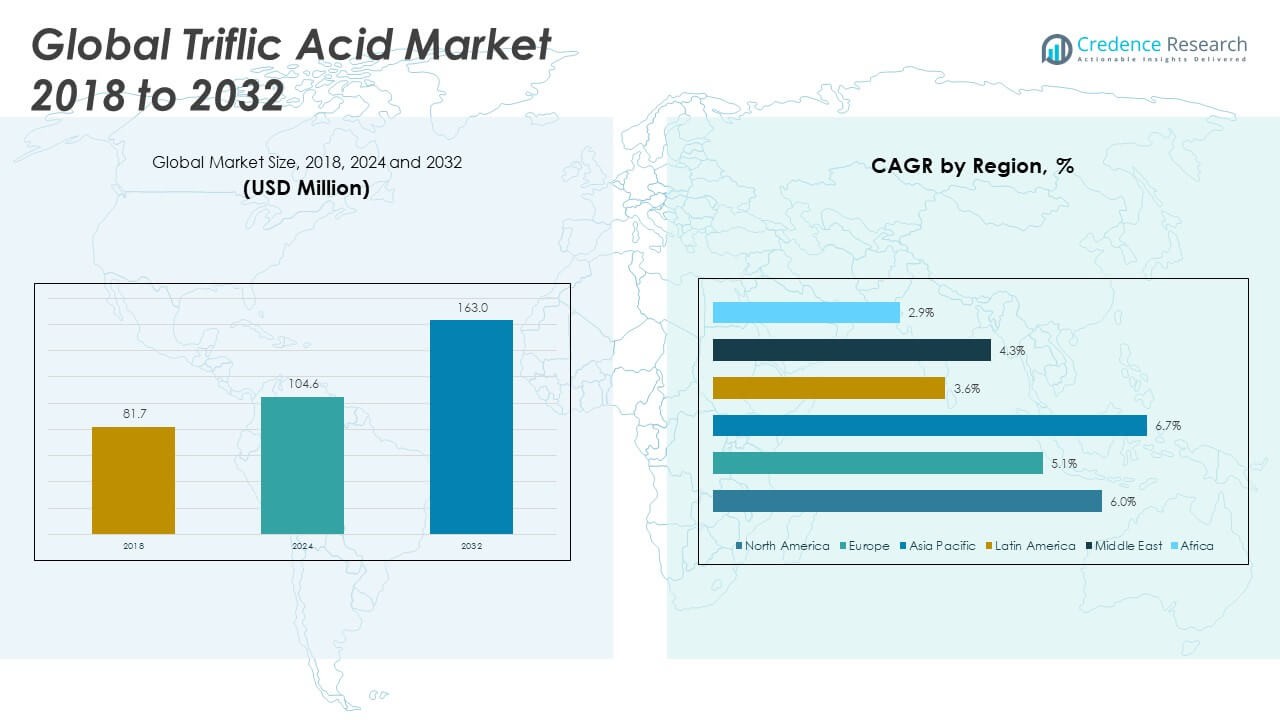
The Triflic Acid Market size was valued at USD 81.7 million in 2018 to USD 104.6 million in 2024 and is anticipated to reach USD 163.0 million by 2032, at a CAGR of 5.70% during the forecast period.
The Triflic Acid market is witnessing growth driven by its increasing adoption in the pharmaceutical and specialty chemicals industries. It serves as a powerful acid catalyst in the synthesis of complex molecules, enabling high reaction efficiency and selectivity. The rising demand for high-purity materials in electronics, particularly in semiconductor and battery applications, further supports market expansion. Additionally, the shift toward sustainable and green chemistry practices has amplified interest in triflic acid due to its non-oxidizing nature and thermal stability, which align with low-waste and energy-efficient production processes. Advancements in manufacturing processes have improved production yields and reduced costs, enhancing its commercial viability across sectors.
North America holds a significant share of the Triflic Acid market, driven by a strong presence of pharmaceutical companies and robust investment in chemical R&D. Europe follows closely, supported by advanced chemical manufacturing infrastructure and stringent environmental regulations encouraging the use of high-performance reagents. Asia-Pacific is the fastest-growing region, fueled by rapid industrialization in China, India, and South Korea, where demand for triflic acid is rising across electronics, pharmaceuticals, and chemical production. Latin America and the Middle East & Africa remain emerging markets, with gradual growth tied to expanding industrial capabilities and increased focus on sustainable production technologies. Strategic collaborations between local manufacturers and global chemical companies are enhancing regional supply chains. Moreover, government support for high-tech industries in Asia-Pacific is expected to solidify the region’s leadership in the coming years.
Market Insights:
- The Triflic Acid Market was valued at USD 104.6 million in 2024 and is projected to reach USD 163.0 million by 2032, growing at a CAGR of 5.70%.
- Strong demand from the pharmaceutical and specialty chemical industries is driving market growth due to triflic acid’s role as a powerful, non-oxidizing acid catalyst.
- The electronics sector, particularly in semiconductors and battery technologies, is fueling demand for high-purity triflic acid in etching and advanced material synthesis.
- The market is benefiting from the shift toward sustainable and green chemistry practices, with triflic acid supporting low-waste, energy-efficient production processes.
- Innovations in manufacturing, including flow chemistry and optimized purification, are improving yield, reducing cost, and expanding global supply capabilities.
- High production costs and stringent safety handling requirements limit broader adoption, especially among small and mid-sized enterprises.
- Asia-Pacific is the fastest-growing region, while North America and Europe remain mature markets supported by pharmaceutical demand and chemical R&D investments.
Market Drivers:
Rising Demand for High-Performance Acid Catalysts in Pharmaceuticals and Specialty Chemicals
The pharmaceutical and specialty chemical industries are primary drivers for the Triflic Acid Market. Triflic acid is used as a strong, non-oxidizing acid catalyst that enables efficient and selective transformations in drug synthesis and fine chemical production. It supports reactions under mild conditions while delivering high yields and product purity. The increase in complex drug formulations and advanced synthesis routes has amplified the need for such high-performance catalysts. Triflic acid is particularly valuable in processes where conventional acids fail to provide the desired selectivity or stability. The Triflic Acid Market benefits from ongoing innovation in active pharmaceutical ingredients (APIs), where it plays a critical role in streamlining reaction mechanisms.
Expansion of the Electronics Sector and Growing Need for Ultra-Pure Chemical Agents
The electronics industry is increasingly driving the growth of the Triflic Acid Market. It is widely used in microelectronics for etching, doping, and as a reagent in the synthesis of specialty fluorinated compounds. These applications require ultra-pure and stable acids that do not introduce impurities or cause material degradation. The rise in semiconductor manufacturing and the global demand for high-performance electronic components fuel this demand. Triflic acid meets the stringent purity and performance criteria required in the production of advanced electronic materials. Its integration into electronics-grade processes positions it as a strategic input for high-tech applications.
Adoption of Sustainable Chemistry and Environmentally Stable Reagents
The global shift toward sustainable industrial practices is pushing manufacturers to adopt safer, more efficient chemical agents. Triflic acid, with its thermal stability and low volatility, aligns with these objectives. It is preferred for processes that minimize hazardous waste generation and energy consumption. Regulatory bodies and environmental standards are influencing industries to reduce their ecological footprint, and this is prompting the adoption of cleaner chemical alternatives. The Triflic Acid Market is benefiting from this transition, especially in sectors seeking to improve their environmental compliance without compromising on process efficiency. It supports the development of greener production routes in both large-scale and niche applications.
- For example, BASF SE emphasizes its commitment to sustainable chemistry in its 2023 sustainability initiatives, highlighting the development and application of advanced catalytic processes aimed at reducing hazardous waste and improving energy efficiency in chemical manufacturing.
Advancements in Manufacturing Processes and Global Supply Chain Optimization
Recent advancements in synthesis and purification techniques have improved the cost-efficiency and scalability of triflic acid production. Manufacturers are implementing continuous flow processes and optimized reaction conditions to enhance throughput and product consistency. This progress enables broader adoption of triflic acid, even in cost-sensitive applications. The Triflic Acid Market is also supported by the expansion of global distribution networks and strategic partnerships between suppliers and end-use industries. It allows reliable access to high-purity triflic acid across multiple regions. These developments ensure stable supply, meet growing demand, and contribute to long-term market growth.
- For instance, in July 2023, Global Fluorine Chemical Factory (GFCF) announced the launch of a new production facility in Abu Dhabi’s KEZAD zone, tripling its overall capacity for fluorine-based chemicals. The facility incorporates continuous flow production and advanced purification systems to enhance scalability and ensure consistent product quality.
Market Trends:
Growing Integration of Triflic Acid in Sustainable and Green Synthesis Processes
Industries are actively seeking alternatives to hazardous and energy-intensive chemical processes, leading to the integration of triflic acid in green synthesis routes. Its strong acidity, thermal stability, and non-oxidizing nature make it suitable for sustainable manufacturing applications. It supports reactions under mild conditions, helping reduce energy usage and waste generation. In the pharmaceutical and agrochemical sectors, triflic acid enables selective transformations without producing corrosive by-products. The Triflic Acid Market reflects this shift, with companies promoting it as a cleaner catalyst aligned with environmental regulations. Demand is increasing in response to stricter emissions controls and a global push for greener chemical technologies.
Rising Use of Triflic Acid in Semiconductor and Electronics Manufacturing
The electronics industry continues to adopt triflic acid for high-purity processing applications. It plays a role in etching, surface treatment, and doping steps where impurity control is critical. The growing production of microchips, printed circuit boards, and specialty electronics is increasing the demand for ultrapure reagents. The Triflic Acid Market is gaining momentum as electronics manufacturers look for reliable materials that maintain performance and consistency. Companies are scaling up their use of high-performance acids that meet international quality and safety standards. Triflic acid’s compatibility with sensitive processes and materials positions it as a key input in this sector.
- For instance, Sigma-Aldrich offers trifluoromethanesulfonic acid-d with 98 atom % isotopic purity for mass spectrometry and high-throughput screening, supporting advanced analytical and semiconductor applications
Expansion of Research and Development Activities Across Multiple End-Use Industries
Increased R&D investments across pharmaceuticals, polymers, and specialty chemicals are accelerating the application scope of triflic acid. Researchers are leveraging its catalytic properties to explore new reaction mechanisms and synthesis pathways. It is gaining attention for its role in fluorination reactions and functional group conversions, which are critical for the development of advanced materials and drugs. The Triflic Acid Market is supported by academic collaborations and private sector funding aimed at innovation and formulation design. It continues to emerge as a versatile tool in modern chemistry labs. The trend reflects a broader movement toward precision chemistry and process optimization.
- For example, Sagar Life Sciences has established a dedicated R&D division equipped with gram-level research laboratories and pilot plant facilities capable of producing quantities ranging from 1 to 10 kilograms. The company focuses on process optimization and custom synthesis, supporting both small-scale and pilot-scale production.
Shifting Focus Toward High-Purity Grades and Custom Formulations
Demand for high-purity and application-specific variants of triflic acid is increasing across industrial segments. Manufacturers are responding by offering customized grades that align with distinct quality specifications and handling requirements. The shift is particularly evident in electronics and life sciences, where product purity directly influences final performance. The Triflic Acid Market is evolving toward more refined and targeted offerings, catering to niche but high-value applications. It promotes greater efficiency and reliability in end-user operations. This trend is reshaping supplier strategies and encouraging further innovation in product formulation and distribution.
Market Challenges Analysis:
High Production Costs and Handling Complexity Limit Broader Adoption
The Triflic Acid Market faces challenges due to the high cost of production and complex handling requirements. Manufacturing triflic acid involves the use of fluorinated raw materials and specialized synthesis processes, which significantly raise production expenses. It demands strict environmental and safety controls due to its corrosive and reactive nature, increasing operational overhead for end users. These factors restrict its usage to high-value applications where cost is justified by performance. Small and mid-sized enterprises often hesitate to adopt it due to the investment needed for safe storage, transportation, and usage. This cost and compliance burden narrows its accessibility, slowing wider market penetration.
Stringent Regulatory and Environmental Compliance Constraints
Triflic acid is classified as a hazardous chemical, and its use is tightly regulated by occupational safety and environmental protection bodies across major regions. Industries must meet stringent guidelines for handling, disposal, and worker safety, which adds complexity to its adoption. The Triflic Acid Market must navigate these regulations while maintaining supply chain reliability and product purity. Regulatory shifts or tightened restrictions can disrupt availability or require reformulation of existing processes. It creates uncertainty for manufacturers and users who rely on consistent access. Compliance demands continue to shape production, distribution, and end-user decisions, posing a significant barrier to unregulated expansion.
Market Opportunities:
Emerging Applications in Advanced Materials and Battery Technologies
The growing focus on next-generation materials and energy storage technologies presents strong opportunities for the Triflic Acid Market. Triflic acid plays a critical role in the synthesis of fluorinated compounds used in specialty polymers and advanced battery electrolytes. Its stability and high acidity enable precision in chemical modification, making it valuable in the development of solid-state batteries and lithium-based systems. It can support cleaner, more efficient production of high-performance materials in electronics and energy sectors. The market stands to benefit from increasing investments in electric mobility and renewable energy infrastructure. It aligns with the demand for specialized chemicals that improve energy density, thermal stability, and cycle life in modern batteries.
Increased Demand from Emerging Economies and Regional Manufacturing Growth
Expanding chemical and pharmaceutical manufacturing capabilities in emerging economies offer new growth avenues for the Triflic Acid Market. Countries such as China, India, and Brazil are increasing domestic production of active pharmaceutical ingredients and specialty intermediates. This growth creates a need for efficient, high-purity acid catalysts like triflic acid. It allows regional manufacturers to improve synthesis efficiency and meet global quality standards. Favorable government policies supporting local production and reduced reliance on imports can boost adoption. The market is positioned to benefit from strategic collaborations and regional supply chain development in fast-industrializing countries.
Market Segmentation Analysis:
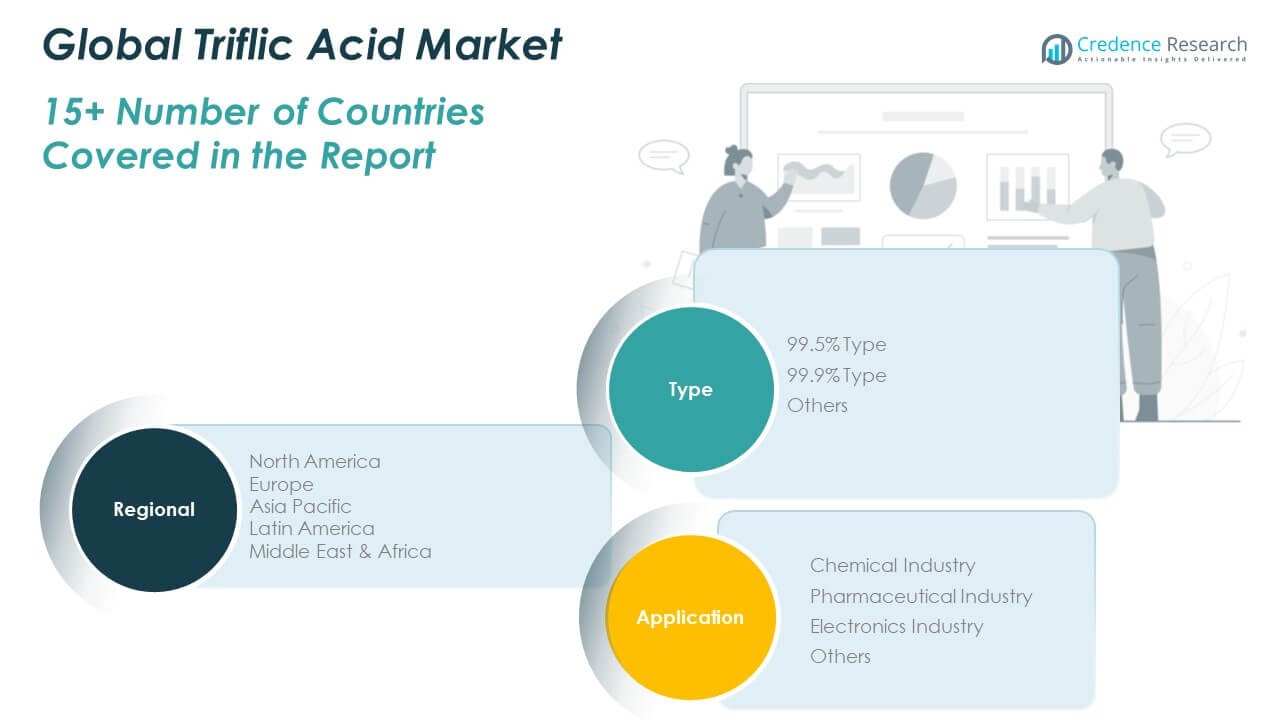
By type, the Triflic Acid Market is segmented into the chemical industry, pharmaceutical The Triflic Acid Market is segmented by type into 99.5% type, 99.9% type, and others. The 99.5% type holds a significant share due to its widespread use in general industrial processes where ultra-high purity is not critical. It is favored in cost-sensitive applications across chemical synthesis and material processing. The 99.9% type dominates high-performance segments that demand exceptional purity, such as pharmaceuticals, semiconductors, and fine chemical production. Its high reactivity and low contamination levels make it essential for controlled and selective transformations. The “others” category includes customized or intermediate grades used in experimental or pilot-scale applications.
- For example, Sigma‑Aldrich (MilliporeSigma) sells its ReagentPlus® triflic acid at ≥99% purity (often used in pharmaceutical and electronics labs)
By application, the Triflic Acid Market is segmented into the chemical industry, pharmaceutical industry, electronics industry, and others. The chemical industry leads in volume consumption due to triflic acid’s role as a strong acid catalyst in various reactions. The pharmaceutical industry contributes significantly in value, leveraging its selectivity and compatibility with sensitive active ingredients. The electronics industry continues to grow, using triflic acid in etching and material modification processes where purity is essential. The “others” segment includes niche applications such as academic research and advanced material development.
- For instance, Solvay’s industrial-scale triflic acid product is explicitly marketed for electronic applications such as liquid crystal and battery production. Additionally, distributors like Wego Chemical Group list electronics among end-use markets for its triflic acid portfolio, confirming the chemical’s relevance in semiconductor and battery supply chains.
Segmentation:
By Type
- 5% Type
- 9% Type
- Others
By Application
- Chemical Industry
- Pharmaceutical Industry
- Electronics Industry
- Others
By Region
- North America
- U.S.
- Canada
- Mexico
- Europe
- UK
- France
- Germany
- Italy
- Spain
- Russia
- Rest of Europe
- Asia Pacific
- China
- Japan
- South Korea
- India
- Australia
- Southeast Asia
- Rest of Asia Pacific
- Latin America
- Brazil
- Argentina
- Rest of Latin America
- Middle East
- GCC Countries
- Israel
- Turkey
- Rest of Middle East
- Africa
- South Africa
- Egypt
- Rest of Africa
Regional Analysis:
The North America Triflic Acid Market size was valued at USD 19.4 million in 2018 to USD 23.5 million in 2024 and is anticipated to reach USD 34.2 million by 2032, at a CAGR of 6.0% during the forecast period. North America holds a notable 21% share of the global Triflic Acid Market, driven by its robust pharmaceutical and specialty chemicals industries. The presence of leading R&D facilities and established regulatory compliance standards enhances the adoption of high-purity catalysts. It is extensively used across drug synthesis, electronics, and laboratory applications in the United States and Canada. Demand continues to grow due to increased investment in sustainable chemical processes and advanced materials. Regional manufacturers benefit from a well-developed supply chain and access to advanced infrastructure. The market remains stable, supported by consistent demand from healthcare and high-tech sectors.
The Europe Triflic Acid Market size was valued at USD 22.5 million in 2018 to USD 27.4 million in 2024 and is anticipated to reach USD 39.9 million by 2032, at a CAGR of 5.1% during the forecast period. Europe commands approximately 25% of the global Triflic Acid Market, backed by a mature chemical manufacturing base and strong environmental policies. The region relies on triflic acid in pharmaceutical innovation, high-value specialty chemicals, and regulated laboratory applications. It maintains strict guidelines for chemical usage and waste management, which aligns with the controlled use of triflic acid. Germany, France, and the UK are key contributors, supporting market growth through industrial-scale adoption. European manufacturers focus on eco-efficient synthesis, which further increases the relevance of triflic acid. It continues to play a vital role in developing sustainable industrial chemistry.
The Asia Pacific Triflic Acid Market size was valued at USD 28.8 million in 2018 to USD 39.3 million in 2024 and is anticipated to reach USD 67.6 million by 2032, at a CAGR of 6.7% during the forecast period. Asia Pacific holds the largest share of the Triflic Acid Market at 39%, supported by rapid industrialization and expansion in electronics and pharmaceutical sectors. China, India, South Korea, and Japan are leading consumers, utilizing triflic acid in semiconductor manufacturing, API production, and chemical synthesis. The region’s low-cost manufacturing base and supportive government policies are encouraging adoption. It benefits from increasing domestic production capacity and international partnerships. With rising demand for high-purity reagents, manufacturers in Asia Pacific are scaling up capabilities. The market continues to grow rapidly, establishing the region as the global growth engine.
The Latin America Triflic Acid Market size was valued at USD 3.5 million in 2018 to USD 4.8 million in 2024 and is anticipated to reach USD 8.0 million by 2032, at a CAGR of 3.6% during the forecast period. Latin America accounts for roughly 5% of the Triflic Acid Market and shows steady demand driven by pharmaceutical and agrochemical industries. Brazil and Mexico are key markets, focusing on expanding chemical manufacturing and API production. It is gradually adopted in industrial applications that require selective and efficient acid catalysis. Limited local production poses a challenge, but regional players are exploring imports and joint ventures. The market shows potential for growth as industrialization progresses. Increasing regulatory alignment with global standards may support wider usage in the coming years.
The Middle East Triflic Acid Market size was valued at USD 5.1 million in 2018 to USD 6.7 million in 2024 and is anticipated to reach USD 11.1 million by 2032, at a CAGR of 4.3% during the forecast period. The Middle East holds a 7% share of the Triflic Acid Market, with demand stemming from the region’s developing pharmaceutical and petrochemical sectors. The United Arab Emirates and Saudi Arabia are emerging hubs for specialty chemicals and industrial R&D. It supports clean synthesis processes that align with the region’s goals for diversification and green manufacturing. Growing interest in advanced electronics and energy storage materials contributes to demand. Regional players are exploring technology transfers and international supply agreements. The market is building momentum, supported by national industrial strategies.
The Africa Triflic Acid Market size was valued at USD 2.4 million in 2018 to USD 2.8 million in 2024 and is anticipated to reach USD 2.1 million by 2032, at a CAGR of 2.9% during the forecast period. Africa represents the smallest share in the Triflic Acid Market, at less than 3%, with usage concentrated in academic research and select pharmaceutical activities. Countries such as South Africa, Nigeria, and Egypt are gradually adopting advanced chemical inputs to modernize local industries. It faces limitations in terms of infrastructure, supply chain access, and skilled workforce. Despite these challenges, academic and government initiatives to develop chemical research may increase awareness and adoption. The market remains in an early stage, with potential for long-term growth as industrial capacity expands. Efforts to enhance regional manufacturing and education in applied sciences may support future development.
Key Player Analysis:
- Merck KGaA
- SynQuest Laboratories, Inc.
- TCI Chemicals
- Alfa Aesar (Thermo Fisher Scientific)
- Sigma-Aldrich (Merck Group)
- ABCR GmbH
- Tokyo Chemical Industry Co., Ltd.
- Oakwood Chemical
- Ark Pharm, Inc.
- Matrix Scientific
- BASF SE
- Solvay SA
- Zhejiang Haili Chemical Co., Ltd.
- Daejung Chemicals & Metals Co., Ltd.
Competitive Analysis:
The Triflic Acid Market features a concentrated competitive landscape with a few key global players dominating production and distribution. Companies such as Central Glass Co., Ltd., Solvay S.A., Merck KGaA, and TCI Chemicals play a significant role in supplying high-purity triflic acid for critical applications. It remains capital-intensive due to the complexity of synthesis and stringent purity standards, limiting new entrants. Established players invest in R&D to develop advanced grades and ensure regulatory compliance across diverse end-use sectors. Strategic partnerships, capacity expansions, and geographic diversification are common strategies to maintain market presence. The Triflic Acid Market is shaped by performance consistency, technical support, and reliable delivery, giving established suppliers a competitive edge. It continues to evolve with growing demand from pharmaceuticals, electronics, and specialty chemicals, prompting manufacturers to refine production technologies and enhance supply chain resilience. Competitive dynamics are expected to intensify with rising demand for customized and sustainable chemical solutions.
Recent Developments:
- In April 2025, Merck KGaA announced a significant acquisition, entering into a definitive agreement to acquire SpringWorks Therapeutics, Inc., a U.S.-based biopharmaceutical company specializing in treatments for severe rare diseases and cancer. The deal, valued at approximately $3.9 billion, is designed to sharpen Merck’s focus on rare tumors, accelerate growth, and strengthen its presence in the U.S. healthcare market.
- In January 2025, Merck KGaA also launched the beta version of M-Trust™, a first-to-market cyber-physical trust platform. This platform enables the creation of digital twins for enhanced product quality and authenticity, aiming to address challenges related to product safety, traceability, and counterfeiting. The launch took place at CES 2025, with the platform immediately available for B2B users globally, reflecting Merck’s commitment to digital innovation in the chemical and life sciences industries.
- In July 2023, the Khalifa Economic Zones Abu Dhabi (KEZAD Group), the UAE’s largest operator of integrated and purpose-built economic zones, announced a significant partnership with Global Fluorine Chemical Factory LLC (GFCF). The agreement enables GFCF to establish phase two of its operations in KEZAD Mussafah, which will allow the company to triple its production capacity.
Market Concentration & Characteristics:
The Triflic Acid Market exhibits a high degree of concentration, with a limited number of specialized manufacturers controlling a majority of global supply. It is characterized by high entry barriers due to complex production processes, stringent safety regulations, and the need for advanced purification technologies. The market emphasizes product quality, consistency, and compliance with international standards, making supplier reliability critical. It serves niche but high-value sectors such as pharmaceuticals, electronics, and specialty chemicals, where demand for ultrapure acid catalysts is strong. Long-term contracts and technical expertise often define supplier-client relationships. It remains innovation-driven, with a focus on developing customized formulations and sustainable production methods.
Report Coverage:
The research report offers an in-depth analysis based on type and application. It details leading market players, providing an overview of their business, product offerings, investments, revenue streams, and key applications. Additionally, the report includes insights into the competitive environment, SWOT analysis, current market trends, as well as the primary drivers and constraints. Furthermore, it discusses various factors that have driven market expansion in recent years. The report also explores market dynamics, regulatory scenarios, and technological advancements that are shaping the industry. It assesses the impact of external factors and global economic changes on market growth. Lastly, it provides strategic recommendations for new entrants and established companies to navigate the complexities of the market.
Future Outlook:
- Demand for triflic acid will rise with increased pharmaceutical R&D focused on complex molecule synthesis.
- Growth in the semiconductor industry will drive adoption of high-purity acid for microfabrication processes.
- Expansion of electric vehicle production will boost use in battery electrolyte development.
- Sustainable chemistry initiatives will support wider use of triflic acid in green synthesis pathways.
- Emerging economies will increase consumption due to industrialization and domestic API manufacturing.
- Technological advances in production will improve yield, reduce cost, and enhance scalability.
- Custom-grade formulations will gain traction in specialty applications requiring precise performance.
- Strategic partnerships between global suppliers and regional distributors will strengthen market access.
- Regulatory compliance and environmental safety will shape innovation in handling and waste management.
- Digitalization in chemical manufacturing will improve traceability and process control in triflic acid applications.

Request a Free Sample
Fill in your details and we'll send you a free sample report.
- Sample data tables & charts
- Research methodology
Market Dynamics
Rising Demand for High-Performance Acid Catalysts in Pharmaceuticals and Specialty Chemicals
Triflic acid is increasingly used as a powerful, non-oxidizing acid catalyst in pharmaceutical and specialty chemical synthesis, enabling efficient and selective transformations for complex drug molecules and fine chemicals. The need for high yields and product purity in these industries is driving adoption.
Expansion of the Electronics Sector and Need for Ultra-Pure Chemical Agents
The growth of the semiconductor and electronics industries is fueling demand for high-purity triflic acid, which is essential for etching, doping, and advanced material synthesis. Its ability to meet stringent purity requirements makes it a critical input for microelectronics and battery manufacturing.
Adoption of Sustainable Chemistry and Environmentally Stable Reagents
With a global shift toward greener and more sustainable industrial practices, triflic acid is favored for its thermal stability, low volatility, and ability to support low-waste, energy-efficient production processes. Regulatory and environmental pressures are accelerating its use as a cleaner alternative to traditional acids.
Advancements in Manufacturing Processes and Global Supply Chain Optimization
Innovations such as continuous flow chemistry and improved purification techniques have enhanced the scalability and cost-efficiency of triflic acid production. These advancements are making high-purity triflic acid more accessible and supporting its broader adoption across industries.
Emerging Applications in Advanced Materials and Battery Technologies
Triflic acid is finding new roles in the synthesis of specialty polymers and advanced battery electrolytes, particularly for solid-state and lithium-based batteries. The push for electric vehicles and renewable energy storage is creating additional demand for this high-performance reagent.
Need a Custom Version of This Report?
Tailor the scope, geography, or segments to your exact requirements.
- Custom geography or segment scope
- Direct access to our analyst team
Frequently Asked Questions
What is the current size of the Triflic Acid Market?
What factors are driving the growth of the Triflic Acid Market?
What are the key segments within the Triflic Acid Market?
What are some challenges faced by the Triflic Acid Market?
Who are the major players in the Triflic Acid Market?
Table of Content
Chapter 1 Market Segmentation
- 1.1 Segmentation Framework
- 1.1.1 Product and Service Classification
- 1.1.2 Application and End-Use Classification
- 1.1.3 Technology and Solution Classification
- 1.1.4 Customer and Distribution Channel Classification
- 1.1.5 Geographic Segmentation
- 1.1.6 Market Segment Definitions and Boundaries
- 1.2 By Type
- 1.2.1 99.5% Type
- 1.2.2 99.9% Type
- 1.2.3 Others
- 1.3 By Application
- 1.3.1 Chemical Industry
- 1.3.2 Pharmaceutical Industry
- 1.3.3 Electronics Industry
- 1.3.4 Others
Chapter 2 Introduction
- 2.1 Report Objectives and Scope
- 2.2 Product Definition and Industry Terminology
- 2.3 Market Inclusions and Exclusions
- 2.4 Research Process
- 2.4.1 Primary Research and Expert Interviews
- 2.4.2 Secondary Research and Source Review
- 2.4.3 Top-Down and Bottom-Up Estimation
- 2.4.4 Data Triangulation and Verification
- 2.5 Market Size Measurement Basis
- 2.5.1 2024: USD 104.6 million → 2032: USD 163.0 million
- 2.6 Historical and Forecast Reference Periods
- 2.6.1 Base Year: 2024
- 2.6.2 Forecast Period: 2024-2032
- 2.7 Research Assumptions and Limitations
Chapter 3 Executive Summary
- 3.1 Market Snapshot and Key Findings
- 3.2 Base-Year Market Size, 2024
- 3.3 Forecast Market Size, 2032
- 3.4 Revenue and Volume Growth Outlook
- 3.5 Key Demand and Supply Indicators
- 3.6 Leading Market Segments
- 3.7 Fastest-Growing Market Opportunities
- 3.8 Regional Performance Highlights
- 3.9 Technology and Industry Transformation
- 3.10 Competitive Landscape Summary
- 3.11 Analyst View and Strategic Implications
Chapter 4 Global Triflic Acid Market Trends and Developments
- 4.1 Historical Industry Development
- 4.2 Recent Market Trends and Developments
- 4.3 Demand and Customer Behavior Trends
- 4.4 Technology and Product Innovation
- 4.5 Artificial Intelligence, Automation and Digitalization
- 4.6 Local Manufacturing and Supply Chain Realignment
- 4.7 Industry Partnerships, Mergers and Acquisitions
- 4.8 Sustainability and Circular Economy Developments
- 4.9 Government and Private Sector Investment Trends
- 4.10 Emerging Business Models and Commercialization
- 4.11 Industry Developments and Announcements
Chapter 5 Global Triflic Acid Market Production, Supply and Demand Analysis
- 5.1 Demand Trend and Consumption Analysis
- 5.2 Demand Forecast, 2024-2032
- 5.3 Production and Output Trend
- 5.4 Production and Output Forecast, 2024-2032
- 5.5 Installed Capacity and Capacity Utilization
- 5.6 Company-Wise Production Plants and Statistics
- 5.6.1 Installed Production Capacity
- 5.6.2 Actual Production
- 5.6.3 Planned Capacity and Expansion Targets
- 5.7 Supply Chain Structure and Procurement Trends
- 5.8 Supply-Demand Gap and Bottlenecks
- 5.9 Import Dependence and Sourcing Structure
- 5.10 Contract Manufacturing and Outsourcing
- 5.11 Regional Supply and Demand Concentration
Chapter 6 Global Triflic Acid Market Pricing Analysis
- 6.1 Pricing Structure and Measurement
- 6.2 Historical Pricing Trends
- 6.3 Pricing Outlook, 2024-2032
- 6.4 Average Selling Price and Unit Economics
- 6.5 Pricing by Product and Market Segment
- 6.6 Geographic Pricing Differences
- 6.7 Key Input, Energy, Labor and Logistics Costs
- 6.8 Contract Pricing and Purchasing Models
- 6.9 Pricing Sensitivity and Competitive Positioning
- 6.10 Price, Margin and Profitability Implications
Chapter 7 Global Triflic Acid Market Dynamics
- 7.1 Market Growth Drivers
- 7.1.1 Demand-Side Drivers
- 7.1.2 Technology and Innovation Drivers
- 7.1.3 Infrastructure and Investment Drivers
- 7.1.4 Regulatory and Policy Drivers
- 7.2 Market Restraints
- 7.2.1 Cost and Affordability Constraints
- 7.2.2 Technology and Adoption Barriers
- 7.2.3 Supply Chain and Operational Constraints
- 7.3 Market Challenges
- 7.3.1 Competitive Pressure and Margin Erosion
- 7.3.2 Skills, Infrastructure and Implementation Gaps
- 7.4 Emerging Market Opportunities
- 7.5 Market Dynamics Impact and Time-Horizon Assessment
Chapter 8 Global Triflic Acid Value Chain Analysis
- 8.1 Industry Value Chain Overview
- 8.2 Upstream Suppliers and Critical Inputs
- 8.3 Technology and Component Providers
- 8.4 Manufacturing or Service Delivery
- 8.5 Distribution, Channel Partners and Integrators
- 8.6 Downstream Applications and End Users
- 8.7 Value Addition and Profit Pools
- 8.8 Vertical Integration and Outsourcing
- 8.9 Supplier Concentration and Risk
- 8.10 Supply Chain Localization and Resilience
Chapter 9 Global Triflic Acid Market Regulations and Policies
- 9.1 Relevant Laws, Standards and Compliance Frameworks
- 9.2 Product, Service, Safety and Quality Requirements
- 9.3 Government Policies, Incentives and Subsidies
- 9.4 Imports, Exports and Trade Barriers
- 9.5 Public Procurement and Local Content Requirements
- 9.6 Environmental and Sustainability Compliance
- 9.7 Upcoming Policy Changes and Market Implications
Chapter 10 Global Triflic Acid Market Hotspots and Opportunities
- 10.1 Market Opportunity Mapping and Growth Hotspots
- 10.2 High-Growth Applications and Customer Groups
- 10.3 Underserved Markets and White-Space Opportunities
- 10.4 Emerging Technology and Product Opportunities
- 10.5 New Capacity and Investment Hotspots
- 10.6 Market Entry and Expansion Opportunities
- 10.7 Distribution and Partnership Opportunities
- 10.8 Near-Term and Long-Term Commercial Potential
- 10.9 Opportunity Attractiveness and Execution Risks
Chapter 11 Global Triflic Acid Market Outlook, 2024-2032
- 11.1 Market Size and Analysis
- 11.1.1 Revenue (Market Measurement: 2024: USD 104.6 million → 2032: USD 163.0 million)
- 11.1.2 Market Volume and Quantity Sold
- 11.1.3 Historical Market Size
- 11.1.4 Base-Year Market Size, 2024
- 11.2 Market Forecast, 2024-2032
- 11.2.1 Revenue Forecast to 2032
- 11.2.2 Volume Forecast to 2032
- 11.2.3 CAGR and Year-on-Year Growth
- 11.2.4 Incremental Revenue Opportunity
- 11.3 Forecast Assumptions and Scenario Analysis
- 11.3.1 Base-Case Forecast
- 11.3.2 Optimistic and Conservative Scenarios
- 11.3.3 Technology, Pricing and Policy Sensitivities
- 11.4 Market Attractiveness and Growth Outlook
Chapter 12 Global Triflic Acid Market Segmentation and Outlook
- 12.1 Segmentation Summary and Market Shares, 2024
- 12.2 Largest and Fastest-Growing Segments
- 12.3 By Type - Market Size and Forecast, 2024-2032
- 12.3.1 Segment Definition and Scope
- 12.3.2 Historical Market Size
- 12.3.3 Revenue Forecast, 2024-2032
- 12.3.4 Volume Forecast, 2024-2032
- 12.3.5 Base-Year Market Share, 2024
- 12.3.6 Segment CAGR and Growth Drivers
- 12.3.7 Subsegment Market Size and Forecast
- 12.3.7.1 99.5% Type
- 12.3.7.2 99.9% Type
- 12.3.7.3 Others
- 12.3.8 Subsegment Pricing and Adoption Trends
- 12.3.9 Leading Suppliers and Competition
- 12.3.10 Regional Demand and Opportunities
- 12.4 By Application - Market Size and Forecast, 2024-2032
- 12.4.1 Segment Definition and Scope
- 12.4.2 Historical Market Size
- 12.4.3 Revenue Forecast, 2024-2032
- 12.4.4 Volume Forecast, 2024-2032
- 12.4.5 Base-Year Market Share, 2024
- 12.4.6 Segment CAGR and Growth Drivers
- 12.4.7 Subsegment Market Size and Forecast
- 12.4.7.1 Chemical Industry
- 12.4.7.2 Pharmaceutical Industry
- 12.4.7.3 Electronics Industry
- 12.4.7.4 Others
- 12.4.8 Subsegment Pricing and Adoption Trends
- 12.4.9 Leading Suppliers and Competition
- 12.4.10 Regional Demand and Opportunities
- 12.5 Segment Growth Comparison
- 12.6 Segment Attractiveness and Priority Matrix
Chapter 13 Global Triflic Acid End-Use and Application Market Outlook
- 13.1 End-Use Industry and Customer Demand Structure
- 13.2 Leading Applications and Customer Groups
- 13.3 End-Use Market Size, Share and Forecast
- 13.4 Major End-Use Industry Deep Dives
- 13.4.1 Customer Requirements and Use Cases
- 13.4.2 Demand and Replacement Cycles
- 13.4.3 Technical and Regulatory Considerations
- 13.4.4 Purchasing and Procurement Models
- 13.4.5 Leading Vendors and Distribution Channels
- 13.4.6 Forecast and Commercial Opportunities
- 13.5 Emerging Applications and Cross-Segment Demand
- 13.6 End-Use Industry Investment Priorities
Chapter 14 Global Triflic Acid Geographic Market Outlook, 2024-2032
- 14.1 Regional Market Size and Share, 2024
- 14.2 Regional Market Forecast, 2024-2032
- 14.3 Regional Pricing, Production and Demand Differences
- 14.4 North America
- 14.4.1 United States
- 14.4.2 Canada
- 14.4.3 Mexico
- 14.5 Europe
- 14.5.1 Germany
- 14.5.2 France
- 14.5.3 Italy
- 14.5.4 United Kingdom
- 14.5.5 Spain
- 14.5.6 Poland
- 14.5.7 Russia
- 14.5.8 Netherlands
- 14.5.9 Belgium
- 14.5.10 Sweden
- 14.5.11 Denmark
- 14.5.12 Norway
- 14.5.13 Rest of Europe
- 14.6 Asia Pacific
- 14.6.1 China
- 14.6.2 India
- 14.6.3 Japan
- 14.6.4 South Korea
- 14.6.5 Thailand
- 14.6.6 Indonesia
- 14.6.7 Vietnam
- 14.6.8 Malaysia
- 14.6.9 Australia
- 14.6.10 Rest of Asia Pacific
- 14.7 Latin America
- 14.7.1 Brazil
- 14.7.2 Argentina
- 14.7.3 Colombia
- 14.7.4 Chile
- 14.7.5 Rest of Latin America
- 14.8 Middle East
- 14.8.1 Saudi Arabia
- 14.8.2 United Arab Emirates
- 14.8.3 Turkey
- 14.8.4 Israel
- 14.8.5 Iran
- 14.8.6 Rest of the Middle East
- 14.9 Africa
- 14.9.1 South Africa
- 14.9.2 Egypt
- 14.9.3 Nigeria
- 14.9.4 Morocco
- 14.9.5 Rest of Africa
- 14.10 Regional Investment, Policy and Supply Chain Differences
- 14.11 Regional Competitive Landscape
- 14.12 Geographic Growth Hotspots
Chapter 15 Global Triflic Acid Technology, Innovation and Sustainability Outlook
- 15.1 Technology Landscape and Maturity
- 15.2 Product, Process and Service Innovation
- 15.3 AI, Automation and Digital Tools in the Industry
- 15.4 Technology Adoption and Performance Benchmarking
- 15.5 Innovation Pipeline and R&D Investment
- 15.6 Patent and Intellectual Property Trends
- 15.7 Energy Efficiency and Resource Management
- 15.8 Sustainability, Recycling and Circularity
- 15.9 Technology Roadmap, 2024-2032
- 15.10 Risks of Obsolescence and Technology Substitution
Chapter 16 Global Triflic Acid Market Key Strategic Imperatives
- 16.1 Growth and Market Entry Priorities
- 16.2 High-Return Products and Segments
- 16.3 Pricing, Profitability and Cost Optimization
- 16.4 Technology Investment and Product Differentiation
- 16.5 Supply Chain Localization and Resilience
- 16.6 Distribution and Customer Acquisition
- 16.7 Partnership, Acquisition and Capacity Strategy
- 16.8 Regional Expansion Priorities
- 16.9 Short-, Medium- and Long-Term Actions
Chapter 17 Competition Outlook
- 17.1 Industry Competition Characteristics
- 17.2 Market Structure and Concentration
- 17.3 Market Share and Competitive Positioning, 2024
- 17.4 Company-Wise Revenue and Product Benchmarking
- 17.5 Production and Service Capacity Benchmarking
- 17.6 Technology, Pricing and Differentiation
- 17.7 Regional Footprint and Distribution Strength
- 17.8 Mergers, Acquisitions and Strategic Alliances
- 17.9 New Entrants and Competitive Threats
- 17.10 Porter's Five Forces and Industry Attractiveness
- 17.11 Competitive Outlook, 2024-2032
Chapter 18 Company Profiles
- 18.1 Company Coverage and Selection Criteria
- 18.2 Merck KGaA
- 18.2.1 Business Description
- 18.2.2 Company Ownership and Geographic Presence
- 18.2.3 Product and Service Portfolio
- 18.2.4 Manufacturing and Operating Footprint
- 18.2.5 Production Capacity and Expansion Plans
- 18.2.6 Financial Performance and Investment
- 18.2.7 Market Share and Competitive Position
- 18.2.8 Technology and Innovation Capabilities
- 18.2.9 Strategic Alliances or Partnerships
- 18.2.10 Recent Developments
- 18.2.11 Growth Strategy and Outlook
- 18.3 Solvay SA
- 18.4 TCI Chemicals
- 18.5 Sigma-Aldrich (Merck Group)
- 18.6 BASF SE
- 18.7 Central Glass Co., Ltd.
- 18.8 Alfa Aesar (Thermo Fisher Scientific)
- 18.9 Zhejiang Haili Chemical Co., Ltd.
- 18.10 Daejung Chemicals & Metals Co., Ltd.
- 18.11 SynQuest Laboratories, Inc.
- 18.12 Other Relevant Market Participants
Note: Every listed company is profiled on the structure shown under the first company. The company list is preliminary and may change based on research findings, market developments, data availability and client requirements.
Chapter 19 Disclaimer
- 19.1 Research and Forecast Disclaimer
- 19.2 Data Source and Estimation Limitations
Note: The depth of individual sections depends on data availability for this market. Volume, capacity, trade and other unit-based metrics are included where applicable.

