
Market Overview
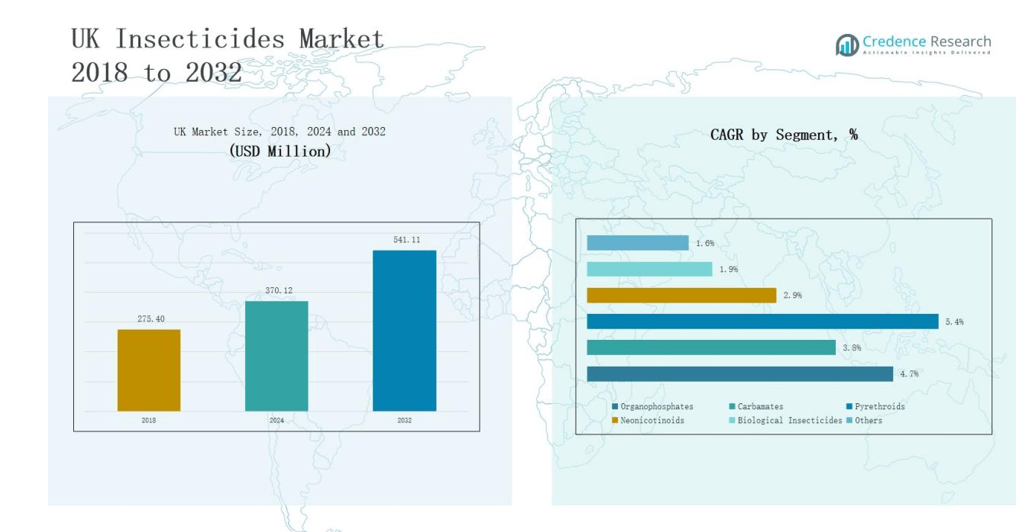
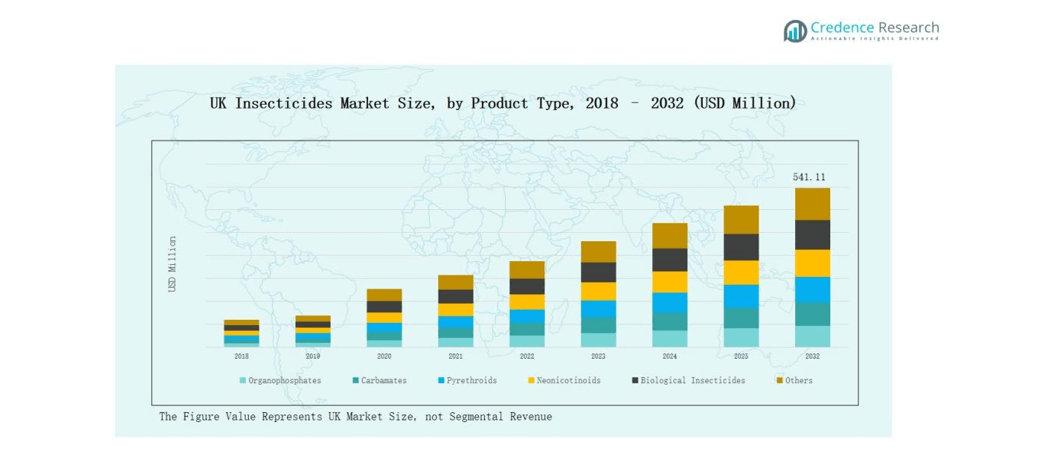
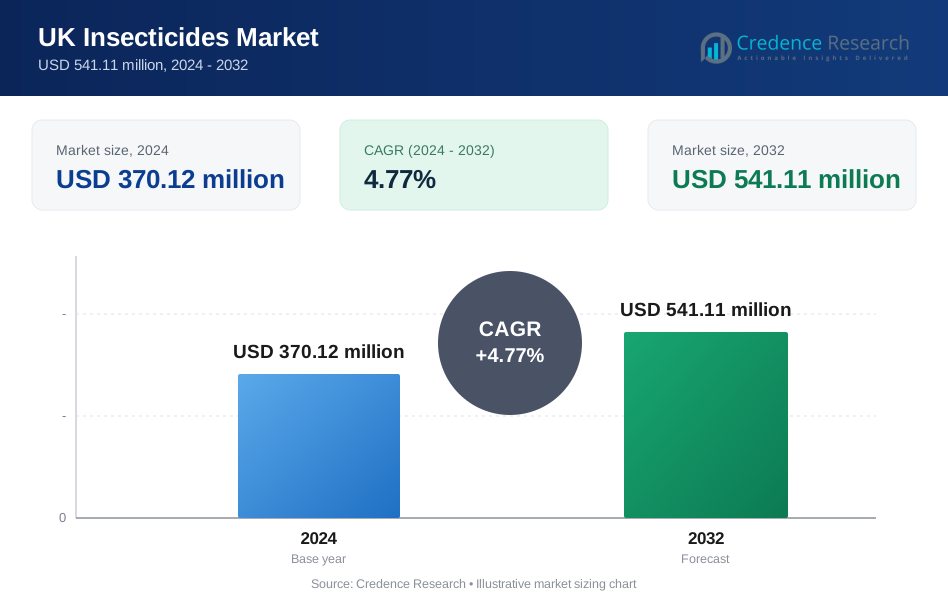
UK Insecticides Market size was valued at USD 275.40 million in 2018 to USD 370.12 million in 2024 and is anticipated to reach USD 541.11 million by 2032, at a CAGR of 4.77% during the forecast period.
| REPORT ATTRIBUTE | DETAILS |
|---|---|
| Historical Period | 2020-2023 |
| Base Year | 2024 |
| Forecast Period | 2025-2032 |
| UK Insecticides Market Size 2024 | USD 370.12 million |
| UK Insecticides Market, CAGR | 4.77% |
| UK Insecticides Market Size 2032 | USD 541.11 million |
The UK Insecticides Market is led by global and regional players including BASF SE, Bayer CropScience, Syngenta, FMC Corporation, ADAMA Agricultural Solutions, Nufarm Limited, UPL Limited, Certis UK, Koppert Biological Systems, and Marrone Bio Innovations. These companies compete through broad product portfolios, investments in sustainable formulations, and strong distribution networks. Multinationals focus on chemical and biological innovations to meet strict regulations, while regional firms emphasize eco-friendly and niche solutions. Among regions, England dominates with 52% market share, driven by intensive agriculture, horticulture, and strong adoption of pest control solutions across both agricultural and public health applications.
Market Insights
- The UK Insecticides Market grew from USD 275.40 million in 2018 to USD 370.12 million in 2024 and is expected to reach USD 541.11 million by 2032, registering 4.77% growth.
- Organophosphates lead product type with 32% share, followed by pyrethroids at 28%, while biological insecticides show strong growth momentum with 7% share due to eco-friendly demand.
- Agriculture dominates applications with 54% share, supported by intensive crop production, while public health holds 20%, reflecting vector control and municipal pest management initiatives nationwide.
- England leads with 52% regional share, benefiting from large-scale agriculture, horticulture, and public health usage, while Scotland, Wales, and Northern Ireland together account for the remaining 48%.
- BASF SE, Bayer CropScience, Syngenta, FMC Corporation, ADAMA Agricultural Solutions, Nufarm Limited, UPL Limited, Certis UK, Koppert Biological Systems, and Marrone Bio Innovations drive competition through innovation and sustainable portfolios.
Market Segment Insights
By Product Type
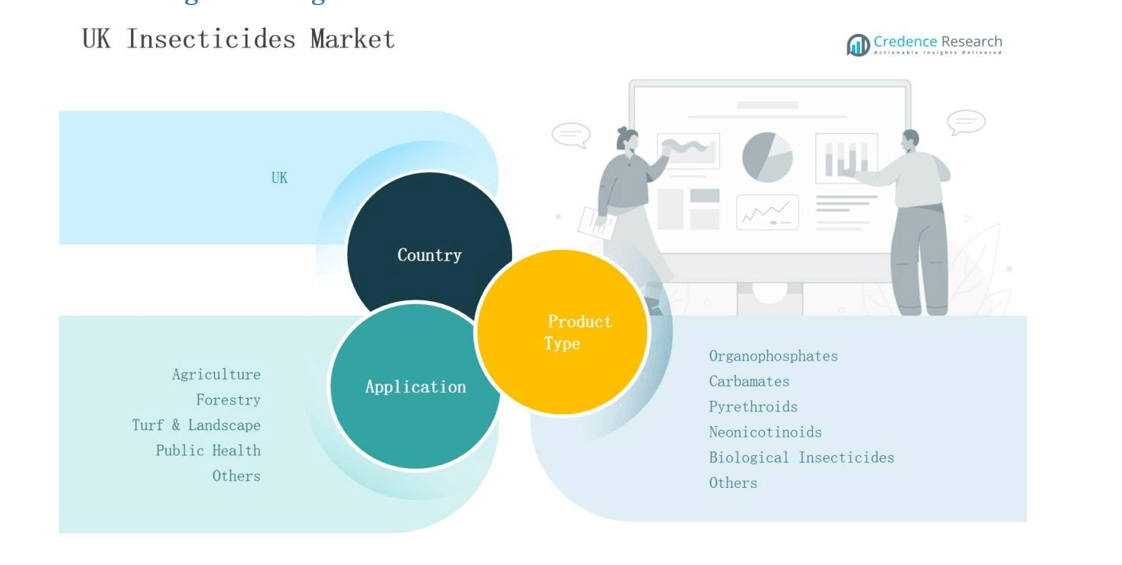
Organophosphates account for the largest share of the UK insecticides market at 32%, driven by their broad-spectrum effectiveness against a wide range of pests in agriculture. Pyrethroids follow closely with a 28% share, supported by strong adoption in crop protection due to low toxicity to mammals and cost efficiency. Neonicotinoids represent around 18%, with demand sustained in horticulture despite regulatory scrutiny. Carbamates hold 10%, mainly in niche applications. Biological insecticides are expanding rapidly with a 7% share, fueled by demand for eco-friendly alternatives. The remaining 5% belongs to other categories, catering to specialized pest control needs.
- For instance, in July 2023, Syngenta introduced its neonicotinoid-based seed treatment Cruiser for sugar beet in the UK under emergency use authorization, highlighting the continued reliance on neonicotinoids despite regulatory restrictions.
By Application
Agriculture dominates the UK insecticides market with a 54% share, driven by the country’s intensive crop production and need for yield protection against pests. Public health applications hold a 20% share, reflecting government-led initiatives for mosquito, fly, and vector control. Turf and landscape management contributes 12%, supported by the upkeep of sports grounds, golf courses, and urban green spaces. Forestry applications account for 7%, targeting pest outbreaks that threaten timber and biodiversity. The remaining 7% includes other uses such as domestic gardening and pest control in non-agricultural settings, reflecting the market’s diversified demand base.
- For instance, in May 2023, following full UK regulatory approval, ICL UK introduced its turf-specialty insecticide Acelepryn® for use on golf courses and sports grounds. The product is used to address chafer grubs and leatherjackets but is subject to label restrictions to mitigate risk, including a statutory 'Dangerous to bees' warning
Market Overview
Rising Agricultural Productivity Needs
The UK insecticides market benefits strongly from the push for higher agricultural productivity. Farmers face increasing pressure to secure crop yields against pest infestations, especially in cereals, fruits, and vegetables. Limited arable land and rising demand for food security encourage reliance on efficient pest control solutions. Chemical insecticides such as organophosphates and pyrethroids remain vital due to their cost-effectiveness and broad-spectrum impact. This reliance sustains steady demand across farming communities, even while eco-friendly alternatives gradually gain acceptance.
- For instance, Bayer introduced its insecticide Sivanto® Prime in the UK to help fruit and vegetable growers control sucking pests while maintaining pollinator safety.
Expansion of Public Health Initiatives
Public health programs in the UK actively drive demand for insecticides aimed at controlling disease vectors. Government campaigns targeting mosquitoes, flies, and ticks highlight the importance of reducing risks associated with vector-borne diseases. Municipal authorities and health agencies deploy insecticides for integrated pest management in urban areas. This consistent institutional demand stabilizes the market, particularly in the non-agricultural segment. Growth in awareness of hygiene and safety standards also strengthens the role of insecticides in safeguarding public health across cities and communities.
- For instance, Sumitomo Chemical’s subsidiary Valent BioSciences announced continued partnerships with UK municipal programs, delivering biological larvicides based on Bacillus thuringiensis israelensis (Bti) for sustainable mosquito control.
Rising Adoption of Biological Insecticides
The market is seeing robust growth in biological insecticides as sustainability gains priority. Farmers and commercial growers are shifting toward eco-friendly solutions that reduce chemical residues and meet EU and UK regulatory standards. Growing consumer demand for organic and residue-free produce supports the trend. Biological insecticides such as microbial and plant-based solutions are gaining ground in horticulture and protected farming. Innovation from global leaders and domestic companies ensures new product launches, further boosting adoption. This segment offers significant long-term growth potential.
Key Trends & Opportunities
Integration of Sustainable Crop Protection
Sustainability has become a defining trend in the UK insecticides market. The shift toward environmentally safe formulations aligns with EU and UK regulations that restrict harmful chemicals. Companies invest in developing biopesticides and hybrid solutions to meet these requirements while maintaining effectiveness. Farmers adopting integrated pest management (IPM) programs create opportunities for insecticide makers to position eco-friendly portfolios. This integration strengthens market credibility and opens pathways for long-term partnerships with both large-scale agriculture and organic farming sectors.
- For instance, Syngenta received UK regulatory approval for its biocontrol product Taegro, a Bacillus-based fungicide and insecticide designed for organic and conventional farming systems.
Technological Advancements in Formulations
Opportunities are emerging from innovation in insecticide formulations designed to improve efficiency and safety. Advances in nano-formulations, slow-release products, and precision application technologies help reduce environmental impact while maintaining pest control effectiveness. Companies introducing user-friendly products with improved residual action attract both professional and small-scale users. These innovations also extend insecticide applicability across forestry, landscaping, and turf management. By addressing regulatory and environmental concerns, advanced formulations position companies for long-term success in the UK market.
- For instance, Bayer launched Vayego® 200 SC in Europe, a second-generation diamide insecticide with long-lasting residual action for crops like potatoes and leafy vegetables, addressing grower demand for efficiency and reduced spraying frequency.
Key Challenges
Stringent Regulatory Framework
The UK insecticides market faces a strong challenge from restrictive regulations on chemical pesticides. Neonicotinoid bans and stricter approval requirements for organophosphates and carbamates limit product availability. Compliance with safety standards demands heavy investment in research, slowing down innovation timelines. Regulatory pressures force companies to continuously reformulate products, raising costs. These limitations particularly impact small manufacturers who lack resources for compliance, creating barriers to entry and consolidation in the market.
Growing Resistance in Pests
Pest resistance to common insecticides is an escalating challenge that undermines product effectiveness. Farmers in the UK increasingly report reduced efficacy of pyrethroids and other widely used formulations. This resistance requires higher application volumes or product switching, raising operational costs for growers. It also forces companies to invest in R&D for novel solutions, delaying market returns. Without effective management strategies, pest resistance could reduce farmer confidence and shift demand toward alternative, non-chemical methods.
High Cost of Biological Alternatives
Although biological insecticides present a strong growth avenue, their high cost limits adoption. Many UK farmers, especially small-scale growers, find biopesticides expensive compared to traditional options like organophosphates and pyrethroids. Limited awareness and lower shelf life also affect usage. While subsidies and sustainability targets may encourage adoption, widespread acceptance requires competitive pricing and proven field effectiveness. These barriers slow down the transition to greener pest control methods, challenging market expansion in the short term.
Regional Analysis
England
England dominates the UK Insecticides Market with a 52% share. It benefits from intensive agricultural activity in regions such as East Anglia, where cereals, vegetables, and horticultural crops drive insecticide demand. The need to protect high-value crops underpins reliance on organophosphates and pyrethroids. Strong demand for biological insecticides is also rising, supported by organic farming initiatives. Public health applications add steady demand across urban areas with municipal pest control programs. England remains the largest and most consistent contributor to overall market growth.
Scotland
Scotland accounts for 18% of the market share, driven by extensive cereal and barley cultivation. Farmers prioritize crop protection due to climatic conditions that encourage pest infestations. Forestry applications form a significant part of demand, particularly in timber production zones. Pyrethroids and neonicotinoids are commonly adopted for effective pest management. Biological solutions are also gaining traction among growers focusing on sustainable production. The Scottish market continues to expand, supported by strong agricultural policy frameworks and government incentives.
Wales
Wales represents 15% of the market share, with demand led by livestock-associated farming and crop protection. Insecticides play a crucial role in ensuring farm productivity and protecting grasslands. Turf and landscape management is also a strong application segment, supported by the region’s sports facilities and green areas. Farmers in Wales show interest in biological insecticides to align with environmental standards. Public health usage further strengthens demand in residential zones. The region shows steady growth prospects within the national market.
Northern Ireland
Northern Ireland holds 15% of the UK Insecticides Market share, supported by its mixed farming practices. The market benefits from strong cereal and potato cultivation, which requires reliable pest control. Farmers actively use organophosphates and pyrethroids for consistent results. Public health applications remain relevant, particularly in vector control for rural communities. Turf and landscape management also adds demand from golf courses and recreational areas. Northern Ireland sustains its role as a stable contributor within the overall market structure.
Market Segmentations:
By Product Type
- Organophosphates
- Carbamates
- Pyrethroids
- Neonicotinoids
- Biological Insecticides
- Others
By Application
- Agriculture
- Forestry
- Turf & Landscape
- Public Health
- Others
By Region
- England
- Scotland
- Wales
- Northern Ireland
Competitive Landscape
The UK Insecticides Market is highly competitive, with a strong mix of global and regional players shaping industry dynamics. Leading multinational companies such as BASF SE, Bayer CropScience, Syngenta, FMC Corporation, and ADAMA Agricultural Solutions dominate the market with extensive portfolios and advanced R&D capabilities. Their strength lies in offering both chemical and biological solutions that meet evolving regulatory standards. Regional players, including Certis UK and Koppert Biological Systems, focus on sustainable and niche biological products, catering to rising demand for eco-friendly alternatives. UPL Limited and Nufarm Limited strengthen competition through cost-effective formulations and broad distribution networks. Marrone Bio Innovations emphasizes biological innovation, aligning with consumer and regulatory preferences for safer crop protection. Intense rivalry encourages continuous product development, partnerships, and investments in integrated pest management solutions. The market is characterized by consolidation trends, where leading firms expand presence through acquisitions and collaborations to maintain dominance across agriculture, forestry, turf, and public health applications.
Key Players
- BASF SE
- Bayer CropScience
- Syngenta
- FMC Corporation
- ADAMA Agricultural Solutions
- Nufarm Limited
- UPL Limited
- Certis UK
- Koppert Biological Systems
- Marrone Bio Innovations
Recent Developments
- In April 2025, Bayer gained approval for its new aphicide Sivanto Prime (flupyradifurone) in Great Britain and Northern Ireland, targeting sugar beet, peas, carrots, and potatoes.
- In January 2025, the UK government rejected emergency use of thiamethoxam (Cruiser SB) on sugar beet due to risks to pollinators, reinforcing the shift toward safer pest control alternatives.
- In April 2025, Bayer expanded its product suite with several new isoflucypram + prothioconazole fungicidal mixtures Caley, Milteo, Resilis, Vivalis, and Scorpio approved for use in Great Britain on cereals like wheat, barley, rye, oats, and triticale.
Report Coverage
The research report offers an in-depth analysis based on Product Type,Application and Region. It details leading market players, providing an overview of their business, product offerings, investments, revenue streams, and key applications. Additionally, the report includes insights into the competitive environment, SWOT analysis, current market trends, as well as the primary drivers and constraints. Furthermore, it discusses various factors that have driven market expansion in recent years. The report also explores market dynamics, regulatory scenarios, and technological advancements that are shaping the industry. It assesses the impact of external factors and global economic changes on market growth. Lastly, it provides strategic recommendations for new entrants and established companies to navigate the complexities of the market.
Future Outlook
- Demand for biological insecticides will expand due to stricter regulatory frameworks.
- Public health programs will sustain consistent insecticide usage across urban regions.
- Integrated pest management adoption will grow among commercial and small-scale farmers.
- Technological innovations in formulations will improve product efficiency and safety.
- Resistance management strategies will shape product development and farmer adoption.
- Expansion of organic farming will drive eco-friendly insecticide applications.
- Turf and landscape maintenance will support steady demand from sports and recreational areas.
- Forestry insecticide applications will strengthen with pest outbreaks impacting timber production.
- Consolidation among global and regional players will increase competitive intensity.
- Government incentives for sustainable agriculture will accelerate adoption of alternative pest control solutions.
Request a Free Sample
Fill in your details and we'll send you a free sample report.
- Sample data tables & charts
- Research methodology
Need a Custom Version of This Report?
Tailor the scope, geography, or segments to your exact requirements.
- Custom geography or segment scope
- Direct access to our analyst team
Frequently Asked Questions
What is the current market size for UK Insecticides Market, and what is its projected size in 2032?
Which UK Insecticides Market segment held the largest share in 2024?
What are the primary factors fueling the growth of the UK Insecticides Market?
Who are the leading companies in the UK Insecticides Market?
Table of Content
Chapter 1. Report Introduction
- 1.1 Report Description & Purpose
- 1.1.1 Report Title & Market Definition
- 1.1.2 Unique Selling Propositions (USP) & Key Differentiators
- 1.1.3 Value Proposition for Stakeholders
- 1.2 Research Objectives
- 1.2.1 Market Sizing Objectives (Volume & Revenue)
- 1.2.2 Segmentation Objectives
- 1.2.3 Competitive Intelligence Objectives
- 1.2.4 Forecast & Scenario Objectives
- 1.3 Report Scope
- 1.3.1 UK Insecticides Scope – Types & Subtypes Covered
- 1.3.2 Geographic Scope – Regions & Countries Covered
- 1.3.3 Historical Period, Base Year & Forecast Period (2024; forecast to 2032)
- 1.3.4 Inclusions & Exclusions
- 1.4 HS Code & Classification Framework
- 1.5 Currency, Units & Pricing Basis
- 1.6 Target Stakeholders
- 1.7 Limitations & Assumptions
Chapter 2. Executive Summary
- 2.1 Global UK Insecticides Market Snapshot
- 2.1.1 Market Size – Historical (2024) & Forecast (2024-2032) (2024: USD 370.12 million → 2032: USD 541.11 million)
- 2.1.2 Volume & Revenue – Global Totals
- 2.1.3 Key Market Highlights – Top Five Facts
- 2.2 UK Insecticides Market Segmentation Snapshot
- 2.2.1 Market Split by Region – 2024 vs. 2032
- 2.3 Competitive Snapshot
- 2.3.1 Top 10 Players by Revenue Share – 2024
- 2.3.2 Top 10 Players by Volume Share – 2024
- 2.3.3 Recent Strategic Developments (18-Month Summary)
- 2.4 Key Investment Highlights & Strategic Conclusions
Chapter 3. UK Insecticides Market Dynamics & Industry Analysis
- 3.1 Market Overview & Context
- 3.1.1 UK Insecticides Market Position in the Broader Automotive Value Chain
- 3.1.2 OEM vs. Replacement Market Dynamics
- 3.1.3 Market Maturity & Development Stage by Region
- 3.2 UK Insecticides Market Drivers
- 3.3 UK Insecticides Market Restraints & Challenges
- 3.4 UK Insecticides Market Opportunities
- 3.5 Porter's Five Forces Analysis
- 3.5.1 Threat of New Entrants
- 3.5.2 Bargaining Power of Suppliers
- 3.5.3 Bargaining Power of Buyers
- 3.5.4 Threat of Substitutes
- 3.5.5 Competitive Rivalry – Intensity Assessment
- 3.6 UK Insecticides Value Chain Analysis
- 3.6.1 Upstream – Raw Material/Input Suppliers
- 3.6.1.1 Raw Material/Input 1
- 3.6.1.2 Raw Material/Input 2
- 3.6.1.3 Raw Material/Input 3
- 3.6.2 Midstream – Production/Manufacturing/Service Delivery
- 3.6.2.1 Production/Process Overview
- 3.6.2.2 Key Facility Locations & Capacity by Manufacturer
- 3.6.3 Downstream – Distribution & End Consumer
- 3.6.3.1 Primary Channel – B2B/OEM
- 3.6.3.2 Secondary Channels – Dealer, Retail, Online, Direct
- 3.6.4 Value Chain Profitability Analysis
- 3.6.1 Upstream – Raw Material/Input Suppliers
- 3.7 PESTEL Analysis
- 3.7.1 Political Factors
- 3.7.2 Economic Factors
- 3.7.3 Social Factors
- 3.7.4 Technological Factors
- 3.7.5 Environmental Factors
- 3.7.6 Legal Factors
- 3.8 UK Insecticides Supply Chain Analysis
- 3.8.1 Raw Material/Input Supply Risk Assessment
- 3.8.2 Manufacturing Concentration Risk (Geographic Exposure)
- 3.8.3 Trade Disruption Impact Analysis
- 3.9 Regulatory & Policy Landscape
Note: The regulatory and policy landscape section covers regulations based on their applicability to the market, UK Insecticides category, geography, and scope of the study. Only regulatory frameworks with a material impact on operations, compliance, trade, sustainability, or market access are analyzed in detail.
Chapter 4. Key Investment Pockets & Opportunity Analysis
- 4.1 UK Insecticides Market Attractiveness Analysis
- 4.1.1 By Region – Investment Attractiveness Matrix (Volume × CAGR)
- 4.2 Absolute Revenue Growth Opportunity
- 4.2.1 By Region – Absolute USD Growth Through 2032
- 4.3 Incremental Volume Opportunity
- 4.3.1 By Region – Incremental Volume Through 2032
- 4.3.2 Segment – Incremental Volume
- 4.4 Emerging Submarket Opportunity Deep Dive (Subject to Applicability)
- 4.5 Emerging Market Opportunity Scorecards
- 4.5.1 United States
- 4.5.2 Europe
- 4.5.3 Asia
- 4.5.4 Middle East & Africa
Note: Emerging Market Opportunity Scorecards will be included based on relevance and strategic importance. Regions listed are indicative and may vary depending on data availability and market dynamics.
Chapter 5. UK Insecticides Import-Export Analysis & Trade Flows
- 5.1 Global Trade Overview
- 5.1.1 Global Export Value by Country (2024)
- 5.1.2 Global Export Volume by Country (2024)
- 5.1.3 Global Import Value by Country (2024)
- 5.1.4 Global Import Volume by Country (2024)
- 5.1.5 Net Trade Balance by Country (2024)
- 5.2 Export Analysis – Segment
- 5.2.1 Type 1 (HS Code)
- 5.2.2 Type 2 (HS Code)
- 5.2.3 Type 3 (HS Code)
- 5.2.4 Type 4 (HS Code)
- 5.2.5 Type 5 (HS Code)
- 5.3 Import Analysis – Segment
- 5.3.1 Type 1 (HS Code)
- 5.3.2 Type 2 (HS Code)
- 5.3.3 Type 3 (HS Code)
- 5.3.4 Type 4 (HS Code)
- 5.3.5 Type 5 (HS Code)
- 5.4 Average Unit Trade Prices
- 5.4.1 Average Export Price – Segment & Country
- 5.4.2 Average Import Price – Segment & Source Country
- 5.4.3 Price Trends (2024)
- 5.5 Key Trade Route Analysis
- 5.5.1 Trade Route 1
- 5.5.2 Trade Route 2
- 5.5.3 Trade Route 3
- 5.5.4 Trade Route 4
- 5.5.5 Trade Route 5
- 5.6 Trade Policy Impact Assessment
- 5.6.1 US Anti-Dumping & Section 301 Tariffs
- 5.6.2 EU Customs Union Impact
- 5.6.3 Major Free Trade Agreements
- 5.6.4 USMCA Rules of Origin
Note: Trade policy analysis will be included only where relevant to the UK Insecticides market.
Chapter 6. Competitive Landscape & Company Benchmarking
- 6.1 UK Insecticides Market Concentration & Structure
- 6.1.1 Herfindahl-Hirschman Index (HHI) – vs. 2024
- 6.1.2 Tier 1, Tier 2 & Tier 3 Market Structure
- 6.1.3 Global, Regional & Local Player Dynamics
- 6.2 UK Insecticides Market Share Analysis – 2024
- 6.2.1 Global Revenue Share by Company
- 6.2.2 Global Volume Share by Company
- 6.2.3 Regional Revenue Share
- 6.2.4 Market Share Evolution ( vs. 2024)
- 6.2.5 OEM Segment Share by Company
- 6.2.6 Replacement Segment Share by Company
- 6.3 Production/Delivery Capacity & Facility Analysis
- 6.3.1 Global Installed Capacity
- 6.3.2 Capacity Utilization Rates
- 6.3.3 Production/Output Volume
- 6.3.4 Facility Locations & Capacity Map
- 6.3.5 Planned Capacity Additions
- 6.4 UK Insecticides Competitive Benchmarking Matrix
- 6.4.1 Revenue, Volume, CAGR & Profitability Comparison
- 6.4.2 Channel Revenue Mix
- 6.4.3 Geographic Revenue Exposure
- 6.4.4 R&D Intensity
- 6.4.5 Sustainability Maturity
- 6.5 Strategic Developments in UK Insecticides (Last 24 Months)
- 6.5.1 Mergers, Acquisitions & Divestments
- 6.5.2 New UK Insecticides Launches
- 6.5.3 Facility Expansions
- 6.5.4 Strategic Alliances, Joint Ventures & Partnerships
- 6.5.5 Distribution Expansion & Market Entry
- 6.5.6 Sustainability & ESG Initiatives
- 6.6 Competitive Strategy Mapping
- 6.6.1 Leader, Challenger, Follower & Niche Classification
- 6.6.2 Pricing Strategy Comparison
- 6.6.3 Channel Strategy Matrix
Note: Strategic developments are included based on their materiality and the availability of reliable information.
Chapter 7. Global UK Insecticides Market – By Distribution Channel
- 7.1 Segment Overview
- 7.1.1 Volume & Revenue Split by Channel (2024 & 2032)
- 7.1.2 Channel Mix Evolution (2024-2032)
Chapter 8. Regional Market Analysis – Global Overview
- 8.1 Global Regional Overview
- 8.1.1 Regional Volume Share
- 8.1.2 Regional Revenue Share
- 8.1.3 Regional Volume by Region
- 8.1.4 Regional Revenue by Region
- 8.1.5 Regional Forecast Through 2032
- 8.2 Cross-Regional Segment Analysis
- 8.2.1 By Distribution Channel
- 8.2.2 By Brand/Price Tier
Chapter 9. North America UK Insecticides Market
- 9.1 United States
- 9.2 Canada
- 9.3 Mexico
Chapter 10. Europe UK Insecticides Market
- 10.1 Germany
- 10.2 France
- 10.3 Italy
- 10.4 United Kingdom
- 10.5 Spain
- 10.6 Poland
- 10.7 Russia
- 10.8 Netherlands
- 10.9 Belgium
- 10.10 Sweden
- 10.11 Denmark
- 10.12 Norway
- 10.13 Rest of Europe
Chapter 11. Asia Pacific UK Insecticides Market
- 11.1 China
- 11.2 India
- 11.3 Japan
- 11.4 South Korea
- 11.5 Thailand
- 11.6 Indonesia
- 11.7 Vietnam
- 11.8 Malaysia
- 11.9 Australia
- 11.10 Rest of Asia Pacific
Chapter 12. Latin America UK Insecticides Market
- 12.1 Brazil
- 12.2 Argentina
- 12.3 Colombia
- 12.4 Chile
- 12.5 Rest of Latin America
Chapter 13. Middle East UK Insecticides Market
- 13.1 Saudi Arabia
- 13.2 United Arab Emirates
- 13.3 Turkey
- 13.4 Israel
- 13.5 Iran
- 13.6 Rest of the Middle East
Chapter 14. Africa UK Insecticides Market
- 14.1 South Africa
- 14.2 Egypt
- 14.3 Nigeria
- 14.4 Morocco
- 14.5 Rest of Africa
Chapter 15. UK Insecticides Company Profiles
- 15.1 [Company 01]
- 15.1.1 Company Overview
- 15.1.2 Key Management Personnel
- 15.1.3 Products & Services Portfolio
- 15.1.4 Financial Performance
- 15.1.5 Key Market Focus & Geographic Presence
- 15.1.6 Recent Developments & Strategic Initiatives
Note: The company profile list is preliminary and may change based on research findings, market developments, data availability, and client requirements.
Chapter 16. Appendices
- Appendix A – List of Abbreviations & Acronyms
- Appendix B – Industry Classification Code Reference – Full Series
- Appendix C – Production & Capacity Data Tables
- Appendix D – End-Use & Demand Base Tables
- Appendix E – Consumption & Replacement Rate Assumptions
- Appendix F – ASP Reference Tables
- Appendix G – Manufacturing & Facility Database
- Appendix H – Import-Export Data Tables
- Appendix I – Regulatory Summary Tables
- Appendix J – Primary Research Participant List (Anonymized)
- Appendix K – Primary Research Questionnaire Framework
- Appendix L – Data Sources & Bibliography
- Appendix M – Market Size Divergence & Source Comparison
Chapter 17. Research Methodology
- 17.1 Research Framework & Philosophy
- 17.2 Secondary Research – Sources, Hierarchy & Data Extraction
- 17.3 Data Modeling – Bottom-Up & Top-Down Market Sizing
- 17.4 Primary Research – Stakeholder Framework, LOI & Sample Sizes
- 17.5 Forecast Methodology – Regression, Scenario & Sensitivity Analysis
- 17.6 Quality Control – Four-Layer Validation Framework
- 17.7 Limitations & Standard Assumptions
- 17.8 Disclaimer
