
| REPORT ATTRIBUTE | DETAILS |
|---|---|
| Historical Period | 2019-2022 |
| Base Year | 2023 |
| Forecast Period | 2024-2032 |
| Underground Mining Automation Market Size 2024 | USD 1,433.6 Million |
| Underground Mining Automation Market, CAGR | 6.4% |
| Underground Mining Automation Market Size 2032 | USD 2,354.83 Million |
Market Overview:
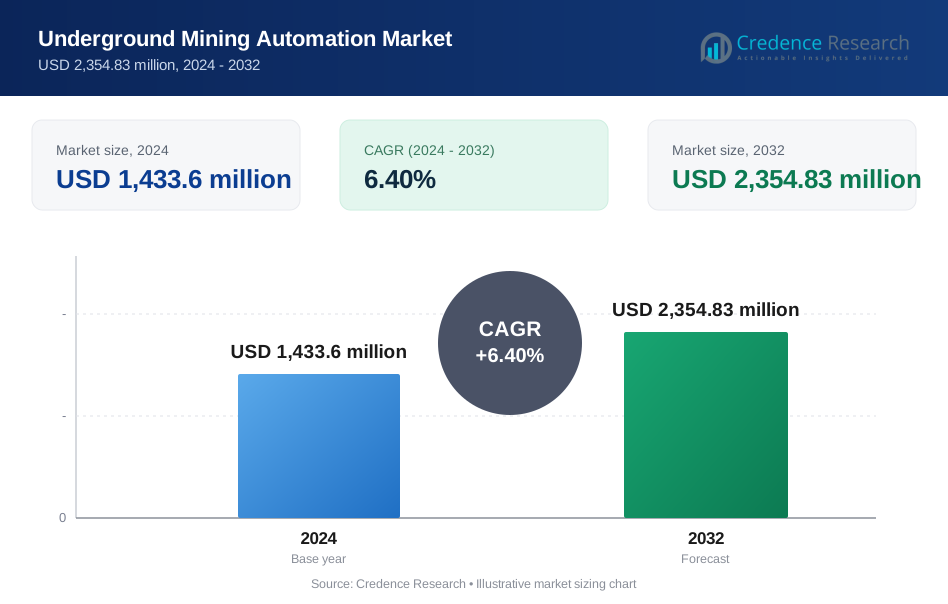
The global Underground Mining Automation Market is projected to grow from USD 1,433.6 million in 2024 to USD 2,354.83 million by 2032, registering a compound annual growth rate (CAGR) of 6.4% during the forecast period.
This growth reflects the increasing adoption of automation technologies to enhance safety, efficiency, and productivity in underground mining operations. Automation solutions, including autonomous vehicles, drilling systems, and monitoring software, are transforming traditional mining practices, making operations more sustainable and cost-effective.
Key drivers of the market include the rising demand for minerals and metals, driven by expanding industries such as construction, automotive, and electronics. The need to address safety concerns in hazardous underground environments is also propelling the adoption of automated systems that minimize human intervention in critical operations. Furthermore, technological advancements in robotics, IoT, and AI are enabling real-time monitoring, predictive maintenance, and efficient resource utilization. Governments and mining companies are increasingly investing in automation to comply with stringent environmental regulations and reduce operational costs, further driving market growth.
North America holds the largest share of the underground mining automation market, supported by advanced mining infrastructure and significant investments in automation technologies in the United States and Canada. Asia-Pacific is the fastest-growing region, driven by rising mining activities in countries like China, India, and Australia, where automation is being adopted to address labor shortages and improve safety standards. Europe is also a significant contributor, supported by stringent safety regulations and a focus on sustainable mining practices. Emerging regions like Latin America and the Middle East & Africa are witnessing steady growth, fueled by increasing mining exploration activities and infrastructure development.
Market Insights:
- The market is projected to grow from USD 1,433.6 million in 2024 to USD 2,354.83 million by 2032, driven by increasing automation in mining operations.
- Rising global demand for minerals and metals necessitates automated solutions to enhance productivity and reduce operational costs.
- Automation adoption is fueled by the need to mitigate risks in hazardous underground environments and ensure worker safety.
- Innovations in robotics, IoT, and AI are enabling predictive maintenance, real-time monitoring, and resource optimization.
- North America leads the market due to advanced mining infrastructure and significant investments in automation technologies.
- Asia-Pacific is the fastest-growing region, driven by increased mining activities in China, India, and Australia.
- High initial investment costs and the complexity of integrating automation technologies into existing systems pose market restraints.
Market Drivers:
Technological Advancements and Innovation:
The rapid advancement of technology, particularly in artificial intelligence (AI) and robotics, is a significant driver for the underground mining automation market. Companies are increasingly adopting automated solutions to enhance operational efficiency and safety. For instance, Caterpillar has introduced autonomous haul trucks that can operate around the clock without human intervention, leading to a reported 30% increase in productivity and a 25% reduction in operational costs. Additionally, the integration of IoT technologies allows for real-time monitoring of equipment, enabling predictive maintenance and minimizing downtime, which is crucial for maintaining productivity in mining operations. Research indicates that companies implementing automation technologies have observed an average production efficiency increase of 20-30%, particularly in regions with high labor costs where automation reduces reliance on manual labor.
Growing Focus on Safety and Risk Mitigation:
Safety concerns in underground mining operations are prompting companies to invest in automation technologies that reduce risks to workers. The U.S. Mine Safety and Health Administration (MSHA) reported that automated systems can decrease the likelihood of accidents by up to 40%. Consequently, mining companies are increasingly deploying remote-controlled machinery and drones for tasks such as surveying and inspection. For example, Barrick Gold Corporation has implemented drone technology for mapping and monitoring, resulting in improved safety outcomes and reduced exposure of personnel to hazardous environments. Furthermore, advancements in proximity detection systems (PDS) have become critical control measures, improving safety by detecting nearby personnel or vehicles and preventing collisions.
Increasing Demand for Operational Efficiency:
The need for increased operational efficiency is driving the adoption of automation solutions in underground mining. A report from the International Council on Mining and Metals (ICMM) indicates that companies implementing automation technologies have seen an average increase in production efficiency of 20-30%. This trend is particularly evident in regions with high labor costs, where automation can significantly reduce reliance on manual labor. For instance, Anglo American has reported enhanced ore recovery rates through the use of automated drilling systems that provide precise control over drilling parameters. Moreover, automated haul truck systems have been shown to optimize haulage routes, further enhancing productivity while reducing operational costs.
Government Regulations and Environmental Considerations:
Stricter government regulations concerning environmental protection and worker safety are also fueling the growth of underground mining automation. Regulatory bodies are increasingly mandating the use of technologies that minimize environmental impact and enhance safety protocols. For example, the European Union's stringent emissions standards require mining operations to adopt cleaner technologies, which often include automated systems designed to optimize resource extraction while reducing waste. In response, many mining companies are investing in automation as a means to comply with these regulations while also improving their sustainability practices. The integration of advanced data analytics into mining operations allows for better resource management and compliance with Environmental, Social, and Governance (ESG) standards, further driving the adoption of automated solutions in the industry.
Market Trends:
Technological Integration and Efficiency:
The underground mining automation market is experiencing a transformative phase driven by technological integration, particularly through the adoption of autonomous vehicles and advanced data analytics. Companies like Boliden have successfully implemented automated drilling rigs, which increased operational hours from 5,000 to 7,000 annually. This shift not only enhances productivity but also reduces the need for additional staff, resulting in significant cost savings-up to EUR 2.5 million annually for the Aitik mine alone. For instance, a report from the International Council on Mining and Metals (ICMM) indicates that automation technologies can improve overall operational efficiency by 20-30%, demonstrating how these advancements are reshaping productivity while minimizing human risk in hazardous environments.
Enhanced Safety Protocols:
Safety remains a paramount concern in underground mining, and recent technological advancements are making significant strides in this area. The mining industry has reported a 14% reduction in fatal accidents since 2000, largely attributed to innovations such as proximity detection systems and advanced monitoring tools. For instance, the integration of drones and LIDAR technologies has improved surveying capabilities, allowing operators to gather high-quality data for geotechnical analysis. A study conducted by the U.S. Mine Safety and Health Administration (MSHA) found that these technologies can decrease the likelihood of accidents by up to 40%, illustrating how a proactive approach not only increases safety but also empowers mine operators with critical insights into the underground environment.
Real-Time Monitoring and Predictive Maintenance:
The implementation of real-time monitoring systems is becoming increasingly prevalent in underground mining operations. These systems leverage IoT technologies to collect data on equipment performance and environmental conditions. For instance, A study indicated that condition monitoring can lead to a 30% reduction in unexpected downtime by providing operators with precise maintenance needs rather than relying on rigid schedules. Additionally, predictive maintenance models utilizing machine learning can enhance operational efficiency by analyzing complex datasets to forecast equipment failures before they occur, potentially saving companies an average of $100,000 per incident related to equipment breakdowns.
Regulatory Support and Future Innovations:
Regulatory frameworks are evolving to support the integration of automation technologies in mining, fostering an environment conducive to innovation. Governments are recognizing the need for updated regulations that encourage the use of advanced technologies while ensuring safety and environmental sustainability. For example, recent initiatives by the European Union have emphasized stricter emissions standards that incentivize cleaner technologies in mining operations. As mining companies invest in automation, collaboration between industry stakeholders is crucial for developing universal standards that facilitate broader adoption of these technologies. Looking ahead, ongoing research and development are expected to yield even more sophisticated solutions, including fully autonomous systems capable of operating independently in challenging underground conditions, potentially increasing overall productivity by an additional 15-20%.
Market Challenges Analysis:
High Initial Investment Costs:
One of the primary challenges facing the underground mining automation market is the high initial investment required for automated equipment and systems. The cost of advanced machinery, such as autonomous haul trucks and drilling rigs, can range from USD 500,000 to USD 1.5 million per unit, making it a significant financial burden for many mining companies, particularly smaller enterprises. Furthermore, ongoing maintenance and operational costs can substantially impact profitability. A survey conducted by the International Council on Mining and Metals (ICMM) indicates that companies may need to allocate up to 20% of their annual budgets for maintenance alone, which can deter investment in automation technologies.
Shortage of Skilled Workforce:
The transition to automated systems in underground mining necessitates a workforce with specialized skills to operate and maintain these advanced technologies. However, there is a notable shortage of technically skilled personnel in the industry. According to a report by the U.S. Bureau of Labor Statistics, the mining sector is expected to face a labor gap of approximately 50,000 workers by 2030 due to retirements and the lack of new entrants into technical roles. This skills gap poses a significant obstacle to the widespread adoption of automation, as companies struggle to find qualified candidates who can effectively manage and troubleshoot automated systems.
Regulatory Challenges:
Regulatory frameworks also present challenges to the underground mining automation market. Governments impose strict safety and environmental regulations that mining companies must adhere to while integrating automation technologies. For instance, the Mine Safety and Health Administration (MSHA) in the United States enforces comprehensive safety standards that can complicate the implementation of new automated systems. Compliance with these regulations often requires additional investments in safety features and training programs, which can slow down the adoption process and increase operational costs.
Social Acceptance and Job Displacement Concerns:
The introduction of automation in underground mining raises concerns about job displacement among workers, leading to resistance from labor unions and local communities. Many miners fear that increased automation will result in significant job losses, which can create social unrest. A study by the Canadian Mining Association found that over 60% of workers expressed apprehension about losing their jobs due to automation advancements. Addressing these concerns requires effective communication strategies from mining companies to demonstrate how automation can enhance safety and operational efficiency while also creating new job opportunities in technology management and maintenance roles.
Market Opportunities:
The underground mining automation market presents significant growth opportunities as the demand for minerals and metals continues to rise globally. Industries such as construction, electronics, and automotive increasingly rely on efficient and sustainable mining operations, creating a need for advanced automation technologies. Automation solutions, including autonomous haulage systems, real-time monitoring, and robotic drilling, offer substantial efficiency gains, reducing operational costs and increasing safety. Additionally, technological advancements in AI and IoT enable mining companies to implement predictive maintenance and optimize resource utilization, enhancing overall productivity. The growing focus on worker safety in hazardous environments further drives the adoption of automation, as it minimizes human exposure to dangerous conditions.
Emerging markets, particularly in Asia-Pacific, Latin America, and the Middle East & Africa, provide untapped potential for market growth. In Asia-Pacific, countries like China, India, and Australia are ramping up mining automation to address labor shortages and improve safety standards, creating significant opportunities for solution providers. Similarly, the expansion of mining exploration activities in Latin America and MEA, supported by investments in infrastructure development, opens avenues for automation technology deployment. Companies that focus on cost-effective solutions, seamless integration with existing systems, and local partnerships will be well-positioned to capitalize on these opportunities. Furthermore, increasing environmental regulations globally offer an avenue for sustainable mining technologies, providing a competitive edge for innovative automation systems.
Market Segmentation Analysis:
By Type, the market includes equipment automation, software automation, and services. Equipment automation holds the largest share, driven by the adoption of autonomous vehicles, drilling rigs, and loaders to improve operational efficiency and safety. Software automation, encompassing fleet management systems and monitoring platforms, is growing rapidly due to its ability to enable real-time tracking and predictive maintenance. The services segment, including system integration and maintenance, supports the seamless adoption and ongoing functionality of automated systems.
By Technology, the market is divided into robotics, IoT, AI, and others. Robotics leads this segment, with autonomous and semi-autonomous machines becoming integral to underground mining operations. IoT technology plays a crucial role in connecting equipment and systems for efficient data collection and analysis. AI-driven solutions are gaining traction for predictive maintenance and resource optimization, further enhancing the efficiency of mining operations.
By End User, the market serves mining companies, original equipment manufacturers (OEMs), and technology providers. Mining companies dominate this segment as they increasingly adopt automation to address labor shortages, safety concerns, and cost reduction pressures. OEMs and technology providers also play a significant role by offering innovative, customized solutions to meet diverse operational needs.
Segmentations:
By Product Type,
- Hardware
- Software
- Services
By Level of Automation,
- Lower Level Automation
- Mid-Level Automation
- Full Automation
By Application,
- Loading & Hauling
- Surface Drilling
- Fleet Management
- Tele Operations
- Others
By End Use,
- Chromium mining
- Coal mining
- Diamond mining
- Gold mining
- Iron ore mining
- Manganese mining
- Platinum and palladium mining
- Uranium mining
- Others
By Region,
- North America
- U.S.
- Canada
- Mexico
- Europe
- UK
- France
- Germany
- Italy
- Spain
- Russia
- Belgium
- Netherlands
- Austria
- Sweden
- Poland
- Denmark
- Switzerland
- Rest of Europe
- Asia Pacific
- China
- Japan
- South Korea
- India
- Australia
- Thailand
- Indonesia
- Vietnam
- Malaysia
- Philippines
- Taiwan
- Rest of Asia Pacific
- Latin America
- Brazil
- Argentina
- Peru
- Chile
- Colombia
- Rest of Latin America
- Middle East
- UAE
- KSA
- Israel
- Turkey
- Iran
- Rest of Middle East
- Africa
- Egypt
- Nigeria
- Algeria
- Morocco
- Rest of Africa
Regional Analysis:
North America holds the largest share of the underground mining automation market, accounting for approximately 35% of the global market share. The region’s dominance is driven by its advanced mining infrastructure and substantial investments in automation technologies, which exceeded $1.5 billion in 2022 across the United States and Canada. The United States leads the region, with over 75% of coal mines incorporating autonomous vehicles and robotic drilling systems to enhance safety and efficiency. Canadian mining operations, particularly in gold and nickel extraction, have increasingly adopted IoT and AI-driven solutions, reducing operational downtime by up to 30%. The presence of leading technology providers like Caterpillar, Sandvik, and Komatsu further accelerates market growth by introducing cutting-edge automation solutions.
Asia-Pacific is the fastest-growing region, capturing approximately 30% of the market share. Growth is fueled by increased mining activities in China, India, and Australia, where automation addresses labor shortages and safety concerns. China’s extensive coal mining sector accounts for over 40% of global coal production, with significant adoption of robotic solutions and real-time monitoring systems to optimize productivity. In India, government-led modernization initiatives have encouraged mining companies to integrate automated machinery, resulting in a 20% improvement in operational efficiency. Australia, hosting some of the largest iron ore and coal mining projects globally, leads in autonomous haulage systems, with companies like Rio Tinto operating fleets of over 100 autonomous trucks.
Europe accounts for approximately 20% of the market share, supported by stringent safety and environmental regulations. Countries such as Germany, Sweden, and Russia lead the region, with Germany implementing robotic drilling and AI-driven monitoring systems across 80% of its underground mining operations. Sweden, known for its sustainable mining practices, has widely adopted battery-powered automated equipment to reduce emissions by over 50% in some mines. Russia’s expanding metal mining sector, particularly in gold and palladium, relies on automated machinery to enhance productivity and maintain competitiveness in challenging underground environments.
Latin America and the Middle East & Africa (MEA) collectively hold around 15% of the market share, representing emerging opportunities. In Latin America, countries like Brazil and Chile dominate, driven by copper and iron ore mining, with Chile adopting automated machinery in 60% of its active copper mines. In MEA, South Africa and Saudi Arabia are key contributors, with investments in advanced technologies improving safety standards and operational efficiency. South Africa’s gold mining sector has seen a 25% increase in productivity due to automation, while Saudi Arabia’s Vision 2030 initiative emphasizes the use of robotics in mining operations. These regions benefit from rising exploration activities and infrastructure development, showcasing significant growth potential.
Key Player Analysis:
- Caterpillar Inc.
- Komatsu Ltd.
- Sandvik AB
- Epiroc AB
- Hexagon AB
- RPMGlobal Holdings
- Trimble Inc.
- Siemens AG
- Rockwell Automation
- ABB Group
Competitive Analysis:
The underground mining automation market is highly competitive, driven by the presence of leading global players such as Caterpillar Inc., Komatsu Ltd., and Sandvik AB, which collectively hold a significant share of the market. These companies leverage advanced technologies such as autonomous haulage systems, robotic drilling solutions, and IoT-based monitoring platforms to enhance operational efficiency and safety. For instance, over 70% of large-scale mining projects globally integrate automated solutions provided by these key players. Emerging competitors like Epiroc AB and Hexagon AB are expanding their market presence by offering innovative software and digital solutions tailored for underground mining operations. Additionally, partnerships between automation providers and mining companies are accelerating the adoption of customized solutions, particularly in regions like Asia-Pacific and Latin America. High investments in R&D, coupled with a focus on sustainability and compliance with safety standards, further intensify competition in this dynamic market.
Recent Developments:
- In January 2024, Caterpillar Inc. successfully demonstrated its first battery electric prototype underground mining truck at its proving ground in Tasmania, Australia. This event, attended by Newmont and other industry leaders, marks a significant step in expanding Caterpillar's portfolio of sustainable underground mining solutions. The new truck is designed to operate alongside the R1700 XE battery electric loader, completing Caterpillar's first fully electric underground load and haul solution. This collaboration aims to create a fully connected, automated, zero carbon-emitting mining system, showcasing the company’s commitment to enhancing safety and productivity through automation technologies.
- On September 24, 2024, Komatsu Ltd. unveiled its first battery-electric powered Load-Haul-Dump (LHD) machine, the WX04B, at MINExpo INTERNATIONAL 2024 in Las Vegas. This innovative LHD is specifically designed for narrow vein mines and features a battery swap system that allows for efficient ground-level battery changes without complex infrastructure requirements. The WX04B can operate for up to four hours on a single charge and is complemented by a newly developed 150kW battery charger that enhances operational flexibility while reducing costs associated with charging infrastructure.
- In September 2024, Sandvik AB introduced an electric modular platform for its Toro™ underground loaders and trucks at MINExpo INTERNATIONAL 2024. This modular approach is tailored to meet diverse customer needs during the ongoing transition to electric mining solutions. The platform includes an electric driveline and various modules that enhance productivity while prioritizing safety and environmental sustainability. Notably, the new platform aims to facilitate a smooth transition between different technologies, allowing for efficient parts inventory management and competence development at mine sites.
- At MINExpo 2024 in November 2024, Epiroc AB showcased several advancements in electrification and automation technologies for underground mining. Highlights included the introduction of the Scooptram ST18 SG, the largest battery-electric loader produced by Epiroc, which emphasizes reduced emissions and enhanced productivity. Additionally, Epiroc presented its Avatel™ solution-the world’s first semi-automated wireless underground explosives charging system-allowing a single operator to complete charging cycles from a safe distance. These innovations reflect Epiroc's commitment to improving safety standards while advancing automation capabilities in the mining sector.
Market Concentration & Characteristics:
The underground mining automation market exhibits a moderately consolidated structure, with a few dominant players such as Caterpillar Inc., Komatsu Ltd., and Sandvik AB holding a significant market share. These companies leverage their extensive product portfolios, global presence, and advanced technologies, including autonomous vehicles and AI-driven monitoring systems, to maintain their leadership. The market is characterized by high entry barriers due to the substantial initial investments required for technology development and integration. Additionally, the market is shaped by a growing emphasis on safety, sustainability, and operational efficiency, driving the adoption of automated solutions. Emerging players like Epiroc AB and Hexagon AB are enhancing competition by focusing on innovative and cost-effective solutions tailored to specific mining operations. The increasing adoption of IoT and robotics further highlights the market's shift toward data-driven, real-time monitoring systems to optimize underground mining processes.
Report Coverage:
The research report offers an in-depth analysis based on Product Type, Level of Automation, Application, and End Use. It details leading market players, providing an overview of their business, product offerings, investments, revenue streams, and key applications. Additionally, the report includes insights into the competitive environment, SWOT analysis, current market trends, as well as the primary drivers and constraints. Furthermore, it discusses various factors that have driven market expansion in recent years. The report also explores market dynamics, regulatory scenarios, and technological advancements that are shaping the industry. It assesses the impact of external factors and global economic changes on market growth. Lastly, it provides strategic recommendations for new entrants and established companies to navigate the complexities of the market.
Future Outlook:
- The adoption of advanced automation technologies, including AI, IoT, and robotics, will continue to transform underground mining operations by enhancing safety and efficiency.
- Increasing global demand for minerals and metals will drive investments in automated solutions to optimize resource extraction and reduce operational costs.
- Autonomous vehicles and equipment, such as haulage trucks and drilling systems, will see widespread adoption to minimize human exposure to hazardous environments.
- Real-time monitoring and predictive maintenance systems will gain traction, enabling mining companies to enhance productivity and reduce downtime.
- Emerging markets, particularly in Asia-Pacific and Latin America, will offer significant growth opportunities as mining activities expand in these regions.
- Sustainability goals and stringent environmental regulations will encourage the development of energy-efficient and eco-friendly automation technologies.
- Integration of digital twin technology will allow operators to simulate and optimize underground mining processes, improving decision-making.
- Collaboration between mining companies and technology providers will drive innovation, creating customized solutions tailored to specific operational needs.
- The increasing focus on worker safety will lead to greater adoption of automation systems that reduce risks in underground operations.
- Growth in government-backed mining modernization initiatives globally will further accelerate the adoption of advanced automation technologies.
Request a Free Sample
Fill in your details and we'll send you a free sample report.
- Sample data tables & charts
- Research methodology
Need a Custom Version of This Report?
Tailor the scope, geography, or segments to your exact requirements.
- Custom geography or segment scope
- Direct access to our analyst team
Frequently Asked Questions
What is the current size of the Underground Mining Automation Market?
What factors are driving the growth of the Underground Mining Automation Market?
What are some challenges faced by the Underground Mining Automation Market?
Who are the major players in the Underground Mining Automation Market?
Which segment is leading the market share?
Table of Content
Chapter 1. Report Introduction
- 1.1 Report Description & Purpose
- 1.1.1 Report Title & Market Definition
- 1.1.2 Unique Selling Propositions (USP) & Key Differentiators
- 1.1.3 Value Proposition for Stakeholders
- 1.2 Research Objectives
- 1.2.1 Market Sizing Objectives (Volume & Revenue) (Volume Where Applicable)
- 1.2.2 Segmentation Objectives
- 1.2.3 Competitive Intelligence Objectives
- 1.2.4 Forecast & Scenario Objectives
- 1.3 Report Scope
- 1.3.1 Underground Mining Automation Scope – Segments & Subsegments Covered
- 1.3.2 Geographic Scope – Regions & Countries Covered
- 1.3.3 Historical Period, Base Year & Forecast Period (2024; forecast to 2032)
- 1.3.4 Inclusions & Exclusions
- 1.4 Industry Classification & Applicable Codes
- 1.5 Currency, Measurement Units & Valuation Basis
- 1.6 Target Stakeholders
- 1.7 Limitations & Assumptions
Chapter 2. Executive Summary
- 2.1 Global Underground Mining Automation Market Snapshot
- 2.1.1 Market Size – Historical (2024) & Forecast (2024-2032) (2024: USD 1,433.6 million → 2032: USD 2,354.83 million)
- 2.1.2 Volume & Revenue – Global Totals (Volume Where Applicable)
- 2.1.3 Key Market Highlights – Top Five Facts
- 2.2 Underground Mining Automation Market Segmentation Snapshot
- 2.2.1 Market Split by Region – 2024 vs. 2032
- 2.3 Competitive Snapshot
- 2.3.1 Top 10 Players by Revenue Share – 2024
- 2.3.2 Top 10 Players by Volume Share – 2024 (Volume Where Applicable)
- 2.3.3 Recent Strategic Developments (18-Month Summary)
- 2.4 Key Investment Highlights & Strategic Conclusions
Chapter 3. Underground Mining Automation Market Dynamics & Industry Analysis
- 3.1 Market Overview & Context
- 3.1.1 Underground Mining Automation Market Position in the Broader Industry Value Chain
- 3.1.2 Demand Structure & Purchasing Dynamics
- 3.1.3 Market Maturity & Development Stage by Region
- 3.2 Underground Mining Automation Market Drivers
- 3.3 Underground Mining Automation Market Restraints & Challenges
- 3.4 Underground Mining Automation Market Opportunities
- 3.5 Porter's Five Forces Analysis
- 3.5.1 Threat of New Entrants
- 3.5.2 Bargaining Power of Suppliers
- 3.5.3 Bargaining Power of Buyers
- 3.5.4 Threat of Substitutes
- 3.5.5 Competitive Rivalry – Intensity Assessment
- 3.6 Underground Mining Automation Value Chain Analysis
- 3.6.1 Upstream – Key Inputs, Resources & Suppliers
- 3.6.1.1 Key Input/Resource 1
- 3.6.1.2 Key Input/Resource 2
- 3.6.1.3 Key Input/Resource 3
- 3.6.2 Midstream – Core Operations & Value Creation
- 3.6.2.1 Operating Model & Process Overview
- 3.6.2.2 Key Operating Locations & Capabilities by Company
- 3.6.3 Downstream – Market Channels & End Users
- 3.6.3.1 Direct Sales & Customer Engagement Channels
- 3.6.3.2 Indirect Sales, Intermediaries & Partner Channels
- 3.6.4 Value Chain Profitability Analysis
- 3.6.1 Upstream – Key Inputs, Resources & Suppliers
- 3.7 PESTEL Analysis
- 3.7.1 Political Factors
- 3.7.2 Economic Factors
- 3.7.3 Social Factors
- 3.7.4 Technological Factors
- 3.7.5 Environmental Factors
- 3.7.6 Legal Factors
- 3.8 Underground Mining Automation Supply Chain Analysis
- 3.8.1 Critical Input & Resource Availability Risk Assessment
- 3.8.2 Supplier & Operational Concentration Risk (Geographic Exposure)
- 3.8.3 Supply & Service Disruption Impact Analysis
- 3.9 Regulatory & Policy Landscape
Note: The regulatory and policy landscape section covers regulations based on their applicability to the market, Underground Mining Automation category, geography, and scope of the study. Only regulatory frameworks with a material impact on operations, compliance, trade, sustainability, or market access are analyzed in detail.
Chapter 4. Key Investment Pockets & Opportunity Analysis
- 4.1 Underground Mining Automation Market Attractiveness Analysis
- 4.1.1 By Region – Investment Attractiveness Matrix (Market Size × CAGR)
- 4.2 Absolute Revenue Growth Opportunity
- 4.2.1 By Region – Absolute Revenue Growth Through 2032
- 4.3 Incremental Demand Opportunity
- 4.3.1 By Region – Incremental Demand Through 2032
- 4.3.2 Segment – Incremental Demand
- 4.4 Emerging Submarket Opportunity Deep Dive (Subject to Applicability)
- 4.5 Priority Market Opportunity Scorecards
- 4.5.1 United States
- 4.5.2 Europe
- 4.5.3 Asia
- 4.5.4 Middle East & Africa
Note: Priority market opportunity scorecards reflect the geographic scope and strategic relevance of the study. Listed markets are indicative and may be adapted to the industry.
Chapter 5. Underground Mining Automation Cross-Border Trade & Market Access Analysis
- 5.1 International Trade & Cross-Border Activity Overview
- 5.1.1 Global Export Value by Country (2024)
- 5.1.2 Global Export Volume by Country (2024) (Volume Where Applicable)
- 5.1.3 Global Import Value by Country (2024)
- 5.1.4 Global Import Volume by Country (2024) (Volume Where Applicable)
- 5.1.5 Net Trade Balance by Country (2024)
- 5.2 Export Analysis – Segment
- 5.2.1 Category 1 (Applicable Classification Code)
- 5.2.2 Category 2 (Applicable Classification Code)
- 5.2.3 Category 3 (Applicable Classification Code)
- 5.2.4 Category 4 (Applicable Classification Code)
- 5.2.5 Category 5 (Applicable Classification Code)
- 5.3 Import Analysis – Segment
- 5.3.1 Category 1 (Applicable Classification Code)
- 5.3.2 Category 2 (Applicable Classification Code)
- 5.3.3 Category 3 (Applicable Classification Code)
- 5.3.4 Category 4 (Applicable Classification Code)
- 5.3.5 Category 5 (Applicable Classification Code)
- 5.4 Cross-Border Pricing & Transaction Benchmarks
- 5.4.1 Export Pricing – Segment & Country
- 5.4.2 Import Pricing – Segment & Source Country
- 5.4.3 Price Trends (2024)
- 5.5 Key Cross-Border Trade & Delivery Routes
- 5.5.1 Cross-Border Trade/Delivery Route 1
- 5.5.2 Cross-Border Trade/Delivery Route 2
- 5.5.3 Cross-Border Trade/Delivery Route 3
- 5.5.4 Cross-Border Trade/Delivery Route 4
- 5.5.5 Cross-Border Trade/Delivery Route 5
- 5.6 Trade Policy & Market Access Impact Assessment
- 5.6.1 Tariff & Non-Tariff Barriers
- 5.6.2 Regional Trade & Economic Integration Frameworks
- 5.6.3 Bilateral & Multilateral Trade Agreements
- 5.6.4 Cross-Border Operating, Licensing & Localization Requirements
Note: This chapter applies where cross-border trade or delivery is relevant to Underground Mining Automation. Goods, services, and digital offerings are assessed using applicable classifications and transaction measures. Import-export volumes, trade balances, and route analyses are included only where meaningful to the market.
Chapter 6. Competitive Landscape & Company Benchmarking
- 6.1 Underground Mining Automation Market Concentration & Structure
- 6.1.1 Herfindahl-Hirschman Index (HHI) – vs. 2024
- 6.1.2 Leading, Mid-Sized & Emerging Player Structure
- 6.1.3 Global, Regional & Local Player Dynamics
- 6.2 Underground Mining Automation Market Share Analysis – 2024
- 6.2.1 Global Revenue Share by Company
- 6.2.2 Global Volume Share by Company (Volume Where Applicable)
- 6.2.3 Regional Revenue Share
- 6.2.4 Market Share Evolution ( vs. 2024)
- 6.2.5 Company Market Share by Key Segment
- 6.2.6 Company Market Share by Customer Group
- 6.3 Operating Scale, Capacity & Infrastructure Analysis
- 6.3.1 Global Operating Scale & Supply Capacity
- 6.3.2 Resource Utilization & Operating Efficiency
- 6.3.3 Output, Service Delivery & Activity Metrics
- 6.3.4 Operating Footprint & Infrastructure Map
- 6.3.5 Planned Operational & Capacity Expansion
- 6.4 Underground Mining Automation Competitive Benchmarking Matrix
- 6.4.1 Revenue, Growth, Profitability & Operating Metric Comparison
- 6.4.2 Channel Revenue Mix
- 6.4.3 Geographic Revenue Exposure
- 6.4.4 R&D Intensity
- 6.4.5 Sustainability Maturity
- 6.5 Strategic Developments in Underground Mining Automation (Last 24 Months)
- 6.5.1 Mergers, Acquisitions & Divestments
- 6.5.2 New Products, Services & Solutions in Underground Mining Automation
- 6.5.3 Operational & Infrastructure Expansions
- 6.5.4 Strategic Alliances, Joint Ventures & Partnerships
- 6.5.5 Distribution Expansion & Market Entry
- 6.5.6 Sustainability & ESG Initiatives
- 6.6 Competitive Strategy Mapping
- 6.6.1 Leader, Challenger, Follower & Niche Classification
- 6.6.2 Pricing Strategy Comparison
- 6.6.3 Channel Strategy Matrix
Note: Strategic developments are included based on their materiality and the availability of reliable information.
Chapter 7. Global Underground Mining Automation Market – By Sales & Delivery Channel
- 7.1 Segment Overview
- 7.1.1 Volume & Revenue Split by Channel (2024 & 2032) (Volume Where Applicable)
- 7.1.2 Channel Mix Evolution (2024-2032)
Chapter 8. Regional Market Analysis – Global Overview
- 8.1 Global Regional Overview
- 8.1.1 Regional Volume Share (Volume Where Applicable)
- 8.1.2 Regional Revenue Share
- 8.1.3 Regional Volume by Region (Volume Where Applicable)
- 8.1.4 Regional Revenue by Region
- 8.1.5 Regional Forecast Through 2032
- 8.2 Cross-Regional Segment Analysis
- 8.2.1 By Sales & Delivery Channel
- 8.2.2 By Competitive Positioning & Price Tier
Chapter 9. North America Underground Mining Automation Market
- 9.1 United States
- 9.2 Canada
- 9.3 Mexico
Chapter 10. Europe Underground Mining Automation Market
- 10.1 Germany
- 10.2 France
- 10.3 Italy
- 10.4 United Kingdom
- 10.5 Spain
- 10.6 Poland
- 10.7 Russia
- 10.8 Netherlands
- 10.9 Belgium
- 10.10 Sweden
- 10.11 Denmark
- 10.12 Norway
- 10.13 Rest of Europe
Chapter 11. Asia Pacific Underground Mining Automation Market
- 11.1 China
- 11.2 India
- 11.3 Japan
- 11.4 South Korea
- 11.5 Thailand
- 11.6 Indonesia
- 11.7 Vietnam
- 11.8 Malaysia
- 11.9 Australia
- 11.10 Rest of Asia Pacific
Chapter 12. Latin America Underground Mining Automation Market
- 12.1 Brazil
- 12.2 Argentina
- 12.3 Colombia
- 12.4 Chile
- 12.5 Rest of Latin America
Chapter 13. Middle East Underground Mining Automation Market
- 13.1 Saudi Arabia
- 13.2 United Arab Emirates
- 13.3 Turkey
- 13.4 Israel
- 13.5 Iran
- 13.6 Rest of the Middle East
Chapter 14. Africa Underground Mining Automation Market
- 14.1 South Africa
- 14.2 Egypt
- 14.3 Nigeria
- 14.4 Morocco
- 14.5 Rest of Africa
Chapter 15. Underground Mining Automation Company Profiles
- 15.1 [Company 01]
- 15.1.1 Company Overview
- 15.1.2 Key Management Personnel
- 15.1.3 Products & Services Portfolio
- 15.1.4 Financial Performance
- 15.1.5 Key Market Focus & Geographic Presence
- 15.1.6 Recent Developments & Strategic Initiatives
Note: The company profile list is preliminary and may change based on research findings, market developments, data availability, and client requirements.
Chapter 16. Appendices
- Appendix A – List of Abbreviations & Acronyms
- Appendix B – Industry Classification Code Reference – Full Series
- Appendix C – Supply, Output & Operating Capacity Data Tables
- Appendix D – End-Use & Demand Base Tables
- Appendix E – Demand, Adoption & Usage Assumptions
- Appendix F – Pricing & Revenue Metric Reference Tables
- Appendix G – Company Operations & Infrastructure Database
- Appendix H – Cross-Border Trade & Activity Data Tables (Where Applicable)
- Appendix I – Regulatory Summary Tables
- Appendix J – Primary Research Participant List (Anonymized)
- Appendix K – Primary Research Questionnaire Framework
- Appendix L – Data Sources & Bibliography
- Appendix M – Market Size Divergence & Source Comparison
Chapter 17. Research Methodology
- 17.1 Research Framework & Philosophy
- 17.2 Secondary Research – Sources, Hierarchy & Data Extraction
- 17.3 Data Modeling – Bottom-Up & Top-Down Market Sizing
- 17.4 Primary Research – Stakeholder Framework, LOI & Sample Sizes
- 17.5 Forecast Methodology – Regression, Scenario & Sensitivity Analysis
- 17.6 Quality Control – Four-Layer Validation Framework
- 17.7 Limitations & Standard Assumptions
- 17.8 Disclaimer
