
Market Overview
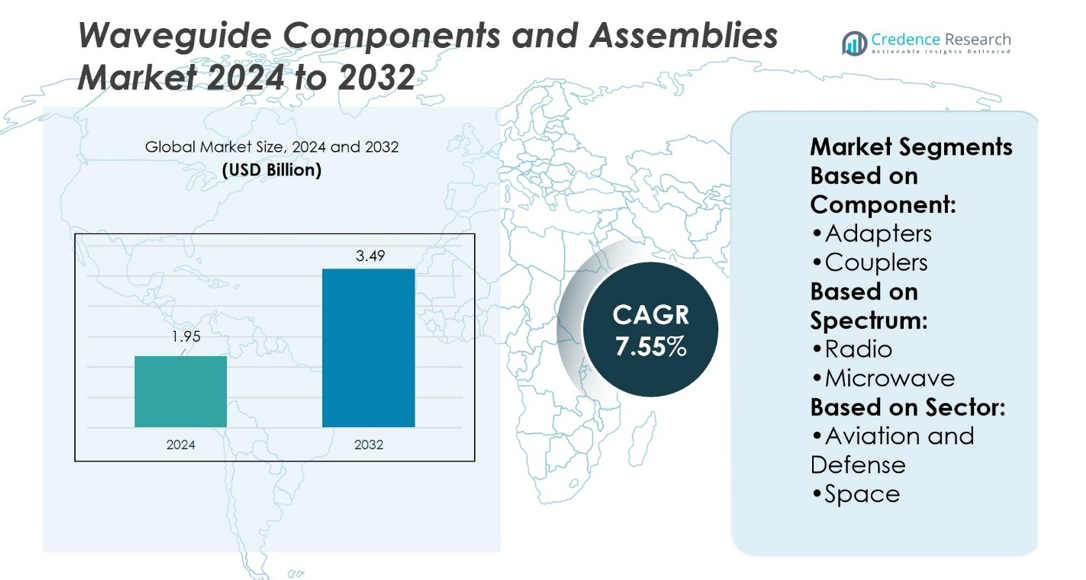
Waveguide Components and Assemblies Market size was valued at USD 1.95 billion in 2024 and is anticipated to reach USD 3.49 billion by 2032, at a CAGR of 7.55% during the forecast period.
| REPORT ATTRIBUTE | DETAILS |
|---|---|
| Historical Period | 2020-2023 |
| Base Year | 2024 |
| Forecast Period | 2025-2032 |
| Waveguide Components and Assemblies Market Size 2024 | USD 1.95 billion |
| Waveguide Components and Assemblies Market, CAGR | 7.55% |
| Waveguide Components and Assemblies Market Size 2032 | USD 3.49 billion |
The Waveguide Components and Assemblies Market grows with rising demand for high-frequency communication, defense radar, and satellite systems. Drivers include increasing deployment of 5G networks, expansion of space programs, and adoption of advanced radar for surveillance and navigation. It supports secure, low-loss signal transmission in critical aerospace and defense operations. Trends highlight miniaturization, lightweight materials, and adoption of 3D printing to design complex geometries. Manufacturers focus on high-power and high-bandwidth solutions to meet growing data needs. Expanding use in industrial automation and medical imaging further strengthens market opportunities across diverse sectors with emphasis on precision and reliability.
North America leads the Waveguide Components and Assemblies Market with strong defense and satellite programs, while Europe follows with aerospace and industrial applications. Asia Pacific shows rapid growth driven by 5G expansion, space missions, and defense modernization. Latin America and the Middle East & Africa contribute steadily through telecom upgrades and radar investments. Key players include ETL Systems, Ferrite Microwave Technologies, Globes Elektronik GmbH, Millimeter Wave Products Inc., European EMC Products Ltd., Logus Microwave, Kete Microwave Electronics, Amplitech, Anello Photonics, and Space Machine & Engineering.
Market Insights
- Waveguide Components and Assemblies Market size was valued at USD 1.95 billion in 2024 and is expected to reach USD 3.49 billion by 2032, at a CAGR of 7.55%.
- Rising demand for high-frequency communication, defense radar, and satellite systems drives market growth.
- Miniaturization, lightweight materials, and 3D printing adoption shape product development trends.
- Strong competition exists with companies focusing on innovation, high-power assemblies, and global expansion strategies.
- High manufacturing costs and complex design requirements act as restraints for smaller players.
- North America leads with defense and satellite adoption, while Europe follows with aerospace and industrial growth.
- Asia Pacific records rapid expansion with 5G and space missions, while Latin America and Middle East & Africa sustain steady demand through telecom and radar investments.
Market Drivers
Growing Demand for High-Frequency Communication in Aerospace and Defense Applications
The Waveguide Components and Assemblies Market benefits from rising demand in aerospace and defense sectors. Military radar, satellite links, and electronic warfare systems require precise, low-loss transmission paths. It ensures high performance under harsh conditions and delivers stable signals across wide frequency bands. Waveguide assemblies provide superior power handling compared to coaxial alternatives. Defense programs expand their radar coverage and invest in advanced signal detection, increasing demand. Manufacturers strengthen supply chains to support military-grade specifications.
- For instance, Ferrite Microwave Technologies offers high-power waveguide components from 50 W up to 50 MW, covering frequencies from 50 MHz to 50 GHz-spanning UHF to Ka-band bands-enabling integration with both sub-6 GHz and millimeter-wave 5G infrastructure.
Expansion of 5G Infrastructure and Next-Generation Wireless Networks
The deployment of 5G networks drives adoption of advanced waveguide components. High-frequency millimeter-wave applications require low-loss connectors, bends, and filters. The Waveguide Components and Assemblies Market grows with increasing base station installations worldwide. It supports reliable communication in densely populated areas with rising data traffic. Telecom operators deploy waveguide assemblies to enable efficient backhaul and fronthaul networks. Growth in smart devices and IoT ecosystems further increases need for robust signal transmission.
- For instance, Millimeter Wave Products Inc. (Mi-Wave) operates a 25,000 sq ft manufacturing facility in St. Petersburg, Florida, equipped with advanced labs, test rooms, and a specialized anechoic chamber.
Technological Advancements in Satellite Communication and Space Exploration
Satellite operators demand compact, lightweight, and efficient waveguide assemblies to improve bandwidth. The Waveguide Components and Assemblies Market benefits from the launch of new communication satellites and space missions. It enables high-capacity data transmission between ground stations and orbiting platforms. Companies invest in miniaturized waveguide solutions to optimize payload space. New satellite constellations for broadband internet create continuous demand. Government agencies and private firms expand investments to support global connectivity goals.
Rising Industrial Automation and Medical Imaging Applications
Waveguide components play a critical role in industrial and healthcare sectors. The Waveguide Components and Assemblies Market supports precision in imaging systems, process monitoring, and non-destructive testing. It ensures low-interference data transfer in automated manufacturing lines. Medical imaging devices such as MRI scanners integrate waveguide assemblies for signal accuracy. Expanding industrial IoT systems increase demand for efficient transmission hardware. Companies adopt high-quality assemblies to reduce downtime and strengthen productivity.
Market Trends
Integration of Waveguide Components in Millimeter-Wave Technologies
The Waveguide Components and Assemblies Market shows strong adoption in millimeter-wave systems. It supports high-frequency bands required for advanced radar, automotive sensors, and wireless backhaul. Millimeter-wave applications demand precise waveguide filters, couplers, and terminations. Manufacturers introduce compact designs to improve system integration without reducing efficiency. Research on 28 GHz and 39 GHz bands drives development of specialized assemblies. Market participants focus on precision machining and advanced coatings to maintain performance.
- For instance, Logus Microwave’s WR28 series waveguide switch covers a frequency range of 26.5 to 40 GHz, with a maximum insertion loss of just 0.15 dB and isolation of 55 dB, enabling efficient, low-loss switching in dense mm-wave systems.
Shift Toward Miniaturization and Lightweight Materials
Manufacturers emphasize smaller and lighter assemblies to meet aerospace, defense, and satellite needs. The Waveguide Components and Assemblies Market benefits from demand for compact solutions in payload-constrained environments. It enables efficient performance without adding significant weight. Lightweight alloys and advanced composites improve durability under vibration and thermal stress. Companies enhance designs to maintain low insertion loss in reduced footprints. Demand rises for hybrid components combining strength with space efficiency.
- For instance, Amplitech’s APTW6-06700775-50K10-112-D6 is a high-gain waveguide amplifier in a compact package (2.5 in × 3.75 in). It covers 6.7 to 7.75 GHz, delivers 60 dB gain (minimum), with a noise figure of 0.7 dB.
Growing Use of 3D Printing and Advanced Manufacturing Methods
Producers adopt additive manufacturing to design complex waveguide geometries. The Waveguide Components and Assemblies Market leverages 3D printing to reduce prototyping costs and speed product development. It allows creation of intricate bends and twists with high accuracy. Manufacturers optimize production cycles by reducing material waste and lead times. Advanced processes support customized assemblies for niche frequencies. Broader adoption of additive techniques improves scalability across multiple end-use industries.
Increased Focus on High-Power and High-Bandwidth Applications
Rising demand for high-power radar and broadband satellite communication drives product innovation. The Waveguide Components and Assemblies Market addresses requirements for higher bandwidth and stronger thermal stability. It supports transmission of large data volumes with minimal loss. Engineers design assemblies capable of handling several kilowatts of power. New materials improve resistance against heat and electromagnetic interference. Market players introduce reinforced connectors and flanges to ensure reliability in critical operations.
Market Challenges Analysis
High Manufacturing Costs and Complex Design Requirements
The Waveguide Components and Assemblies Market faces challenges linked to high production costs and complex design standards. Precision machining and specialized materials increase expenses, especially for aerospace and defense applications. It requires strict adherence to tolerance levels to ensure minimal signal loss. Custom designs for satellite, radar, and telecom sectors further add to development costs. Smaller manufacturers struggle to compete with large firms that maintain advanced facilities. Limited scalability of complex components slows mass adoption in cost-sensitive markets.
Supply Chain Limitations and Maintenance Constraints
Global supply chain disruptions create barriers in sourcing critical metals and alloys. The Waveguide Components and Assemblies Market experiences delays in delivery of connectors, flanges, and other subcomponents. It raises costs for end-users and affects long-term contracts. Maintenance is also challenging due to the delicate structure of waveguides. Specialized skills are required to repair or replace damaged assemblies in high-frequency systems. Limited availability of trained personnel in emerging regions restricts faster adoption across industrial and medical applications.
Market Opportunities
Expanding Role of Satellite Communication and Space Programs
The Waveguide Components and Assemblies Market holds strong opportunities in satellite communication and space exploration. Government agencies and private firms launch constellations that require compact and durable assemblies. It supports high-data transmission across intercontinental and remote regions. Lightweight designs with advanced thermal stability address payload constraints in orbital platforms. Companies that deliver miniaturized, reliable solutions gain access to new contracts. Growing demand for broadband connectivity from space opens pathways for rapid adoption.
Adoption in Emerging Industrial and Healthcare Applications
Industrial automation and medical imaging create promising opportunities for waveguide suppliers. The Waveguide Components and Assemblies Market enables precise signal transfer in MRI scanners, non-destructive testing, and factory IoT systems. It ensures uninterrupted performance in demanding environments with strict accuracy requirements. Industries adopt high-quality assemblies to reduce interference and improve efficiency. Healthcare equipment manufacturers integrate specialized components to meet rising diagnostic needs. Expanding use across non-traditional applications increases the addressable market for global players.
Market Segmentation Analysis:
By Component
The Waveguide Components and Assemblies Market is segmented by component into adapters, couplers, loads and filters, isolators and circulators, duplexers, phase shifters, power combiners, pressure windows, and others. Adapters and couplers remain essential for flexible system integration in aerospace, defense, and telecom applications. It supports precise connectivity between different devices while minimizing signal losses. Isolators and circulators protect sensitive equipment and ensure stable signal flow, particularly in high-frequency radar systems. Loads and filters manage unwanted frequencies, while phase shifters play a critical role in phased-array radar technology. Power combiners and duplexers improve efficiency in transmitting and receiving systems, while pressure windows maintain performance under demanding environmental conditions.
- For instance, Quantic M-Wave delivered WR28 high-power circulators that integrate a termination and waveguide run into a single assembly, designed for operation at 35 GHz. These custom components streamline system integration while maintaining performance in compact form factors.
By Spectrum
The market is divided by spectrum into radio, microwave, EO/IR, ultraviolet, X-ray, and gamma ray. Radio and microwave segments dominate with widespread use in communication, radar, and navigation systems. It ensures reliable data transmission across civilian and military platforms. EO/IR systems expand adoption in surveillance and targeting solutions for defense and space. Ultraviolet, X-ray, and gamma ray applications find use in scientific research, imaging, and specialized industrial processes. Rising reliance on high-frequency bands strengthens demand for advanced assemblies that deliver low-loss performance.
- For instance, Ducommun’s PCC series crossguide directional couplers operate across 18 to 110 GHz. They offer a standard coupling level of 20 dB, and deliver shorter insertion length with lower insertion loss than multi-hole alternatives.
By Sector
The Waveguide Components and Assemblies Market is segmented by sector into aviation and defense, and space. Aviation and defense hold a strong share due to heavy deployment in radar, missile guidance, and secure communication systems. It supports mission-critical operations by delivering high reliability and minimal interference. Space emerges as a high-growth sector with demand for lightweight, durable, and thermally stable assemblies. Satellite constellations, broadband services, and deep-space exploration programs expand opportunities for waveguide suppliers. The focus on compact, miniaturized assemblies strengthens adoption across both segments, making them vital to the industry’s future growth.
Segments:
Based on Component:
- Adapters
- Couplers
Based on Spectrum:
- Radio
- Microwave
Based on Sector:
- Aviation and Defense
- Space
Based on the Geography:
- North America
- U.S.
- Canada
- Mexico
- Europe
- UK
- France
- Germany
- Italy
- Spain
- Russia
- Belgium
- Netherlands
- Austria
- Sweden
- Poland
- Denmark
- Switzerland
- Rest of Europe
- Asia Pacific
- China
- Japan
- South Korea
- India
- Australia
- Thailand
- Indonesia
- Vietnam
- Malaysia
- Philippines
- Taiwan
- Rest of Asia Pacific
- Latin America
- Brazil
- Argentina
- Peru
- Chile
- Colombia
- Rest of Latin America
- Middle East
- UAE
- KSA
- Israel
- Turkey
- Iran
- Rest of Middle East
- Africa
- Egypt
- Nigeria
- Algeria
- Morocco
- Rest of Africa
Regional Analysis
North America
North America accounted for 34% share of the Waveguide Components and Assemblies Market in 2024, driven by strong demand in defense, aerospace, and communication systems. The United States leads the region with extensive investments in radar, electronic warfare, and 5G network infrastructure. It supports high adoption of waveguide assemblies in military programs, satellite communication, and air traffic control systems. Canada contributes through demand for satellite broadband and aviation applications, while defense contractors in both countries procure advanced components meeting strict specifications. Leading manufacturers in the region strengthen their supply chains to deliver precision products aligned with military standards. Continuous funding for space exploration projects such as NASA’s deep-space missions further expands opportunities for high-frequency waveguide solutions.
Europe
Europe captured 27% share of the Waveguide Components and Assemblies Market in 2024, supported by aerospace, satellite, and industrial automation sectors. Countries such as Germany, France, and the United Kingdom drive adoption through strong defense programs and satellite communication initiatives. It benefits from the European Space Agency’s projects that require lightweight, compact, and durable assemblies. Defense modernization programs focus on radar upgrades, secure communications, and electronic countermeasure systems. Industrial users adopt waveguide components for advanced imaging and non-destructive testing solutions. Local suppliers collaborate with research institutions to develop innovative designs suited for both defense and commercial aerospace. Increasing emphasis on secure connectivity and industrial automation supports continuous regional demand.
Asia Pacific
Asia Pacific held 29% share of the Waveguide Components and Assemblies Market in 2024, making it a critical growth region. China, Japan, South Korea, and India invest heavily in defense, satellite launches, and high-speed communication networks. It experiences rising adoption in 5G infrastructure, military radar, and space exploration programs. China expands satellite communication networks while India’s ISRO advances its space missions, fueling demand for compact and reliable assemblies. Japan and South Korea contribute through adoption in automotive radar and industrial automation. Regional manufacturers innovate in lightweight materials to support payload optimization in satellites. Expanding government budgets for defense and space programs continue to strengthen the role of Asia Pacific in the market.
Latin America
Latin America represented 6% share of the Waveguide Components and Assemblies Market in 2024, supported by growing demand in aerospace and communication applications. Brazil leads with investments in satellite programs and defense modernization, while Mexico focuses on expanding telecom infrastructure. It faces challenges of limited local manufacturing capabilities, driving dependence on imports from North America and Europe. Regional demand remains steady with growth in broadcasting, radar surveillance, and aviation systems. Partnerships with global suppliers help Latin American countries access advanced assemblies tailored to local requirements. Continuous efforts to expand satellite connectivity and defense capabilities provide long-term opportunities for suppliers.
Middle East and Africa
The Middle East and Africa accounted for 4% share of the Waveguide Components and Assemblies Market in 2024, driven by defense procurement and communication projects. Gulf countries invest in radar surveillance, secure communications, and space exploration programs. It benefits from partnerships with international firms that supply advanced assemblies for military and aerospace systems. Africa’s demand is rising slowly, supported by telecommunication upgrades and early adoption of satellite-based connectivity. Regional governments emphasize strengthening defense capabilities and improving secure communication networks. Limited local production capabilities create opportunities for international suppliers to expand their presence in the region. Growing reliance on defense and satellite services continues to sustain market demand.
Key Player Analysis
- ETL Systems
- Ferrite Microwave Technologies
- Globes Elektronik GmbH
- Millimeter Wave Products Inc.
- European EMC Products Ltd.
- Logus Microwave
- Kete Microwave Electronics Co. Ltd.
- Amplitech
- Anello Photonics Inc.
- Space Machine & Engineering
Competitive Analysis
The competitive landscape of the Waveguide Components and Assemblies Market features including ETL Systems, Ferrite Microwave Technologies, Globes Elektronik GmbH, Millimeter Wave Products Inc., European EMC Products Ltd., Logus Microwave, Kete Microwave Electronics Co. Ltd., Amplitech, Anello Photonics Inc., and Space Machine & Engineering. The Waveguide Components and Assemblies Market remains highly competitive with a strong focus on technological advancement and application-specific solutions. Companies prioritize research and development to improve signal transmission, reduce insertion loss, and enhance durability under high-frequency conditions. The market shows a clear trend toward miniaturization and lightweight designs to support aerospace, defense, and satellite applications. Suppliers emphasize customization to meet the precise needs of telecom operators, military programs, and space agencies. Strategic partnerships with defense contractors, satellite providers, and industrial firms expand access to global markets. Continuous innovation, efficient manufacturing practices, and strong distribution networks remain critical factors that shape competition in this sector.
Recent Developments
- In February 2025, Climeon commissioned its first land-based HeatPower genset at Landmark Power Holdings' Rhodesia plant in the UK, demonstrating the potential of ORC-based waste heat recovery for efficient, low-carbon power generation in flexible gas engine plants.
- In February 2025, Siemens Energy, and NEM Energy signed a new deal in order to deliver two horizontal Heat Recovery Steam Generators (HRSGs) for a new combined cycle power plant in Texas, USA. An estimated 1.2 GW will be produced by the facility when it is finished.
- In May 2024, Quantic Electronics acquired M Wave Design, enhancing its capabilities in the market. M Wave Design’s expertise in advanced waveguide systems strengthens Quantic's portfolio, supporting growth in telecommunications, aerospace, and defense sectors. This acquisition aims to drive innovations in signal transmission and component performance.
- In 2024, Northrop Grumman shipped satellites for Space Norway's Arctic Satellite Broadband Mission, featuring their GEOStar-3 platform. This mission highlights the growing importance of advanced waveguide components in ensuriIng efficient satellite communications, crucial for both commercial and military applications in polar regions.
Report Coverage
The research report offers an in-depth analysis based on Component, Spectrum, Sector and Geography. It details leading market players, providing an overview of their business, product offerings, investments, revenue streams, and key applications. Additionally, the report includes insights into the competitive environment, SWOT analysis, current market trends, as well as the primary drivers and constraints. Furthermore, it discusses various factors that have driven market expansion in recent years. The report also explores market dynamics, regulatory scenarios, and technological advancements that are shaping the industry. It assesses the impact of external factors and global economic changes on market growth. Lastly, it provides strategic recommendations for new entrants and established companies to navigate the complexities of the market.
Future Outlook
- Demand for high-frequency waveguide assemblies will grow with advanced radar and 5G expansion.
- Miniaturized and lightweight designs will gain importance in aerospace and satellite applications.
- Adoption of 3D printing will accelerate production of complex waveguide components.
- Defense modernization programs will strengthen investments in secure communication systems.
- Satellite constellations for global broadband will expand opportunities for compact assemblies.
- Industrial automation will increase usage of waveguide components in testing and monitoring systems.
- Medical imaging equipment will integrate more precise assemblies to improve diagnostic accuracy.
- Research on high-power and high-bandwidth applications will drive product innovation.
- Global supply chains will shift toward regionalized production for critical microwave components.
- Sustainability goals will encourage the use of advanced materials with higher energy efficiency.

Request a Free Sample
Fill in your details and we'll send you a free sample report.
- Sample data tables & charts
- Research methodology
Market Dynamics
Expansion of 5G Infrastructure and Next-Generation Wireless Networks
The rollout of 5G networks globally is driving demand for advanced waveguide components that support high-frequency, low-loss signal transmission in base stations and backhaul networks. These components are essential for enabling reliable, high-capacity communication in densely populated urban areas.
Growing Demand for High-Frequency Communication in Aerospace and Defense
Military radar, satellite links, and electronic warfare systems require precise, low-loss waveguide assemblies to ensure stable signal transmission across wide frequency bands. Ongoing defense modernization and increased radar coverage are fueling procurement of advanced waveguide solutions.
Technological Advancements in Satellite Communication and Space Exploration
The launch of new communication satellites and space missions is increasing the need for compact, lightweight, and efficient waveguide assemblies. These components are critical for high-bandwidth data transmission between ground stations and satellites, supporting global connectivity initiatives.
Rising Industrial Automation and Medical Imaging Applications
Waveguide components are increasingly used in industrial automation for process monitoring and in medical imaging devices such as MRI scanners, where they ensure precise, low-interference data transfer. The growth of industrial IoT and advanced diagnostic equipment is expanding the market’s application base.
Shift Toward Miniaturization and Lightweight Materials
Aerospace, defense, and satellite sectors are demanding smaller, lighter waveguide assemblies to optimize payload and improve system integration. The adoption of advanced materials and miniaturized designs is enabling higher performance in space-constrained and high-vibration environments.
Need a Custom Version of This Report?
Tailor the scope, geography, or segments to your exact requirements.
- Custom geography or segment scope
- Direct access to our analyst team
Frequently Asked Questions
What is the current market size for Waveguide Components and Assemblies Market, and what is its projected size in 2032?
At what Compound Annual Growth Rate is the Waveguide Components and Assemblies Market projected to grow between 2025 and 2032?
What are the primary factors fueling the growth of the Waveguide Components and Assemblies Market?
Who are the leading companies in the Waveguide Components and Assemblies Market?
Table of Content
Chapter 1 Market Segmentation
- 1.1 Segmentation Framework
- 1.1.1 Product and Service Classification
- 1.1.2 Application and End-Use Classification
- 1.1.3 Technology and Solution Classification
- 1.1.4 Customer and Distribution Channel Classification
- 1.1.5 Geographic Segmentation
- 1.1.6 Market Segment Definitions and Boundaries
- 1.2 By Sector
- 1.2.1 Aviation and Defense
- 1.2.2 Space
- 1.2.3 Industrial Automation
- 1.2.4 Medical Imaging
- 1.3 By Spectrum
- 1.3.1 Radio
- 1.3.2 Microwave
- 1.3.3 EO/IR
- 1.3.4 Ultraviolet
- 1.3.5 X-ray
- 1.3.6 Gamma Ray
- 1.4 By Component
- 1.4.1 Adapters
- 1.4.2 Couplers
- 1.4.3 Loads and Filters
- 1.4.4 Isolators and Circulators
- 1.4.5 Duplexers
- 1.4.6 Phase Shifters
- 1.4.7 Power Combiners
- 1.4.8 Pressure Windows
- 1.4.9 Others
Chapter 2 Introduction
- 2.1 Report Objectives and Scope
- 2.2 Product Definition and Industry Terminology
- 2.3 Market Inclusions and Exclusions
- 2.4 Research Process
- 2.4.1 Primary Research and Expert Interviews
- 2.4.2 Secondary Research and Source Review
- 2.4.3 Top-Down and Bottom-Up Estimation
- 2.4.4 Data Triangulation and Verification
- 2.5 Market Size Measurement Basis
- 2.5.1 2024: USD 1.95 billion → 2032: USD 3.49 billion
- 2.6 Historical and Forecast Reference Periods
- 2.6.1 Base Year: 2024
- 2.6.2 Forecast Period: 2024-2032
- 2.7 Research Assumptions and Limitations
Chapter 3 Executive Summary
- 3.1 Market Snapshot and Key Findings
- 3.2 Base-Year Market Size, 2024
- 3.3 Forecast Market Size, 2032
- 3.4 Revenue and Volume Growth Outlook
- 3.5 Key Demand and Supply Indicators
- 3.6 Leading Market Segments
- 3.7 Fastest-Growing Market Opportunities
- 3.8 Regional Performance Highlights
- 3.9 Technology and Industry Transformation
- 3.10 Competitive Landscape Summary
- 3.11 Analyst View and Strategic Implications
Chapter 4 Global Waveguide Components and Assemblies Market Trends and Developments
- 4.1 Historical Industry Development
- 4.2 Recent Market Trends and Developments
- 4.3 Demand and Customer Behavior Trends
- 4.4 Technology and Product Innovation
- 4.5 Artificial Intelligence, Automation and Digitalization
- 4.6 Local Manufacturing and Supply Chain Realignment
- 4.7 Industry Partnerships, Mergers and Acquisitions
- 4.8 Sustainability and Circular Economy Developments
- 4.9 Government and Private Sector Investment Trends
- 4.10 Emerging Business Models and Commercialization
- 4.11 Industry Developments and Announcements
Chapter 5 Global Waveguide Components and Assemblies Market Production, Supply and Demand Analysis
- 5.1 Demand Trend and Consumption Analysis
- 5.2 Demand Forecast, 2024-2032
- 5.3 Production and Output Trend
- 5.4 Production and Output Forecast, 2024-2032
- 5.5 Installed Capacity and Capacity Utilization
- 5.6 Company-Wise Production Plants and Statistics
- 5.6.1 Installed Production Capacity
- 5.6.2 Actual Production
- 5.6.3 Planned Capacity and Expansion Targets
- 5.7 Supply Chain Structure and Procurement Trends
- 5.8 Supply-Demand Gap and Bottlenecks
- 5.9 Import Dependence and Sourcing Structure
- 5.10 Contract Manufacturing and Outsourcing
- 5.11 Regional Supply and Demand Concentration
Chapter 6 Global Waveguide Components and Assemblies Market Pricing Analysis
- 6.1 Pricing Structure and Measurement
- 6.2 Historical Pricing Trends
- 6.3 Pricing Outlook, 2024-2032
- 6.4 Average Selling Price and Unit Economics
- 6.5 Pricing by Product and Market Segment
- 6.6 Geographic Pricing Differences
- 6.7 Key Input, Energy, Labor and Logistics Costs
- 6.8 Contract Pricing and Purchasing Models
- 6.9 Pricing Sensitivity and Competitive Positioning
- 6.10 Price, Margin and Profitability Implications
Chapter 7 Global Waveguide Components and Assemblies Market Dynamics
- 7.1 Market Growth Drivers
- 7.1.1 Demand-Side Drivers
- 7.1.2 Technology and Innovation Drivers
- 7.1.3 Infrastructure and Investment Drivers
- 7.1.4 Regulatory and Policy Drivers
- 7.2 Market Restraints
- 7.2.1 Cost and Affordability Constraints
- 7.2.2 Technology and Adoption Barriers
- 7.2.3 Supply Chain and Operational Constraints
- 7.3 Market Challenges
- 7.3.1 Competitive Pressure and Margin Erosion
- 7.3.2 Skills, Infrastructure and Implementation Gaps
- 7.4 Emerging Market Opportunities
- 7.5 Market Dynamics Impact and Time-Horizon Assessment
Chapter 8 Global Waveguide Components and Assemblies Value Chain Analysis
- 8.1 Industry Value Chain Overview
- 8.2 Upstream Suppliers and Critical Inputs
- 8.3 Technology and Component Providers
- 8.4 Manufacturing or Service Delivery
- 8.5 Distribution, Channel Partners and Integrators
- 8.6 Downstream Applications and End Users
- 8.7 Value Addition and Profit Pools
- 8.8 Vertical Integration and Outsourcing
- 8.9 Supplier Concentration and Risk
- 8.10 Supply Chain Localization and Resilience
Chapter 9 Global Waveguide Components and Assemblies Market Regulations and Policies
- 9.1 Relevant Laws, Standards and Compliance Frameworks
- 9.2 Product, Service, Safety and Quality Requirements
- 9.3 Government Policies, Incentives and Subsidies
- 9.4 Imports, Exports and Trade Barriers
- 9.5 Public Procurement and Local Content Requirements
- 9.6 Environmental and Sustainability Compliance
- 9.7 Upcoming Policy Changes and Market Implications
Chapter 10 Global Waveguide Components and Assemblies Market Hotspots and Opportunities
- 10.1 Market Opportunity Mapping and Growth Hotspots
- 10.2 High-Growth Applications and Customer Groups
- 10.3 Underserved Markets and White-Space Opportunities
- 10.4 Emerging Technology and Product Opportunities
- 10.5 New Capacity and Investment Hotspots
- 10.6 Market Entry and Expansion Opportunities
- 10.7 Distribution and Partnership Opportunities
- 10.8 Near-Term and Long-Term Commercial Potential
- 10.9 Opportunity Attractiveness and Execution Risks
Chapter 11 Global Waveguide Components and Assemblies Market Outlook, 2024-2032
- 11.1 Market Size and Analysis
- 11.1.1 Revenue (Market Measurement: 2024: USD 1.95 billion → 2032: USD 3.49 billion)
- 11.1.2 Market Volume and Quantity Sold
- 11.1.3 Historical Market Size
- 11.1.4 Base-Year Market Size, 2024
- 11.2 Market Forecast, 2024-2032
- 11.2.1 Revenue Forecast to 2032
- 11.2.2 Volume Forecast to 2032
- 11.2.3 CAGR and Year-on-Year Growth
- 11.2.4 Incremental Revenue Opportunity
- 11.3 Forecast Assumptions and Scenario Analysis
- 11.3.1 Base-Case Forecast
- 11.3.2 Optimistic and Conservative Scenarios
- 11.3.3 Technology, Pricing and Policy Sensitivities
- 11.4 Market Attractiveness and Growth Outlook
Chapter 12 Global Waveguide Components and Assemblies Market Segmentation and Outlook
- 12.1 Segmentation Summary and Market Shares, 2024
- 12.2 Largest and Fastest-Growing Segments
- 12.3 By Sector - Market Size and Forecast, 2024-2032
- 12.3.1 Segment Definition and Scope
- 12.3.2 Historical Market Size
- 12.3.3 Revenue Forecast, 2024-2032
- 12.3.4 Volume Forecast, 2024-2032
- 12.3.5 Base-Year Market Share, 2024
- 12.3.6 Segment CAGR and Growth Drivers
- 12.3.7 Subsegment Market Size and Forecast
- 12.3.7.1 Aviation and Defense
- 12.3.7.2 Space
- 12.3.7.3 Industrial Automation
- 12.3.7.4 Medical Imaging
- 12.3.8 Subsegment Pricing and Adoption Trends
- 12.3.9 Leading Suppliers and Competition
- 12.3.10 Regional Demand and Opportunities
- 12.4 By Spectrum - Market Size and Forecast, 2024-2032
- 12.4.1 Segment Definition and Scope
- 12.4.2 Historical Market Size
- 12.4.3 Revenue Forecast, 2024-2032
- 12.4.4 Volume Forecast, 2024-2032
- 12.4.5 Base-Year Market Share, 2024
- 12.4.6 Segment CAGR and Growth Drivers
- 12.4.7 Subsegment Market Size and Forecast
- 12.4.7.1 Radio
- 12.4.7.2 Microwave
- 12.4.7.3 EO/IR
- 12.4.7.4 Ultraviolet
- 12.4.7.5 X-ray
- 12.4.7.6 Gamma Ray
- 12.4.8 Subsegment Pricing and Adoption Trends
- 12.4.9 Leading Suppliers and Competition
- 12.4.10 Regional Demand and Opportunities
- 12.5 By Component - Market Size and Forecast, 2024-2032
- 12.5.1 Segment Definition and Scope
- 12.5.2 Historical Market Size
- 12.5.3 Revenue Forecast, 2024-2032
- 12.5.4 Volume Forecast, 2024-2032
- 12.5.5 Base-Year Market Share, 2024
- 12.5.6 Segment CAGR and Growth Drivers
- 12.5.7 Subsegment Market Size and Forecast
- 12.5.7.1 Adapters
- 12.5.7.2 Couplers
- 12.5.7.3 Loads and Filters
- 12.5.7.4 Isolators and Circulators
- 12.5.7.5 Duplexers
- 12.5.7.6 Phase Shifters
- 12.5.7.7 Power Combiners
- 12.5.7.8 Pressure Windows
- 12.5.7.9 Others
- 12.5.8 Subsegment Pricing and Adoption Trends
- 12.5.9 Leading Suppliers and Competition
- 12.5.10 Regional Demand and Opportunities
- 12.6 Segment Growth Comparison
- 12.7 Segment Attractiveness and Priority Matrix
Chapter 13 Global Waveguide Components and Assemblies Geographic Market Outlook, 2024-2032
- 13.1 Regional Market Size and Share, 2024
- 13.2 Regional Market Forecast, 2024-2032
- 13.3 Regional Pricing, Production and Demand Differences
- 13.4 North America
- 13.4.1 United States
- 13.4.2 Canada
- 13.4.3 Mexico
- 13.5 Europe
- 13.5.1 Germany
- 13.5.2 France
- 13.5.3 Italy
- 13.5.4 United Kingdom
- 13.5.5 Spain
- 13.5.6 Poland
- 13.5.7 Russia
- 13.5.8 Netherlands
- 13.5.9 Belgium
- 13.5.10 Sweden
- 13.5.11 Denmark
- 13.5.12 Norway
- 13.5.13 Rest of Europe
- 13.6 Asia Pacific
- 13.6.1 China
- 13.6.2 India
- 13.6.3 Japan
- 13.6.4 South Korea
- 13.6.5 Thailand
- 13.6.6 Indonesia
- 13.6.7 Vietnam
- 13.6.8 Malaysia
- 13.6.9 Australia
- 13.6.10 Rest of Asia Pacific
- 13.7 Latin America
- 13.7.1 Brazil
- 13.7.2 Argentina
- 13.7.3 Colombia
- 13.7.4 Chile
- 13.7.5 Rest of Latin America
- 13.8 Middle East
- 13.8.1 Saudi Arabia
- 13.8.2 United Arab Emirates
- 13.8.3 Turkey
- 13.8.4 Israel
- 13.8.5 Iran
- 13.8.6 Rest of the Middle East
- 13.9 Africa
- 13.9.1 South Africa
- 13.9.2 Egypt
- 13.9.3 Nigeria
- 13.9.4 Morocco
- 13.9.5 Rest of Africa
- 13.10 Regional Investment, Policy and Supply Chain Differences
- 13.11 Regional Competitive Landscape
- 13.12 Geographic Growth Hotspots
Chapter 14 Global Waveguide Components and Assemblies Technology, Innovation and Sustainability Outlook
- 14.1 Technology Landscape and Maturity
- 14.2 Product, Process and Service Innovation
- 14.3 AI, Automation and Digital Tools in the Industry
- 14.4 Technology Adoption and Performance Benchmarking
- 14.5 Innovation Pipeline and R&D Investment
- 14.6 Patent and Intellectual Property Trends
- 14.7 Energy Efficiency and Resource Management
- 14.8 Sustainability, Recycling and Circularity
- 14.9 Technology Roadmap, 2024-2032
- 14.10 Risks of Obsolescence and Technology Substitution
Chapter 15 Global Waveguide Components and Assemblies Market Key Strategic Imperatives
- 15.1 Growth and Market Entry Priorities
- 15.2 High-Return Products and Segments
- 15.3 Pricing, Profitability and Cost Optimization
- 15.4 Technology Investment and Product Differentiation
- 15.5 Supply Chain Localization and Resilience
- 15.6 Distribution and Customer Acquisition
- 15.7 Partnership, Acquisition and Capacity Strategy
- 15.8 Regional Expansion Priorities
- 15.9 Short-, Medium- and Long-Term Actions
Chapter 16 Competition Outlook
- 16.1 Industry Competition Characteristics
- 16.2 Market Structure and Concentration
- 16.3 Market Share and Competitive Positioning, 2024
- 16.4 Company-Wise Revenue and Product Benchmarking
- 16.5 Production and Service Capacity Benchmarking
- 16.6 Technology, Pricing and Differentiation
- 16.7 Regional Footprint and Distribution Strength
- 16.8 Mergers, Acquisitions and Strategic Alliances
- 16.9 New Entrants and Competitive Threats
- 16.10 Porter's Five Forces and Industry Attractiveness
- 16.11 Competitive Outlook, 2024-2032
Chapter 17 Company Profiles
- 17.1 Company Coverage and Selection Criteria
- 17.2 ETL Systems
- 17.2.1 Business Description
- 17.2.2 Company Ownership and Geographic Presence
- 17.2.3 Product and Service Portfolio
- 17.2.4 Manufacturing and Operating Footprint
- 17.2.5 Production Capacity and Expansion Plans
- 17.2.6 Financial Performance and Investment
- 17.2.7 Market Share and Competitive Position
- 17.2.8 Technology and Innovation Capabilities
- 17.2.9 Strategic Alliances or Partnerships
- 17.2.10 Recent Developments
- 17.2.11 Growth Strategy and Outlook
- 17.3 Ferrite Microwave Technologies
- 17.4 Globes Elektronik GmbH
- 17.5 Millimeter Wave Products Inc.
- 17.6 European EMC Products Ltd.
- 17.7 Logus Microwave
- 17.8 Kete Microwave Electronics Co. Ltd.
- 17.9 Amplitech
- 17.10 Anello Photonics Inc.
- 17.11 Space Machine & Engineering
- 17.12 Other Relevant Market Participants
Note: Every listed company is profiled on the structure shown under the first company. The company list is preliminary and may change based on research findings, market developments, data availability and client requirements.
Chapter 18 Disclaimer
- 18.1 Research and Forecast Disclaimer
- 18.2 Data Source and Estimation Limitations
Note: The depth of individual sections depends on data availability for this market. Volume, capacity, trade and other unit-based metrics are included where applicable.

